Back to Integrations
integrationJira Software node
integrationOpenAI node

Jira Software and OpenAI integration

Save yourself the work of writing custom integrations for Jira Software and OpenAI and use n8n instead. Build adaptable and scalable Development, Productivity, AI, and Langchain workflows that work with your technology stack. All within a building experience you will love.

How to connect Jira Software and OpenAI

  • Step 1: Create a new workflow
  • Step 2: Add and configure nodes
  • Step 3: Connect
  • Step 4: Customize and extend your integration
  • Step 5: Test and activate your workflow

Step 1: Create a new workflow and add the first step

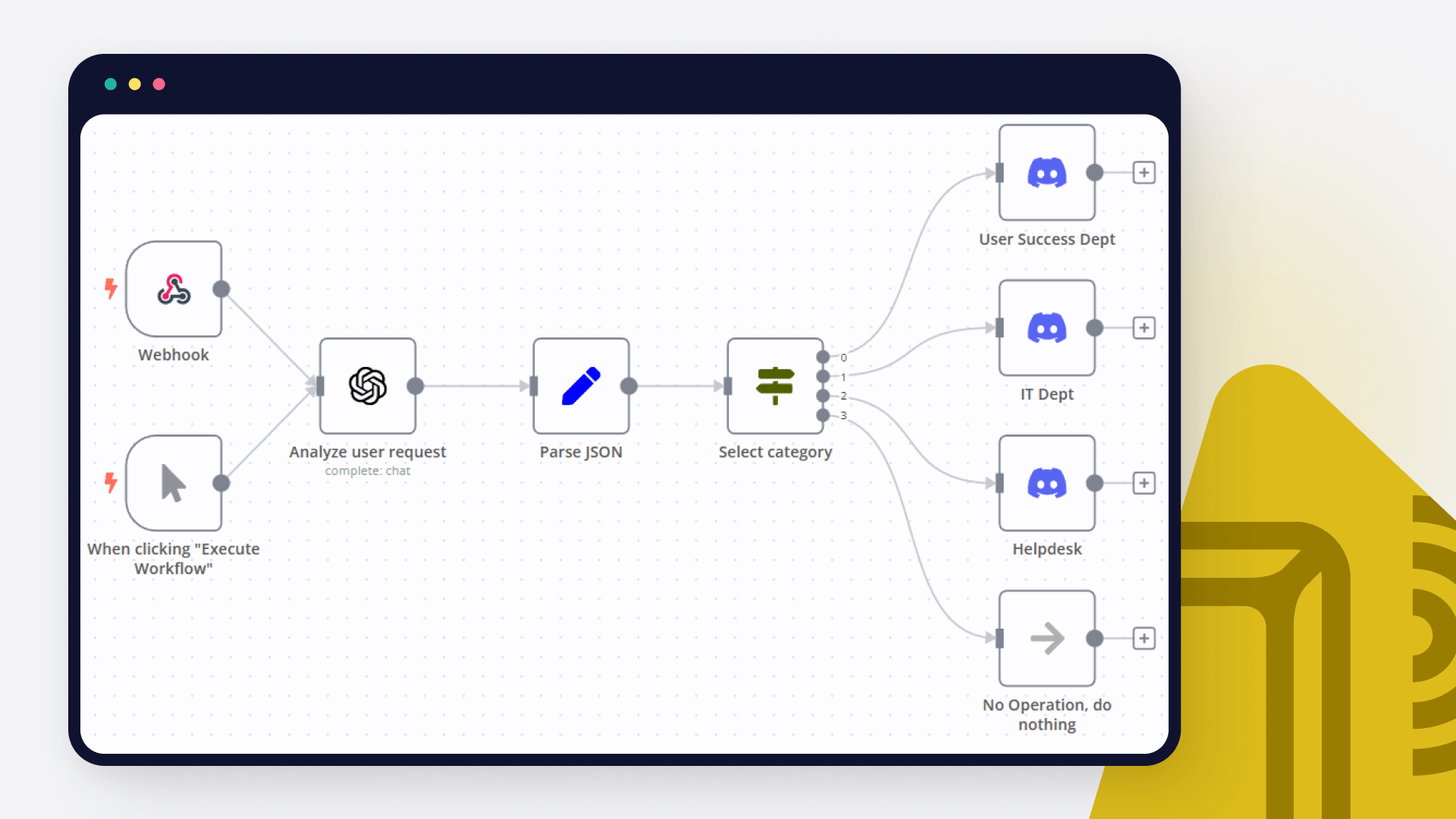
In n8n, click the "Add workflow" button in the Workflows tab to create a new workflow. Add the starting point – a trigger on when your workflow should run: an app event, a schedule, a webhook call, another workflow, an AI chat, or a manual trigger. Sometimes, the HTTP Request node might already serve as your starting point.
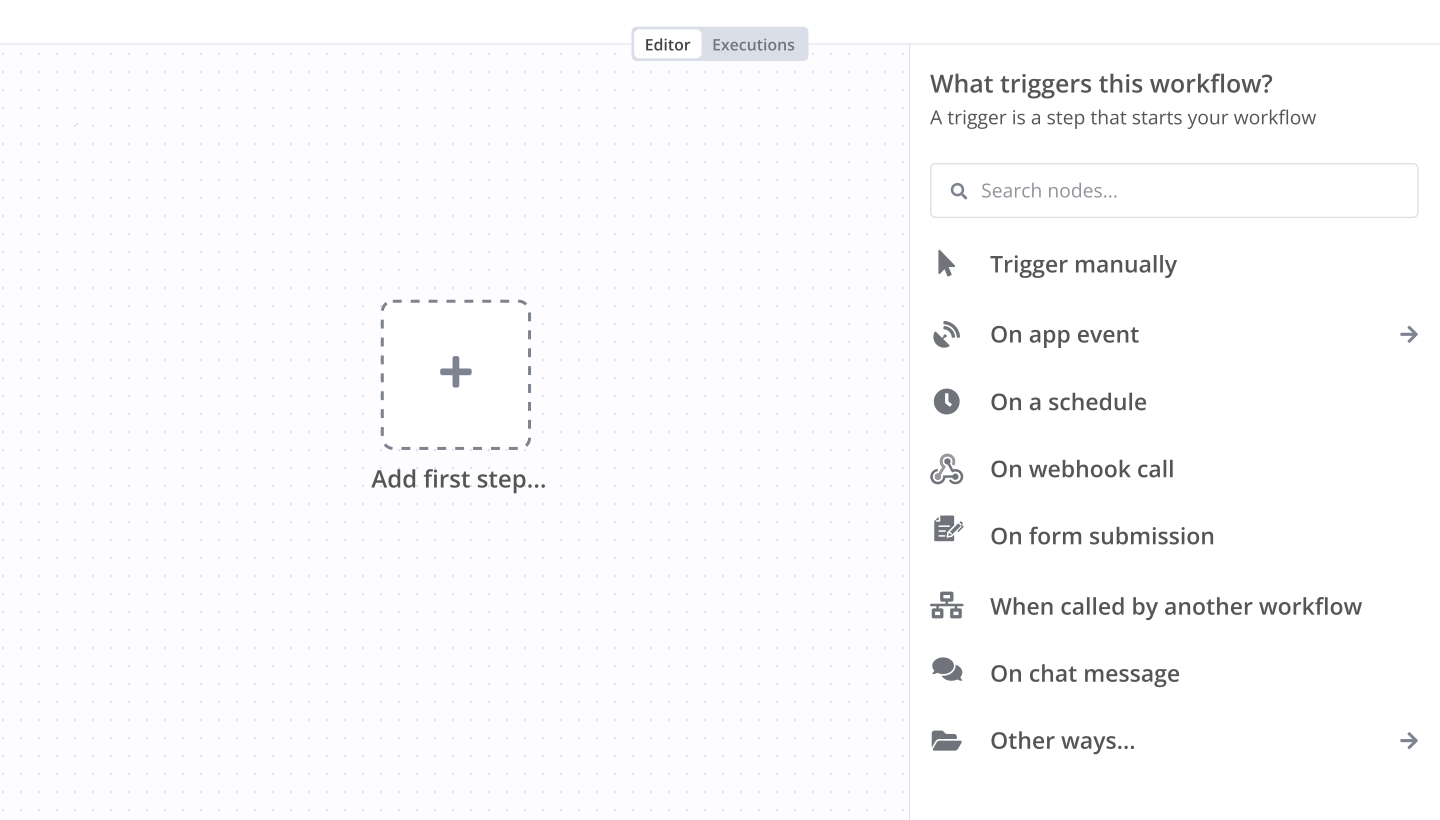
Jira Software and OpenAI integration: Create a new workflow and add the first step

Step 2: Add and configure Jira Software and OpenAI nodes

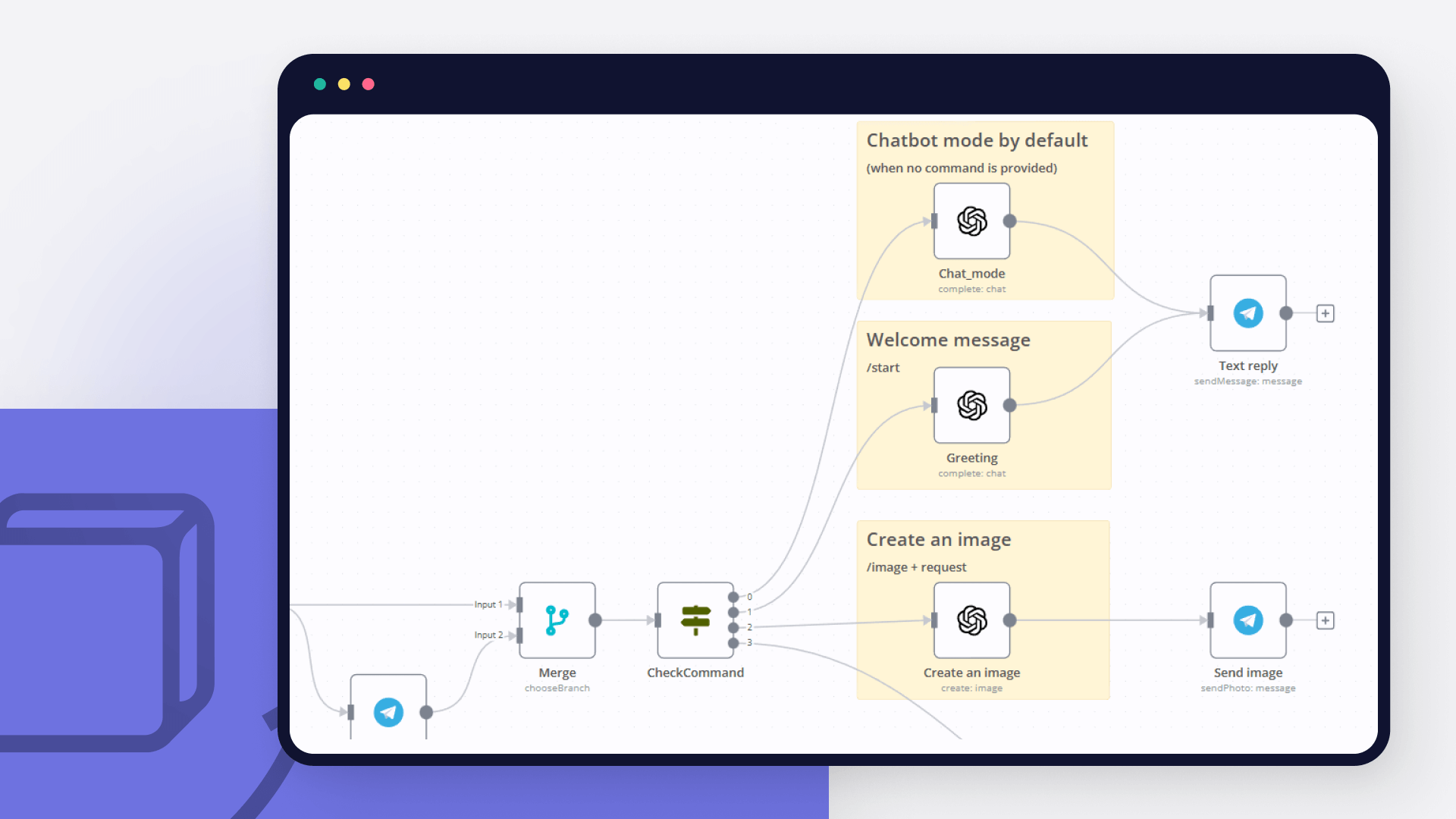
You can find Jira Software and OpenAI in the nodes panel. Drag them onto your workflow canvas, selecting their actions. Click each node, choose a credential, and authenticate to grant n8n access. Configure Jira Software and OpenAI nodes one by one: input data on the left, parameters in the middle, and output data on the right.

Jira Software and OpenAI integration: Add and configure Jira Software and OpenAI nodes

Step 3: Connect Jira Software and OpenAI

A connection establishes a link between Jira Software and OpenAI (or vice versa) to route data through the workflow. Data flows from the output of one node to the input of another. You can have single or multiple connections for each node.

Jira Software and OpenAI integration: Connect Jira Software and OpenAI

Step 4: Customize and extend your Jira Software and OpenAI integration

Use n8n's core nodes such as If, Split Out, Merge, and others to transform and manipulate data. Write custom JavaScript or Python in the Code node and run it as a step in your workflow. Connect Jira Software and OpenAI with any of n8n’s 1000+ integrations, and incorporate advanced AI logic into your workflows.

Jira Software and OpenAI integration: Customize and extend your Jira Software and OpenAI integration

Step 5: Test and activate your Jira Software and OpenAI workflow

Save and run the workflow to see if everything works as expected. Based on your configuration, data should flow from Jira Software to OpenAI or vice versa. Easily debug your workflow: you can check past executions to isolate and fix the mistake. Once you've tested everything, make sure to save your workflow and activate it.

Jira Software and OpenAI integration: Test and activate your Jira Software and OpenAI workflow

Analyze & sort suspicious email contents with ChatGPT

Analyze & Sort Suspicious Email Contents with ChatGPT and Jira

Who is this for?
This workflow is tailored for IT security teams, managed service providers (MSPs), and organizations aiming to streamline the detection and reporting of phishing emails. It's especially useful for teams handling high email volumes and requiring quick, automated analysis.

What problem is this workflow solving?
Phishing emails pose a significant cybersecurity threat, and manual review processes are time-consuming and prone to human error. This workflow automates the identification of malicious emails, provides AI-driven insights, and generates structured reports, enabling faster and more efficient responses to email-based threats.

What this workflow does
This workflow integrates Gmail or Microsoft Outlook to monitor and capture incoming emails. It processes the email content and headers, converts the email's body to a visual screenshot for clarity, and uses ChatGPT's advanced AI to analyze the email for phishing indicators. Based on the analysis, it categorizes emails as potentially malicious or benign, creating detailed Jira tickets for each case. Attachments, including the email body and screenshots, are automatically uploaded for comprehensive reporting.

Key steps include:
Email Integration: Captures emails from Gmail or Microsoft Outlook.
Content Processing: Extracts and organizes email content and metadata.
AI Analysis: Uses ChatGPT to evaluate email content and headers.
Classification: Categorizes emails as malicious or benign.
Automated Reporting: Creates Jira tickets with detailed analysis and attachments.

Setup
Authentication: Configure Gmail or Microsoft Outlook credentials in n8n.
API Keys: Add credentials for the HTML screenshot service (hcti.io) and OpenAI.
Jira Configuration: Set up project and issue types in the Jira nodes.
Customization: Update sticky notes and nodes to fit your organizational requirements, such as modifying the AI prompt or Jira ticket fields.

How to customize this workflow to your needs
Adjust email triggers to include or exclude specific senders or subjects.
Refine the AI prompt in the ChatGPT node to tailor phishing detection criteria.
Modify Jira ticket content to include additional fields or match specific workflows.

This workflow is ideal for automating email threat detection, reducing response times, and enhancing overall cybersecurity processes. By leveraging AI-powered insights, it helps organizations stay ahead of phishing attacks.

Nodes used in this workflow

Popular Jira Software and OpenAI workflows

+4

Generate continuous PRD updates in Google Docs from Slack, Zoom, Jira, Zendesk, Figma and analytics using OpenAI

This workflow creates an automated Product Intelligence Engine that continuously collects signals from multiple product sources and generates structured PRD updates using AI. It ingests conversations, feedback, support tickets, analytics, and design comments, standardizes them, analyzes them with an AI PRD Agent, and automatically updates a Google Doc with structured PRD recommendations. Instead of manually reviewing Slack threads, Zoom calls, Jira comments, support tickets, and customer forms, this workflow centralizes everything into one intelligent PRD analysis system. High-Level Architecture - The workflow runs in 4 layers: Signal Ingestion Layer Captures product signals from: • Slack (channel messages + app mentions) • Customer Form submissions • Zoom recordings (scheduled) • Jira comments (scheduled) • Zendesk tickets (scheduled) • Figma comments (file updates) • Platform analytics via webhook • (Extendable to Salesforce / HubSpot) Standardization Layer Each source passes through a Format Node that: • Extracts relevant text • Normalizes metadata • Adds timestamps • Labels source type All inputs are converted into a unified "product signal" object. Intelligence Layer (AI PRD Agent) All signals are merged into a single stream using a Merge node. The PRD Analysis Agent then: • Extracts feature requests • Detects scope changes • Identifies risks and constraints • Evaluates priority signals • Detects target user shifts • Generates structured PRD updates PRD Governance Layer - output in a Google Doc The structured AI output is appended to a Google Doc, which is fully traceable. This creates a living PRD that continuously evolves based on real product signals. Required Credentials (And How To Add Them): You will need to configure the following credentials in n8n: Slack Used for Slack Trigger. Steps: Create a Slack App at api.slack.com Enable: app_mentions:read channels:history chat:write (optional if you want replies) Install app to workspace Copy Bot OAuth Token In n8n → Create Slack API credential Paste token Reference - https://www.youtube.com/watch?v=qk5JH6ImK0I Zoom (OAuth2) Used to fetch recordings. Steps: Create an OAuth App in Zoom Marketplace Add the Redirect URL from n8n Copy Client ID + Secret Add Zoom OAuth2 credential in n8n Connect account Reference - https://www.youtube.com/watch?v=BC6O_3LYgac Google Docs (OAuth2) Used to update PRD document. Steps: Create Google Cloud Project Add Doc URl to n8n Replace the example Google Doc URL with your own PRD document. Reference - https://www.youtube.com/watch?v=iieEHvu93dc Jira (Cloud) Steps: Generate API token from Atlassian Create Jira Software Cloud credential Enter: Email API token Domain Reference - https://www.youtube.com/watch?v=T4z7lzqSZDY Zendesk Steps: Generate API token Add Zendesk credential Enter: Subdomain Email API token Figma Steps: Generate a personal access token in Figma Add Figma credentials with the team ID Paste token Platform Analytics Webhook Replace: <PLACEHOLDER_VALUE__your_analytics_api_endpoint> With your real analytics endpoint. You can: • Send Mixpanel exports • Send Amplitude exports • Or POST custom JSON What Makes This Powerful • Eliminates product signal silos • Creates AI-driven PRD governance • Ensures traceability of decisions • Enables continuous PRD evolution • Scales across teams

Analyze & Sort Suspicious Email Contents with ChatGPT

Analyze & Sort Suspicious Email Contents with ChatGPT and Jira Who is this for? This workflow is tailored for IT security teams, managed service providers (MSPs), and organizations aiming to streamline the detection and reporting of phishing emails. It's especially useful for teams handling high email volumes and requiring quick, automated analysis. What problem is this workflow solving? Phishing emails pose a significant cybersecurity threat, and manual review processes are time-consuming and prone to human error. This workflow automates the identification of malicious emails, provides AI-driven insights, and generates structured reports, enabling faster and more efficient responses to email-based threats. What this workflow does This workflow integrates Gmail or Microsoft Outlook to monitor and capture incoming emails. It processes the email content and headers, converts the email's body to a visual screenshot for clarity, and uses ChatGPT's advanced AI to analyze the email for phishing indicators. Based on the analysis, it categorizes emails as potentially malicious or benign, creating detailed Jira tickets for each case. Attachments, including the email body and screenshots, are automatically uploaded for comprehensive reporting. Key steps include: Email Integration: Captures emails from Gmail or Microsoft Outlook. Content Processing: Extracts and organizes email content and metadata. AI Analysis: Uses ChatGPT to evaluate email content and headers. Classification: Categorizes emails as malicious or benign. Automated Reporting: Creates Jira tickets with detailed analysis and attachments. Setup Authentication: Configure Gmail or Microsoft Outlook credentials in n8n. API Keys: Add credentials for the HTML screenshot service (hcti.io) and OpenAI. Jira Configuration: Set up project and issue types in the Jira nodes. Customization: Update sticky notes and nodes to fit your organizational requirements, such as modifying the AI prompt or Jira ticket fields. How to customize this workflow to your needs Adjust email triggers to include or exclude specific senders or subjects. Refine the AI prompt in the ChatGPT node to tailor phishing detection criteria. Modify Jira ticket content to include additional fields or match specific workflows. This workflow is ideal for automating email threat detection, reducing response times, and enhancing overall cybersecurity processes. By leveraging AI-powered insights, it helps organizations stay ahead of phishing attacks.

Analyze Suspicious Email Contents with ChatGPT Vision

Phishing Email Detection and Reporting with n8n Who is this for? This workflow is designed for IT teams, security professionals, and managed service providers (MSPs) looking to automate the process of detecting, analyzing, and reporting phishing emails. What problem is this workflow solving? Phishing emails are a significant cybersecurity threat, and manually detecting and reporting them is time-consuming and prone to errors. This workflow streamlines the process by automating email analysis, generating detailed reports, and logging incidents in a centralized system like Jira. What this workflow does This workflow automates phishing email detection and reporting by integrating Gmail and Microsoft Outlook email triggers, analyzing the content and headers of incoming emails, and generating Jira tickets for flagged phishing emails. Here’s what happens: Email Triggers: Captures incoming emails from Gmail or Microsoft Outlook. Email Analysis: Extracts email content, headers, and metadata for analysis. HTML Screenshot: Converts the email’s HTML body into a visual screenshot. AI Phishing Detection: Leverages ChatGPT to analyze the email and detect potential phishing indicators. Jira Integration: Automatically creates a Jira ticket with detailed analysis and attaches the email screenshot for review by the security team. Customizable Reports: Includes options to customize ticket descriptions and adapt the workflow to organizational needs. Setup Authentication: Set up Gmail and Microsoft Outlook OAuth credentials in n8n to access your email accounts securely. API Keys: Add API credentials for the HTML screenshot service (hcti.io) and ChatGPT. Jira Integration: Configure your Jira project and issue types in the workflow. Workflow Configuration: Update sticky notes and nodes to include any additional setup or configuration details unique to your system. How to customize this workflow to your needs Email Filters**: Modify email triggers to filter specific subjects or sender addresses. Analysis Scope**: Adjust the ChatGPT prompt to refine phishing detection logic. Integration**: Replace Jira with your preferred ticketing system or modify the ticket fields to include additional information. This workflow provides an end-to-end automated solution for phishing email management, enhancing efficiency and reducing security risks. It’s perfect for teams looking to minimize manual effort and improve incident response times.

Orchestrate security vulnerability remediation with Port, OpenAI, Jira and Slack

Complete security workflow from vulnerability detection to automated remediation, with severity-based routing and full organizational context from Port's catalog. This template provides end-to-end lifecycle management including automatic Jira ticket creation with appropriate priority, AI-powered remediation planning, and Claude Code-triggered fixes for critical vulnerabilities. The full guide is available here. How it works The n8n workflow orchestrates the following steps: Webhook trigger**: Receives vulnerability alerts from security scanners (Snyk, Wiz, SonarQube, etc.) via POST request. Port context enrichment**: Uses Port's n8n node to query your software catalog for service metadata, ownership, environment, SLA requirements, and dependencies related to the vulnerability. AI remediation planning**: OpenAI analyzes the vulnerability with Port context and generates a remediation plan, determining if automated fixing is possible. Severity-based routing**: Routes vulnerabilities through different paths based on severity level: Critical: Jira ticket (Highest priority) → Check if auto-fixable → Trigger Claude Code fix → Slack alert with fix status High: Jira ticket (High priority) → Slack notification to team channel Medium/Low: Jira ticket only for tracking Jira integration**: Creates tickets with full context including vulnerability details, affected service information from Port, and AI-generated remediation steps. Claude Code remediation**: For auto-fixable critical vulnerabilities, triggers Claude Code via Port action to create a pull request with the security patch, referencing the Jira ticket. Slack notifications**: Sends contextual alerts to the appropriate team channel (retrieved from Port) with Jira ticket reference and remediation status. Prerequisites You have a Port account and have completed the onboarding process. Services and repositories are cataloged in Port with ownership information. Your security scanner (Snyk, Wiz, SonarQube) can send webhooks. You have a working n8n instance (Cloud or self-hosted) with Port's n8n custom node installed. Jira Cloud account with appropriate project permissions. Slack workspace with bot permissions to post messages. OpenAI API key for remediation planning. Setup Register for free on Port.io if you haven't already. Create the Context Retriever Agent in Port following the guide. Import the workflow and configure credentials (Port, Jira, Slack, OpenAI, Bearer Auth). Select your Jira project in each Jira node (Critical, High, Medium/Low). Update default-organization/repository with your default repository for Claude Code fixes. Point your security scanner webhook to the workflow URL. Test with a sample vulnerability payload. ⚠️ This template is intended for Self-Hosted instances only.

Escalate product UAT critical bugs with OpenAI, Jira and Slack

Description Automatically detect and escalate Product UAT critical bugs using AI, create Jira issues, notify engineering teams, and close the feedback loop with testers. This workflow analyzes raw UAT feedback submitted via a webhook, classifies it with an AI model, validates severity, and automatically escalates confirmed critical bugs to Jira and Slack. Testers are notified, and the original webhook receives a structured response for full traceability. It is designed for teams that want fast, reliable critical bug handling during UAT without manual triage. Context During Product UAT and beta testing, critical bugs are often buried in unstructured feedback coming from forms, Slack, or internal tools. Missing or delaying these issues can block releases and create friction between Product and Engineering. This workflow ensures: Faster detection of critical bugs Immediate escalation to engineering Clear ownership and visibility Consistent communication with testers It combines AI-based classification with deterministic routing to keep UAT feedback actionable and production-ready. Who is this for? Product Managers running UAT or beta programs Project Managers coordinating QA and release readiness Engineering teams who need fast, clean bug escalation Product Ops teams standardizing feedback workflows Any team handling high-volume UAT feedback Perfect for teams that want speed, clarity, and traceability during UAT. Requirements Webhook trigger (form, Slack integration, internal tool, etc.) OpenAI account (for AI triage) Jira (critical bug tracking) Slack (engineering alerts) Gmail or Slack (tester notifications) How it works Trigger The workflow starts when UAT feedback is submitted via a webhook. Normalize & Clean Incoming data is normalized (tester, build, page, message) and cleaned to ensure a consistent, AI-ready structure. AI Triage & Validation An AI model analyzes the feedback and returns a structured triage result (type, severity, summary, confidence), which is parsed and validated. Critical Bug Escalation Validated critical bugs automatically: create a Jira issue with full context trigger an engineering Slack alert Closed Loop The tester is notified via Slack or email, and the workflow responds to the original webhook with a structured status payload. What you get Automated critical bug detection during UAT Instant Jira ticket creation Real-time engineering alerts in Slack Automatic tester communication Full traceability via structured webhook responses About me : I’m Yassin a Product Manager Scaling tech products with a data-driven mindset. 📬 Feel free to connect with me on Linkedin
+2

Triage product UAT feedback with OpenAI, Jira, Slack, Notion and Google Sheets

Description Automatically triage Product UAT feedback using AI, route it to the right tools and teams, and close the feedback loop with testers, all in one workflow. This workflow analyzes raw UAT feedback, classifies it (critical bug, feature request, UX improvement, or noise), validates AI confidence, escalates when human review is needed, and synchronizes everything across Jira, Slack, Notion, Google Sheets, and email. Context Product teams often receive unstructured UAT feedback from multiple sources (forms, Slack, internal tools), making triage slow, inconsistent, and error-prone. This workflow ensures: Faster bug detection Consistent categorization Zero feedback lost Clear accountability between Product, Engineering, and Design It combines AI automation with human-in-the-loop control, making it safe for real production environments. Who is this for? Product Managers running UAT or beta programs Project Managers coordinating QA and release validation Product Ops / PMO teams Engineering teams who want faster, cleaner bug escalation Any team managing high-volume UAT feedback Perfect for teams that want speed without sacrificing control. Requirements Webhook trigger (form, internal tool, Slack integration, etc.) OpenAI account (for AI triage) Jira (bug tracking) Slack (team notifications) Notion (product roadmap / UX backlog) Google Sheets (UAT feedback log) Gmail (tester & manual review notifications) How it works Trigger The workflow starts when UAT feedback is submitted via a webhook (form, Slack, or internal tool). Normalize & Clean Incoming data is normalized into a consistent structure (tester, build, page, message) and cleaned to be AI-ready. AI Triage An AI model analyzes the feedback and returns: Type (Critical Bug, Feature Request, UX Improvement, Noise) Severity & sentiment Summary and suggested title Confidence score Quality Control If the AI output is unreliable (low confidence or parsing error), the feedback is automatically routed to manual review via email and Slack. Routing & Actions If confidence is sufficient: Critical Bugs → Jira issue + Engineering Slack alert Feature Requests → Notion roadmap UX Improvements → Design / UX tracking Noise → Archived but traceable Closed Loop The tester is notified via Slack or email, and the workflow responds to the original webhook with a structured status payload. What you get One unified UAT triage system Faster bug escalation Clean product and UX backlogs Full traceability of every feedback Automatic tester communication Safe AI usage with human fallback About me : I’m Yassin a Product Manager Scaling tech products with a data-driven mindset. 📬 Feel free to connect with me on Linkedin

Build your own Jira Software and OpenAI integration

Create custom Jira Software and OpenAI workflows by choosing triggers and actions. Nodes come with global operations and settings, as well as app-specific parameters that can be configured. You can also use the HTTP Request node to query data from any app or service with a REST API.

Jira Software supported actions

Changelog
Get issue changelog
Create
Create a new issue
Delete
Delete an issue
Get
Get an issue
Get Many
Get many issues
Notify
Create an email notification for an issue and add it to the mail queue
Status
Return either all transitions or a transition that can be performed by the user on an issue, based on the issue's status
Update
Update an issue
Add
Add attachment to issue
Get
Get an attachment
Get Many
Get many attachments
Remove
Remove an attachment
Add
Add comment to issue
Get
Get a comment
Get Many
Get many comments
Remove
Remove a comment
Update
Update a comment
Create
Create a new user
Delete
Delete a user
Get
Retrieve a user

OpenAI supported actions

Message a Model
Generate a model response with GPT 3, 4, 5, etc. using Responses API
Classify Text for Violations
Check whether content complies with usage policies
Analyze Image
Take in images and answer questions about them
Generate an Image
Creates an image from a text prompt
Edit Image
Edit an image
Generate Audio
Creates audio from a text prompt
Transcribe a Recording
Transcribes audio into text
Translate a Recording
Translates audio into text in English
Delete a File
Delete a file from the server
List Files
Returns a list of files that belong to the user's organization
Upload a File
Upload a file that can be used across various endpoints
Create
Create a conversation
Get
Get a conversation
Remove
Remove a conversation
Update
Update a conversation
Generate
Creates a video from a text prompt

Jira Software and OpenAI integration details

Use case

Save engineering resources

Reduce time spent on customer integrations, engineer faster POCs, keep your customer-specific functionality separate from product all without having to code.

Learn more

FAQs

  • Can Jira Software connect with OpenAI?

  • Can I use Jira Software’s API with n8n?

  • Can I use OpenAI’s API with n8n?

  • Is n8n secure for integrating Jira Software and OpenAI?

  • How to get started with Jira Software and OpenAI integration in n8n.io?

Need help setting up your Jira Software and OpenAI integration?

Discover our latest community's recommendations and join the discussions about Jira Software and OpenAI integration.
Artem
sérgio eduardo floresta filho
Andrew adawdad
PinkFloyd
Steve Warburton

Looking to integrate Jira Software and OpenAI in your company?

Over 3000 companies switch to n8n every single week

Why use n8n to integrate Jira Software with OpenAI

Build complex workflows, really fast
Build complex workflows, really fast

Handle branching, merging and iteration easily.
Pause your workflow to wait for external events.

Code when you need it, UI when you don't

Simple debugging

Your data is displayed alongside your settings, making edge cases easy to track down.

Use templates to get started fast

Use 1000+ workflow templates available from our core team and our community.

Reuse your work

Copy and paste, easily import and export workflows.

Implement complex processes faster with n8n

red iconyellow iconred iconyellow icon