Back to Integrations
integrationMailgun node
integrationGoogle Sheets node

Mailgun and Google Sheets integration

Save yourself the work of writing custom integrations for Mailgun and Google Sheets and use n8n instead. Build adaptable and scalable Communication, Development, Data & Storage, and Productivity workflows that work with your technology stack. All within a building experience you will love.

How to connect Mailgun and Google Sheets

  • Step 1: Create a new workflow
  • Step 2: Add and configure nodes
  • Step 3: Connect
  • Step 4: Customize and extend your integration
  • Step 5: Test and activate your workflow

Step 1: Create a new workflow and add the first step

In n8n, click the "Add workflow" button in the Workflows tab to create a new workflow. Add the starting point – a trigger on when your workflow should run: an app event, a schedule, a webhook call, another workflow, an AI chat, or a manual trigger. Sometimes, the HTTP Request node might already serve as your starting point.

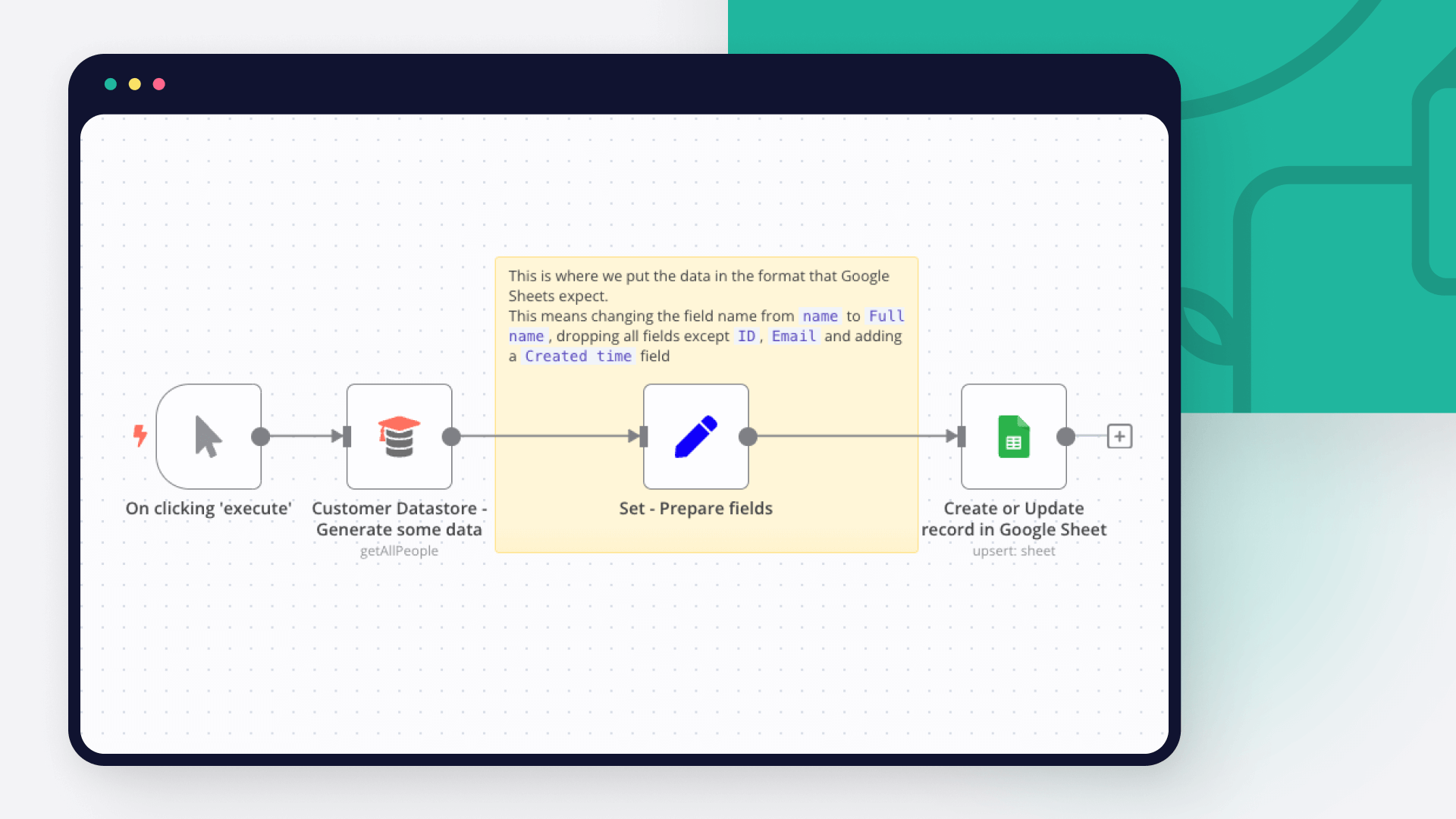
Mailgun and Google Sheets integration: Create a new workflow and add the first step

Step 2: Add and configure Mailgun and Google Sheets nodes

You can find Mailgun and Google Sheets in the nodes panel. Drag them onto your workflow canvas, selecting their actions. Click each node, choose a credential, and authenticate to grant n8n access. Configure Mailgun and Google Sheets nodes one by one: input data on the left, parameters in the middle, and output data on the right.

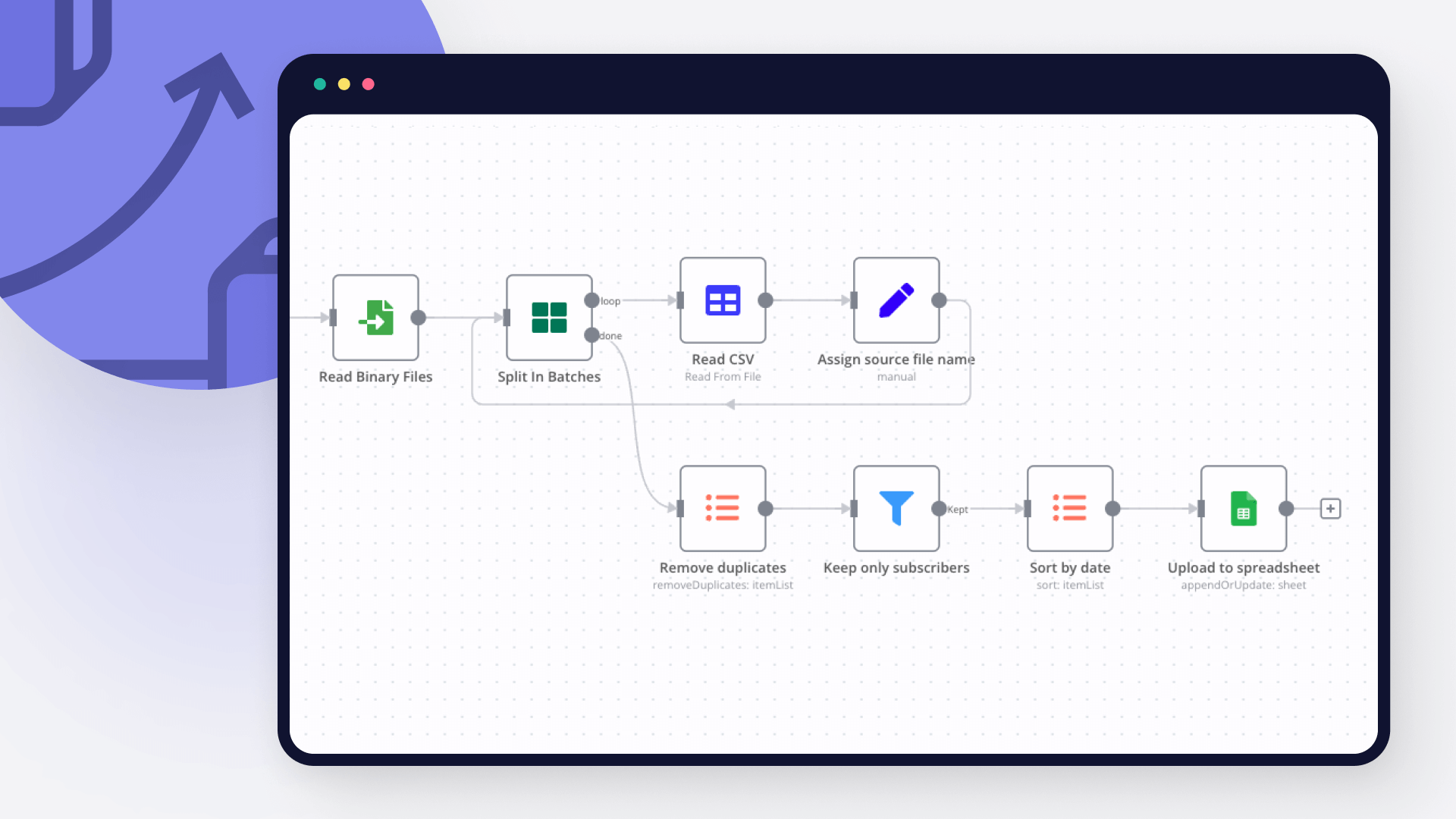
Mailgun and Google Sheets integration: Add and configure Mailgun and Google Sheets nodes

Step 3: Connect Mailgun and Google Sheets

A connection establishes a link between Mailgun and Google Sheets (or vice versa) to route data through the workflow. Data flows from the output of one node to the input of another. You can have single or multiple connections for each node.

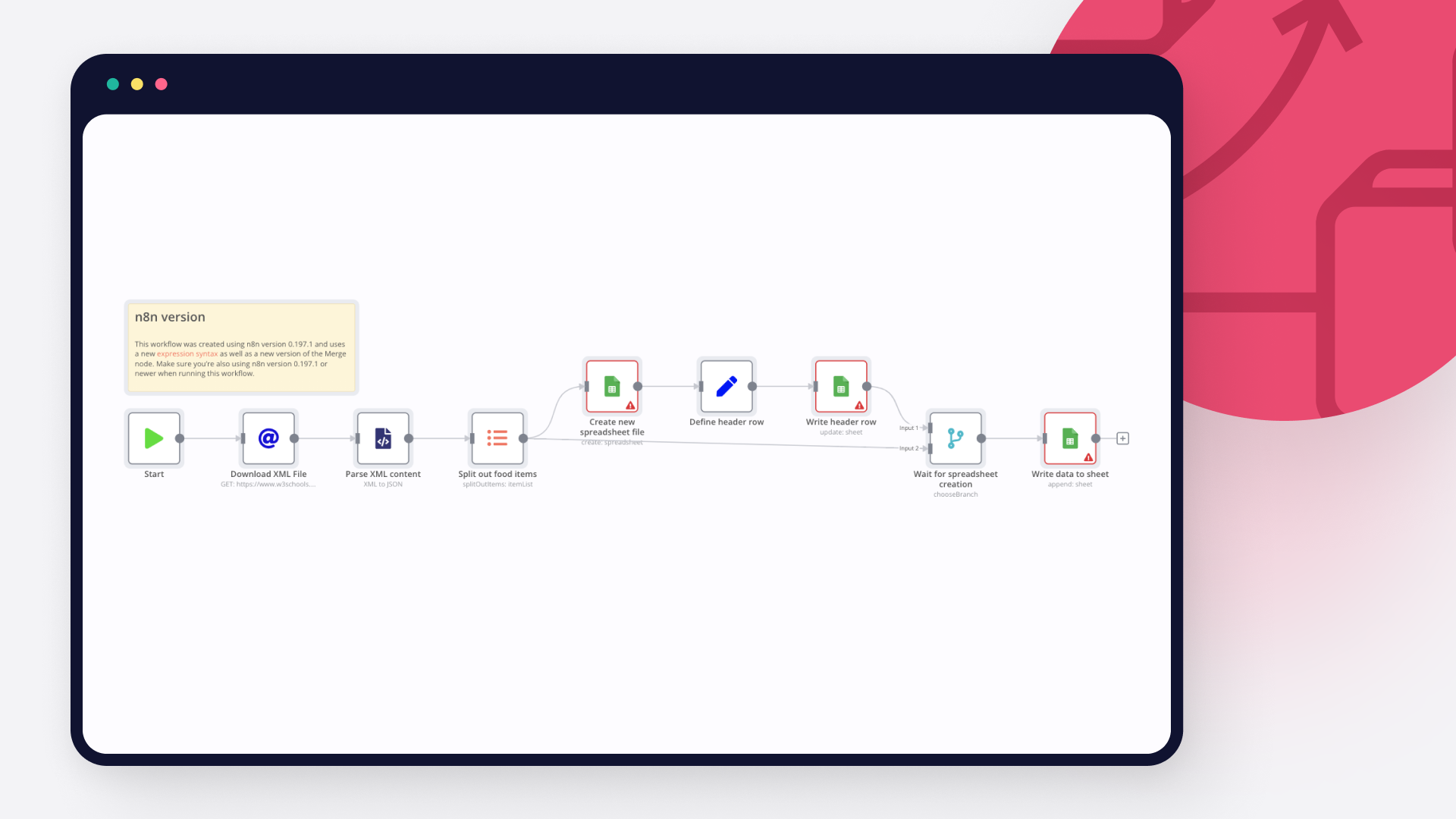
Mailgun and Google Sheets integration: Connect Mailgun and Google Sheets

Step 4: Customize and extend your Mailgun and Google Sheets integration

Use n8n's core nodes such as If, Split Out, Merge, and others to transform and manipulate data. Write custom JavaScript or Python in the Code node and run it as a step in your workflow. Connect Mailgun and Google Sheets with any of n8n’s 1000+ integrations, and incorporate advanced AI logic into your workflows.

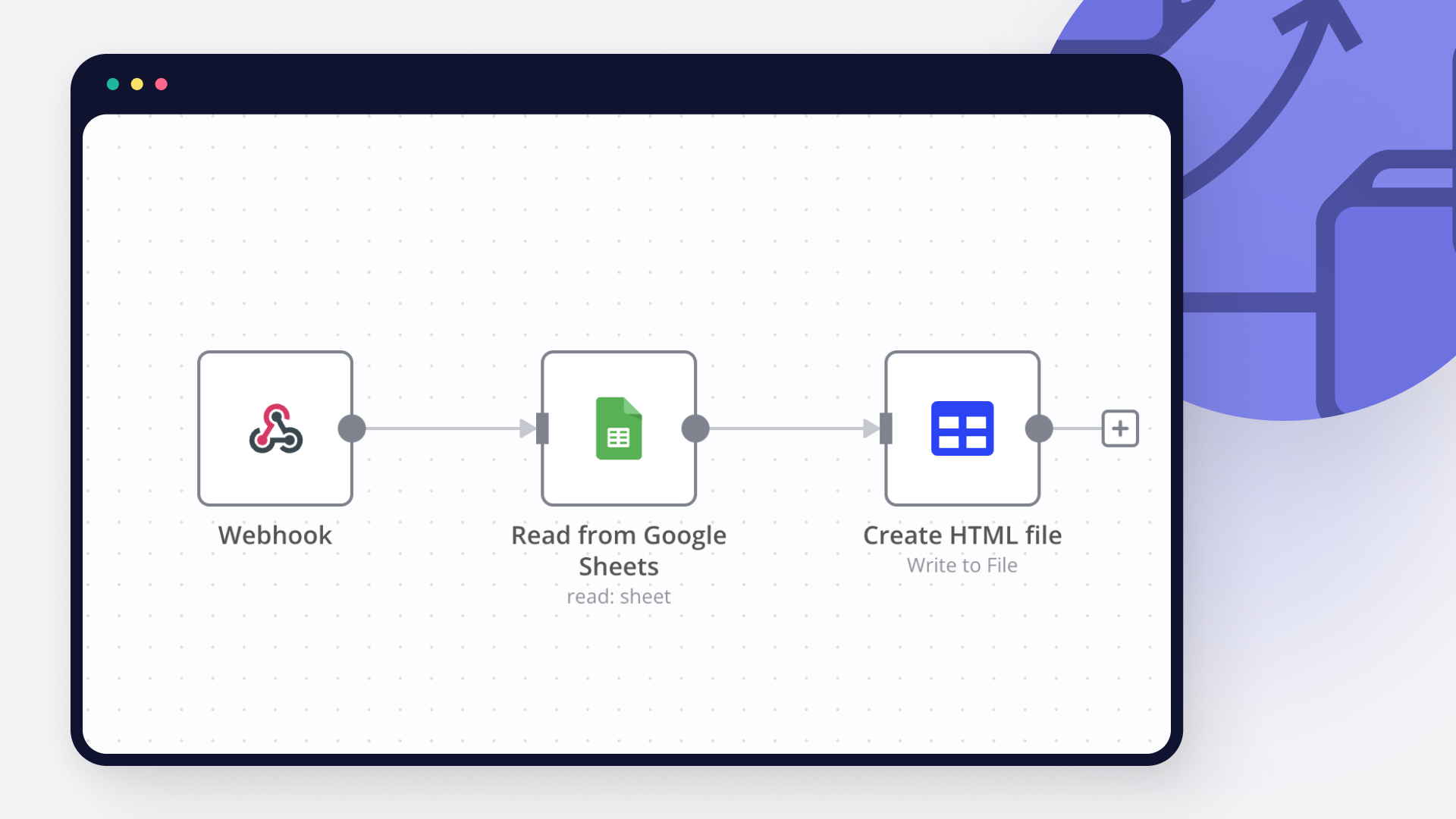
Mailgun and Google Sheets integration: Customize and extend your Mailgun and Google Sheets integration

Step 5: Test and activate your Mailgun and Google Sheets workflow

Save and run the workflow to see if everything works as expected. Based on your configuration, data should flow from Mailgun to Google Sheets or vice versa. Easily debug your workflow: you can check past executions to isolate and fix the mistake. Once you've tested everything, make sure to save your workflow and activate it.

Mailgun and Google Sheets integration: Test and activate your Mailgun and Google Sheets workflow

AI agent creates content to be picked by ChatGPT, Gemini, Google

🧠 Who is this for?
Marketing teams, content creators, solopreneurs, and agencies who want to generate emotionally-resonant, SEO-optimized content tailored to audience psychology and buyer journey stages — and get picked up by AI discovery engines like ChatGPT, Gemini, and Perplexity.

How it works:
✅ Decodes why people buy (using buyer psychology)
✅ Creates SEO + emotionally resonant content for 4 formats:
→ Blog Posts, Newsletters, Landing Pages, Social Media
✅ Structures the content to be picked up by ChatGPT, Gemini, Perplexity & Google
✅ Automatically routes it to Google Sheets, Gmail, or even WordPress

This isn’t just about writing better content — it’s about getting seen by the tools that shape the internet.

How long does it take to set-up: 30 Mins

Nodes used in this workflow

Popular Mailgun and Google Sheets workflows

+3

AI Agent Creates Content to Be Picked by ChatGPT, Gemini, Google

🧠 Who is this for? Marketing teams, content creators, solopreneurs, and agencies who want to generate emotionally-resonant, SEO-optimized content tailored to audience psychology and buyer journey stages — and get picked up by AI discovery engines like ChatGPT, Gemini, and Perplexity. How it works: ✅ Decodes why people buy (using buyer psychology) ✅ Creates SEO + emotionally resonant content for 4 formats: → Blog Posts, Newsletters, Landing Pages, Social Media ✅ Structures the content to be picked up by ChatGPT, Gemini, Perplexity & Google ✅ Automatically routes it to Google Sheets, Gmail, or even WordPress This isn’t just about writing better content — it’s about getting seen by the tools that shape the internet. How long does it take to set-up: 30 Mins
+2

Process Scanned Invoices with Google Drive, OCR & OpenAI to Google Sheets

This template allows you to automatically process scanned invoices from Google Drive, extract key information using AI, and organize the data in Google Sheets with email notifications. Overview This comprehensive workflow automates the entire invoice processing pipeline by monitoring a Google Drive folder for new invoice uploads, intelligently processing both PDF and image formats, extracting structured data using AI-powered information extraction, and automatically organizing the results in a Google Sheet while sending email notifications. The system handles various file formats and includes smart fallback mechanisms for challenging documents like CamScanner PDFs. How it Works File Monitoring: The workflow continuously monitors a specified Google Drive folder for new invoice files using a trigger that checks every minute for newly created files. File Processing: When new files are detected, the system downloads them and determines the file type (PDF or image) using a smart switch mechanism. Text Extraction: For PDFs: Attempts direct text extraction first For Images: Uses OCR.Space API for optical character recognition For problematic PDFs (like CamScanner): Falls back to OCR processing AI Information Extraction: Processes the extracted text through OpenAI's language model to identify and extract key invoice information including: Company name Total amount Currency Invoice date Invoice number Data Storage: Automatically appends the extracted information to a Google Sheet with links back to the original scanned documents. Notification: Sends formatted email notifications via Mailgun when new invoices are processed, including an HTML table summary. How to Use Setup Google Drive: Create a dedicated folder in Google Drive for invoice uploads and note the folder ID. Configure Credentials: Set up the following credential connections in n8n: Google Drive OAuth2 API Google Sheets OAuth2 API OpenAI API OCR.Space API Mailgun API Update Configuration: Replace the Google Drive folder ID with your target folder Replace the Google Sheets document ID with your destination spreadsheet Update email addresses in the Mailgun node Test the Workflow: Use the manual trigger to process existing invoices in your folder for initial testing. Activate: Enable the workflow to start automatic monitoring of new invoice uploads. Requirements External APIs: OpenAI API** - For AI-powered information extraction from invoice text OCR.Space API** - For optical character recognition of image-based invoices Mailgun API** - For sending email notifications Google Services: Google Drive API** - For monitoring folders and downloading files Google Sheets API** - For storing extracted invoice data Setup Prerequisites: Google Drive folder dedicated to invoice uploads Google Sheet with appropriate column headers (date, company name, total, currency, invoice number, scan link, etc.) Email domain configured with Mailgun (or alternative email service) OCR.Space account for image processing capabilities: https://ocr.space/OCRAPI Recommended Settings: Set the Google Drive trigger to check for new files every minute Ensure sufficient API rate limits for your expected invoice volume Configure proper error handling for failed OCR or AI extraction attempts

Build your own Mailgun and Google Sheets integration

Create custom Mailgun and Google Sheets workflows by choosing triggers and actions. Nodes come with global operations and settings, as well as app-specific parameters that can be configured. You can also use the HTTP Request node to query data from any app or service with a REST API.

Google Sheets supported actions

Create
Create a spreadsheet
Delete
Delete a spreadsheet
Append or Update Row
Append a new row or update an existing one (upsert)
Append Row
Create a new row in a sheet
Clear
Delete all the contents or a part of a sheet
Create
Create a new sheet
Delete
Permanently delete a sheet
Delete Rows or Columns
Delete columns or rows from a sheet
Get Row(s)
Retrieve one or more rows from a sheet
Update Row
Update an existing row in a sheet

FAQs

  • Can Mailgun connect with Google Sheets?

  • Can I use Mailgun’s API with n8n?

  • Can I use Google Sheets’s API with n8n?

  • Is n8n secure for integrating Mailgun and Google Sheets?

  • How to get started with Mailgun and Google Sheets integration in n8n.io?

Need help setting up your Mailgun and Google Sheets integration?

Discover our latest community's recommendations and join the discussions about Mailgun and Google Sheets integration.
Sergey Komardenkov
sérgio eduardo floresta filho
Julian
therealJMT
Guilherme

Looking to integrate Mailgun and Google Sheets in your company?

Over 3000 companies switch to n8n every single week

Why use n8n to integrate Mailgun with Google Sheets

Build complex workflows, really fast

Build complex workflows, really fast

Handle branching, merging and iteration easily.
Pause your workflow to wait for external events.

Code when you need it, UI when you don't

Simple debugging

Your data is displayed alongside your settings, making edge cases easy to track down.

Use templates to get started fast

Use 1000+ workflow templates available from our core team and our community.

Reuse your work

Copy and paste, easily import and export workflows.

Implement complex processes faster with n8n

red iconyellow iconred iconyellow icon