Back to Integrations
integrationOpenAI node
integrationShopify node

OpenAI and Shopify integration

Save yourself the work of writing custom integrations for OpenAI and Shopify and use n8n instead. Build adaptable and scalable AI, Langchain, and Sales workflows that work with your technology stack. All within a building experience you will love.

How to connect OpenAI and Shopify

  • Step 1: Create a new workflow
  • Step 2: Add and configure nodes
  • Step 3: Connect
  • Step 4: Customize and extend your integration
  • Step 5: Test and activate your workflow

Step 1: Create a new workflow and add the first step

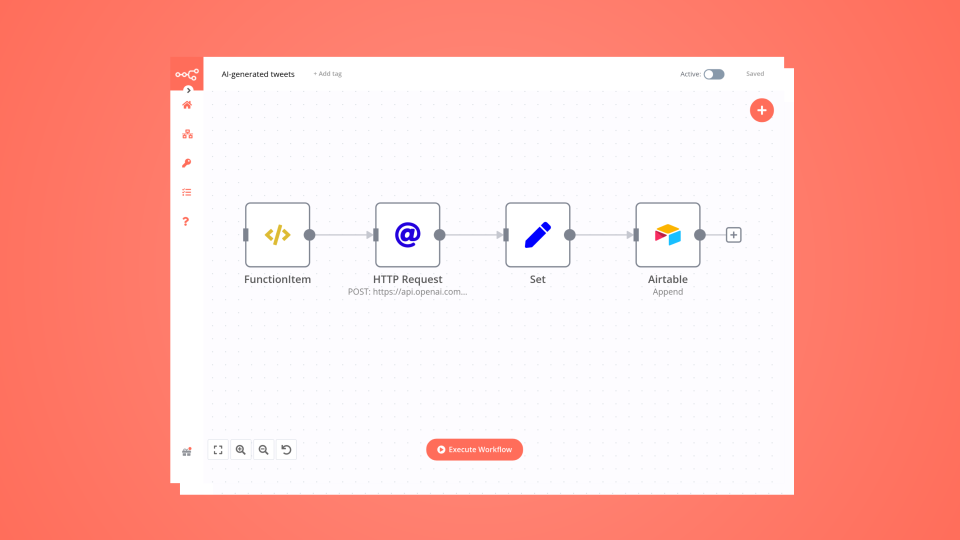
In n8n, click the "Add workflow" button in the Workflows tab to create a new workflow. Add the starting point – a trigger on when your workflow should run: an app event, a schedule, a webhook call, another workflow, an AI chat, or a manual trigger. Sometimes, the HTTP Request node might already serve as your starting point.

OpenAI and Shopify integration: Create a new workflow and add the first step

Step 2: Add and configure OpenAI and Shopify nodes

You can find OpenAI and Shopify in the nodes panel. Drag them onto your workflow canvas, selecting their actions. Click each node, choose a credential, and authenticate to grant n8n access. Configure OpenAI and Shopify nodes one by one: input data on the left, parameters in the middle, and output data on the right.

OpenAI and Shopify integration: Add and configure OpenAI and Shopify nodes

Step 3: Connect OpenAI and Shopify

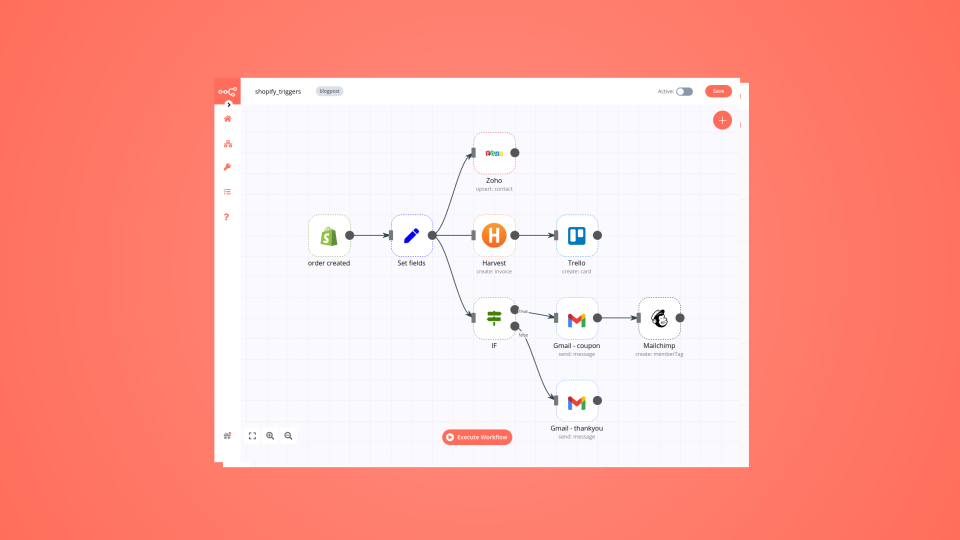
A connection establishes a link between OpenAI and Shopify (or vice versa) to route data through the workflow. Data flows from the output of one node to the input of another. You can have single or multiple connections for each node.

OpenAI and Shopify integration: Connect OpenAI and Shopify

Step 4: Customize and extend your OpenAI and Shopify integration

Use n8n's core nodes such as If, Split Out, Merge, and others to transform and manipulate data. Write custom JavaScript or Python in the Code node and run it as a step in your workflow. Connect OpenAI and Shopify with any of n8n’s 1000+ integrations, and incorporate advanced AI logic into your workflows.

OpenAI and Shopify integration: Customize and extend your OpenAI and Shopify integration

Step 5: Test and activate your OpenAI and Shopify workflow

Save and run the workflow to see if everything works as expected. Based on your configuration, data should flow from OpenAI to Shopify or vice versa. Easily debug your workflow: you can check past executions to isolate and fix the mistake. Once you've tested everything, make sure to save your workflow and activate it.

OpenAI and Shopify integration: Test and activate your OpenAI and Shopify workflow

AI blog generator for Shopify product listings: Using GPT-4o and Google Sheets

🧠 AI Blog Generator for Shopify Products using GPT-4o

The AI Blog Generator is an advanced automation workflow powered by n8n, integrating GPT-4o and Google Sheets to generate SEO-rich blog articles for Shopify products. It automates the entire process — from pulling product data, analyzing images for nutritional information, to producing structured HTML content ready for publishing — with zero manual writing.

💡 Key Advantages

🔗 Shopify Product Sync**
Automatically pulls product data (title, description, images, etc.) via Shopify API.

🤖 AI-Powered Nutrition Extraction**
Uses GPT-4o to intelligently analyze product images and extract nutritional information.

✍️ SEO Blog Generation**
GPT-4o generates blog titles, meta descriptions, and complete articles using both product metadata and extracted nutritional info.

🗂️ Structured Content Output**
Produces well-formatted HTML with headers, bullet points, and nutrition tables for seamless Shopify blog integration.

📄 Google Sheets Integration**
Tracks blog creation, manages retries, and prevents duplicate publishing using a centralized Google Sheet.

📤 Shopify Blog API Integration**
Publishes the generated blog to Shopify using a two-step blog + article API call.

⚙️ How It Works

Manual Trigger
Initiate the process using a test trigger or a scheduler.

Fetch Products from Shopify
Retrieves all product details including descriptions and images.

Extract Product Images
Splits and processes each image individually.

OCR + Nutrition AI
GPT-4o reads nutrition facts from product images. Skips items without valid info.

Check Existing Logs
References a Google Sheet to avoid duplicates and determine retry status.

AI Blog Generation
Creates a blog with headings, bullet points, intro, and a nutrition table.

Shopify Blog + Article Posting
Uses the Shopify API to publish the blog and its content.

Update Google Sheet
Logs the blog URL, HTML content, errors, and status for future reference.

🛠️ Setup Steps

Shopify Node**: Connects to your Shopify store and fetches product data.
Split Out Node**: Divides product images for individual OCR processing.
OpenAI Node**: Uses GPT-4o to extract nutrition data from images.
If Node**: Filters for entries with valid nutrition information.
Edit Fields Node**: Formats the product data for AI processing.
AI Agent Node**: Generates SEO blog content.
Google Sheets Nodes**: Reads and updates blog creation status.
HTTP Request Nodes**: Posts the blog and article via Shopify’s API.

🔐 Credentials Required

Shopify Access Token** – For retrieving product data and posting blogs
OpenAI API Key** – For GPT-4o-based AI generation and image processing
Google Sheets OAuth** – For accessing the log sheet

👤 Ideal For

Ecommerce teams looking to automate content for hundreds of products
Shopify store owners aiming to boost organic traffic through blogging
Marketing teams building scalable, AI-driven content workflows

💬 Bonus Tip

The workflow is modular. You can easily extend it with internal linking, language translation, or even social media sharing — all within the same n8n flow.

Nodes used in this workflow

Popular OpenAI and Shopify workflows

AI Blog Generator for Shopify Product listings: Using GPT-4o and Google Sheets

🧠 AI Blog Generator for Shopify Products using GPT-4o The AI Blog Generator is an advanced automation workflow powered by n8n, integrating GPT-4o and Google Sheets to generate SEO-rich blog articles for Shopify products. It automates the entire process — from pulling product data, analyzing images for nutritional information, to producing structured HTML content ready for publishing — with zero manual writing. 💡 Key Advantages 🔗 Shopify Product Sync** Automatically pulls product data (title, description, images, etc.) via Shopify API. 🤖 AI-Powered Nutrition Extraction** Uses GPT-4o to intelligently analyze product images and extract nutritional information. ✍️ SEO Blog Generation** GPT-4o generates blog titles, meta descriptions, and complete articles using both product metadata and extracted nutritional info. 🗂️ Structured Content Output** Produces well-formatted HTML with headers, bullet points, and nutrition tables for seamless Shopify blog integration. 📄 Google Sheets Integration** Tracks blog creation, manages retries, and prevents duplicate publishing using a centralized Google Sheet. 📤 Shopify Blog API Integration** Publishes the generated blog to Shopify using a two-step blog + article API call. ⚙️ How It Works Manual Trigger Initiate the process using a test trigger or a scheduler. Fetch Products from Shopify Retrieves all product details including descriptions and images. Extract Product Images Splits and processes each image individually. OCR + Nutrition AI GPT-4o reads nutrition facts from product images. Skips items without valid info. Check Existing Logs References a Google Sheet to avoid duplicates and determine retry status. AI Blog Generation Creates a blog with headings, bullet points, intro, and a nutrition table. Shopify Blog + Article Posting Uses the Shopify API to publish the blog and its content. Update Google Sheet Logs the blog URL, HTML content, errors, and status for future reference. 🛠️ Setup Steps Shopify Node**: Connects to your Shopify store and fetches product data. Split Out Node**: Divides product images for individual OCR processing. OpenAI Node**: Uses GPT-4o to extract nutrition data from images. If Node**: Filters for entries with valid nutrition information. Edit Fields Node**: Formats the product data for AI processing. AI Agent Node**: Generates SEO blog content. Google Sheets Nodes**: Reads and updates blog creation status. HTTP Request Nodes**: Posts the blog and article via Shopify’s API. 🔐 Credentials Required Shopify Access Token** – For retrieving product data and posting blogs OpenAI API Key** – For GPT-4o-based AI generation and image processing Google Sheets OAuth** – For accessing the log sheet 👤 Ideal For Ecommerce teams looking to automate content for hundreds of products Shopify store owners aiming to boost organic traffic through blogging Marketing teams building scalable, AI-driven content workflows 💬 Bonus Tip The workflow is modular. You can easily extend it with internal linking, language translation, or even social media sharing — all within the same n8n flow.
+5

Generate Shopify Product Listings from Images with Gemini AI and Airtable

Shopify Digital Product Automation (from just and image to complete Shopify product page.) This Shopify Digital Product Automation is an advanced n8n-powered workflow that leverages AI (Google Gemini), Airtable, and Shopify API to generate product details from images and automatically post them to Shopify. It fully automates the process — from uploading images to publishing Shopify products — with minimal manual effort. 💡 Key Advantages Our Shopify Digital Product Automation offers five core advantages: 🔗 Shopify Product Sync — Automatically posts product details including title, description, SEO fields, and matched category to Shopify. ✍️ AI-Powered Product Generation — Gemini analyzes uploaded images and generates engaging, SEO-friendly product titles, descriptions, and metadata. 🗂️ Structured Output — Outputs JSON-ready product data compatible with Shopify, ensuring smooth automation. 📄 Airtable Integration — Tracks uploaded images, analyzed data, and generated products to prevent duplication. 📤 End-to-End Automation — Handles the complete workflow from image upload to Shopify posting without manual intervention. ⚙️ How It Works The workflow follows a step-by-step automated process: Step-by-Step Process Upload Images – Add your digital artwork or poster images to Google Drive and record them in Airtable. Image Analysis – AI fetches new images and analyzes visual elements like characters, series, poster text, and style. Store Analysis Results – Updates analyzed data in Airtable and marks images as Used. Fetch Shopify Collections – Retrieves current collections from your Shopify store for category matching. Generate Product Details – Gemini generates product title, description, matched category, SEO page title, meta description, and URL handle. Save Generated Products – Stores generated product details in Airtable and marks them as generated. Post Products to Shopify – Automatically creates new products in Shopify using the API. Update Status – Marks products as posted in Airtable after successful posting. 🛠️ Setup Steps Required Node Configuration To implement this workflow, configure the following n8n nodes: Trigger Node** – Start workflow manually or via scheduler. Airtable Node** – Fetch raw images and store processed product details. Google Drive Node** – Access image files. HTTP Request Node** – Fetch Shopify collections. Code Node** – Refine AI outputs and format product data. Split & Limit Nodes** – Process images and products in batches. LangChain / Gemini Node** – Generate product titles, descriptions, and SEO data. Shopify Node** – Create products via Shopify API. Status Update Node** – Update Airtable with processing and posting status. 🔐 Credentials Required Before running the workflow, ensure you have the following credentials configured: Shopify Access Token** – For posting products and fetching collections. Gemini API Key** – For AI-powered product generation. Airtable API Key** – For storing and tracking workflow data. Google Drive OAuth** – To access image files. 👤 Ideal For This automation workflow is designed for: Shopify store owners managing hundreds of digital products Ecommerce teams automating product listings Marketing teams needing scalable, AI-driven product content workflows 💬 Bonus Tip The workflow is fully modular and customizable. You can extend it to: Automatically assign prices or discounts Multi-language product description generation Social media promotion of new products Email campaign integration All extensions can be implemented within the same n8n flow, making it a complete digital product automation solution.
+7

Shopify Multi-Module Automation with GPT-4o, Langchain Agents & Integrations

This n8n workflow orchestrates a powerful suite of AI Agents and automations to manage and optimize various aspects of an e-commerce operation, particularly for platforms like Shopify. It leverages Langchain AI Agents powered by OpenAI, along with a variety of integrated services, to handle customer support, product recommendations, abandoned cart recovery, inventory management, post-purchase engagement, review monitoring, marketing campaigns, and operational alerts. Tools & Services Used n8n:** Core automation and orchestration platform. Langchain AI Agents:** For intelligent decision-making, task execution, and natural language processing across multiple modules. OpenAI (e.g., GPT-4o Mini):** Powers the AI Agents and direct LLM calls for tasks like sentiment analysis and content generation. Shopify (Conceptual - requires specific API/Webhook setup):** For triggers (abandoned cart, order delivered) and actions (fetching products/inventory, creating discounts). Google Sheets:** Used as a data store for FAQs, logging low stock, review databases, and campaign outcomes. Slack:** For internal team notifications (escalations, low stock, negative reviews). Twilio (or similar SMS service):** For sending SMS alerts (cart recovery, restock notifications). Email (Generic SMTP/API):** For sending various emails (AI responses, recovery emails, review requests, campaign emails). Notion:** For logging customer interactions. HTTP Request Nodes:** For generic API interactions (fetching customer info, product search, CRM, campaign tracking). Webhook Nodes:** For receiving external triggers (incoming messages, product inquiries, review submissions, restock signals). Cron Nodes:** For scheduled tasks (hourly inventory checks, daily campaigns). Workflow Overview This workflow is a collection of interconnected sub-workflows, each designed to automate a specific e-commerce process: Customer Support & Escalation Handles incoming customer messages, attempts to answer with FAQs or order status using an AI Agent, and escalates to a human agent via Slack if necessary. Logs interactions to Notion. Product Inquiry & Recommendation Processes product inquiries, searches a product catalog, filters/sorts results, uses an AI Agent for selection refinement, and can build a product carousel for user response. Abandoned Cart Recovery Detects abandoned carts, fetches customer data, uses an AI Agent to strategize recovery (e.g., offer discounts), and sends follow-up communications via email/SMS. Inventory Management (Low Stock Alert) Periodically checks inventory levels, identifies low-stock items, uses an AI Agent to format reports, and notifies relevant teams via Slack/email, logging to Google Sheets. Post-Purchase Review Request After a set period post-delivery, an AI Agent drafts and initiates sending a personalized product review request email to the customer. Review Monitoring & Flagging Listens for new product reviews, uses an AI model for sentiment analysis, alerts a support team for negative reviews via Slack, and logs all reviews. Scheduled Marketing Campaigns Fetches target audiences, segments them, uses AI Agents to generate tailored email content, sends campaigns, tracks basic metrics, and employs another AI Agent to suggest campaign adjustments. Manual Restock Alert & Logging Allows triggering a restock notification via webhook, sends an SMS alert, and uses an LLM to log the event. Prerequisites Ensure you have active accounts and necessary API keys/credentials for: OpenAI Shopify (or your e-commerce platform API) Google Cloud (for Google Sheets API) Slack (Bot Token) Twilio (Account SID, Auth Token, From Number) Your Email Sending Service (SMTP details or API key) Notion (Integration Token) Any other external APIs used (e.g., CRM, Product Search, Customer Info, Campaign Tracking) How to Use This Template Step 1: Import the Template Open your n8n instance. Go to “Workflows” > “Create Workflow”. Click the three dots (…) > “Import from File”. Upload the downloaded JSON file of this workflow. Step 2: Configure Critical Nodes & Credentials This is the most crucial step. Systematically go through each of the 8 sections outlined in the Sticky Notes within the workflow and configure the relevant nodes: SECTION 1 (Customer Support):** Get FAQs Data (Google Sheets): Set sheetId to YOUR_SHEET_ID_HERE and configure Google API credentials. Lookup Order API (HTTP Request): Set url to YOUR_ORDER_LOOKUP_API_ENDPOINT_HERE. Notify Human Agent (Slack): Configure Slack API credentials and channel. Send AI Response to Customer (HTTP Request): Set url to YOUR_CUSTOMER_RESPONSE_API_ENDPOINT_HERE. Store to Notion (Notion): Set pageId (Database ID) to YOUR_NOTION_DATABASE_URL_OR_ID_HERE and Notion API credentials. SECTION 2 (Product Inquiry):** Search Products API (HTTP Request): Set url to YOUR_PRODUCT_SEARCH_API_ENDPOINT_HERE. Build Product Carousel (Function): Update YOUR_DEFAULT_PRODUCT_IMAGE_URL_HERE and YOUR_FALLBACK_PRODUCT_URL_HERE. Respond to User with Carousel (HTTP Request): Set url for sending carousel data. SECTION 3 (Abandoned Cart):** Detect Abandoned Cart (Shopify Trigger): Configure Shopify credentials and ensure the correct trigger event. Fetch Customer Info (HTTP Request): Set url to YOUR_CUSTOMER_INFO_API_ENDPOINT_HERE. Create Discount (if applicable) (Shopify): Configure Shopify credentials and review discount creation parameters. Send Recovery Email (HTTP Request/Email Send): Set email API endpoint or SMTP credentials. Send SMS Reminder (Twilio): Configure Twilio credentials and from number (YOUR_TWILIO_PHONE_NUMBER_HERE). SECTION 4 (Low Stock Alerts):** Fetch Inventory (Shopify): Configure Shopify credentials. Notify Slack (Low Stock) (Slack): Configure Slack API credentials and channel. Generate Email Report (Low Stock) (Email Send): Configure SMTP/email credentials and to address. Export to Sheets (Low Stock Log) (Google Sheets): Set sheetId to YOUR_INVENTORY_LOG_SHEET_ID_HERE and Google API credentials. SECTION 5 (Review Request):** Order Delivered Trigger (Shopify Trigger): Configure Shopify credentials. Fetch Customer Data (for Review) (HTTP Request): Set url to YOUR_CUSTOMER_INFO_API_ENDPOINT_HERE. DraftReviewRequestEmail (Tool): Update YOUR_PRODUCT_PAGE_URL_BASE_HERE and YOUR_WEBSITE_URL_HERE. Send Review Request Email (Email Send): Configure SMTP/email credentials. SECTION 6 (Review Monitoring):** OpenAI node (currently Assistant Create): IMPORTANT: For sentiment analysis, change this node type to @n8n/n8n-nodes-langchain.lmChatOpenAi. Then configure its prompt for sentiment analysis (e.g., System: "Analyze sentiment. Respond with positive, negative, or neutral." User: "Review: {{ $('Listen for Review Webhook').first().json.body.review_text }}"). Set OpenAI credentials. Notify Support Team (Negative Review) (Slack): Configure Slack API credentials and channel. Add Review to Database (Google Sheets): Set sheetId to YOUR_REVIEWS_DATABASE_SHEET_ID_HERE and Google API credentials. SECTION 7 (Marketing Campaigns):** Fetch Target Audience API (HTTP Request): Set url to YOUR_CRM_API_FOR_AUDIENCE_HERE. GenerateCampaignEmailVariant (Tool): Update YOUR_CAMPAIGN_LANDING_PAGE_HERE. Send Campaign Email (Email Send): Configure SMTP/email credentials. Track Campaign Metrics API (HTTP Request): Set url for YOUR_CAMPAIGN_TRACKING_API_ENDPOINT_HERE. Log Campaign Outcome & Adjustments (Google Sheets): Set sheetId to YOUR_CAMPAIGN_LOG_SHEET_ID_HERE and Google API credentials. SECTION 8 (Manual Restock):** Send SMS Alert (Restock) (Twilio): Configure Twilio credentials, from number (YOUR_TWILIO_PHONE_NUMBER_HERE), and to (WAREHOUSE_MANAGER_PHONE_NUMBER_HERE). OpenAI Chat Model (for Basic LLM Chain): Configure OpenAI credentials. Send restock Request Email1 (Email Send): Configure SMTP/email credentials and to address. Step 3: Implement Tool Logic Go into each @n8n/n8n-nodes-langchain.toolCode node (e.g., SearchFAQs, RefineProductSelection, DetermineDiscount, etc.). The current JavaScript is placeholder. You MUST replace this with actual JavaScript logic that performs the intended action for each tool, often by making API calls or processing data based on the agent's input. Step 4: Review AI Agent Prompts & Tool Connections Carefully review the systemMessage for each AI Agent node to ensure it accurately reflects its role and how it should use its tools. CRITICAL:** Verify the index for tools connected to each AI Agent. Each tool connected to a single agent must have a unique, sequential index (0, 1, 2, ...). AI Agent (ID cd71629d-... in your JSON): SearchFAQs tool should be index: 0, LookupOrderStatus tool should be index: 1. (Please double-check and correct the connection indices in your actual workflow file if they are still both pointing to index 0). AI Agent6 (ID 4c24879b-... in your JSON): AnalyzeCampaignPerformance tool should be index: 0, SuggestCampaignAdjustments tool should be index: 1. (Please double-check and correct the connection indices in your actual workflow file if they are still both pointing to index 0). Initial Test Run Disable most of the workflow sections initially. Focus on one section at a time (e.g., Section 1: Customer Support). Manually trigger the first node (e.g., simulate an incoming webhook). Execute node by node, checking the output and debugging configurations and tool logic. For time-based triggers (Cron, Wait nodes), temporarily shorten the durations for faster testing. Once a section is working, move to the next. Use Cases E-commerce Businesses (Shopify, etc.):** To automate customer service, marketing, sales recovery, and operations. Digital Marketing Agencies:** To offer advanced automation services to e-commerce clients. Freelancers & Consultants:** To build and deploy sophisticated AI-driven e-commerce solutions. n8n Developers:** As a comprehensive template and learning resource for building complex multi-agent systems.
+2

Auto-Generate Problem-Focused Blog Posts for Shopify Products with AI

This workflow contains community nodes that are only compatible with the self-hosted version of n8n. AI Blog Automation for Shopify is a n8n workflow that automatically transforms your Shopify products into engaging, problem-focused blog posts. Say goodbye to spending 5+ hours per article – this workflow generates SEO-optimized content that addresses customer pain points, not just product features. 🎯 Who is this for? E-commerce store owners** wanting consistent content marketing without the time investment. Dropshipping entrepreneurs** with frequent product launches needing automated blog content. Shopify merchants** who know blogging drives traffic but lack writing resources. Content marketers** seeking scalable, cost-effective blog automation. 🚨 Problem Solved Creating quality blog content is time-consuming and expensive. Most store owners either skip blogging entirely or burn out after a few posts. This workflow solves it by: Automatically generating problem-first content (not salesy product descriptions). Creating stunning AI-generated hero images for each post. Publishing directly to your Shopify blog with proper SEO formatting. Costing only $0.05-0.15 per post vs. $200+ for professional writers. ⚙️ What This Workflow Does | Feature | Description | |---------|-------------| | Triggers | - Manual execution for existing products- Automatic trigger when new products are created | | Analyzes Products | Uses LangChain + OpenAI to:- Identify core problems the product solves- Analyze customer pain points- Generate problem-focused angles | | Creates Content | GPT-4o-mini generates 1000-1500 word articles:- Problem-first approach (not product-first)- SEO-optimized structure- Natural product integration- Soft call-to-actions | | Generates Images | DALL-E 3 creates blog hero images:- Matches blog theme (not just product)- Brand-consistent styling- Mobile-optimized dimensions | | Hosts Images | Uploads to ImgBB (free CDN):- No expiration- Fast global delivery- Direct URL integration | | Publishes | Posts directly to Shopify blog:- Proper HTML formatting- SEO meta descriptions- Relevant tags- Mobile-responsive images | 🚀 Setup Instructions 🔐 Credentials Needed Shopify Access Token API** (with read_products, write_content, read_content scopes) OpenAI API** (for content + image generation) ImgBB API** (free image hosting) 🔧 Shopify Configuration Create private app in Shopify admin Enable required API scopes: read_products - Read product data write_content - Create blog posts read_content - Access blog configuration Copy access token (starts with shpat_) 🧩 Node Setup Manual Trigger** — For on-demand execution Shopify Trigger** — Auto-runs on product creation Shopify Node** — Fetches product data LangChain + OpenAI** — Generates problem-focused content Structured Output Parser** — Formats AI response HTTP Request** — Retrieves blog configuration DALL-E Node** — Creates hero images ImgBB Upload** — Hosts images on free CDN GraphQL Mutation** — Publishes to Shopify blog 🛠️ Customization Tips | Feature | How to Customize | |---------|------------------| | Content Length | Adjust word count in AI Content Generator prompt | | Image Style | Modify DALL-E prompt for brand colors/aesthetics | | Author Name | Change author field in Publish Blog Article node | | Blog Selection | Update blog ID to target specific Shopify blog | | Publishing | Set isPublished: false to save as drafts | | Brand Voice | Customize tone and style in content prompts | 📦 Pre-Requirements n8n instance (Cloud or self-hosted)** (Cloud/Self-hosted) Install: @n8n/n8n-nodes-langchain Shopify private app** with proper scopes OpenAI account** with billing enabled ImgBB account** (free) 🔧 Nodes Used Manual Trigger Shopify Trigger Shopify LangChain LLM OpenAI Chat Model Structured Output Parser HTTP Request OpenAI (DALL-E) Wait ✅ Test the Workflow Import workflow and configure all credentials. Update store URLs and API tokens. Run manually or add a new product to trigger automatically. Check your Shopify blog for the new problem-focused post! 💰 Expected Results Time Saved**: 5+ hours per blog post Cost**: $0.10-0.20 per post (vs. $200+ for writers) Traffic**: 40-60% increase within 3 months (typical) Content Quality**: Problem-focused, not salesy Made by: Khaisa Studio Tags: shopify, blog, automation, ai, content-marketing, seo Category: E-commerce Automation, Content Marketing Need customization? contact me on LinkedIn or Web

Automatically Share Shopify New Products Across All Social Media Platforms

Who Is This For? This workflow is perfect for e-commerce store owners using Shopify who want to automatically announce new products to their customer base through personalized WhatsApp messages. It's ideal for businesses looking to increase product visibility and drive sales without manual outreach efforts. What This Workflow Does This workflow automatically sends WhatsApp product announcements whenever a new product is added to your Shopify store. It processes product data by extracting images, generating product links, and converting HTML descriptions into clean, bullet-point feature lists using OpenAI. Customer data is pulled from Shopify, formatted, and phone numbers are verified on WhatsApp via the Rapiwa API. Personalized messages with product images, features, and purchase links are sent only to verified numbers. All verification and messaging activity is logged in Google Sheets, clearly tracking which contacts were verified and successfully reached. Features Shopify Integration** that triggers automatically when new products are created Image Processing** to extract and filter valid product images from Shopify Product URL Generation** to create direct links to new products AI-Powered Description Conversion** using OpenAI to transform HTML descriptions into concise bullet points Customer Data Retrieval** from Shopify store via API WhatsApp Number Verification** using Rapiwa to check if customer numbers are valid WhatsApp accounts Personalized WhatsApp Messaging** with product details, features, and images Dual-Path Logging** to Google Sheets, tracking both verified (sent) and unverified (not sent) messages Batch Processing** to handle multiple customers efficiently Rate Limiting** with wait steps to avoid API restrictions Requirements Shopify Access Token API credentials** for accessing product and customer data OpenAI API credentials** for converting HTML descriptions to bullet points Rapiwa API credentials** for WhatsApp number verification and messaging Google Sheets OAuth2 credentials** for logging message delivery status Support & Help WhatsApp**: Chat on WhatsApp Discord**: SpaGreen Community Facebook Group**: SpaGreen Support Website**: https://spagreen.net Developer Portfolio**: Codecanyon SpaGreen
+6

Automatically Share Shopify New Products Across All Social Media Platforms

Who it's for This n8n workflow is designed for Shopify store owners, e-commerce managers, and digital marketers who want to automate their product promotion across multiple platforms. The workflow automatically creates promotional content for new products and distributes them across various social media and content management platforms. Key Features Automatically detects new Shopify products AI converts product descriptions into clear bullet points Optimizes images for each platform Publishes formatted posts to WordPress Shares content across multiple social platforms Sends notifications after successful posts Requirements Shopify Access Token**: For detecting new products in your store OpenAI API Credentials**: For enhancing product descriptions WordPress API Credentials**: For creating posts and uploading media Social Media Platform Credentials**: Facebook Graph API Telegram Bot API LinkedIn OAuth2 API Discord Bot API Notification Service Credentials**: Gmail OAuth2 Rapiwa API (for WhatsApp) Workflow Steps Shopify Trigger: Detects when a new product is created in your Shopify store Image Processing: Extracts and processes product images from the Shopify data Content Enhancement: Uses OpenAI to convert HTML product descriptions into concise, customer-friendly bullet points WordPress Integration: Creates a blog post on your WordPress site with the product information Multi-Platform Sharing: Automatically shares the product on: Facebook page, Telegram channel, LinkedIn profile and page, Discord channel, Instagram Notification System: Sends completion notifications through multiple channels (Telegram, Gmail, Discord, WhatsApp) Support & Help WhatsApp**: Chat on WhatsApp Discord**: SpaGreen Community Facebook Group**: SpaGreen Support Website**: https://spagreen.net Developer Portfolio**: Codecanyon SpaGreen

Build your own OpenAI and Shopify integration

Create custom OpenAI and Shopify workflows by choosing triggers and actions. Nodes come with global operations and settings, as well as app-specific parameters that can be configured. You can also use the HTTP Request node to query data from any app or service with a REST API.

OpenAI supported actions

Message a Model
Generate a model response with GPT 3, 4, 5, etc. using Responses API
Classify Text for Violations
Check whether content complies with usage policies
Analyze Image
Take in images and answer questions about them
Generate an Image
Creates an image from a text prompt
Edit Image
Edit an image
Generate Audio
Creates audio from a text prompt
Transcribe a Recording
Transcribes audio into text
Translate a Recording
Translates audio into text in English
Delete a File
Delete a file from the server
List Files
Returns a list of files that belong to the user's organization
Upload a File
Upload a file that can be used across various endpoints
Create
Create a conversation
Get
Get a conversation
Remove
Remove a conversation
Update
Update a conversation
Generate
Creates a video from a text prompt

Shopify supported actions

Create
Create an order
Delete
Delete an order
Get
Get an order
Get Many
Get many orders
Update
Update an order
Create
Create a product
Delete
Delete a product
Get
Get a product
Get Many
Get many products
Update
Update a product

OpenAI and Shopify integration details

Use case

Supercharge your CRM

Need a more powerful integration with your CRM? n8n lets you go beyond standard integrations offered by popular CRMs!

Learn more

FAQs

  • Can OpenAI connect with Shopify?

  • Can I use OpenAI’s API with n8n?

  • Can I use Shopify’s API with n8n?

  • Is n8n secure for integrating OpenAI and Shopify?

  • How to get started with OpenAI and Shopify integration in n8n.io?

Need help setting up your OpenAI and Shopify integration?

Discover our latest community's recommendations and join the discussions about OpenAI and Shopify integration.
Artem
sérgio eduardo floresta filho
Andrew adawdad
PinkFloyd
Steve Warburton

Looking to integrate OpenAI and Shopify in your company?

Over 3000 companies switch to n8n every single week

Why use n8n to integrate OpenAI with Shopify

Build complex workflows, really fast

Build complex workflows, really fast

Handle branching, merging and iteration easily.
Pause your workflow to wait for external events.

Code when you need it, UI when you don't

Simple debugging

Your data is displayed alongside your settings, making edge cases easy to track down.

Use templates to get started fast

Use 1000+ workflow templates available from our core team and our community.

Reuse your work

Copy and paste, easily import and export workflows.

Implement complex processes faster with n8n

red iconyellow iconred iconyellow icon