Back to Integrations
integrationOpenAI node
integrationSpotify node

OpenAI and Spotify integration

Save yourself the work of writing custom integrations for OpenAI and Spotify and use n8n instead. Build adaptable and scalable AI, Langchain, and Miscellaneous workflows that work with your technology stack. All within a building experience you will love.

How to connect OpenAI and Spotify

  • Step 1: Create a new workflow
  • Step 2: Add and configure nodes
  • Step 3: Connect
  • Step 4: Customize and extend your integration
  • Step 5: Test and activate your workflow

Step 1: Create a new workflow and add the first step

In n8n, click the "Add workflow" button in the Workflows tab to create a new workflow. Add the starting point – a trigger on when your workflow should run: an app event, a schedule, a webhook call, another workflow, an AI chat, or a manual trigger. Sometimes, the HTTP Request node might already serve as your starting point.
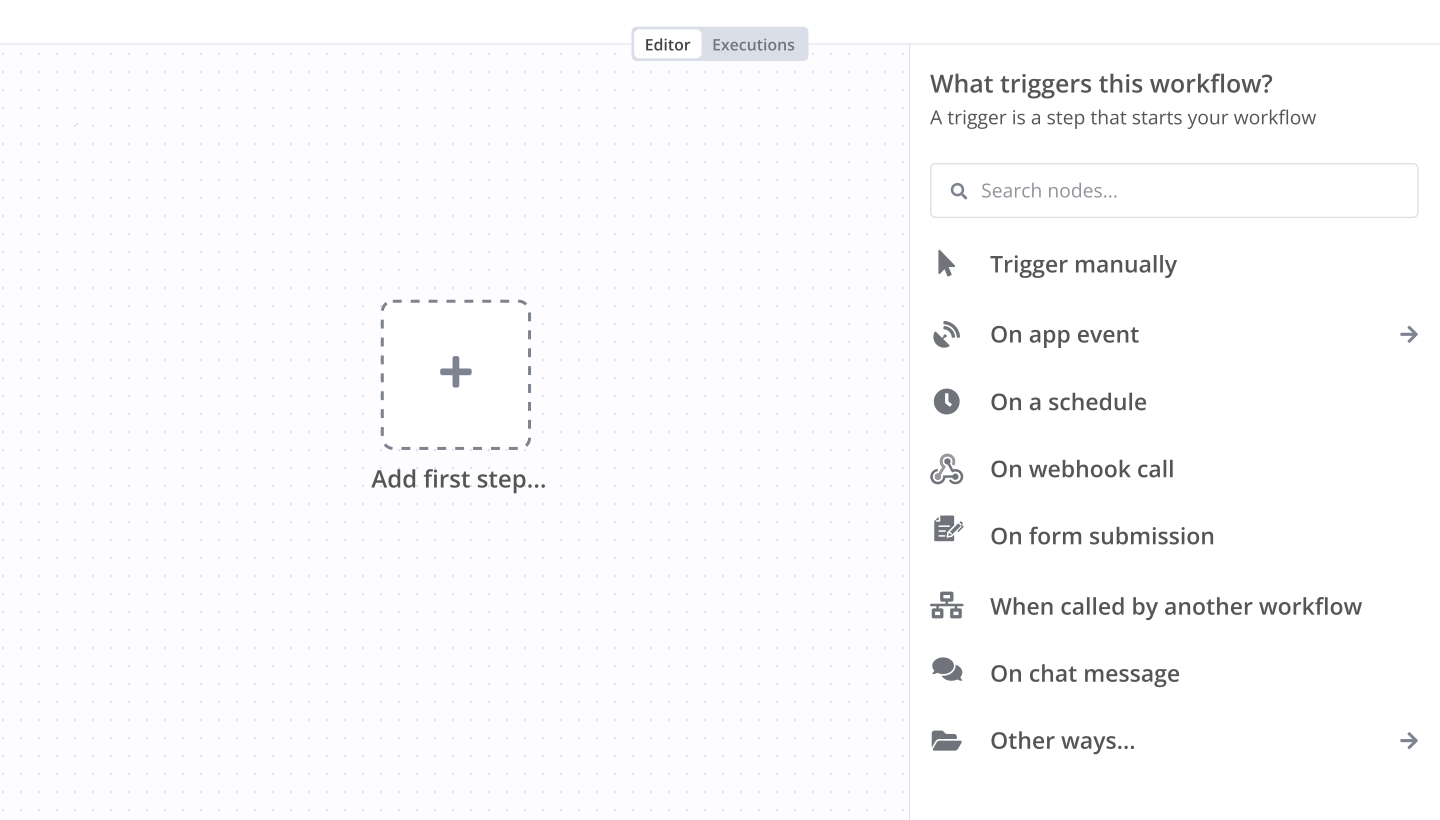
OpenAI and Spotify integration: Create a new workflow and add the first step

Step 2: Add and configure OpenAI and Spotify nodes

You can find OpenAI and Spotify in the nodes panel. Drag them onto your workflow canvas, selecting their actions. Click each node, choose a credential, and authenticate to grant n8n access. Configure OpenAI and Spotify nodes one by one: input data on the left, parameters in the middle, and output data on the right.

OpenAI and Spotify integration: Add and configure OpenAI and Spotify nodes

Step 3: Connect OpenAI and Spotify

A connection establishes a link between OpenAI and Spotify (or vice versa) to route data through the workflow. Data flows from the output of one node to the input of another. You can have single or multiple connections for each node.

OpenAI and Spotify integration: Connect OpenAI and Spotify

Step 4: Customize and extend your OpenAI and Spotify integration

Use n8n's core nodes such as If, Split Out, Merge, and others to transform and manipulate data. Write custom JavaScript or Python in the Code node and run it as a step in your workflow. Connect OpenAI and Spotify with any of n8n’s 1000+ integrations, and incorporate advanced AI logic into your workflows.

OpenAI and Spotify integration: Customize and extend your OpenAI and Spotify integration

Step 5: Test and activate your OpenAI and Spotify workflow

Save and run the workflow to see if everything works as expected. Based on your configuration, data should flow from OpenAI to Spotify or vice versa. Easily debug your workflow: you can check past executions to isolate and fix the mistake. Once you've tested everything, make sure to save your workflow and activate it.

OpenAI and Spotify integration: Test and activate your OpenAI and Spotify workflow

Telegram to Spotify with OpenAI

Search music and play to Spotify from Telegram

This workflow is a simple demonstration on accessing a message model from Telegram and it makes searching for songs an easy task even if you can't remember the artist or song name.
An OpenAI message model tries to figure out the song and sends it to an active Spotify device**.

Use case
Imagine an office where you play music in the background and the employees can control the music without having to login to the playing account.

How it works
You describe the song in Telegram.
Telegram bot sends the text to n8n.
An OpenAI message model tries to find the song.
Spotify gets the search query string.
First match is then added to queue.
-- If there is no match a message is sent to Telegram and the process ends.
We change to the next track in the list.
We make sure the song starts playing by trying to resume.
We fetch the currently playing track.
We return "now playing" information to Telegram: Song Name - Artist Name - Album Name.

Error handling
Every Spotify step has it's on error handler under settings where we output the error.
Message parser receives the error and sends it to Telegram.

Requirements
Active workflow*
OpenAI API key
Telegram bot
Spotify account and Oauth2 API
Spotify active on a device**

.* The Telegram trigger is activated only if this workflow is active. You can however TEST the workflow in the editor by clicking "Test step" and then it waits for the Telegram event. When event is received, just step through all steps or just clicking "Test step" on the "Fetch Now Playing" node.

.** You must have a Spotify device active when trying to communicate with a device. Open Spotify and play something - not it is active.

Nodes used in this workflow

Popular OpenAI and Spotify workflows

Create lyric posters from Spotify tracks with Musixmatch and OpenAI

Turn a song into a ready-to-hang poster, by using Musixmatch and AI This n8n workflow turns a song title and artist name into a gallery-ready poster by combining Musixmatch lyric intelligence with a tightly controlled AI art direction pipeline. At its core, Musixmatch is used to identify the correct song and retrieve official lyrics, which then drive a highly curated image-generation prompt and final poster artwork. What this workflow does Trigger via chat The workflow starts when a chat message is received. The user provides a song title and artist name. Identify the correct track with Musixmatch The Musixmatch “Match track by metadata” node is used to: Resolve ambiguities in song titles Confirm the correct track Retrieve a stable commontrack_id This ensures all downstream steps reference the correct song. Retrieve full lyrics from Musixmatch Using the confirmed commontrack_id, the Musixmatch lyrics endpoint fetches the official song lyrics. Lyrics are treated as authoritative source material for creative interpretation. AI Agent selects and interprets a lyric A dedicated AI Agent: Selects one single-line lyric (strictly enforced constraints) Analyzes its emotional and thematic meaning Interprets mood, tension, and implied narrative The lyric becomes the conceptual anchor of the poster. AI Agent constructs a high-fidelity image prompt The agent outputs a fully structured, production-ready image-generation prompt including: Song metadata (reference only) Emotional interpretation Visual style choice Composition and layout rules Typography and legibility constraints Quality and design guardrails No drafts, explanations, or partial output are allowed. Generate the final poster image The completed prompt is passed directly to the image generation node. The result is a high-resolution, A4 portrait poster designed to feel intentional, modern, and gallery-ready. Output A single poster image (1024×1536, A4 portrait ratio) Features: One carefully chosen lyric line Clean, modern typography High-end contemporary poster design Subtle film grain Fully legible text and metadata Requirements Musixmatch API credentials** Track matching and lyric retrieval OpenAI API credentials** Language model for creative direction Image model for poster generation Use cases Creating lyric posters for personal collections Album or song promotion visuals Editorial or social media artwork Print-ready music-inspired posters Exploring visual interpretations of song lyrics

Personalized Taiwan Indie Music Recommendations with AI, Star Sign & Weather via Spotify

This n8n workflow recommends Taiwan indie music based on a user's city, mood, birthday, today's weather, and star sign. Here's a concise overview: Trigger: Starts manually with the "When clicking ‘Test workflow’" node. Input Setup: The "infomation" node sets user inputs (e.g., city: Taipei, mood: Happy, birthday: 1996/11/21). Song Recommendation: The "get song recommendation" node uses OpenAI's GPT-4o-mini to: Fetch today's weather for the specified city. Determine the user's zodiac sign from their birthday. Check the zodiac sign's daily fortune. Recommend a Taiwan indie song considering weather and fortune. Explain the song choice and highlight its features. Return results in JSON format. Data Extraction: The "Information Extractor" node parses the JSON output, extracting fields like date, city, weather, zodiac sign, fortune, song, artist, and additional info. Spotify Search: The "Spotify" node searches for the recommended song using the artist and song name, retrieving a Spotify URL. Final Output: The "Final Output" node compiles all data, including the Spotify link, into a structured format. Additional Note: A "Sticky Note" provides context about the workflow's purpose and credits the creator, n8nguide. This workflow integrates AI, weather data, astrology, and Spotify to deliver personalized Taiwan indie music recommendations.

Turn NASA Astronomy Pictures into Matching Spotify Tracks using GPT-4o Vision

Who is this for Space Enthusiasts & Music Lovers**: Discover new music paired with stunning cosmic visuals. Community Managers**: specific Slack channels with engaging, creative daily content. n8n Learners**: Learn how to chain Image Analysis (Vision), Logic, and API integrations (Spotify/Slack). How it works Schedule: The workflow runs every night at 10 PM. Mood Logic: It checks the day of the week to adjust the energy level (e.g., higher energy for Friday nights, calmer vibes for Mondays). Visual Analysis: OpenAI (GPT-4o) analyzes the NASA APOD image to determine its color palette, mood, and subject matter, converting these into musical parameters (Valence, Energy). Curation: Spotify searches for a track that matches these specific parameters. Creative Writing: OpenAI generates a short poem or caption linking the image to the song. Delivery: The image, track link, and poem are posted to Slack, and the track is automatically saved to a designated Spotify Playlist. Requirements NASA API Key** (Free) OpenAI API Key** (Must have access to GPT-4o model) Spotify Developer Credentials** (Client ID and Client Secret) Slack** Workspace and Bot Token How to set up Set up your credentials for NASA, OpenAI, Spotify, and Slack in n8n. Create a specific Playlist in Spotify and copy its Playlist ID. Copy the Channel ID from the Slack channel where you want to post. Paste these IDs into the respective nodes (marked with <PLACEHOLDER>) or use the Set Fields node to manage them globally.

Telegram to Spotify with OpenAI

Search music and play to Spotify from Telegram This workflow is a simple demonstration on accessing a message model from Telegram and it makes searching for songs an easy task even if you can't remember the artist or song name. An OpenAI message model tries to figure out the song and sends it to an active Spotify device**. Use case Imagine an office where you play music in the background and the employees can control the music without having to login to the playing account. How it works You describe the song in Telegram. Telegram bot sends the text to n8n. An OpenAI message model tries to find the song. Spotify gets the search query string. First match is then added to queue. -- If there is no match a message is sent to Telegram and the process ends. We change to the next track in the list. We make sure the song starts playing by trying to resume. We fetch the currently playing track. We return "now playing" information to Telegram: Song Name - Artist Name - Album Name. Error handling Every Spotify step has it's on error handler under settings where we output the error. Message parser receives the error and sends it to Telegram. Requirements Active workflow* OpenAI API key Telegram bot Spotify account and Oauth2 API Spotify active on a device** .* The Telegram trigger is activated only if this workflow is active. You can however TEST the workflow in the editor by clicking "Test step" and then it waits for the Telegram event. When event is received, just step through all steps or just clicking "Test step" on the "Fetch Now Playing" node. .** You must have a Spotify device active when trying to communicate with a device. Open Spotify and play something - not it is active.

Build your own OpenAI and Spotify integration

Create custom OpenAI and Spotify workflows by choosing triggers and actions. Nodes come with global operations and settings, as well as app-specific parameters that can be configured. You can also use the HTTP Request node to query data from any app or service with a REST API.

OpenAI supported actions

Message a Model
Generate a model response with GPT 3, 4, 5, etc. using Responses API
Classify Text for Violations
Check whether content complies with usage policies
Analyze Image
Take in images and answer questions about them
Generate an Image
Creates an image from a text prompt
Edit Image
Edit an image
Generate Audio
Creates audio from a text prompt
Transcribe a Recording
Transcribes audio into text
Translate a Recording
Translates audio into text in English
Delete a File
Delete a file from the server
List Files
Returns a list of files that belong to the user's organization
Upload a File
Upload a file that can be used across various endpoints
Create
Create a conversation
Get
Get a conversation
Remove
Remove a conversation
Update
Update a conversation
Generate
Creates a video from a text prompt

Spotify supported actions

Get
Get an album by URI or ID
Get New Releases
Get a list of new album releases
Get Tracks
Get an album's tracks by URI or ID
Search
Search albums by keyword
Get
Get an artist by URI or ID
Get Albums
Get an artist's albums by URI or ID
Get Related Artists
Get an artist's related artists by URI or ID
Get Top Tracks
Get an artist's top tracks by URI or ID
Search
Search artists by keyword
Get Liked Tracks
Get the user's liked tracks
Get Following Artists
Get your followed artists
Add Song to Queue
Add a song to your queue
Currently Playing
Get your currently playing track
Next Song
Skip to your next track
Pause
Pause your music
Previous Song
Skip to your previous song
Recently Played
Get your recently played tracks
Resume
Resume playback on the current active device
Set Volume
Set volume on the current active device
Start Music
Start playing a playlist, artist, or album
Add an Item
Add tracks to a playlist by track and playlist URI or ID
Create a Playlist
Create a new playlist
Get
Get a playlist by URI or ID
Get the User's Playlists
Get a user's playlists
Get Tracks
Get a playlist's tracks by URI or ID
Remove an Item
Remove tracks from a playlist by track and playlist URI or ID
Search
Search playlists by keyword
Get
Get a track by its URI or ID
Get Audio Features
Get audio features for a track by URI or ID
Search
Search tracks by keyword

OpenAI and Spotify integration details

FAQs

  • Can OpenAI connect with Spotify?

  • Can I use OpenAI’s API with n8n?

  • Can I use Spotify’s API with n8n?

  • Is n8n secure for integrating OpenAI and Spotify?

  • How to get started with OpenAI and Spotify integration in n8n.io?

Need help setting up your OpenAI and Spotify integration?

Discover our latest community's recommendations and join the discussions about OpenAI and Spotify integration.
Artem
sérgio eduardo floresta filho
Andrew adawdad
PinkFloyd
Steve Warburton

Looking to integrate OpenAI and Spotify in your company?

Over 3000 companies switch to n8n every single week

Why use n8n to integrate OpenAI with Spotify

Build complex workflows, really fast

Build complex workflows, really fast

Handle branching, merging and iteration easily.
Pause your workflow to wait for external events.

Code when you need it, UI when you don't

Simple debugging

Your data is displayed alongside your settings, making edge cases easy to track down.

Use templates to get started fast

Use 1000+ workflow templates available from our core team and our community.

Reuse your work

Copy and paste, easily import and export workflows.

Implement complex processes faster with n8n

red iconyellow iconred iconyellow icon