Back to Integrations
integrationShopify node
integrationStripe node

Shopify and Stripe integration

Save yourself the work of writing custom integrations for Shopify and Stripe and use n8n instead. Build adaptable and scalable Sales, and Finance & Accounting workflows that work with your technology stack. All within a building experience you will love.

How to connect Shopify and Stripe

  • Step 1: Create a new workflow
  • Step 2: Add and configure nodes
  • Step 3: Connect
  • Step 4: Customize and extend your integration
  • Step 5: Test and activate your workflow

Step 1: Create a new workflow and add the first step

In n8n, click the "Add workflow" button in the Workflows tab to create a new workflow. Add the starting point – a trigger on when your workflow should run: an app event, a schedule, a webhook call, another workflow, an AI chat, or a manual trigger. Sometimes, the HTTP Request node might already serve as your starting point.
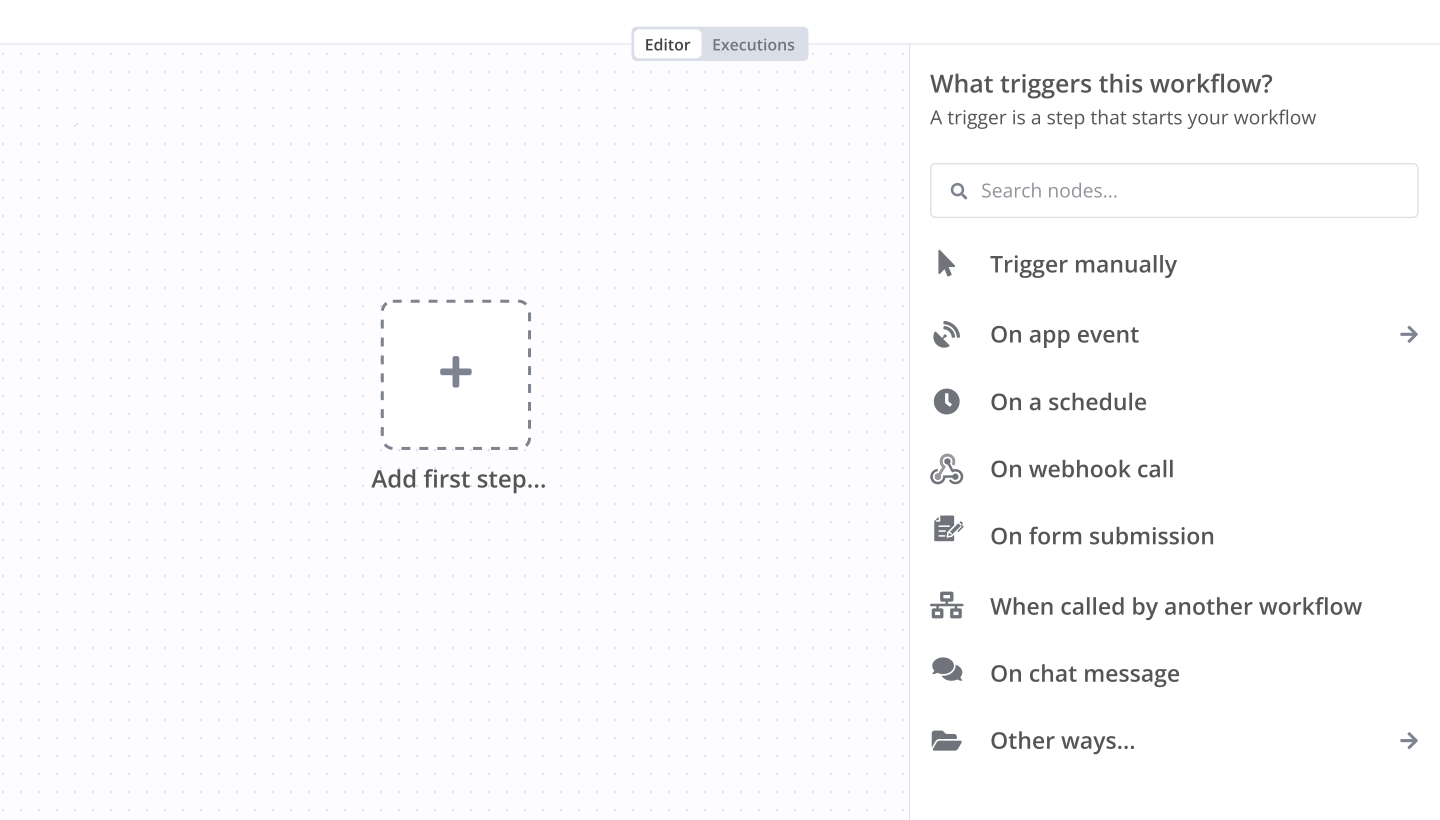
Shopify and Stripe integration: Create a new workflow and add the first step

Step 2: Add and configure Shopify and Stripe nodes

You can find Shopify and Stripe in the nodes panel. Drag them onto your workflow canvas, selecting their actions. Click each node, choose a credential, and authenticate to grant n8n access. Configure Shopify and Stripe nodes one by one: input data on the left, parameters in the middle, and output data on the right.

Shopify and Stripe integration: Add and configure Shopify and Stripe nodes

Step 3: Connect Shopify and Stripe

A connection establishes a link between Shopify and Stripe (or vice versa) to route data through the workflow. Data flows from the output of one node to the input of another. You can have single or multiple connections for each node.

Shopify and Stripe integration: Connect Shopify and Stripe

Step 4: Customize and extend your Shopify and Stripe integration

Use n8n's core nodes such as If, Split Out, Merge, and others to transform and manipulate data. Write custom JavaScript or Python in the Code node and run it as a step in your workflow. Connect Shopify and Stripe with any of n8n’s 1000+ integrations, and incorporate advanced AI logic into your workflows.

Shopify and Stripe integration: Customize and extend your Shopify and Stripe integration

Step 5: Test and activate your Shopify and Stripe workflow

Save and run the workflow to see if everything works as expected. Based on your configuration, data should flow from Shopify to Stripe or vice versa. Easily debug your workflow: you can check past executions to isolate and fix the mistake. Once you've tested everything, make sure to save your workflow and activate it.

Shopify and Stripe integration: Test and activate your Shopify and Stripe workflow

Monitor agency profitability with Facebook Ads, Shopify, Stripe, Clockify, Google Sheets, Slack and Gemini

Overview
Stop guessing your agency's actual margins. This workflow acts as a centralized financial brain for digital marketing agencies. It aggregates real-time data from your time-tracking, ad platforms, and payment processors to calculate precise profitability metrics (Gross Profit, Net Margin, ROAS, and Efficiency).

It doesn't just crunch numbers; it uses Google Gemini to act as a virtual CFO, analyzing the data and sending an executive summary to Slack with actionable insights, while simultaneously archiving the data to Google Sheets for historical trending.

Key Features
Multi-Source Aggregation: Pulls data from Facebook Ads, Google Ads, Shopify, Stripe, and Clockify.

Smart Cost Allocation: Automatically calculates overhead (default 30%) and software costs against your gross revenue.

AI Analysis: Uses Google Gemini to review the calculated metrics and draft a "Human-readable" executive summary for Slack.

Dual Output: Sends instant alerts to Slack and logs granular data to Google Sheets.

How to Setup

  1. Configure Credentials
    Ensure you have authenticated credentials for:

Clockify

Stripe & Shopify

Facebook Marketing API & Google Ads

Google Sheets & Google Gemini (PaLM)

Slack

  1. Prepare Google Sheet
    Create a new Google Sheet with the following headers in Row 1:
    timestamp, date, totalRevenue, totalAdSpend, facebookAdSpend, googleAdSpend, totalTimeCost, grossProfit, profitMargin, roas.

  2. Adjust Logic Configuration
    Open the "Code in JavaScript" node. At the very top, you will see a CONFIG object. Edit these values to match your agency's model:

const CONFIG = {
platformFeeRate: 0.029, // Stripe/Shopify fees
monthlySoftwareCosts: 500, // Fixed monthly SaaS costs
overheadRate: 0.30, // Overhead % (rent, admin, etc)
minProfitMargin: 20 // Target margin %
};

  1. Remove Mock Data
    The template includes "Set" nodes with mock data for testing purposes. Simply bypass these nodes and connect the API nodes directly to the "Merge" node when you are ready to go live.

Nodes used in this workflow

Popular Shopify and Stripe workflows

+5

Monitor agency profitability with Facebook Ads, Shopify, Stripe, Clockify, Google Sheets, Slack and Gemini

Overview Stop guessing your agency's actual margins. This workflow acts as a centralized financial brain for digital marketing agencies. It aggregates real-time data from your time-tracking, ad platforms, and payment processors to calculate precise profitability metrics (Gross Profit, Net Margin, ROAS, and Efficiency). It doesn't just crunch numbers; it uses Google Gemini to act as a virtual CFO, analyzing the data and sending an executive summary to Slack with actionable insights, while simultaneously archiving the data to Google Sheets for historical trending. Key Features Multi-Source Aggregation: Pulls data from Facebook Ads, Google Ads, Shopify, Stripe, and Clockify. Smart Cost Allocation: Automatically calculates overhead (default 30%) and software costs against your gross revenue. AI Analysis: Uses Google Gemini to review the calculated metrics and draft a "Human-readable" executive summary for Slack. Dual Output: Sends instant alerts to Slack and logs granular data to Google Sheets. How to Setup Configure Credentials Ensure you have authenticated credentials for: Clockify Stripe & Shopify Facebook Marketing API & Google Ads Google Sheets & Google Gemini (PaLM) Slack Prepare Google Sheet Create a new Google Sheet with the following headers in Row 1: timestamp, date, totalRevenue, totalAdSpend, facebookAdSpend, googleAdSpend, totalTimeCost, grossProfit, profitMargin, roas. Adjust Logic Configuration Open the "Code in JavaScript" node. At the very top, you will see a CONFIG object. Edit these values to match your agency's model: const CONFIG = { platformFeeRate: 0.029, // Stripe/Shopify fees monthlySoftwareCosts: 500, // Fixed monthly SaaS costs overheadRate: 0.30, // Overhead % (rent, admin, etc) minProfitMargin: 20 // Target margin % }; Remove Mock Data The template includes "Set" nodes with mock data for testing purposes. Simply bypass these nodes and connect the API nodes directly to the "Merge" node when you are ready to go live.
+5

Consolidate Stripe, PayPal, Shopify and bank revenue and prepare tax filings with OpenAI

How It Works Consolidates daily revenue from Stripe, PayPal, Shopify, and bank feeds into a single system. The workflow automatically normalizes data across payment sources, uses AI to categorize income transactions, calculates reporting-period totals, and generates tax-compliant CSV and XML submissions. Designed for e-commerce businesses, SaaS companies, and multi-channel retailers managing complex revenue streams, it eliminates manual reconciliation, reduces filing errors, and speeds up financial reporting by automating the entire pipeline from data collection to government submission. Setup Steps Connect Stripe/PayPal/Shopify accounts with API keys to respective nodes. Configure bank feed authentication Set OpenAI credentials for AI Income Categorizer node. Link Google Drive and Gmail Add government tax API endpoint and authentication credentials. Prerequisites Stripe, PayPal, Shopify, or bank APIs; OpenAI account; Google Workspace; Use Cases Quarterly tax preparation for e-commerce; multi-channel revenue reconciliation; Customization Modify normalization rules per jurisdiction; add expense categories to AI prompt; Benefits Eliminates manual reconciliation; reduces tax filing time by 80%; improves accuracy;
+5

Automated Tax Filing with Multi-Platform Revenue Analysis using GPT-4

How It Works This workflow automates monthly revenue aggregation from multiple financial sources, including Stripe, PayPal, Shopify, and bank feeds, while delivering intelligent tax forecasting through GPT-4–based structured analysis. It systematically retrieves revenue data, consolidates disparate datasets into a unified view, and applies GPT-4 to predict upcoming tax obligations with greater accuracy. The system then generates clearly formatted, audit-ready reports and automatically distributes tax projections to designated agents via Gmail, while securely storing all outputs in Google Sheets to maintain traceable audit trails. Designed for tax professionals, accounting firms, and finance teams, it enables accurate predictive tax planning and supports a proactive compliance strategy without the need for manual calculations or spreadsheet-driven analysis. Setup Steps Connect Stripe, PayPal, Shopify credentials via n8n authentication. Configure OpenAI GPT-4 API key for structured tax analysis. Connect Gmail account for report distribution and Google Sheets. Set monthly trigger schedule and customize tax category rules. Prerequisites Stripe, PayPal, Shopify, or bank feed accounts; OpenAI API key; Gmail account; Google Sheets. Use Cases Accounting firms automating quarterly tax prep for multiple clients Customization Modify revenue sources, adjust GPT-4 prompts for specific tax scenarios Benefits Eliminates manual tax calculations, reduces forecasting errors

Build your own Shopify and Stripe integration

Create custom Shopify and Stripe workflows by choosing triggers and actions. Nodes come with global operations and settings, as well as app-specific parameters that can be configured. You can also use the HTTP Request node to query data from any app or service with a REST API.

Shopify supported actions

Create
Create an order
Delete
Delete an order
Get
Get an order
Get Many
Get many orders
Update
Update an order
Create
Create a product
Delete
Delete a product
Get
Get a product
Get Many
Get many products
Update
Update a product

Stripe supported actions

Get
Get a balance
Create
Create a charge
Get
Get a charge
Get Many
Get many charges
Update
Update a charge
Create
Create a coupon
Get Many
Get many coupons
Create
Create a customer
Delete
Delete a customer
Get
Get a customer
Get Many
Get many customers
Update
Update a customer
Add
Add a customer card
Get
Get a customer card
Remove
Remove a customer card
Create
Create a meter event
Create
Create a source
Delete
Delete a source
Get
Get a source
Create
Create a token

FAQs

  • Can Shopify connect with Stripe?

  • Can I use Shopify’s API with n8n?

  • Can I use Stripe’s API with n8n?

  • Is n8n secure for integrating Shopify and Stripe?

  • How to get started with Shopify and Stripe integration in n8n.io?

Need help setting up your Shopify and Stripe integration?

Discover our latest community's recommendations and join the discussions about Shopify and Stripe integration.
Driss Talainte
Adriano Cantele

Looking to integrate Shopify and Stripe in your company?

Over 3000 companies switch to n8n every single week

Why use n8n to integrate Shopify with Stripe

Build complex workflows, really fast

Build complex workflows, really fast

Handle branching, merging and iteration easily.
Pause your workflow to wait for external events.

Code when you need it, UI when you don't

Simple debugging

Your data is displayed alongside your settings, making edge cases easy to track down.

Use templates to get started fast

Use 1000+ workflow templates available from our core team and our community.

Reuse your work

Copy and paste, easily import and export workflows.

Implement complex processes faster with n8n

red iconyellow iconred iconyellow icon