Back to Integrations
integrationWebhook node
integrationBaserow node

Webhook and Baserow integration

Save yourself the work of writing custom integrations for Webhook and Baserow and use n8n instead. Build adaptable and scalable Development, Core Nodes, and Data & Storage workflows that work with your technology stack. All within a building experience you will love.

How to connect Webhook and Baserow

  • Step 1: Create a new workflow
  • Step 2: Add and configure nodes
  • Step 3: Connect
  • Step 4: Customize and extend your integration
  • Step 5: Test and activate your workflow

Step 1: Create a new workflow and add the first step

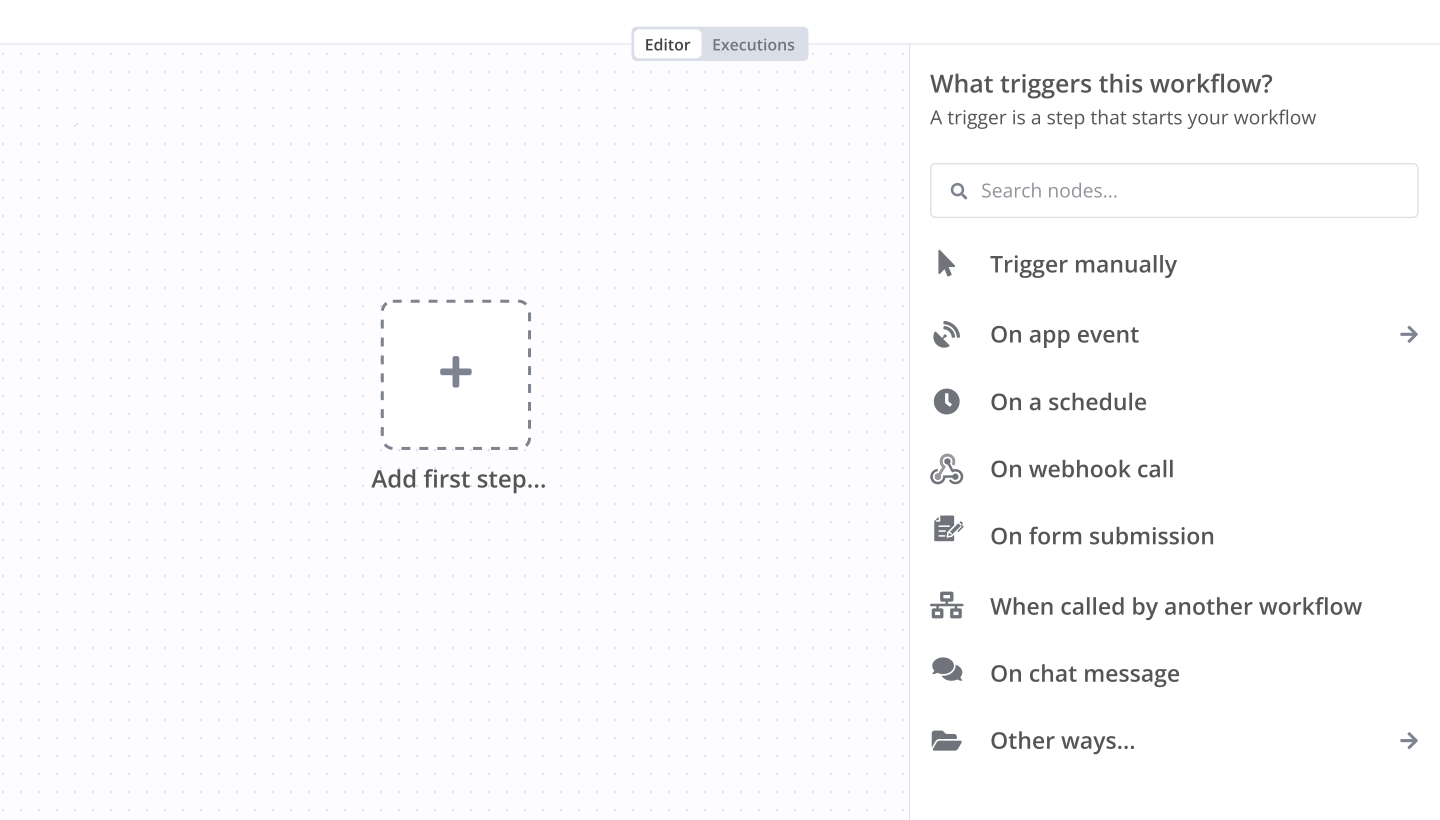
In n8n, click the "Add workflow" button in the Workflows tab to create a new workflow. Add the starting point – a trigger on when your workflow should run: an app event, a schedule, a webhook call, another workflow, an AI chat, or a manual trigger. Sometimes, the HTTP Request node might already serve as your starting point.

Webhook and Baserow integration: Create a new workflow and add the first step

Step 2: Add and configure Webhook and Baserow nodes

You can find Webhook and Baserow in the nodes panel. Drag them onto your workflow canvas, selecting their actions. Click each node, choose a credential, and authenticate to grant n8n access. Configure Webhook and Baserow nodes one by one: input data on the left, parameters in the middle, and output data on the right.

Webhook and Baserow integration: Add and configure Webhook and Baserow nodes

Step 3: Connect Webhook and Baserow

A connection establishes a link between Webhook and Baserow (or vice versa) to route data through the workflow. Data flows from the output of one node to the input of another. You can have single or multiple connections for each node.

Webhook and Baserow integration: Connect Webhook and Baserow

Step 4: Customize and extend your Webhook and Baserow integration

Use n8n's core nodes such as If, Split Out, Merge, and others to transform and manipulate data. Write custom JavaScript or Python in the Code node and run it as a step in your workflow. Connect Webhook and Baserow with any of n8n’s 1000+ integrations, and incorporate advanced AI logic into your workflows.

Webhook and Baserow integration: Customize and extend your Webhook and Baserow integration

Step 5: Test and activate your Webhook and Baserow workflow

Save and run the workflow to see if everything works as expected. Based on your configuration, data should flow from Webhook to Baserow or vice versa. Easily debug your workflow: you can check past executions to isolate and fix the mistake. Once you've tested everything, make sure to save your workflow and activate it.

Webhook and Baserow integration: Test and activate your Webhook and Baserow workflow

All-in-one Telegram/Baserow AI assistant 🤖🧠 Voice/Photo/Save notes/Long term mem

Telegram Personal Assistant with Long-Term Memory & Note-Taking

This n8n workflow transforms your Telegram bot into a powerful personal assistant that handles voice, photo, and text messages. The assistant uses AI to interpret messages, save important details as long-term memories or notes in a Baserow database, and recall information for future interactions.

🌟 How It Works

Message Reception & Routing
Telegram Integration: The workflow is triggered by incoming messages on your Telegram bot.
Dynamic Routing: A switch node inspects the message to determine whether it's voice, text, or photo (with captions) and routes it for the appropriate processing.

Content Processing
Voice Messages: Audio files are retrieved and sent to an AI transcription node to convert spoken words into text.
Text Messages: Text is directly captured and prepared for analysis.
Photos: If an image is received, the bot fetches the file (and caption, if provided) and uses an AI-powered image analysis node to extract relevant details.

AI-Powered Agent & Memory Management
The core AI agent (powered by GPT-4o-mini) processes the incoming message along with any previous conversation history stored in PostgreSQL memory buffers.
Long-Term Memory: When a message contains personal or noteworthy information, the assistant uses a dedicated tool to save this data as a long-term memory in Baserow.
Note-Taking: For specific instructions or reminders, the assistant saves concise notes in a separate Baserow table.
The AI agent follows defined rules to decide which details are saved as memories and which are saved as notes.

Response Generation
After processing the message and updating memory/notes as needed, the AI agent crafts a contextual and personalized response.
The response is sent back to the user via Telegram, ensuring smooth and natural conversation flow.

🚀 Key Features

Multimodal Input:**
Seamlessly handles voice, photo (with captions), and text messages.

Long-Term Memory & Note-Taking:**
Uses a Baserow database to store personal details and notes, enhancing conversational context over time.

AI-Driven Contextual Responses:**
Leverages an AI agent to generate personalized, context-aware replies based on current input and past interactions.

User Security & Validation:**
Incorporates validation steps to verify the user's Telegram ID before processing, ensuring secure and personalized interactions.

Easy Baserow Setup:**
Comes with a clear setup guide and sample configurations to quickly integrate Baserow for managing memories and notes.

🔧 Setup Guide

Telegram Bot Setup:
Create your bot via BotFather and obtain the Bot Token.
Configure the Telegram webhook in n8n with your bot's token and URL.

Baserow Database Configuration:
Memory Table:
Create a workspace titled "Memories and Notes".
Set up a table (e.g., "Memory Table") with at least two fields:
Memory (long text)
Date Added (US date format with time)
Notes Table:
Duplicate the Memory Table and rename it to "Notes Table".
Change the first field's name from "Memory" to "Notes".

n8n Workflow Import & Configuration:
Import the workflow JSON into your n8n instance.
Update credentials for Telegram, Baserow, OpenAI, and PostgreSQL (for memory buffering) as needed.
Adjust node settings if you need to customize AI agent prompts or memory management rules.

Testing & Deployment:
Test your bot by sending various message types (text, voice, photo) to confirm that the workflow processes them correctly, updates Baserow, and returns the appropriate response.
Monitor logs to ensure that memory and note entries are correctly stored and retrieved.

✨ Example Interactions

Voice Message Processing:**
User sends a voice note requesting a reminder.
Bot Response: "Thanks for your message! I've noted your reminder and saved it for future reference."

Photo with Caption:**
User sends a photo with the caption "Save this recipe for dinner ideas."
Bot Response: "Got it! I've saved this recipe along with the caption for you."

Text Message for Memory Saving:**
User: "I love hiking on weekends."
Bot Response: "Noted! I’ll remember your interest in hiking."

Retrieving Information:**
User asks: "What notes do I have?"
Bot Response: "Here are your latest notes: [list of saved notes]."

🛠️ Resources & Next Steps

Telegram Bot Configuration:** Telegram BotFather Guide
n8n Documentation:** n8n Docs
Community Forums:** Join discussions and share your customizations!

This workflow not only streamlines message processing but also empowers users with a personal AI assistant that remembers details over time. Customize the rules and responses further to fit your unique requirements and enjoy a more engaging, intelligent conversation experience on Telegram!

Nodes used in this workflow

Popular Webhook and Baserow workflows

Create AI Videos with OpenAI Scripts, Leonardo Images & HeyGen Avatars

Short Content Automation 🎬 (AI Video System with Bulk Gen, Avatar & Music Customization) Overview 🎯 The "Short Content" automation is a powerful, all-in-one solution designed to streamline the creation of short videos for social media, marketing, or personal projects. Leveraging cutting-edge AI tools and seamless workflows, this automation handles everything from scriptwriting to video assembly—saving time and effort while delivering professional results. Best Short Content AI System - Watch Video Problem 🛠️ Creating short videos manually is time-consuming and expensive. Businesses and creators struggle with: Hiring writers, designers, and editors. Juggling multiple tools for scripts, visuals, and editing. Inconsistent quality and slow turnaround times. This automation solves these challenges with a fully AI-driven, one-click workflow. Solution ✅ A no-code, end-to-end automation that: Writes scripts using AI (LLM) or manual input. Generates visuals (Leonardo AI) or acting scenes (RunwayML). Edits and assembles videos (JSON2Video). Generates avatars using HeyGen or Captions.ai. Tracks progress and analytics in Baserow. 🔥 Result: High-quality short videos in minutes, not days—with zero manual effort. Setup ⚙️ (4–8 minutes) Upload Blueprint to N8N Import the provided JSON workflow into your N8N instance. Upload Database to Baserow (Free) Follow the setup video step-by-step. How It Works 🌟 Start with a Pre-Built Form Fill in the included Baserow form with your video requirements. Generate Videos Instantly Single Video Mode: Run one video at a time for quick results. Bulk Mode: Upload a CSV or use Baserow to queue unlimited videos—perfect for scaling content. Workflow Handles the Rest Manage & Iterate Track all videos in Baserow: Edit inputs, retry failed jobs, or adjust styles anytime. What’s Included 📦 ✅ Baserow Template: Pre-configured database. ✅ N8N JSON Blueprint: Ready-to-use workflow. ✅ Step-by-Step Video Guides: Setup & usage instructions. Customization 🎨 🔧 Video Generation Customization Script Options**: Auto-generate using AI or write manually. Captions**: Customize type, color, and style. Video Types**: Storytelling, trends, educational, etc. Audio**: Add background music easily. Avatars**: Switch between HeyGen and Captions.ai. Adjust size, position, voice, and appearance. ⚙️ System Customization N8N Workflow**: Easily customizable for new integrations, prompts, and logic. Baserow Database**: Modify options or add new ones to match your workflow. 🌐 Explore more workflows ❤️ Buy more workflows at: adamcrafts 🦾 Custom workflows at: [email protected] > Build once, customize endlessly, and scale your video content like never before. 🚀
+2

All-in-One Telegram/Baserow AI Assistant 🤖🧠 Voice/Photo/Save Notes/Long Term Mem

Telegram Personal Assistant with Long-Term Memory & Note-Taking This n8n workflow transforms your Telegram bot into a powerful personal assistant that handles voice, photo, and text messages. The assistant uses AI to interpret messages, save important details as long-term memories or notes in a Baserow database, and recall information for future interactions. 🌟 How It Works Message Reception & Routing Telegram Integration: The workflow is triggered by incoming messages on your Telegram bot. Dynamic Routing: A switch node inspects the message to determine whether it's voice, text, or photo (with captions) and routes it for the appropriate processing. Content Processing Voice Messages: Audio files are retrieved and sent to an AI transcription node to convert spoken words into text. Text Messages: Text is directly captured and prepared for analysis. Photos: If an image is received, the bot fetches the file (and caption, if provided) and uses an AI-powered image analysis node to extract relevant details. AI-Powered Agent & Memory Management The core AI agent (powered by GPT-4o-mini) processes the incoming message along with any previous conversation history stored in PostgreSQL memory buffers. Long-Term Memory: When a message contains personal or noteworthy information, the assistant uses a dedicated tool to save this data as a long-term memory in Baserow. Note-Taking: For specific instructions or reminders, the assistant saves concise notes in a separate Baserow table. The AI agent follows defined rules to decide which details are saved as memories and which are saved as notes. Response Generation After processing the message and updating memory/notes as needed, the AI agent crafts a contextual and personalized response. The response is sent back to the user via Telegram, ensuring smooth and natural conversation flow. 🚀 Key Features Multimodal Input:** Seamlessly handles voice, photo (with captions), and text messages. Long-Term Memory & Note-Taking:** Uses a Baserow database to store personal details and notes, enhancing conversational context over time. AI-Driven Contextual Responses:** Leverages an AI agent to generate personalized, context-aware replies based on current input and past interactions. User Security & Validation:** Incorporates validation steps to verify the user's Telegram ID before processing, ensuring secure and personalized interactions. Easy Baserow Setup:** Comes with a clear setup guide and sample configurations to quickly integrate Baserow for managing memories and notes. 🔧 Setup Guide Telegram Bot Setup: Create your bot via BotFather and obtain the Bot Token. Configure the Telegram webhook in n8n with your bot's token and URL. Baserow Database Configuration: Memory Table: Create a workspace titled "Memories and Notes". Set up a table (e.g., "Memory Table") with at least two fields: Memory (long text) Date Added (US date format with time) Notes Table: Duplicate the Memory Table and rename it to "Notes Table". Change the first field's name from "Memory" to "Notes". n8n Workflow Import & Configuration: Import the workflow JSON into your n8n instance. Update credentials for Telegram, Baserow, OpenAI, and PostgreSQL (for memory buffering) as needed. Adjust node settings if you need to customize AI agent prompts or memory management rules. Testing & Deployment: Test your bot by sending various message types (text, voice, photo) to confirm that the workflow processes them correctly, updates Baserow, and returns the appropriate response. Monitor logs to ensure that memory and note entries are correctly stored and retrieved. ✨ Example Interactions Voice Message Processing:** User sends a voice note requesting a reminder. Bot Response: "Thanks for your message! I've noted your reminder and saved it for future reference." Photo with Caption:** User sends a photo with the caption "Save this recipe for dinner ideas." Bot Response: "Got it! I've saved this recipe along with the caption for you." Text Message for Memory Saving:** User: "I love hiking on weekends." Bot Response: "Noted! I’ll remember your interest in hiking." Retrieving Information:** User asks: "What notes do I have?" Bot Response: "Here are your latest notes: [list of saved notes]." 🛠️ Resources & Next Steps Telegram Bot Configuration:** Telegram BotFather Guide n8n Documentation:** n8n Docs Community Forums:** Join discussions and share your customizations! This workflow not only streamlines message processing but also empowers users with a personal AI assistant that remembers details over time. Customize the rules and responses further to fit your unique requirements and enjoy a more engaging, intelligent conversation experience on Telegram!

Create AI Videos with Scripts, Images & HeyGen Avatars (🔥 LIMITED-TIME OFFER)

Short Content Automation 🎬 (AI Video System with Bulk Gen, Avatar & Music Customization) 🔥 LIMITED-TIME OFFER: AI Video Automation (Previously \$59) Previously Template 🚀 Transform Your Content Game in Minutes – Save Hours of Work! Introducing a powerful AI Video System to automate short video creation — from scriptwriting to avatar + image generation, music, and assembly — all with n8n. This is not a basic template. It's a complete, customizable system with step-by-step videos and my personal enhancements. 🎁 Why $10 Now? (Regular Price: \$59) ✅ Over 4000 people viewed my original automation — see it here — and I receive many messages from people who want it. ✅ I learned n8n from free templates and I want to give back. ✅ People asking for a more accessible price — this is my answer. ⏳ Limited-Time Deal: 7 Days Only! After that, this price goes away and the blueprint will be unlisted. 📦 What You Get ✅ Full n8n Workflow: From text prompt → ready-to-publish short video ✅ AI Tools Integration: OpenAI, Leonardo.AI, HeyGen, etc. ✅ Customization Options: Avatar, Voice, Music, Style ✅ Video Setup Guide: Step-by-step walkthrough ✅ Clean UI, easy-to-use, even if you're not a developer 💬 Made With Love by an n8n Creator This system is based on months of refinement and feedback from users like you. Now it’s your turn to scale your content, automate your work, and stand out. 💵 Only $10 – Let’s Build Together. > 📌 Get it now. Use it forever. No subscriptions. Just value.

Automated Task Generation from Blueprints with Baserow & Weekend-Aware Scheduling

This n8n template demonstrates how to automatically create tasks (or in general, records) in Baserow based on template or blueprint tables. The first blueprint table is the master table that holds the general information about the template. For example: a standard procedure to handle incidents. The second table is the details table that holds multiple records for the template. Each record in that table is a specific task that needs to be assigned to someone with a certain deadline. This makes it easy to streamline task creation for recurring processes. Use cases are many: Project management (generate tasks for employees based on a project template) HR & onboarding (generate tasks for employee onboarding based on a template) Operations (create checklists for maintenance, audits, or recurring procedures) Good to know The Baserow template for handling Standard Operating Procedures works perfect as a base schema to try out this workflow. Authentication is done through a database token. Check the documentation on how to create such a token. Tasks are inserted using the HTTP request node instead of a dedicated Baserow node. This is to support batch import instead of importing records one by one. Requirements Baserow account (cloud or self-hosted) A Baserow database with at least the following tables: Assignee / employee table. This is required to be able to assign someone to a task. Master table with procedure or template information. This is required to be able to select a certain template Details table with all the steps associated with a procedure or template. This is required to convert each step into a specific task. A step must have a field Days to complete with the number of days to complete the step. This field will be used to calculate the deadline. Tasks table that contains the actual tasks with an assignee and deadline. How it works Trigger task creation (webhook)** The automation starts when the webhook is triggered through a POST request. It should contain an assignee, template, date and note in the body of the request. It will send a succes or failure response once all steps are completed. Configure settings and ids** Stores the ids of the involved Baserow database and tables, together with the API credentials and the data from the webhook. Get all template steps** Gets all the steps from the template Details table that are associated with the id of the Master template table. For example: the master template can have a record about handling customer complaints. The details table contains all the steps to handle this procedure. Calculate deadlines for each step** Prepares the input of the tasks by using the same property names as the field of the Tasks table. Adjust this names, add or remove fields if this is required for your database structure. The deadline of each step is calculated by adding the number of days a step can take based on the deadline of the first step. This is done through a field Days to complete in the template Details table. For example. If the schedule_date property in the webhook is set to 2025-10-01 and the Days to complete for the step is 3, then the deadline will be 2025-10-04 Avoid scheduling during the weekend** It might happen that the calculated deadline is on a Saturday or Sunday. This Code node moves those dates to the first Monday to avoid scheduling during the weekend. Aggregate tasks for insert** Aggregates the data from the previous nodes as an array in a property named items. This matches perfect with the Baserow API to insert new records in batch. Generate tasks in batch** Calls the API endpoint /api/database/rows/table/{table_id}/batch/ to insert multiple records at once in the tasks table. Check the Baserow API documentation for further details. Success / Error response** Sends a simple text response to indicate the success or failure of the record creation. This is to offer feedback when triggering the automation from a Baserow application, but can be replaced with a JSON response. How to use Call the Trigger task creation node with the required parameters through a POST request. This can be done from any web application. For example: the application builder in Baserow supports an action to send an HTTP request. The Procedure details page in the Standard Operating Procedures template demonstrates this action. The following information is required in the body of the request. This information is required to create the actual tasks. { "assignee_id": integer refering to the id of the assignee in the database, "template_id": integer refering to the id of the template or procedure in the master table, "schedule_date": the date the tasks need to start scheduling, "note": text with an optional note about the tasks } Set the corresponding ids in the Configure settings and ids node. Check the names of the properties in the Calculate deadlines for each step node. Make sure the names of those properties match the field names of your Tasks table. You can replace the text message in the Success response and Failure response with a more structured format if this is necessary in your application. Customising this workflow Add support for public holidays (e.g., using an external calendar API). Modify the task assignment logic (e.g., pre-assign tasks in the details table). Combine with notifications (email, Slack, etc.) to alert employees when new tasks are generated.

Automate Meeting Intelligence with VEXA, OpenAI & Mem0 for Conversation Insights

VEXA: AI-Powered Meeting Intelligence I'll be honest, I built this because I was getting lazy in meetings and missing key details. I started with a simple VEXA integration for transcripts, then added AI to pull out summaries and tasks. But that just solved part of the problem. The real breakthrough came when we integrated Mem0, creating a persistent memory of every conversation. Now, you can stop taking notes and actually focus on the person you're talking to, knowing a system is tracking everything that matters. This is the playbook for how we built it. How It Works This isn't just one workflow; it's a two-part system designed to manage the entire meeting lifecycle from start to finish. Bot Management: It starts when you flick a switch in your CRM (Baserow). A command deploys or removes an AI bot from Google Meet. No fluff—it's there when you need it, gone when you don't. The workflow uses a quick "digital sticky note" in Redis to remember who the meeting is with and instantly updates the status in your Baserow table. AI Analysis & Memory: Once the meeting ends, VEXA sends the transcript over. Using the client ID (thank god for redis) , we feed the conversation to an AI model (OpenAI). It doesn't just summarize; it extracts actionable next steps and potential risks. All this structured data is then logged into a memory layer (Mem0), creating a permanent, searchable record of every client conversation. Setup Steps: Your Action Plan This is designed for rapid deployment. Here's what you do: Register Webhook: Run the manual trigger in the workflow once. This sends your n8n webhook URL to VEXA, telling it where to dump transcripts after a call. Connect Your CRM: Copy the vexa-start webhook URL from n8n. Paste it into your Baserow automation so it triggers when you set the "Send Bot" field to Start_Bot. Integrate Your Tools: Plug your VEXA, Mem0, Redis, and OpenAI API credentials into n8n. Use the Baserow Template: I've created a free Baserow template to act as your control panel. Grab it here: https://baserow.io/public/grid/t5kYjovKEHjNix2-6Rijk99y4SDeyQY4rmQISciC14w. It has all the fields you need to command the bot. Requirements An active n8n instance or cloud account. Accounts for VEXA.ai, Mem0.ai, Baserow, and OpenAI. A Redis database . Your Baserow table must have these fields: Meeting Link, Bot Name, Send Bot, and Status. Next Steps: Getting More ROI This workflow is the foundation. The real value comes from what you build on top of it. Automate Follow-ups:** Use the AI-identified next steps to automatically trigger follow-up emails or create tasks in your project management tool. Create a Unified Client Memory:** Connect your email and other communication platforms. Use Mem0 to parse and store every engagement, building a complete, holistic view of every client relationship. Build a Headless CRM:** Combine these workflows to build a fully AI-powered system that handles everything from lead capture to client management without any manual data entry. Copy the workflow and stop taking notes

WhatsApp Outbound Messaging with Baserow & WasenderAPI

Master Outbound WhatsApp: Baserow & WasenderAPI This workflow integrates with your Baserow 'Messages' table, triggering on 'Sent' status. Messages fire via WasenderAPI, rigorously logged as 'Outbound' in Baserow. Gain total control; drive results. How it works Monitors Baserow 'Messages' table for 'Sent' status. Sends messages via WasenderAPI. Logs outbound details in Baserow. Who's it for For teams dominating outbound WhatsApp and centralizing Baserow logging. Demand communication efficiency? This is your solution. Setup Steps Rapid implementation. Action plan: Activate all critical workflow nodes. Copy Sent_whatsapp webhook URL. Configure Baserow automation (on 'Sent' status) to trigger webhook. Ensure Baserow 'Messages' table includes 'Status' ('Sent' option), linked 'WhatsApp Number', and 'Message Content' fields. (Optional: Baserow Message Form for input). Embed WasenderAPI and Baserow API tokens in n8n Credentials. Security is non-negotiable. Requirements Active n8n instance (self-hosted/cloud). WasenderAPI.com trial/subscription. Baserow account with pre-configured 'Contacts' (link) and 'Messages' (link) tables.

Build your own Webhook and Baserow integration

Create custom Webhook and Baserow workflows by choosing triggers and actions. Nodes come with global operations and settings, as well as app-specific parameters that can be configured. You can also use the HTTP Request node to query data from any app or service with a REST API.

Baserow supported actions

Batch Create
Create up to 200 rows in one request
Batch Delete
Delete up to 200 rows in one request
Batch Update
Update up to 200 rows in one request
Create
Create a row
Delete
Delete a row
Get
Retrieve a row
Get Many
Retrieve many rows
Update
Update a row

Webhook and Baserow integration details

integrationWebhook node
Webhook

Webhooks are automatic notifications that apps send when something occurs. They are sent to a certain URL, which is effectively the app's phone number or address, and contain a message or payload. Polling is nearly never quicker than webhooks, and it takes less effort from you.

Use case

Save engineering resources

Reduce time spent on customer integrations, engineer faster POCs, keep your customer-specific functionality separate from product all without having to code.

Learn more

FAQs

  • Can Webhook connect with Baserow?

  • Can I use Webhook’s API with n8n?

  • Can I use Baserow’s API with n8n?

  • Is n8n secure for integrating Webhook and Baserow?

  • How to get started with Webhook and Baserow integration in n8n.io?

Need help setting up your Webhook and Baserow integration?

Discover our latest community's recommendations and join the discussions about Webhook and Baserow integration.
Benjamin Hatton
Albert Ashkhatoyan
Víctor González
Salomão
sg tech

Looking to integrate Webhook and Baserow in your company?

Over 3000 companies switch to n8n every single week

Why use n8n to integrate Webhook with Baserow

Build complex workflows, really fast

Build complex workflows, really fast

Handle branching, merging and iteration easily.
Pause your workflow to wait for external events.

Code when you need it, UI when you don't

Simple debugging

Your data is displayed alongside your settings, making edge cases easy to track down.

Use templates to get started fast

Use 1000+ workflow templates available from our core team and our community.

Reuse your work

Copy and paste, easily import and export workflows.

Implement complex processes faster with n8n

red iconyellow iconred iconyellow icon