Back to Integrations
integrationWebhook node
integrationMicrosoft Excel 365 node

Webhook and Microsoft Excel 365 integration

Save yourself the work of writing custom integrations for Webhook and Microsoft Excel 365 and use n8n instead. Build adaptable and scalable Development, Core Nodes, Data & Storage, and Productivity workflows that work with your technology stack. All within a building experience you will love.

How to connect Webhook and Microsoft Excel 365

  • Step 1: Create a new workflow
  • Step 2: Add and configure nodes
  • Step 3: Connect
  • Step 4: Customize and extend your integration
  • Step 5: Test and activate your workflow

Step 1: Create a new workflow and add the first step

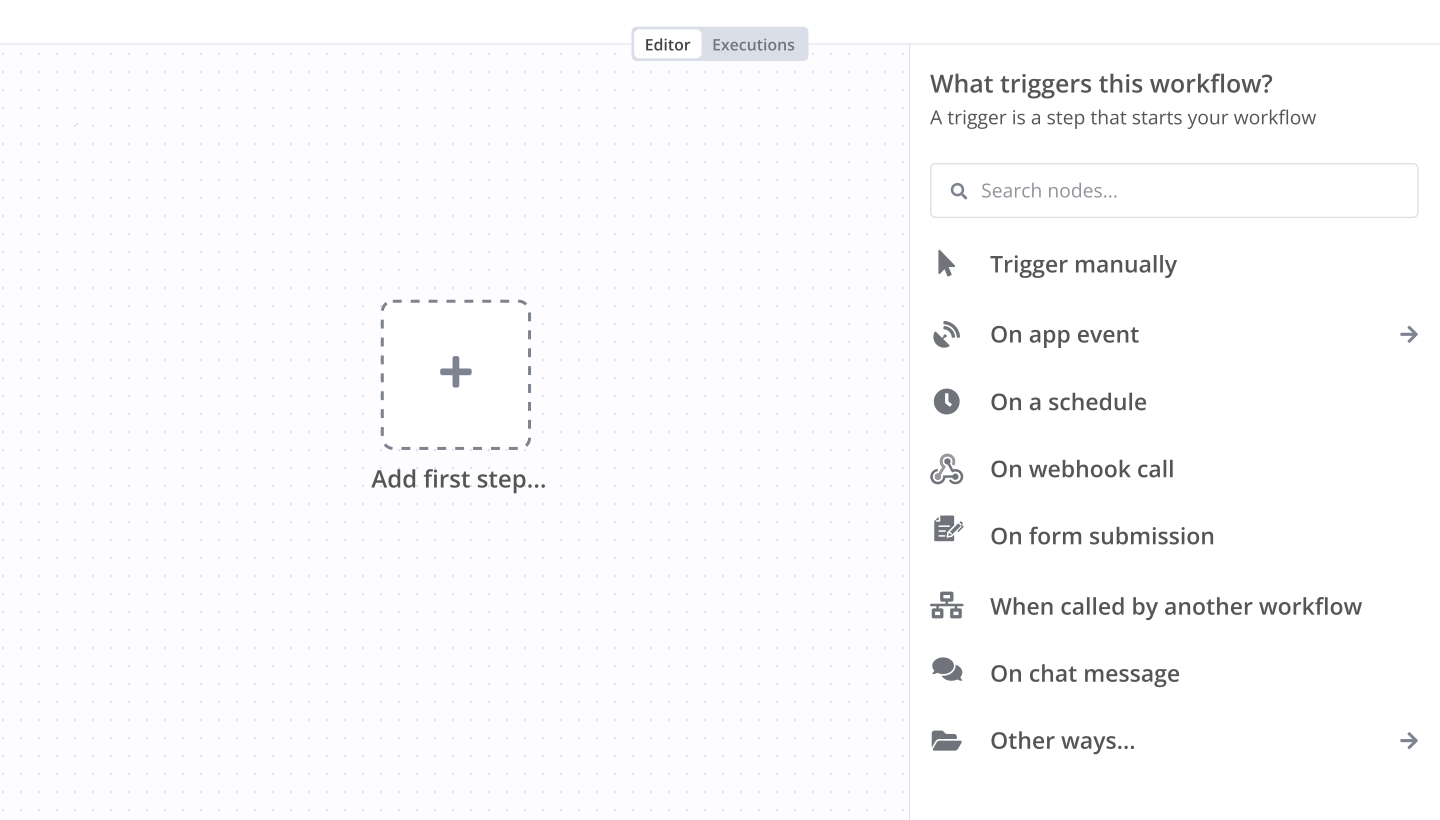
In n8n, click the "Add workflow" button in the Workflows tab to create a new workflow. Add the starting point – a trigger on when your workflow should run: an app event, a schedule, a webhook call, another workflow, an AI chat, or a manual trigger. Sometimes, the HTTP Request node might already serve as your starting point.

Webhook and Microsoft Excel 365 integration: Create a new workflow and add the first step

Step 2: Add and configure Webhook and Microsoft Excel 365 nodes

You can find Webhook and Microsoft Excel 365 in the nodes panel. Drag them onto your workflow canvas, selecting their actions. Click each node, choose a credential, and authenticate to grant n8n access. Configure Webhook and Microsoft Excel 365 nodes one by one: input data on the left, parameters in the middle, and output data on the right.

Webhook and Microsoft Excel 365 integration: Add and configure Webhook and Microsoft Excel 365 nodes

Step 3: Connect Webhook and Microsoft Excel 365

A connection establishes a link between Webhook and Microsoft Excel 365 (or vice versa) to route data through the workflow. Data flows from the output of one node to the input of another. You can have single or multiple connections for each node.

Webhook and Microsoft Excel 365 integration: Connect Webhook and Microsoft Excel 365

Step 4: Customize and extend your Webhook and Microsoft Excel 365 integration

Use n8n's core nodes such as If, Split Out, Merge, and others to transform and manipulate data. Write custom JavaScript or Python in the Code node and run it as a step in your workflow. Connect Webhook and Microsoft Excel 365 with any of n8n’s 1000+ integrations, and incorporate advanced AI logic into your workflows.

Webhook and Microsoft Excel 365 integration: Customize and extend your Webhook and Microsoft Excel 365 integration

Step 5: Test and activate your Webhook and Microsoft Excel 365 workflow

Save and run the workflow to see if everything works as expected. Based on your configuration, data should flow from Webhook to Microsoft Excel 365 or vice versa. Easily debug your workflow: you can check past executions to isolate and fix the mistake. Once you've tested everything, make sure to save your workflow and activate it.

Webhook and Microsoft Excel 365 integration: Test and activate your Webhook and Microsoft Excel 365 workflow

Fetch live ETF metrics from JustETF to Excel with one-click updates

Automate Your ETF Comparison: Real-Time Data & Analysis

Automate ETF research in Excel with one click.
This n8n workflow pulls live data from justetf.com using ISIN codes from your Excel table, extracts key metrics (dividends, fees, 5-year performance), and updates your “Div study” sheet instantly — all triggered by a button in Excel.

Perfect for dividend investors, ETF screeners, or portfolio trackers who want fresh, accurate data without manual copy-paste.

How it works
Trigger: Click “Update Table” in Excel → calls n8n via webhook
Excel: Logs current time (GMT-2) and reads all rows from “DivComp” table
HTTP Request: Fetches ETF profile page from justetf.com using ISIN
HTML Extraction: Parses page with CSS selectors to grab dividends, fees, 5Y performance
Code Node: Cleans & structures data (e.g., last 5 years of dividends, yield, growth)
Update Excel: Writes clean values back to your table (fees, yield, performance, name)

Setup steps
In Excel:
Add a button → assign macro that calls your n8n webhook URL (path: /ETF)
Ensure table “DivComp” has: ISIN, Dernière mise à jour, Frais, Performance depuis 5 ans, etc.

In n8n:
Connect Microsoft Excel (OneDrive) credential
Update workbook/worksheet/table references if needed
Test with 1–2 ISINs first

Click “Update Table” → watch data refresh in real time!

Tags: ETF, Excel, Web Scraping, Investing, Finance, Automation, justetf, Dividend Tracking

Nodes used in this workflow

Popular Webhook and Microsoft Excel 365 workflows

Fetch Live ETF Metrics from JustETF to Excel with One-Click Updates

Automate Your ETF Comparison: Real-Time Data & Analysis Automate ETF research in Excel with one click. This n8n workflow pulls live data from justetf.com using ISIN codes from your Excel table, extracts key metrics (dividends, fees, 5-year performance), and updates your “Div study” sheet instantly — all triggered by a button in Excel. Perfect for dividend investors, ETF screeners, or portfolio trackers who want fresh, accurate data without manual copy-paste. How it works Trigger: Click “Update Table” in Excel → calls n8n via webhook Excel: Logs current time (GMT-2) and reads all rows from “DivComp” table HTTP Request: Fetches ETF profile page from justetf.com using ISIN HTML Extraction: Parses page with CSS selectors to grab dividends, fees, 5Y performance Code Node: Cleans & structures data (e.g., last 5 years of dividends, yield, growth) Update Excel: Writes clean values back to your table (fees, yield, performance, name) Setup steps In Excel: Add a button → assign macro that calls your n8n webhook URL (path: /ETF) Ensure table “DivComp” has: ISIN, Dernière mise à jour, Frais, Performance depuis 5 ans, etc. In n8n: Connect Microsoft Excel (OneDrive) credential Update workbook/worksheet/table references if needed Test with 1–2 ISINs first Click “Update Table” → watch data refresh in real time! Tags: ETF, Excel, Web Scraping, Investing, Finance, Automation, justetf, Dividend Tracking

Generate PDF pricing proposals from Excel with Gotenberg and Outlook

Who is this for This template is built for consultants, agencies, and service businesses that quote custom engagements and want to eliminate the manual work of building, formatting, and delivering pricing proposals. If you have a SharePoint or OneDrive pricing sheet, a self-hosted Gotenberg instance, and a Gmail account, you can have personalized PDF proposals landing in prospect inboxes in under 30 minutes of setup. What it does The workflow accepts a form submission from your website or internal tools, looks up live pricing from your Excel pricing sheet, calculates the correct totals for the selected services and discount tier, renders a branded PDF proposal, and emails it to the requestor — all without any manual steps. How it works A Webhook Trigger receives a POST request from your web form containing the prospect's details, the services they're interested in, the applicable discount level, and the requestor's contact information. Fetch Pricing Sheet calls the Microsoft Graph API to pull all rows from your pricing_request.xlsx Excel table stored in OneDrive or SharePoint — so your proposals always reflect current, live pricing without any hardcoding. Process & Price is a Code node that filters the pricing rows down to only the selected services, applies the correct price tier (Discount, Retail, or Premium), and calculates line items and a grand total. It normalizes raw Excel data into clean proposal objects ready for rendering. Build HTML renders the processed data into a fully branded, print-optimized HTML document. The layout includes a cover page with prospect and firm details, a line-item pricing table, payment terms, and a signature block. All brand variables — logo URL, firm name, colors, and footer content — are defined as named constants at the top of the Code node for easy one-time customization. Convert to PDF sends the finished HTML to your self-hosted Gotenberg instance, which returns a print-ready, US Letter PDF using your CSS page layout — no third-party PDF service or API key required. Email Proposal delivers the PDF as an attachment via Gmail OAuth2 to the requestor. Internal recipients (e.g., a sales inbox) can be added as a CC with a single constant. How to set up In Webhook Trigger, copy the production webhook URL and wire it to your web form's POST action. In Fetch Pricing Sheet, update the SharePoint hostname, site path, drive, and file path to point to your pricing_request.xlsx. In Process & Price, confirm that your Excel column names match the field references in the Code node (service name, retail price, discount price, premium price). In Build HTML, update the brand constants at the top of the Code node: FIRM_NAME, LOGO_URL, ACCENT_COLOR, FOOTER_TEXT, and TERMS_TEXT. In Convert to PDF, update the Gotenberg base URL to your self-hosted instance. In Email Proposal, select your Gmail OAuth2 credential and update the INTERNAL_CC constant if desired. Requirements Microsoft 365 account with OneDrive or SharePoint access (for the pricing Excel file) Self-hosted Gotenberg instance (for HTML-to-PDF conversion) Gmail account with OAuth2 configured in n8n A web form or API client capable of POSTing JSON to a webhook URL Self-hosted n8n** — this workflow uses direct Microsoft Graph API calls and Gotenberg, which require a self-hosted instance for full compatibility How to customize the workflow Pricing tiers* — Add or rename price columns in your Excel sheet and update the tier-selection logic in Process & Price* to match. Proposal layout* — All styling, fonts, colors, and section order are controlled inside Build HTML*. The HTML uses @page CSS rules and table-based layout for reliable PDF rendering across Gotenberg versions. Discount logic* — Modify the discount calculation in Process & Price* to support percentage-based discounts, volume thresholds, or client-specific pricing rules. Email delivery** — Swap the Gmail node for Outlook, SendGrid, or any SMTP-compatible service supported by n8n. Map the pdfBuffer binary attachment and the rest of the workflow requires no changes. CRM routing** — Add a lookup step after the webhook to pull prospect details from HubSpot, Salesforce, or a SharePoint contact list and merge them into the proposal data before pricing. Approval gate* — Insert a Wait node and an internal Slack or email notification between Convert to PDF and Email Proposal* to require internal sign-off before delivery. Visit automatedintelligentsolutions.com for more information, support, and workflows.

Automate Meeting Documentation with SharePoint, Word, Excel & Outlook

What this template does Receives meeting data via a webform, cleans/structures it, fills a Word docx template, uploads the file to SharePoint, appends a row to Excel 365, and sends an Outlook email with the document attached. Good to know Uses a community node: DocxTemplater to render the DOCX from a template. Install it from the Community Nodes catalog. The template context is the workflow item JSON. In your docx file, use placeholders. Includes a minimal HTML form snippet (outside n8n) you can host anywhere. Replace the placeholder WEBHOOK_URL with your Webhook URL before testing. Microsoft nodes require Azure app credentials with correct permissions (SharePoint, Excel/Graph, Outlook). How it works Webhook — Receives meeting form JSON (POST). Code (Parse Meeting Data) — Parses/normalizes fields, builds semicolon‑separated strings for attendees/absentees, and flattens discussion points / action items. SharePoint (Download) — Fetches the DOCX template (e.g., meeting_minutes_template.docx). Merge — Combines template binary + JSON context by position. DocxTemplater — Renders meeting_{{now:yyyy-MM-dd}}.docx using the JSON context. SharePoint (Upload) — Saves the generated DOCX to a target folder (e.g., /Meetings). Microsoft Excel 365 (Append) — Appends a row to your sheet (Date, Time, Attendees, etc.). Microsoft Outlook (Send message) — Emails the generated DOCX as an attachment. Requirements Community node DocxTemplater installed Microsoft 365 access with credentials for: SharePoint (download template + upload output) Excel 365 (append to table/worksheet) Outlook (send email) A Word template with placeholders matching the JSON keys Need Help 🔗 LinkedIn – Wessel Bulte

Build your own Webhook and Microsoft Excel 365 integration

Create custom Webhook and Microsoft Excel 365 workflows by choosing triggers and actions. Nodes come with global operations and settings, as well as app-specific parameters that can be configured. You can also use the HTTP Request node to query data from any app or service with a REST API.

Microsoft Excel 365 supported actions

Append
Add rows to the end of the table
Convert to Range
Convert a table to a range
Create
Add a table based on range
Delete
Delete a table
Get Columns
Retrieve a list of table columns
Get Rows
Retrieve a list of table rows
Lookup
Look for rows that match a given value in a column
Add Sheet
Add a new sheet to the workbook
Delete
Delete workbook
Get Many
Get workbooks
Append
Append data to sheet
Append or Update
Append a new row or update the current one if it already exists (upsert)
Clear
Clear sheet
Delete
Delete sheet
Get Many
Get a list of sheets
Get Rows
Retrieve a list of sheet rows
Update
Update rows of a sheet or sheet range

Webhook and Microsoft Excel 365 integration details

integrationWebhook node
Webhook

Webhooks are automatic notifications that apps send when something occurs. They are sent to a certain URL, which is effectively the app's phone number or address, and contain a message or payload. Polling is nearly never quicker than webhooks, and it takes less effort from you.

Use case

Save engineering resources

Reduce time spent on customer integrations, engineer faster POCs, keep your customer-specific functionality separate from product all without having to code.

Learn more

FAQs

  • Can Webhook connect with Microsoft Excel 365?

  • Can I use Webhook’s API with n8n?

  • Can I use Microsoft Excel 365’s API with n8n?

  • Is n8n secure for integrating Webhook and Microsoft Excel 365?

  • How to get started with Webhook and Microsoft Excel 365 integration in n8n.io?

Need help setting up your Webhook and Microsoft Excel 365 integration?

Discover our latest community's recommendations and join the discussions about Webhook and Microsoft Excel 365 integration.
Benjamin Hatton
Albert Ashkhatoyan
Víctor González
Salomão
sg tech

Looking to integrate Webhook and Microsoft Excel 365 in your company?

Over 3000 companies switch to n8n every single week

Why use n8n to integrate Webhook with Microsoft Excel 365

Build complex workflows, really fast

Build complex workflows, really fast

Handle branching, merging and iteration easily.
Pause your workflow to wait for external events.

Code when you need it, UI when you don't

Simple debugging

Your data is displayed alongside your settings, making edge cases easy to track down.

Use templates to get started fast

Use 1000+ workflow templates available from our core team and our community.

Reuse your work

Copy and paste, easily import and export workflows.

Implement complex processes faster with n8n

red iconyellow iconred iconyellow icon