Back to Integrations
integrationWebhook node
integrationRedis node

Webhook and Redis integration

Save yourself the work of writing custom integrations for Webhook and Redis and use n8n instead. Build adaptable and scalable Development, Core Nodes, and Data & Storage workflows that work with your technology stack. All within a building experience you will love.

How to connect Webhook and Redis

  • Step 1: Create a new workflow
  • Step 2: Add and configure nodes
  • Step 3: Connect
  • Step 4: Customize and extend your integration
  • Step 5: Test and activate your workflow

Step 1: Create a new workflow and add the first step

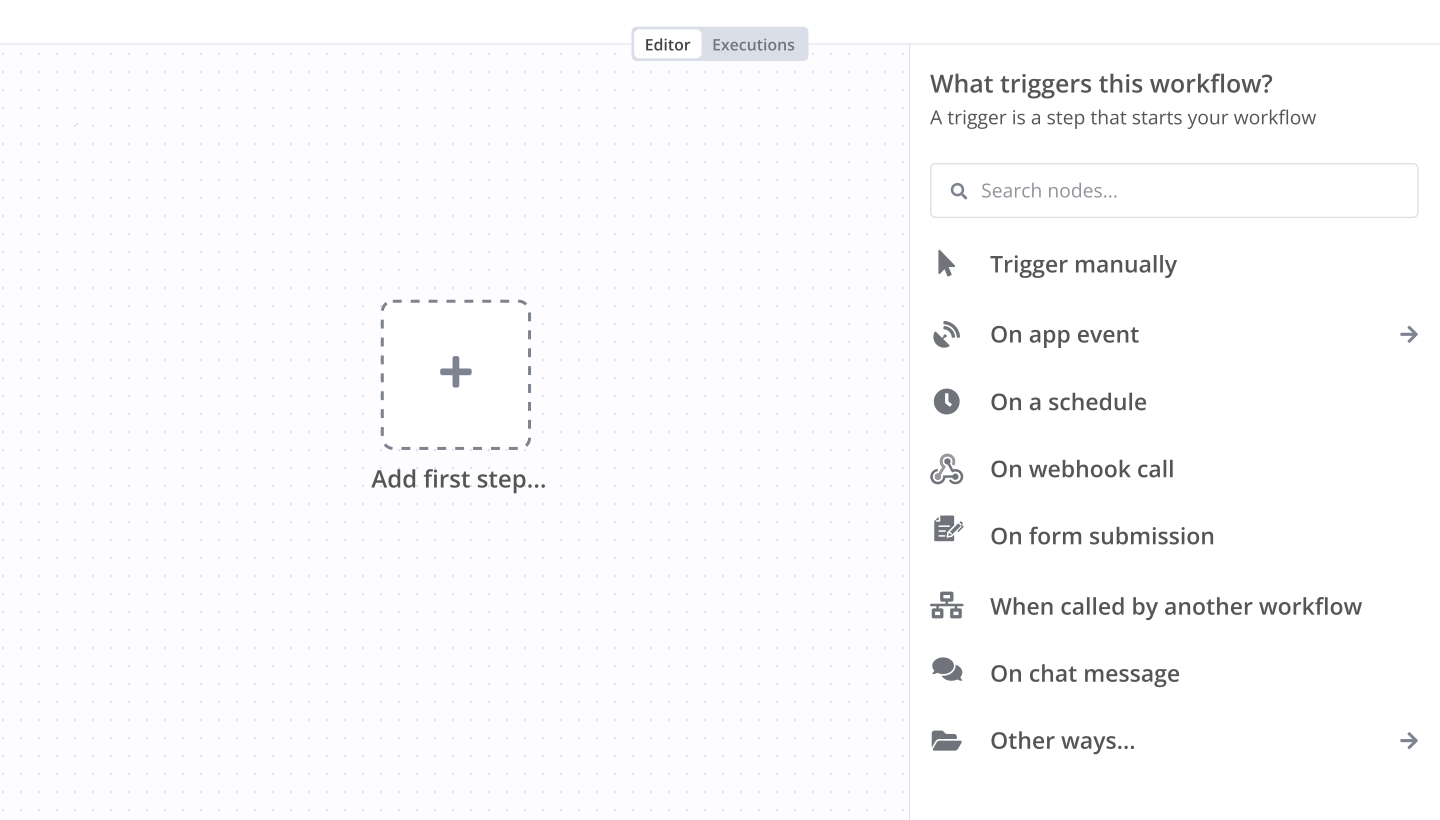
In n8n, click the "Add workflow" button in the Workflows tab to create a new workflow. Add the starting point – a trigger on when your workflow should run: an app event, a schedule, a webhook call, another workflow, an AI chat, or a manual trigger. Sometimes, the HTTP Request node might already serve as your starting point.

Webhook and Redis integration: Create a new workflow and add the first step

Step 2: Add and configure Webhook and Redis nodes

You can find Webhook and Redis in the nodes panel. Drag them onto your workflow canvas, selecting their actions. Click each node, choose a credential, and authenticate to grant n8n access. Configure Webhook and Redis nodes one by one: input data on the left, parameters in the middle, and output data on the right.

Webhook and Redis integration: Add and configure Webhook and Redis nodes

Step 3: Connect Webhook and Redis

A connection establishes a link between Webhook and Redis (or vice versa) to route data through the workflow. Data flows from the output of one node to the input of another. You can have single or multiple connections for each node.

Webhook and Redis integration: Connect Webhook and Redis

Step 4: Customize and extend your Webhook and Redis integration

Use n8n's core nodes such as If, Split Out, Merge, and others to transform and manipulate data. Write custom JavaScript or Python in the Code node and run it as a step in your workflow. Connect Webhook and Redis with any of n8n’s 1000+ integrations, and incorporate advanced AI logic into your workflows.

Webhook and Redis integration: Customize and extend your Webhook and Redis integration

Step 5: Test and activate your Webhook and Redis workflow

Save and run the workflow to see if everything works as expected. Based on your configuration, data should flow from Webhook to Redis or vice versa. Easily debug your workflow: you can check past executions to isolate and fix the mistake. Once you've tested everything, make sure to save your workflow and activate it.

Webhook and Redis integration: Test and activate your Webhook and Redis workflow

Conversational interviews with AI agents and n8n forms

This n8n template combines an AI agent with n8n's multi-page forms to create a novel interaction which allows automated question-and-answer sessions. One of the more obvious use-cases of this interaction is what I'm calling the AI interviewer.

You can read the full post here: https://community.n8n.io/t/build-your-own-ai-interview-agents-with-n8n-forms/62312

Live demo here: https://jimleuk.app.n8n.cloud/form/driving-lessons-survey

How it works

A form trigger is used to start the interview and a new session is created in redis to capture the transcript.
An AI agent is then tasked to ask questions to the user regarding the topic of the interview. This is setup as a loop so the questions never stop unless the user wishes to end the interview.
Each answer is recorded in our session set up earlier between questions.
When the user requests to end the interview we break the loop and show the interview completion screen.
Finally, the session is then saved in a Google Sheet which can then be shared with team members and for the purpose of data analysis.

How to use

You'll need to be on a n8n instance that is accessible to your target audience. Not technical enough to setup your own server? Try out n8n cloud and instantly deploy template!
Remember to activate the workflow so the form trigger is published and available for users to use.

Requirements
Groq LLM for AI agent. Feel free to swap this out for any other LLM.
Redis(-compatible) storage for capturing sessions

Customising this workflow

The next step would be adding tools! AI interviews with knowledge retrieval could definitely open up other possibilities. Eg. An onboarding wizard generating questions by pulling facts from internal knowledgebase.

Nodes used in this workflow

Popular Webhook and Redis workflows

+6

Predictive Health Monitoring & Alert System with GPT-4o-mini

How It Works The system collects real-time wearable health data, normalizes it, and uses AI to analyze trends and risk scores. It detects anomalies by comparing with historical patterns and automatically triggers alerts and follow-up actions when thresholds are exceeded. Setup Steps Configure Webhook Endpoint - Set up webhook to receive data from wearable devices Connect Database - Initialize storage for health metrics and historical data Set Normalization Rules - Define data standardization parameters for different devices Configure AI Model - Set up health score calculation and risk prediction algorithms Define Thresholds - Establish alert triggers for critical health metrics Connect Notification Channels - Configure email and Slack integrations Set Up Reporting - Create automated report templates and schedules Test Workflow - Run end-to-end tests with sample health data Workflow Template Webhook → Store Database → Normalize Data → Calculate Health Score → Analyze Metrics → Compare Previous → Check Threshold → Generate Reports/Alerts → Email/Slack → Schedule Follow-up Workflow Steps Ingest real-time wearable data via webhook, store and standardize it, and use GPT-4 for trend analysis and risk scoring. Monitor metrics against thresholds, trigger SMS, email, or Slack alerts, generate reports, and schedule follow-ups. Setup Instructions Configure webhook, database, GPT-4 API, notifications, calendar integration, and customize alert thresholds. Prerequisites Wearable API, patient database, GPT-4 key, email SMTP, optional Slack/Twilio, calendar integration. Use Cases Monitor glucose for diabetics, track elderly vitals/fall risk, assess corporate wellness, and post-surgery recovery alerts. Customization Adjust risk algorithms, add metrics, integrate telemedicine. Benefits Early intervention reduces readmissions and automates 80% of monitoring tasks.

AI secretary for scheduling with WhatsApp and Telegram

🏥 AI secretary for scheduling with WhatsApp and Telegram > ⚠️ Community Disclaimer > This workflow is community-maintained and self-hosted. > It is not officially affiliated with or supported by n8n GmbH, OpenAI, or Google. > Users are responsible for their own configuration, security, and data compliance (e.g., HIPAA, LGPD, GDPR). > Always secure API keys and ensure compliance with your local privacy regulations. 🧠 Description This template deploys an AI-powered virtual medical secretary that automates appointment scheduling, rescheduling, and cancellations for clinics and healthcare professionals. It seamlessly integrates OpenAI for natural language understanding, Google Calendar for real-time booking, and Evolution API (WhatsApp) or Telegram for patient communication. Patients can chat naturally via WhatsApp or Telegram, receiving empathetic, professional, and human-like responses — while your calendar stays automatically synchronized in real time. 💡 What Problem Does This Solve? Managing appointments manually is time-consuming and error-prone, often requiring staff to handle repetitive tasks like checking availability, confirming times, or rescheduling. Traditional systems lack conversational capabilities, forcing patients to call or text staff directly. This template solves that by creating a conversational AI assistant that interacts with patients through familiar messaging channels, reducing administrative workload and ensuring accurate real-time scheduling through Google Calendar. ⚙️ Key Features 📅 Google Calendar Integration — Real-time synchronization of consultations and exams 🤖 AI Assistant Powered by OpenAI — Understands patient intent and replies naturally 💬 Multi-Channel Support — Works with WhatsApp (via Evolution API) and Telegram 🔄 Automated Workflow — Handles booking, rescheduling, and cancellations 🏥 Healthcare-Focused Design — Tailored for clinics, doctors, and medical secretaries ✅ Customizable Responses — Modify prompts, message flows, and confirmation texts ⏰ Reminders & Follow-ups — Reduce no-shows with automated notifications 🧩 Setup Instructions (Step-by-Step) Obtain Required Credentials: OpenAI API Key Google Calendar API Credentials (OAuth or Service Account) Evolution API Token (for WhatsApp) Telegram Bot Token (if using Telegram) Configure n8n Environment: Add your credentials under Settings → Credentials. Ensure your n8n instance has internet access to the APIs. Configure Node “Variables Config” & Update Nodes: Set nm_Clinic → Name of the clinic Set nm_Agent → Name of the AI agent Set ds_Address_Clinic → Address of the clinic Set nm_Health_Plan → Name of the health insurance provider Set nm_Evolution_Instance → Name of your Evolution API instance Set nm_City_Clinic → City where the clinic is located Customize the Conversation Flow: Edit OpenAI prompt nodes to match your clinic’s tone of voice. Update Google Calendar event templates with your preferred titles and descriptions. Deploy and Test: Test both WhatsApp and Telegram channels. Verify that appointments appear correctly in Google Calendar. Review conversation logs to fine-tune the responses. 🚀 Suggested Use Cases Ideal for: Clinics and medical offices wanting 24/7 automated appointment management Healthcare professionals reducing manual scheduling and follow-ups Multi-channel (WhatsApp + Telegram) patient interaction Reducing no-shows with reminders and confirmations Clinics seeking to modernize patient communication and optimize staff time This assistant ensures every patient request is handled naturally — while Google Calendar remains the single source of truth for scheduling.

+9

AI Personal Assistant with GPT-4o, RAG & Voice for WhatsApp using Supabase

🧠 Intelligent AI Assistant with RAG & Voice for WhatsApp – Built with GPT-4o & Supabase 📌 About this workflow and its creator Hi! I’m Amanda, a creator of intelligent automations using n8n and Make. I’ve been building AI-powered workflows for over 2 years, always focused on usability and innovation. This one here is very special to me – a truly advanced AI assistant that reads, listens, interprets and responds like a real human 🤖✨ This ready-to-use workflow acts as a powerful AI personal assistant capable of understanding messages via voice, text, documents, or even images. It supports full multi-channel operation (WhatsApp via Evolution API, Instagram, Facebook, and more), and includes advanced RAG capabilities using Supabase + GPT-4o. It’s designed to be highly extensible, with memory, prompt update tools, and knowledge base management. ⚙️ What this workflow does 💬 Understands user input via text, document, audio or image (voice, OCR, PDF) 🎤 Transcribes and interprets voice messages using OpenAI Whisper 🧠 Understands prompts and user commands using GPT-4o via LangChain agent 🗂️ Searches knowledge base using RAG + Supabase vector DB 📄 Accepts documents and automatically indexes them for future questions 🧾 Summarizes documents and stores metadata in Supabase 🗃️ Offers memory support (PostgreSQL chat memory per user session) 📧 Sends replies through WhatsApp (Evolution API), Instagram, Facebook, etc. 📅 Manages schedules (via tool integration with Google Calendar) 📬 Sends and searches emails (with support tools) 🛠 Modular and expandable structure (tools for saving knowledge, deleting, updating prompt) 🔧 Setup Instructions n8n Hosting This workflow requires n8n self-hosted (or n8n Cloud with custom credentials + community nodes enabled). Create required databases Use the provided SQL queries inside the setar_supabase_tabelas_vectoriais, criar_cerebro, and criar_rag_controle nodes to initialize: documents table for RAG cerebro table for prompt memoria_chat for session memory rag_controle for summaries and indexing Credentials needed OpenAI API (for chat, embeddings and Whisper transcription) Redis (for managing message buffer) Supabase (for vector store + metadata) Postgres (for memory and prompts) Evolution API (or other messaging platforms) Webhook Set the webhook path to receive messages from your Evolution or WhatsApp API provider. Configure ‘Set’ node In the config node, adjust: adminNumero: your personal WhatsApp or admin number evolutionApiKey: your private API key utilizacaoApenasViaAdmin: toggle if this should only respond to admin numbers Tool connections Ensure the supporting workflows are also imported and connected for: Emails Knowledge management Calendar events 📎 Notes This workflow uses LangChain agents, OpenAI GPT-4o, Supabase, Redis, and PostgreSQL. It includes multiple “sticky notes” inside the workflow with explanations. Ideal for businesses, consultants, and developers looking to offer an intelligent and extendable AI chatbot experience. 🛍 Want to use this on your system? ❤️ Buy workflows: https://iloveflows.com ☁️ Use n8n Cloud with my partner link: https://n8n.partnerlinks.io/amanda
+3

Create a human-like Evolution API WhatsApp agent with Redis, PostgreSQL and Gemini

🤖 Human-like Evolution API Agent with Redis & PostgreSQL This production-ready template builds a sophisticated AI Agent using Evolution API that mimics human interaction patterns. Unlike standard chatbots that reply instantly to every incoming message, this workflow uses a Smart Redis Buffering System. It waits for the user to finish typing their full thought (text, audio, or image albums) before processing, creating a natural, conversational flow. It features a Hybrid Memory Architecture: active conversations are cached in Redis for ultra-low latency, while the complete chat history is securely stored in PostgreSQL. To optimize token usage and maintain long-term coherence, a Context Refiner Agent summarizes the conversation history before the Main AI generates a response. ✨ Key Features Human-like Buffering:** The agent waits (configurable time) to group consecutive messages, voice notes, and media albums into a single context. This prevents fragmented replies and feels like talking to a real person. Hybrid Memory:* Combines Redis (Hot Cache) for speed and PostgreSQL* (Cold Storage) for permanent history. Context Refinement:** A specialized AI step summarizes past interactions, allowing the Main Agent to understand long conversations without exceeding token limits or increasing costs. Multi-Modal Support:** Natively handles text, audio transcription, and image analysis via Evolution API. Parallel Processing:** Manages "typing..." status and session checks in parallel to reduce response latency. 📋 Requirements To use this workflow, you must configure the Evolution API correctly: Evolution API Instance: You need a running instance of Evolution API. Configuration Guide N8n Community Node: Install the Evolution API node in your n8n instance. n8n-nodes-evolution-api Database: A PostgreSQL database for chat history and a Redis instance for the buffer/cache. AI Models: API keys for your LLM (OpenAI, Anthropic, or Google Gemini). ⚙️ Setup Instructions Install the Node: Go to Settings > Community Nodes in n8n and install n8n-nodes-evolution-api. Credentials: Configure credentials for Redis, PostgreSQL, and your AI provider (e.g., OpenAI/Gemini). Database Setup: Create a chat_history table in PostgreSQL (columns must match the Insert node). Redis Connection: Configure your Redis credentials in the workflow nodes. Global Variables: Set the following in the "Global Variables" node: wait_buffer: Seconds to wait for the user to stop typing (e.g., 5s). wait_conversation: Seconds to keep the cache alive (e.g., 300s). max_chat_history: Number of past messages to retrieve. Webhook: Point your Evolution API instance to this workflow's Webhook URL. 🚀 How it Works Ingestion: Receives data via Evolution API. Detects if it's text, audio, or an album. Smart Buffering: Holds the execution to collect all parts of the user's message (simulating a human reading/listening). Context Retrieval: Checks Redis for the active session. If empty, fetches from PostgreSQL. Refinement: The Refiner Agent summarizes the history to extract key details. Response: The Main Agent generates a reply based on the refined context and current buffer, then saves it to both Redis and Postgres. 💡 Need Assistance? If you’d like help customizing or extending this workflow, feel free to reach out: 📧 Email: [email protected] 🔗 LinkedIn: John Alejandro Silva Rodríguez
+3

Conversational Interviews with AI Agents and n8n Forms

This n8n template combines an AI agent with n8n's multi-page forms to create a novel interaction which allows automated question-and-answer sessions. One of the more obvious use-cases of this interaction is what I'm calling the AI interviewer. You can read the full post here: https://community.n8n.io/t/build-your-own-ai-interview-agents-with-n8n-forms/62312 Live demo here: https://jimleuk.app.n8n.cloud/form/driving-lessons-survey How it works A form trigger is used to start the interview and a new session is created in redis to capture the transcript. An AI agent is then tasked to ask questions to the user regarding the topic of the interview. This is setup as a loop so the questions never stop unless the user wishes to end the interview. Each answer is recorded in our session set up earlier between questions. When the user requests to end the interview we break the loop and show the interview completion screen. Finally, the session is then saved in a Google Sheet which can then be shared with team members and for the purpose of data analysis. How to use You'll need to be on a n8n instance that is accessible to your target audience. Not technical enough to setup your own server? Try out n8n cloud and instantly deploy template! Remember to activate the workflow so the form trigger is published and available for users to use. Requirements Groq LLM for AI agent. Feel free to swap this out for any other LLM. Redis(-compatible) storage for capturing sessions Customising this workflow The next step would be adding tools! AI interviews with knowledge retrieval could definitely open up other possibilities. Eg. An onboarding wizard generating questions by pulling facts from internal knowledgebase.
+5

Youtube RAG search with Frontend using Apify, Qdrant and AI

Ever wanted to build your own RAG search over Youtube videos? Well, now you can! This n8n template shows how you can build a very capable Youtube search engine powered by Apify, Qdrant and your LLM of choice to quickly and efficiently browse over many videos for research. I originally started to template to ask questions on the "n8n @ scale office-hours" livestream videos but then extended it to include the latest videos on the official channel. Check out a demo here: https://jimleuk.app.n8n.cloud/webhook/n8n_videos How it works Stage 1 is to collect the Youtube video transcripts and push them into a vector database. For this, I've used Apify to scrape Youtube and Qdrant to store the embeddings. Transcripts are broken down into smaller chunks and carefully tagged with metadata to assist in later search and filtering. Stage 2 is to build a web frontend for the user to query the vectorised transcripts. I'm using a webhook to serve a simple web app and API to dynamically fetch the results. When searching for a video, I've opted to use Qdrant's search groups API which in this use-case, performs better as it returns a wider range of videos results. In the web frontend, when the user clicks on the results, the matching Youtube video plays in an embedded video player. How to use Once credentials are all set, first run steps 1 - 3 to populate your vector store. Next, set the workflow to active to expose the web frontend. Visit the webhook URL in your browser to use it. If only for personal use, you may want to remove the rate limiting mechanism in step 4. Requirements Apify for Youtube Channel and Video Scraping Qdrant for Vector store OpenAI for LLM and Embeddings Customising the template Not interested in official n8n videos? Swap to a different channel - this template will work on many as long as videos are not private or set to prevent embeds. Technically any vector store should work but may not have the same grouping API. Use the simple vector store node and revert back to basic searching instead.

Build your own Webhook and Redis integration

Create custom Webhook and Redis workflows by choosing triggers and actions. Nodes come with global operations and settings, as well as app-specific parameters that can be configured. You can also use the HTTP Request node to query data from any app or service with a REST API.

Redis supported actions

Delete
Delete a key from Redis
Get
Get the value of a key from Redis
Increment
Atomically increments a key by 1. Creates the key if it does not exist.
Info
Returns generic information about the Redis instance
Keys
Returns all the keys matching a pattern
List Length
Returns the length of a list
Pop
Pop data from a redis list
Publish
Publish message to redis channel
Push
Push data to a redis list
Set
Set the value of a key in redis

Webhook and Redis integration details

integrationWebhook node
Webhook

Webhooks are automatic notifications that apps send when something occurs. They are sent to a certain URL, which is effectively the app's phone number or address, and contain a message or payload. Polling is nearly never quicker than webhooks, and it takes less effort from you.

Use case

Save engineering resources

Reduce time spent on customer integrations, engineer faster POCs, keep your customer-specific functionality separate from product all without having to code.

Learn more

FAQs

  • Can Webhook connect with Redis?

  • Can I use Webhook’s API with n8n?

  • Can I use Redis’s API with n8n?

  • Is n8n secure for integrating Webhook and Redis?

  • How to get started with Webhook and Redis integration in n8n.io?

Need help setting up your Webhook and Redis integration?

Discover our latest community's recommendations and join the discussions about Webhook and Redis integration.
Benjamin Hatton
Albert Ashkhatoyan
Víctor González
Salomão
sg tech

Looking to integrate Webhook and Redis in your company?

Over 3000 companies switch to n8n every single week

Why use n8n to integrate Webhook with Redis

Build complex workflows, really fast

Build complex workflows, really fast

Handle branching, merging and iteration easily.
Pause your workflow to wait for external events.

Code when you need it, UI when you don't

Simple debugging

Your data is displayed alongside your settings, making edge cases easy to track down.

Use templates to get started fast

Use 1000+ workflow templates available from our core team and our community.

Reuse your work

Copy and paste, easily import and export workflows.

Implement complex processes faster with n8n

red iconyellow iconred iconyellow icon