Back to Integrations
integrationWebhook node
integrationMicrosoft SharePoint node

Webhook and Microsoft SharePoint integration

Save yourself the work of writing custom integrations for Webhook and Microsoft SharePoint and use n8n instead. Build adaptable and scalable Development, and Core Nodes workflows that work with your technology stack. All within a building experience you will love.

How to connect Webhook and Microsoft SharePoint

  • Step 1: Create a new workflow
  • Step 2: Add and configure nodes
  • Step 3: Connect
  • Step 4: Customize and extend your integration
  • Step 5: Test and activate your workflow

Step 1: Create a new workflow and add the first step

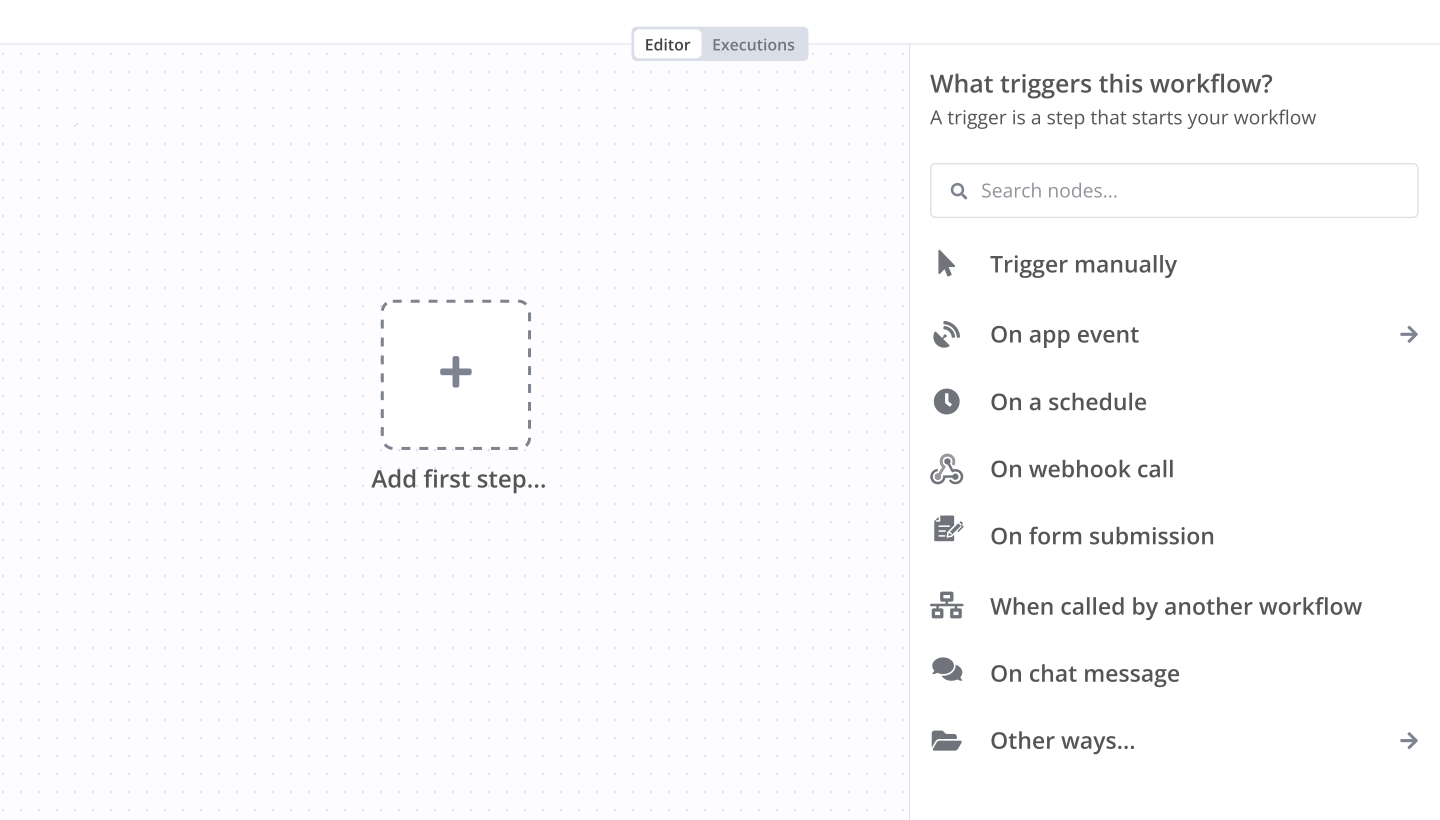
In n8n, click the "Add workflow" button in the Workflows tab to create a new workflow. Add the starting point – a trigger on when your workflow should run: an app event, a schedule, a webhook call, another workflow, an AI chat, or a manual trigger. Sometimes, the HTTP Request node might already serve as your starting point.

Webhook and Microsoft SharePoint integration: Create a new workflow and add the first step

Step 2: Add and configure Webhook and Microsoft SharePoint nodes

You can find Webhook and Microsoft SharePoint in the nodes panel. Drag them onto your workflow canvas, selecting their actions. Click each node, choose a credential, and authenticate to grant n8n access. Configure Webhook and Microsoft SharePoint nodes one by one: input data on the left, parameters in the middle, and output data on the right.

Webhook and Microsoft SharePoint integration: Add and configure Webhook and Microsoft SharePoint nodes

Step 3: Connect Webhook and Microsoft SharePoint

A connection establishes a link between Webhook and Microsoft SharePoint (or vice versa) to route data through the workflow. Data flows from the output of one node to the input of another. You can have single or multiple connections for each node.

Webhook and Microsoft SharePoint integration: Connect Webhook and Microsoft SharePoint

Step 4: Customize and extend your Webhook and Microsoft SharePoint integration

Use n8n's core nodes such as If, Split Out, Merge, and others to transform and manipulate data. Write custom JavaScript or Python in the Code node and run it as a step in your workflow. Connect Webhook and Microsoft SharePoint with any of n8n’s 1000+ integrations, and incorporate advanced AI logic into your workflows.

Webhook and Microsoft SharePoint integration: Customize and extend your Webhook and Microsoft SharePoint integration

Step 5: Test and activate your Webhook and Microsoft SharePoint workflow

Save and run the workflow to see if everything works as expected. Based on your configuration, data should flow from Webhook to Microsoft SharePoint or vice versa. Easily debug your workflow: you can check past executions to isolate and fix the mistake. Once you've tested everything, make sure to save your workflow and activate it.

Webhook and Microsoft SharePoint integration: Test and activate your Webhook and Microsoft SharePoint workflow

Bilingual newsletters with GPT-4o, AI images & videos for HubSpot & SP

Who’s it for
Marketing, growth, and automation teams that need to ship polished bilingual newsletters—complete with images, optional video, and multi-channel distribution—without writing a line of code.

How it works / What it does
A Webhook receives a plain-language request (e.g. “Create a newsletter about XYZ and store it in SharePoint”). The Webhook can be changed to another trigger, fr example Manual Trigger.
An AI Agent (OpenAI GPT-4o) drafts German & English newsletter copy following a strict JSON schema.
SharePoint fetches an HTML template; a Code node injects AI copy into the placeholders.
Optional creative assets:
Pollinations AI → image (resolution check & frame overlay)
FAL AI → short video + Lyria2 audio → merged via FFmpeg API
A Gmail Approval step sends the draft to an approver; the flow continues only on “Approve”.
Depending on user intent the workflow:
Emails the newsletter to HubSpot contacts, and/or
Saves HTML (+ JPG/Video URL) to a SharePoint library.

How to set up
Import the template
Open the yellow sticky note and follow the checklist
Create credentials for OpenAI, HubSpot (App Token), Microsoft 365, Gmail, and FAL AI.
Enter them in n8n Credential Manager (never in the HTTP node).
Edit the Configuration Settings Set node with your ENV_* variables.
Activate the workflow, copy the production Webhook URL, and trigger it with JSON body { "text": "…" } or with a desired trigger.

Requirements
OpenAI account
Microsoft 365 tenant (SharePoint & Outlook)
HubSpot App Token
FAL AI API Key (video & audio generation)

How to customize
Want a different language? Tweak the AI prompt inside AI Agent.
Want a different storage provider? Change the SharePoint nodes to Google Drive or Dropbox.
Skip video generation: set include_video to false in the incoming prompt.
Change the distribution logic by adjusting the WF Result Switch node.
Add more channels (e.g. Slack) by inserting additional branches after the Switch and modifying the intent determination at the beginning of the workflow.

Nodes used in this workflow

Popular Webhook and Microsoft SharePoint workflows

Auto-Generate SEO Content from Trends with GPT-4o, FAL AI & Multi-Storage

Who's it for Content creators, SEO specialists, and marketing teams who want to automatically generate SEO-optimized content based on trending topics—complete with AI-generated images, optional videos, and ready-to-publish HTML. How it works / What it does Webhook receives a request with use case and video preferences. Get Trends XLSX downloads a spreadsheet (created by the Social Media Trends workflow) from SharePoint. Select Topic from Trends randomly picks one trending topic from the spreadsheet. AI Agent (GPT-4o) generates bilingual newsletter content about the selected trend. Get Newsletter Template fetches your HTML template; Build Newsletter injects the AI content. Optional creative assets: • Pollinations AI → generates a 1080 × 1350 image. • FAL AI → creates video from the image + Lyria2 audio → merged via FFmpeg. Gmail Approval sends the draft for review; continues only on approval. Upload all files (HTML + JPG + video URL) to your chosen storage provider. How to set up Import the template into n8n (cloud or self-hosted). Create credentials: OpenAI, Microsoft 365 (SharePoint), Gmail, and FAL AI. Upload your HTML newsletter template to SharePoint (see yellow sticky note for required placeholders). Ensure you have a trends spreadsheet (from the Social Media Trends workflow) in your SharePoint folder. Update Configuration Settings with your ENV_* variables. Activate the workflow and POST to the webhook: { "text": "usecase: blog post, include_video: true" }. Requirements n8n 1.33 + OpenAI account Microsoft 365 tenant (SharePoint) Gmail account FAL AI API Key (for video generation) A trends spreadsheet (from the Social Media Trends workflow) How to customize Change storage provider: replace SharePoint upload nodes with Google Drive, Dropbox, or S3. Modify topic selection: edit Select Topic from Trends for different selection logic. Adjust content tone: tweak the prompt in Prepare Newsletter Data. Skip video generation: set include_video: false in the webhook request.
+3

Bilingual Newsletters with GPT-4o, AI Images & Videos for HubSpot & SP

Who’s it for Marketing, growth, and automation teams that need to ship polished bilingual newsletters—complete with images, optional video, and multi-channel distribution—without writing a line of code. How it works / What it does A Webhook receives a plain-language request (e.g. “Create a newsletter about XYZ and store it in SharePoint”). The Webhook can be changed to another trigger, fr example Manual Trigger. An AI Agent (OpenAI GPT-4o) drafts German & English newsletter copy following a strict JSON schema. SharePoint fetches an HTML template; a Code node injects AI copy into the placeholders. Optional creative assets: Pollinations AI → image (resolution check & frame overlay) FAL AI → short video + Lyria2 audio → merged via FFmpeg API A Gmail Approval step sends the draft to an approver; the flow continues only on “Approve”. Depending on user intent the workflow: Emails the newsletter to HubSpot contacts, and/or Saves HTML (+ JPG/Video URL) to a SharePoint library. How to set up Import the template Open the yellow sticky note and follow the checklist Create credentials for OpenAI, HubSpot (App Token), Microsoft 365, Gmail, and FAL AI. Enter them in n8n Credential Manager (never in the HTTP node). Edit the Configuration Settings Set node with your ENV_* variables. Activate the workflow, copy the production Webhook URL, and trigger it with JSON body { "text": "…" } or with a desired trigger. Requirements OpenAI account Microsoft 365 tenant (SharePoint & Outlook) HubSpot App Token FAL AI API Key (video & audio generation) How to customize Want a different language? Tweak the AI prompt inside AI Agent. Want a different storage provider? Change the SharePoint nodes to Google Drive or Dropbox. Skip video generation: set include_video to false in the incoming prompt. Change the distribution logic by adjusting the WF Result Switch node. Add more channels (e.g. Slack) by inserting additional branches after the Switch and modifying the intent determination at the beginning of the workflow.

Automate Meeting Documentation with SharePoint, Word, Excel & Outlook

What this template does Receives meeting data via a webform, cleans/structures it, fills a Word docx template, uploads the file to SharePoint, appends a row to Excel 365, and sends an Outlook email with the document attached. Good to know Uses a community node: DocxTemplater to render the DOCX from a template. Install it from the Community Nodes catalog. The template context is the workflow item JSON. In your docx file, use placeholders. Includes a minimal HTML form snippet (outside n8n) you can host anywhere. Replace the placeholder WEBHOOK_URL with your Webhook URL before testing. Microsoft nodes require Azure app credentials with correct permissions (SharePoint, Excel/Graph, Outlook). How it works Webhook — Receives meeting form JSON (POST). Code (Parse Meeting Data) — Parses/normalizes fields, builds semicolon‑separated strings for attendees/absentees, and flattens discussion points / action items. SharePoint (Download) — Fetches the DOCX template (e.g., meeting_minutes_template.docx). Merge — Combines template binary + JSON context by position. DocxTemplater — Renders meeting_{{now:yyyy-MM-dd}}.docx using the JSON context. SharePoint (Upload) — Saves the generated DOCX to a target folder (e.g., /Meetings). Microsoft Excel 365 (Append) — Appends a row to your sheet (Date, Time, Attendees, etc.). Microsoft Outlook (Send message) — Emails the generated DOCX as an attachment. Requirements Community node DocxTemplater installed Microsoft 365 access with credentials for: SharePoint (download template + upload output) Excel 365 (append to table/worksheet) Outlook (send email) A Word template with placeholders matching the JSON keys Need Help 🔗 LinkedIn – Wessel Bulte

Build your own Webhook and Microsoft SharePoint integration

Create custom Webhook and Microsoft SharePoint workflows by choosing triggers and actions. Nodes come with global operations and settings, as well as app-specific parameters that can be configured. You can also use the HTTP Request node to query data from any app or service with a REST API.

Microsoft SharePoint supported actions

Download
Download a file
Update
Update a file
Upload
Upload an existing file
Create
Create an item in an existing list
Create or Update
Create a new item, or update the current one if it already exists (upsert)
Delete
Delete an item from a list
Get
Retrieve an item from a list
Get Many
Get specific items in a list or list many items
Update
Update an item in an existing list
Get
Retrieve details of a single list
Get Many
Retrieve a list of lists

Webhook and Microsoft SharePoint integration details

integrationWebhook node
Webhook

Webhooks are automatic notifications that apps send when something occurs. They are sent to a certain URL, which is effectively the app's phone number or address, and contain a message or payload. Polling is nearly never quicker than webhooks, and it takes less effort from you.

Use case

Save engineering resources

Reduce time spent on customer integrations, engineer faster POCs, keep your customer-specific functionality separate from product all without having to code.

Learn more

FAQs

  • Can Webhook connect with Microsoft SharePoint?

  • Can I use Webhook’s API with n8n?

  • Can I use Microsoft SharePoint’s API with n8n?

  • Is n8n secure for integrating Webhook and Microsoft SharePoint?

  • How to get started with Webhook and Microsoft SharePoint integration in n8n.io?

Need help setting up your Webhook and Microsoft SharePoint integration?

Discover our latest community's recommendations and join the discussions about Webhook and Microsoft SharePoint integration.
Benjamin Hatton
Albert Ashkhatoyan
Víctor González
Salomão
sg tech

Looking to integrate Webhook and Microsoft SharePoint in your company?

Over 3000 companies switch to n8n every single week

Why use n8n to integrate Webhook with Microsoft SharePoint

Build complex workflows, really fast

Build complex workflows, really fast

Handle branching, merging and iteration easily.
Pause your workflow to wait for external events.

Code when you need it, UI when you don't

Simple debugging

Your data is displayed alongside your settings, making edge cases easy to track down.

Use templates to get started fast

Use 1000+ workflow templates available from our core team and our community.

Reuse your work

Copy and paste, easily import and export workflows.

Implement complex processes faster with n8n

red iconyellow iconred iconyellow icon