Network Vulnerability Scanner (used NMAP as engine) with Automated CVE Report
Workflow Overview
This n8n workflow provides comprehensive network vulnerability scanning with automated CVE enrichment and professional report generation. It performs Nmap scans, queries the National Vulnerability Database (NVD) for CVE information, generates detailed HTML/PDF reports, and distributes them via Telegram and email.
Key Features
Automated Network Scanning**: Full Nmap service and version detection scan
CVE Enrichment**: Automatic vulnerability lookup using NVD API
CVSS Scoring**: Vulnerability severity assessment with CVSS v3.1/v3.0 scores
Professional Reporting**: HTML reports with detailed findings and recommendations
PDF Generation**: Password-protected PDF reports using Prince XML
Multi-Channel Distribution**: Telegram and email delivery
Multiple Triggers**: Webhook API, web form, manual execution, scheduled scans
Rate Limiting**: Respects NVD API rate limits
Comprehensive Data**: Service detection, CPE matching, CVE details with references
Use Cases
Regular security audits of network infrastructure
Compliance scanning for vulnerability management
Penetration testing reconnaissance phase
Asset inventory with vulnerability context
Continuous security monitoring
Vulnerability assessment reporting for management
DevSecOps integration for infrastructure testing
Setup Instructions
Prerequisites
Before setting up this workflow, ensure you have:
System Requirements
n8n instance (self-hosted) with command execution capability
Alpine Linux base image (or compatible Linux distribution)
Minimum 2 GB RAM (4 GB recommended for large scans)
2 GB free disk space for dependencies
Network access to scan targets
Internet connectivity for NVD API
Required Knowledge
Basic networking concepts (IP addresses, ports, protocols)
Understanding of CVE/CVSS vulnerability scoring
Nmap scanning basics
External Services
Telegram Bot (optional, for Telegram notifications)
Email server / SMTP credentials (optional, for email reports)
NVD API access (public, no API key required but rate-limited)
Step 1: Understanding the Workflow Components
Core Dependencies
Nmap: Network scanner
Purpose: Port scanning, service detection, version identification
Usage: Performs TCP SYN scan with service/version detection
nmap-helper: JSON conversion tool
Repository: https://github.com/net-shaper/nmap-helper
Purpose: Converts Nmap XML output to JSON format
Prince XML: HTML to PDF converter
Website: https://www.princexml.com
Version: 16.1 (Alpine 3.20)
Purpose: Generates professional PDF reports from HTML
Features: Password protection, print-optimized formatting
NVD API: Vulnerability database
Endpoint: https://services.nvd.nist.gov/rest/json/cves/2.0
Purpose: CVE information, CVSS scores, vulnerability descriptions
Rate Limit: Public API allows limited requests per minute
Documentation: https://nvd.nist.gov/developers
Step 2: Telegram Bot Configuration (Optional)
If you want to receive reports via Telegram:
Create Telegram Bot
Open Telegram and search for @BotFather
Start a chat and send /newbot
Follow prompts:
Bot name: Network Scanner Bot (or your choice)
Username: network_scanner_bot (must end with 'bot')
BotFather will provide:
Bot token: 123456789:ABCdefGHIjklMNOpqrsTUVwxyz (save this)
Bot URL: https://t.me/your_bot_username
Get Your Chat ID
Start a chat with your new bot
Send any message to the bot
Visit: https://api.telegram.org/bot<YOUR_BOT_TOKEN>/getUpdates
Find your chat ID in the response
Save this chat ID (e.g., 123456789)
Alternative: Group Chat ID
For sending to a group:
Add bot to your group
Send a message in the group
Check getUpdates URL
Group chat IDs are negative: -1001234567890
Add Credentials to n8n
Navigate to Credentials in n8n
Click Add Credential
Select Telegram API
Fill in:
Access Token: Your bot token from BotFather
Click Save
Test connection if available
Step 3: Email Configuration (Optional)
If you want to receive reports via email:
Add SMTP Credentials to n8n
Navigate to Credentials in n8n
Click Add Credential
Select SMTP
Fill in:
Host: SMTP server address (e.g., smtp.gmail.com)
Port: SMTP port (587 for TLS, 465 for SSL, 25 for unencrypted)
User: Your email username
Password: Your email password or app password
Secure: Enable for TLS/SSL
Click Save
Gmail Users:
Enable 2-factor authentication
Generate app-specific password: https://myaccount.google.com/apppasswords
Use app password in n8n credential
Step 4: Import and Configure Workflow
Configure Basic Parameters
Locate "1. Set Parameters" Node:
Click the node to open settings
Default configuration:
network: Input from webhook/form/manual trigger
timestamp: Auto-generated (format: yyyyMMdd_HHmmss)
report_password: Almafa123456 (change this!)
Change Report Password:
Edit report_password assignment
Set strong password: 12+ characters, mixed case, numbers, symbols
This password will protect the PDF report
Save changes
Step 5: Configure Notification Endpoints
Telegram Configuration
Locate "14/a. Send Report in Telegram" Node:
Open node settings
Update fields:
Chat ID: Replace -123456789012 with your actual chat ID
Credentials: Select your Telegram credential
Save changes
Message customization:
Current: Sends PDF as document attachment
Automatic filename: vulnerability_report_<timestamp>.pdf
No caption by default (add if needed)
Email Configuration
Locate "14/b. Send Report in Email with SMTP" Node:
Open node settings
Update fields:
From Email:
[email protected] → Your sender email
To Email:
[email protected] → Your recipient email
Subject: Customize if needed (default includes network target)
Text: Email body message
Credentials: Select your SMTP credential
Save changes
Multiple Recipients:
Change toEmail field to comma-separated list:
[email protected],
[email protected],
[email protected]
Add CC/BCC:
In node options, add:
cc: Carbon copy recipients
bcc: Blind carbon copy recipients
Step 6: Configure Triggers
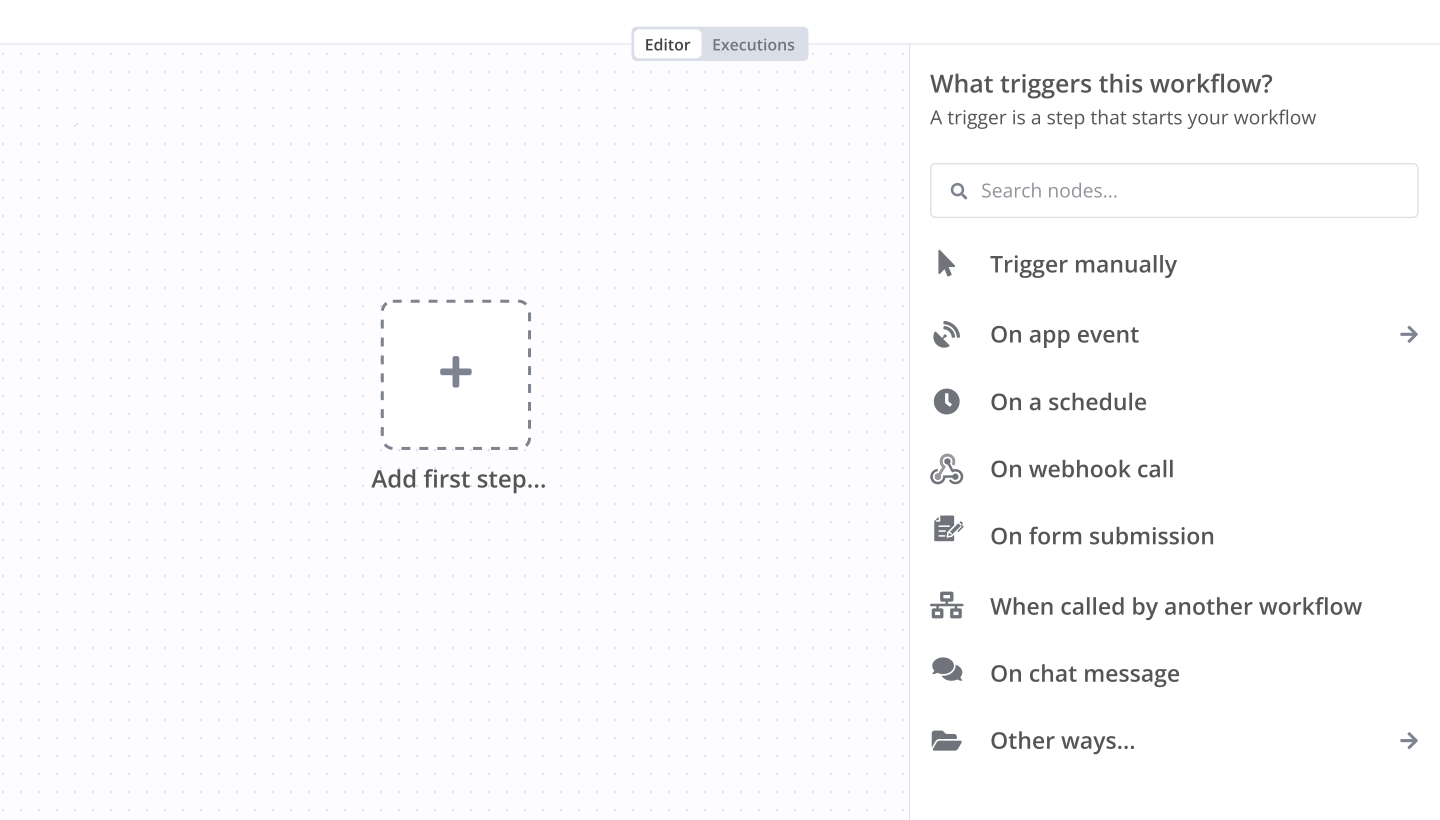
The workflow supports 4 trigger methods:
Trigger 1: Webhook API (Production)
Locate "Webhook" Node:
Path: /vuln-scan
Method: POST
Response: Immediate acknowledgment "Process started!"
Async: Scan runs in background
Trigger 2: Web Form (User-Friendly)
Locate "On form submission" Node:
Path: /webhook-test/form/target
Method: GET (form display), POST (form submit)
Form Title: "Add scan parameters"
Field: network (required)
Form URL:
https://your-n8n-domain.com/webhook-test/form/target
Users can:
Open form URL in browser
Enter target network/IP
Click submit
Receive confirmation
Trigger 3: Manual Execution (Testing)
Locate "Manual Trigger" Node:
Click to activate
Opens workflow with "Pre-Set-Target" node
Default target: scanme.nmap.org (Nmap's official test server)
To change default target:
Open "Pre-Set-Target" node
Edit network value
Enter your test target
Save changes
Trigger 4: Scheduled Scans (Automated)
Locate "Schedule Trigger" Node:
Default: Daily at 1:00 AM
Uses "Pre-Set-Target" for network
To change schedule:
Open node settings
Modify trigger time:
Hour: 1 (1 AM)
Minute: 0
Day of week: All days (or select specific days)
Save changes
Schedule Examples:
Every day at 3 AM: Hour: 3, Minute: 0
Weekly on Monday at 2 AM: Hour: 2, Day: Monday
Twice daily (8 AM, 8 PM): Create two Schedule Trigger nodes
Step 7: Test the Workflow
Recommended Test Target
Use Nmap's official test server for initial testing:
Target**: scanme.nmap.org
Purpose**: Official Nmap testing server
Safe**: Designed for scanning practice
Permissions**: Public permission to scan
Important: Never scan targets without permission. Unauthorized scanning is illegal.
Manual Test Execution
Open workflow in n8n editor
Click Manual Trigger node to select it
Click Execute Workflow button
Workflow will start with scanme.nmap.org as target
Monitor Execution
Watch nodes turn green as they complete:
Need to Add Helper?: Checks if nmap-helper installed
Add NMAP-HELPER: Installs helper (if needed, ~2-3 minutes)
Optional Params Setter: Sets scan parameters
Execute Nmap Scan: Runs scan (5-30 minutes depending on target)
Parse NMAP JSON to Services: Extracts services (~1 second)
CVE Enrichment Loop: Queries NVD API (1 second per service)
8-10. Report Generation: Creates HTML/PDF reports (~5-10 seconds)
Convert to PDF: Generates password-protected PDF (~10 seconds)
14a/14b. Distribution: Sends reports
Check Outputs
Click nodes to view outputs:
Parse NMAP JSON**: View discovered services
CVE Enrichment**: See vulnerabilities found
Prepare Report Structure**: Check statistics
Read Report PDF**: Download report to verify
Verify Distribution
Telegram:
Open Telegram chat with your bot
Check for PDF document
Download and open with password
Email:
Check inbox for report email
Verify subject line includes target network
Download PDF attachment
Open with password
How to Use
Understanding the Scan Process
Initiating Scans
Method 1: Webhook API
Use curl or any HTTP client and add "network" parameter in a POST request.
Response:
Process started!
Scan runs asynchronously. You'll receive results via configured channels (Telegram/Email).
Method 2: Web Form
Open form URL in browser:
https://your-n8n.com/webhook-test/form/target
Fill in form:
network: Enter target (IP, range, domain)
Click Submit
Receive confirmation
Wait for report delivery
Advantages:
No command line needed
User-friendly interface
Input validation
Good for non-technical users
Method 3: Manual Execution
For testing or one-off scans:
Open workflow in n8n
Edit "Pre-Set-Target" node:
Change network value to your target
Click Manual Trigger node
Click Execute Workflow
Monitor progress in real-time
Advantages:
See execution in real-time
Debug issues immediately
Test configuration changes
View intermediate outputs
Method 4: Scheduled Scans
For regular, automated security audits:
Configure "Schedule Trigger" node with desired time
Configure "Pre-Set-Target" node with default target
Activate workflow
Scans run automatically on schedule
Advantages:
Automated security monitoring
Regular compliance scans
No manual intervention needed
Consistent scheduling
Scan Targets Explained
Supported Target Formats
Single IP Address:
192.168.1.100
10.0.0.50
CIDR Notation (Subnet):
192.168.1.0/24 # Scans 192.168.1.0-255 (254 hosts)
10.0.0.0/16 # Scans 10.0.0.0-255.255 (65534 hosts)
172.16.0.0/12 # Scans entire 172.16-31.x.x range
IP Range:
192.168.1.1-50 # Scans 192.168.1.1 to 192.168.1.50
10.0.0.1-10.0.0.100 # Scans across range
Multiple Targets:
192.168.1.1,192.168.1.2,192.168.1.3
Hostname/Domain:
scanme.nmap.org
example.com
server.local
Choosing Appropriate Targets
Development/Testing:
Use scanme.nmap.org (official test target)
Use your own isolated lab network
Never scan public internet without permission
Internal Networks:
Use CIDR notation for entire subnets
Scan DMZ networks separately from internal
Consider network segmentation in scan design
Understanding Report Contents
Report Structure
The generated report includes:
Executive Summary:
Total hosts discovered
Total services identified
Total vulnerabilities found
Severity breakdown (Critical, High, Medium, Low, Info)
Scan date and time
Target network
Overall Statistics:
Visual dashboard with key metrics
Severity distribution chart
Quick risk assessment
Detailed Findings by Host:
For each discovered host:
IP address
Hostname (if resolved)
List of open ports and services
Service details:
Port number and protocol
Service name (e.g., http, ssh, mysql)
Product (e.g., Apache, OpenSSH, MySQL)
Version (e.g., 2.4.41, 8.2p1, 5.7.33)
CPE identifier
Vulnerability Details:
For each vulnerable service:
CVE ID**: Unique vulnerability identifier (e.g., CVE-2021-44228)
Severity**: CRITICAL / HIGH / MEDIUM / LOW / INFO
CVSS Score**: Numerical score (0.0-10.0)
Published Date**: When vulnerability was disclosed
Description**: Detailed vulnerability explanation
References**: Links to advisories, patches, exploits
Recommendations:
Immediate actions (patch critical/high severity)
Long-term improvements (security processes)
Best practices
Vulnerability Severity Levels
CRITICAL (CVSS 9.0-10.0):
Color: Red
Characteristics: Remote code execution, full system compromise
Action: Immediate patching required
Examples: Log4Shell, EternalBlue, Heartbleed
HIGH (CVSS 7.0-8.9):
Color: Orange
Characteristics: Significant security impact, data exposure
Action: Patch within days
Examples: SQL injection, privilege escalation, authentication bypass
MEDIUM (CVSS 4.0-6.9):
Color: Yellow
Characteristics: Moderate security impact
Action: Patch within weeks
Examples: Information disclosure, denial of service, XSS
LOW (CVSS 0.1-3.9):
Color: Green
Characteristics: Minor security impact
Action: Patch during regular maintenance
Examples: Path disclosure, weak ciphers, verbose error messages
INFO (CVSS 0.0):
Color: Blue
Characteristics: No vulnerability found or informational
Action: No action required, awareness only
Examples: Service version detected, no known CVEs
Understanding CPE
CPE (Common Platform Enumeration):
Standard naming scheme for IT products
Used for CVE lookup in NVD database
Workflow CPE Handling:
Nmap detects service and version
Nmap provides CPE (if in database)
Workflow uses CPE to query NVD API
NVD returns CVEs associated with that CPE
Special case: nginx vendor fixed from igor_sysoev to nginx
Working with Reports
Accessing HTML Report
Location:
/tmp/vulnerability_report_<timestamp>.html
Viewing:
Open in web browser directly from n8n
Click "11. Read Report for Output" node
Download HTML file
Open locally in any browser
Advantages:
Interactive (clickable links)
Searchable text
Easy to edit/customize
Smaller file size
Accessing PDF Report
Location:
/tmp/vulnerability_report_<timestamp>.pdf
Password:
Default: Almafa123456 (configured in "1. Set Parameters")
Change in workflow before production use
Required to open PDF
Opening PDF:
Receive PDF via Telegram or Email
Open with PDF reader (Adobe, Foxit, Browser)
Enter password when prompted
View, print, or share
Advantages:
Professional appearance
Print-optimized formatting
Password protection
Portable (works anywhere)
Preserves formatting
Report Customization
Change Report Title:
Open "8. Prepare Report Structure" node
Find metadata object
Edit title and subtitle fields
Customize Styling:
Open "9. Generate HTML Report" node
Modify CSS in <style> section
Change colors, fonts, layout
Add Company Logo:
Edit HTML generation code
Add `` tag in header section
Include base64-encoded logo or URL
Modify Recommendations:
Open "9. Generate HTML Report" node
Find Recommendations section
Edit recommendation text
Scanning Ethics and Legality
Authorization is Mandatory:
Never scan networks without explicit written permission
Unauthorized scanning is illegal in most jurisdictions
Can result in criminal charges and civil liability
Scope Definition:
Document approved scan scope
Exclude out-of-scope systems
Maintain scan authorization documents
Notification:
Inform network administrators before scans
Provide scan window and source IPs
Have emergency contact procedures
Safe Targets for Testing:
scanme.nmap.org: Official Nmap test server
Your own isolated lab network
Cloud instances you own
Explicitly authorized environments
Compliance Considerations
PCI DSS:
Quarterly internal vulnerability scans required
Scan all system components
Re-scan after significant changes
Document scan results
HIPAA:
Regular vulnerability assessments required
Risk analysis and management
Document remediation efforts
ISO 27001:
Vulnerability management process
Regular technical vulnerability scans
Document procedures
NIST Cybersecurity Framework:
Identify vulnerabilities (DE.CM-8)
Maintain inventory
Implement vulnerability management
License and Credits
Workflow:
Created for n8n workflow automation
Free for personal and commercial use
Modify and distribute as needed
No warranty provided
Dependencies:
Nmap**: GPL v2 - https://nmap.org
nmap-helper**: Open source - https://github.com/net-shaper/nmap-helper
Prince XML**: Commercial license required for production use - https://www.princexml.com
NVD API**: Public API by NIST - https://nvd.nist.gov
Third-Party Services:
Telegram Bot API: https://core.telegram.org/bots/api
SMTP: Standard email protocol
Support
For Nmap issues:
Documentation: https://nmap.org/book/
Community: https://seclists.org/nmap-dev/
For NVD API issues:
Status page: https://nvd.nist.gov
Contact: https://nvd.nist.gov/general/contact
For Prince XML issues:
Documentation: https://www.princexml.com/doc/
Support: https://www.princexml.com/doc/help/
Workflow Metadata
External Dependencies**: Nmap, nmap-helper, Prince XML, NVD API
License**: Open for modification and commercial use
Security Disclaimer
This workflow is provided for legitimate security testing and vulnerability assessment purposes only. Users are solely responsible for ensuring they have proper authorization before scanning any network or system. Unauthorized network scanning is illegal and unethical. The authors assume no liability for misuse of this workflow or any damages resulting from its use. Always obtain written permission before conducting security assessments.