Back to Integrations
integrationWebhook node
integrationTodoist node

Webhook and Todoist integration

Save yourself the work of writing custom integrations for Webhook and Todoist and use n8n instead. Build adaptable and scalable Development, Core Nodes, and Productivity workflows that work with your technology stack. All within a building experience you will love.

How to connect Webhook and Todoist

  • Step 1: Create a new workflow
  • Step 2: Add and configure nodes
  • Step 3: Connect
  • Step 4: Customize and extend your integration
  • Step 5: Test and activate your workflow

Step 1: Create a new workflow and add the first step

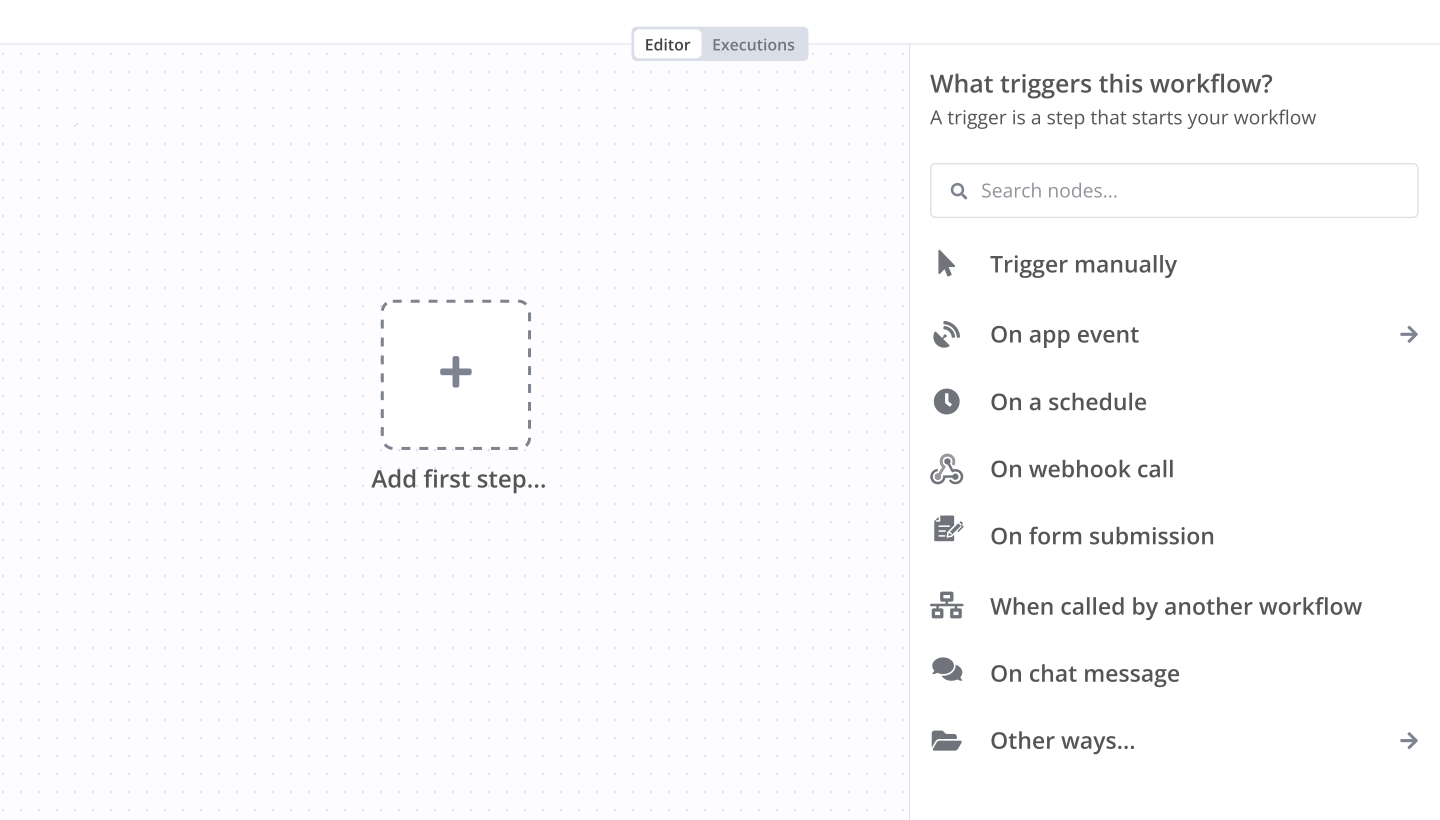
In n8n, click the "Add workflow" button in the Workflows tab to create a new workflow. Add the starting point – a trigger on when your workflow should run: an app event, a schedule, a webhook call, another workflow, an AI chat, or a manual trigger. Sometimes, the HTTP Request node might already serve as your starting point.

Webhook and Todoist integration: Create a new workflow and add the first step

Step 2: Add and configure Webhook and Todoist nodes

You can find Webhook and Todoist in the nodes panel. Drag them onto your workflow canvas, selecting their actions. Click each node, choose a credential, and authenticate to grant n8n access. Configure Webhook and Todoist nodes one by one: input data on the left, parameters in the middle, and output data on the right.

Webhook and Todoist integration: Add and configure Webhook and Todoist nodes

Step 3: Connect Webhook and Todoist

A connection establishes a link between Webhook and Todoist (or vice versa) to route data through the workflow. Data flows from the output of one node to the input of another. You can have single or multiple connections for each node.

Webhook and Todoist integration: Connect Webhook and Todoist

Step 4: Customize and extend your Webhook and Todoist integration

Use n8n's core nodes such as If, Split Out, Merge, and others to transform and manipulate data. Write custom JavaScript or Python in the Code node and run it as a step in your workflow. Connect Webhook and Todoist with any of n8n’s 1000+ integrations, and incorporate advanced AI logic into your workflows.

Webhook and Todoist integration: Customize and extend your Webhook and Todoist integration

Step 5: Test and activate your Webhook and Todoist workflow

Save and run the workflow to see if everything works as expected. Based on your configuration, data should flow from Webhook to Todoist or vice versa. Easily debug your workflow: you can check past executions to isolate and fix the mistake. Once you've tested everything, make sure to save your workflow and activate it.

Webhook and Todoist integration: Test and activate your Webhook and Todoist workflow

Realtime Notion Todoist 2-way sync with Redis

Purpose

This solution enables you to manage all your Notion and Todoist tasks from different workspaces as well as your calendar events in a single place.

All tasks can be managed in Todoist and additionally Fantastical can be used to manage scheduled tasks & events all together.

Demo & Explanation

How it works

The realtime sync consists of two workflows, both triggered by a registered webhook from either Notion or Todoist
To avoid overwrites by lately arriving webhook calls, every time the current task is retrieved from both sides.
Redis is used to prevent from endless loops, since an update in one system triggers another webhook call again. Using the ID of the task, the trigger is being locked down for 15 seconds.
Depending on the detected changes, the other side is updated accordingly.
Generally Notion is treaded as the main source. Using an "Obsolete" Status, it is guaranteed, that tasks never get deleted entirely by accident.
The Todoist ID is stored in the Notion task, so they stay linked together
An additional full sync workflow daily fixes inconsistencies, if any of them occurred, since webhooks cannot be trusted entirely.
Since Todoist requires a more complex setup, a tiny workflow helps with activating the webhook.
Another tiny workflow helps generating a global config, which is used by all workflows for mapping purposes.

Mapping (Notion >> Todoist)

Name: Task Name
Priority: Priority (1: do first, 2: urgent, 3: important, 4: unset)
Due: Date
Status: Section (Done: completed, Obsolete: deleted)
<page_link>: Description (read-only)
Todoist ID: <task_id>

Current limitations

Changes on the same task cannot be made simultaneously in both systems within a 15-20 second time frame
Subtasks are not linked automatically to their parent yet
Recurring tasks are not supported yet
Tasks names do not support URL’s yet

Compatibility
n8n v2.5.0 and above

Updates
This templated has been updated to work with the new "combined" Todoist API (v1). The general flow works exactly the same as before. Only the setup of the Todoist Webhook might look a tiny bit different then shown in the setup video, so please also have a look at the yellow sticky notes.

Prerequisites

Notion
A database must already exist (get a basic template here) with the following properties (case matters!):
Text: "Name"
Status: "Status", containing at least the options "Backlog", "In progress", "Done", "Obsolete"
Select: "Priority", containing the options "do first", "urgent", "important"
Date: "Due"
Checkbox: "Focus"
Text: "Todoist ID"
Todoist
A project must already exist with the same sections like defined as Status in Notion (except Done and Obsolete)
Redis
Create a Free Redis Cloud instance or self-host

Setup

The setup involves quite a lot of steps, yet many of them can be automated for business internal purposes.

Just follow the video or do the following steps:
Setup credentials for Notion (access token), Todoist (access token) and Redis - you can also create empty credentials and populate these later during further setup
Clone this workflow by clicking the "Use workflow" button and then choosing your n8n instance - otherwise you need to map the credentials of many nodes.
Follow the instructions described within the bundle of sticky notes on the top left of the workflow

How to use

You can apply changes (create, update, delete) to tasks both in Notion and Todoist which then get synced over within a couple of seconds (this is handled by the differential realtime sync)
The daily running full sync, resolves possible discrepancies in Todoist and sends a summary via email, if anything needed to be updated. In case that contains an unintended change, you can jump to the Task from the email directly to fix it manually.

Nodes used in this workflow

Popular Webhook and Todoist workflows

+3

Realtime Notion Todoist 2-way Sync with Redis

Purpose This solution enables you to manage all your Notion and Todoist tasks from different workspaces as well as your calendar events in a single place. All tasks can be managed in Todoist and additionally Fantastical can be used to manage scheduled tasks & events all together. Demo & Explanation How it works The realtime sync consists of two workflows, both triggered by a registered webhook from either Notion or Todoist To avoid overwrites by lately arriving webhook calls, every time the current task is retrieved from both sides. Redis is used to prevent from endless loops, since an update in one system triggers another webhook call again. Using the ID of the task, the trigger is being locked down for 15 seconds. Depending on the detected changes, the other side is updated accordingly. Generally Notion is treaded as the main source. Using an "Obsolete" Status, it is guaranteed, that tasks never get deleted entirely by accident. The Todoist ID is stored in the Notion task, so they stay linked together An additional full sync workflow daily fixes inconsistencies, if any of them occurred, since webhooks cannot be trusted entirely. Since Todoist requires a more complex setup, a tiny workflow helps with activating the webhook. Another tiny workflow helps generating a global config, which is used by all workflows for mapping purposes. Mapping (Notion >> Todoist) Name: Task Name Priority: Priority (1: do first, 2: urgent, 3: important, 4: unset) Due: Date Status: Section (Done: completed, Obsolete: deleted) <page_link>: Description (read-only) Todoist ID: <task_id> Current limitations Changes on the same task cannot be made simultaneously in both systems within a 15-20 second time frame Subtasks are not linked automatically to their parent yet Recurring tasks are not supported yet Tasks names do not support URL’s yet Compatibility n8n v2.5.0 and above Updates This templated has been updated to work with the new "combined" Todoist API (v1). The general flow works exactly the same as before. Only the setup of the Todoist Webhook might look a tiny bit different then shown in the setup video, so please also have a look at the yellow sticky notes. Prerequisites Notion A database must already exist (get a basic template here) with the following properties (case matters!): Text: "Name" Status: "Status", containing at least the options "Backlog", "In progress", "Done", "Obsolete" Select: "Priority", containing the options "do first", "urgent", "important" Date: "Due" Checkbox: "Focus" Text: "Todoist ID" Todoist A project must already exist with the same sections like defined as Status in Notion (except Done and Obsolete) Redis Create a Free Redis Cloud instance or self-host Setup The setup involves quite a lot of steps, yet many of them can be automated for business internal purposes. Just follow the video or do the following steps: Setup credentials for Notion (access token), Todoist (access token) and Redis - you can also create empty credentials and populate these later during further setup Clone this workflow by clicking the "Use workflow" button and then choosing your n8n instance - otherwise you need to map the credentials of many nodes. Follow the instructions described within the bundle of sticky notes on the top left of the workflow How to use You can apply changes (create, update, delete) to tasks both in Notion and Todoist which then get synced over within a couple of seconds (this is handled by the differential realtime sync) The daily running full sync, resolves possible discrepancies in Todoist and sends a summary via email, if anything needed to be updated. In case that contains an unintended change, you can jump to the Task from the email directly to fix it manually.

Sync tasks between Todoist and Notion with Redis-powered 2-way logic

Purpose This solution enables you to manage all your Notion and Todoist tasks from different workspaces as well as your calendar events in a single place. This is 2 way sync with partial support for recurring How it works The realtime sync consists of two workflows, both triggered by a registered webhook from either Notion or Todoist. To avoid overwrites by lately arriving webhook calls, every time the current task is retrieved from both sides. Redis is used to prevent from endless loops, since an update in one system triggers another webhook call again. Using the ID of the task, the trigger is being locked down for 80 seconds. Depending on the detected changes, the other side is updated accordingly .Generally Notion is treaded as the main source. Using an "Obsolete" Status, it is guaranteed, that tasks never get deleted entirely by accident. The Todoist ID is stored in the Notion task, so they stay linked together An additional full sync workflow daily fixes inconsistencies, if any of them occurred, since webhooks cannot be trusted entirely. Since Todoist requires a more complex setup, a tiny workflow helps with activating the webhook. Another tiny workflow helps generating a global config, which is used by all workflows for mapping purposes. Mapping (Notion >> Todoist) Name: Task Name Priority: Priority (1: do first, 2: urgent, 3: important, 4: unset) Due: Date Status: Section (Done: completed, Obsolete: deleted) <page_link>: Description (read-only) Todoist ID: <task_id> Current limitations Changes on the same task cannot be made simultaneously in both systems within a 15-20 second time frame. Subtasks are not linked automatically to their parent yet. Tasks names do not support URL’s yet. Credentials Follow the video: Setup credentials for Notion (access token), Todoist (access token) and Redis. Todoist Follow this video to get Todoist to obtain API Token. Todoist Credentials.mp4 Notion Follow this video to get Notion Integration Secret. Redis Follow this video to get Redis Setup The setup involves quite a lot of steps, yet many of them can be automated for business internal purposes. Just follow the video or do the following steps: Setup credentials for Notion (access token), Todoist (access token) and Redis - you can also create empty credentials and populate these later during further setup Clone this workflow by clicking the "Use workflow" button and then choosing your n8n instance - otherwise you need to map the credentials of many nodes. Follow the instructions described within the bundle of sticky notes on the top left of the workflow How to use You can apply changes (create, update, delete) to tasks both in Notion and Todoist which then get synced over within a couple of seconds (this is handled by the differential realtime sync) The daily running full sync, resolves possible discrepancies in Todoist. This workflow incorporates ideas and techniques inspired by Mario (https://n8n.io/creators/octionic/) whose expertise with specific nodes helped shape parts of this automation. Significant enhancements and customizations have been made to deliver a unique and improved solution.

Sync tasks between Notion and Todoist in both directions with Redis

Purpose This solution enables you to manage all your Notion and Todoist tasks from different workspaces as well as your calendar events in a single place. This is 2 way sync with partial support for recurring How it works The realtime sync consists of two workflows, both triggered by a registered webhook from either Notion or Todoist. To avoid overwrites by lately arriving webhook calls, every time the current task is retrieved from both sides. Redis is used to prevent from endless loops, since an update in one system triggers another webhook call again. Using the ID of the task, the trigger is being locked down for 80 seconds. Depending on the detected changes, the other side is updated accordingly .Generally Notion is treaded as the main source. Using an "Obsolete" Status, it is guaranteed, that tasks never get deleted entirely by accident. The Todoist ID is stored in the Notion task, so they stay linked together An additional full sync workflow daily fixes inconsistencies, if any of them occurred, since webhooks cannot be trusted entirely. Since Todoist requires a more complex setup, a tiny workflow helps with activating the webhook. Another tiny workflow helps generating a global config, which is used by all workflows for mapping purposes. Mapping (Notion >> Todoist) Name: Task Name Priority: Priority (1: do first, 2: urgent, 3: important, 4: unset) Due: Date Status: Section (Done: completed, Obsolete: deleted) <page_link>: Description (read-only) Todoist ID: <task_id> Current limitations Changes on the same task cannot be made simultaneously in both systems within a 15-20 second time frame. Subtasks are not linked automatically to their parent yet. Tasks names do not support URL’s yet. Credentials Follow the video: Setup credentials for Notion (access token), Todoist (access token) and Redis. Todoist Follow this video to get Todoist to obtain API Token. Todoist Credentials.mp4 Notion Follow this video to get Notion Integration Secret. Redis Follow this video to get Redis Setup The setup involves quite a lot of steps, yet many of them can be automated for business internal purposes. Just follow the video or do the following steps: Setup credentials for Notion (access token), Todoist (access token) and Redis - you can also create empty credentials and populate these later during further setup Clone this workflow by clicking the "Use workflow" button and then choosing your n8n instance - otherwise you need to map the credentials of many nodes. Follow the instructions described within the bundle of sticky notes on the top left of the workflow How to use You can apply changes (create, update, delete) to tasks both in Notion and Todoist which then get synced over within a couple of seconds (this is handled by the differential realtime sync) The daily running full sync, resolves possible discrepancies in Todoist. This workflow incorporates ideas and techniques inspired by Mario (https://n8n.io/creators/octionic/) whose expertise with specific nodes helped shape parts of this automation. Significant enhancements and customizations have been made to deliver a unique and improved solution.

Track & Alert Public Transport Delays using ScrapeGraphAI, Teams and Todoist

Public Transport Delay Tracker with Microsoft Teams and Todoist ⚠️ COMMUNITY TEMPLATE DISCLAIMER: This is a community-contributed template that uses ScrapeGraphAI (a community node). Please ensure you have the ScrapeGraphAI community node installed in your n8n instance before using this template. This workflow continuously monitors public-transportation websites and apps for real-time schedule changes and delays, then posts an alert to a Microsoft Teams channel and creates a follow-up task in Todoist. It is ideal for commuters or travel coordinators who need instant, actionable updates about transit disruptions. Pre-conditions/Requirements Prerequisites An n8n instance (self-hosted or n8n cloud) ScrapeGraphAI community node installed Microsoft Teams account with permission to create an Incoming Webhook Todoist account with at least one project Access to target transit authority websites or APIs Required Credentials ScrapeGraphAI API Key** – Enables scraping of transit data Microsoft Teams Webhook URL** – Sends messages to a specific channel Todoist API Token** – Creates follow-up tasks (Optional) Transit API key if you are using a protected data source Specific Setup Requirements | Resource | What you need | |--------------------------|---------------------------------------------------------------| | Teams Channel | Create a channel → Add “Incoming Webhook” → copy the URL | | Todoist Project | Create “Transit Alerts” project and note its Project ID | | Transit URLs/APIs | Confirm the URLs/pages contain the schedule & delay elements | How it works This workflow continuously monitors public-transportation websites and apps for real-time schedule changes and delays, then posts an alert to a Microsoft Teams channel and creates a follow-up task in Todoist. It is ideal for commuters or travel coordinators who need instant, actionable updates about transit disruptions. Key Steps: Webhook (Trigger)**: Starts the workflow on a schedule or via HTTP call. Set Node**: Defines target transit URLs and parsing rules. ScrapeGraphAI Node**: Scrapes live schedule and delay data. Code Node**: Normalizes scraped data, converts times, and flags delays. IF Node**: Determines if a delay exceeds the user-defined threshold. Microsoft Teams Node**: Sends formatted alert message to the selected Teams channel. Todoist Node**: Creates a “Check alternate route” task with due date equal to the delayed departure time. Sticky Note Node**: Holds a blueprint-level explanation for future editors. Set up steps Setup Time: 15–20 minutes Install community node: In n8n, go to “Manage Nodes” → “Install” → search for “ScrapeGraphAI” → install and restart n8n. Create Teams webhook: In Microsoft Teams, open target channel → “Connectors” → “Incoming Webhook” → give it a name/icon → copy the URL. Create Todoist API token: Todoist → Settings → Integrations → copy your personal API token. Add credentials in n8n: Settings → Credentials → create new for ScrapeGraphAI, Microsoft Teams, and Todoist. Import workflow template: File → Import Workflow JSON → select this template. Configure Set node: Replace example transit URLs with those of your local transit authority. Adjust delay threshold: In the Code node, edit const MAX_DELAY_MINUTES = 5; as needed. Activate workflow: Toggle “Active”. Monitor executions to ensure messages and tasks are created. Node Descriptions Core Workflow Nodes: Webhook** – Triggers workflow on schedule or external HTTP request. Set** – Supplies list of URLs and scraping selectors. ScrapeGraphAI** – Scrapes timetable, status, and delay indicators. Code** – Parses results, converts to minutes, and builds payloads. IF** – Compares delay duration to threshold. Microsoft Teams** – Posts formatted adaptive-card-style message. Todoist** – Adds a task with priority and due date. Sticky Note** – Internal documentation inside the workflow canvas. Data Flow: Webhook → Set → ScrapeGraphAI → Code → IF a. IF (true branch) → Microsoft Teams → Todoist b. IF (false branch) → (workflow ends) Customization Examples Change alert message formatting // In the Code node const message = `⚠️ Delay Alert: Route: ${item.route} Expected: ${item.scheduled} New Time: ${item.newTime} Delay: ${item.delay} min Link: ${item.url}`; return [{ json: { message } }]; Post to multiple Teams channels // Duplicate the Microsoft Teams node and reference a different credential items.forEach(item => { item.json.webhookUrl = $node["Set"].json["secondaryChannelWebhook"]; }); return items; Data Output Format The workflow outputs structured JSON data: { "route": "Blue Line", "scheduled": "2024-12-01T14:25:00Z", "newTime": "2024-12-01T14:45:00Z", "delay": 20, "status": "Delayed", "url": "https://transit.example.com/blue-line/status" } Troubleshooting Common Issues Scraping returns empty data – Verify CSS selectors/XPath in the Set node and ensure the target site hasn’t changed its markup. Teams message not sent – Check that the stored webhook URL is correct and the connector is still active. Todoist task duplicated – Add a unique key (e.g., route + timestamp) to avoid inserting duplicates. Performance Tips Limit the number of URLs per execution when monitoring many routes. Cache previous scrape results to avoid hitting site rate limits. Pro Tips: Use n8n’s built-in Cron instead of Webhook if you only need periodic polling. Add a SplitInBatches node after scraping to process large route lists incrementally. Enable execution logging to an external database for detailed audit trails.
Build your own Webhook and Todoist integration

Create custom Webhook and Todoist workflows by choosing triggers and actions. Nodes come with global operations and settings, as well as app-specific parameters that can be configured. You can also use the HTTP Request node to query data from any app or service with a REST API.

Todoist supported actions

Close
Close a task
Create
Create a new task
Delete
Delete a task
Get
Get a task
Get Many
Get many tasks
Move
Move a task
Quick Add
Quick add a task using natural language
Reopen
Reopen a task
Update
Update a task
Archive
Archive a project
Create
Create a new project
Delete
Delete a project
Get
Get a project
Get Collaborators
Get project collaborators
Get Many
Get many projects
Unarchive
Unarchive a project
Update
Update a project
Create
Create a new section
Delete
Delete a section
Get
Get a section
Get Many
Get many sections
Update
Update a section
Create
Create a new comment
Delete
Delete a comment
Get
Get a comment
Get Many
Get many comments
Update
Update a comment
Create
Create a new label
Delete
Delete a label
Get
Get a label
Get Many
Get many labels
Update
Update a label
Create
Create a new reminder
Delete
Delete a reminder
Get Many
Get many reminders
Update
Update a reminder

Webhook and Todoist integration details

integrationWebhook node
Webhook

Webhooks are automatic notifications that apps send when something occurs. They are sent to a certain URL, which is effectively the app's phone number or address, and contain a message or payload. Polling is nearly never quicker than webhooks, and it takes less effort from you.

Use case

Save engineering resources

Reduce time spent on customer integrations, engineer faster POCs, keep your customer-specific functionality separate from product all without having to code.

Learn more

FAQs

  • Can Webhook connect with Todoist?

  • Can I use Webhook’s API with n8n?

  • Can I use Todoist’s API with n8n?

  • Is n8n secure for integrating Webhook and Todoist?

  • How to get started with Webhook and Todoist integration in n8n.io?

Need help setting up your Webhook and Todoist integration?

Discover our latest community's recommendations and join the discussions about Webhook and Todoist integration.
Benjamin Hatton
Albert Ashkhatoyan
Víctor González
Salomão
sg tech

Looking to integrate Webhook and Todoist in your company?

Over 3000 companies switch to n8n every single week

Why use n8n to integrate Webhook with Todoist

Build complex workflows, really fast

Build complex workflows, really fast

Handle branching, merging and iteration easily.
Pause your workflow to wait for external events.

Code when you need it, UI when you don't

Simple debugging

Your data is displayed alongside your settings, making edge cases easy to track down.

Use templates to get started fast

Use 1000+ workflow templates available from our core team and our community.

Reuse your work

Copy and paste, easily import and export workflows.
Implement complex processes faster with n8n

red iconyellow iconred iconyellow icon