Back to Integrations
integrationWebhook node
integrationWhatsApp Business Cloud node

Webhook and WhatsApp Business Cloud integration

Save yourself the work of writing custom integrations for Webhook and WhatsApp Business Cloud and use n8n instead. Build adaptable and scalable Development, Core Nodes, Communication, and HITL workflows that work with your technology stack. All within a building experience you will love.

How to connect Webhook and WhatsApp Business Cloud

  • Step 1: Create a new workflow
  • Step 2: Add and configure nodes
  • Step 3: Connect
  • Step 4: Customize and extend your integration
  • Step 5: Test and activate your workflow

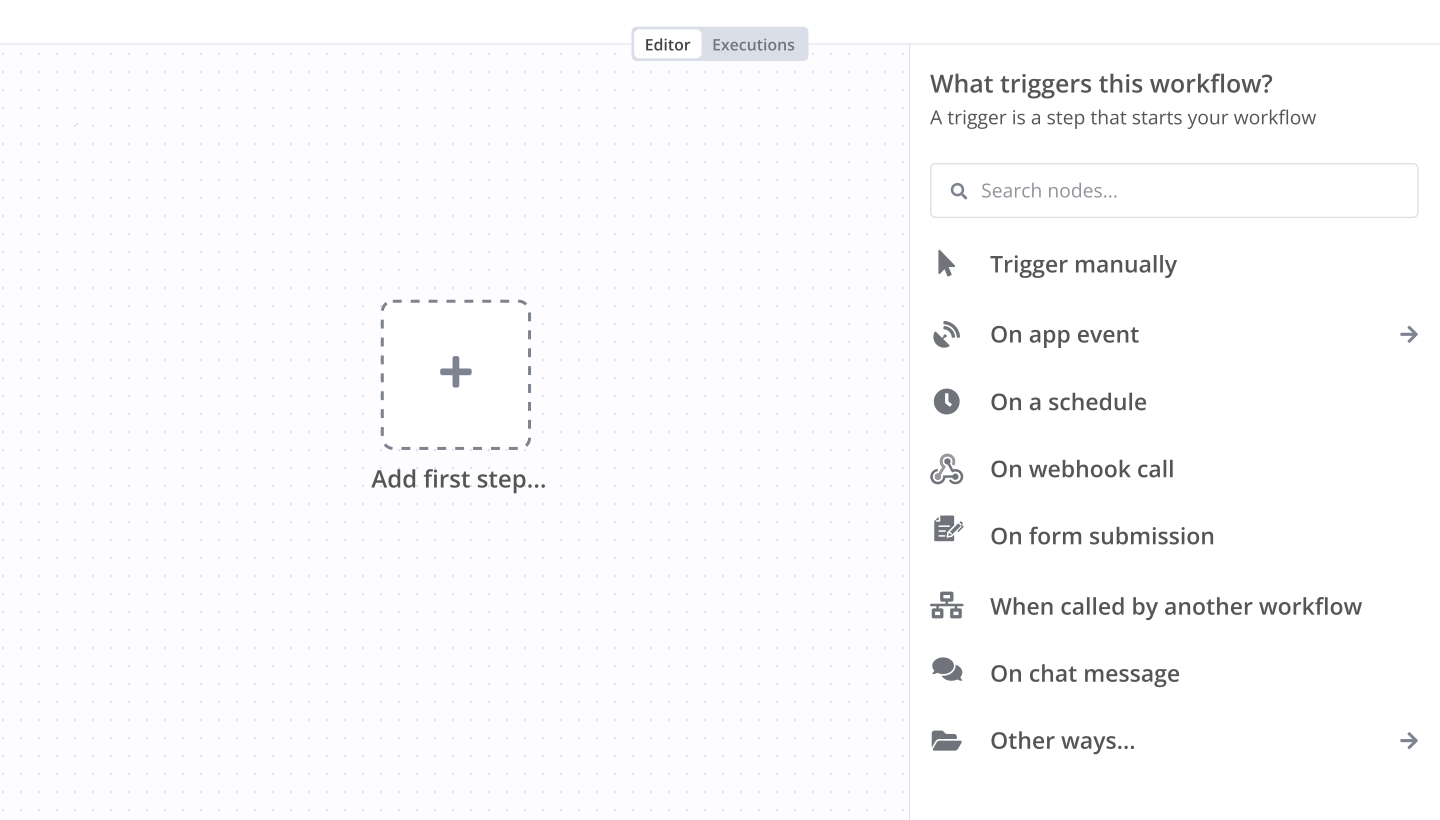
Step 1: Create a new workflow and add the first step

In n8n, click the "Add workflow" button in the Workflows tab to create a new workflow. Add the starting point – a trigger on when your workflow should run: an app event, a schedule, a webhook call, another workflow, an AI chat, or a manual trigger. Sometimes, the HTTP Request node might already serve as your starting point.

Webhook and WhatsApp Business Cloud integration: Create a new workflow and add the first step

Step 2: Add and configure Webhook and WhatsApp Business Cloud nodes

You can find Webhook and WhatsApp Business Cloud in the nodes panel. Drag them onto your workflow canvas, selecting their actions. Click each node, choose a credential, and authenticate to grant n8n access. Configure Webhook and WhatsApp Business Cloud nodes one by one: input data on the left, parameters in the middle, and output data on the right.

Webhook and WhatsApp Business Cloud integration: Add and configure Webhook and WhatsApp Business Cloud nodes

Step 3: Connect Webhook and WhatsApp Business Cloud

A connection establishes a link between Webhook and WhatsApp Business Cloud (or vice versa) to route data through the workflow. Data flows from the output of one node to the input of another. You can have single or multiple connections for each node.

Webhook and WhatsApp Business Cloud integration: Connect Webhook and WhatsApp Business Cloud

Step 4: Customize and extend your Webhook and WhatsApp Business Cloud integration

Use n8n's core nodes such as If, Split Out, Merge, and others to transform and manipulate data. Write custom JavaScript or Python in the Code node and run it as a step in your workflow. Connect Webhook and WhatsApp Business Cloud with any of n8n’s 1000+ integrations, and incorporate advanced AI logic into your workflows.

Webhook and WhatsApp Business Cloud integration: Customize and extend your Webhook and WhatsApp Business Cloud integration

Step 5: Test and activate your Webhook and WhatsApp Business Cloud workflow

Save and run the workflow to see if everything works as expected. Based on your configuration, data should flow from Webhook to WhatsApp Business Cloud or vice versa. Easily debug your workflow: you can check past executions to isolate and fix the mistake. Once you've tested everything, make sure to save your workflow and activate it.

Webhook and WhatsApp Business Cloud integration: Test and activate your Webhook and WhatsApp Business Cloud workflow

Complete business WhatsApp AI-powered RAG chatbot using OpenAI

The provided workflow in n8n is designed to create a Business WhatsApp AI RAG (Retrieval-Augmented Generation) Chatbot.

How it works:
Webhook Setup: The workflow begins by setting up webhooks for verification and response. The Verify webhook receives GET requests and sends back a verification code, while the Respond webhook handles incoming POST requests from Meta regarding WhatsApp messages.
Message Handling: Once a message is received, the workflow checks if the incoming JSON contains a user message. If it does, the message is processed further; otherwise, a generic response is sent.
AI Agent Interaction: The user's message is passed to the AI Agent node, which uses a conversational agent with a predefined system message tailored for an electronics store. This ensures that the AI provides accurate and professional responses based on the knowledge base.
Knowledge Base Utilization: The AI Agent references a knowledge base stored in Qdrant, a vector database. Documents from Google Drive are downloaded, vectorized using OpenAI embeddings, and stored in Qdrant for retrieval during conversations.
Response Generation: The AI Agent generates a response using the OpenAI chat model (gpt-4o-mini) and sends it back to the user via WhatsApp.

Set up steps:
Create Qdrant Collection:
Update the QDRANTURL and COLLECTION variables in the workflow.
Use the Create collection HTTP request node to initialize the collection in Qdrant.

Vectorize Documents:
Configure the Get folder and Download Files nodes to fetch documents from a specified Google Drive folder.
Use the Embeddings OpenAI node to generate embeddings for the downloaded files.
Store the vectorized documents in Qdrant using the Qdrant Vector Store node.

Configure Webhooks:
Ensure both Verify and Respond webhooks have the same URL.
Set the Verify webhook to use the GET HTTP method and the Respond webhook to use the POST HTTP method.

Set Up AI Agent:
Define the system prompt for the AI Agent, specifying guidelines for product information, technical support, customer service, and knowledge base usage.
Link the AI Agent to the OpenAI chat model and configure any additional tools as needed.

Test Workflow:
Trigger the workflow manually using the When clicking ‘Test workflow’ node to ensure all components are functioning correctly.
Monitor the flow of data through the nodes and verify that responses are being generated and sent accurately.

By following these steps, the workflow will be fully operational, enabling a robust AI-powered chatbot capable of handling customer inquiries via WhatsApp.

Need help customizing?
Contact me for consulting and support or add me on Linkedin.

Nodes used in this workflow

Popular Webhook and WhatsApp Business Cloud workflows

Summarize Calls & Notify Teams via HubSpot, Slack, Email, WhatsApp

This workflow automates the process of handling conversation transcriptions and distributing key information across your organization. Here's what it does: Trigger: The workflow is initiated via a webhook that receives a transcription (e.g., from a call or meeting). Summarization & Extraction: Using AI, the transcription is summarized, and key information is extracted — such as action items, departments involved, and client details. Department Notifications: The relevant summarized information is automatically routed to specific departments via email based on content classification. CRM Sync: The summarized version is saved to the associated contact or deal in HubSpot for future reference and visibility. *Multi-Channel Alerts: *The summary is also sent via WhatsApp and Slack to keep internal teams instantly informed, regardless of platform. Use Case: Ideal for sales, customer service, or operations teams who manage client conversations and want to ensure seamless cross-departmental communication, documentation, and follow-up. Apps Used: Webhook (Trigger) OpenAI (or other AI/NLP for summarization) HubSpot Email Slack WhatsApp (via Twilio or third-party provider)
+7

AI Sales Agent: WhatsApp, FB, IG, OpenAI, Airtable, Supabase Auto-Booking

This workflow automates multi-channel AI-driven sales engagement for lead qualification, service information delivery, and consultation booking. It integrates WhatsApp, Facebook Messenger, Instagram DM, and an n8n chat interface with a backend CRM (Airtable), a knowledge base (Supabase), and conversational AI (OpenAI), all orchestrated by n8n. Tools & Services Used Messaging Platforms: WhatsApp, Facebook Messenger, Instagram DM, n8n Built-in Chat AI Core & Processing: OpenAI (GPT-4o for main agent logic, Whisper for audio transcription) CRM & Data Management: Airtable (for initial WhatsApp lead lookup, lead form submissions, and as the backend for the crmAgent sub-workflow operations) Knowledge Base: Supabase (Vector Store for technical_and_sales_knowledge tool) Chat Memory: PostgreSQL (for the main AI Agent's conversation history) Orchestration & Automation: n8n (Self-hosted, utilizing Langchain community nodes) Calendar Service: Integrated via the calendarAgent sub-workflow CRM Service: Integrated via the crmAgent sub-workflow (interacting with Airtable) Workflow Overview This automation performs the following steps: Trigger: A new interaction is initiated through one of the following channels: A new message is received via the WhatsApp Trigger. A new message is received via the Facebook Trigger (Webhook). A new message is received via the Instagram Trigger (Webhook). A new message is received via the n8n Chat Trigger. Alternatively, a new lead is submitted via the Airtable Form Submitted Webhook. Channel-Specific Ingestion & Pre-processing: For WhatsApp: The system attempts to find an existing lead in Airtable using the sender's phone number. Incoming messages are routed by the Handle Message Types switch: Text messages are passed to the Edit Fields - chat1 node to prepare input for the AI Agent, including any found lead information. Audio messages are processed: the WhatsApp Business Cloud node gets the media URL, the HTTP Request node downloads the audio, OpenAI transcribes it to text, and Edit Fields - chat2 prepares this transcribed text and lead information for the AI Agent. Unsupported message types trigger the Reply To User1 node to send a notification that the message type cannot be processed. For Facebook Messenger: The system responds to webhook verification (Respond to Webhook - facebook get) and acknowledges new messages (Respond to Webhook - facebook post). The If is not echo - facebook node filters out messages sent by the page. The Sales Agent Demo - typing_on node sends a typing indicator. The Edit Fields - facebook node prepares the message text, sender ID, and Facebook-specific context for the AI Agent. For Instagram DM: The system responds to webhook verification (Respond to Webhook - instagram get) and acknowledges new messages (Respond to Webhook - instagram post). The If is not echo - instagram node filters out messages sent by the business account. The Edit Fields - instagram node prepares the message text, sender ID, and Instagram-specific context for the AI Agent. For n8n Chat: The Edit Fields - chat node prepares the user's input and session information for the AI Agent. Input Aggregation for AI Agent: Processed data from all active messaging channels (WhatsApp text/audio, Facebook, Instagram, n8n Chat) is funneled through the No Operation, do nothing node to the main AI Agent. AI Sales Conversation & Tool Utilization: The AI Agent (using OpenAI Chat Model - GPT-4o, and Postgres Chat Memory) engages the user according to its system prompt, aiming to qualify them for Paint Protection Film (PPF), Ceramic Coating, or Window Tint. The AI Agent uses the technical_and_sales_knowledge tool (which queries the Demo Supabase vector store via Embeddings OpenAI and OpenAI Chat Model1) to provide service details and answer questions. The AI Agent uses the crmAgent tool (a sub-workflow) to log contact details (Name, Email, service interest) and update opportunity statuses in Airtable. The AI Agent uses the calendarAgent tool (a sub-workflow) to book consultation appointments once preferred dates/times are provided. This occurs after contact details are logged in the CRM. Response Delivery: The AI Agent's final textual response is passed to the Switch node. The Switch node routes the response to the appropriate node for delivery on the original channel: Reply To User for WhatsApp. Facebook Graph API - Sales Agent Demo for Facebook Messenger. Instagram Graph API - smb.sales.agent.demo for Instagram DM. Output - chat for the n8n Chat interface. Airtable Form Submission Processing (Separate Branch): When the Airtable Form Submitted webhook receives data, the Airtable node fetches the full record. The Create Contact node creates a new contact in the Airtable 'Contacts' table. The Edit Fields - form node prepares data for a notification. The WhatsApp Business Cloud2 node sends a templated WhatsApp message to the lead, confirming their form submission.
+6

Complete business WhatsApp AI-Powered RAG Chatbot using OpenAI

The provided workflow in n8n is designed to create a Business WhatsApp AI RAG (Retrieval-Augmented Generation) Chatbot. How it works: Webhook Setup: The workflow begins by setting up webhooks for verification and response. The Verify webhook receives GET requests and sends back a verification code, while the Respond webhook handles incoming POST requests from Meta regarding WhatsApp messages. Message Handling: Once a message is received, the workflow checks if the incoming JSON contains a user message. If it does, the message is processed further; otherwise, a generic response is sent. AI Agent Interaction: The user's message is passed to the AI Agent node, which uses a conversational agent with a predefined system message tailored for an electronics store. This ensures that the AI provides accurate and professional responses based on the knowledge base. Knowledge Base Utilization: The AI Agent references a knowledge base stored in Qdrant, a vector database. Documents from Google Drive are downloaded, vectorized using OpenAI embeddings, and stored in Qdrant for retrieval during conversations. Response Generation: The AI Agent generates a response using the OpenAI chat model (gpt-4o-mini) and sends it back to the user via WhatsApp. Set up steps: Create Qdrant Collection: Update the QDRANTURL and COLLECTION variables in the workflow. Use the Create collection HTTP request node to initialize the collection in Qdrant. Vectorize Documents: Configure the Get folder and Download Files nodes to fetch documents from a specified Google Drive folder. Use the Embeddings OpenAI node to generate embeddings for the downloaded files. Store the vectorized documents in Qdrant using the Qdrant Vector Store node. Configure Webhooks: Ensure both Verify and Respond webhooks have the same URL. Set the Verify webhook to use the GET HTTP method and the Respond webhook to use the POST HTTP method. Set Up AI Agent: Define the system prompt for the AI Agent, specifying guidelines for product information, technical support, customer service, and knowledge base usage. Link the AI Agent to the OpenAI chat model and configure any additional tools as needed. Test Workflow: Trigger the workflow manually using the When clicking ‘Test workflow’ node to ensure all components are functioning correctly. Monitor the flow of data through the nodes and verify that responses are being generated and sent accurately. By following these steps, the workflow will be fully operational, enabling a robust AI-powered chatbot capable of handling customer inquiries via WhatsApp. Need help customizing? Contact me for consulting and support or add me on Linkedin.
+4

Recover Shopify Abandoned Carts with Email, SMS, WhatsApp & Facebook Retargeting

This workflow is a complete, production-ready solution for recovering abandoned carts in Shopify stores using a multi-channel, multi-touch approach. It automates personalized follow-ups via Email, SMS, and WhatsApp, tracks every customer interaction for multi-touch attribution, and enables advanced retargeting and analytics. Key features: Multi-step, timed recovery sequence (Email → SMS → Email → WhatsApp) Customer segmentation (new, returning, VIP) and A/B testing Dynamic discounting and personalized messaging Touchpoint logging to Google Sheets for attribution analysis Facebook Custom Audience retargeting for unrecovered carts Slack notifications for high-value cart recoveries What does this workflow do? Listens for abandoned cart events from Shopify (or any e-commerce platform) via webhook. Normalizes and enriches cart data by fetching full cart details and customer purchase history. Predicts the likely reason for abandonment (e.g., price sensitivity, checkout complexity, technical issues) using rule-based logic. Segments the customer (new, returning, VIP), assigns an A/B test group, and generates a personalized discount and checkout URL. Runs a timed, multi-channel recovery sequence: 1 hour after abandonment: Checks if the order is completed. If not, sends a personalized Email #1 and logs the touchpoint. 4 hours after abandonment: Checks again. If not recovered, sends an SMS with a discount code and logs the touchpoint. 24 hours after abandonment: Checks again. If not recovered, sends Email #2 (with social proof/urgency) and logs the touchpoint. 48 hours after abandonment: Final check. If not recovered, sends a WhatsApp reminder and logs the touchpoint. If the cart is still not recovered: Hashes customer identifiers and adds them to a Facebook Custom Audience for retargeting. Logs every touchpoint (email, SMS, WhatsApp) to a Google Sheet for multi-touch attribution analysis. Sends a Slack notification if a high-value cart is recovered. Why is this workflow useful? Boosts recovery rates:** By using multiple channels and personalized timing, you maximize the chance of recovering lost sales. Improves attribution:** Every customer interaction is logged, so you can analyze which channels and messages drive conversions. Enables advanced retargeting:** Unrecovered carts are automatically added to a Facebook Custom Audience for paid retargeting. Saves time:** Fully automated, with easy configuration for your store, messaging, and analytics. Scalable and extensible:** Easily adapt the sequence, add more channels, or integrate with other tools. How to install and configure Prerequisites n8n instance (v2.0.2+ recommended) Shopify store with API access Accounts and API credentials for: SendGrid (email) Twilio (SMS) WhatsApp Business API Google Sheets (service account) Facebook Graph API (for Custom Audiences) Slack (for notifications) Setup steps Import the workflow into your n8n instance. Configure the “Workflow Configuration” node: Set your Shopify domain, API URLs, Google Sheets ID, and high-value threshold. Connect all required credentials in the respective nodes: Shopify, SendGrid, Twilio, WhatsApp, Google Sheets, Facebook Graph API, Slack. Create a Google Sheet named “Touchpoints” with columns: cart_id, customer_id, touchpoint_type, timestamp, channel, ab_group. Set up the webhook in your Shopify store (or e-commerce platform) to trigger the workflow on cart abandonment. Test the workflow with a sample abandoned cart event to ensure emails, SMS, WhatsApp, and logging work as expected. Enable the workflow in n8n for live operation. Node-by-node breakdown Abandoned Cart Webhook:** Receives abandoned cart events. Workflow Configuration:** Stores global settings (API URLs, Shopify domain, Google Sheets ID, high-value threshold). Normalize Cart Data:** Cleans and standardizes incoming cart data. Fetch Cart Details / Fetch Customer History:** Enriches data with full cart and customer info. Predict Abandonment Reason:** Uses business logic to guess why the cart was abandoned. Personalization Engine:** Segments the customer, assigns A/B group, calculates discount, and builds checkout URL. Customer Segment Check / Device Type Check:** Applies routing logic for personalized messaging. Wait / Check Order Status / Generate & Send Messages:** Timed sequence for Email, SMS, and WhatsApp, with order status checks at each step. Log Touchpoint (Google Sheets):** Records every message sent for attribution. Attribution Merge:** Combines all touchpoints into a single journey for analysis. Hash Customer Data for Facebook / Add to Retargeting Audience:** Adds unrecovered carts to a Facebook Custom Audience. Check Cart Value Threshold / Notify High-Value Recovery:** Sends Slack alerts for high-value recoveries. Customization tips Adjust wait times and message content to fit your brand and audience. Add or remove channels (e.g., push notifications, phone calls) as needed. Expand the Google Sheet for deeper analytics (e.g., add UTM parameters, campaign IDs). Integrate with your CRM or analytics platform for end-to-end tracking. Troubleshooting Make sure all API credentials are set and tested. Check Google Sheets permissions for the service account. Test each channel (email, SMS, WhatsApp) individually before going live. Review the workflow execution logs in n8n for errors or failed steps.

Classify Lead Sentiment with Google Gemini and Send WhatsApp Responses via Typeform & Supabase

Automatically classify incoming leads based on the sentiment of their message using Google Gemini, store them in Supabase by category, and send tailored WhatsApp messages via the official WhatsApp Cloud API. ✅ Use Case: This workflow is ideal for sales, onboarding, and customer support teams who want to: Understand the tone and urgency of each lead Prioritize hot leads instantly Send smart, automatic WhatsApp replies based on user sentiment 🧠 How it works: Capture lead via a Typeform webhook Clean and structure the data (name, email, message, etc.) Run sentiment analysis using Google Gemini to classify the message as: Positive → Hot Lead Neutral → Warm Lead Negative → Cold Lead Store lead data in Supabase under the corresponding category Merge data to unify flow paths Send WhatsApp message using the official WhatsApp Cloud API, with a custom reply for each sentiment result 🔧 Tools used: Typeform (incoming data) Google Gemini (AI-based sentiment classification) Supabase (database) WhatsApp Cloud API (response automation) 🏷 Tags: AI, Sentiment Analysis, Lead Qualification, Supabase, WhatsApp, Gemini, Typeform, CRM, Automation, Customer Engagement
+3

Multi-Source News Curator with Mistral AI Analysis, Summaries & Custom Channels

Flexible News Curator - Multi-Sources, AI Analysis, Summaries, Translation, and Settable Channels 🎬 Overview The Flexible News Curator workflow can automate the collection, filtering, AI-driven analysis, and summarization of news from diverse sources of your interest. Using customizable search themes, RSS feeds, and (optional) video descriptions, it delivers concise, quality news summaries via configurable channels. This workflow is designed to help reduce information overload and keep you updated effortlessly. Click the image below to watch the video guide: ✨ Features Multi-Source News Aggregation**: Collect news from customizable RSS feeds, SerpAPI, and Video Channel Feeds (if enabled). AI-Powered News Selection \& Summarization**: Uses advanced AI agents (Mistral Cloud Chat Model by default) to select, analyze, and summarize top news. Quality Assurance Step**: Optional AI-powered filtering to improve news selection quality before analysis. Multi-Language Translation \& Tone Customization**: Translate summaries and customize tone for localized or tailored consumption. Multi-Channel Delivery**: Send outputs via Email, Telegram, WhatsApp, Webhook, or save to disk. Advanced Filtering**: Regex-based filtering on URLs, titles, and content to exclude unwanted articles. Sub-Workflow Architecture**: Modular handling of video transcripts, content retrieval, multi-theme searching, and more. Flexible Scheduling \& Trigger Options**: Supports schedule-based triggering, email (IMAP) triggers, and webhook-based activation. (Optional) Video Search**: Video content descriptions via Video Channel Feeds. 👤 Who is this for? This workflow benefits professionals, researchers, marketers, and anyone who needs to stay informed about specific news themes without wasting time on irrelevant information or reading too many news to select the most interesting ones. 💡 What problem does this solve? The workflow tackles the challenge of information overload by automatically filtering, summarizing, and delivering the essential news tailored to your interests and preferences. It integrates various data sources and channels for comprehensive yet efficient news consumption. Ideal use-cases include: Monitoring breakthroughs in research fields Receiving daily business opportunity updates (e.g., real estate) Lower the cognitive load required to follow your favorite news Translating news summaries to your chosen language 🔍 What this workflow does The workflow gathers news from RSS feeds, search engines, and social media, then: Filters duplicates and irrelevant content via custom regex filters and date ranges. Applies optional AI-powered Quality Assurance for headline evaluation. Selects top news articles with AI analysis focused on user-defined criteria and audience. Summarizes individual articles using AI summarization agents, ensuring structured, consistent outputs. Optionally translates and adjusts the tone of summaries. Distributes summaries through configured channels such as email, social media, messaging apps, or webhook calls. 🔄 Workflow Steps News Gathering Fetch news using RSS feeds, SerpAPI search, and optionally video channel feeds. Standardize output structures for seamless merging. Employ sub-workflows for video transcript retrieval and looping over custom RSS feed lists. Filtering Remove duplicates and news outside the specified date range. Exclude articles matching user-defined keywords via regex filters in URLs, titles, and content. Limit the number of news articles for AI analysis. News Selection Optionally invoke an AI Quality Assurance agent to pre-filter headlines. Aggregate news for AI analysis. Select and summarize top news articles with AI agents using customizable criteria. Parse AI responses into defined JSON structures to ensure consistent data. News Summarization Prepare individual article content. Summarize content with AI agents and validate structured output. Sender Preparation Combine general summaries with selected top news summaries. Format final summaries as text and HTML suitable for delivery. Optionally apply translation and tone adjustment. Sending Deliver summaries through selected channels (Email, Telegram, WhatsApp, Webhook). Optionally save the output to disk as JSON. 📌 Expected Input / Configuration The workflow is primarily configured via the Configure Workflow Args node or the Global Variables custom node, with these key parameters: | Parameter | Description | Type | | :-- | :-- | :-- | | search_themes | List of keywords/themes to search in SerpAPI | List of strings | | datetime_delta | Number of days back to include news from; e.g., 0 = today | Integer | | link_censor | Regex to exclude unwanted URLs | Regex string | | title_censor | Regex to exclude unwanted titles | Regex string | | content_censor | Regex to exclude unwanted content | Regex string | | use_qa | Flag to enable AI Quality Assurance for headline filtering | Boolean | | max_news_analysis | Max number of articles sent to News Analyzer | Integer | | qa_max_news | Number of headlines the QA Agent analyzes | Integer | | qa_max_top_news | Number of headlines selected by QA Agent | Integer | | qa_check_criteria | Criteria used by QA Agent to discard low-quality headlines | List of strings | | qa_select_criteria | Criteria used by QA Agent to rank/select the best headlines | List of strings | | news_focus | What the News Analyzer should focus on while selecting news | String | | news_target_audience | Target audience description for the News Analyzer | String | | news_criteria | Instructions for the News Analyzer to identify relevant news | List of strings | | language | Language for news summaries; triggers translation if not English | String | | translator_tone | Tone for translation (e.g., casual, professional) | String | | translator_notes | Additional instructions for the translator | String | | email_sender | Email address used for sending (via SMTP) | String | | email_recipients | Recipient email addresses (comma-separated) | String | | email_subject | Email subject line | String | | telegram_chat_id | Telegram chat ID for sending notifications | String | | phone_number | Phone number for WhatsApp messages | String | | rss_feeds | Custom list of RSS feeds (objects with link and needs_content_search properties) | JSON array of objects | | video_rss_feeds | Custom list of video RSS feeds | JSON array of objects | | enable_video_search | Enable/disable video search functionality | Boolean | | enabled_senders | List of enabled delivery channels (email, telegram, whatsapp, webhook, save-to-disk) | List of strings | Hint: To add or combine keywords in censors, use the pattern "keyword1|keyword2|keyword3". 📦 Expected Output Structured JSON containing a general news summary, top news with summaries, and metadata, suitable for your preferred channel delivery. 📌 Example An example that includes workflow parameters is provided in a note within the workflow. ⚙️ n8n Setup Used n8n version:** 1.100.1 n8n-nodes-serpapi:** 0.1.6 n8n-nodes-globals:** 1.1.0 LLM Model:** mistral-small-latest (API) IMAP:** imap.gmail.com (Port 993) Platform:** Podman 4.3.1 on Linux Date:** 2025-07-15 ⚡ Requirements to Use / Setup Self-hosted n8n instance. (This workflow contains community nodes that are only compatible with the self-hosted version of n8n.) Install necessary custom nodes: n8n-nodes-serpapi n8n-nodes-globals (or use Edit Field (Set) node instead) Configure all sub-workflows bundled within this template (see Sub-Workflows Guide). Provide valid credentials to nodes for SerpAPI, Telegram, WhatsApp, Mistral Cloud Chat API, and SMTP (for email). Custom RSS feed list must be set by you in the workflow args. You must either install the SerpAPI custom node or deactivate it. ⚠️ Notes, Assumptions \& Warnings The workflow timeout is set to 30 minutes by default; adjust depending on your setup and workload. Duplicate removal is applied, but occasional overlaps might still appear depending on feed sources. This workflow assumes familiarity with n8n, RSS feeds, API key management and regex expressions. Video search only works for configured video channels; remember to respect the rights of these channels. Using AI agents (Mistral or substitute LLMs) requires access to their API services and keys. Out-of-the-box customization is done via the Global Variables node or direct workflow argument edits. ℹ️ About Us This workflow was developed by the Hybroht team of AI enthusiasts and developers dedicated to enhancing the capabilities of AI through collaborative processes. Our goal is to create tools that harness the possibilities of AI technology and more. For questions, support, or feature requests, reach out via [email protected]. ❓ Questions & Issues We will answer any questions, provided they are related to this workflow. Please contact us if there is any bug/issue with this workflow. We will assist you. ⚖️ Warranty & Legal Notice You can view the full license terms here. Please review them before making your purchase. By purchasing this product, you agree to these terms.

Build your own Webhook and WhatsApp Business Cloud integration

Create custom Webhook and WhatsApp Business Cloud workflows by choosing triggers and actions. Nodes come with global operations and settings, as well as app-specific parameters that can be configured. You can also use the HTTP Request node to query data from any app or service with a REST API.

WhatsApp Business Cloud supported actions

Send
Send and Wait for Response
Send Template
Upload
Download
Delete

Webhook and WhatsApp Business Cloud integration details

integrationWebhook node
Webhook

Webhooks are automatic notifications that apps send when something occurs. They are sent to a certain URL, which is effectively the app's phone number or address, and contain a message or payload. Polling is nearly never quicker than webhooks, and it takes less effort from you.

Use case

Save engineering resources

Reduce time spent on customer integrations, engineer faster POCs, keep your customer-specific functionality separate from product all without having to code.

Learn more

FAQs

  • Can Webhook connect with WhatsApp Business Cloud?

  • Can I use Webhook’s API with n8n?

  • Can I use WhatsApp Business Cloud’s API with n8n?

  • Is n8n secure for integrating Webhook and WhatsApp Business Cloud?

  • How to get started with Webhook and WhatsApp Business Cloud integration in n8n.io?

Need help setting up your Webhook and WhatsApp Business Cloud integration?

Discover our latest community's recommendations and join the discussions about Webhook and WhatsApp Business Cloud integration.
Benjamin Hatton
Albert Ashkhatoyan
Víctor González
Salomão
sg tech

Looking to integrate Webhook and WhatsApp Business Cloud in your company?

Over 3000 companies switch to n8n every single week

Why use n8n to integrate Webhook with WhatsApp Business Cloud

Build complex workflows, really fast

Build complex workflows, really fast

Handle branching, merging and iteration easily.
Pause your workflow to wait for external events.

Code when you need it, UI when you don't

Simple debugging

Your data is displayed alongside your settings, making edge cases easy to track down.

Use templates to get started fast

Use 1000+ workflow templates available from our core team and our community.

Reuse your work

Copy and paste, easily import and export workflows.

Implement complex processes faster with n8n

red iconyellow iconred iconyellow icon