Back to Integrations
integrationWhatsApp Business Cloud node
integrationGoogle Sheets node

WhatsApp Business Cloud and Google Sheets integration

Save yourself the work of writing custom integrations for WhatsApp Business Cloud and Google Sheets and use n8n instead. Build adaptable and scalable Communication, HITL, Data & Storage, and Productivity workflows that work with your technology stack. All within a building experience you will love.

How to connect WhatsApp Business Cloud and Google Sheets

  • Step 1: Create a new workflow
  • Step 2: Add and configure nodes
  • Step 3: Connect
  • Step 4: Customize and extend your integration
  • Step 5: Test and activate your workflow

Step 1: Create a new workflow and add the first step

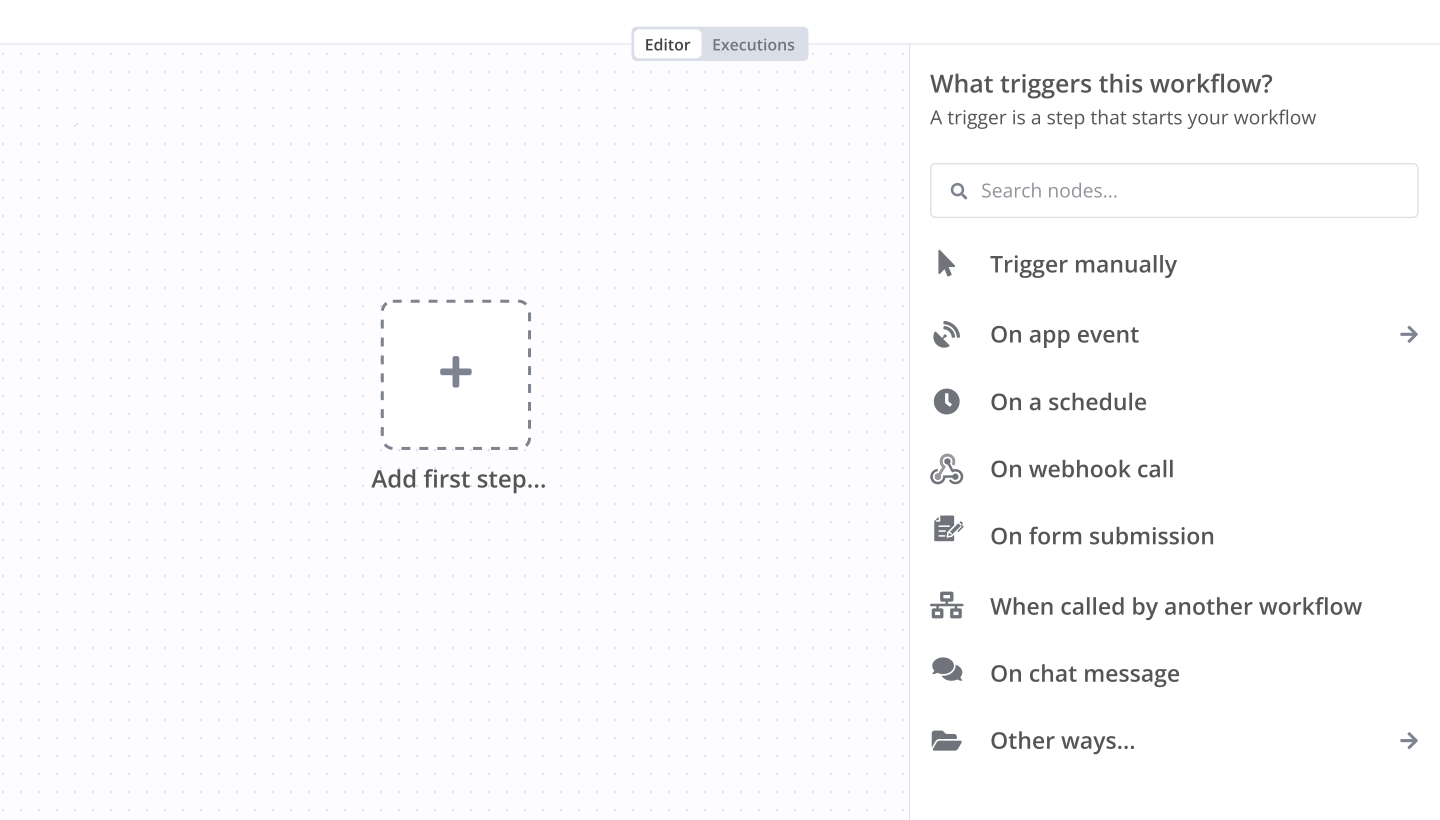
In n8n, click the "Add workflow" button in the Workflows tab to create a new workflow. Add the starting point – a trigger on when your workflow should run: an app event, a schedule, a webhook call, another workflow, an AI chat, or a manual trigger. Sometimes, the HTTP Request node might already serve as your starting point.

WhatsApp Business Cloud and Google Sheets integration: Create a new workflow and add the first step

Step 2: Add and configure WhatsApp Business Cloud and Google Sheets nodes

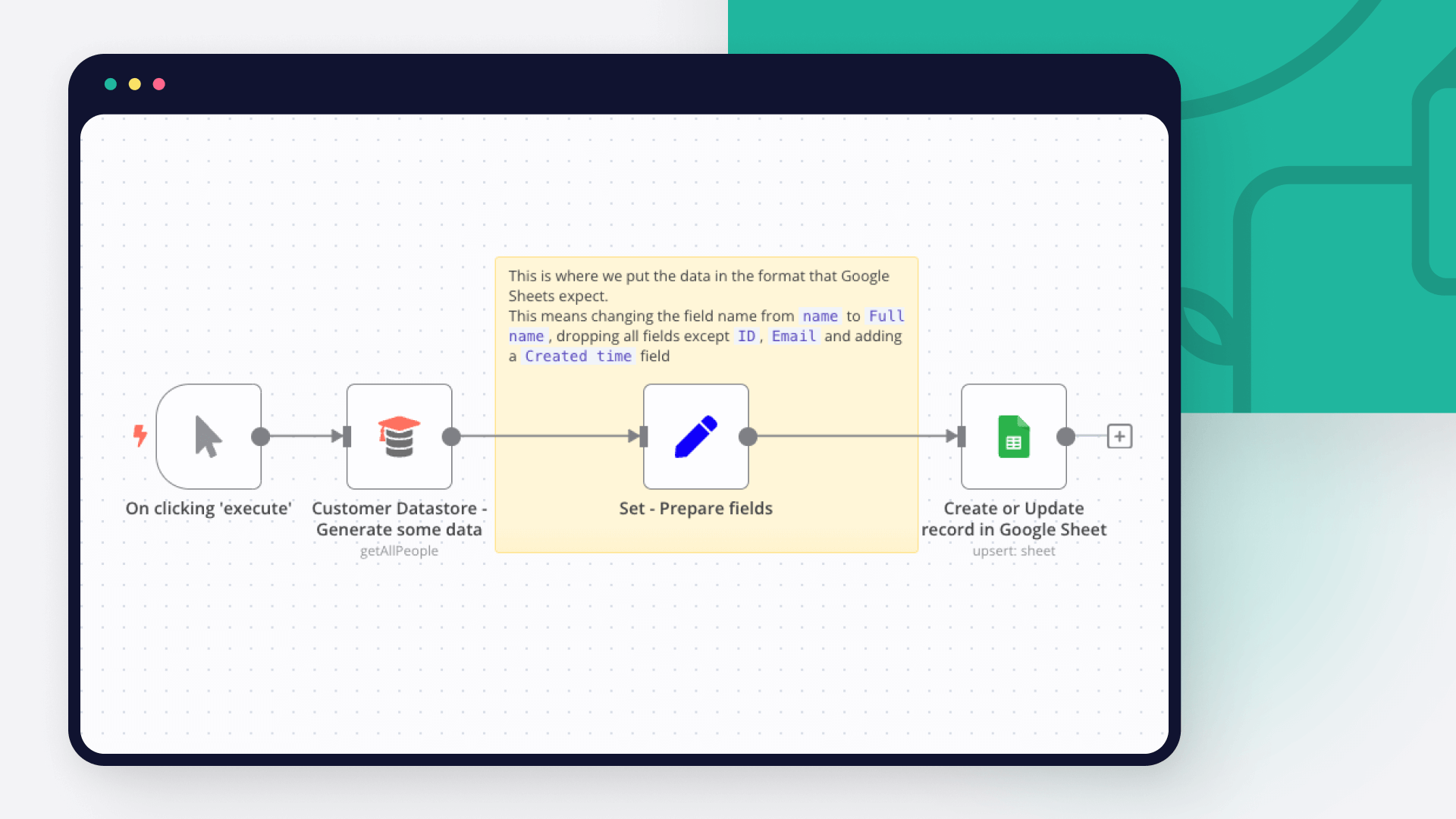
You can find WhatsApp Business Cloud and Google Sheets in the nodes panel. Drag them onto your workflow canvas, selecting their actions. Click each node, choose a credential, and authenticate to grant n8n access. Configure WhatsApp Business Cloud and Google Sheets nodes one by one: input data on the left, parameters in the middle, and output data on the right.

WhatsApp Business Cloud and Google Sheets integration: Add and configure WhatsApp Business Cloud and Google Sheets nodes

Step 3: Connect WhatsApp Business Cloud and Google Sheets

A connection establishes a link between WhatsApp Business Cloud and Google Sheets (or vice versa) to route data through the workflow. Data flows from the output of one node to the input of another. You can have single or multiple connections for each node.

WhatsApp Business Cloud and Google Sheets integration: Connect WhatsApp Business Cloud and Google Sheets

Step 4: Customize and extend your WhatsApp Business Cloud and Google Sheets integration

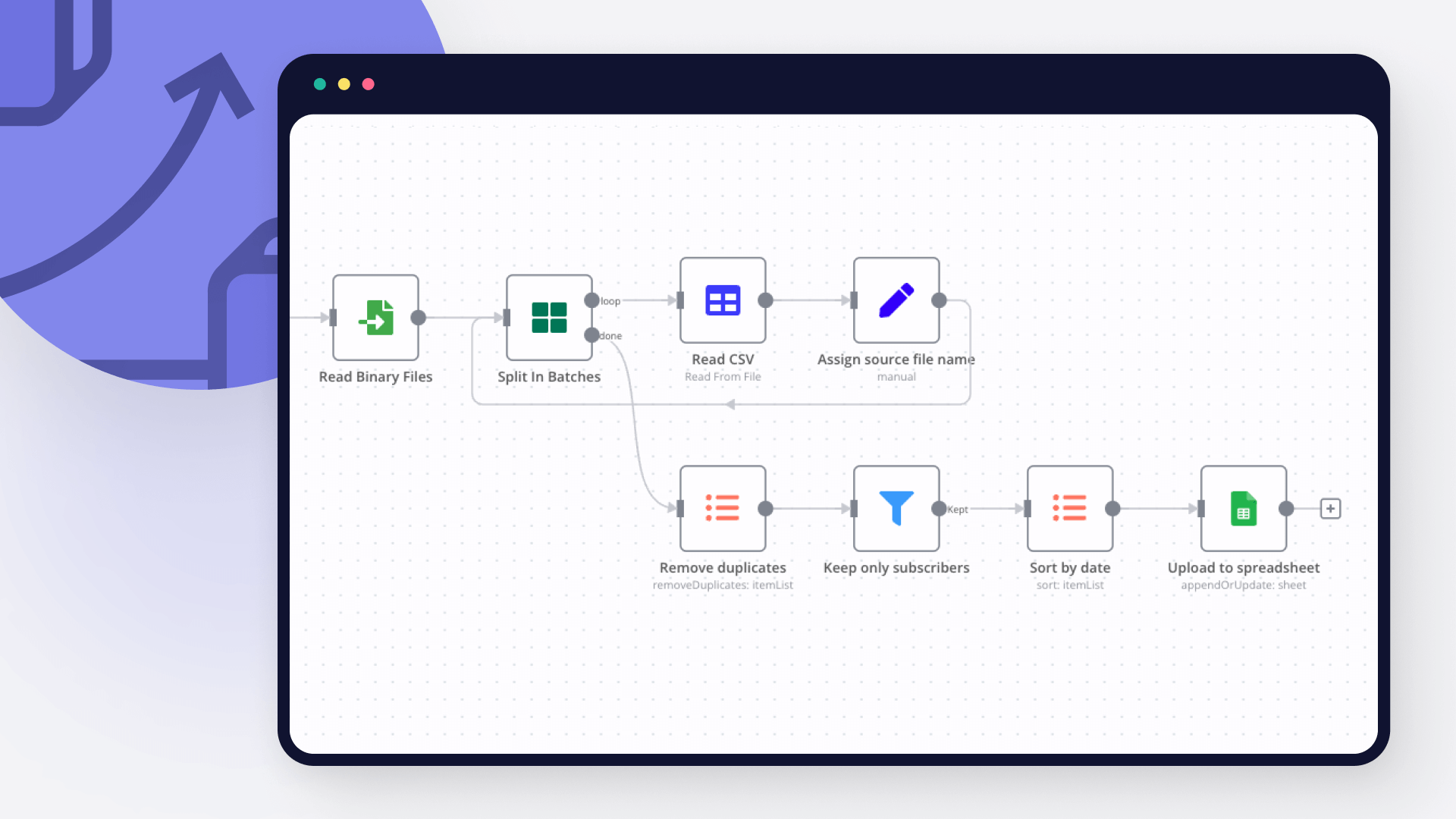
Use n8n's core nodes such as If, Split Out, Merge, and others to transform and manipulate data. Write custom JavaScript or Python in the Code node and run it as a step in your workflow. Connect WhatsApp Business Cloud and Google Sheets with any of n8n’s 1000+ integrations, and incorporate advanced AI logic into your workflows.

WhatsApp Business Cloud and Google Sheets integration: Customize and extend your WhatsApp Business Cloud and Google Sheets integration

Step 5: Test and activate your WhatsApp Business Cloud and Google Sheets workflow

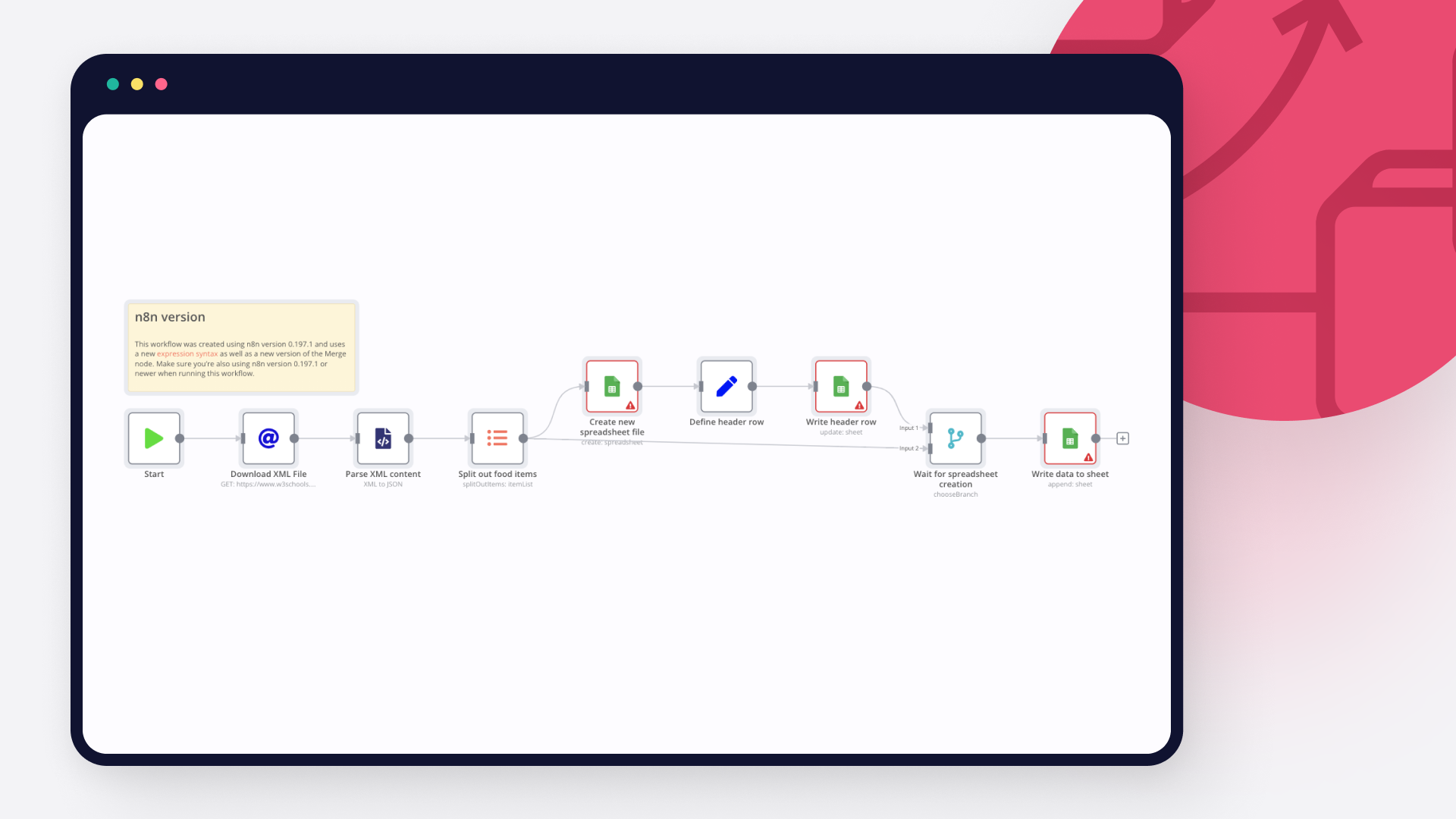
Save and run the workflow to see if everything works as expected. Based on your configuration, data should flow from WhatsApp Business Cloud to Google Sheets or vice versa. Easily debug your workflow: you can check past executions to isolate and fix the mistake. Once you've tested everything, make sure to save your workflow and activate it.

WhatsApp Business Cloud and Google Sheets integration: Test and activate your WhatsApp Business Cloud and Google Sheets workflow

🚀 Boost your customer service with this WhatsApp Business bot!

This n8n workflow demonstrates how to automate customer interactions and appointment management via WhatsApp Business bot.

After submitting a Google Form, the user receives a notification via WhatsApp. These notifications are sent via a template message.
In case user sends a message to the bot, the text and user data is stored in Google Sheets.
To reply back to the user, fill in the ReplyText column and change the Status to 'Ready'. In a few seconds n8n will fetch the unsent replies and deliver them one by one via WhatsApp Business node.

Customize this workflow to fit your specific needs, connect different online services and enhance your customer communication! 🎉

Setup Instructions

To get this workflow up and running, you'll need to:

👇 Create a WhatsApp template message on the Meta Business portal.

Obtain an Access Token and WhatsApp Business Account ID from the Meta Developers Portal. This is needed for the WhatsApp Business Node to send messages.

Set up a WhatsApp Trigger node with App ID and App Secret from the Meta Developers Portal.

Right after that copy the WhatsApp Trigger URL and add it as a Callback URL in the Meta Developers Portal. This trigger is needed to receive incoming messages and their status updates.

Connect your Google Sheets account for data storage and management. Check out the documentation page.

⚠️ Important Notes

WhatsApp allows automatic custom text messages only within 24 hours of the last user message. Outside with time frame only approved template messages can be sent.
The workflow uses a Google Sheet to manage form submissions, incoming messages and prepare responses. You can replace these nodes and connect the WhatsApp bot with other systems.

Nodes used in this workflow

Popular WhatsApp Business Cloud and Google Sheets workflows

Automated Law Firm Lead Management & Scheduling with AI, Jotform & Calendar

Youtube Explanation: [https://youtu.be/KgmNiV7SwkU](https://youtu.be/KgmNiV7SwkU ) This n8n workflow is designed to automate the initial intake and scheduling for a law firm. It's split into two main parts: New Inquiry Handling: Kicks off when a potential client fills out a JotForm, saves their data, and sends them an initial welcome message on WhatsApp. Appointment Scheduling: Activates when the client replies on WhatsApp, allowing an AI agent to chat with them to schedule a consultation. Here’s a detailed breakdown of the prerequisites and each node. Prerequisites Before building this workflow, you'll need accounts and some setup for each of the following services: JotForm JotForm Account**: You need an active JotForm account. A Published Form**: Create a form with the exact fields used in the workflow: Full Name, Email Address, Phone Number, I am a..., Legal Service of Interest, Brief Message, and How Did You Hear About Us?. API Credentials**: Generate API keys from your JotForm account settings to connect it with n8n. Google Google Account**: To use Google Sheets and Google Calendar. Google Sheet**: Create a new sheet named "Law Client Enquiries". The first row must have these exact headers: Full Name, Email Address, Phone Number, client type, Legal Service of Interest, Brief Message, How Did You Hear About Us?. Google Calendar**: An active calendar to manage appointments. Google Cloud Project**: Service Account Credentials (for Sheets): In the Google Cloud Console, create a service account, generate JSON key credentials, and enable the Google Sheets API. You must then share your Google Sheet with the service account's email address (e.g., [email protected]). OAuth Credentials (for Calendar): Create OAuth 2.0 Client ID credentials to allow n8n to access your calendar on your behalf. You'll need to enable the Google Calendar API. Gemini API Key: Enable the Vertex AI API in your Google Cloud project and generate an API key to use the Google Gemini models. WhatsApp Meta Business Account**: Required to use the WhatsApp Business Platform. WhatsApp Business Platform Account: You need to set up a business account and connect a phone number to it. This is **different from the regular WhatsApp or WhatsApp Business app. API Credentials**: Get the necessary access tokens and IDs from your Meta for Developers dashboard to connect your business number to n8n. PostgreSQL Database A running PostgreSQL instance**: This can be hosted anywhere (e.g., AWS, DigitalOcean, Supabase). The AI agent needs it to store and retrieve conversation history. Database Credentials**: You'll need the host, port, user, password, and database name to connect n8n to it. Node-by-Node Explanation The workflow is divided into two distinct logical flows. Flow 1: New Client Intake from JotForm This part triggers when a new client submits your form. JotForm Trigger What it does: This is the starting point. It automatically runs the workflow whenever a new submission is received for the specified JotForm (Form ID: 252801824783057). Prerequisites: A JotForm account and a created form. Append or update row in sheet (Google Sheets) What it does: It takes the data from the JotForm submission and adds it to your "Law Client Enquiries" Google Sheet. How it works: It uses the appendOrUpdate operation. It tries to find a row where the "Email Address" column matches the email from the form. If it finds a match, it updates that row; otherwise, it appends a new row at the bottom. Prerequisites: A Google Sheet with the correct headers, shared with your service account. AI Agent What it does: This node crafts the initial welcome message to be sent to the client. How it works: It uses a detailed prompt that defines a persona ("Alex," a legal intake assistant) and instructs the AI to generate a professional WhatsApp message. It dynamically inserts the client's name and service of interest from the Google Sheet data into the prompt. Connected Node: It's powered by the Google Gemini Chat Model. Send message (WhatsApp) What it does: It sends the message generated by the AI Agent to the client. How it works: It takes the client's phone number from the data (Phone Number column) and the AI-generated text (output from the AI Agent node) to send the message via the WhatsApp Business API. Prerequisites: A configured WhatsApp Business Platform account. Flow 2: AI-Powered Scheduling via WhatsApp This part triggers when the client replies to the initial message. WhatsApp Trigger What it does: This node listens for incoming messages on your business's WhatsApp number. When a client replies, it starts this part of the workflow. Prerequisites: A configured WhatsApp Business Platform account. If node What it does: It acts as a simple filter. It checks if the incoming message text is empty. If it is (e.g., a status update), the workflow stops. If it contains text, it proceeds to the AI agent. AI Agent1 What it does: This is the main conversational brain for scheduling. It handles the back-and-forth chat with the client. How it works: Its prompt is highly detailed, instructing it to act as "Alex" and follow a strict procedure for scheduling. It has access to several "tools" to perform actions. Connected Nodes: Google Gemini Chat Model1: The language model that does the thinking. Postgres Chat Memory: Remembers the conversation history with a specific user (keyed by their WhatsApp ID), so the user doesn't have to repeat themselves. Tools: Know about the user enquiry, GET MANY EVENTS..., and Create an event. AI Agent Tools (What the AI can do) Know about the user enquiry (Google Sheets Tool): When the AI needs to know who it's talking to, it uses this tool. It takes the user's phone number and looks up their original enquiry details in the "Law Client Enquiries" sheet. GET MANY EVENTS... (Google Calendar Tool): When a client suggests a date, the AI uses this tool to check your Google Calendar for any existing events on that day to see if you're free. Create an event (Google Calendar Tool): Once a time is agreed upon, the AI uses this tool to create the event in your Google Calendar, adding the client as an attendee. Send message1 (WhatsApp) What it does: Sends the AI's response back to the client. This could be a confirmation that the meeting is booked, a question asking for their email, or a suggestion for a different time if the requested slot is busy. How it works: It sends the output text from AI Agent1 to the client's WhatsApp ID, continuing the conversation.
+2

Customer Support WhatsApp Bot with Google Docs Knowledge Base and Gemini AI

Document-Aware WhatsApp AI Bot for Customer Support Google Docs-Powered WhatsApp Support Agent 24/7 WhatsApp AI Assistant with Live Knowledge from Google Docs 📝Description Template Smart WhatsApp AI Assistant Using Google Docs Help customers instantly on WhatsApp using a smart AI assistant that reads your company’s internal knowledge from a Google Doc in real time. Built for clubs, restaurants, agencies, or any business where clients ask questions based on a policy, FAQ, or services document. ⚙️ How it works Users send free-form questions to your WhatsApp Business number (e.g. “What are the gym rules?” or “Are you open today?”) The bot automatically reads your company’s internal Google Doc (policy, schedule, etc.) It merges the document content with today’s date and the user’s question to craft a custom AI prompt The AI (Gemini or ChatGPT) then replies back on WhatsApp using natural, helpful language All conversations are logged to Google Sheets for reporting or audit > 💡Bonus: The AI even understands dates inside the document and compares them to today’s date — e.g. if your document says “Closed May 25 for 30 days,” it will say “We're currently closed until June 24. 🧰 Set up steps Connect your WhatsApp Cloud API account (Meta) Add your Google account and grant access to the Doc containing your company info Choose your AI model (ChatGPT/OpenAI or Gemini) Paste your document ID into the Google Docs node Connect your WhatsApp webhook to Meta (only takes 5 minutes) Done — start receiving and answering customer questions! > 📄 Works best with free-tier OpenAI/Gemini, Google Docs, and Meta's Cloud API (no phone required). Everything is modular, extensible, and low-code. 🔄 Customization Tips Change the Google Doc anytime to update answers — no retraining needed Add your logo and business name in the AI agent’s “System Prompt” Add fallback routes like “Escalate to human” if the bot can't help Clone for multiple brands by duplicating the workflow and swapping in new docs 🤝 Need Help Setting It Up? If you'd like help connecting your WhatsApp Business API, setting up Google Docs access, or customizing this AI assistant for your business or clients… 📩 I offer setup, branding, and customization services: WhatsApp Cloud API setup & verification Google OAuth & Doc structure guidance AI model configuration (OpenAI / Gemini) Branding & prompt tone customization Logging, reporting, and escalation logic Just send a message via: Email: [email protected] WhatsApp: +20 106 180 3236
+8

Automated HR Service System with WhatsApp, GPT-4 Classification & Google Workspace

Who is this for? This workflow is ideal for HR teams, startups, and enterprises that want to handle employee interactions through WhatsApp and automate responses using LLM (OpenAI) and intelligent routing. What problem is this workflow solving? Managing WhatsApp messages manually can be time-consuming and error-prone. This workflow solves that by: Auto-classifying messages using LLM Routing them to the right AI-powered agent Automating leave approvals, attendance, HR FAQs, complaints, and candidate shortlisting Delivering final responses interactively via WhatsApp What this workflow does WhatsApp Trigger captures incoming messages LLM Classification analyzes message intent and outputs category (1–5) Switch Node routes the message to the correct agent: 1 → Leave Agent 2 → HR FAQ Chatbot 3 → Attendance Agent 4 → Complaint/Request Agent 5 → Shortlisting Agent Each agent performs specific tasks using tools like: Google Sheets (fetch dept head emails, JD/applicants, logs) Google Calendar (schedule meetings) Vector Search (for policy embeddings) OpenAI (transcription, classification, chatbot) Final WhatsApp Response node sends updates and interactive options to the user Setup Connect WhatsApp API (e.g., via Twilio or WhatsApp Business Cloud API) Configure OpenAI credentials Set up Google Sheets with: Employee data JD and applicants info Policy documents (for embedding) Prepare Google Calendar access Create a vector store with embedded company policy docs How to customize this workflow to your needs Update the LLM prompt to suit your company’s categories or expand to more intents Replace sample sheets with your organization’s actual data Train your own policy embeddings if needed Add/modify agents (e.g., Payroll Bot, IT Support Bot) by cloning an existing pattern Adjust the Switch Node if you add more classifications With this modular and intelligent setup, you can turn your WhatsApp into a smart HR & operations assistant powered by AI, accessible 24/7.
+2

Automate Product Training & Customer Support via WhatsApp, GPT-4 & Google Sheets

WhatsApp AI Agent: Auto-Train Product Data & Handle Customer Support Who Is This For This workflow is ideal for eCommerce founders, product managers, customer support teams, and automation builders who rely on WhatsApp to manage product information and interact with clients. It’s perfect for businesses that want to automate product data entry and support responses directly from WhatsApp messages using GPT-4 and Google Sheets. What Problem Does This Workflow Solve Manual Product Data Entry**: Collecting and organizing product data from links is tedious and error-prone. Slow Customer Response Times**: Responding to client questions manually leads to delays and inconsistent support. No Logging System for Issues**: Without automation, support issues often go undocumented, making it harder to learn and improve. What This Workflow Does Step 1 – Incoming Message Detection Listens for incoming messages via WhatsApp. If the message starts with train:, it routes to the product training process. Otherwise, it routes to the customer support assistant. Step 2 – Product Data Training Extracts URL** from the message using a regex script. Fetches HTML content** from the URL. Cleans HTML data** to extract readable product description. Saves raw data** (URL + description) into Google Sheets. Uses GPT-4** to enhance product data: → Name, price (one-time or subscription), topic, and FAQs. Updates the product row** in Google Sheets with structured information. Step 3 – Customer Support Flow Analyzes user messages with GPT-4 to understand the request or issue. Looks up relevant product info in Google Sheets. Detects potential problems (e.g. payment, login, delivery). Suggests an appropriate solution. Logs the problem, solution, and category to the Customer Issues sheet. Sends a response back to the client via WhatsApp. Step 4 – Client Response Sends the AI-generated response to the client via WhatsApp. Keeps the communication fast, clear, and professional. Setup Guide Prerequisites WhatsApp Business API access** OpenAI API Key** Google Account** with Google Sheets access A hosted instance of n8n (Cloud or self-hosted) Setup Steps Import the Workflow into your n8n instance. Connect your credentials for WhatsApp, OpenAI, and Google Sheets. Customize Google Sheet IDs and names as needed. Test by sending a train: message or a regular customer message to WhatsApp. Activate the workflow to make it live. How to Customize This Workflow Edit AI prompts** to reflect your product type, language style, or tone. Change the trigger keyword** (e.g. from train: to add: or anything else). Add integrations** like Notion, Airtable, or CRM tools. Expand the Sheets structure** with more product fields (e.g. stock status, image link). Add notifications** to Slack or email after product updates or issue logging. 📄 Documentation: Notion Guide Need help customizing? Contact me for consulting and support : Linkedin / Youtube

Automate Multi-Channel Customer Support with WhatsApp, Email & AI Translation

Description AI-Powered Multi-language Customer Support In this guide, we'll walk you through setting up a comprehensive AI-driven workflow that handles customer messages in any language through WhatsApp and email channels, providing intelligent translation, summarization, and automated responses. Ready to revolutionize your customer support? Let's get started! What's the Goal? Automatically handle customer messages** from WhatsApp and email in any language Translate and validate** incoming messages with smart language detection Generate intelligent summaries** with priority classification for support teams Provide automated responses** back to customers via their preferred channel Log all interactions** to database for tracking and analytics Send notifications** to admin team for high-priority cases Deliver 24/7 multilingual customer support** without manual effort Integrate seamlessly** with WhatsApp Business API and email systems By the end, you'll have a fully automated customer support system that handles multilingual communications, prioritizes urgent cases, and maintains comprehensive interaction logs. Why Does It Matter? Manual handling of multilingual customer support can be overwhelming and inefficient. Here's why this workflow is a game-changer: Break Global Language Barriers**: Handle customer inquiries in any language effortlessly Never Miss Important Messages**: Priority detection ensures urgent cases get immediate attention Save 80% of Manual Work**: Automation handles routine inquiries and escalates complex ones 24/7 Availability**: Respond to customers anytime, enhancing satisfaction and retention Professional Customer Experience**: Consistent, well-formatted responses in the customer's language Complete Audit Trail**: Database logging provides insights and accountability Scalable Solution**: Handle growing customer base without proportional staff increase Think of it as your always-on, multilingual customer support team that never sleeps and never misses a beat. How It Works Here's the step-by-step magic behind the automation: Step 1: Multi-Channel Message Capture WhatsApp Trigger**: Captures incoming WhatsApp messages via Business API webhook Email Trigger (IMAP)**: Monitors designated customer support email for new messages Both channels feed into the same processing pipeline for consistent handling Step 2: Data Normalization & Validation Data Normalizer & Validator**: Standardizes message format regardless of source channel Extracts key information: sender details, message content, timestamp, channel source Validates data integrity and handles malformed inputs gracefully Step 3: Smart Language Translation Smart Language Translator**: Automatically detects source language and translates to English Preserves original message context and cultural nuances Stores both original and translated versions for reference Step 4: Enhanced Summary & Priority Processing Enhanced Summary & Priority Processor**: Uses AI to analyze translated content Generates concise summaries highlighting key customer concerns Priority Classification**: Automatically tags messages as: 🔴 High Priority: Urgent issues, complaints, billing problems 🟡 Medium Priority: Product inquiries, general support 🟢 Low Priority: Thank you messages, general feedback Creates structured output with priority flags for support team triage Step 5: Message Source Intelligence Check Message Source**: Determines optimal response channel and method Routes WhatsApp messages back to WhatsApp, emails back to email Maintains conversation context and threading Step 6: Automated Customer Response Customer WhatsApp Auto-Response**: Sends acknowledgment via WhatsApp Customer Email Auto-Response**: Sends professional email replies Responses include: Confirmation of message receipt Estimated response time based on priority Reference number for tracking Next steps or immediate solutions for common issues Step 7: Database Logging & Analytics Log to Database**: Stores complete interaction history including: Original message and translation Priority classification and reasoning Response sent and timestamp Customer contact information Channel and source metadata Enables analytics, reporting, and quality assurance Step 8: Admin Notifications & Alerts Admin Email Notification**: Immediate email alerts for high-priority cases Admin WhatsApp Alert**: SMS/WhatsApp notifications for urgent escalations Workflow Completion & Metrics**: Performance tracking and completion confirmations Workflow Architecture ┌─────────────────┐ ┌──────────────────┐ │ WhatsApp │ │ Email Trigger │ │ Trigger │ │ (IMAP) │ └─────────┬───────┘ └─────────┬────────┘ │ │ └──────────┬───────────┘ │ ┌──────────▼──────────┐ │ Data Normalizer & │ │ Validator │ └──────────┬──────────┘ │ ┌──────────▼──────────┐ │ Smart Language │ │ Translator │ └──────────┬──────────┘ │ ┌──────────▼──────────┐ │ Enhanced Summary & │ │ Priority Processor │ └──────────┬──────────┘ │ ┌──────────▼──────────┐ │ Check Message │ │ Source │ └─────────┬┬──────────┘ ┌┘└┐ ┌──────────▼┐ ┌▼──────────┐ │ Customer │ │ Customer │ │ WhatsApp │ │ Email │ │ Response │ │ Response │ └──────────┬┘ └┬──────────┘ └┬─┬┘ ┌─────────▼─▼─────────┐ │ Log to Database │ └─────────┬───────────┘ │ ┌─────────▼───────────┐ │ Admin Email │ │ Notification │ └─────────┬───────────┘ │ ┌─────────▼───────────┐ │ Admin WhatsApp │ │ Alert │ └─────────┬───────────┘ │ ┌─────────▼───────────┐ │ Workflow Completion │ │ & Metrics │ └─────────────────────┘ How to Use the Workflow? Importing a workflow in n8n is straightforward and allows you to use pre-built or shared workflows to save time. Below is a step-by-step guide to importing the Multi-language Customer Support workflow in n8n. Steps to Import a Workflow in n8n Obtain the Workflow JSON Source the Workflow: Workflows are typically shared as JSON files or code snippets. You might receive them from: The n8n community (e.g., n8n.io workflows page) A colleague or tutorial (e.g., a .json file or copied JSON code) Exported from another n8n instance Format**: Ensure you have the workflow in JSON format, either as a file (e.g., customer-support-workflow.json) or as text copied to your clipboard Access the n8n Workflow Editor Log in to n8n: Open your n8n instance (via n8n Cloud or your self-hosted instance) Navigate to the Workflows tab in the n8n dashboard Open a New Workflow: Click Add Workflow to create a blank workflow, or open an existing workflow if you want to merge the imported workflow Import the Workflow Option 1: Import via JSON Code (Clipboard): In the n8n editor, click the three dots (⋯) in the top-right corner to open the menu Select Import from Clipboard Paste the JSON code of the workflow into the provided text box Click Import to load the workflow into the editor Option 2: Import via JSON File: In the n8n editor, click the three dots (⋯) in the top-right corner Select Import from File Choose the .json file from your computer Click Open to import the workflow Configuration Requirements Essential Setup Notes: WhatsApp Integration: Configure WhatsApp Business API credentials in the WhatsApp Trigger node Set up webhook URL in your WhatsApp Business account Test connection with a sample message Email Configuration: Set up IMAP credentials for your customer support email in the Email Trigger node Configure SMTP settings for outbound email responses Ensure proper email authentication (SPF, DKIM records) Translation Services: Add Google Translate API credentials in the Smart Language Translator node Alternative: Configure Azure Translator or AWS Translate based on preference Set up language detection and translation parameters Database Connection: Configure database credentials in the "Log to Database" node Create required tables for storing customer interactions: CREATE TABLE customer_interactions ( id SERIAL PRIMARY KEY, customer_contact VARCHAR(255), channel VARCHAR(50), original_message TEXT, translated_message TEXT, summary TEXT, priority VARCHAR(20), response_sent TEXT, timestamp TIMESTAMP DEFAULT CURRENT_TIMESTAMP ); Admin Notifications: Set up admin email addresses in notification nodes Configure WhatsApp/SMS credentials for urgent alerts Customize notification templates and thresholds Priority Classification Rules: Customize JavaScript code in "Enhanced Summary & Priority Processor" node Define keywords and patterns for priority detection: // High Priority Keywords const urgentKeywords = ['urgent', 'emergency', 'billing issue', 'not working', 'broken', 'refund', 'complaint']; // Medium Priority Keywords const mediumKeywords = ['question', 'how to', 'support', 'help', 'information']; // Classification logic if (urgentKeywords.some(keyword => message.toLowerCase().includes(keyword))) { priority = 'HIGH'; } else if (mediumKeywords.some(keyword => message.toLowerCase().includes(keyword))) { priority = 'MEDIUM'; } else { priority = 'LOW'; } Response Templates: Customize auto-response templates in both WhatsApp and Email response nodes Include your company branding and contact information Set up response templates for different priority levels and common scenarios Testing and Deployment: Test Each Channel: Send test messages via WhatsApp and email to verify end-to-end flow Verify Translations: Test with messages in different languages Check Database Logging: Confirm all interactions are properly stored Test Admin Notifications: Verify alerts are sent for high-priority cases Monitor Performance: Set up workflow execution monitoring and error handling Your Multi-language Customer Support workflow is now ready to handle customer communications 24/7 across multiple channels with intelligent automation and human oversight where needed!
+3

Send sales forecast charts and answer Q&A on WhatsApp with OpenAI

How It Works Top Branch Workflow* The Data Scientist: Ingest: Pulls historical sales data from Google Sheets. Math Engine: Runs 7 statistical algorithms (e.g., Seasonal Naive, Linear Trend, Regression). It backtests them against your history and scientifically selects the winner with the lowest error rate. The Data Analyst: Interpret: The AI Agent takes the mathematical output and translates it into business insights, assigning confidence scores based on error margins. Report: Generates a visual trend chart (PNG) and sends a complete briefing to your phone. Bottom Branch Workflow* The Consultant: AI Agent 2 handles the follow-up questions. It pulls the latest analysis context and checks historical rate data to give an informed answer. Recall: When you ask a question via WhatsApp, the bot retrieves the saved forecast state. Answer: It acts as an on-demand analyst, comparing current forecasts against historical actuals to give you instant answers. Setup Steps 1) Google Sheet: Prepare columns: Year, Month, Sales. Map the Sheet ID in the "Workflow Configuration" node. 2) Forecast Engine: No config needed. It automatically detects seasonality vs. linear trends. 3) Database: Create a table latest_forecast to store the JSON output. 4) Credentials: Connect Google Sheets, OpenAI, and WhatsApp Use Cases & Benefits For Business Owners: Gain enterprise-grade forecasting on autopilot. Always have a sophisticated financial outlook running in the background 24/7. For Sales Leaders: Get immediate visibility into future revenue trends. Bypass the wait for end-of-month manual reports and get a strategic "pulse check" delivered instantly to your phone. 🤖Virtual Data Team: Instantly add the capabilities of a Data Scientist and Data Analyst to your business or division. It works alongside your existing team to handle the heavy lifting, or stands in as your dedicated automated department. 🧠Precision & Trust: Combines the best of both worlds: rigorous, deterministic code for the math (no hallucinations) and advanced AI for the strategic explanation. You get numbers you can trust with context you can use. ⚡Decision-Ready Insights: Stop digging through dashboards. High-level intelligence is pushed directly to you on WhatsApp, allowing you to make faster, data-driven decisions from anywhere. 📬 Want to Customize This? [email protected]

Build your own WhatsApp Business Cloud and Google Sheets integration

Create custom WhatsApp Business Cloud and Google Sheets workflows by choosing triggers and actions. Nodes come with global operations and settings, as well as app-specific parameters that can be configured. You can also use the HTTP Request node to query data from any app or service with a REST API.

WhatsApp Business Cloud supported actions

Send
Send and Wait for Response
Send Template
Upload
Download
Delete

Google Sheets supported actions

Create
Create a spreadsheet
Delete
Delete a spreadsheet
Append or Update Row
Append a new row or update an existing one (upsert)
Append Row
Create a new row in a sheet
Clear
Delete all the contents or a part of a sheet
Create
Create a new sheet
Delete
Permanently delete a sheet
Delete Rows or Columns
Delete columns or rows from a sheet
Get Row(s)
Retrieve one or more rows from a sheet
Update Row
Update an existing row in a sheet

FAQs

  • Can WhatsApp Business Cloud connect with Google Sheets?

  • Can I use WhatsApp Business Cloud’s API with n8n?

  • Can I use Google Sheets’s API with n8n?

  • Is n8n secure for integrating WhatsApp Business Cloud and Google Sheets?

  • How to get started with WhatsApp Business Cloud and Google Sheets integration in n8n.io?

Need help setting up your WhatsApp Business Cloud and Google Sheets integration?

Discover our latest community's recommendations and join the discussions about WhatsApp Business Cloud and Google Sheets integration.
Sergey Komardenkov
sérgio eduardo floresta filho
Julian
therealJMT
Guilherme

Looking to integrate WhatsApp Business Cloud and Google Sheets in your company?

Over 3000 companies switch to n8n every single week

Why use n8n to integrate WhatsApp Business Cloud with Google Sheets

Build complex workflows, really fast

Build complex workflows, really fast

Handle branching, merging and iteration easily.
Pause your workflow to wait for external events.

Code when you need it, UI when you don't

Simple debugging

Your data is displayed alongside your settings, making edge cases easy to track down.

Use templates to get started fast

Use 1000+ workflow templates available from our core team and our community.

Reuse your work

Copy and paste, easily import and export workflows.

Implement complex processes faster with n8n

red iconyellow iconred iconyellow icon