Back to Integrations
integrationAirtable node
integrationBrevo node

Airtable and Brevo integration

Save yourself the work of writing custom integrations for Airtable and Brevo and use n8n instead. Build adaptable and scalable Data & Storage, Marketing, and Communication workflows that work with your technology stack. All within a building experience you will love.

How to connect Airtable and Brevo

  • Step 1: Create a new workflow
  • Step 2: Add and configure nodes
  • Step 3: Connect
  • Step 4: Customize and extend your integration
  • Step 5: Test and activate your workflow

Step 1: Create a new workflow and add the first step

In n8n, click the "Add workflow" button in the Workflows tab to create a new workflow. Add the starting point – a trigger on when your workflow should run: an app event, a schedule, a webhook call, another workflow, an AI chat, or a manual trigger. Sometimes, the HTTP Request node might already serve as your starting point.
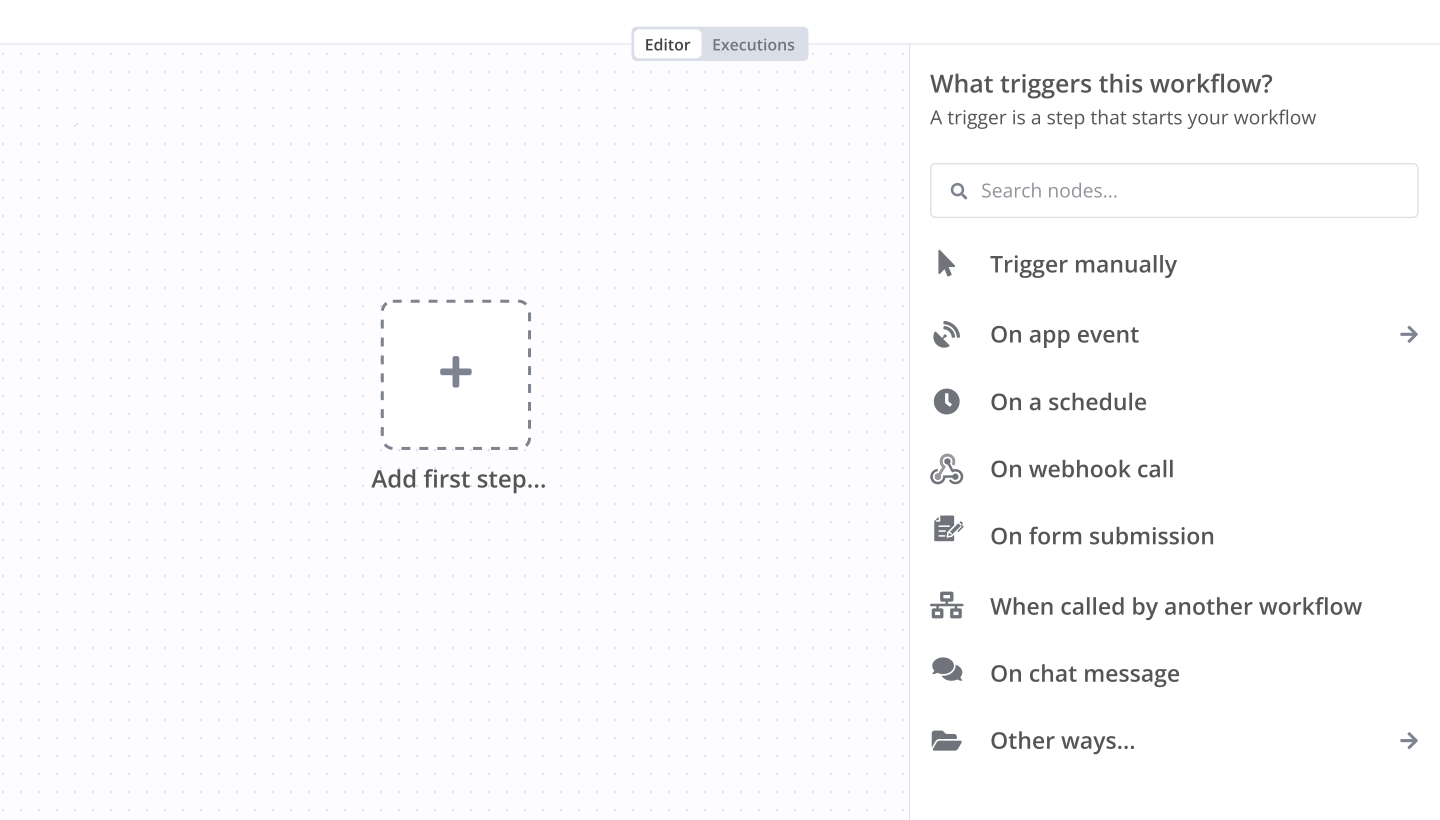
Airtable and Brevo integration: Create a new workflow and add the first step

Step 2: Add and configure Airtable and Brevo nodes

You can find Airtable and Brevo in the nodes panel. Drag them onto your workflow canvas, selecting their actions. Click each node, choose a credential, and authenticate to grant n8n access. Configure Airtable and Brevo nodes one by one: input data on the left, parameters in the middle, and output data on the right.

Airtable and Brevo integration: Add and configure Airtable and Brevo nodes

Step 3: Connect Airtable and Brevo

A connection establishes a link between Airtable and Brevo (or vice versa) to route data through the workflow. Data flows from the output of one node to the input of another. You can have single or multiple connections for each node.

Airtable and Brevo integration: Connect Airtable and Brevo

Step 4: Customize and extend your Airtable and Brevo integration

Use n8n's core nodes such as If, Split Out, Merge, and others to transform and manipulate data. Write custom JavaScript or Python in the Code node and run it as a step in your workflow. Connect Airtable and Brevo with any of n8n’s 1000+ integrations, and incorporate advanced AI logic into your workflows.

Airtable and Brevo integration: Customize and extend your Airtable and Brevo integration

Step 5: Test and activate your Airtable and Brevo workflow

Save and run the workflow to see if everything works as expected. Based on your configuration, data should flow from Airtable to Brevo or vice versa. Easily debug your workflow: you can check past executions to isolate and fix the mistake. Once you've tested everything, make sure to save your workflow and activate it.

Airtable and Brevo integration: Test and activate your Airtable and Brevo workflow

Automate marketing campaigns with Airtable CRM & Brevo email tracking

🎯 General principles

This template automates the management of marketing campaign from a CRM based on Airtable, using Brevo for sending and tracking emails.

🧩 It is based on two main steps:
Sending emails to targeted companies in Airtable, creating an interaction record for each sent email.

Real-time tracking of events (email delivered / opened / clicked, unsubscribe request) via a n8n webhook, updating the corresponding interaction or company record.

This workflow provides precise tracking of marketing actions and facilitates the history of interactions with prospects or clients.

Prerequisites
Airtable with at least 3 tables:
Company: Contains information about your clients or prospects.
Interaction: Log of exchanges and events.
Campaign: Information about the ongoing campaign.

Brevo:
A predefined email template, which can include a link to a form.
API access for sending and tracking emails.

⚙️ Step-by-step description
1️⃣ Sending Emails
Selecting targeted companies
The workflow queries the Company table in Airtable, filtering on a tag or a specific field related to the campaign (e.g., Campaign = "1").
Preparing data for Brevo
For each company, retrieves the necessary information: email address.
Sending the email via Brevo
Uses a Brevo Send Template node with a predefined template.
Brevo returns a unique identifier for each email sent.
Creating an interaction in Airtable
A record is added to the Interaction table containing:
Company
Date and time of interaction
Media = email
Brevo email identifier
2️⃣ Tracking Events
Receiving Brevo events
Brevo triggers a webhook to n8n for each event:
Delivered
Opened
Clicked
Unsubscribed
Matching with the interaction
Based on the Brevo identifier received, the workflow finds the corresponding Interaction in Airtable.
Updating the interaction
The interaction status is updated based on the event (e.g., "Opened" with date and time).
Managing unsubscribes
In case of an unsubscribe:
The workflow finds the Company associated via the interaction.
A specific field in the Company table (e.g., Opt-in) is updated to "No" in order to exclude this company from future campaigns.
✅ Benefits of this template
Automated sending and real-time tracking.
Interaction history stored in the CRM.
RGPD (European regulations) compliance through automatic unsubscribe management.
Clear view of campaign effectiveness (open rates, clicks, etc.).

📬 Contact
Need help customizing this (e.g., expanding Data Tables, connecting multiple surveys, or automating follow-ups)?

📧 [email protected]
🔗 guy.salvatore
🌐 smarthome-smartelec.fr

Nodes used in this workflow

Popular Airtable and Brevo workflows

Automated Inventory Management with Airtable PO Creation & Supplier Emails

In-depth description of this automation: This is a fully automated daily supply chain and procurement workflow that keeps product stock levels healthy and suppliers updated, by automatically generating and emailing purchase orders (POs) and syncing PO statuses in Airtable. 📅 Daily triggers Two Schedule Trigger nodes run: One runs at midnight (00:00) to manage low stock and new purchase order creation. Another runs at 1:00 AM to process existing pending POs and email suppliers. 🚦 Step-by-step breakdown 1️⃣ Get Products with low stock Searches the “Products Table” in Airtable for items where {stock_level} <= {reorder_threshold}. Detects products that need restocking. 2️⃣ Get supplier details Fetches supplier data for each low-stock product using its supplier_id. 3️⃣ Calculate Dynamic Reorder Quantity JS code calculates an optimal reorder quantity: Uses average_daily_sales × (lead_time × 1.5) × safety_margin (1.2) Adds extra buffer so the new order covers both immediate demand and next cycle. 4️⃣ Search existing POs Looks in the “Purchase Orders” table for active POs (status Pending or Sent) matching each product. Prevents duplicate orders. 5️⃣ Remove duplicate product orders JS node compares current low-stock products with existing POs. Filters out products already covered, so new POs are only created for truly uncovered products. 6️⃣ Create new purchase orders For filtered products, creates new PO records in Airtable with: product_name product_id calculated reorder_qty supplier info and email initial status Pending 📧 Process existing pending purchase orders and email suppliers 7️⃣ Get Purchase Orders which are pending Searches Airtable for all POs with status Pending. 8️⃣ Group products with suppliers JS code groups these POs by supplier_id. Builds a summary (total products, total quantity) and an HTML email with a styled table of items. 9️⃣ Send PO emails to suppliers Uses Brevo (SendInBlue) to send emails. Subject and content include supplier-specific order details. 🔄 Update PO statuses to Sent Extracts Airtable record IDs of the sent POs. Updates those POs in Airtable, changing status from Pending → Sent. 📌 Summary ✅ Runs every day ✅ Dynamically calculates reorder needs ✅ Avoids duplicate purchase orders ✅ Automatically creates purchase orders in Airtable ✅ Groups & emails daily PO summaries to suppliers ✅ Updates PO status after sending email ⚙ Tables involved Products Table:** stores products, stock levels, reorder thresholds, average daily sales, supplier references. Suppliers Table:** stores supplier emails and metadata. Purchase Orders Table:** tracks product orders with supplier IDs, status, quantities, etc. This workflow makes daily procurement fully automated: detects risk of stockouts, creates POs smartly, keeps suppliers in sync by email, and updates order statuses in one closed loop — perfect for any small or mid-sized business using Airtable + N8N.

Send application follow-up reminders from Airtable via email and SMS

How it works This workflow runs on a daily schedule and automatically sends follow-up reminders to candidates who have received an application link but have not yet applied. It checks Airtable for eligible records, calculates how much time has passed since outreach was sent, and decides whether to send a first reminder, second reminder, or no message. All decision logic is handled in a single Code node, which outputs a simple routing value. This makes the workflow easy to understand and prevents fragile conditional logic. Each reminder is sent only once. After a reminder is sent, the workflow updates Airtable with a corresponding “sent” flag so the same reminder cannot be sent again on future runs. Setup steps Connect your Airtable account and select the table containing candidate records. Ensure Airtable includes a timestamp field indicating when outreach was sent. Ensure checkbox fields exist for each reminder (for example, “Reminder 1 Sent” and “Reminder 2 Sent”). Connect your email provider (Brevo) and SMS provider. Set the Cron node to run once per day at your preferred time. Initial setup typically takes 10–15 minutes. When to use this template You want automated follow-ups without manual chasing You need to avoid sending duplicate reminders You want Airtable to remain the source of truth

Send candidate outcome emails and SMS and notify referrers with Airtable

How it works This workflow automates post-event and post-course communications for candidates, while also notifying referring partners at the correct milestones. The workflow is triggered when Airtable updates timestamp fields related to Info Event Outcome or Course Outcome. Airtable controls when the workflow runs, and n8n controls what happens next. This separation avoids race conditions and keeps the system reliable. After triggering, the workflow normalizes record data and determines exactly one action path using a centralized Code node. Based on the outcome, it sends the correct candidate email and SMS, and optionally notifies the referring person. Each message is sent only once using checkbox “sent” flags stored in Airtable. Setup steps Connect Airtable and select the table containing candidate records. Ensure Airtable includes timestamp fields for Info Event Outcome and Course Outcome updates. Ensure checkbox fields exist to track which messages have already been sent. Connect your email provider (Brevo) and SMS provider. Customize message content inside the Email and SMS nodes if needed. Initial setup typically takes 15–20 minutes. When to use this template You need reliable post-event and post-course messaging You want to notify referring partners automatically You must prevent duplicate emails or SMS

Automate Marketing Campaigns with Airtable CRM & Brevo Email Tracking

🎯 General principles This template automates the management of marketing campaign from a CRM based on Airtable, using Brevo for sending and tracking emails. 🧩 It is based on two main steps: Sending emails to targeted companies in Airtable, creating an interaction record for each sent email. Real-time tracking of events (email delivered / opened / clicked, unsubscribe request) via a n8n webhook, updating the corresponding interaction or company record. This workflow provides precise tracking of marketing actions and facilitates the history of interactions with prospects or clients. Prerequisites Airtable with at least 3 tables: Company: Contains information about your clients or prospects. Interaction: Log of exchanges and events. Campaign: Information about the ongoing campaign. Brevo: A predefined email template, which can include a link to a form. API access for sending and tracking emails. ⚙️ Step-by-step description 1️⃣ Sending Emails Selecting targeted companies The workflow queries the Company table in Airtable, filtering on a tag or a specific field related to the campaign (e.g., Campaign = "1"). Preparing data for Brevo For each company, retrieves the necessary information: email address. Sending the email via Brevo Uses a Brevo Send Template node with a predefined template. Brevo returns a unique identifier for each email sent. Creating an interaction in Airtable A record is added to the Interaction table containing: Company Date and time of interaction Media = email Brevo email identifier 2️⃣ Tracking Events Receiving Brevo events Brevo triggers a webhook to n8n for each event: Delivered Opened Clicked Unsubscribed Matching with the interaction Based on the Brevo identifier received, the workflow finds the corresponding Interaction in Airtable. Updating the interaction The interaction status is updated based on the event (e.g., "Opened" with date and time). Managing unsubscribes In case of an unsubscribe: The workflow finds the Company associated via the interaction. A specific field in the Company table (e.g., Opt-in) is updated to "No" in order to exclude this company from future campaigns. ✅ Benefits of this template Automated sending and real-time tracking. Interaction history stored in the CRM. RGPD (European regulations) compliance through automatic unsubscribe management. Clear view of campaign effectiveness (open rates, clicks, etc.). 📬 Contact Need help customizing this (e.g., expanding Data Tables, connecting multiple surveys, or automating follow-ups)? 📧 [email protected] 🔗 guy.salvatore 🌐 smarthome-smartelec.fr

Build your own Airtable and Brevo integration

Create custom Airtable and Brevo workflows by choosing triggers and actions. Nodes come with global operations and settings, as well as app-specific parameters that can be configured. You can also use the HTTP Request node to query data from any app or service with a REST API.


Airtable supported actions

Get Many
List all the bases
Get Schema
Get the schema of the tables in a base
Create
Create a new record in a table
Create or Update
Create a new record, or update the current one if it already exists (upsert)
Delete
Delete a record from a table
Get
Retrieve a record from a table
Search
Search for specific records or list all
Update
Update a record in a table

Brevo supported actions

Create
Create or Update
Delete
Get
Get Many
Update
Create
Update
Delete
Get Many
Send
Send Template
Create
Delete
Get Many

FAQs

  • Can Airtable connect with Brevo?

  • Can I use Airtable’s API with n8n?

  • Can I use Brevo’s API with n8n?

  • Is n8n secure for integrating Airtable and Brevo?

  • How to get started with Airtable and Brevo integration in n8n.io?

Need help setting up your Airtable and Brevo integration?

Discover our latest community's recommendations and join the discussions about Airtable and Brevo integration.
Michael Wells

Looking to integrate Airtable and Brevo in your company?

Over 3000 companies switch to n8n every single week

Why use n8n to integrate Airtable with Brevo

Build complex workflows, really fast

Build complex workflows, really fast

Handle branching, merging and iteration easily.
Pause your workflow to wait for external events.

Code when you need it, UI when you don't

Simple debugging

Your data is displayed alongside your settings, making edge cases easy to track down.

Use templates to get started fast

Use 1000+ workflow templates available from our core team and our community.

Reuse your work

Copy and paste, easily import and export workflows.

Implement complex processes faster with n8n

red iconyellow iconred iconyellow icon