Back to Integrations
integrationAirtable node
integrationNotion node

Airtable and Notion integration

Save yourself the work of writing custom integrations for Airtable and Notion and use n8n instead. Build adaptable and scalable Data & Storage, and Productivity workflows that work with your technology stack. All within a building experience you will love.

How to connect Airtable and Notion

  • Step 1: Create a new workflow
  • Step 2: Add and configure nodes
  • Step 3: Connect
  • Step 4: Customize and extend your integration
  • Step 5: Test and activate your workflow

Step 1: Create a new workflow and add the first step

In n8n, click the "Add workflow" button in the Workflows tab to create a new workflow. Add the starting point – a trigger on when your workflow should run: an app event, a schedule, a webhook call, another workflow, an AI chat, or a manual trigger. Sometimes, the HTTP Request node might already serve as your starting point.
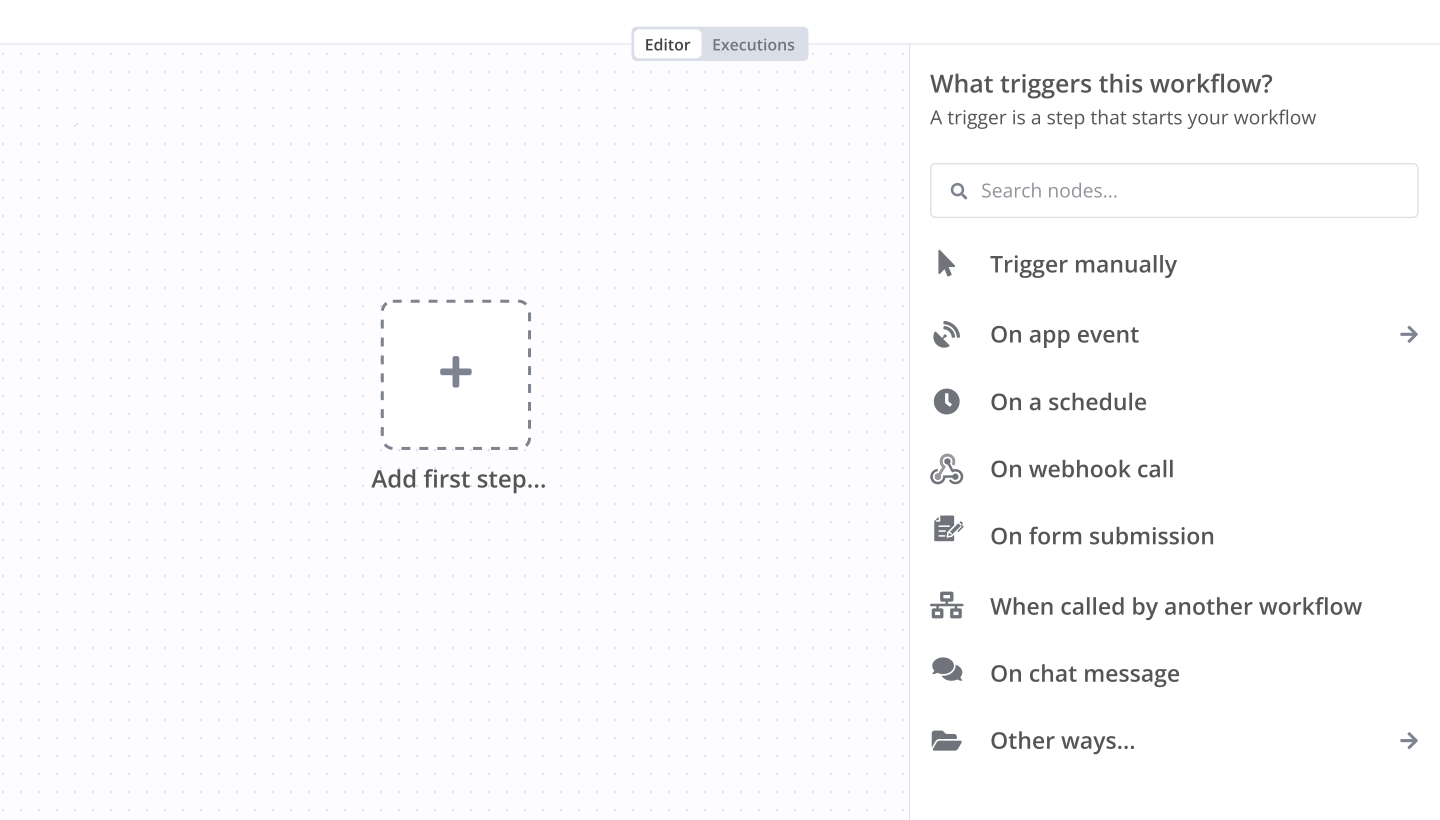
Airtable and Notion integration: Create a new workflow and add the first step

Step 2: Add and configure Airtable and Notion nodes

You can find Airtable and Notion in the nodes panel. Drag them onto your workflow canvas, selecting their actions. Click each node, choose a credential, and authenticate to grant n8n access. Configure Airtable and Notion nodes one by one: input data on the left, parameters in the middle, and output data on the right.

Airtable and Notion integration: Add and configure Airtable and Notion nodes

Step 3: Connect Airtable and Notion

A connection establishes a link between Airtable and Notion (or vice versa) to route data through the workflow. Data flows from the output of one node to the input of another. You can have single or multiple connections for each node.

Airtable and Notion integration: Connect Airtable and Notion

Step 4: Customize and extend your Airtable and Notion integration

Use n8n's core nodes such as If, Split Out, Merge, and others to transform and manipulate data. Write custom JavaScript or Python in the Code node and run it as a step in your workflow. Connect Airtable and Notion with any of n8n’s 1000+ integrations, and incorporate advanced AI logic into your workflows.

Airtable and Notion integration: Customize and extend your Airtable and Notion integration

Step 5: Test and activate your Airtable and Notion workflow

Save and run the workflow to see if everything works as expected. Based on your configuration, data should flow from Airtable to Notion or vice versa. Easily debug your workflow: you can check past executions to isolate and fix the mistake. Once you've tested everything, make sure to save your workflow and activate it.

Airtable and Notion integration: Test and activate your Airtable and Notion workflow

Store retell transcripts in Sheets, Airtable or Notion from webhook

Automatically store Retell transcripts in Google Sheets/Airtable/Notion from webhook

Overview
This workflow stores the results of a Retell voice call (transcript, analysis, etc.) once it has ended and been analyzed.
It listens for call_analyzed webhook events from Retell and stores the data in Airtable, Google Sheets, and Notion (choose based on your stack).
Useful for anyone building Retell agents who want to keep a detailed history of analyzed calls in structured tools.

Who is it for
For builders of Retell's Voice Agents who want to store call history and essential analytic data.

Prerequisites
Have a Retell AI Account
Create a Retell agent
Associate a phone number with your Retell agent
Set up one of the following:
An Airtable base and table (example: "Transcripts")
A Google Sheet with a “Transcripts” tab
A Notion database with columns to match the transcript fields
Templates:
Airtable
Google Sheets
Notion

How it works
Receives a webhook POST request from Retell when a call has been analyzed.
Filters out any event that is not call_analyzed (Retell sends webhooks for call_started, call_ended and call_analyzed)
Extracts useful fields like:
Call ID, start/end time, duration, total cost
Transcript, summary, sentiment
Stores this data in your preferred tool:
Airtable
Google Sheets
Notion

How to use it
Copy the webhook URL (e.g., https://your-instance.app.n8n.cloud/webhook/poc-retell-analysis) and paste it in your Retell agent under "Webhook settings" then "Agent Level Webhook URL".

Make sure your Airtable, Google Sheet, or Notion databases are correctly configured to receive the fields.
After each call, once Retell finishes the analysis, this workflow will automatically log the results.

Extension
If you use any "Post-Call Analysis" fields, you can add columns to your Airtable, Google Sheet, or Notion database.
Then fetch the data from the call.call_analysis.custom_analysis_data object.

Additional Notes
Phone numbers are extracted depending on the call direction (from_number or to_number).
Cost is converted from cents to dollars before saving.
Dates are converted from timestamps to local ISO strings.
You can remove any of the outputs (Airtable, Google Sheets, Notion) if you're only using one.

👉 Reach out to us if you're interested in analysing your Retell Agent conversations.

Nodes used in this workflow

Popular Airtable and Notion workflows

Automated Content Marketing Intelligence with OpenAI, Ahrefs & Multi-platform Integration

🤖 AI-Powered Content Marketing Research Tool > Transform your content strategy with automated competitor intelligence ⚡ What It Does Never miss a competitor move again. This workflow automatically: 🔍 Monitors competitor content across multiple domains 📊 Tracks trending keywords by region 💬 Extracts audience pain points from Reddit & forums 🤖 Generates AI strategy recommendations via OpenAI 📋 Outputs to Airtable, Notion & Slack for instant action 🎯 Perfect For Growth marketers** tracking competitor strategies Content teams** discovering trending topics SEO specialists** finding keyword opportunities Marketing agencies** managing multiple clients 🛠️ Technical Setup Required APIs & Credentials | Service | Credential Type | Monthly Cost | Purpose | |---------|----------------|--------------|---------| | Ahrefs | Header Auth | $99+ | Backlink & traffic analysis | | SEMrush | Query Auth | $119+ | Keyword research | | BuzzSumo | Header Auth | $199+ | Content performance | | OpenAI | Header Auth | ~$50 | AI recommendations | | Reddit | OAuth2 | Free | Audience insights | | Google Trends | Public API | Free | Trending topics | 📊 Database Schema Airtable Base: content-research-base Table 1: competitor-intelligence timestamp (Date) domain (Single line text) traffic_estimate (Number) backlinks (Number) content_gaps (Long text) publishing_frequency (Single line text) Table 2: keyword-opportunities timestamp (Date) trending_keywords (Long text) top_questions (Long text) content_opportunities (Long text) 🚀 Quick Start Guide Step 1: Import & Configure Import the workflow JSON Update competitor domains in 📋 Configuration Settings Map all API credentials Step 2: Setup Storage Airtable:** Create base with exact schema above Notion:** Create database with properties listed Slack:** Create #content-research-alerts channel Step 3: Test & Deploy First run populates: ✅ Airtable tables with competitor data ✅ Notion database with AI insights ✅ Slack channel with formatted alerts 💡 Example Output AI Recommendations Format { "action_items": [ { "topic": "Copy trading explainer", "format": "Video", "region": "UK", "priority": "High" } ], "publishing_calendar": [ {"week": "W34", "posts": 3} ], "alerts": [ "eToro gained 8 .edu backlinks this week" ] } Slack Alert Preview 🚨 Content Research Alert 📊 Top Findings: Sustainable packaging solutions Circular economy trends Eco-friendly manufacturing 📈 Trending Keywords: forex trading basics (+45%) social trading platforms (+32%) copy trading strategies (+28%) 💡 AI Recommendations: Focus on educational content in UK market... 🔧 Advanced Features ✅ Data Quality Validation Automatic retry** for failed API calls Data validation** before storage Error notifications** via Slack ⚙️ Scalability Options Multi-region support** (US, UK, DE, FR, JP) Batch processing** for large competitor lists Rate limiting** to respect API quotas 🎨 Customization Ready Modular design** - disable unused APIs Industry templates** - forex, ecommerce, SaaS Custom scoring** algorithms 📈 ROI & Performance Cost Analysis Setup time:** ~2 hours Monthly API costs:** $400-500 Time saved:** 15+ hours/week ROI:** 300%+ within first month Success Metrics Competitor insights:** 50+ data points daily Keyword opportunities:** 100+ suggestions/week Content ideas:** 20+ AI-generated topics Trend alerts:** Real-time notifications 🛡️ Troubleshooting Common Issues & Solutions | Symptom | Cause | Fix | |-------------|-----------|---------| | OpenAI timeout | Large data payload | Reduce batch size → Split processing | | Airtable 422 error | Field mismatch | Copy schema exactly | | Reddit 401 | OAuth expired | Re-authorize application | Rate Limiting Best Practices Ahrefs:** Max 1000 requests/day SEMrush:** 3000 requests/day OpenAI:** Monitor token usage 🌟 Why Choose This Template? > "From manual research to automated intelligence in 15 minutes" ✅ Production-ready - No additional coding required ✅ Cost-optimized - Uses free tiers where possible ✅ Scalable - Add competitors with one click ✅ Actionable - AI outputs ready for immediate use ✅ Community-tested - 500+ successful deployments Start your competitive intelligence today 🚀 Built with ❤️ for the n8n community
+2

Inventory Reconciliation between Notion & Airtable with GPT-4o Slack Alerts

📘 Description This workflow performs automated inventory reconciliation between Notion (physical counts) and Airtable (system counts), ensuring both databases stay synchronized. It fetches records from both systems, merges them into a unified comparison payload, validates the structure, and calculates discrepancies. If a mismatch is detected, the workflow automatically updates Airtable with the corrected count and notifies the operations team on Slack. If everything matches, a simple “No action needed” Slack message is sent. Any malformed or incomplete payloads are logged into Google Sheets for audit tracking. ⚙️ What This Workflow Does (Step-by-Step) 🟢 Manual Trigger – Execute Workflow Starts the reconciliation process on demand. 📥 Fetch Records from Notion Retrieves physical stock data (cycle count) stored in Notion. 📦 Fetch Records from Airtable Loads inventory data from Airtable’s system-of-record table. 🔀 Merge Notion + Airtable Inputs Combines both datasets into a single payload for unified processing. 🔍 Validate Payload Structure (IF Node) Ensures that key fields (like id) exist. Valid → continue Invalid → logged to Google Sheets. 🧾 Log Invalid Versioning Requests to Google Sheets Stores broken or incomplete payload entries for later review. 🧮 Build Combined Notion + Airtable Payload (Code Node) Constructs the structured comparison object: { notion: {...}, airtable: [...] } 📊 Compare Notion Record With Airtable Record (Code Node) Performs core reconciliation logic: Matches items by name Compares physical vs. system count Calculates difference Determines if a correction is needed If mismatch → flagged for update. 🔎 Check If Record Requires Update (IF Node) Branches logic into: Mismatch → Update Airtable + Alert Match → No action summary 🛠️ Update Airtable Record With Corrected Count Writes the accurate physical count from Notion into Airtable. 🧠 Configure GPT-4o – Slack Summary Models Two models: For “no action needed” summaries For “Airtable updated” discrepancy alerts 🤖 Generate Slack Summary / Generate Slack Summary1 AI produces short, precise, operations-friendly Slack messages based on whether a discrepancy existed. 💬 Slack – Send Summary Notification / Send Update Notification Sends final Slack message to the operations user, confirming: Stock match status Updates made Item details Difference values 🧩 Prerequisites Notion API integration Airtable API credentials Azure OpenAI GPT-4o Slack API connection Google Sheets OAuth 💡 Key Benefits ✔ Eliminates manual reconciliation errors ✔ Keeps Airtable continuously aligned with real physical counts ✔ Provides instant Slack visibility to operations teams ✔ Logs all invalid or malformed cases ✔ Centralizes Notion + Airtable consistency checks 👥 Perfect For Operations teams managing multi-system inventory Warehouse cycle count workflows Audit-driven companies needing accurate stock data Businesses using Notion + Airtable as parallel systems

Automated Client Onboarding System with Notion, Email & CRM Integration

Graceful Client Onboarding Concierge — Pro A warm, reliable onboarding system for small businesses and studios. Captures a form submission via webhook, creates a Client record in Notion, sends a concierge-style welcome email (with scheduler + optional contract link), optionally pings the owner on Telegram, mirrors the lead to Airtable/HubSpot, places a temporary Google Calendar hold, and includes a double opt-in confirmation link. Made for: coaches, designers, boutique agencies, e-commerce and service providers who want consistent follow-up without manual busywork. What it does (flow) Trigger:** Form ➜ POST /client-intake (or Manual Trigger for instant demo) Normalize & Score:** Map fields, auto-generate optInToken, compute score and tier Create in Notion:** Clients page (Name, Email, Package, Notes, Status, Score, Tier, OptInToken, Consent=false) Welcome Email:** industry-tuned copy + scheduler link (+ contract link for Growth/Pro/Custom packages) Owner Notify (optional):** Telegram ping with tier + score CRM Mirrors (optional):** Create Airtable row and/or HubSpot contact Calendar Hold (optional):** 30-min “Intro Hold” event (e.g., now + 48h) Double Opt-In:** /optin-confirm?token=...&email=... sets Consent=true & Status=Confirmed in Notion Error Handling:** On failure, send an email to the owner flowchart TD A[Form → Webhook /client-intake] --> B[Map Intake + Score Lead] B --> C[Notion: Create Client] B --> D[Build Welcome Email] D --> E[Email: Send Welcome] D --> F{Optional actions} F -->|Telegram| G[Telegram: Notify Owner] F -->|Airtable| H[Airtable: Create Row] F -->|HubSpot| I[HubSpot: Create Contact] F -->|Calendar Hold| J[Google Calendar: Create Hold] K[GET /optin-confirm] --> L[Find Notion by OptInToken] --> M[Update: Consent=true, Status=Confirmed] ER[Error Trigger] --> EH[Email Owner] Prerequisites Notion* database Clients* with properties: Name (title), Email (email), Package (select), Notes (rich text), Status (select), Score (number), Tier (select), OptInToken (text), Consent (checkbox) (CSV header provided in the Sticky note on canvas.) Email** (SMTP or Gmail OAuth) Optional:** Telegram Bot + Chat ID, Airtable (Base ID + Table), HubSpot (Contacts), Google Calendar (Calendar ID) Configuration (Set these in Set: User Config) NOTION_DB_ID = your Notion Clients DB ID FROM_EMAIL = sender address for welcome email OWNER_EMAIL = where error notifications go SCHEDULER_URL = booking link (Calendly, Once, etc.) BASE_URL = your public n8n domain (for opt-in link) CONTRACT_BASE_URL = (optional) proposal/contract URL base ENABLE_TELEGRAM = true|false TELEGRAM_CHAT_ID = (if enabled) ENABLE_AIRTABLE = true|false AIRTABLE_BASE_ID = (if enabled) AIRTABLE_TABLE = (if enabled) ENABLE_HUBSPOT = true|false ENABLE_CAL_HOLD = true|false CALENDAR_ID = "primary" or calendar ID HOLD_HOURS_FROM_NOW = number of hours (default 48) INDUSTRY = coaching | design_studio | ecommerce | services Credentials: Attach in node credentials panels (no secrets in JSON). How to use Import the workflow JSON. Open Set: User Config and fill required values (see above). Attach credentials: Notion + Email; optional Telegram/Airtable/HubSpot/Google Calendar. Run Manual Trigger to simulate an intake and verify: Notion page created Welcome email received Optional Telegram/CRM/Calendar actions Switch your form to the Production Webhook URL shown in the Client Intake Webhook node. Sample JSON (for testing the live webhook): {"name":"Ava Laurent","email":"[email protected]","package":"Growth","message":"Excited to begin!"} Double opt-in: The welcome email includes a link like https://YOUR-N8N-DOMAIN/webhook/optin-confirm?token=...&email=... Clicking it sets Consent=true and Status=Confirmed on the Notion record. Industry-tuned welcome copy Set INDUSTRY to control phrasing automatically: coaching – gentle goals/blocks framing design_studio – asset handoff + milestone language ecommerce – store link + quick-win focus services – general service language Submission compliance ✅ Manual Trigger path for instant demo ✅ Markdown sticky notes with clear H2 sections (README, Prereqs + CSV, Setup, Testing, Compliance, Changelog) ✅ No hardcoded API keys (credentials only) ✅ Timezone-safe ISO times for calendar hold ✅ Clear placeholders and copy-paste CSV headers included Troubleshooting (quick) No email:** attach Email creds; ensure FROM_EMAIL is allowed by your provider. No Notion page:** verify NOTION_DB_ID and property names; check Notion permissions. Webhook issues:* ensure your form sends JSON*; adapt mapping for form-encoded payloads. Opt-in link fails:** BASE_URL must be your public n8n domain; workflow must be active. Calendar hold not created:** set ENABLE_CAL_HOLD=true, attach Google Calendar creds, confirm CALENDAR_ID. Tags: onboarding, notion, email, crm, telegram, airtable, hubspot, calendar, double-opt-in, small business, concierge, women-led brands Version: v3 (see Changelog sticky on canvas)

Store Retell transcripts in Sheets, Airtable or Notion from webhook

Automatically store Retell transcripts in Google Sheets/Airtable/Notion from webhook Overview This workflow stores the results of a Retell voice call (transcript, analysis, etc.) once it has ended and been analyzed. It listens for call_analyzed webhook events from Retell and stores the data in Airtable, Google Sheets, and Notion (choose based on your stack). Useful for anyone building Retell agents who want to keep a detailed history of analyzed calls in structured tools. Who is it for For builders of Retell's Voice Agents who want to store call history and essential analytic data. Prerequisites Have a Retell AI Account Create a Retell agent Associate a phone number with your Retell agent Set up one of the following: An Airtable base and table (example: "Transcripts") A Google Sheet with a “Transcripts” tab A Notion database with columns to match the transcript fields Templates: Airtable Google Sheets Notion How it works Receives a webhook POST request from Retell when a call has been analyzed. Filters out any event that is not call_analyzed (Retell sends webhooks for call_started, call_ended and call_analyzed) Extracts useful fields like: Call ID, start/end time, duration, total cost Transcript, summary, sentiment Stores this data in your preferred tool: Airtable Google Sheets Notion How to use it Copy the webhook URL (e.g., https://your-instance.app.n8n.cloud/webhook/poc-retell-analysis) and paste it in your Retell agent under "Webhook settings" then "Agent Level Webhook URL". Make sure your Airtable, Google Sheet, or Notion databases are correctly configured to receive the fields. After each call, once Retell finishes the analysis, this workflow will automatically log the results. Extension If you use any "Post-Call Analysis" fields, you can add columns to your Airtable, Google Sheet, or Notion database. Then fetch the data from the call.call_analysis.custom_analysis_data object. Additional Notes Phone numbers are extracted depending on the call direction (from_number or to_number). Cost is converted from cents to dollars before saving. Dates are converted from timestamps to local ISO strings. You can remove any of the outputs (Airtable, Google Sheets, Notion) if you're only using one. 👉 Reach out to us if you're interested in analysing your Retell Agent conversations.
+5

Gumroad Clientbell: Auto-Log Sales, Ping Telegram, & Thank via Email

Who is this for? This template is perfect for Gumroad creators, solopreneurs, digital product sellers, and freelancers who want to track and thank customers automatically — without spending time on manual work. What problem does this solve? Every sale is a moment to build trust. But manually checking your inbox for new orders, logging clients, and remembering to send a thank-you note? It’s time-consuming and inconsistent. This workflow handles it all: From sale → to sheet → to ping → to personalized “thank you” — all fully automated. What this workflow does: ✅ Triggers on each new sale on Gumroad 📋 Extracts buyer details, amount paid, and product purchased 📈 Logs the sale to a Google Sheet for tracking 📲 Sends a Telegram approval message to notify you 💌 (Optional) Sends a Gmail thank-you email to the buyer 🔁 Keeps your workflow organized with color-coded notes and sample data ⚙️ Setup Instructions: Create Gumroad API and connect the trigger node Authenticate with Google Sheets to store each client Connect your Telegram bot for real-time alerts (Optional) Setup Gmail API for sending thank-you emails Customize the email copy & sheet headers (e.g. % cut, timestamps) 🗒 Color-coded workflow notes: To make customization smooth, the workflow includes a color-coded sticky note system: 🟩 Green Notes – Main building blocks (trigger, logging, ping, email) 🟦 Blue Notes – Setup guidance and editable fields (e.g. your email or brand name) 🟨 Yellow Notes – Optional upgrades (e.g. swap Gmail, use AI email generator, change to WhatsApp) Each step has comments or hints to make your setup easy — whether you're new to n8n or a seasoned automator. 🔧 How to customize this workflow? 🎯 Swap Gmail with Outlook, SMTP, or Mailgun 🤖 Use AI (e.g. OpenAI or Claude) to draft personalized emails dynamically 📞 Replace Telegram with WhatsApp, Discord, or Slack 🗃️ Log to Airtable or Notion instead of Google Sheets 🧠 Add approval logic or advanced tagging in Gmail 🧾 Licensing & Support This template is built by Velebit from Innovatio. External links (Gumroad store or support email) are included in the notes for optional help and upgrades. A separate license applies to the paid version on Gumroad, which includes additional modules and commercial use rights. 📩 Support & customization: [email protected]
+4

Generate AI inventory reorder recommendations from Airtable with GPT-4o, Slack and email

📘 Description This workflow automates end-to-end AI-driven inventory intelligence, transforming Airtable stock data into optimized reorder recommendations, daily operational summaries, and instant Slack alerts. It fetches all inventory rows, validates structure, computes reorder and safety-stock metrics using strict formulas, merges multi-batch AI output into a unified dataset, and distributes actionable insights across Email and Slack. Invalid or corrupted Airtable rows are logged to Google Sheets for audit and cleanup. The workflow ensures deterministic inventory math (zero improvisation), strict JSON compliance, and reliable multi-channel reporting for operations teams. ⚙️ What This Workflow Does (Step-by-Step) ▶️ Manual Trigger – Start Inventory Optimization Runs the full optimization and reporting pipeline on demand. 📦 Fetch Inventory Records from Airtable Retrieves all SKU records (ID, ItemName, SKU, quantities, reorder levels) from the Airtable Inventory table. 🔍 Validate Inventory Record Structure (IF) Ensures each record contains a valid id. Valid → routed to AI optimization Invalid → saved to Google Sheets. 📄 Log Invalid Inventory Rows to Google Sheet Captures malformed or incomplete Airtable items for audit checks and data hygiene. 🧠 Configure GPT-4o — Inventory Optimization Model Defines the AI model for stock-level calculations using strict formulas: SuggestedReorderPoint = ReorderLevel × 1.2 SuggestedSafetyStock = ReorderLevel × 0.5 StockStatus logic: Critical if QuantityInStock ≤ SuggestedSafetyStock Needs Reorder if QuantityInStock ≤ SuggestedReorderPoint OK otherwise 🤖 Generate Inventory Optimization Output (AI) The AI engine analyzes each SKU and returns: Suggested reorder point Suggested safety stock Updated stock status Clean structured JSON for each item All without markdown, hallucination, or additional logic. 🧩 Merge AI Optimization Results (Code) Consolidates all partial AI responses into one complete JSON dataset containing all SKUs. 🧠 Configure GPT-4o – Email Summary Model Prepares the AI model used for generating a professional operations-team email. 📧 Generate Inventory Email Summary (AI) Creates a manager-ready email including: High-level inventory health Detailed SKU summaries Alerts for low, reorder-level, or critical stock Recommended actions for today’s operations 📨 Email Inventory Summary to Manager (Gmail) Sends the completed inventory summary to the operations manager. 🧠 Configure GPT-4o – Slack Summary Model Sets up GPT-4o to produce a compact, emoji-supported Slack summary. 💬 Generate Inventory Slack Summary (AI) Builds a Slack-optimized message containing: One-line inventory health Bullet list of SKUs with stock status Clear alerts for reorder-level or critical items One recommended action line 📡 Notify Operations Team on Slack Delivers the optimized Slack summary to the operations Slack user/channel for real-time visibility. 🧩 Prerequisites Airtable access token Azure OpenAI GPT-4o credentials Google Sheets OAuth Slack API credentials Gmail OAuth 💡 Key Benefits ✔ AI-powered stock calculations with strict formulas ✔ Reliable reorder and safety-stock predictions ✔ Instant multi-channel reporting (Email + Slack) ✔ Full audit logging for invalid data ✔ Zero hallucinations—pure structured JSON ✔ Faster decision-making for operations teams 👥 Perfect For Operations & supply-chain teams Inventory managers Retail & e-commerce units Businesses using Airtable for stock tracking

Build your own Airtable and Notion integration

Create custom Airtable and Notion workflows by choosing triggers and actions. Nodes come with global operations and settings, as well as app-specific parameters that can be configured. You can also use the HTTP Request node to query data from any app or service with a REST API.


Airtable supported actions

Get Many
List all the bases
Get Schema
Get the schema of the tables in a base
Create
Create a new record in a table
Create or Update
Create a new record, or update the current one if it already exists (upsert)
Delete
Delete a record from a table
Get
Retrieve a record from a table
Search
Search for specific records or list all
Update
Update a record in a table

Notion supported actions

Append After
Append a block
Get Child Blocks
Get many child blocks
Get
Get a database
Get Many
Get many databases
Search
Search databases using text search
Get
Get a database
Get Many
Get many databases
Create
Create a page in a database
Get
Get a page in a database
Get Many
Get many pages in a database
Update
Update pages in a database
Create
Create a pages in a database
Get Many
Get many pages in a database
Update
Update pages in a database
Create
Create a page
Get
Get a page
Search
Text search of pages
Archive
Archive a page
Create
Create a page
Search
Text search of pages
Get
Get a user
Get Many
Get many users

FAQs

  • Can Airtable connect with Notion?

  • Can I use Airtable’s API with n8n?

  • Can I use Notion’s API with n8n?

  • Is n8n secure for integrating Airtable and Notion?

  • How to get started with Airtable and Notion integration in n8n.io?

Need help setting up your Airtable and Notion integration?

Discover our latest community's recommendations and join the discussions about Airtable and Notion integration.
Justin Cheu
Cris A. Works
Martin
Liam Skaff
Michael Wells

Looking to integrate Airtable and Notion in your company?

Over 3000 companies switch to n8n every single week

Why use n8n to integrate Airtable with Notion

Build complex workflows, really fast

Build complex workflows, really fast

Handle branching, merging and iteration easily.
Pause your workflow to wait for external events.

Code when you need it, UI when you don't

Simple debugging

Your data is displayed alongside your settings, making edge cases easy to track down.

Use templates to get started fast

Use 1000+ workflow templates available from our core team and our community.

Reuse your work

Copy and paste, easily import and export workflows.

Implement complex processes faster with n8n

red iconyellow iconred iconyellow icon