Back to Integrations
integrationAsana node
integrationSlack node

Asana and Slack integration

Save yourself the work of writing custom integrations for Asana and Slack and use n8n instead. Build adaptable and scalable Productivity, Communication, and HITL workflows that work with your technology stack. All within a building experience you will love.

How to connect Asana and Slack

  • Step 1: Create a new workflow
  • Step 2: Add and configure nodes
  • Step 3: Connect
  • Step 4: Customize and extend your integration
  • Step 5: Test and activate your workflow

Step 1: Create a new workflow and add the first step

In n8n, click the "Add workflow" button in the Workflows tab to create a new workflow. Add the starting point – a trigger on when your workflow should run: an app event, a schedule, a webhook call, another workflow, an AI chat, or a manual trigger. Sometimes, the HTTP Request node might already serve as your starting point.
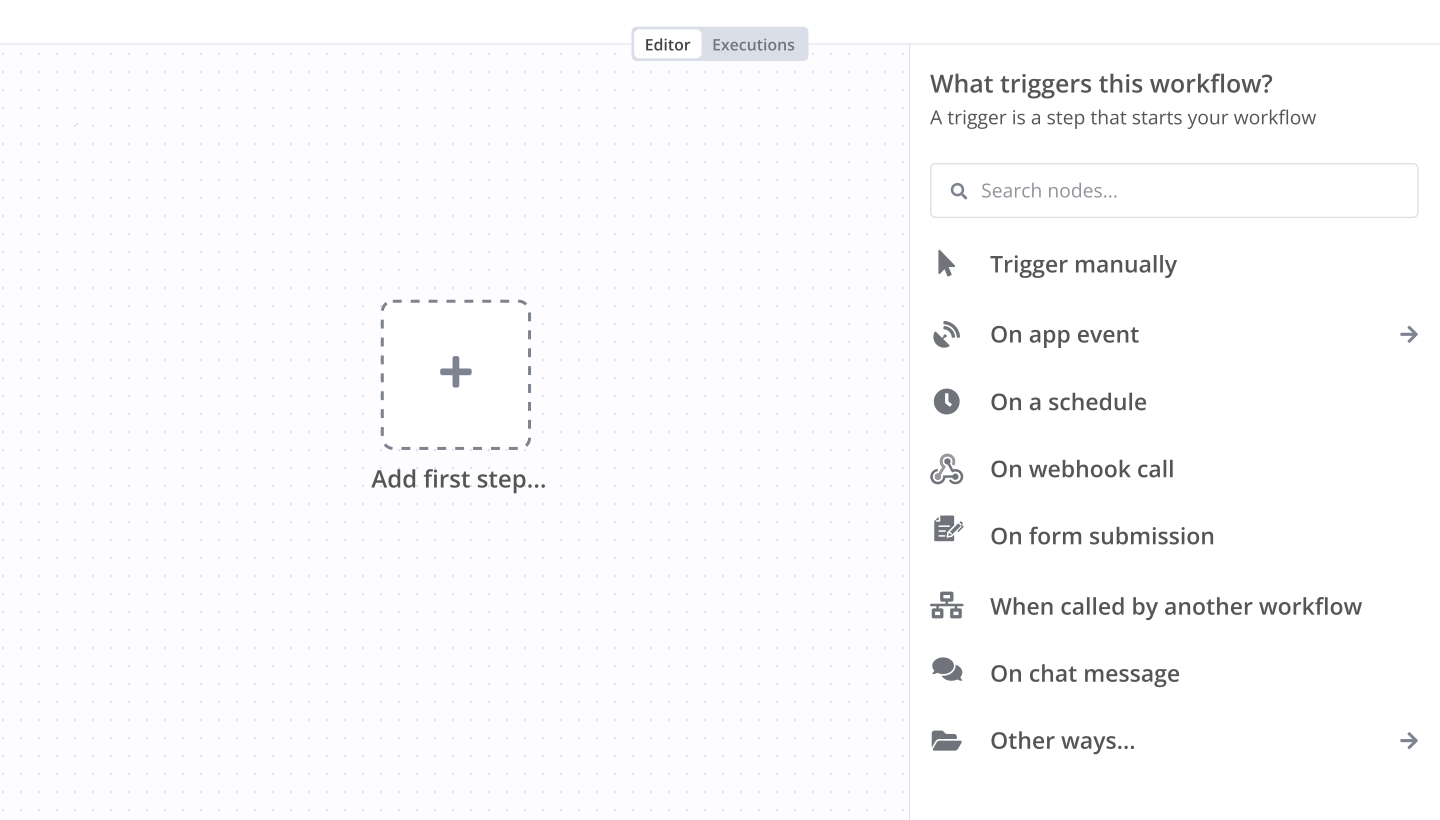
Asana and Slack integration: Create a new workflow and add the first step

Step 2: Add and configure Asana and Slack nodes

You can find Asana and Slack in the nodes panel. Drag them onto your workflow canvas, selecting their actions. Click each node, choose a credential, and authenticate to grant n8n access. Configure Asana and Slack nodes one by one: input data on the left, parameters in the middle, and output data on the right.

Asana and Slack integration: Add and configure Asana and Slack nodes

Step 3: Connect Asana and Slack

A connection establishes a link between Asana and Slack (or vice versa) to route data through the workflow. Data flows from the output of one node to the input of another. You can have single or multiple connections for each node.

Asana and Slack integration: Connect Asana and Slack

Step 4: Customize and extend your Asana and Slack integration

Use n8n's core nodes such as If, Split Out, Merge, and others to transform and manipulate data. Write custom JavaScript or Python in the Code node and run it as a step in your workflow. Connect Asana and Slack with any of n8n’s 1000+ integrations, and incorporate advanced AI logic into your workflows.

Asana and Slack integration: Customize and extend your Asana and Slack integration

Step 5: Test and activate your Asana and Slack workflow

Save and run the workflow to see if everything works as expected. Based on your configuration, data should flow from Asana to Slack or vice versa. Easily debug your workflow: you can check past executions to isolate and fix the mistake. Once you've tested everything, make sure to save your workflow and activate it.

Asana and Slack integration: Test and activate your Asana and Slack workflow

AI-powered Scrum Master assistant with OpenAI, Slack and Asana integration

What is This?

This automation simulates Scrum Master role on daily meetings. Essentially it is an AI Scrum Master using different sources of data.

As intelligent support system for Scrum Masters that leverages data from Asana, Slack, and direct developer responses for comprehensive sprint status analysis and identification of areas requiring intervention.

As such it is usable for Scrum Masters (of course) but Scrum Team aswell, Product Owner and possibly Business Owner.

Who is it For?

This automation is designed for Agile teams to support the Scrum Master role by collecting and analyzing data from various sources to identify potential impediments and support the team in sprint delivery.

How Does It Work?

The workflow has four main data entry points, that are launched either on-click or on workdays.

First is collecting project section information from Asana. The automation retrieves project structure, available sections, and their organization, allowing the AI to understand the team's work context.

Second is getting recently modified tasks in the Asana project. The system tracks changes in tasks, their status, assignments, and updates to detect potential delays or issues.

Third is obtaining communication in the team's Slack channel. The flow collects data about recent conversations, discussion threads, and team communication to identify warning signals or areas requiring attention.

Fourth is directly collecting responses from developers about the current sprint - their progress, impediments, concerns, and support needs.

All collected data is passed to an AI model that analyzes it within the Scrum methodology context and identifies:
Potential impediments in sprint delivery
Areas requiring Scrum Master intervention
Recommendations for team support
Warning signals regarding Sprint Goal achievement

Output is being pushed to Slack channel so it can be potentially used by another iteration of same flow itself via Slack channel history.

Requirements

You need Asana oAuth credentials
You need OpenAI / alternative AI for processing data
You need to have Slack app with proper permissions
channels:history
chat:write
groups:history
im:history
mpim:history
users.profile:write
users:write

Configuration

Set up node "Asana Project and Slack Channel". Provide Asana project ID and Slack Channel ID
(optional) Set up node "Get Scrum Master Answers". There are daily questions/answers that are being sent to channel.

Alternative use

You can get rid of the whole "Ask Users Daily ScrumMaster Questions" part if you don't want to do it simirarly as "daily Scrum standups". In such case whole flow is essentially changed to static analyzer of project status based on Slack and Asana.

Extensions and Customizations

There are many possibilities to extend this automation depending on team needs. For example, you can add integration with additional project management tools, implement different notification schemes based on detected issue criticality, or adjust data collection frequency to match the team's work rhythm.

Disclaimers and Notes

Whole automation has one important assumption: project is run on single Slack channel and on single Asana board. Of cource this can be extended, but is beyond currently designed scope.

Adding new sources for AI to analyze should be fairly easy - just add another branch of data and push it to AI prompt.

This automation represents a proof-of-concept and should not replace an actual Scrum Master. The Scrum Master role extends far beyond data collection and analysis - it requires deep understanding of team dynamics, business context, and interpersonal skills.

As Scrum.org emphasizes, the Scrum Master doesn't need to be present during Daily Scrum, and their role is to ensure the meeting happens, but developers are responsible for conducting the meeting. Mindlessly executing daily questions without proper context analysis can lead to situations where the Scrum Master becomes a team manager instead of a self-organization facilitator.

A real Scrum Master analyzes much more data than what's collected by automation - they observe team dynamics, understand business context, identify deeper root causes of problems, and support the team in developing self-organization skills. AI can be a valuable support tool, but it cannot replace the human intuition, empathy, and experience essential in this role.

The automation should be treated as a tool supporting the Teams's work, providing additional insights and helping identify areas requiring attention, but always under the supervision and interpretation of an experienced Scrum practitioner.

Nodes used in this workflow

Popular Asana and Slack workflows

+2

Automate client onboarding with Asana, Google Docs, Gmail, Slack and Sheets

📊 Description Automate short-term trading research by generating high-quality trade ideas using MCP (Market Context Protocol) signals and AI-powered analysis. 📈🤖 This workflow evaluates market context, catalysts, momentum, and risk factors to produce structured trade ideas with clear reasoning, confidence scores, and execution notes. Designed for fast-moving markets, it helps traders and analysts spot actionable opportunities consistently—without manual screening or emotional bias. Perfect for systematic traders, research teams, and AI-driven trading desks. ⚡📊 🔁 What This Template Does 1️⃣ Ingests market context and asset data from MCP inputs. 📥 2️⃣ Normalizes symbols, sectors, and time horizons for analysis. 🧾 3️⃣ Evaluates short-term momentum and catalyst strength. 🚀 4️⃣ Analyzes risk, volatility, and downside exposure. ⚠️ 5️⃣ Uses AI to generate a structured trade thesis. 🤖 6️⃣ Assigns a confidence score and risk level to each idea. 📊 7️⃣ Produces clear entry logic, rationale, and trade direction. 🧠 8️⃣ Filters out low-quality or low-conviction setups. 🚫 9️⃣ Outputs clean JSON-ready trade ideas for downstream systems. 🔁 ⭐ Key Benefits ✅ Automates short-term trade idea generation ✅ Reduces emotional bias with AI-based scoring ✅ Combines market context, catalysts, and momentum ✅ Produces structured, repeatable trade logic ✅ Saves hours of manual chart and news analysis ✅ Ideal for fast-paced trading environments 🧩 Features MCP (Market Context Protocol) data ingestion AI-powered trade thesis generation Confidence and risk scoring logic Short-term momentum and catalyst analysis Strict structured output for automation reliability Easy integration into dashboards or execution systems 🔐 Requirements MCP-compatible market data source OpenAI API credentials (GPT-4o or GPT-4o-mini recommended) n8n instance with AI nodes enabled Defined schema for trade idea output 🎯 Target Audience Short-term and swing traders Quant and discretionary trading teams Market research analysts Fintech platforms generating trade signals Automation engineers building trading workflows
+2

AI-Powered Scrum Master Assistant with OpenAI, Slack and Asana Integration

What is This? This automation simulates Scrum Master role on daily meetings. Essentially it is an AI Scrum Master using different sources of data. As intelligent support system for Scrum Masters that leverages data from Asana, Slack, and direct developer responses for comprehensive sprint status analysis and identification of areas requiring intervention. As such it is usable for Scrum Masters (of course) but Scrum Team aswell, Product Owner and possibly Business Owner. Who is it For? This automation is designed for Agile teams to support the Scrum Master role by collecting and analyzing data from various sources to identify potential impediments and support the team in sprint delivery. How Does It Work? The workflow has four main data entry points, that are launched either on-click or on workdays. First is collecting project section information from Asana. The automation retrieves project structure, available sections, and their organization, allowing the AI to understand the team's work context. Second is getting recently modified tasks in the Asana project. The system tracks changes in tasks, their status, assignments, and updates to detect potential delays or issues. Third is obtaining communication in the team's Slack channel. The flow collects data about recent conversations, discussion threads, and team communication to identify warning signals or areas requiring attention. Fourth is directly collecting responses from developers about the current sprint - their progress, impediments, concerns, and support needs. All collected data is passed to an AI model that analyzes it within the Scrum methodology context and identifies: Potential impediments in sprint delivery Areas requiring Scrum Master intervention Recommendations for team support Warning signals regarding Sprint Goal achievement Output is being pushed to Slack channel so it can be potentially used by another iteration of same flow itself via Slack channel history. Requirements You need Asana oAuth credentials You need OpenAI / alternative AI for processing data You need to have Slack app with proper permissions channels:history chat:write groups:history im:history mpim:history users.profile:write users:write Configuration Set up node "Asana Project and Slack Channel". Provide Asana project ID and Slack Channel ID (optional) Set up node "Get Scrum Master Answers". There are daily questions/answers that are being sent to channel. Alternative use You can get rid of the whole "Ask Users Daily ScrumMaster Questions" part if you don't want to do it simirarly as "daily Scrum standups". In such case whole flow is essentially changed to static analyzer of project status based on Slack and Asana. Extensions and Customizations There are many possibilities to extend this automation depending on team needs. For example, you can add integration with additional project management tools, implement different notification schemes based on detected issue criticality, or adjust data collection frequency to match the team's work rhythm. Disclaimers and Notes Whole automation has one important assumption: project is run on single Slack channel and on single Asana board. Of cource this can be extended, but is beyond currently designed scope. Adding new sources for AI to analyze should be fairly easy - just add another branch of data and push it to AI prompt. This automation represents a proof-of-concept and should not replace an actual Scrum Master. The Scrum Master role extends far beyond data collection and analysis - it requires deep understanding of team dynamics, business context, and interpersonal skills. As Scrum.org emphasizes, the Scrum Master doesn't need to be present during Daily Scrum, and their role is to ensure the meeting happens, but developers are responsible for conducting the meeting. Mindlessly executing daily questions without proper context analysis can lead to situations where the Scrum Master becomes a team manager instead of a self-organization facilitator. A real Scrum Master analyzes much more data than what's collected by automation - they observe team dynamics, understand business context, identify deeper root causes of problems, and support the team in developing self-organization skills. AI can be a valuable support tool, but it cannot replace the human intuition, empathy, and experience essential in this role. The automation should be treated as a tool supporting the Teams's work, providing additional insights and helping identify areas requiring attention, but always under the supervision and interpretation of an experienced Scrum practitioner.

Qualify webhook leads with GPT-4o-mini and create Asana tasks automatically

📊 Description Automate your inbound lead qualification pipeline by enriching raw lead data, scoring it with AI, and instantly creating follow-up tasks for your sales team. 🎯🤖 This workflow receives new leads via webhook, enriches them using RocketReach to fetch verified emails and contact details, applies confidence-based filtering, and uses GPT-4o-mini to score each lead based on seniority, company fit, and data quality. High-quality leads automatically generate Asana tasks and Slack notifications, while low-quality leads are safely filtered out — ensuring your team focuses only on the best opportunities. 🚀📋 🔁 What This Template Does 1️⃣ Receives inbound lead data via webhook (name, company, job title, LinkedIn URL). 🌐 2️⃣ Normalizes incoming data into a clean, structured format. 🧾 3️⃣ Enriches lead profiles using RocketReach to fetch emails and phone numbers. 📇 4️⃣ Calculates email confidence scores based on quality grades (A–D). 📊 5️⃣ Filters out low-confidence leads automatically. 🚫 6️⃣ Uses AI (GPT-4o-mini) to score qualified leads from 1–10. 🤖 7️⃣ Assigns priority levels (High / Medium / Low) with reasoning. 🧠 8️⃣ Creates an Asana task for leads scoring above the threshold. ✅ 9️⃣ Sends Slack notifications for both qualified and disqualified leads. 💬 🔟 Returns a structured webhook response with scoring results. 🔁 1️⃣1️⃣ Sends Gmail alerts automatically if any workflow error occurs. 🚨 ⭐ Key Benefits ✅ Eliminates manual lead enrichment and qualification ✅ Uses verified contact data from RocketReach ✅ AI scoring ensures consistent, unbiased lead evaluation ✅ Automatically routes high-quality leads to sales via Asana ✅ Keeps teams informed with real-time Slack notifications ✅ Prevents sales effort from being wasted on low-quality leads 🧩 Features Webhook-based inbound lead intake RocketReach profile enrichment Email confidence scoring logic AI lead scoring with strict JSON output Configurable quality and score thresholds Automatic Asana task creation Slack alerts for qualified and disqualified leads Gmail-based error handling Frontend-ready webhook responses 🔐 Requirements RocketReach API key OpenAI API key (GPT-4o-mini recommended) Asana OAuth2 credentials Slack API credentials Gmail OAuth2 credentials (for error alerts) Webhook client sending lead details (first_name, last_name, company, job_title, linkedin_url) 🎯 Target Audience B2B sales teams handling inbound leads Revenue operations (RevOps) teams SaaS companies optimizing lead qualification Lead generation agencies Automation teams building AI-driven sales pipelines
+3

AI-powered Client Onboarding with Jotform, Asana, Slack, and HubSpot

Streamline client onboarding and project setup from hours to minutes with AI-driven automation. This intelligent workflow eliminates manual coordination, builds proposals, creates projects in Asana, welcomes clients on Slack, and logs everything — ensuring 90% faster onboarding and zero dropped steps. What This Workflow Does Transforms your client onboarding from scattered tools and emails into one seamless automation: 📝 Capture Client Details – Jotform intake form collects client, company, and project information. 🧠 AI-Powered Analysis – LangChain AI Agent analyzes the project scope, estimates effort, and recommends team composition. 📄 Generate Proposal – Automatically builds a professional HTML proposal summarizing goals, timeline, and estimated hours. 🗂️ Create Asana Project – Generates a new project with all key details, milestones, and assigned team members. 💬 Slack Collaboration – Creates a dedicated Slack channel, sends welcome messages, and introduces the project team. 📧 Welcome Email – Sends a personalized onboarding email to the client with project summary and next steps. 💼 CRM Sync – Creates or updates a HubSpot contact with complete project and client information. 📊 Audit Logging – Logs all onboarding activity to Google Sheets for centralized record-keeping. Key Features 🤖 AI Proposal Generation – Uses LangChain AI to generate smart project summaries and resource plans. ⚙️ End-to-End Automation – From form submission to project creation, communication, and CRM logging. 💬 Smart Slack Setup – Automatic channel creation and messaging for internal coordination. 📧 Personalized Client Emails – Beautifully formatted, professional onboarding emails. 🗂️ Asana Integration – Project creation with dynamic task templates and priorities. 📊 Google Sheets Logging – Instant audit trail for every client submission and generated proposal. 💼 CRM Integration – Automatically syncs client data with HubSpot for sales and account tracking. Perfect For 🚀 Agencies & Service Providers – Automate client onboarding, proposal creation, and task setup. 🏢 Consultancies – Quickly turn client requests into structured projects with assigned resources. 💻 Freelancers & Creators – Impress clients with AI-built proposals and instant communication. 📈 Growing Teams – Scale onboarding without extra admin or coordination time. 🧠 Operations Teams – Ensure consistency and transparency across all onboarding activities. What You’ll Need Required Integrations 🧾 Jotform – Client intake form (project details, budget, company info). Create your form for free on Jotform using this link 🤖 AI Agent – For analyzing project scope and building proposals. 🗂️ Asana – Project creation and task assignment. 💬 Slack – For automated client channel creation and internal communication. 📧 Gmail – For onboarding and proposal emails. 💼 HubSpot – CRM contact creation and project linkage. 📊 Google Sheets – For logging all onboarding and AI results. Optional Enhancements 📄 PDF Generation (PDF Munk) – Convert AI-generated proposals into downloadable PDFs. 💬 Slack Interactive Approvals – Add buttons for internal review before client communication. 📈 Performance Dashboard – Connect Google Sheets data to Looker Studio for tracking onboarding times. 🌍 Multilingual Support – Add translation nodes for international clients. 🔐 File Attachments – Send proposal PDFs or onboarding kits automatically via Gmail. Quick Start 1️⃣ Import Template – Copy and import the JSON file into your n8n workspace. 2️⃣ Set Up Jotform – Create a form with fields for client name, company, project name, budget, and requirements. 3️⃣ Add Credentials – Connect Jotform, AI Agent, Asana, Slack, Gmail, HubSpot, and Google Sheets. 4️⃣ Configure Sheet ID – Replace YOUR_SHEET_ID in the Google Sheets node. 5️⃣ Customize Proposal HTML – Edit AI prompt and branding to reflect your company’s style. 6️⃣ Test Workflow – Submit a test form and verify Slack, Asana, Gmail, and Sheets outputs. 7️⃣ Deploy – Activate workflow and share the Jotform link with your sales or operations team. Customization Options 1️⃣ Proposal Branding – Customize proposal HTML with logos, brand colors, and formatting. 2️⃣ AI Prompt Tuning – Refine the LangChain AI prompt to match your tone or project style. 3️⃣ Task Templates – Adjust task names, assignees, and due dates in the Asana creation node. 4️⃣ Slack Messaging – Update welcome message formatting and team introduction details. 5️⃣ CRM Fields – Map additional HubSpot properties for better data tracking. 6️⃣ Sheet Logging – Add more columns for tracking team recommendations or proposal scores. Expected Results ⚡ 90% Faster Onboarding – Reduce manual setup from hours to minutes. 🤖 AI Precision – Intelligent proposals and team allocations that impress clients instantly. 📈 Zero Missed Steps – Every project automatically created, communicated, and logged. 💬 Seamless Collaboration – Slack, Gmail, and Asana in perfect sync. 🗂️ Complete Transparency – Every onboarding step logged for accountability and improvement. 🏆 Use Cases 🧑‍💼 Marketing & Creative Agencies – Automate creative project scoping and proposal creation. 💻 Software Development Teams – Rapidly assess client tech requirements and allocate developers. 🧾 Consulting Firms – Build data-backed, AI-enhanced proposals for client engagements. 🏢 Corporate PMOs – Standardize project setup and approvals across multiple departments. Pro Tips 💡 Refine AI Prompt – Include examples of past projects to improve proposal quality. 💬 Add Slack Approvals – Insert “manager approval” logic before sending proposals. 📄 Attach PDFs – Use PDF Munk for branded, downloadable proposals. 📊 Track Conversion – Link HubSpot deal stage changes based on Asana progress. 📅 Monitor Efficiency – Use Sheet timestamps to calculate average onboarding time. Learning Resources This workflow demonstrates: AI integration using Agents Multi-app orchestration and data syncing Advanced HTML and email template customization Real-world Asana and Slack API usage CRM syncing and Google Sheets logging Modular, scalable n8n workflow design Workflow Structure Visualization 📝 Jotform Submission ↓ 🧠 AI Project Analysis (Agent) ↓ 📄 Proposal Generation (HTML) ↓ 🗂️ Asana Project Creation ↓ 💬 Slack Channel Setup & Message ↓ 📧 Gmail Welcome Email ↓ 💼 HubSpot Contact Creation ↓ 📊 Google Sheets Log Ready to Revolutionize Client Onboarding? Import this template today and let AI handle the heavy lifting. Your team saves hours, your clients get instant engagement — and your entire process runs flawlessly. ✨

Turn new high-volume ranked keywords into Asana tasks with DataForSEO

This weekly workflow automatically discovers new high-volume, ranked keywords for your domain on Google without manual SERP monitoring. On each run, the workflow fetches the latest ranking and search volume data using the DataForSEO Labs API and stores a fresh snapshot in Google Sheets. It then compares this data with the previous run to identify any new keywords your domain started ranking for, focusing on queries with a search volume above 1,000. All newly ranked keywords that match this rule are added to a dedicated Google Sheet, along with their ranking position and search volume, creating a growing historical log you can use to analyze gains over time. Once new terms are identified, the workflow creates tasks in Asana to help your team act on them quickly, and sends you a Slack summary highlighting the latest changes. Who’s it for SEO professionals, marketers, and content teams who want an automated way to discover newly ranked, high-volume Google keywords and turn organic ranking gains into actionable content or optimization tasks. What it does This workflow automatically detects when your domain starts ranking for new high-volume keywords on Google, records them in Google Sheets, creates related tasks in Asana, and sends a weekly summary via Slack. How it works Runs on a predefined schedule (default: once a week). Reads your keywords and target domains from Google Sheets. Extracts the latest Google results and keyword metrics via DataForSEO API. Compares current data with the previous snapshot. Logs newly ranked keywords to a dedicated Google Sheet. Creates follow-up tasks in Asana for content team. Sends a Slack summary with key changes. Requirements DataForSEO account and API credentials Google Sheets spreadsheet with your keywords, following the required column structure (as in the example). Google Sheets spreadsheet with your target domains, following the required column structure (as in the example). Asana account Slack account Customization You can easily tailor this workflow to your needs by adjusting the run schedule, changing the minimum search volume threshold, exporting results to other tools (like Looker Studio or BigQuery), and customizing the content of the Asana task or Slack message to match your team’s workflow.
+4

Generate AI inventory reorder recommendations from Airtable with GPT-4o, Slack and email

📘 Description This workflow automates end-to-end AI-driven inventory intelligence, transforming Airtable stock data into optimized reorder recommendations, daily operational summaries, and instant Slack alerts. It fetches all inventory rows, validates structure, computes reorder and safety-stock metrics using strict formulas, merges multi-batch AI output into a unified dataset, and distributes actionable insights across Email and Slack. Invalid or corrupted Airtable rows are logged to Google Sheets for audit and cleanup. The workflow ensures deterministic inventory math (zero improvisation), strict JSON compliance, and reliable multi-channel reporting for operations teams. ⚙️ What This Workflow Does (Step-by-Step) ▶️ Manual Trigger – Start Inventory Optimization Runs the full optimization and reporting pipeline on demand. 📦 Fetch Inventory Records from Airtable Retrieves all SKU records (ID, ItemName, SKU, quantities, reorder levels) from the Airtable Inventory table. 🔍 Validate Inventory Record Structure (IF) Ensures each record contains a valid id. Valid → routed to AI optimization Invalid → saved to Google Sheets. 📄 Log Invalid Inventory Rows to Google Sheet Captures malformed or incomplete Airtable items for audit checks and data hygiene. 🧠 Configure GPT-4o — Inventory Optimization Model Defines the AI model for stock-level calculations using strict formulas: SuggestedReorderPoint = ReorderLevel × 1.2 SuggestedSafetyStock = ReorderLevel × 0.5 StockStatus logic: Critical if QuantityInStock ≤ SuggestedSafetyStock Needs Reorder if QuantityInStock ≤ SuggestedReorderPoint OK otherwise 🤖 Generate Inventory Optimization Output (AI) The AI engine analyzes each SKU and returns: Suggested reorder point Suggested safety stock Updated stock status Clean structured JSON for each item All without markdown, hallucination, or additional logic. 🧩 Merge AI Optimization Results (Code) Consolidates all partial AI responses into one complete JSON dataset containing all SKUs. 🧠 Configure GPT-4o – Email Summary Model Prepares the AI model used for generating a professional operations-team email. 📧 Generate Inventory Email Summary (AI) Creates a manager-ready email including: High-level inventory health Detailed SKU summaries Alerts for low, reorder-level, or critical stock Recommended actions for today’s operations 📨 Email Inventory Summary to Manager (Gmail) Sends the completed inventory summary to the operations manager. 🧠 Configure GPT-4o – Slack Summary Model Sets up GPT-4o to produce a compact, emoji-supported Slack summary. 💬 Generate Inventory Slack Summary (AI) Builds a Slack-optimized message containing: One-line inventory health Bullet list of SKUs with stock status Clear alerts for reorder-level or critical items One recommended action line 📡 Notify Operations Team on Slack Delivers the optimized Slack summary to the operations Slack user/channel for real-time visibility. 🧩 Prerequisites Airtable access token Azure OpenAI GPT-4o credentials Google Sheets OAuth Slack API credentials Gmail OAuth 💡 Key Benefits ✔ AI-powered stock calculations with strict formulas ✔ Reliable reorder and safety-stock predictions ✔ Instant multi-channel reporting (Email + Slack) ✔ Full audit logging for invalid data ✔ Zero hallucinations—pure structured JSON ✔ Faster decision-making for operations teams 👥 Perfect For Operations & supply-chain teams Inventory managers Retail & e-commerce units Businesses using Airtable for stock tracking

Build your own Asana and Slack integration

Create custom Asana and Slack workflows by choosing triggers and actions. Nodes come with global operations and settings, as well as app-specific parameters that can be configured. You can also use the HTTP Request node to query data from any app or service with a REST API.

Asana supported actions

Create
Create a new project
Delete
Delete a project
Get
Get a project
Get Many
Get many projects
Update
Update a project
Create
Create a subtask
Get Many
Get many subtasks
Create
Create a task
Delete
Delete a task
Get
Get a task
Get Many
Get many tasks
Move
Move a task
Search
Search for tasks
Update
Update a task
Add
Add a comment to a task
Remove
Remove a comment from a task
Add
Add a task to a project
Remove
Remove a task from a project
Add
Add a tag to a task
Remove
Remove a tag from a task
Get
Get a user
Get Many
Get many users

Slack supported actions

Archive
Archives a conversation
Close
Closes a direct message or multi-person direct message
Create
Initiates a public or private channel-based conversation
Get
Get information about a channel
Get Many
Get many channels in a Slack team
History
Get a conversation's history of messages and events
Invite
Invite a user to a channel
Join
Joins an existing conversation
Kick
Removes a user from a channel
Leave
Leaves a conversation
Member
List members of a conversation
Open
Opens or resumes a direct message or multi-person direct message
Rename
Renames a conversation
Replies
Get a thread of messages posted to a channel
Set Purpose
Sets the purpose for a conversation
Set Topic
Sets the topic for a conversation
Unarchive
Unarchives a conversation
Get
Get Many
Get & filters team files
Upload
Create or upload an existing file
Delete
Get Permalink
Search
Send
Send and Wait for Response
Update
Add
Adds a reaction to a message
Get
Get the reactions of a message
Remove
Remove a reaction of a message
Add
Add a star to an item
Delete
Delete a star from an item
Get Many
Get many stars of autenticated user
Get
Get information about a user
Get Many
Get a list of many users
Get User's Profile
Get a user's profile
Get User's Status
Get online status of a user
Update User's Profile
Update a user's profile
Add Users
Create
Disable
Enable
Get Many
Get Users
Update

FAQs

  • Can Asana connect with Slack?

  • Can I use Asana’s API with n8n?

  • Can I use Slack’s API with n8n?

  • Is n8n secure for integrating Asana and Slack?

  • How to get started with Asana and Slack integration in n8n.io?

Need help setting up your Asana and Slack integration?

Discover our latest community's recommendations and join the discussions about Asana and Slack integration.
Nicolas N
Muhammed Iqbal P B
Nicolas N

Looking to integrate Asana and Slack in your company?

Over 3000 companies switch to n8n every single week

Why use n8n to integrate Asana with Slack

Build complex workflows, really fast

Build complex workflows, really fast

Handle branching, merging and iteration easily.
Pause your workflow to wait for external events.

Code when you need it, UI when you don't

Simple debugging

Your data is displayed alongside your settings, making edge cases easy to track down.

Use templates to get started fast

Use 1000+ workflow templates available from our core team and our community.

Reuse your work

Copy and paste, easily import and export workflows.

Implement complex processes faster with n8n

red iconyellow iconred iconyellow icon