Back to Integrations
integrationAWS S3 node
integrationSlack node

AWS S3 and Slack integration

Save yourself the work of writing custom integrations for AWS S3 and Slack and use n8n instead. Build adaptable and scalable Development, Data & Storage, Communication, and HITL workflows that work with your technology stack. All within a building experience you will love.

How to connect AWS S3 and Slack

  • Step 1: Create a new workflow
  • Step 2: Add and configure nodes
  • Step 3: Connect
  • Step 4: Customize and extend your integration
  • Step 5: Test and activate your workflow

Step 1: Create a new workflow and add the first step

In n8n, click the "Add workflow" button in the Workflows tab to create a new workflow. Add the starting point – a trigger on when your workflow should run: an app event, a schedule, a webhook call, another workflow, an AI chat, or a manual trigger. Sometimes, the HTTP Request node might already serve as your starting point.
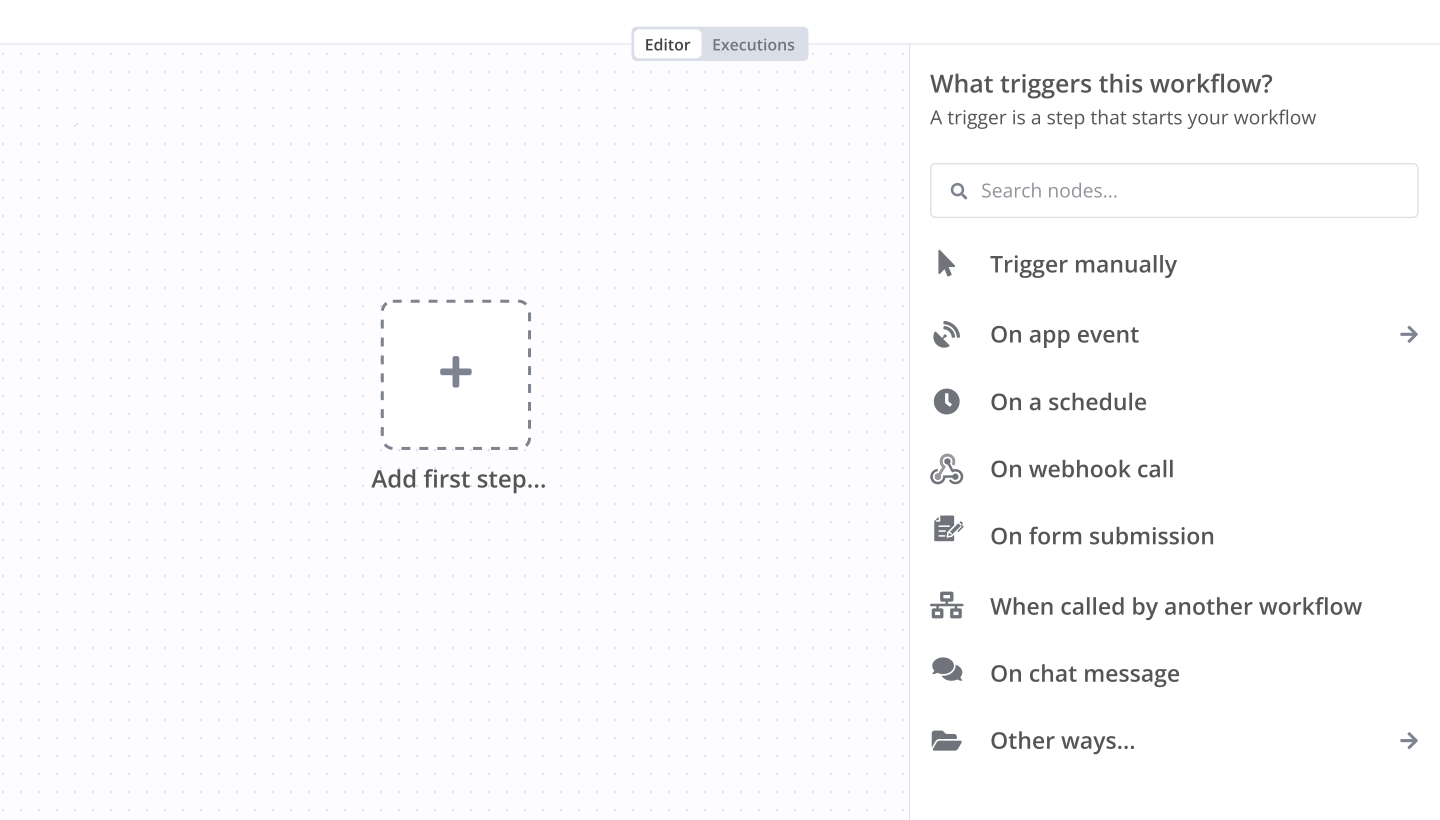
AWS S3 and Slack integration: Create a new workflow and add the first step

Step 2: Add and configure AWS S3 and Slack nodes

You can find AWS S3 and Slack in the nodes panel. Drag them onto your workflow canvas, selecting their actions. Click each node, choose a credential, and authenticate to grant n8n access. Configure AWS S3 and Slack nodes one by one: input data on the left, parameters in the middle, and output data on the right.

AWS S3 and Slack integration: Add and configure AWS S3 and Slack nodes

Step 3: Connect AWS S3 and Slack

A connection establishes a link between AWS S3 and Slack (or vice versa) to route data through the workflow. Data flows from the output of one node to the input of another. You can have single or multiple connections for each node.

AWS S3 and Slack integration: Connect AWS S3 and Slack

Step 4: Customize and extend your AWS S3 and Slack integration

Use n8n's core nodes such as If, Split Out, Merge, and others to transform and manipulate data. Write custom JavaScript or Python in the Code node and run it as a step in your workflow. Connect AWS S3 and Slack with any of n8n’s 1000+ integrations, and incorporate advanced AI logic into your workflows.

AWS S3 and Slack integration: Customize and extend your AWS S3 and Slack integration

Step 5: Test and activate your AWS S3 and Slack workflow

Save and run the workflow to see if everything works as expected. Based on your configuration, data should flow from AWS S3 to Slack or vice versa. Easily debug your workflow: you can check past executions to isolate and fix the mistake. Once you've tested everything, make sure to save your workflow and activate it.

AWS S3 and Slack integration: Test and activate your AWS S3 and Slack workflow

Airtable base backups to S3

This workflow exports every table in a base as its own CSV, saves the files in a time-stamped folder in Amazon S3, pings you on Slack, and optionally prunes older copies. You get an automated weekly backup that is easy to inspect or re-import as needed. You can easily swap the S3 node for the storage provider of your choice.

++How it works++

Weekly Backup
Schedule trigger fires weekly
Sets and formats the week ex. [2025-W12]
Create a folder in S3 bucket with the week
Loops through all tables in Airtable base creating CSVs and uploading to the new path
Slack message is sent on completion

Monthly Prune
Schedule trigger fires weekly
Sets a cut-off date 4 weeks in the past
Lists folders in S3
Deletes all folders > 4 weeks old

++Setup Steps++

Clone workflow
Swap credentials for Airtable, AWS, and Slack
Ensure AWS credential has appropriate IAM policy to manage bucket & objects
Set workflow to "Active"

Nodes used in this workflow

Popular AWS S3 and Slack workflows

Salesforce to S3 File Migration & Cleanup

Salesforce to S3 File Migration & Cleanup Automate archiving old Salesforce files to Amazon S3, log them back in Salesforce, and free up org storage — all from a scheduled n8n workflow. 🔧 How It Works (High-Level) Schedule Trigger kicks off (e.g., daily). Query Salesforce for ContentDocument records older than 365 days. Loop Each File → download binary via REST. Upload to S3 with the original filename. Lookup Links (ContentDocumentLink) to keep the parent record reference. Filter Out Users (ignore LinkedEntityId starting with 005). Create S3_File__c record in Salesforce for traceability. Delete Original File from Salesforce to reclaim storage. Notify via Slack when the batch is done. 🚀 Set Up Steps (Time: ~45–90 mins) Import n8n Workflow JSON and wire up credentials (Salesforce OAuth2, AWS S3, Slack). Install Salesforce Unmanaged Package (Custom Object S3_File__c, Apex controller, LWC, settings). Fill S3Settings__c (bucket, region, keys, expiry) or swap to Named Credentials. Test with a Sandbox Batch (e.g., small date range) and verify upload/delete. Schedule & Monitor (tweak interval, Slack channel). 💖 Why you’ll love it 💸 Slash storage costs — offload gigabytes to S3 🔍 Full traceability — every file still tracked in Salesforce 🧰 Plug & play — import JSON, install package, plug in creds 🧱 Modular & extensible — swap S3, add approvals, build an uploader UI ⏱ Set it & forget it — scheduled automation + Slack alerts 📦 What’s Included n8n JSON Flow** – ready to import. Salesforce Unmanaged Package** – Apex (S3FilesController.cls), LWC (s3FilesViewer), S3_File__c, S3Settings__c. S3 + Salesforce Setup Guide** – quick reference for configuring keys, permissions, and the LWC. All components are editable — extend, replace, or integrate with your own processes. 🧱 Requirements n8n instance (self-hosted or Cloud) with HTTP Request, AWS S3, Slack, and Salesforce nodes. Salesforce org with API access & permission to install unmanaged packages. You have to have Query All Files permission. Setup-> Permission Sets / Profile -> App Permission -> Content -> Query All Files. Allows View All Data users to SOQL query all files in the org. AWS S3 bucket + IAM user/role with GetObject/PutObject (and optional ListBucket).

Airtable Base Backups to S3

This workflow exports every table in a base as its own CSV, saves the files in a time-stamped folder in Amazon S3, pings you on Slack, and optionally prunes older copies. You get an automated weekly backup that is easy to inspect or re-import as needed. You can easily swap the S3 node for the storage provider of your choice. ++How it works++ Weekly Backup Schedule trigger fires weekly Sets and formats the week ex. [2025-W12] Create a folder in S3 bucket with the week Loops through all tables in Airtable base creating CSVs and uploading to the new path Slack message is sent on completion Monthly Prune Schedule trigger fires weekly Sets a cut-off date 4 weeks in the past Lists folders in S3 Deletes all folders > 4 weeks old ++Setup Steps++ Clone workflow Swap credentials for Airtable, AWS, and Slack Ensure AWS credential has appropriate IAM policy to manage bucket & objects Set workflow to "Active"

Summarize invoices with AWS Textract, Google Gemini, and send to Slack

Who’s it for This workflow is built for finance teams, operations managers, founders, and businesses that process invoices regularly and want to eliminate manual document handling. It’s especially useful for teams that need quick, structured invoice insights delivered directly to their communication tools. What it does / How it works This workflow automates the entire invoice-processing pipeline from upload to notification. A user uploads an invoice file through an n8n form trigger. The uploaded file is securely stored in AWS S3. AWS Textract analyzes the invoice and extracts text and structured data such as vendor name, totals, and line items. The extracted data is sent to AI Agent, which summarizes the invoice and highlights key financial details. The AI-generated summary is sent as a direct message to a selected user in Slack. All steps run automatically after the form submission. Requirements AWS credentials with access to: Amazon S3 AWS Textract Google Gemini (PaLM) API credentials Slack API credentials An existing S3 bucket to store uploaded invoice files How to set up Connect your AWS credentials in n8n with permissions for S3 and Textract. Specify the S3 bucket name where invoice files should be uploaded. Add and authenticate your Google Gemini API credentials. Connect your Slack account and choose the user or channel for notifications. Test the workflow by submitting an invoice through the n8n form. How to customize the workflow Update the Gemini prompt to extract specific fields such as tax, due date, or invoice number. Route invoices differently based on total amount or vendor. Send Slack messages to a channel instead of a direct message. Store extracted invoice data in a database or spreadsheet. Add approval or alert steps for high-value invoices.
+4

HR Policy Retrieval using Slack, S3, and GPT-4.1-mini with RAG

HR Chatbot with RAG: Retrieve Company Policies via Slack, Amazon S3, and OpenAI Overview Answer HR and company policy questions via Slack, powered by a Knowledge Base of internal documents stored in S3. The assistant uses vector search and an OpenAI Chat Model to retrieve accurate answers. The HR Assistant is an AI-powered Slack bot that allows employees to ask questions in natural language and get accurate answers from company documentation. Documents are managed through an ingestion workflow that retrieves files from S3, transforms them into embeddings, and stores them in a vector database. On Slack, the assistant interprets questions, searches the Knowledge Base, and responds with concise and reliable answers, or clearly states when information isn’t available. How it works Normal interaction An employee asks a question in Slack (e.g., “How many vacation days do I have?”). The assistant checks the Knowledge Base (vector store). If relevant information is found, the assistant provides a clear answer. If not, it responds with: “That answer doesn’t appear to be covered in the materials I have access to.” Standardized process of Knowledge Base ingestion Trigger – The ingestion workflow is manually executed. S3 Download – Files are pulled from the company’s S3 bucket. Data Loader – Documents are pre-processed and split into chunks. Embeddings – Each chunk is converted into an embedding via OpenAI. Vector Store – Embeddings are stored in the Knowledge Base (vector DB). Chatbot Workflow – When questions arrive via Slack, the assistant queries the vector store to find the most relevant context before generating a response. Required Connections To use the HR Assistant effectively, you need: A Slack workspace, where the bot is installed and invited to relevant channels. An S3 bucket containing company documents (e.g., HR policies, procedures). Access to OpenAI API keys for both embeddings and chat models. Proper permissions to fetch documents from S3 and write to the vector store. A configured n8n instance with both ingestion and chatbot workflows. Setup Time ≈ 20–30 minutes (depending on number of documents and Slack integration). Customising this workflow Add more document sources (e.g., Google Drive, Confluence) in the ingestion pipeline. Expand the Slack integration to allow commands like /askHR or to restrict the bot to only respond when @mentioned. Add scheduled ingestion (instead of manual trigger) to automatically refresh the Knowledge Base from S3. Connect analytics nodes to monitor which HR topics employees ask most often.

Build your own AWS S3 and Slack integration

Create custom AWS S3 and Slack workflows by choosing triggers and actions. Nodes come with global operations and settings, as well as app-specific parameters that can be configured. You can also use the HTTP Request node to query data from any app or service with a REST API.

AWS S3 supported actions

Create
Create a bucket
Delete
Delete a bucket
Get Many
Get many buckets
Search
Search within a bucket
Copy
Copy a file
Delete
Delete a file
Download
Download a file
Get Many
Get many files
Upload
Upload a file
Create
Create a folder
Delete
Delete a folder
Get Many
Get many folders

Slack supported actions

Archive
Archives a conversation
Close
Closes a direct message or multi-person direct message
Create
Initiates a public or private channel-based conversation
Get
Get information about a channel
Get Many
Get many channels in a Slack team
History
Get a conversation's history of messages and events
Invite
Invite a user to a channel
Join
Joins an existing conversation
Kick
Removes a user from a channel
Leave
Leaves a conversation
Member
List members of a conversation
Open
Opens or resumes a direct message or multi-person direct message
Rename
Renames a conversation
Replies
Get a thread of messages posted to a channel
Set Purpose
Sets the purpose for a conversation
Set Topic
Sets the topic for a conversation
Unarchive
Unarchives a conversation
Get
Get Many
Get & filters team files
Upload
Create or upload an existing file
Delete
Get Permalink
Search
Send
Send and Wait for Response
Update
Add
Adds a reaction to a message
Get
Get the reactions of a message
Remove
Remove a reaction of a message
Add
Add a star to an item
Delete
Delete a star from an item
Get Many
Get many stars of autenticated user
Get
Get information about a user
Get Many
Get a list of many users
Get User's Profile
Get a user's profile
Get User's Status
Get online status of a user
Update User's Profile
Update a user's profile
Add Users
Create
Disable
Enable
Get Many
Get Users
Update

FAQs

  • Can AWS S3 connect with Slack?

  • Can I use AWS S3’s API with n8n?

  • Can I use Slack’s API with n8n?

  • Is n8n secure for integrating AWS S3 and Slack?

  • How to get started with AWS S3 and Slack integration in n8n.io?

Need help setting up your AWS S3 and Slack integration?

Discover our latest community's recommendations and join the discussions about AWS S3 and Slack integration.
Nicolas N
Muhammed Iqbal P B
Nicolas N

Looking to integrate AWS S3 and Slack in your company?

Over 3000 companies switch to n8n every single week

Why use n8n to integrate AWS S3 with Slack

Build complex workflows, really fast

Build complex workflows, really fast

Handle branching, merging and iteration easily.
Pause your workflow to wait for external events.

Code when you need it, UI when you don't

Simple debugging

Your data is displayed alongside your settings, making edge cases easy to track down.

Use templates to get started fast

Use 1000+ workflow templates available from our core team and our community.

Reuse your work

Copy and paste, easily import and export workflows.

Implement complex processes faster with n8n

red iconyellow iconred iconyellow icon