Back to Integrations
integrationClickUp node
integrationHTTP Request node

ClickUp and HTTP Request integration

Save yourself the work of writing custom integrations for ClickUp and HTTP Request and use n8n instead. Build adaptable and scalable Productivity, Communication, Development, and Core Nodes workflows that work with your technology stack. All within a building experience you will love.

How to connect ClickUp and HTTP Request

  • Step 1: Create a new workflow
  • Step 2: Add and configure nodes
  • Step 3: Connect
  • Step 4: Customize and extend your integration
  • Step 5: Test and activate your workflow

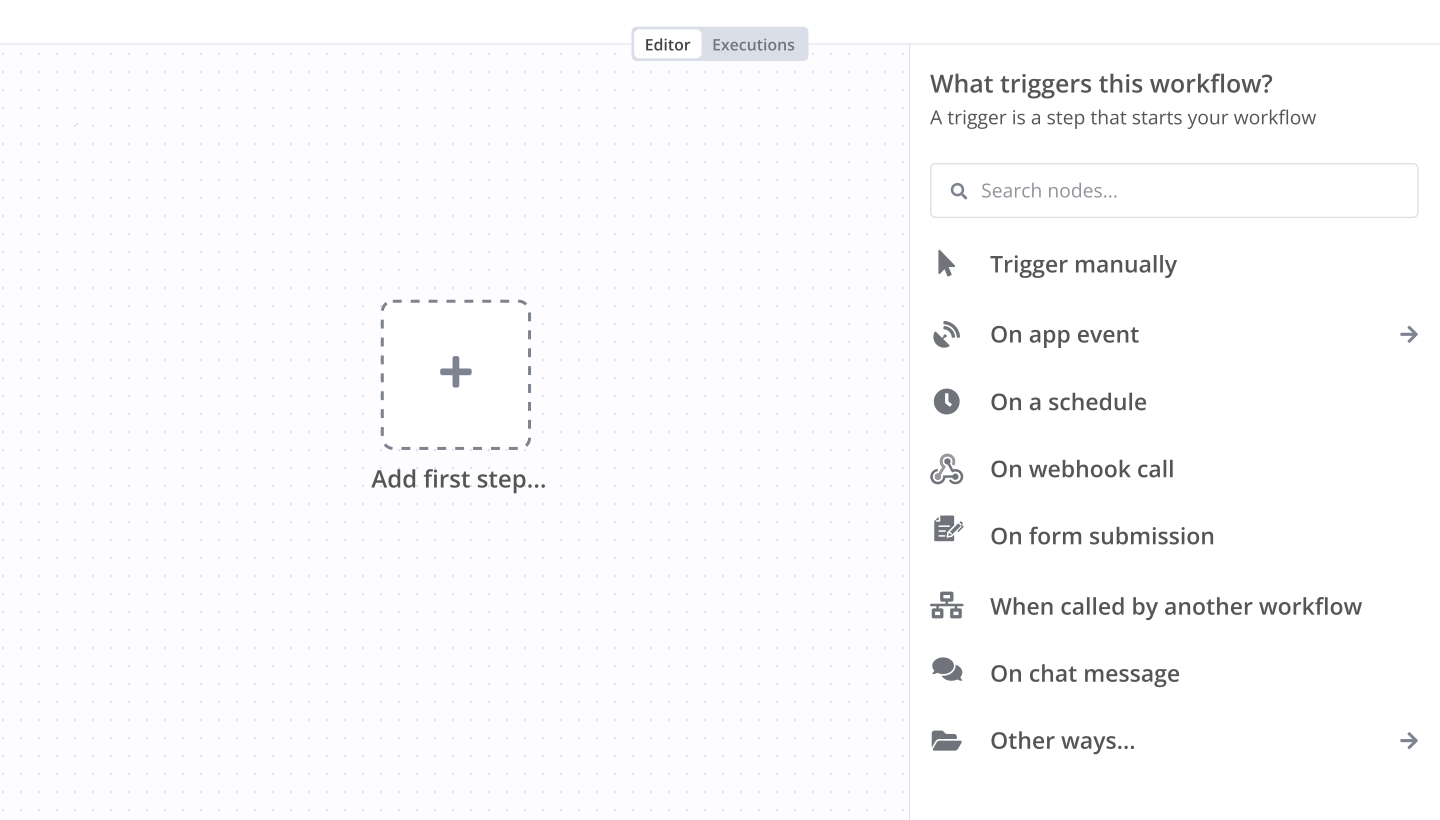
Step 1: Create a new workflow and add the first step

In n8n, click the "Add workflow" button in the Workflows tab to create a new workflow. Add the starting point – a trigger on when your workflow should run: an app event, a schedule, a webhook call, another workflow, an AI chat, or a manual trigger. Sometimes, the HTTP Request node might already serve as your starting point.

ClickUp and HTTP Request integration: Create a new workflow and add the first step

Step 2: Add and configure ClickUp and HTTP Request nodes

You can find ClickUp and HTTP Request in the nodes panel. Drag them onto your workflow canvas, selecting their actions. Click each node, choose a credential, and authenticate to grant n8n access. Configure ClickUp and HTTP Request nodes one by one: input data on the left, parameters in the middle, and output data on the right.

ClickUp and HTTP Request integration: Add and configure ClickUp and HTTP Request nodes

Step 3: Connect ClickUp and HTTP Request

A connection establishes a link between ClickUp and HTTP Request (or vice versa) to route data through the workflow. Data flows from the output of one node to the input of another. You can have single or multiple connections for each node.

ClickUp and HTTP Request integration: Connect ClickUp and HTTP Request

Step 4: Customize and extend your ClickUp and HTTP Request integration

Use n8n's core nodes such as If, Split Out, Merge, and others to transform and manipulate data. Write custom JavaScript or Python in the Code node and run it as a step in your workflow. Connect ClickUp and HTTP Request with any of n8n’s 1000+ integrations, and incorporate advanced AI logic into your workflows.

ClickUp and HTTP Request integration: Customize and extend your ClickUp and HTTP Request integration

Step 5: Test and activate your ClickUp and HTTP Request workflow

Save and run the workflow to see if everything works as expected. Based on your configuration, data should flow from ClickUp to HTTP Request or vice versa. Easily debug your workflow: you can check past executions to isolate and fix the mistake. Once you've tested everything, make sure to save your workflow and activate it.

ClickUp and HTTP Request integration: Test and activate your ClickUp and HTTP Request workflow

Zoom AI meeting assistant creates mail summary, ClickUp tasks and follow-up call

Update 19-04-2025
Change from OpenAI to Claude 3.7 Sonnet module
Adding the Think Tool

The update enables significantly better results to be achieved. This is particularly noticeable during longer meetings!

What this workflow does
This workflow retrieves the Zoom meeting data from the last 24 hours. The transcript of the last meeting is then retrieved, processed, a summary is created using AI and sent to all participants by email.
AI is then used to create tasks and follow-up appointments based on the content of the meeting.

Important: You need a Zoom Workspace Pro account and must have activated Cloud Recording/Transcripts!

This workflow has the following sequence:

manual trigger (Can be replaced by a scheduled trigger or a webhook)
retrieval of of Zoom meeting data
filter the events of the last 24 hours
retrieval of transcripts and extract of the text
creating a meeting summary, format to html and send per mail
create tasks and follow-up call (if discussed in the meeting) in ClickUp/Outlook (can be replaced by Gmail, Airtable, and so forth) via sub workflow

Requirements:
Zoom Workspace (via API and HTTP Request): Documentation
Microsoft Outlook: Documentation
ClickUp: Documentation
AI API access (e.g. via OpenAI, Anthropic, Google or Ollama)
SMTP access data (for sending the mail)

You must set up the individual sub-workflows as separate workflows. Then set the “Execute workflow trigger” here. Then select the corresponding sub-workflow in the AI Agent Tools.
You can select the number of domains yourself. If the data queries are not required, simply delete the corresponding tool (e.g. “Analytics_Domain_5).

Feel free to contact me via LinkedIn, if you have any questions!

Nodes used in this workflow

Popular ClickUp and HTTP Request workflows

AI Proposal Generator

Overview Stop spending hours formatting proposals. This workflow turns a short post-call form into a high-converting, fully-personalized PandaDoc proposal—plus updates your CRM and drafts the follow-up email for you. After a sales call, just fill out a 3-minute form summarizing key pain points, solutions pitched, and the price. The workflow uses AI to generate polished proposal copy, then builds a PandaDoc draft using dynamic data mapped into the JSON body (which you can fully customize per business). It also updates the lead record in ClickUp with the proposal link, company name, and quote—then creates an email draft in Gmail, ready to send. Who’s it for Freelancers and consultants sending service proposals Agencies closing deals over sales calls Sales reps who want to automate proposal follow-up Teams using ClickUp as their lightweight CRM How it works After a call, fill out a short form with client details, pitch notes, and price AI generates professional proposal copy based on form input Proposal is formatted and sent to PandaDoc via HTTP request ClickUp lead is updated with: Company Name Proposal URL Quote/price A Gmail draft is created using the proposal link and a thank-you message Example use case > You hop off a call, fill out: > - Prospect: Shopify agency > - Pain: No lead gen system > - Solution: Automated cold outreach > - Price: $2,500/month > > 3 minutes later: PandaDoc proposal is ready, CRM is updated, and your email draft is waiting to be sent. How to set up Replace the form with your preferred tool (e.g. Tally, Typeform) Connect PandaDoc API and structure your proposal template Customize the JSON body inside the HTTP request to match your business Link your ClickUp space and custom fields Connect Gmail (or other email tool) for final follow-up draft Requirements Form tool for capturing sales call notes OpenAI or LLM key for generating proposal copy PandaDoc API access ClickUp custom fields set up for lead tracking Gmail integration How to customize Customize your PandaDoc proposal fields in the JSON body of the HTTP node Replace ClickUp with another CRM like HubSpot or Notion Adjust AI tone (casual, premium, corporate) for proposal writing Add Slack or Telegram alerts when the draft is ready Add PDF generation or auto-send email step

Generate AI matte painting video variations with Seedance for VFX review

📘 Description This workflow is a fully automated AI matte painting generation system for VFX pipelines, designed to convert a single environment prompt into multiple cinematic background variations. It handles generation, validation, multi-variant rendering, compositing preparation, review workflows, and final delivery—eliminating manual coordination between artists, supervisors, and production systems. ⚙️ Step-by-Step Flow The process begins with a webhook trigger that serves as the shot request intake layer, receiving a POST request containing the environment prompt, shot code, optional plate image URL, and metadata such as project, sequence, and supervisor details. This input is then passed through a validation and normalization stage, ensuring all required fields are present while standardizing elements like sequence codes, project IDs, Slack channels, and timestamps. Once validated, the system fans out the request into four distinct cinematic variations—day (overcast realism), dusk (golden hour lighting), night (moonlit cinematic), and fog (atmospheric depth)—with each variant assigned a custom-engineered prompt. At the core of the workflow, a dynamic mode selection logic determines whether to use image-to-video generation (if a plate image is provided) or text-to-video generation (if no reference is available), while also configuring parameters such as audio generation, aspect ratio, and duration. Each variation is then submitted as an independent job to the Seedance API for AI video generation, returning unique job IDs for tracking. A polling loop handles asynchronous processing by checking the status of each job every 20 seconds until all reach a “succeeded” state, operating independently per variation. Once completed, the system constructs detailed metadata for each asset, including video URL, atmosphere type, variant ID, resolution, duration, and tags such as AI-generated and review status. In parallel, it generates an auto-configured Nuke compositing template with pre-built nodes for plate input, AI background, merge setup, color grading placeholders, and output writing. For production tracking, a Jira review task is created for each variation, while all assets are logged within the ClickUp system. An aggregation layer then consolidates all four variations into a single structured summary, formatted for seamless Slack delivery. A Slack notification is sent to the supervisor with the complete review package, including links to all variations, Jira tickets, inline Nuke scripts, and associated metadata. Finally, the system downloads the generated video assets and completes the workflow by sending an email to the requester with the video attachments and full production context, ensuring a smooth end-to-end delivery pipeline. 🚨 Error Handling • Global error trigger • Instant Slack alert • Prevents silent failures across pipeline 🧩 Prerequisites • Seedance API (video generation) • Slack OAuth2 • Gmail OAuth2 • Jira Cloud • ClickUp API • Webhook integration (input system) 💡 Key Benefits ✔ Parallel generation of multiple cinematic variations ✔ Automatic decision between image-to-video vs text-to-video ✔ Built-in compositing (Nuke script auto-generation) ✔ Full production pipeline (generation → review → delivery) ✔ Async-safe with polling loop ✔ Centralized asset tracking (Jira + ClickUp) ✔ Zero manual VFX coordination 👥 Perfect For VFX studios Film/TV production pipelines AI-driven matte painting workflows Previsualization teams Creative automation systems

Triage customer support emails with Groq AI, ClickUp and Google Sheets

Customer Support Triage Automation with AI, ClickUp and Google Sheets 📘 Description This workflow automates the complete customer support email triage process by intelligently classifying incoming support emails, validating AI outputs, assigning tickets to appropriate teams, and orchestrating all downstream actions in a consistent, trackable manner. It is designed for support teams that need to instantly categorise and route high volumes of customer inquiries while maintaining quality, accountability, and fast response times. The workflow is triggered automatically when new emails arrive in your support inbox. Incoming emails are analysed by Grok AI to determine ticket category (Bug Report, Feature Request, Billing Question, Technical Support, General Inquiry, or Marketing Email) and urgency level (Low, Medium, High, Critical). A validation layer ensures AI outputs meet quality standards with automatic corrections for invalid responses. Based on the categorisation, the workflow applies intelligent routing rules to assign tickets to the right team (Engineering, Billing, Product, or Support), calculates SLA deadlines based on urgency, and detects escalation triggers like negative sentiment or churn risk keywords. For every ticket, the workflow runs parallel actions: it creates a detailed ClickUp task for team tracking, logs complete ticket information to Google Sheets for analytics, sends real-time Slack notifications to appropriate channels, and delivers a professional acknowledgement email to the customer with ticket details and tracking links. ⚙️ What This Workflow Does (Step-by-Step) 📧 Email Intake - Fetches new support emails from the Outlook inbox automatically. 📝 Assign Email Values - Normalises email data into a consistent structure for processing. 🧠 AI Analysis with Grok - Classifies tickets by category and urgency using AI reasoning. 🔍 Parse AI Response - Extracts structured data from AI output and adds metadata. ✅ Validate AI Response - Ensures outputs meet quality standards with automatic fixes for invalid categories or missing summaries. 🎯 Smart Assignment & SLA - Routes tickets to appropriate teams, calculates SLA deadlines (1 hour for Critical, 4 hours for High, 24 hours for Medium, 48 hours for Low), and flags escalation cases based on sentiment or urgency. 📋 Create ClickUp Task - Generates organised tasks with priority levels, tags, and complete ticket context. 🔗 Get ClickUp Task URL - Captures task links for tracking and reference. 📊 Log to Google Sheets - Records all ticket details in a centralised tracking spreadsheet. 💬 Team Notification (Slack) - Alerts the support team with ticket summary and ClickUp link. 🚨 Escalation Notification (Slack) - Sends urgent alerts to the escalation channel for critical or high-risk tickets. ✉️ Customer Acknowledgement (Email) - Delivers professional auto-reply with ticket details, SLA timeline, and tracking link. 🧩 Prerequisites • Microsoft Outlook or Gmail account for support inbox • Grok API credentials (x.ai) - can be replaced with OpenAI or Claude • Google Sheets OAuth2 for ticket tracking • ClickUp API access for task management • Slack API access for team notifications • Gmail OAuth2 for customer acknowledgement emails 💡 Key Benefits ✔ Instant categorisation of all incoming support emails ✔ Intelligent team routing based on ticket type and urgency ✔ Automatic SLA deadline calculation and tracking ✔ Built-in validation prevents AI errors from reaching customers ✔ Escalation detection for negative sentiment and churn risk ✔ Complete audit trail in Google Sheets ✔ Real-time team awareness via Slack ✔ Professional customer communication with zero delay ✔ Seamless ClickUp integration for task management 👥 Perfect For Customer support teams handling high email volumes SaaS companies managing technical support requests Operations teams needing instant triage and routing Businesses requiring strict SLA compliance Support organisations using ClickUp for task management Teams wanting complete visibility and accountability

Automate Stripe Invoicing Workflow with ClickUp & Gmail Notifications

Stripe invoicing automation that is connected to your CRM, in this example, it is ClickUp. At the end of the flow, once your lead has been sent an invoice, you (or your team) will be sent an email notifying you of the newly sent invoice with all relevant details. How it works: • Monitors ClickUp task status → triggers workflow when status changes to send invoice. • Fetches task details from ClickUp, including customer name, email, and project cost. • Creates a Stripe customer using the fetched information. • Generates a Stripe invoice via HTTP request, including description, footer, and due date (calculated in Unix timestamp). • Adds invoice items automatically with correct amounts (converted to cents for Stripe). • Sends the invoice to the customer automatically (manual or auto-charge option). • Sends notification emails to team members with a link to the ClickUp task. Works with other CRMs like Monday or HubSpot, not just ClickUp. Test mode is available in Stripe to validate the workflow without sending real invoices. Setup steps: • You will need to connect your ClickUp Account • Connect your Stripe Account via HTTP Request (Shown in YouTube Video Linked Below) • You will need to connect your email account to N8N (Gmail, Outlook etc) for sending the emails to your team and the client Important Have your Stripe account and PUT IT IN TEST/DEVELOPER MODE when testing and developing the automation. Alternatively, set up an entirely separate account from your main Stripe account. This is only up until the point where you want to send the invoice, as you cannot send an invoice when your Stripe account is in test/developer mode For a complete rundown on how to set this up watch my YouTube tutorial linked below See full video tutorial here: https://youtu.be/vthK5I8x33k?si=W0Nreu403pDs-ud3 My LinkedIn: https://www.linkedin.com/in/seb-gardner-5b439a260/

+4

Zoom AI Meeting Assistant creates mail summary, ClickUp tasks and follow-up call

Update 19-04-2025 Change from OpenAI to Claude 3.7 Sonnet module Adding the Think Tool The update enables significantly better results to be achieved. This is particularly noticeable during longer meetings! What this workflow does This workflow retrieves the Zoom meeting data from the last 24 hours. The transcript of the last meeting is then retrieved, processed, a summary is created using AI and sent to all participants by email. AI is then used to create tasks and follow-up appointments based on the content of the meeting. Important: You need a Zoom Workspace Pro account and must have activated Cloud Recording/Transcripts! This workflow has the following sequence: manual trigger (Can be replaced by a scheduled trigger or a webhook) retrieval of of Zoom meeting data filter the events of the last 24 hours retrieval of transcripts and extract of the text creating a meeting summary, format to html and send per mail create tasks and follow-up call (if discussed in the meeting) in ClickUp/Outlook (can be replaced by Gmail, Airtable, and so forth) via sub workflow Requirements: Zoom Workspace (via API and HTTP Request): Documentation Microsoft Outlook: Documentation ClickUp: Documentation AI API access (e.g. via OpenAI, Anthropic, Google or Ollama) SMTP access data (for sending the mail) You must set up the individual sub-workflows as separate workflows. Then set the “Execute workflow trigger” here. Then select the corresponding sub-workflow in the AI Agent Tools. You can select the number of domains yourself. If the data queries are not required, simply delete the corresponding tool (e.g. “Analytics_Domain_5). Feel free to contact me via LinkedIn, if you have any questions!

CrunchBase Competitor Intelligence Tracker

Automated system for monitoring and analyzing competitor activities, funding rounds, and market movements using CrunchBase data. 🚀 What It Does Tracks competitor funding rounds Monitors leadership changes Analyzes investment patterns Identifies new market entries Tracks product launches 🎯 Perfect For Startup founders Business strategists Market analysts Investment professionals Corporate development ⚙️ Key Benefits ✅ Competitive intelligence ✅ Early warning system ✅ Market trend analysis ✅ Strategic insights ✅ Time-saving automation 🔧 What You Need CrunchBase API access n8n instance Google Sheets (for data storage) Notification preferences 📊 Tracking Metrics Funding amounts and rounds Investor networks Hiring trends Market expansion Product updates 🛠️ Setup & Support Quick Setup Start tracking in 20 minutes with our step-by-step guide 📺 Watch Tutorial 💼 Get Expert Support 📧 Direct Help Gain a competitive edge with automated tracking and analysis of your competitors' activities and strategies.

Build your own ClickUp and HTTP Request integration

Create custom ClickUp and HTTP Request workflows by choosing triggers and actions. Nodes come with global operations and settings, as well as app-specific parameters that can be configured. You can also use the HTTP Request node to query data from any app or service with a REST API.

ClickUp supported actions

Create
Create a checklist
Delete
Delete a checklist
Update
Update a checklist
Create
Create a checklist item
Delete
Delete a checklist item
Update
Update a checklist item
Create
Create a comment
Delete
Delete a comment
Get Many
Get many comments
Update
Update a comment
Create
Create a folder
Delete
Delete a folder
Get
Get a folder
Get Many
Get many folders
Update
Update a folder
Create
Create a goal
Delete
Delete a goal
Get
Get a goal
Get Many
Get many goals
Update
Update a goal
Create
Create a key result
Delete
Delete a key result
Update
Update a key result
Create
Create a list
Custom Fields
Retrieve list's custom fields
Delete
Delete a list
Get
Get a list
Get Many
Get many lists
Member
Get list members
Update
Update a list
Create
Create a space tag
Delete
Delete a space tag
Get Many
Get many space tags
Update
Update a space tag
Create
Create a task
Delete
Delete a task
Get
Get a task
Get Many
Get many tasks
Member
Get task members
Set Custom Field
Set a custom field
Update
Update a task
Create
Create a task dependency
Delete
Delete a task dependency
Add
Add a task to a list
Remove
Remove a task from a list
Add
Add a tag to a task
Remove
Remove a tag from a task
Create
Create a time entry
Delete
Delete a time entry
Get
Get a time entry
Get Many
Get many time entries
Start
Start a time entry
Stop
Stop the current running timer
Update
Update a time Entry
Add
Add tag to time entry
Get Many
Get many time entry tags
Remove
Remove tag from time entry
Use case

Save engineering resources

Reduce time spent on customer integrations, engineer faster POCs, keep your customer-specific functionality separate from product all without having to code.

Learn more

FAQs

  • Can ClickUp connect with HTTP Request?

  • Can I use ClickUp’s API with n8n?

  • Can I use HTTP Request’s API with n8n?

  • Is n8n secure for integrating ClickUp and HTTP Request?

  • How to get started with ClickUp and HTTP Request integration in n8n.io?

Need help setting up your ClickUp and HTTP Request integration?

Discover our latest community's recommendations and join the discussions about ClickUp and HTTP Request integration.
Moiz Contractor
theo
Jon
Dan Burykin
Tony

Looking to integrate ClickUp and HTTP Request in your company?

Over 3000 companies switch to n8n every single week

Why use n8n to integrate ClickUp with HTTP Request

Build complex workflows, really fast

Build complex workflows, really fast

Handle branching, merging and iteration easily.
Pause your workflow to wait for external events.

Code when you need it, UI when you don't

Simple debugging

Your data is displayed alongside your settings, making edge cases easy to track down.

Use templates to get started fast

Use 1000+ workflow templates available from our core team and our community.

Reuse your work

Copy and paste, easily import and export workflows.

Implement complex processes faster with n8n

red iconyellow iconred iconyellow icon