Back to Integrations
integrationClickUp node
integrationJira Software node

ClickUp and Jira Software integration

Save yourself the work of writing custom integrations for ClickUp and Jira Software and use n8n instead. Build adaptable and scalable Productivity, Communication, and Development workflows that work with your technology stack. All within a building experience you will love.

How to connect ClickUp and Jira Software

  • Step 1: Create a new workflow
  • Step 2: Add and configure nodes
  • Step 3: Connect
  • Step 4: Customize and extend your integration
  • Step 5: Test and activate your workflow

Step 1: Create a new workflow and add the first step

In n8n, click the "Add workflow" button in the Workflows tab to create a new workflow. Add the starting point – a trigger on when your workflow should run: an app event, a schedule, a webhook call, another workflow, an AI chat, or a manual trigger. Sometimes, the HTTP Request node might already serve as your starting point.
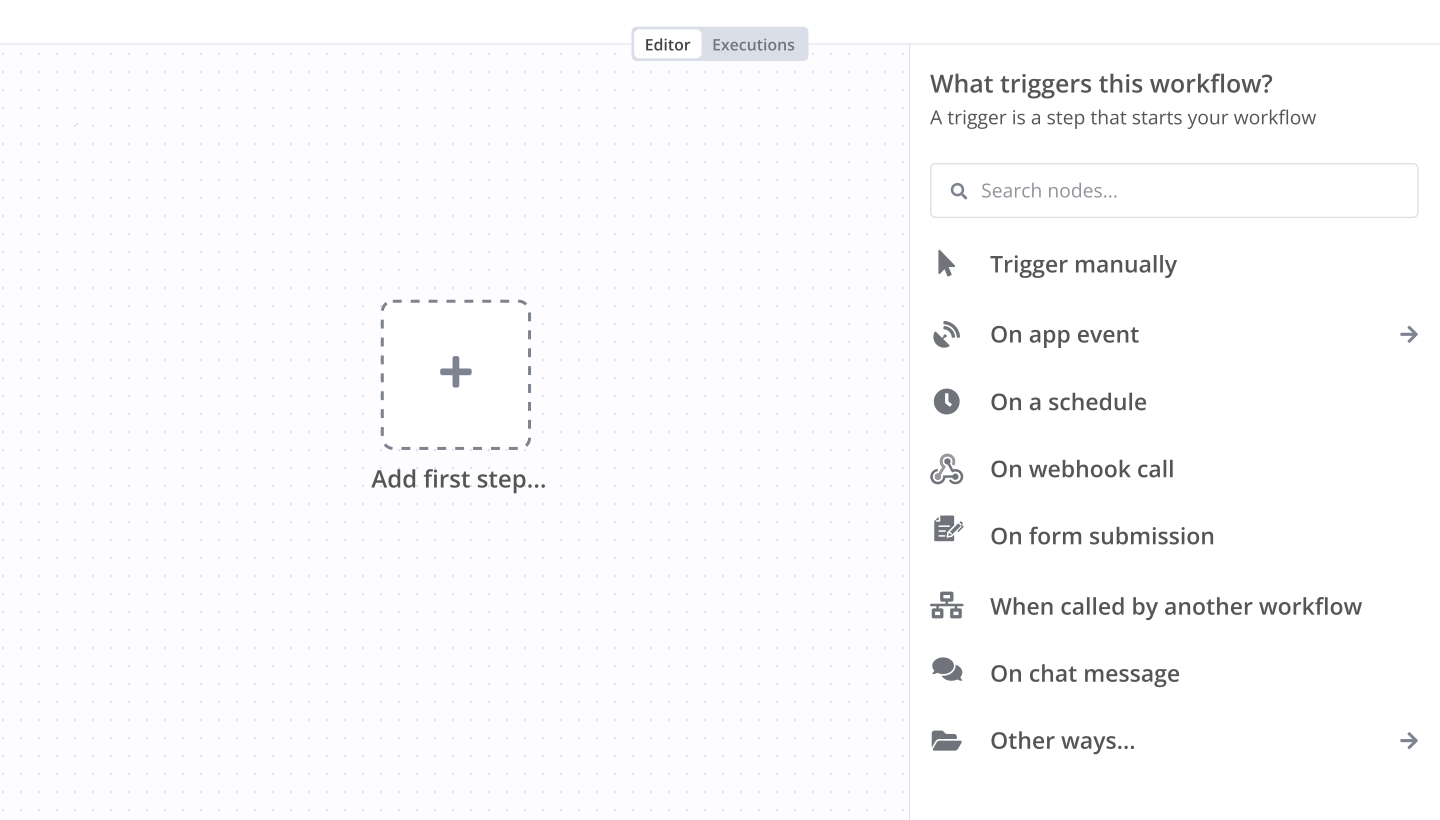
ClickUp and Jira Software integration: Create a new workflow and add the first step

Step 2: Add and configure ClickUp and Jira Software nodes

You can find ClickUp and Jira Software in the nodes panel. Drag them onto your workflow canvas, selecting their actions. Click each node, choose a credential, and authenticate to grant n8n access. Configure ClickUp and Jira Software nodes one by one: input data on the left, parameters in the middle, and output data on the right.

ClickUp and Jira Software integration: Add and configure ClickUp and Jira Software nodes

Step 3: Connect ClickUp and Jira Software

A connection establishes a link between ClickUp and Jira Software (or vice versa) to route data through the workflow. Data flows from the output of one node to the input of another. You can have single or multiple connections for each node.

ClickUp and Jira Software integration: Connect ClickUp and Jira Software

Step 4: Customize and extend your ClickUp and Jira Software integration

Use n8n's core nodes such as If, Split Out, Merge, and others to transform and manipulate data. Write custom JavaScript or Python in the Code node and run it as a step in your workflow. Connect ClickUp and Jira Software with any of n8n’s 1000+ integrations, and incorporate advanced AI logic into your workflows.

ClickUp and Jira Software integration: Customize and extend your ClickUp and Jira Software integration

Step 5: Test and activate your ClickUp and Jira Software workflow

Save and run the workflow to see if everything works as expected. Based on your configuration, data should flow from ClickUp to Jira Software or vice versa. Easily debug your workflow: you can check past executions to isolate and fix the mistake. Once you've tested everything, make sure to save your workflow and activate it.

ClickUp and Jira Software integration: Test and activate your ClickUp and Jira Software workflow

Generate AI matte painting video variations with Seedance for VFX review

📘 Description
This workflow is a fully automated AI matte painting generation system for VFX pipelines, designed to convert a single environment prompt into multiple cinematic background variations. It handles generation, validation, multi-variant rendering, compositing preparation, review workflows, and final delivery—eliminating manual coordination between artists, supervisors, and production systems.

⚙️ Step-by-Step Flow
The process begins with a webhook trigger that serves as the shot request intake layer, receiving a POST request containing the environment prompt, shot code, optional plate image URL, and metadata such as project, sequence, and supervisor details. This input is then passed through a validation and normalization stage, ensuring all required fields are present while standardizing elements like sequence codes, project IDs, Slack channels, and timestamps. Once validated, the system fans out the request into four distinct cinematic variations—day (overcast realism), dusk (golden hour lighting), night (moonlit cinematic), and fog (atmospheric depth)—with each variant assigned a custom-engineered prompt.
At the core of the workflow, a dynamic mode selection logic determines whether to use image-to-video generation (if a plate image is provided) or text-to-video generation (if no reference is available), while also configuring parameters such as audio generation, aspect ratio, and duration. Each variation is then submitted as an independent job to the Seedance API for AI video generation, returning unique job IDs for tracking. A polling loop handles asynchronous processing by checking the status of each job every 20 seconds until all reach a “succeeded” state, operating independently per variation.
Once completed, the system constructs detailed metadata for each asset, including video URL, atmosphere type, variant ID, resolution, duration, and tags such as AI-generated and review status. In parallel, it generates an auto-configured Nuke compositing template with pre-built nodes for plate input, AI background, merge setup, color grading placeholders, and output writing. For production tracking, a Jira review task is created for each variation, while all assets are logged within the ClickUp system. An aggregation layer then consolidates all four variations into a single structured summary, formatted for seamless Slack delivery.
A Slack notification is sent to the supervisor with the complete review package, including links to all variations, Jira tickets, inline Nuke scripts, and associated metadata. Finally, the system downloads the generated video assets and completes the workflow by sending an email to the requester with the video attachments and full production context, ensuring a smooth end-to-end delivery pipeline.

🚨 Error Handling
• Global error trigger
• Instant Slack alert
• Prevents silent failures across pipeline

🧩 Prerequisites
• Seedance API (video generation)
• Slack OAuth2
• Gmail OAuth2
• Jira Cloud
• ClickUp API
• Webhook integration (input system)

💡 Key Benefits
✔ Parallel generation of multiple cinematic variations
✔ Automatic decision between image-to-video vs text-to-video
✔ Built-in compositing (Nuke script auto-generation)
✔ Full production pipeline (generation → review → delivery)
✔ Async-safe with polling loop
✔ Centralized asset tracking (Jira + ClickUp)
✔ Zero manual VFX coordination

👥 Perfect For
VFX studios
Film/TV production pipelines
AI-driven matte painting workflows
Previsualization teams
Creative automation systems

Nodes used in this workflow

Popular ClickUp and Jira Software workflows

Generate AI matte painting video variations with Seedance for VFX review

📘 Description This workflow is a fully automated AI matte painting generation system for VFX pipelines, designed to convert a single environment prompt into multiple cinematic background variations. It handles generation, validation, multi-variant rendering, compositing preparation, review workflows, and final delivery—eliminating manual coordination between artists, supervisors, and production systems. ⚙️ Step-by-Step Flow The process begins with a webhook trigger that serves as the shot request intake layer, receiving a POST request containing the environment prompt, shot code, optional plate image URL, and metadata such as project, sequence, and supervisor details. This input is then passed through a validation and normalization stage, ensuring all required fields are present while standardizing elements like sequence codes, project IDs, Slack channels, and timestamps. Once validated, the system fans out the request into four distinct cinematic variations—day (overcast realism), dusk (golden hour lighting), night (moonlit cinematic), and fog (atmospheric depth)—with each variant assigned a custom-engineered prompt. At the core of the workflow, a dynamic mode selection logic determines whether to use image-to-video generation (if a plate image is provided) or text-to-video generation (if no reference is available), while also configuring parameters such as audio generation, aspect ratio, and duration. Each variation is then submitted as an independent job to the Seedance API for AI video generation, returning unique job IDs for tracking. A polling loop handles asynchronous processing by checking the status of each job every 20 seconds until all reach a “succeeded” state, operating independently per variation. Once completed, the system constructs detailed metadata for each asset, including video URL, atmosphere type, variant ID, resolution, duration, and tags such as AI-generated and review status. In parallel, it generates an auto-configured Nuke compositing template with pre-built nodes for plate input, AI background, merge setup, color grading placeholders, and output writing. For production tracking, a Jira review task is created for each variation, while all assets are logged within the ClickUp system. An aggregation layer then consolidates all four variations into a single structured summary, formatted for seamless Slack delivery. A Slack notification is sent to the supervisor with the complete review package, including links to all variations, Jira tickets, inline Nuke scripts, and associated metadata. Finally, the system downloads the generated video assets and completes the workflow by sending an email to the requester with the video attachments and full production context, ensuring a smooth end-to-end delivery pipeline. 🚨 Error Handling • Global error trigger • Instant Slack alert • Prevents silent failures across pipeline 🧩 Prerequisites • Seedance API (video generation) • Slack OAuth2 • Gmail OAuth2 • Jira Cloud • ClickUp API • Webhook integration (input system) 💡 Key Benefits ✔ Parallel generation of multiple cinematic variations ✔ Automatic decision between image-to-video vs text-to-video ✔ Built-in compositing (Nuke script auto-generation) ✔ Full production pipeline (generation → review → delivery) ✔ Async-safe with polling loop ✔ Centralized asset tracking (Jira + ClickUp) ✔ Zero manual VFX coordination 👥 Perfect For VFX studios Film/TV production pipelines AI-driven matte painting workflows Previsualization teams Creative automation systems

Build your own ClickUp and Jira Software integration

Create custom ClickUp and Jira Software workflows by choosing triggers and actions. Nodes come with global operations and settings, as well as app-specific parameters that can be configured. You can also use the HTTP Request node to query data from any app or service with a REST API.

ClickUp supported actions

Create
Create a checklist
Delete
Delete a checklist
Update
Update a checklist
Create
Create a checklist item
Delete
Delete a checklist item
Update
Update a checklist item
Create
Create a comment
Delete
Delete a comment
Get Many
Get many comments
Update
Update a comment
Create
Create a folder
Delete
Delete a folder
Get
Get a folder
Get Many
Get many folders
Update
Update a folder
Create
Create a goal
Delete
Delete a goal
Get
Get a goal
Get Many
Get many goals
Update
Update a goal
Create
Create a key result
Delete
Delete a key result
Update
Update a key result
Create
Create a list
Custom Fields
Retrieve list's custom fields
Delete
Delete a list
Get
Get a list
Get Many
Get many lists
Member
Get list members
Update
Update a list
Create
Create a space tag
Delete
Delete a space tag
Get Many
Get many space tags
Update
Update a space tag
Create
Create a task
Delete
Delete a task
Get
Get a task
Get Many
Get many tasks
Member
Get task members
Set Custom Field
Set a custom field
Update
Update a task
Create
Create a task dependency
Delete
Delete a task dependency
Add
Add a task to a list
Remove
Remove a task from a list
Add
Add a tag to a task
Remove
Remove a tag from a task
Create
Create a time entry
Delete
Delete a time entry
Get
Get a time entry
Get Many
Get many time entries
Start
Start a time entry
Stop
Stop the current running timer
Update
Update a time Entry
Add
Add tag to time entry
Get Many
Get many time entry tags
Remove
Remove tag from time entry

Jira Software supported actions

Changelog
Get issue changelog
Create
Create a new issue
Delete
Delete an issue
Get
Get an issue
Get Many
Get many issues
Notify
Create an email notification for an issue and add it to the mail queue
Status
Return either all transitions or a transition that can be performed by the user on an issue, based on the issue's status
Update
Update an issue
Add
Add attachment to issue
Get
Get an attachment
Get Many
Get many attachments
Remove
Remove an attachment
Add
Add comment to issue
Get
Get a comment
Get Many
Get many comments
Remove
Remove a comment
Update
Update a comment
Create
Create a new user
Delete
Delete a user
Get
Retrieve a user

FAQs

  • Can ClickUp connect with Jira Software?

  • Can I use ClickUp’s API with n8n?

  • Can I use Jira Software’s API with n8n?

  • Is n8n secure for integrating ClickUp and Jira Software?

  • How to get started with ClickUp and Jira Software integration in n8n.io?

Need help setting up your ClickUp and Jira Software integration?

Discover our latest community's recommendations and join the discussions about ClickUp and Jira Software integration.
Nikolay Titov
Mikey Ross

Looking to integrate ClickUp and Jira Software in your company?

Over 3000 companies switch to n8n every single week

Why use n8n to integrate ClickUp with Jira Software

Build complex workflows, really fast

Build complex workflows, really fast

Handle branching, merging and iteration easily.
Pause your workflow to wait for external events.

Code when you need it, UI when you don't

Simple debugging

Your data is displayed alongside your settings, making edge cases easy to track down.

Use templates to get started fast

Use 1000+ workflow templates available from our core team and our community.

Reuse your work

Copy and paste, easily import and export workflows.

Implement complex processes faster with n8n

red iconyellow iconred iconyellow icon