Back to Integrations
integrationClickUp node
integrationOpenAI node

ClickUp and OpenAI integration

Save yourself the work of writing custom integrations for ClickUp and OpenAI and use n8n instead. Build adaptable and scalable Productivity, Communication, AI, and Langchain workflows that work with your technology stack. All within a building experience you will love.

How to connect ClickUp and OpenAI

  • Step 1: Create a new workflow
  • Step 2: Add and configure nodes
  • Step 3: Connect
  • Step 4: Customize and extend your integration
  • Step 5: Test and activate your workflow

Step 1: Create a new workflow and add the first step

In n8n, click the "Add workflow" button in the Workflows tab to create a new workflow. Add the starting point – a trigger on when your workflow should run: an app event, a schedule, a webhook call, another workflow, an AI chat, or a manual trigger. Sometimes, the HTTP Request node might already serve as your starting point.
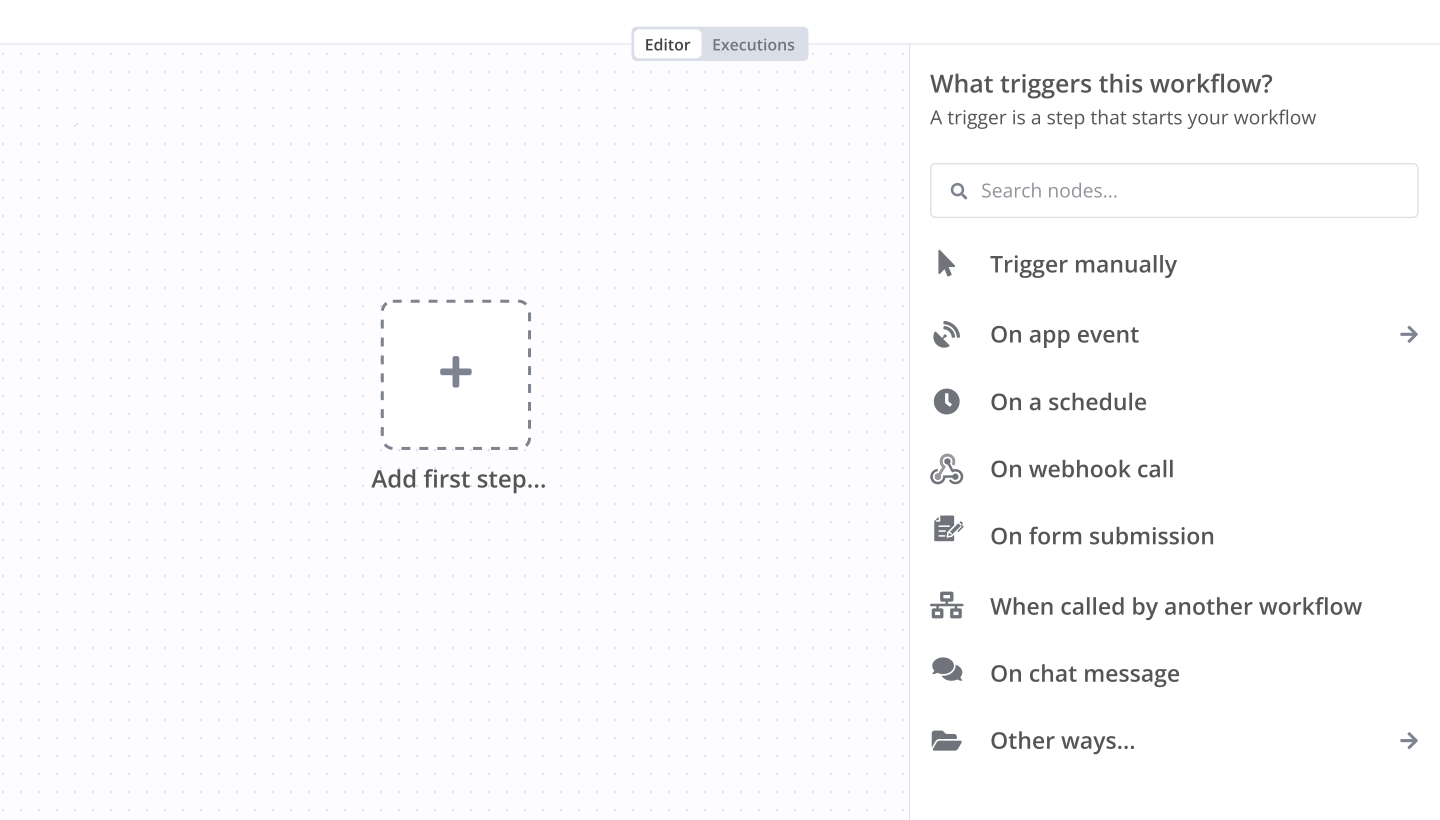
ClickUp and OpenAI integration: Create a new workflow and add the first step

Step 2: Add and configure ClickUp and OpenAI nodes

You can find ClickUp and OpenAI in the nodes panel. Drag them onto your workflow canvas, selecting their actions. Click each node, choose a credential, and authenticate to grant n8n access. Configure ClickUp and OpenAI nodes one by one: input data on the left, parameters in the middle, and output data on the right.

ClickUp and OpenAI integration: Add and configure ClickUp and OpenAI nodes

Step 3: Connect ClickUp and OpenAI

A connection establishes a link between ClickUp and OpenAI (or vice versa) to route data through the workflow. Data flows from the output of one node to the input of another. You can have single or multiple connections for each node.

ClickUp and OpenAI integration: Connect ClickUp and OpenAI

Step 4: Customize and extend your ClickUp and OpenAI integration

Use n8n's core nodes such as If, Split Out, Merge, and others to transform and manipulate data. Write custom JavaScript or Python in the Code node and run it as a step in your workflow. Connect ClickUp and OpenAI with any of n8n’s 1000+ integrations, and incorporate advanced AI logic into your workflows.

ClickUp and OpenAI integration: Customize and extend your ClickUp and OpenAI integration

Step 5: Test and activate your ClickUp and OpenAI workflow

Save and run the workflow to see if everything works as expected. Based on your configuration, data should flow from ClickUp to OpenAI or vice versa. Easily debug your workflow: you can check past executions to isolate and fix the mistake. Once you've tested everything, make sure to save your workflow and activate it.

ClickUp and OpenAI integration: Test and activate your ClickUp and OpenAI workflow

AI proposal generator

Overview
Stop spending hours formatting proposals. This workflow turns a short post-call form into a high-converting, fully-personalized PandaDoc proposal—plus updates your CRM and drafts the follow-up email for you.

After a sales call, just fill out a 3-minute form summarizing key pain points, solutions pitched, and the price. The workflow uses AI to generate polished proposal copy, then builds a PandaDoc draft using dynamic data mapped into the JSON body (which you can fully customize per business). It also updates the lead record in ClickUp with the proposal link, company name, and quote—then creates an email draft in Gmail, ready to send.

Who’s it for
Freelancers and consultants sending service proposals
Agencies closing deals over sales calls
Sales reps who want to automate proposal follow-up
Teams using ClickUp as their lightweight CRM

How it works
After a call, fill out a short form with client details, pitch notes, and price
AI generates professional proposal copy based on form input
Proposal is formatted and sent to PandaDoc via HTTP request
ClickUp lead is updated with:
Company Name
Proposal URL
Quote/price
A Gmail draft is created using the proposal link and a thank-you message

Example use case
> You hop off a call, fill out:
> - Prospect: Shopify agency
> - Pain: No lead gen system
> - Solution: Automated cold outreach
> - Price: $2,500/month
>
> 3 minutes later: PandaDoc proposal is ready, CRM is updated, and your email draft is waiting to be sent.

How to set up
Replace the form with your preferred tool (e.g. Tally, Typeform)
Connect PandaDoc API and structure your proposal template
Customize the JSON body inside the HTTP request to match your business
Link your ClickUp space and custom fields
Connect Gmail (or other email tool) for final follow-up draft

Requirements
Form tool for capturing sales call notes
OpenAI or LLM key for generating proposal copy
PandaDoc API access
ClickUp custom fields set up for lead tracking
Gmail integration

How to customize
Customize your PandaDoc proposal fields in the JSON body of the HTTP node
Replace ClickUp with another CRM like HubSpot or Notion
Adjust AI tone (casual, premium, corporate) for proposal writing
Add Slack or Telegram alerts when the draft is ready
Add PDF generation or auto-send email step

Nodes used in this workflow

Popular ClickUp and OpenAI workflows

AI Proposal Generator

Overview Stop spending hours formatting proposals. This workflow turns a short post-call form into a high-converting, fully-personalized PandaDoc proposal—plus updates your CRM and drafts the follow-up email for you. After a sales call, just fill out a 3-minute form summarizing key pain points, solutions pitched, and the price. The workflow uses AI to generate polished proposal copy, then builds a PandaDoc draft using dynamic data mapped into the JSON body (which you can fully customize per business). It also updates the lead record in ClickUp with the proposal link, company name, and quote—then creates an email draft in Gmail, ready to send. Who’s it for Freelancers and consultants sending service proposals Agencies closing deals over sales calls Sales reps who want to automate proposal follow-up Teams using ClickUp as their lightweight CRM How it works After a call, fill out a short form with client details, pitch notes, and price AI generates professional proposal copy based on form input Proposal is formatted and sent to PandaDoc via HTTP request ClickUp lead is updated with: Company Name Proposal URL Quote/price A Gmail draft is created using the proposal link and a thank-you message Example use case > You hop off a call, fill out: > - Prospect: Shopify agency > - Pain: No lead gen system > - Solution: Automated cold outreach > - Price: $2,500/month > > 3 minutes later: PandaDoc proposal is ready, CRM is updated, and your email draft is waiting to be sent. How to set up Replace the form with your preferred tool (e.g. Tally, Typeform) Connect PandaDoc API and structure your proposal template Customize the JSON body inside the HTTP request to match your business Link your ClickUp space and custom fields Connect Gmail (or other email tool) for final follow-up draft Requirements Form tool for capturing sales call notes OpenAI or LLM key for generating proposal copy PandaDoc API access ClickUp custom fields set up for lead tracking Gmail integration How to customize Customize your PandaDoc proposal fields in the JSON body of the HTTP node Replace ClickUp with another CRM like HubSpot or Notion Adjust AI tone (casual, premium, corporate) for proposal writing Add Slack or Telegram alerts when the draft is ready Add PDF generation or auto-send email step

Route Discord support messages into ClickUp tasks with OpenAI GPT-4.1-mini

How it works This workflow monitors a Discord channel on a schedule and processes recent messages automatically. Each message is checked against a data table to prevent duplicate processing. New messages are analyzed using an AI model to extract structured task details like assignee, priority, and deadlines. The workflow then formats this data and creates a corresponding ClickUp task with full context. Step-by-step Trigger and fetch messages** Schedule Trigger – Runs the workflow every minute. Get many messages – Retrieves the latest Discord messages from a selected channel. Process messages in batches** Loop Over Items – Iterates through each message one at a time for controlled execution. Check for duplicates** Get row(s) – Searches the data table for existing message IDs. If – Filters out messages that have already been processed. Store new messages** Insert row – Saves new message details (ID, author, content) to the data table. Generate task metadata with AI** Message a model – Uses OpenAI to extract structured task data like assignee, priority, estimate, and deadlines. Format task data** Format Task – Converts AI output into ClickUp-compatible fields and formats. Create ClickUp task** Create ClickUp Task – Creates a new task with assignees, dates, priority, and message context. Why use this? Eliminates manual ticket creation from Discord support messages Ensures no duplicate tasks with built-in tracking logic Automatically assigns tasks based on AI-driven classification Improves response time and team accountability Scales support operations without additional overhead

Track employee performance KPIs from ClickUp with GPT-4.1 and Google Sheets

How it works This workflow runs on a schedule to collect task data from ClickUp and evaluate employee performance using AI. Tasks are analyzed to generate structured summaries, productivity metrics, and KPI scores. JavaScript logic refines and standardizes the results. The final performance data is stored in Google Sheets as a live KPI dashboard. Step-by-step Step 1: Collect ClickUp task data** Schedule Trigger – Starts the workflow automatically at defined intervals. Get many folders – Fetches all folders from the selected ClickUp space. Loop Over Items – Iterates through folders to process tasks sequentially. Get many tasks – Retrieves tasks associated with each folder or list. Step 2: Analyze tasks and compute KPIs** Message a model – Sends task details to an AI model to generate summaries and raw performance metrics. Code in JavaScript – Parses AI output, recalculates KPI scores, and assigns standardized ratings. Step 3: Update employee KPI dashboard** Append or update row in sheet – Writes or updates task and employee performance data in Google Sheets. Why use this? Automates employee performance tracking without manual reporting. Produces consistent KPI scores across all ClickUp tasks. Helps managers quickly identify overdue or high-priority work. Keeps Google Sheets dashboards continuously up to date. Improves visibility into productivity and task execution trends.

Launch job vacancies from ATS to Google Calendar, ClickUp and LinkedIn with GPT-4o

Overview: Automated Vacancy Launch & AI Marketing This workflow streamlines the entire job opening process by connecting your ATS to your operational and marketing tools. It not only manages deadlines but also automates the promotion of the vacancy. Key Features: Schedule: Creates SLA and Expiration events in Google Calendar based on ATS dates. Track: Creates a central task in ClickUp to manage the selection process. Content Generation: Uses GPT-4o to analyze the job description and write a compelling marketing post. Publish: Automatically posts the job to LinkedIn and logs the action back in the ClickUp task. Setup Instructions Webhook: Configure your Recrutei ATS (or similar) to trigger this workflow. Google Calendar: Select the calendar for deadline tracking. ClickUp: Map the Team, Space, and List where vacancy tasks should be created. OpenAI: Ensure you have a valid API Key. LinkedIn: Connect your profile or company page.
+2

Analyze Form Feedback with GPT-4 & Sync Tasks to Monday, ClickUp & HubSpot

How it works This workflow automates customer feedback management by capturing reviews through a form, analyzing them with AI for sentiment and insights, and then creating structured tasks across Monday.com, ClickUp, and HubSpot. It ensures that customer concerns are categorized, prioritized, and assigned to the right teams with actionable metadata. Step-by-step Trigger & Input The workflow starts when a customer submits the Feedback Form containing their Name, Message, Rating, and Product/Service. The submitted data is pre-processed with a Code node to cleanly extract fields for analysis. AI Analysis & Processing The extracted review is sent to OpenAI GPT-4 for analysis. AI identifies sentiment, sentiment score, category (e.g., product, service, support, delivery, pricing), department, priority, required actions, keywords, and suggested response tone. A Data Processing node enriches the output with due dates, task titles, structured descriptions, and fallback handling in case of parsing issues. Structured Output Generation An AI Agent and OpenAI Chat model transform the enriched data into a strict JSON format that is compatible with Monday.com, ClickUp, and HubSpot. This ensures consistent field order, formatting, and metadata for all downstream integrations. Task Creation in Platforms The structured task data is automatically pushed to: Monday.com → Creates an item in a specified board. ClickUp → Creates a task with mapped fields and priority. HubSpot → Creates an engagement task in CRM with due date and priority. Benefits Automates end-to-end customer feedback analysis and task creation. Ensures structured, AI-driven insights for actionable responses. Reduces manual work in categorizing and assigning reviews. Keeps customer feedback synchronized across multiple platforms (Monday.com, ClickUp, HubSpot). Improves response time by prioritizing high-impact feedback with due dates.

Build your own ClickUp and OpenAI integration

Create custom ClickUp and OpenAI workflows by choosing triggers and actions. Nodes come with global operations and settings, as well as app-specific parameters that can be configured. You can also use the HTTP Request node to query data from any app or service with a REST API.

ClickUp supported actions

Create
Create a checklist
Delete
Delete a checklist
Update
Update a checklist
Create
Create a checklist item
Delete
Delete a checklist item
Update
Update a checklist item
Create
Create a comment
Delete
Delete a comment
Get Many
Get many comments
Update
Update a comment
Create
Create a folder
Delete
Delete a folder
Get
Get a folder
Get Many
Get many folders
Update
Update a folder
Create
Create a goal
Delete
Delete a goal
Get
Get a goal
Get Many
Get many goals
Update
Update a goal
Create
Create a key result
Delete
Delete a key result
Update
Update a key result
Create
Create a list
Custom Fields
Retrieve list's custom fields
Delete
Delete a list
Get
Get a list
Get Many
Get many lists
Member
Get list members
Update
Update a list
Create
Create a space tag
Delete
Delete a space tag
Get Many
Get many space tags
Update
Update a space tag
Create
Create a task
Delete
Delete a task
Get
Get a task
Get Many
Get many tasks
Member
Get task members
Set Custom Field
Set a custom field
Update
Update a task
Create
Create a task dependency
Delete
Delete a task dependency
Add
Add a task to a list
Remove
Remove a task from a list
Add
Add a tag to a task
Remove
Remove a tag from a task
Create
Create a time entry
Delete
Delete a time entry
Get
Get a time entry
Get Many
Get many time entries
Start
Start a time entry
Stop
Stop the current running timer
Update
Update a time Entry
Add
Add tag to time entry
Get Many
Get many time entry tags
Remove
Remove tag from time entry

OpenAI supported actions

Message a Model
Generate a model response with GPT 3, 4, 5, etc. using Responses API
Classify Text for Violations
Check whether content complies with usage policies
Analyze Image
Take in images and answer questions about them
Generate an Image
Creates an image from a text prompt
Edit Image
Edit an image
Generate Audio
Creates audio from a text prompt
Transcribe a Recording
Transcribes audio into text
Translate a Recording
Translates audio into text in English
Delete a File
Delete a file from the server
List Files
Returns a list of files that belong to the user's organization
Upload a File
Upload a file that can be used across various endpoints
Create
Create a conversation
Get
Get a conversation
Remove
Remove a conversation
Update
Update a conversation
Generate
Creates a video from a text prompt

ClickUp and OpenAI integration details

FAQs

  • Can ClickUp connect with OpenAI?

  • Can I use ClickUp’s API with n8n?

  • Can I use OpenAI’s API with n8n?

  • Is n8n secure for integrating ClickUp and OpenAI?

  • How to get started with ClickUp and OpenAI integration in n8n.io?

Need help setting up your ClickUp and OpenAI integration?

Discover our latest community's recommendations and join the discussions about ClickUp and OpenAI integration.
Artem
sérgio eduardo floresta filho
Nikolay Titov
Andrew adawdad
Mikey Ross

Looking to integrate ClickUp and OpenAI in your company?

Over 3000 companies switch to n8n every single week

Why use n8n to integrate ClickUp with OpenAI

Build complex workflows, really fast
Build complex workflows, really fast

Handle branching, merging and iteration easily.
Pause your workflow to wait for external events.

Code when you need it, UI when you don't

Simple debugging

Your data is displayed alongside your settings, making edge cases easy to track down.

Use templates to get started fast

Use 1000+ workflow templates available from our core team and our community.

Reuse your work

Copy and paste, easily import and export workflows.

Implement complex processes faster with n8n

red iconyellow iconred iconyellow icon