Back to Integrations
integrationDeepL node
integrationGmail node

DeepL and Gmail integration

Save yourself the work of writing custom integrations for DeepL and Gmail and use n8n instead. Build adaptable and scalable Utility, Communication, and HITL workflows that work with your technology stack. All within a building experience you will love.

How to connect DeepL and Gmail

  • Step 1: Create a new workflow
  • Step 2: Add and configure nodes
  • Step 3: Connect
  • Step 4: Customize and extend your integration
  • Step 5: Test and activate your workflow

Step 1: Create a new workflow and add the first step

In n8n, click the "Add workflow" button in the Workflows tab to create a new workflow. Add the starting point – a trigger on when your workflow should run: an app event, a schedule, a webhook call, another workflow, an AI chat, or a manual trigger. Sometimes, the HTTP Request node might already serve as your starting point.
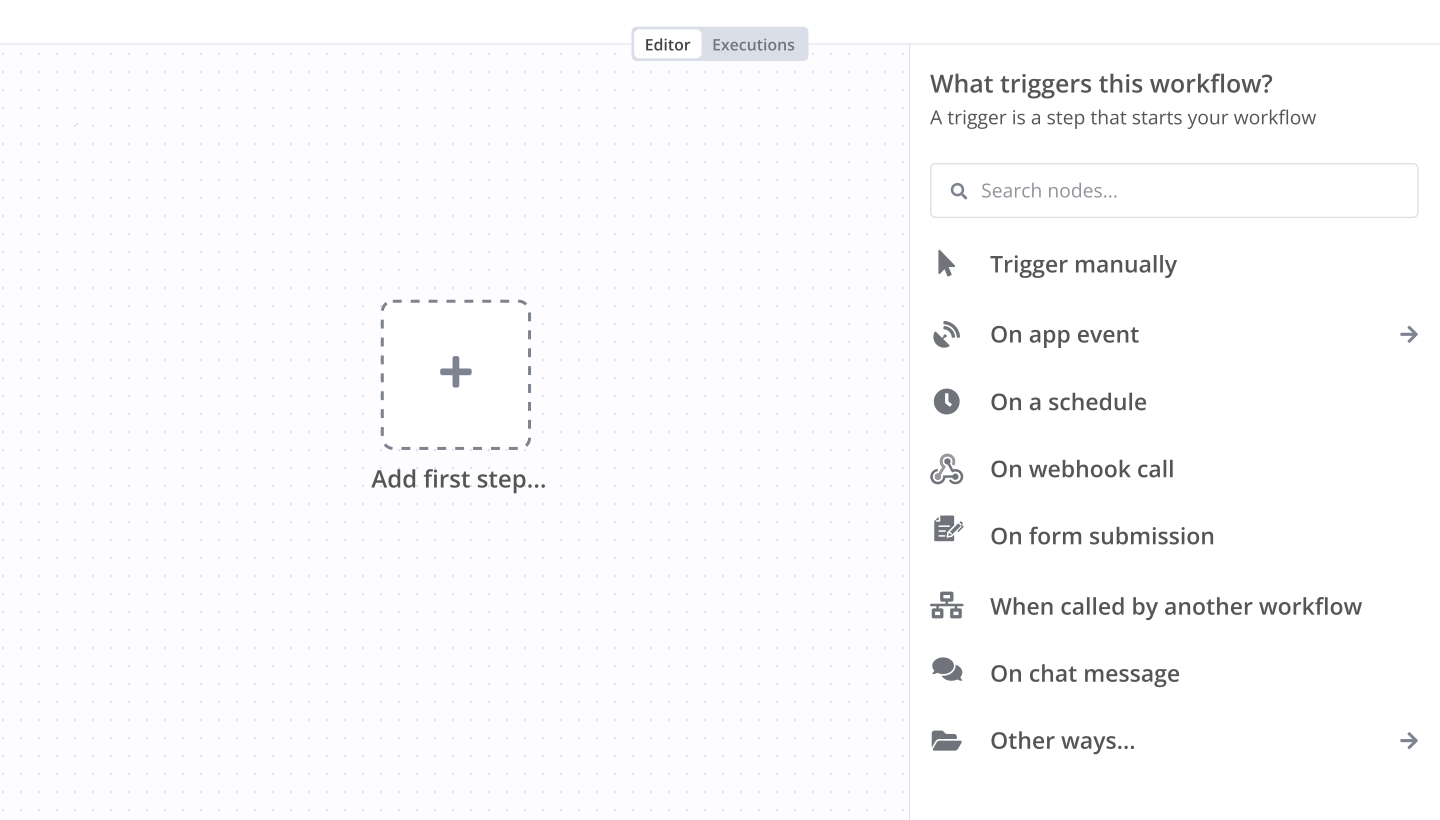
DeepL and Gmail integration: Create a new workflow and add the first step

Step 2: Add and configure DeepL and Gmail nodes

You can find DeepL and Gmail in the nodes panel. Drag them onto your workflow canvas, selecting their actions. Click each node, choose a credential, and authenticate to grant n8n access. Configure DeepL and Gmail nodes one by one: input data on the left, parameters in the middle, and output data on the right.

DeepL and Gmail integration: Add and configure DeepL and Gmail nodes

Step 3: Connect DeepL and Gmail

A connection establishes a link between DeepL and Gmail (or vice versa) to route data through the workflow. Data flows from the output of one node to the input of another. You can have single or multiple connections for each node.

DeepL and Gmail integration: Connect DeepL and Gmail

Step 4: Customize and extend your DeepL and Gmail integration

Use n8n's core nodes such as If, Split Out, Merge, and others to transform and manipulate data. Write custom JavaScript or Python in the Code node and run it as a step in your workflow. Connect DeepL and Gmail with any of n8n’s 1000+ integrations, and incorporate advanced AI logic into your workflows.

DeepL and Gmail integration: Customize and extend your DeepL and Gmail integration

Step 5: Test and activate your DeepL and Gmail workflow

Save and run the workflow to see if everything works as expected. Based on your configuration, data should flow from DeepL to Gmail or vice versa. Easily debug your workflow: you can check past executions to isolate and fix the mistake. Once you've tested everything, make sure to save your workflow and activate it.

DeepL and Gmail integration: Test and activate your DeepL and Gmail workflow

Route multilingual support requests with DeepL, GPT-3.5 and Gmail

Your automated multilingual support assistant that translates, generates AI responses, and translates back to the customer's language with comprehensive error handling.

Stop manually copy-pasting customer messages into Google Translate and crafting responses in multiple languages. This workflow orchestrates the entire multilingual support pipeline: captures requests via form, auto-detects and translates to English, generates professional AI responses, and translates back to the customer's native language automatically. You handle the business; it handles the languages.

This is not a generic "translation" template. It is a functional bidirectional communication pipeline designed to maintain conversation quality across 29 languages with production-grade error recovery.

How the workflow works

The workflow executes in five strategic stages:

Form Capture & Validation: Customer submits request via n8n form (email, question, language dropdown with 29 options). Validates email format, message length (5+ chars), and extracts ISO language code.

Native DeepL Translation (Customer → English): Auto-detects source language and translates customer message to English using n8n's native DeepL node for clean AI input.

AI Response Generation: GPT-3.5-turbo generates professional, empathetic support response in English (2-3 paragraphs, actionable next steps, no unverified promises).

Native DeepL Back-Translation (English → Customer): Translates AI response back to customer's original language, preserving technical accuracy with natural phrasing.

Gmail Delivery & Error Handling:
Success: Beautiful HTML email sent to customer with translated response, English version (collapsible), and metadata
Failures: Professional error emails sent for validation (HTTP 400), translation failures (HTTP 502 + retry 60s), AI failures (HTTP 502 + retry 30s), or back-translation failures (English version sent as fallback)

Benefits

Bidirectional Translation Flow**: Unlike generic translation templates that only translate TO English, this workflow translates both directions (Customer → English → Customer), ensuring responses are delivered in the customer's native language.

Native DeepL Integration**: Uses n8n's built-in DeepL node instead of complex HTTP API configurations. Setup time: 3 minutes vs 15 minutes for HTTP-based approaches.

Production-Grade Error Handling**: Four error checkpoints with specific HTTP status codes (400 for validation, 502 for API failures) and actionable error messages. Includes English fallback when back-translation fails so you never lose a generated response.

Form-Based Input (No Webhook Config)**: Beautiful embedded n8n form with language dropdown eliminates the need for complex webhook integrations or API documentation for end users.

Beautiful HTML Email Delivery**: Modern, mobile-responsive email templates with gradient headers, collapsible sections, and clear CTAs. Five different templates for success and error states.

Cost Efficiency**: ~$0.001 per request (DeepL + OpenAI combined) vs $50-150/month per multilingual support agent. ROI: 25x in Year 1 for teams handling 100+ multilingual requests/month.

Target Audience

E-commerce Businesses** serving international customers across the EU, LATAM, or APAC regions needing support in local languages.

SaaS Companies** with global user bases where language barriers create support bottlenecks and increase ticket resolution time.

Customer Success Teams** at startups expanding internationally without budget for multilingual support staff.

Agencies & MSPs** managing client support across multiple languages and needing to scale without hiring language specialists.

Required APIs

DeepL API** for bidirectional translation (free tier: 500k chars/month covers ~3,300 requests)
OpenAI API** for GPT-3.5-turbo response generation (~$0.001 per response)
Gmail OAuth2** for sending beautiful HTML email responses to customers
n8n Form Trigger** requires public n8n instance (Cloud or self-hosted) to generate embeddable form URL

Easy Customization

Adjust Language Support**: Edit the language dropdown in the Form Trigger node to add/remove languages based on your customer base (currently 29 languages supported).

Notification Channels**: Add Slack, Discord, or Microsoft Teams nodes after Gmail nodes to notify your support team when responses are sent or errors occur.

Custom Email Templates**: Modify the HTML in Gmail nodes to match your brand colors, fonts, and messaging style.

AI Model Upgrade**: Swap GPT-3.5-turbo for GPT-4o in the OpenAI node for 2x better response quality at ~$0.02/request (ideal for high-value customers or complex support queries).

Output Logging**: Add Google Sheets, Airtable, or PostgreSQL nodes after Gmail nodes to log all translations for quality auditing, CSAT tracking, or training data collection.

Custom Prompt Engineering**: Modify the OpenAI system prompt to include company-specific tone, product knowledge, or escalation criteria (e.g., detect refund requests and flag for human review).

Nodes used in this workflow

Popular DeepL and Gmail workflows

Route multilingual support requests with DeepL, GPT-3.5 and Gmail

Your automated multilingual support assistant that translates, generates AI responses, and translates back to the customer's language with comprehensive error handling. Stop manually copy-pasting customer messages into Google Translate and crafting responses in multiple languages. This workflow orchestrates the entire multilingual support pipeline: captures requests via form, auto-detects and translates to English, generates professional AI responses, and translates back to the customer's native language automatically. You handle the business; it handles the languages. This is not a generic "translation" template. It is a functional bidirectional communication pipeline designed to maintain conversation quality across 29 languages with production-grade error recovery. How the workflow works The workflow executes in five strategic stages: Form Capture & Validation: Customer submits request via n8n form (email, question, language dropdown with 29 options). Validates email format, message length (5+ chars), and extracts ISO language code. Native DeepL Translation (Customer → English): Auto-detects source language and translates customer message to English using n8n's native DeepL node for clean AI input. AI Response Generation: GPT-3.5-turbo generates professional, empathetic support response in English (2-3 paragraphs, actionable next steps, no unverified promises). Native DeepL Back-Translation (English → Customer): Translates AI response back to customer's original language, preserving technical accuracy with natural phrasing. Gmail Delivery & Error Handling: Success: Beautiful HTML email sent to customer with translated response, English version (collapsible), and metadata Failures: Professional error emails sent for validation (HTTP 400), translation failures (HTTP 502 + retry 60s), AI failures (HTTP 502 + retry 30s), or back-translation failures (English version sent as fallback) Benefits Bidirectional Translation Flow**: Unlike generic translation templates that only translate TO English, this workflow translates both directions (Customer → English → Customer), ensuring responses are delivered in the customer's native language. Native DeepL Integration**: Uses n8n's built-in DeepL node instead of complex HTTP API configurations. Setup time: 3 minutes vs 15 minutes for HTTP-based approaches. Production-Grade Error Handling**: Four error checkpoints with specific HTTP status codes (400 for validation, 502 for API failures) and actionable error messages. Includes English fallback when back-translation fails so you never lose a generated response. Form-Based Input (No Webhook Config)**: Beautiful embedded n8n form with language dropdown eliminates the need for complex webhook integrations or API documentation for end users. Beautiful HTML Email Delivery**: Modern, mobile-responsive email templates with gradient headers, collapsible sections, and clear CTAs. Five different templates for success and error states. Cost Efficiency**: ~$0.001 per request (DeepL + OpenAI combined) vs $50-150/month per multilingual support agent. ROI: 25x in Year 1 for teams handling 100+ multilingual requests/month. Target Audience E-commerce Businesses** serving international customers across the EU, LATAM, or APAC regions needing support in local languages. SaaS Companies** with global user bases where language barriers create support bottlenecks and increase ticket resolution time. Customer Success Teams** at startups expanding internationally without budget for multilingual support staff. Agencies & MSPs** managing client support across multiple languages and needing to scale without hiring language specialists. Required APIs DeepL API** for bidirectional translation (free tier: 500k chars/month covers ~3,300 requests) OpenAI API** for GPT-3.5-turbo response generation (~$0.001 per response) Gmail OAuth2** for sending beautiful HTML email responses to customers n8n Form Trigger** requires public n8n instance (Cloud or self-hosted) to generate embeddable form URL Easy Customization Adjust Language Support**: Edit the language dropdown in the Form Trigger node to add/remove languages based on your customer base (currently 29 languages supported). Notification Channels**: Add Slack, Discord, or Microsoft Teams nodes after Gmail nodes to notify your support team when responses are sent or errors occur. Custom Email Templates**: Modify the HTML in Gmail nodes to match your brand colors, fonts, and messaging style. AI Model Upgrade**: Swap GPT-3.5-turbo for GPT-4o in the OpenAI node for 2x better response quality at ~$0.02/request (ideal for high-value customers or complex support queries). Output Logging**: Add Google Sheets, Airtable, or PostgreSQL nodes after Gmail nodes to log all translations for quality auditing, CSAT tracking, or training data collection. Custom Prompt Engineering**: Modify the OpenAI system prompt to include company-specific tone, product knowledge, or escalation criteria (e.g., detect refund requests and flag for human review).

Translate and localize multilingual content with DeepL and GPT-4o-mini

Translate and localize content using DeepL and GPT-4o-mini Managing high-quality translations across multiple languages often requires more than just machine translation; it requires cultural context and quality assurance. This workflow automates the entire pipeline, from initial translation to AI-driven quality scoring and cultural localization. Who is this for? Content Teams:** To automate the first draft and review process for blog posts or documentation. Marketing Agencies:** To localize campaign copy for international markets quickly. Product Managers:** To manage UI/UX copy across different regions with consistent glossary support. How it works Content Intake: A Webhook receives the source text and a list of target languages. Language Detection & Validation: The workflow identifies the source language and validates the requested target codes. Parallel Processing: Using the Split Out node, the workflow processes each target language simultaneously. DeepL Translation: High-quality neural machine translation is performed for each language. AI Quality Review: GPT-4o-mini acts as a professional linguist, scoring the translation on accuracy, fluency, and style, and flagging any issues. Cultural Localization: A specialized node applies region-specific formatting for dates and currencies. Aggregation & Reporting: All results are unified, logged to Google Sheets, emailed via Gmail, and returned as a JSON response to the initial requester. How to set up Credentials: Connect your DeepL API, OpenAI, Google Sheets, and Gmail accounts. Google Sheets: Create a sheet with headers: Job ID, Source Text, Languages, Avg Quality, and Completed. Paste the Sheet ID into the Google Sheets node. Webhook: Use the production URL in your CMS or app to trigger the workflow with a POST request. Requirements DeepL API Key** (Free or Pro) OpenAI API Key** (for GPT-4o-mini) Google Account** (for Sheets and Gmail) How to customize Adjust AI Rubric:** Modify the "AI Quality Review" prompt to focus on specific brand voice guidelines or technical terminology. Glossary Support:** Update the DeepL node to include specific Glossary IDs for industry-specific jargon. Localization Rules:** Add more regions or specific formatting rules (like measurement conversions) in the "Apply Localization" Code node.

Multilingual Email Auto-Replies with DeepL, GPT-4o and Slack Human Approval

Who's it for Customer support teams, sales representatives, and international business professionals who need to handle multilingual email communication efficiently while maintaining quality control through human approval. How it works This workflow automates email responses by: Monitoring Gmail for emails with a specific label (e.g., "To_Process") Translating the email content using DeepL to your preferred language Generating an AI-powered summary and draft reply using OpenAI Requesting approval via Slack with a summary and one-click approval link Sending the reply only after human approval is received Removing the label to prevent reprocessing Set up steps Setup takes approximately 15-20 minutes: Configure credentials for Gmail, DeepL, OpenAI, and Slack Create a Gmail label for emails to process Update the Slack channel ID in the configuration node Ensure n8n is accessible via webhook (tunnel or production mode required) Requirements Gmail account with OAuth2 authentication DeepL API key (free tier available) OpenAI API key Slack workspace with OAuth2 app configured n8n instance accessible via webhook URL How to customize the workflow Change translation language**: Modify the DeepL node's target language Adjust AI model**: Switch between GPT-4 or GPT-3.5 in the OpenAI node Customize approval message**: Edit the Slack message format Add multiple languages**: Duplicate the translation node for multi-language support Filter specific senders**: Add conditions to process only certain email addresses

Translate documents to multiple languages with Google Drive and DeepL

Who's it for This workflow is perfect for content creators, international teams, and businesses that need to translate documents into multiple languages automatically. Whether you're localizing documentation, translating marketing materials, or creating multilingual content, this workflow saves hours of manual work. What it does Automatically monitors a Google Drive folder for new documents (PDF, DOCX, TXT, or Markdown) and translates them into multiple languages using DeepL API. Each translated document is saved with a language-specific filename (e.g., document_en.pdf, document_zh.pdf) in a designated folder. You receive an email notification when all translations are complete. How it works Monitors a Google Drive folder for new files Detects file format (PDF/DOCX/TXT/Markdown) and extracts text Translates the content into your chosen languages (default: English, Chinese, Korean, Spanish, French, German) Saves translated files with language codes in the filename Sends an email notification with translation summary Optional: Records translation history in Notion database Set up instructions Requirements Google Drive account (for file storage) DeepL API key (free tier: 500,000 characters/month) Gmail account (for notifications) Notion account (optional, for tracking translation history) Setup steps Create Google Drive folders: Create a "Source" folder for original files Create a "Translated" folder for output Copy the folder IDs from the URLs Get DeepL API key: Sign up at DeepL API Copy your API key Configure the workflow: Open the "Configuration (Edit Here)" node (yellow node) Replace folder IDs with your own Set your notification email Choose target languages Set up credentials: Add Google Drive OAuth2 credentials Add DeepL API credentials Add Gmail OAuth2 credentials Activate the workflow and upload a test file! Customization options Change target languages**: Edit the targetLanguages array in the Configuration node (supports 30+ languages) Adjust polling frequency**: Change trigger from "every minute" to hourly or daily for batch processing Enable Notion tracking**: Set enableNotion to true and provide your database ID Add more file formats**: Extend the Switch node to handle additional file types Filter by file size**: Add conditions to skip files larger than a certain size Supported languages EN (English), ZH (Chinese), KO (Korean), JA (Japanese), ES (Spanish), FR (French), DE (German), IT (Italian), PT (Portuguese), RU (Russian), and 20+ more. Performance Short files** (1 page): ~30 seconds for 6 languages Medium files** (10 pages): ~2 minutes for 6 languages Large files** (100 pages): ~15 minutes for 6 languages Technical Details Trigger**: Google Drive folder monitoring (1-minute polling) Translation**: DeepL API with automatic source language detection Loop implementation**: Split Out + Aggregate pattern for parallel translation Error handling**: Catches API failures and sends email alerts Storage**: Original file format preserved in translated outputs Notes DeepL free tier provides 500,000 characters/month (approximately 250 pages) For high-volume translation, consider upgrading to DeepL Pro The workflow creates new files instead of overwriting, preserving translation history Google Docs are automatically converted to the appropriate format before translation What You'll Learn This workflow demonstrates several n8n patterns: File format detection and routing (Switch node) Loop implementation with Split Out + Aggregate Binary data handling for file operations Conditional logic with IF nodes (optional features) Cross-node data references Error handling and user notifications Perfect for learning automation best practices while solving a real business problem!

Build your own DeepL and Gmail integration

Create custom DeepL and Gmail workflows by choosing triggers and actions. Nodes come with global operations and settings, as well as app-specific parameters that can be configured. You can also use the HTTP Request node to query data from any app or service with a REST API.

DeepL supported actions

Translate
Translate data

Gmail supported actions

Add Label
Delete
Get
Get Many
Mark as Read
Mark as Unread
Remove Label
Reply
Send
Send and Wait for Response
Create
Delete
Get
Get Many
Create
Delete
Get
Get Many
Add Label
Delete
Get
Get Many
Remove Label
Reply
Trash
Untrash

FAQs

  • Can DeepL connect with Gmail?

  • Can I use DeepL’s API with n8n?

  • Can I use Gmail’s API with n8n?

  • Is n8n secure for integrating DeepL and Gmail?

  • How to get started with DeepL and Gmail integration in n8n.io?

Need help setting up your DeepL and Gmail integration?

Discover our latest community's recommendations and join the discussions about DeepL and Gmail integration.
jake chard
Jan Koch
Paul Kennard

Looking to integrate DeepL and Gmail in your company?

Over 3000 companies switch to n8n every single week

Why use n8n to integrate DeepL with Gmail

Build complex workflows, really fast

Build complex workflows, really fast

Handle branching, merging and iteration easily.
Pause your workflow to wait for external events.

Code when you need it, UI when you don't

Simple debugging

Your data is displayed alongside your settings, making edge cases easy to track down.

Use templates to get started fast

Use 1000+ workflow templates available from our core team and our community.

Reuse your work

Copy and paste, easily import and export workflows.

Implement complex processes faster with n8n

red iconyellow iconred iconyellow icon