Back to Integrations
integrationGitHub node
integrationGmail node

GitHub and Gmail integration

Save yourself the work of writing custom integrations for GitHub and Gmail and use n8n instead. Build adaptable and scalable Development, Communication, and HITL workflows that work with your technology stack. All within a building experience you will love.

How to connect GitHub and Gmail

  • Step 1: Create a new workflow
  • Step 2: Add and configure nodes
  • Step 3: Connect
  • Step 4: Customize and extend your integration
  • Step 5: Test and activate your workflow

Step 1: Create a new workflow and add the first step

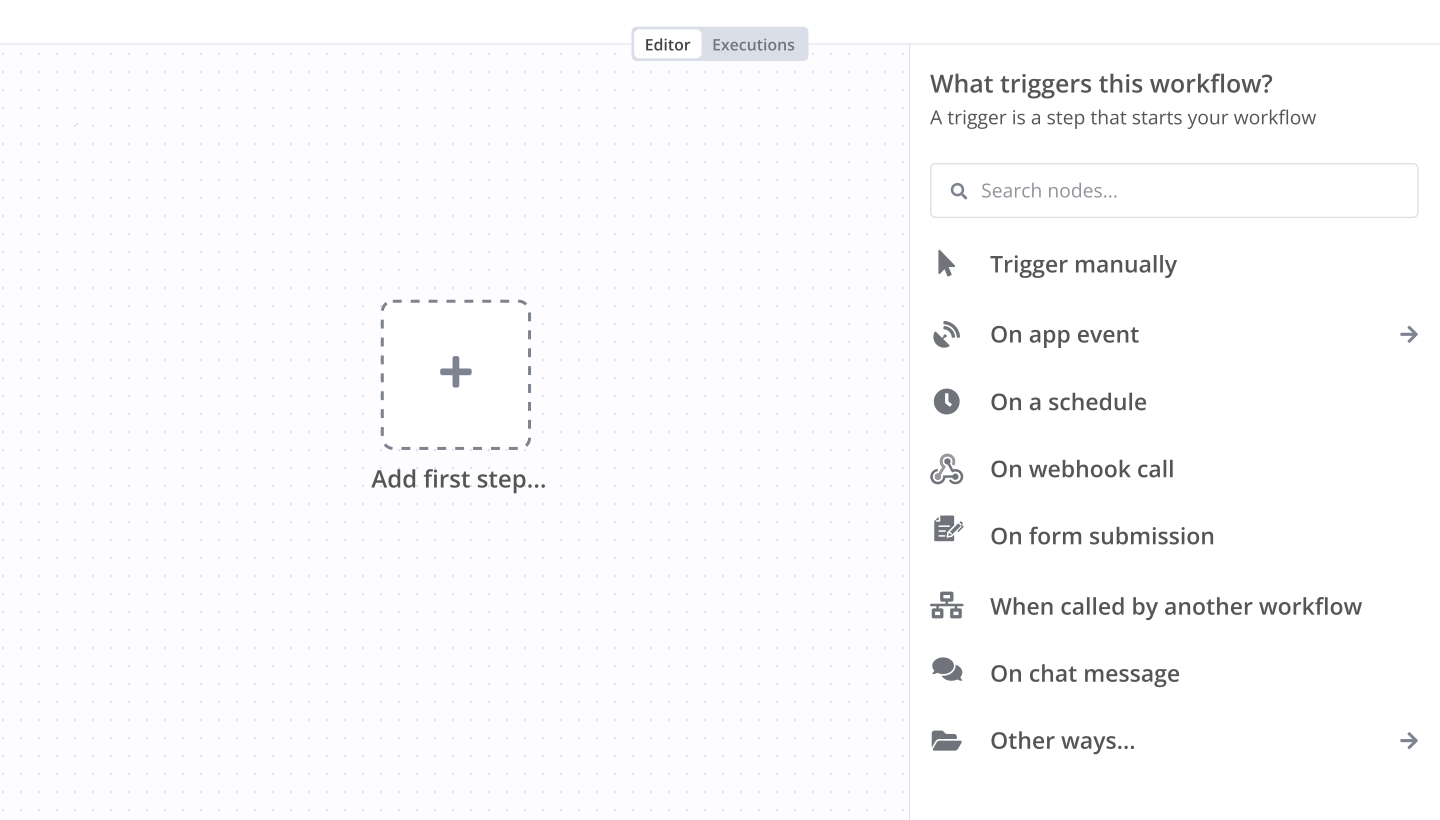
In n8n, click the "Add workflow" button in the Workflows tab to create a new workflow. Add the starting point – a trigger on when your workflow should run: an app event, a schedule, a webhook call, another workflow, an AI chat, or a manual trigger. Sometimes, the HTTP Request node might already serve as your starting point.

GitHub and Gmail integration: Create a new workflow and add the first step

Step 2: Add and configure GitHub and Gmail nodes

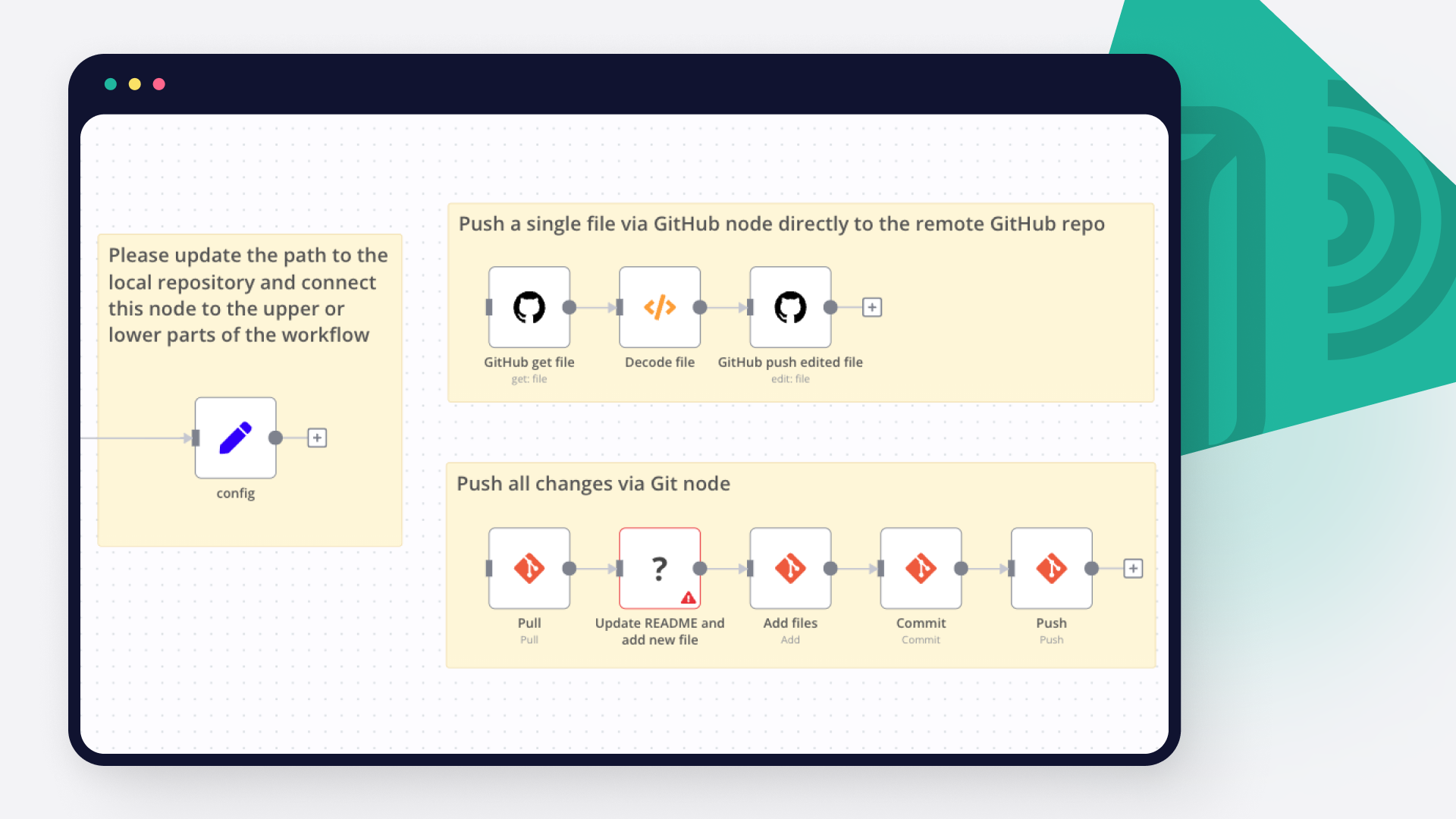
You can find GitHub and Gmail in the nodes panel. Drag them onto your workflow canvas, selecting their actions. Click each node, choose a credential, and authenticate to grant n8n access. Configure GitHub and Gmail nodes one by one: input data on the left, parameters in the middle, and output data on the right.

GitHub and Gmail integration: Add and configure GitHub and Gmail nodes

Step 3: Connect GitHub and Gmail

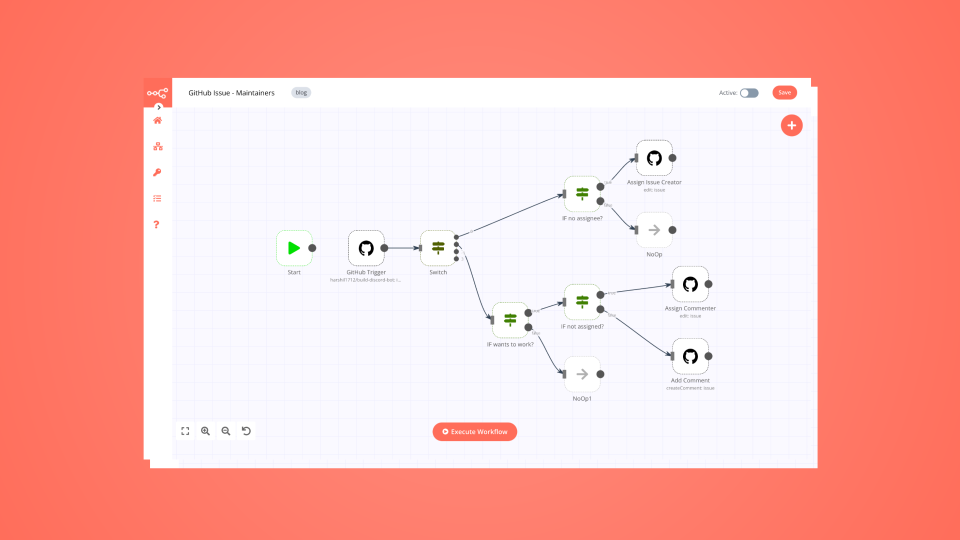
A connection establishes a link between GitHub and Gmail (or vice versa) to route data through the workflow. Data flows from the output of one node to the input of another. You can have single or multiple connections for each node.

GitHub and Gmail integration: Connect GitHub and Gmail

Step 4: Customize and extend your GitHub and Gmail integration

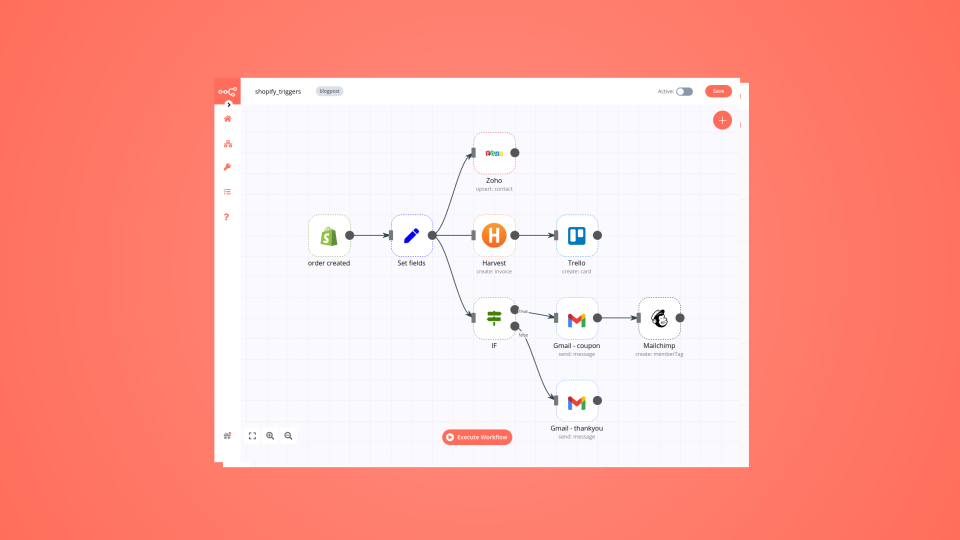
Use n8n's core nodes such as If, Split Out, Merge, and others to transform and manipulate data. Write custom JavaScript or Python in the Code node and run it as a step in your workflow. Connect GitHub and Gmail with any of n8n’s 1000+ integrations, and incorporate advanced AI logic into your workflows.

GitHub and Gmail integration: Customize and extend your GitHub and Gmail integration

Step 5: Test and activate your GitHub and Gmail workflow

Save and run the workflow to see if everything works as expected. Based on your configuration, data should flow from GitHub to Gmail or vice versa. Easily debug your workflow: you can check past executions to isolate and fix the mistake. Once you've tested everything, make sure to save your workflow and activate it.

GitHub and Gmail integration: Test and activate your GitHub and Gmail workflow

AI Timesheet Generator with Gmail, Calendar & GitHub to Google Sheets

AI-Powered Automatic Timesheet Generator for Google Sheets

Stop wasting billable hours on manual time-tracking. AutoTimesheet Pro uses AI to collect emails, meetings, and GitHub work, then writes a clean timesheet straight into Google Sheets. Perfect for developers, consultants, agencies, and remote teams.

Get Started with n8n now!

🚀 Key Features

Automated Google Sheets time-tracking** — zero spreadsheet prep.
AI-generated activity summaries** (≤ 120 chars) via OpenAI GPT-4o-mini.
Gmail integration** — logs only important emails, skipping newsletters & no-replies.
Google Calendar time logger** — captures confirmed events, duration, and attendees.
GitHub commit & PR tracker** — records your commits plus opened/closed PRs.
Daily 7 PM cron trigger** (easily adjustable).
Month-based sheet creation** — new tab spins up on the first run each month.
No-code n8n template* — just connect credentials and tweak one Set Variables* node.
🔌 Easily extensible** — drag-and-drop extra n8n nodes to add Slack, Jira, Notion, Asana, Trello, Toggl, or any other data source you need.

🔍 How It Works

Collect — n8n pulls data from Gmail, Google Calendar, and chosen GitHub repos.
Clean — filters remove noise (newsletters, irrelevant commits, etc.).
Condense — OpenAI rewrites each item into a concise, SEO-friendly description.
Write — workflow appends Date, Type, and Description to your Timesheet Google Sheet.
Extend — simply insert new n8n nodes (e.g., Slack, Notion, Jira) and merge them into the same pipeline.

📈 Benefits for SEO-Minded Professionals

Keyword-rich activity log** improves internal search and reporting.
Structured data** in Sheets simplifies export to accounting or PM tools.
Consistent naming** (CALENDAR_EVENT, EMAIL, COMMIT, PR) makes analytics easy.

✅ Why Choose AutoTimesheet Pro?

Zero manual entry — just open the sheet and bill clients.
Immediate visibility into where your hours went.
Works with any GitHub repo list and any inbox you own.
100 % no-code setup — activate in minutes.
Built on n8n, so you can customize and scale without limits.
📥 Get Started

Ready to replace manual time-tracking with smart automation?

https://n8n.partnerlinks.io/ds9podzjls6d

Join N8N now, connect your Google & GitHub accounts, and let AI handle your daily log.

Nodes used in this workflow

Popular GitHub and Gmail workflows

+2

AI Timesheet Generator with Gmail, Calendar & GitHub to Google Sheets

AI-Powered Automatic Timesheet Generator for Google Sheets Stop wasting billable hours on manual time-tracking. AutoTimesheet Pro uses AI to collect emails, meetings, and GitHub work, then writes a clean timesheet straight into Google Sheets. Perfect for developers, consultants, agencies, and remote teams. Get Started with n8n now! 🚀 Key Features Automated Google Sheets time-tracking** — zero spreadsheet prep. AI-generated activity summaries** (≤ 120 chars) via OpenAI GPT-4o-mini. Gmail integration** — logs only important emails, skipping newsletters & no-replies. Google Calendar time logger** — captures confirmed events, duration, and attendees. GitHub commit & PR tracker** — records your commits plus opened/closed PRs. Daily 7 PM cron trigger** (easily adjustable). Month-based sheet creation** — new tab spins up on the first run each month. No-code n8n template* — just connect credentials and tweak one Set Variables* node. 🔌 Easily extensible** — drag-and-drop extra n8n nodes to add Slack, Jira, Notion, Asana, Trello, Toggl, or any other data source you need. 🔍 How It Works Collect — n8n pulls data from Gmail, Google Calendar, and chosen GitHub repos. Clean — filters remove noise (newsletters, irrelevant commits, etc.). Condense — OpenAI rewrites each item into a concise, SEO-friendly description. Write — workflow appends Date, Type, and Description to your Timesheet Google Sheet. Extend — simply insert new n8n nodes (e.g., Slack, Notion, Jira) and merge them into the same pipeline. 📈 Benefits for SEO-Minded Professionals Keyword-rich activity log** improves internal search and reporting. Structured data** in Sheets simplifies export to accounting or PM tools. Consistent naming** (CALENDAR_EVENT, EMAIL, COMMIT, PR) makes analytics easy. ✅ Why Choose AutoTimesheet Pro? Zero manual entry — just open the sheet and bill clients. Immediate visibility into where your hours went. Works with any GitHub repo list and any inbox you own. 100 % no-code setup — activate in minutes. Built on n8n, so you can customize and scale without limits. 📥 Get Started Ready to replace manual time-tracking with smart automation? https://n8n.partnerlinks.io/ds9podzjls6d Join N8N now, connect your Google & GitHub accounts, and let AI handle your daily log.

Automation flow from Notion to GitHub with email notifications

This automation allows you to track feature requests in Notion, create GitHub issues automatically, and notify your team via email based on issue status. It's ideal for technical and functional teams who collaborate on project delivery using Notion and GitHub. 🔹 SECTION 1: Detect and Sort Issues from Notion Combining: Schedule Trigger + Notion Database + Field Mapping + Status Routing ⏰ 1. Schedule Trigger 🔧 Node Type: Schedule Trigger (you can use a webhook trigger if you are on Notion paid plan) 💬 Description: Triggers the workflow every X minutes to check for new or updated Notion database pages. 📑 2. Get Many Database Pages (Notion) 🔧 Node Type: Notion → Get All Database Pages 📋 What it does: Fetches all rows (pages) from a Notion database that represents tasks or feature requests. ✏️ 3. Sort Issues Fields 🔧 Node Type: Set 📋 Goal: Restructures or cleans data fields such as Title, Status, Labels, and Repository. 🔀 4. Switch: Issue Status Decision 🔧 Node Type: Switch 🎯 What it does: Separates logic based on the Status of the Notion item: If status is "To develop" → proceed to create issue Else → send notification to the team 🔹 SECTION 2: GitHub Issue Creation (IF "To develop") Combining: GitHub Node + Notion Update 🐙 5. Create an Issue (GitHub) 🔧 Node Type: GitHub → Create Issue ⚙️ What it does: Creates a new issue on the GitHub repo defined in the Notion row. 📥 Inputs: Uses dynamic fields: Title, Description, Labels, Repository. 🧩 6. Set Status and Issue URL (Notion Update) 🔧 Node Type: Notion → Update Database Page 🧠 Role: Updates the status of the issue in Notion to In progress and stores the created GitHub Issue URL. 🔹 SECTION 3: Notify Team on Already In-Progress Items (IF NOT "To develop") Combining: Notion Users + Filtering + Email Grouping + Gmail 👥 7. Get Many Users (Notion Users) 🔧 Node Type: Notion → Get All Users 📥 What it does: Retrieves the list of team members (to be notified). 🧠 8. Map Notion Users 🔧 Node Type: Set 📋 Role: Maps and formats data for each user (e.g., Name, Email, Role). 🧹 9. Exclude Bot 🔧 Node Type: Switch 🚫 What it does: Excludes automation/bot users (e.g., notifications@noreply). 🧮 10. Group Recipients 🔧 Node Type: Aggregate 🎯 Goal: Collects all user emails into a single array to send one email to all recipients. 📬 11. Send a Message (Gmail) 🔧 Node Type: Gmail → Send Email

Create Evergreen Content with GitHub Dynamic Images & URL Redirects

Transform static digital assets into dynamic, self-updating powerhouses that stay relevant for years to come! This workflow solves a common problem: once you publish forms, emails, or templates, their content becomes frozen in time. Users discovering them months later see outdated information, missed opportunities, and stale offers. Stop losing opportunities to stale content – make your digital assets work harder and stay fresher, automatically! Here's how it works: 🔗 Stable embed links mean your original assets never need updating 🔄 Dynamic URL redirects that automatically point to the latest pages 🖼️ Auto-updating images that showcase fresh offers or content 📅 Scheduled updates keep everything current without manual intervention Perfect for: Workflow sticky notes that become evergreen marketing billboards Registration forms with current promotions Email signatures with latest offers Website banners that stay seasonally relevant Any digital asset you want to "future-proof" The magic: Set it up once, embed the stable URLs/images in your content, then forget about it. Years later, users will still see fresh, as current information automatically pulled from your workflow. Requirements: Free accounts with GitHub (image storage) and shorten.rest (URL redirects). Both can be swapped for your preferred services. Follow me on LinkedIn for more tips on AI automation and n8n workflows!

AI-Powered Knowledge Assistant using Google Sheets, OpenAI, and Supabase Vector Search

AI-Powered GitHub Commit Reviewer Overview Workflow Name: AI-Powered GitHub Commit Reviewer Author: Akhil Purpose: This n8n workflow triggers on a GitHub push event, fetches commit diffs, formats them into HTML, runs an AI-powered code review using Groq LLM, and sends a detailed review via email. How It Works (Step-by-Step) GitHub Trigger Node Type**: n8n-nodes-base.githubTrigger Purpose**: Initiates the workflow on GitHub push events. Repo**: akhilv77/relevance Output**: JSON with commit and repo details. Parser Node Type**: n8n-nodes-base.set Purpose**: Extracts key info (repo ID, name, commit SHA, file changes). HTTP Request Node Type**: n8n-nodes-base.httpRequest Purpose**: Fetches commit diff details using GitHub API. Auth**: GitHub OAuth2 API. Code (HTML Formatter) Node Type**: n8n-nodes-base.code Purpose**: Formats commit info and diffs into styled HTML. Output**: HTML report of commit details. Groq Chat Model Node Type**: @n8n/n8n-nodes-langchain.lmChatGroq Purpose**: Provides the AI model (llama-3.1-8b-instant). Simple Memory Node Type**: @n8n/n8n-nodes-langchain.memoryBufferWindow Purpose**: Maintains memory context for AI agent. AI Agent Node Type**: @n8n/n8n-nodes-langchain.agent Purpose**: Executes AI-based code review. Prompt**: Reviews for bugs, style, grammar, and security. Outputs styled HTML. Output Parser Node Type**: n8n-nodes-base.code Purpose**: Combines commit HTML with AI review into one HTML block. Gmail Node Type**: n8n-nodes-base.gmail Purpose**: Sends review report via email. Recipient**: [email protected] End Workflow Node Type**: n8n-nodes-base.noOp Purpose**: Marks the end. Customization Tips GitHub Trigger**: Change repo/owner or trigger events. HTTP Request**: Modify endpoint to get specific data. AI Agent**: Update the prompt to focus on different review aspects. Groq Model**: Swap for other supported LLMs if needed. Memory**: Use dynamic session key for per-commit reviews. Email**: Change recipient or email styling. Error Handling Use Error Trigger nodes to handle failures in: GitHub API requests LLM generation Email delivery Use Cases Instant AI-powered feedback on code pushes. Pre-human review suggestions. Security and standards enforcement. Developer onboarding assistance. Required Credentials | Credential | Used By | Notes | |-----------|---------|-------| | GitHub API (ID PSygiwMjdjFDImYb) | GitHub Trigger | PAT with repo and admin:repo_hook | | GitHub OAuth2 API | HTTP Request | OAuth2 token with repo scope | | Groq - Akhil (ID HJl5cdJzjhf727zW) | Groq Chat Model | API Key from GroqCloud | | Gmail OAuth2 - Akhil (ID wqFUFuFpF5eRAp4E) | Gmail | Gmail OAuth2 for sending email | Final Note Made with ❤️ using n8n by Akhil.

Automated Website Uptime Monitor with Email Alerts & GitHub Status Page Update

🖥️ Automated Website Uptime Monitor with Email Alerts & GitHub Status Page Update This n8n workflow continuously monitors your website’s availability, sends email alerts when the server goes down, and automatically updates a status page (index.html) in your GitHub repository to reflect the live status. 📌 Good to Know The workflow checks your website every 2 minutes (interval configurable). If the website is down (503, bad response, or error) → it sends an email alert and updates the GitHub-hosted status page to show Down. If the website is up (200) → it updates the GitHub-hosted status page to show Up. The email notification includes an HTML-formatted alert page. You can use GitHub Pages to host the status page publicly. ℹ️ What is GitHub Pages? GitHub Pages is a free hosting service provided by GitHub that lets you publish static websites (HTML, CSS, JS) directly from a GitHub repository. You can use it to make your index.html status page publicly accessible with a URL like: ⚡ How to Set Up GitHub Pages for Your Status Page Create a new repository on GitHub (recommended name: status). Add a blank index.html file (n8n workflow will later update this file). Go to your repository → Settings → Pages. Under Source, select the branch (main or master) and folder (/root). Save changes. Your status page will now be live at: https://<USERNAME>.github.io/status ✅ Prerequisites An n8n instance (self-hosted or cloud). A GitHub account & repository (to host the status page). A Gmail account (or any email service supported by n8n – example uses Gmail). Access to the target website URL you want to monitor. ⚙️ How it Works Schedule Trigger → Runs every 2 minutes. HTTP Request → Pings your website URL. Switch Node → Evaluates the response status (200 OK vs error/503). Code Node → Generates a dynamic HTML status page (Up/Down). GitHub Repo & File → Github Repo Name Should be https://github.com/<OWNER_NAME>/status (recommended) & Must have(required) a blank file named as index.html before triggering this flow. GitHub Node → Updates/commits the index.html file in your repository. Gmail Node → Sends an email alert if the site is down. 🚀 How to Use Import the workflow JSON into your n8n instance. Configure credentials for: GitHub (Personal Access Token with repo permissions). Gmail (or your preferred email service). Replace the following: https://app.yourdomain.com/health → with your own website URL. [email protected] → with your email address (or distribution list). GitHub repo details → with your repository where index.html will live. Deploy the workflow. (Optional) Enable GitHub Pages on your repo to serve index.html as a live status page. 🛠 Requirements n8n v1.0+ GitHub personal access token Gmail API credentials (or SMTP/email service of your choice) 🎨 Customising this Workflow Interval** → Change schedule from 2 minutes to any desired frequency. Email Content** → Modify HTML alert template in the Gmail node. Status Page Styling** → Edit the HTML/CSS in the Code node to match your branding. Error Handling** → Extend Switch node for other status codes (e.g., 404, 500). Multiple Websites** → Duplicate HTTP Request + Switch nodes for multiple URLs. 👤 Who Can Use It? DevOps & SRE Engineers** → For automated uptime monitoring. Freelancers/Developers** → To monitor client websites. Startups & SMEs** → For a free, lightweight status page without paid tools. Educators/Students** → As a hands-on learning project with n8n. 🌟 Key Features 🔄 Automated uptime checks (configurable interval). 📧 Email notifications on downtime. 📝 Dynamic HTML status page generation. 🌍 GitHub Pages integration for public visibility. ⚡ Lightweight & cost-effective (no paid monitoring tool needed). 🔗 Tools Integration n8n** – Orchestration & automation. GitHub** – Version control + hosting of status page. Gmail** – Email notifications. HTTP Request** – Website availability check. 📈 Example Use Cases Personal website monitoring with public status page. Monitoring SaaS apps & notifying support teams. Internal company services uptime dashboard.

Monitor backup and sync logs with Google Cloud Storage, GitHub, Gmail, OpenAI, and GLPI

Reliable Backup & Sync Execution Validation (Log-Driven) This workflow monitors filesystem sync and backup jobs by validating their execution logs, not by running or inspecting the jobs themselves. After purchase, you will receive a complete package including: workflow.json** – ready to be imported into n8n Shell script templates (.sh)** – reference sync job templates designed to generate structured logs fully compatible with the workflow Complete setup documentation** – step-by-step guide covering configuration, deployment, and operational requirements How it works (high level) Sync jobs are executed externally using standardized shell templates: rsync_job-Template.sh rclone_job-Template.sh Each job produces one deterministic log file per run Logs are uploaded daily to Google Cloud Storage This workflow runs on a schedule and: Verifies that all expected logs exist for the day (UTC) Optionally inspects their contents Sends alerts if logs are missing or report failures Key design principles Log-driven monitoring** (evidence-based, not assumption-based) One job = one log = one source of truth** No SSH, no server access, no execution coupling** Safe to run in untrusted or restricted environments Logging contract (required) Each log file must contain the following lifecycle events, in order: event=START event=RSYNC_END or event=RCLONE_END event=SUMMARY event=END If the END event is missing, the job is considered failed or interrupted. Configuration Expected jobs and log filenames are defined in sync-jobs.json. This workflow only validates presence and state of logs — it never assumes job success.

Build your own GitHub and Gmail integration

Create custom GitHub and Gmail workflows by choosing triggers and actions. Nodes come with global operations and settings, as well as app-specific parameters that can be configured. You can also use the HTTP Request node to query data from any app or service with a REST API.

GitHub supported actions

Create
Create a new file in repository
Delete
Delete a file in repository
Edit
Edit a file in repository
Get
Get the data of a single file
List
List contents of a folder
Create
Create a new issue
Create Comment
Create a new comment on an issue
Edit
Edit an issue
Get
Get the data of a single issue
Lock
Lock an issue
Get Repositories
Returns all repositories of an organization
Create
Creates a new release
Delete
Delete a release
Get
Get a release
Get Many
Get many repository releases
Update
Update a release
Get
Get the data of a single repository
Get Issues
Returns issues of a repository
Get License
Returns the contents of the repository's license file, if one is detected
Get Profile
Get the community profile of a repository with metrics, health score, description, license, etc
Get Pull Requests
Returns pull requests of a repository
List Popular Paths
Get the top 10 popular content paths over the last 14 days
List Referrers
Get the top 10 referrering domains over the last 14 days
Create
Creates a new review
Get
Get a review for a pull request
Get Many
Get many reviews for a pull request
Update
Update a review
Get Repositories
Returns the repositories of a user
Get Issues
Returns the issues assigned to the user
Invite
Invites a user to an organization
Disable
Disable a workflow
Dispatch
Dispatch a workflow event
Dispatch and Wait for Completion
Dispatch a workflow event and wait for a webhook to be called before proceeding
Enable
Enable a workflow
Get
Get a workflow
Get Usage
Get the usage of a workflow
List
List workflows

Gmail supported actions

Add Label
Delete
Get
Get Many
Mark as Read
Mark as Unread
Remove Label
Reply
Send
Send and Wait for Response
Create
Delete
Get
Get Many
Create
Delete
Get
Get Many
Add Label
Delete
Get
Get Many
Remove Label
Reply
Trash
Untrash

FAQs

  • Can GitHub connect with Gmail?

  • Can I use GitHub’s API with n8n?

  • Can I use Gmail’s API with n8n?

  • Is n8n secure for integrating GitHub and Gmail?

  • How to get started with GitHub and Gmail integration in n8n.io?

Need help setting up your GitHub and Gmail integration?

Discover our latest community's recommendations and join the discussions about GitHub and Gmail integration.
jake chard
Jan Koch
Paul Kennard

Looking to integrate GitHub and Gmail in your company?

Over 3000 companies switch to n8n every single week

Why use n8n to integrate GitHub with Gmail

Build complex workflows, really fast

Build complex workflows, really fast

Handle branching, merging and iteration easily.
Pause your workflow to wait for external events.

Code when you need it, UI when you don't

Simple debugging

Your data is displayed alongside your settings, making edge cases easy to track down.

Use templates to get started fast

Use 1000+ workflow templates available from our core team and our community.

Reuse your work

Copy and paste, easily import and export workflows.

Implement complex processes faster with n8n

red iconyellow iconred iconyellow icon