Back to Integrations
integrationGitHub node
integrationGoogle Sheets node

GitHub and Google Sheets integration

Save yourself the work of writing custom integrations for GitHub and Google Sheets and use n8n instead. Build adaptable and scalable Development, Data & Storage, and Productivity workflows that work with your technology stack. All within a building experience you will love.

How to connect GitHub and Google Sheets

  • Step 1: Create a new workflow
  • Step 2: Add and configure nodes
  • Step 3: Connect
  • Step 4: Customize and extend your integration
  • Step 5: Test and activate your workflow

Step 1: Create a new workflow and add the first step

In n8n, click the "Add workflow" button in the Workflows tab to create a new workflow. Add the starting point – a trigger on when your workflow should run: an app event, a schedule, a webhook call, another workflow, an AI chat, or a manual trigger. Sometimes, the HTTP Request node might already serve as your starting point.
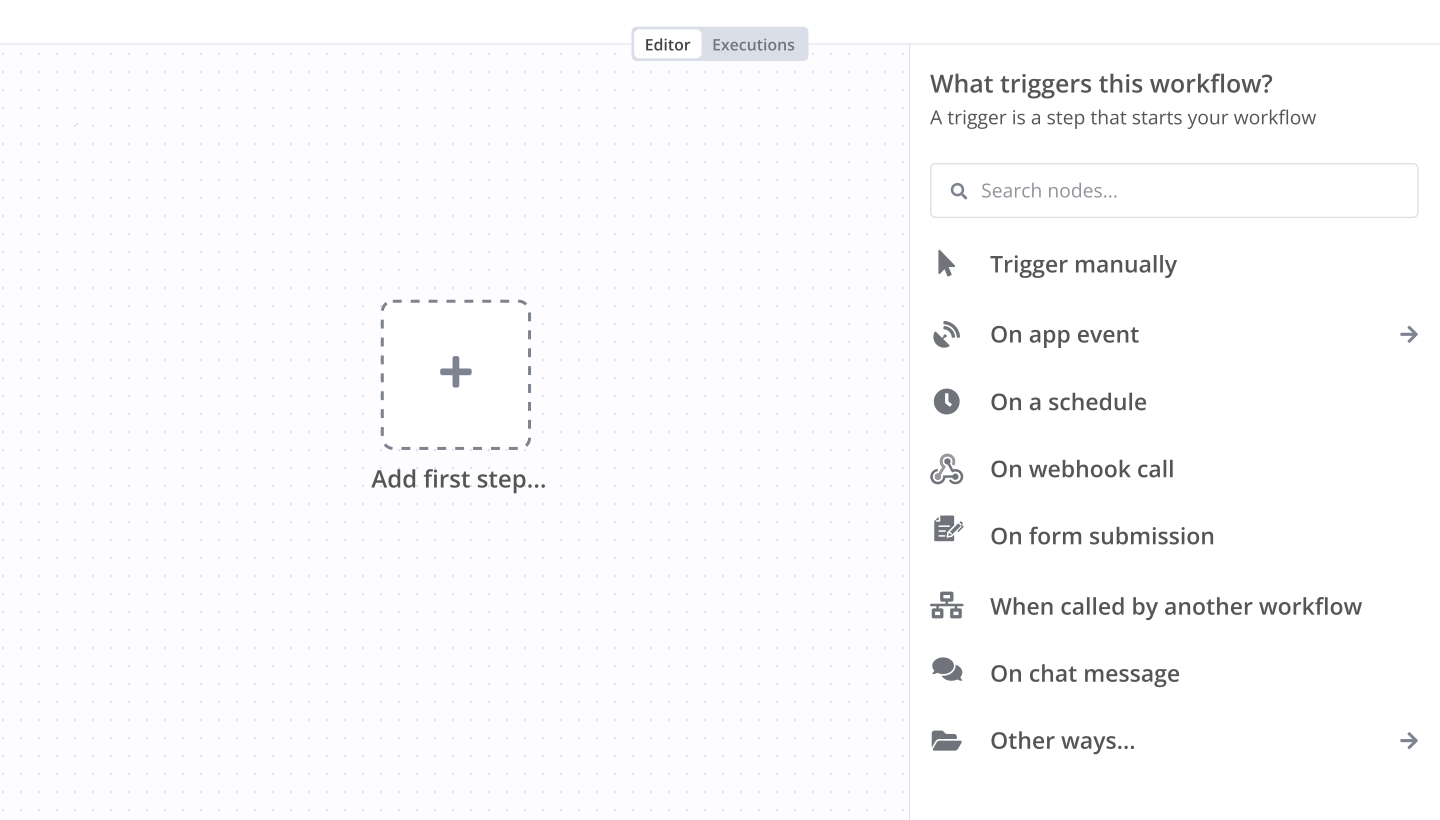
GitHub and Google Sheets integration: Create a new workflow and add the first step

Step 2: Add and configure GitHub and Google Sheets nodes

You can find GitHub and Google Sheets in the nodes panel. Drag them onto your workflow canvas, selecting their actions. Click each node, choose a credential, and authenticate to grant n8n access. Configure GitHub and Google Sheets nodes one by one: input data on the left, parameters in the middle, and output data on the right.

GitHub and Google Sheets integration: Add and configure GitHub and Google Sheets nodes

Step 3: Connect GitHub and Google Sheets

A connection establishes a link between GitHub and Google Sheets (or vice versa) to route data through the workflow. Data flows from the output of one node to the input of another. You can have single or multiple connections for each node.

GitHub and Google Sheets integration: Connect GitHub and Google Sheets

Step 4: Customize and extend your GitHub and Google Sheets integration

Use n8n's core nodes such as If, Split Out, Merge, and others to transform and manipulate data. Write custom JavaScript or Python in the Code node and run it as a step in your workflow. Connect GitHub and Google Sheets with any of n8n’s 1000+ integrations, and incorporate advanced AI logic into your workflows.

GitHub and Google Sheets integration: Customize and extend your GitHub and Google Sheets integration

Step 5: Test and activate your GitHub and Google Sheets workflow

Save and run the workflow to see if everything works as expected. Based on your configuration, data should flow from GitHub to Google Sheets or vice versa. Easily debug your workflow: you can check past executions to isolate and fix the mistake. Once you've tested everything, make sure to save your workflow and activate it.

GitHub and Google Sheets integration: Test and activate your GitHub and Google Sheets workflow

AI Timesheet Generator with Gmail, Calendar & GitHub to Google Sheets

AI-Powered Automatic Timesheet Generator for Google Sheets

Stop wasting billable hours on manual time-tracking. AutoTimesheet Pro uses AI to collect emails, meetings, and GitHub work, then writes a clean timesheet straight into Google Sheets. Perfect for developers, consultants, agencies, and remote teams.

Get Started with n8n now!

🚀 Key Features

Automated Google Sheets time-tracking** — zero spreadsheet prep.
AI-generated activity summaries** (≤ 120 chars) via OpenAI GPT-4o-mini.
Gmail integration** — logs only important emails, skipping newsletters & no-replies.
Google Calendar time logger** — captures confirmed events, duration, and attendees.
GitHub commit & PR tracker** — records your commits plus opened/closed PRs.
Daily 7 PM cron trigger** (easily adjustable).
Month-based sheet creation** — new tab spins up on the first run each month.
No-code n8n template* — just connect credentials and tweak one Set Variables* node.
🔌 Easily extensible** — drag-and-drop extra n8n nodes to add Slack, Jira, Notion, Asana, Trello, Toggl, or any other data source you need.

🔍 How It Works

Collect — n8n pulls data from Gmail, Google Calendar, and chosen GitHub repos.
Clean — filters remove noise (newsletters, irrelevant commits, etc.).
Condense — OpenAI rewrites each item into a concise, SEO-friendly description.
Write — workflow appends Date, Type, and Description to your Timesheet Google Sheet.
Extend — simply insert new n8n nodes (e.g., Slack, Notion, Jira) and merge them into the same pipeline.

📈 Benefits for SEO-Minded Professionals

Keyword-rich activity log** improves internal search and reporting.
Structured data** in Sheets simplifies export to accounting or PM tools.
Consistent naming** (CALENDAR_EVENT, EMAIL, COMMIT, PR) makes analytics easy.

✅ Why Choose AutoTimesheet Pro?

Zero manual entry — just open the sheet and bill clients.
Immediate visibility into where your hours went.
Works with any GitHub repo list and any inbox you own.
100 % no-code setup — activate in minutes.
Built on n8n, so you can customize and scale without limits.
📥 Get Started

Ready to replace manual time-tracking with smart automation?

https://n8n.partnerlinks.io/ds9podzjls6d

Join N8N now, connect your Google & GitHub accounts, and let AI handle your daily log.

Nodes used in this workflow

Popular GitHub and Google Sheets workflows

+2

AI Timesheet Generator with Gmail, Calendar & GitHub to Google Sheets

AI-Powered Automatic Timesheet Generator for Google Sheets Stop wasting billable hours on manual time-tracking. AutoTimesheet Pro uses AI to collect emails, meetings, and GitHub work, then writes a clean timesheet straight into Google Sheets. Perfect for developers, consultants, agencies, and remote teams. Get Started with n8n now! 🚀 Key Features Automated Google Sheets time-tracking** — zero spreadsheet prep. AI-generated activity summaries** (≤ 120 chars) via OpenAI GPT-4o-mini. Gmail integration** — logs only important emails, skipping newsletters & no-replies. Google Calendar time logger** — captures confirmed events, duration, and attendees. GitHub commit & PR tracker** — records your commits plus opened/closed PRs. Daily 7 PM cron trigger** (easily adjustable). Month-based sheet creation** — new tab spins up on the first run each month. No-code n8n template* — just connect credentials and tweak one Set Variables* node. 🔌 Easily extensible** — drag-and-drop extra n8n nodes to add Slack, Jira, Notion, Asana, Trello, Toggl, or any other data source you need. 🔍 How It Works Collect — n8n pulls data from Gmail, Google Calendar, and chosen GitHub repos. Clean — filters remove noise (newsletters, irrelevant commits, etc.). Condense — OpenAI rewrites each item into a concise, SEO-friendly description. Write — workflow appends Date, Type, and Description to your Timesheet Google Sheet. Extend — simply insert new n8n nodes (e.g., Slack, Notion, Jira) and merge them into the same pipeline. 📈 Benefits for SEO-Minded Professionals Keyword-rich activity log** improves internal search and reporting. Structured data** in Sheets simplifies export to accounting or PM tools. Consistent naming** (CALENDAR_EVENT, EMAIL, COMMIT, PR) makes analytics easy. ✅ Why Choose AutoTimesheet Pro? Zero manual entry — just open the sheet and bill clients. Immediate visibility into where your hours went. Works with any GitHub repo list and any inbox you own. 100 % no-code setup — activate in minutes. Built on n8n, so you can customize and scale without limits. 📥 Get Started Ready to replace manual time-tracking with smart automation? https://n8n.partnerlinks.io/ds9podzjls6d Join N8N now, connect your Google & GitHub accounts, and let AI handle your daily log.
+6

Personalize Resumes & Cover Letters with AI, GitHub Pages and Google Drive

🧠 Automated Resume & Cover Letter Generator This project is an automation workflow that generates a personalized resume and cover letter for each job listing. 🚀 Features Automated Resume Crafting Generates an HTML resume from your data. Hosts it live on GitHub Pages. Converts it to PDF using Gotenberg and saves it to Google Drive. Automated Cover Letter Generation Uses an LLM to create a tailored cover letter for each job listing. Simple Input Database Agent Stores your experience in an n8n Data Table with the following fields: role, summary, task, skills, tools, industry. The main agent pulls this data using RAG (Retrieval-Augmented Generation) to personalize the outputs. One-Time GitHub Setup Initializes a blank GitHub repository to host HTML files online, allowing Gotenberg to access and convert them. 🧩 Tech Stack Gotenberg** – Converts HTML to PDF GitHub Pages** – Hosts live HTML files n8n** – Handles data tables and workflow automation LLM (OpenAI / Cohere / etc.)** – Generates cover letters Google Drive** – Stores the final PDFs ⚙️ Installation & Setup Create a GitHub Repository This repo will host your HTML resume through GitHub Pages. Set the Webhook URL In the notify-n8n.yml file, replace: role | summary | task | skills | tools | industry Create the n8n Data Table Add the following columns: role | summary | task | skills | tools | industry Create a Google Spreadsheet Add these columns: company | cover_letter | resume Install Gotenberg Follow the installation instructions on the Gotenberg GitHub repository: https://github.com/thecodingmachine/gotenberg Customize the HTML Template Modify the HTML resume to your liking. You can use an LLM to locate and edit specific sections. Add Authentication and Link Your GitHub Repo Ensure your workflow has permission to push updates to your GitHub Pages branch. Run the Workflow Once everything is connected, trigger the workflow to automatically generate and save personalized resumes and cover letters. 📝 How to Use Copy and paste the job listing description into the Telegram bot. Wait for the "Done" notification before submitting another job. Do not use the bot again until the notification appears. The process usually takes a few minutes to complete. ✅ Notes This workflow is designed to save time and personalize your job applications efficiently. By combining n8n automation, LLMs, and open-source tools like Gotenberg, you can maintain full control over your data while generating high-quality resumes and cover letters for every job opportunity.
+2

Auto-Categorize Blog Posts with OpenAI GPT-4, GitHub, and Google Sheets for Astro/Next.js

Automatically Assign Categories and Tags to Blog Posts with AI This workflow streamlines your content organization process by automatically analyzing new blog posts in your GitHub repository and assigning appropriate categories and tags using OpenAI. It compares new posts against existing entries in a Google Sheet, updates the metadata for each new article, and records the suggested tags and categories for review — all in one automated pipeline. Who’s It For Content creators and editors** managing a static website (e.g., Astro or Next.js) who want AI-driven tagging. SEO specialists** seeking consistent metadata and topic organization. Developers or teams** managing a Markdown-based blog stored in GitHub who want to speed up post curation. How It Works Form Trigger – Starts the process manually with a form that initiates article analysis. Get Data from Google Sheets – Retrieves existing post records to prevent duplicate analysis. Compare GitHub and Google Sheets – Lists all .md or .mdx blog posts from the GitHub repository (piotr-sikora.com/src/content/blog/pl/) and identifies new posts not yet analyzed. Check New Repo Files – Uses a code node to filter only unprocessed files for AI tagging. Switch Node – If there are no new posts, the workflow stops and shows a confirmation message. If new posts exist, it continues to the next step. Get Post Content from GitHub – Downloads the content of each new article. AI Agent (LangChain + OpenAI GPT-4.1-mini) – Reads each post’s frontmatter (--- section) and body. Suggests new categories and tags based on the article’s topic. Returns a JSON object with proposed updates (Structured Output Parser) Append to Google Sheets – Logs results, including: File name Existing tags and categories Proposed tags and categories (AI suggestions) Completion Message – Displays a success message confirming the categorization process has finished. Requirements GitHub account** with repository access to your website content. Google Sheets connection** for storing metadata suggestions. OpenAI account** (credential stored in openAiApi). How to Set Up Connect your GitHub, Google Sheets, and OpenAI credentials in n8n. Update the GitHub repository path to match your project (e.g., src/content/blog/en/). In Google Sheets, create columns: FileName, Categories, Proposed Categories, Tags, Proposed Tags. Adjust the AI model or prompt text if you want different tagging behavior. Run the workflow manually using the Form Trigger node. How to Customize Swap OpenAI GPT-4.1-mini for another LLM (e.g., Claude or Gemini) via the LangChain node. Modify the prompt in the AI Agent to adapt categorization style or tone. Add a GitHub commit node if you want AI-updated metadata written back to files automatically. Use the Schedule Trigger node to automate this process daily. Important Notes All API keys and credentials are securely stored — no hardcoded keys. The workflow includes multiple sticky notes explaining: Repository setup File retrieval and AI tagging Google Sheet data structure It uses a LangChain memory buffer to improve contextual consistency during multiple analyses. Summary This workflow automates metadata management for blogs or documentation sites by combining GitHub content, AI categorization, and Google Sheets tracking. With it, you can easily maintain consistent tags and categories across dozens of articles — boosting SEO, readability, and editorial efficiency without manual tagging.
+2

Review GitHub pull requests and label them using OpenAI GPT-4o-mini and Slack

Automate GitHub pull request reviews and labeling using OpenAI This workflow automates the first line of code review for your development team. By leveraging OpenAI, it analyzes pull request diffs, assigns descriptive labels based on change size and category, posts summary comments back to GitHub, and keeps your team informed via Slack. Who’s it for? DevOps Engineers** looking to standardize PR triage. Team Leads** who want to provide instant feedback to developers. Open Source Maintainers** managing high volumes of contributions. Development Teams** aiming to reduce manual overhead in code reviews. How it works / What it does Trigger: The workflow starts via a GitHub PR Webhook when a pull request is opened or synchronized. Data Gathering: It extracts PR metadata and uses the GitHub Node and HTTP Request Node to fetch a list of changed files and the raw code diff. Analysis: A Code Node categorizes the changes (e.g., size labels like size/S or size/L). AI Review: The AI Agent (powered by OpenAI) analyzes the code diff to generate a quality score, summary, and specific strengths/concerns. Action: The GitHub Node updates the PR with relevant labels. An automated review comment is posted to the PR discussion. A summary is sent to a Slack channel. Reporting: All review data is logged into Google Sheets for long-term tracking and analytics. Requirements GitHub Account:** OAuth credentials with repository access. OpenAI API Key:** For the Chat Model (recommends GPT-4o-mini or higher). Slack Workspace:** A bot token to post to the #code-reviews channel. Google Sheets:** A spreadsheet with headers matching the PR metadata. How to set up GitHub Webhook: Configure your GitHub repository to send "Pull request" events to the Webhook URL provided by this workflow. Credentials: Authenticate your GitHub, OpenAI, Slack, and Google Sheets accounts in their respective nodes. Google Sheets: Select your target Spreadsheet and Sheet name in the "Log to Sheets" node. Slack: Ensure the Slack bot is invited to the channel specified in the "Notify Slack" node. How to customize AI Prompt:* Modify the "System Message" in the AI Code Reviewer* node to reflect your team's specific coding standards or preferred review tone. Labeling Logic:** Edit the "Analyze File Changes" node to add custom labels based on file paths (e.g., frontend, documentation). Review Logic:* Add an If Node* after the AI analysis to only auto-approve PRs with a quality score higher than 90.

Track SDK Documentation Drift with GitHub, Notion, Google Sheets, and Slack

📊 Description Automatically track SDK releases from GitHub, compare documentation freshness in Notion, and send Slack alerts when docs lag behind. This workflow ensures documentation stays in sync with releases, improves visibility, and reduces version drift across teams. 🚀📚💬 What This Template Does Step 1: Listens to GitHub repository events to detect new SDK releases. 🧩 Step 2: Fetches release metadata including version, tag, and publish date. 📦 Step 3: Logs release data into Google Sheets for record-keeping and analysis. 📊 Step 4: Retrieves FAQ or documentation data from Notion. 📚 Step 5: Merges GitHub and Notion data to calculate documentation drift. 🔍 Step 6: Flags SDKs whose documentation is over 30 days out of date. ⚠️ Step 7: Sends detailed Slack alerts to notify responsible teams. 🔔 Key Benefits ✅ Keeps SDK documentation aligned with product releases ✅ Prevents outdated information from reaching users ✅ Provides centralized release tracking in Google Sheets ✅ Sends real-time Slack alerts for overdue updates ✅ Strengthens DevRel and developer experience operations Features GitHub release trigger for real-time monitoring Google Sheets logging for tracking and auditing Notion database integration for documentation comparison Automated drift calculation (days since last update) Slack notifications for overdue documentation Requirements GitHub OAuth2 credentials Notion API credentials Google Sheets OAuth2 credentials Slack Bot token with chat:write permissions Target Audience Developer Relations (DevRel) and SDK engineering teams Product documentation and technical writing teams Project managers tracking SDK and doc release parity Step-by-Step Setup Instructions Connect your GitHub account and select your SDK repository. Replace YOUR_GOOGLE_SHEET_ID and YOUR_SHEET_GID with your tracking spreadsheet. Add your Notion FAQ database ID. Configure your Slack channel ID for alerts. Run once manually to validate setup, then enable automation.

Auto-Answer GitHub PR Questions with GPT-4o, Notion & Slack for Dev Teams

📘 Description: This workflow automates developer Q&A handling by connecting GitHub, GPT-4o (Azure OpenAI), Notion, Google Sheets, and Slack. Whenever a developer comments on a pull request with a “how do I…” or “how to…” question, the workflow automatically detects the query, uses GPT-4o to generate a concise technical response, stores it in Notion for documentation, and instantly shares it on Slack for visibility. It reduces repetitive manual answering, boosts engineering knowledge sharing, and keeps teams informed with AI-powered insights. ⚙️ What This Workflow Does (Step-by-Step) 🟢 GitHub PR Comment Trigger — Starts the automation when a pull request comment is posted in a specified repository. Action: Listens for pull_request_review_comment events. Description: Captures comment text, author, PR number, and repository name as the trigger payload. 🔍 Validate GitHub Webhook Payload (IF Node) — Ensures the webhook data includes a valid comment URL. ✅ True Path: Continues to question detection. ❌ False Path: Sends invalid or missing data to Google Sheets for error logging. ❓ Detect Developer Question in PR Comment — Checks whether the comment includes question patterns such as “how do I…” or “how to…”. If a valid question is found, the workflow proceeds to the AI assistant; otherwise, it ends silently. 🧠 Configure GPT-4o Model (Azure OpenAI) — Connects to the GPT-4o model for intelligent language generation. Acts as the central AI engine to craft short, precise technical answers. 🤖 Generate AI Response for Developer Question — Sends the developer’s comment and PR context to GPT-4o. GPT analyzes the question and produces a short (2–3 line) helpful answer, maintaining professional and technical tone. 🧩 Extract GitHub Comment Metadata — Uses a JavaScript code node to structure key details (repo, user, comment, file path, PR number) into a clean JSON format. Prepares standardized data for storage and further use. 🧾 Save Comment Insight to Notion Database — Appends the GitHub comment, AI response, and metadata into a Notion database (“test db”). Acts as a centralized knowledge base for tracking and reusing AI-generated technical answers. 💬 Post AI Answer & PR Link to Slack — Sends the generated response and GitHub PR comment link to a Slack channel or user. Helps reviewers or teammates instantly view AI-generated suggestions and maintain active discussion threads. 🚨 Log Errors in Google Sheets (Error Handling) — Logs webhook validation or AI-processing errors into a shared Google Sheet (“error log sheet”). Ensures full visibility into workflow issues for future debugging. 🧩 Prerequisites GitHub OAuth credentials with webhook access Azure OpenAI (GPT-4o) account Notion API integration for the documentation database Slack API connection for notifications Google Sheets API access for error tracking 💡 Key Benefits ✅ Automated detection of developer questions in GitHub comments ✅ AI-generated instant answers with context awareness ✅ Centralized documentation in Notion for knowledge reuse ✅ Real-time Slack notifications for visibility and collaboration ✅ Continuous error logging for transparent troubleshooting 👥 Perfect For Developer teams using GitHub for code reviews Engineering leads wanting AI-assisted PR support Companies aiming to build self-learning documentation Teams using Notion and Slack for workflow visibility

Build your own GitHub and Google Sheets integration

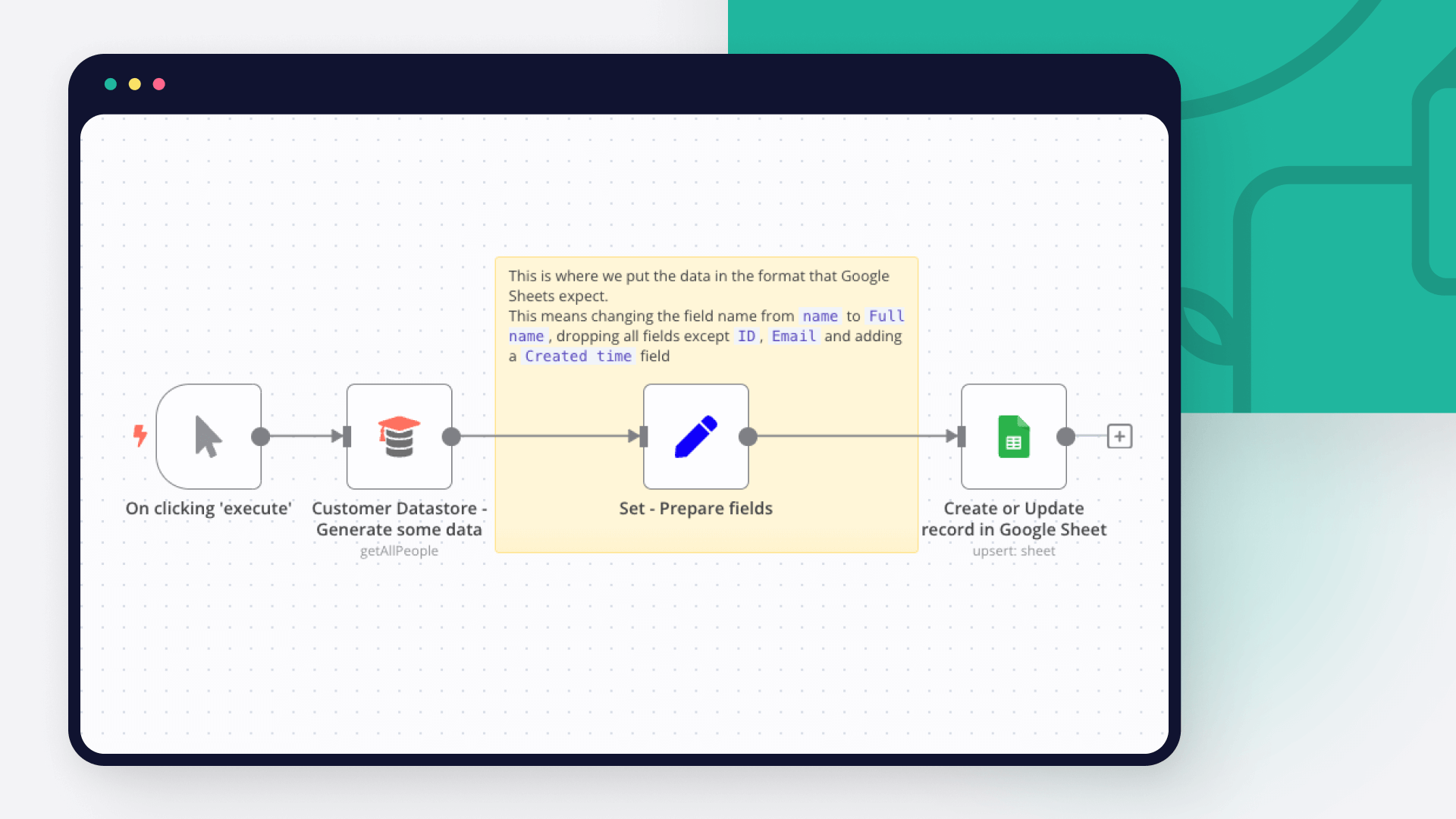
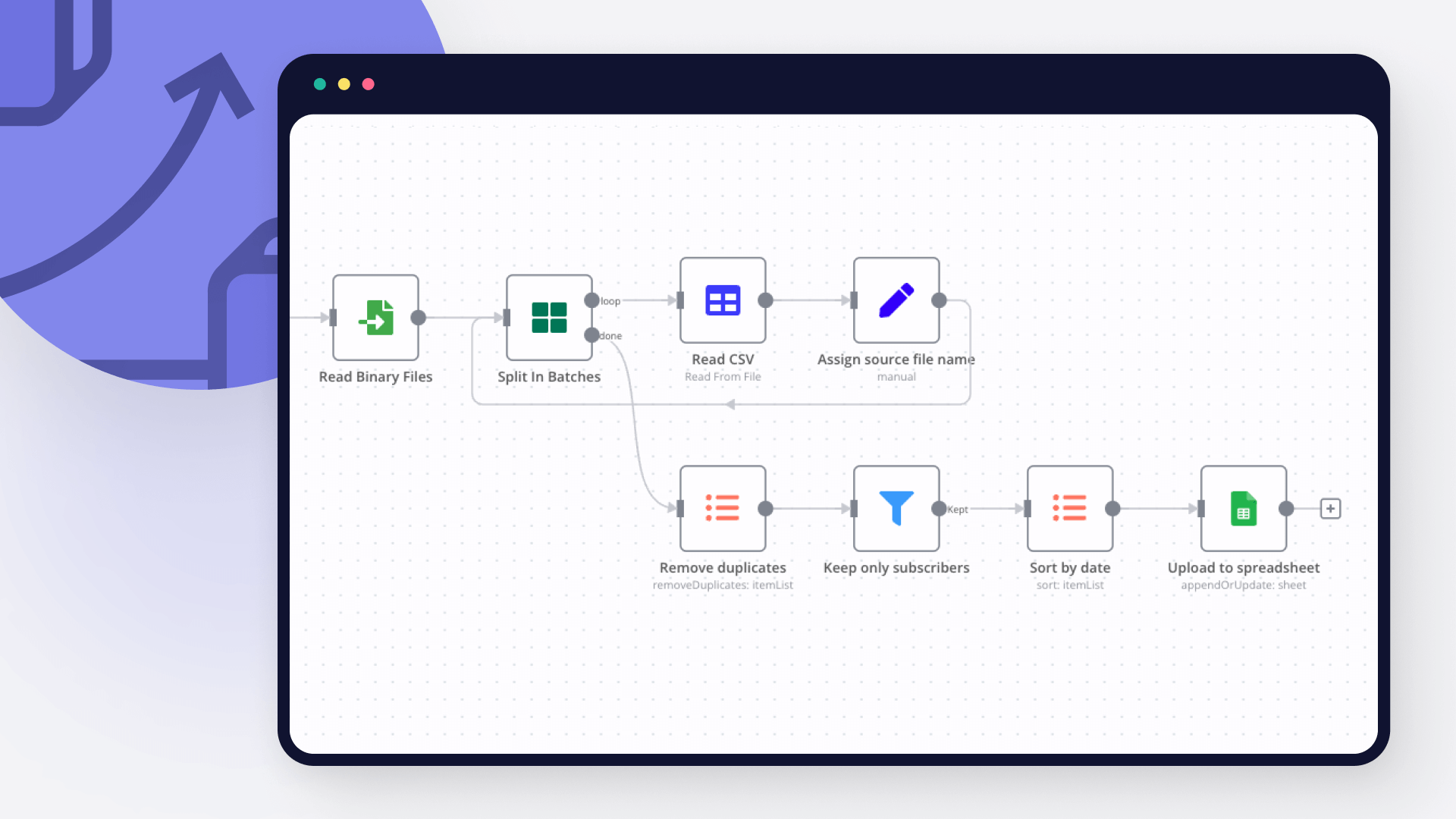
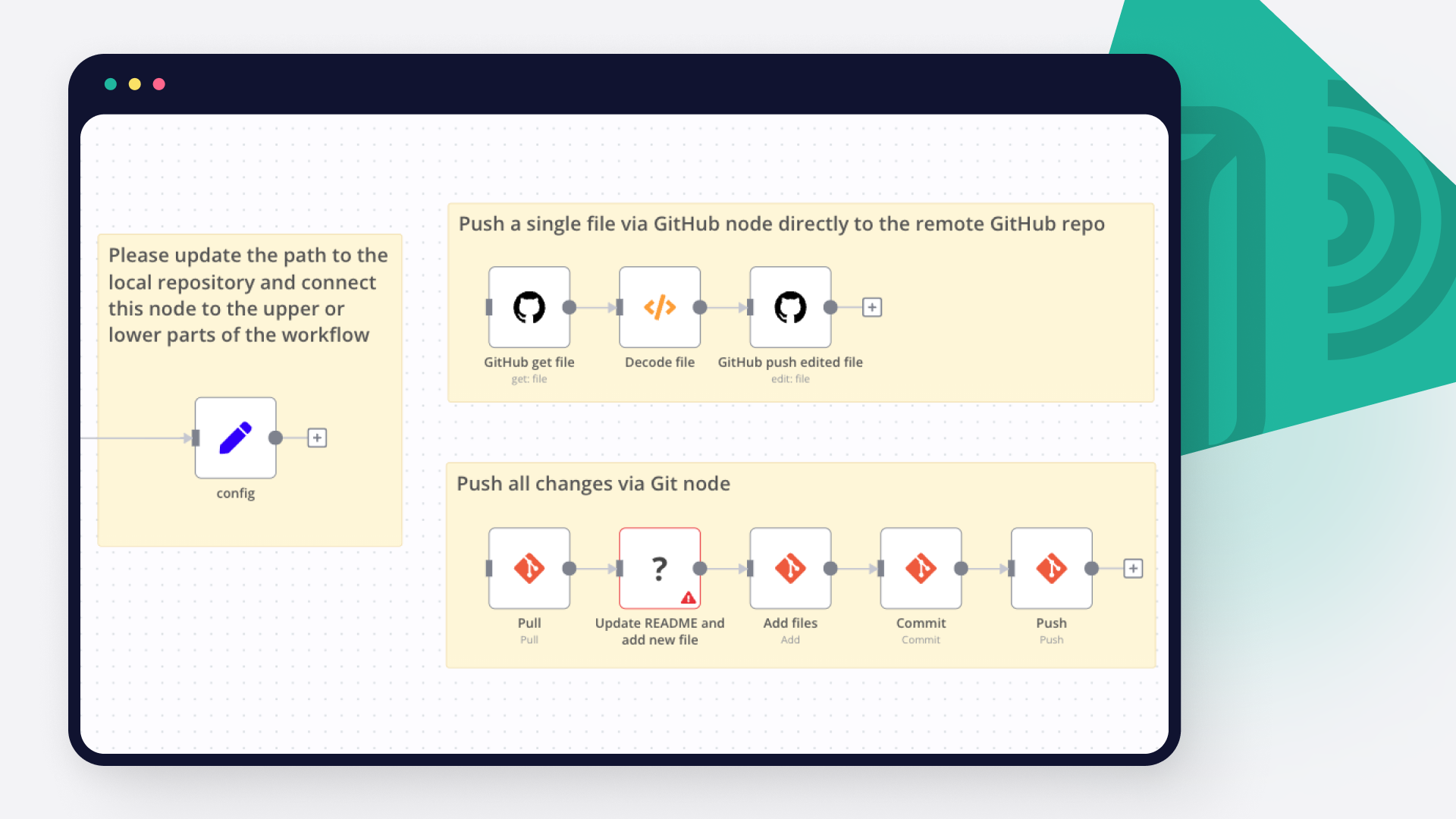
Create custom GitHub and Google Sheets workflows by choosing triggers and actions. Nodes come with global operations and settings, as well as app-specific parameters that can be configured. You can also use the HTTP Request node to query data from any app or service with a REST API.


GitHub supported actions

Create
Create a new file in repository
Delete
Delete a file in repository
Edit
Edit a file in repository
Get
Get the data of a single file
List
List contents of a folder
Create
Create a new issue
Create Comment
Create a new comment on an issue
Edit
Edit an issue
Get
Get the data of a single issue
Lock
Lock an issue
Get Repositories
Returns all repositories of an organization
Create
Creates a new release
Delete
Delete a release
Get
Get a release
Get Many
Get many repository releases
Update
Update a release
Get
Get the data of a single repository
Get Issues
Returns issues of a repository
Get License
Returns the contents of the repository's license file, if one is detected
Get Profile
Get the community profile of a repository with metrics, health score, description, license, etc
Get Pull Requests
Returns pull requests of a repository
List Popular Paths
Get the top 10 popular content paths over the last 14 days
List Referrers
Get the top 10 referrering domains over the last 14 days
Create
Creates a new review
Get
Get a review for a pull request
Get Many
Get many reviews for a pull request
Update
Update a review
Get Repositories
Returns the repositories of a user
Get Issues
Returns the issues assigned to the user
Invite
Invites a user to an organization
Disable
Disable a workflow
Dispatch
Dispatch a workflow event
Dispatch and Wait for Completion
Dispatch a workflow event and wait for a webhook to be called before proceeding
Enable
Enable a workflow
Get
Get a workflow
Get Usage
Get the usage of a workflow
List
List workflows

Google Sheets supported actions

Create
Create a spreadsheet
Delete
Delete a spreadsheet
Append or Update Row
Append a new row or update an existing one (upsert)
Append Row
Create a new row in a sheet
Clear
Delete all the contents or a part of a sheet
Create
Create a new sheet
Delete
Permanently delete a sheet
Delete Rows or Columns
Delete columns or rows from a sheet
Get Row(s)
Retrieve one or more rows from a sheet
Update Row
Update an existing row in a sheet

FAQs

  • Can GitHub connect with Google Sheets?

  • Can I use GitHub’s API with n8n?

  • Can I use Google Sheets’s API with n8n?

  • Is n8n secure for integrating GitHub and Google Sheets?

  • How to get started with GitHub and Google Sheets integration in n8n.io?

Need help setting up your GitHub and Google Sheets integration?

Discover our latest community's recommendations and join the discussions about GitHub and Google Sheets integration.
Sergey Komardenkov
sérgio eduardo floresta filho
Julian
therealJMT
Guilherme

Looking to integrate GitHub and Google Sheets in your company?

Over 3000 companies switch to n8n every single week

Why use n8n to integrate GitHub with Google Sheets

Build complex workflows, really fast

Build complex workflows, really fast

Handle branching, merging and iteration easily.
Pause your workflow to wait for external events.

Code when you need it, UI when you don't

Simple debugging

Your data is displayed alongside your settings, making edge cases easy to track down.

Use templates to get started fast

Use 1000+ workflow templates available from our core team and our community.

Reuse your work

Copy and paste, easily import and export workflows.

Implement complex processes faster with n8n

red iconyellow iconred iconyellow icon