Back to Integrations
integrationGitHub node
integrationJira Software node

GitHub and Jira Software integration

Save yourself the work of writing custom integrations for GitHub and Jira Software and use n8n instead. Build adaptable and scalable Development, and Productivity workflows that work with your technology stack. All within a building experience you will love.

How to connect GitHub and Jira Software

  • Step 1: Create a new workflow
  • Step 2: Add and configure nodes
  • Step 3: Connect
  • Step 4: Customize and extend your integration
  • Step 5: Test and activate your workflow

Step 1: Create a new workflow and add the first step

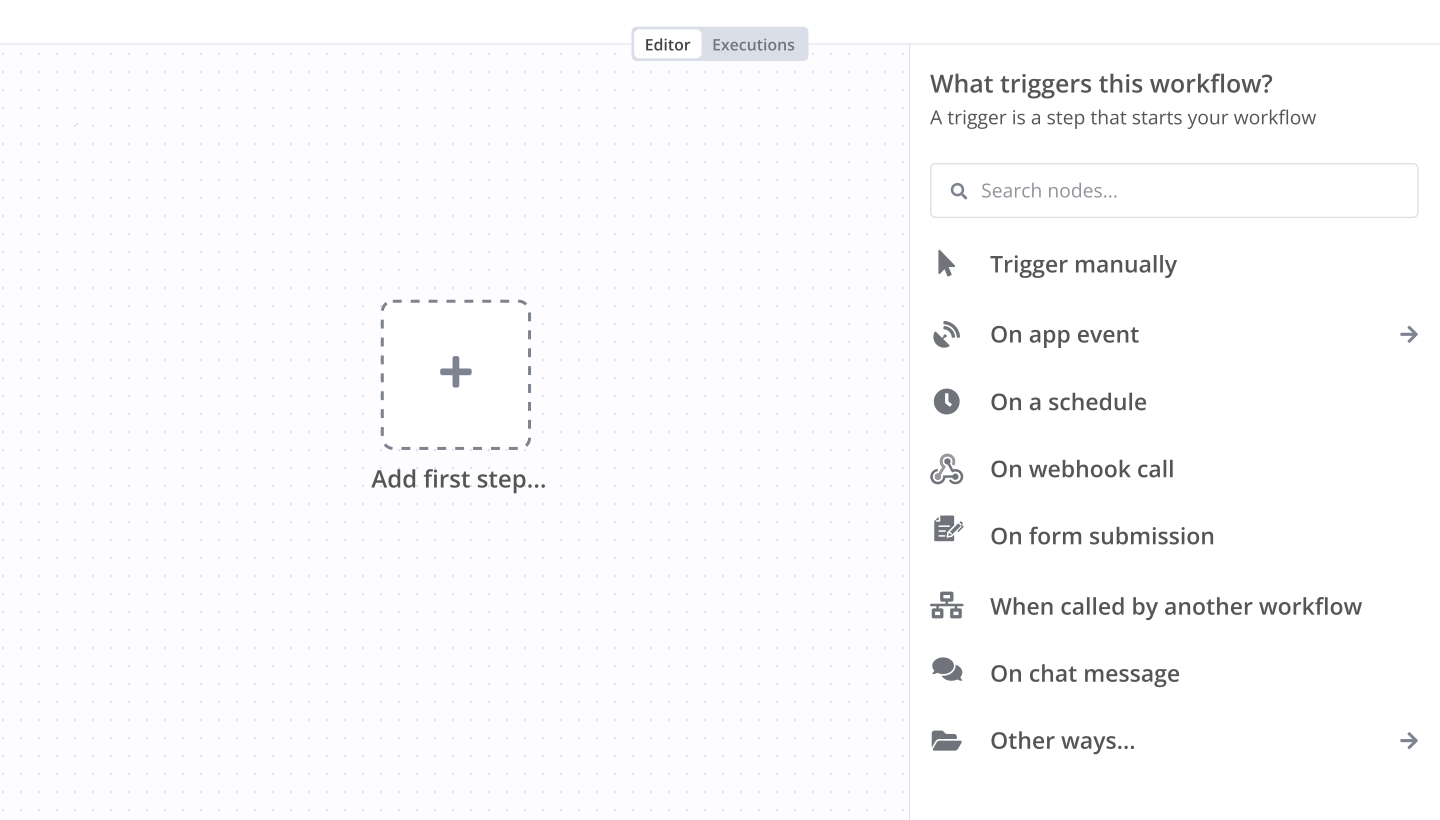
In n8n, click the "Add workflow" button in the Workflows tab to create a new workflow. Add the starting point – a trigger on when your workflow should run: an app event, a schedule, a webhook call, another workflow, an AI chat, or a manual trigger. Sometimes, the HTTP Request node might already serve as your starting point.

GitHub and Jira Software integration: Create a new workflow and add the first step

Step 2: Add and configure GitHub and Jira Software nodes

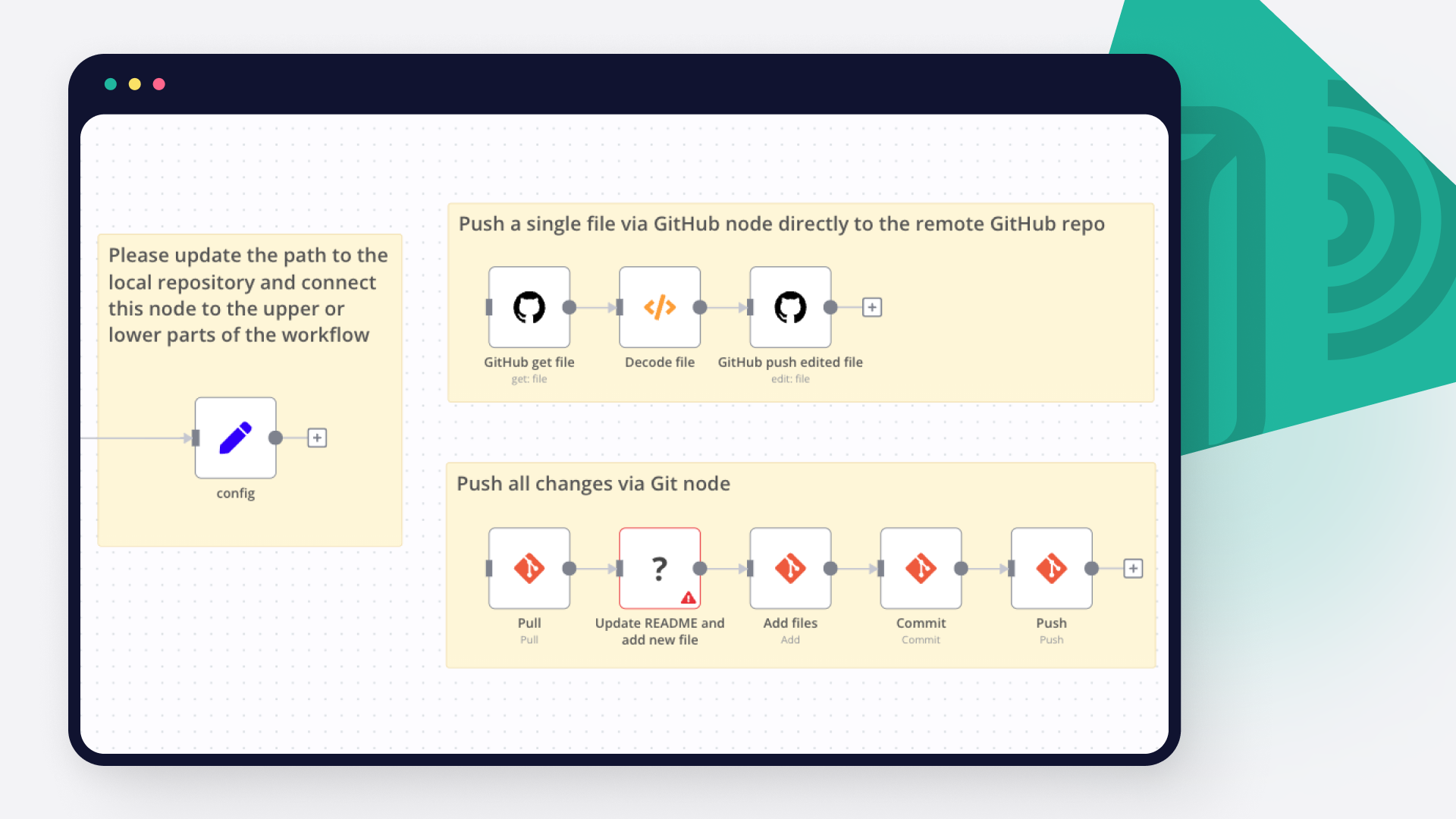
You can find GitHub and Jira Software in the nodes panel. Drag them onto your workflow canvas, selecting their actions. Click each node, choose a credential, and authenticate to grant n8n access. Configure GitHub and Jira Software nodes one by one: input data on the left, parameters in the middle, and output data on the right.

GitHub and Jira Software integration: Add and configure GitHub and Jira Software nodes

Step 3: Connect GitHub and Jira Software

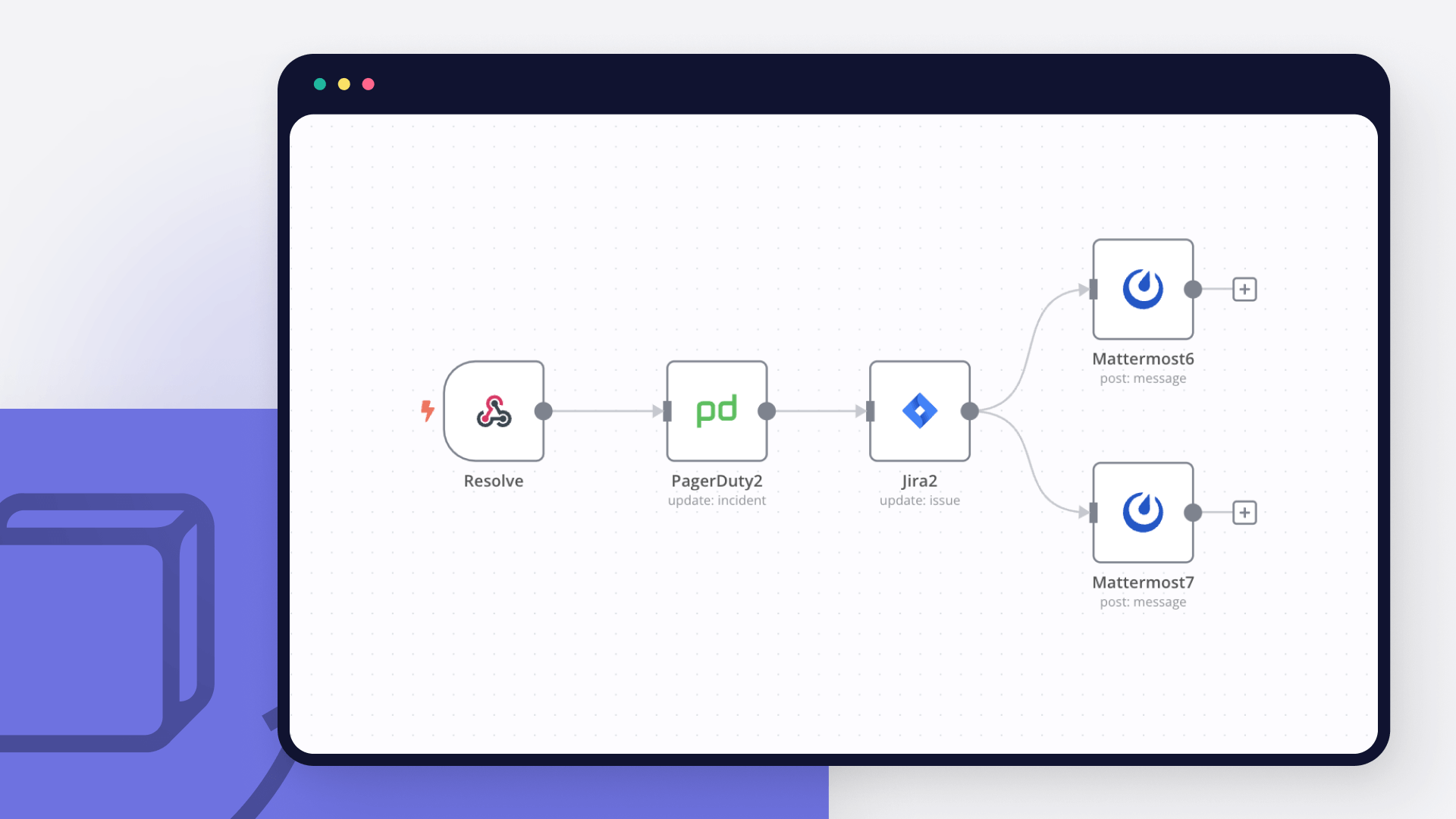
A connection establishes a link between GitHub and Jira Software (or vice versa) to route data through the workflow. Data flows from the output of one node to the input of another. You can have single or multiple connections for each node.

GitHub and Jira Software integration: Connect GitHub and Jira Software

Step 4: Customize and extend your GitHub and Jira Software integration

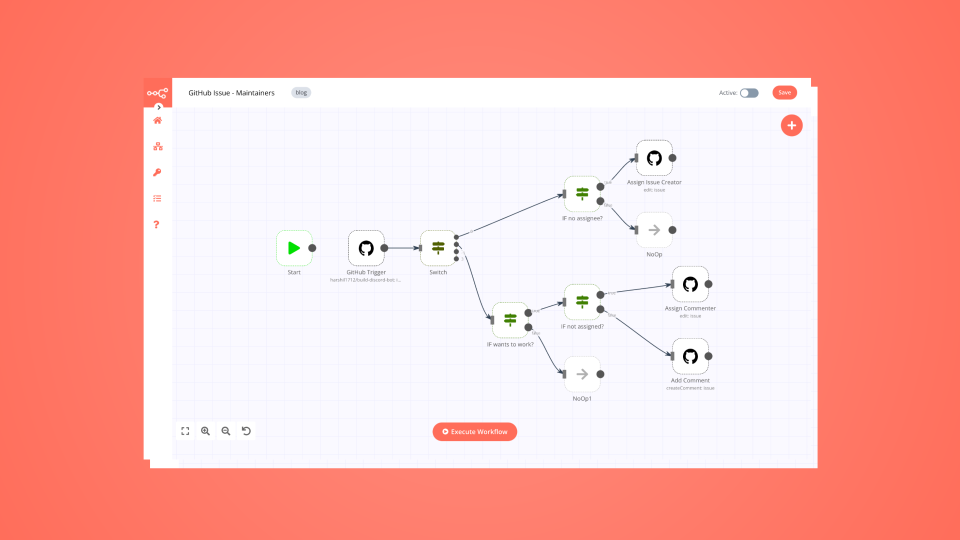
Use n8n's core nodes such as If, Split Out, Merge, and others to transform and manipulate data. Write custom JavaScript or Python in the Code node and run it as a step in your workflow. Connect GitHub and Jira Software with any of n8n’s 1000+ integrations, and incorporate advanced AI logic into your workflows.

GitHub and Jira Software integration: Customize and extend your GitHub and Jira Software integration

Step 5: Test and activate your GitHub and Jira Software workflow

Save and run the workflow to see if everything works as expected. Based on your configuration, data should flow from GitHub to Jira Software or vice versa. Easily debug your workflow: you can check past executions to isolate and fix the mistake. Once you've tested everything, make sure to save your workflow and activate it.

GitHub and Jira Software integration: Test and activate your GitHub and Jira Software workflow

Automate GitHub, JIRA release notes with Google Gemini & notification over email

This n8n template from Intuz provides a complete and automated solution for creating and distributing sophisticated release notes.

It connects to GitHub and JIRA to gather data from recent commits and completed tickets, using specific keywords or labels to identify key features for inclusion.

This information is then processed by Google Gemini to automatically generate well-written, human-like release notes, which are then distributed via email to stakeholders, creating a complete, end-to-end communication pipeline for every new software release.

This template is perfect for development teams looking to streamline their release process, ensure consistent communication, and eliminate the manual effort of writing release notes.

How to use

  1. Set up Credentials:

GitHub
JIRA (Software Cloud API)
Google Gemini (or another PaLM/LLM provider)
Your SMTP email server.

  1. Configure the GitHub Trigger:

Select the Github Trigger node.
In the Repository Owner field, enter your GitHub username or organization name.
In the Repository Name field, select the repository you want to monitor.

  1. Verify the JIRA Integration:

Important:** This workflow assumes your commit messages contain a JIRA key (e.g., "PROJ-123: Fix login bug").
Select the first Code node. It uses a regular expression ([A-Z]+-\d+)/i to find JIRA keys. Adjust this expression if your team uses a different format.
Select the Get an issue node and ensure your JIRA credentials are correctly configured.

  1. Customize the AI Prompt:

Select the Basic LLM Chain node. You can edit the prompt to change the tone, style, or structure of the generated HTML release note to match your company's standards.

  1. Configure Email Notifications:

Select the Send email node.
Update the To Email field with the recipient's email address (e.g., a team distribution list or a stakeholder's email).
Customize the From Email and Subject line as needed.

  1. Activate Workflow:

Save your changes and activate the workflow. Now, every push to your configured repository will trigger the automated generation and sending of release notes.

Required Tools

GitHub: To trigger the workflow on code pushes.
JIRA: To fetch details about the tasks and bugs included in the release.
Google Gemini: To intelligently generate the release note content. (You can swap this for another LLM supported by n8n).
SMTP Provider: To send the final release note via email.

Connect with us

Website: https://www.intuz.com/n8n-workflow-automation-templates
Email: [email protected]
LinkedIn: https://www.linkedin.com/company/intuz
Get Started: https://n8n.partnerlinks.io/intuz

For Custom Worflow Automation
Click here- Get Started

Nodes used in this workflow

Popular GitHub and Jira Software workflows

Send pre-meeting Slack briefings using Google Calendar, Notion, GitHub, and Jira

This n8n template from Intuz provides a complete and automated solution for preparing and delivering context-rich briefings directly to attendees before every meeting. It acts as an AI-powered executive assistant, gathering relevant information from all your key work tools to ensure everyone arrives prepared and aligned. Who's this workflow for? Engineering Managers & Team Leads Product Managers & Project Managers Scrum Masters & Agile Coaches Any team that holds regular status, planning, or technical meetings. How it works Trigger on New Calendar Event: The workflow starts automatically whenever a new meeting is created in a designated Google Calendar. Fetch Previous Context: It immediately connects to Notion to retrieve the notes from the most recent past meeting, ensuring continuity. Wait for the Right Moment: The workflow calculates a time 15 minutes before the meeting's scheduled start and pauses its execution until then. Gather Real-Time Project Data: Just before the meeting, the workflow wakes up and: Extracts keywords from the meeting title. Searches GitHub for recent Pull Requests (PRs) relevant to those keywords. Searches Jira for any tickets or issues that match the meeting's topic. Build the Intelligent Briefing: It assembles all the gathered information—previous notes from Notion, current PRs from GitHub, and relevant tickets from Jira—into a single, beautifully formatted Slack message. Deliver to Each Attendee: The workflow identifies all attendees from the Google Calendar invite, finds their corresponding Slack profiles via email, and sends the personalized briefing as a Direct Message (DM) to each one, ensuring everyone is prepared just in time. Key Requirements to Use This Template n8n Instance: An active n8n account (Cloud or self-hosted). Google Calendar Account: To trigger the workflow on new events. Notion Account: With a dedicated database for storing meeting notes. GitHub Account: To search for relevant pull requests. Jira Cloud Account: To search for relevant project tickets. Slack Workspace & App: A Slack workspace where you have permission to install an app. You will need a Bot Token with the necessary permissions. Setup Instructions Google Calendar Trigger: In the "Capture New Google Calendar Event" node, connect your Google Calendar account and select the calendar you want to monitor. Notion Connection: In the "Get Last Meeting Notes" node, connect your Notion account. Select the Notion Database ID that contains your meeting notes. GitHub & Jira Connections: In the "Get PRs from Repo" node, connect your GitHub account and select the repository to search. In the "Get Jira Issues Related to Meeting" node, connect your Jira Cloud account. You can customize the JQL query if needed. Slack Configuration (Crucial Step): Create a Slack App: Go to api.slack.com/apps, create a new app, and install it to your workspace. Set Permissions: In your app's "OAuth & Permissions" settings, add the following Bot Token Scopes: chat:write (to send messages) and users:read.email (this is critical for looking up attendees). Reinstall the app to your workspace. Get Bot Token: Copy the "Bot User OAuth Token" (it starts with xoxb-). Connect in n8n: In the "Get User Slack Info from Email" node, click "Header Parameters" and replace {{ slack oauth token }} with your actual Bot Token. In the "Send Meeting Context in Slack DM" node, connect your Slack credentials using the same Bot Token. Activate the Workflow: Save the workflow and toggle the "Active" switch to ON. Your automated pre-meeting bot is now live! Connect with us Website: https://www.intuz.com/n8n-workflow-automation-templates Email: [email protected] LinkedIn: https://www.linkedin.com/company/intuz Get Started: https://n8n.partnerlinks.io/intuz For Custom Workflow Automation Click here: Get Started

Auto-resolve Jira Tickets with GitHub Copilot using Port Context

Auto-resolve Jira tickets with coding agents Coding agents can significantly speed up development, but crucial engineering context often gets lost in the process. This guide demonstrates how to use Port as a context lake in n8n workflows to automatically generate GitHub issues from Jira tickets with rich organizational context, ensuring that important information is preserved when assigning them to GitHub Copilot and linking pull requests back to Jira. This setup helps establish a seamless ticket-to-PR workflow, bridging the gap between Jira and GitHub while leveraging Port's comprehensive software catalog as a source of truth. How it works The n8n workflow orchestrates the following steps: Jira trigger — The workflow listens for Jira issue updates via webhook. Condition check — Verifies that the issue status is "In Progress" and has the required label (e.g., "product_approved") without the "copilot_assigned" label. Port context extraction — Uses Port's n8n node to query your software catalog for relevant context about services, repositories, teams, dependencies, and documentation related to the Jira issue. Parse response — Retrieves the AI-generated GitHub issue title and body from Port. Create GitHub issue — Creates a new GitHub issue with the enriched context from Port. Assign to Copilot — Adds a comment to the GitHub issue instructing Copilot to take ownership. Add issue link to Jira ticket — Adds a comment to the Jira ticket with the GitHub issue URL, providing clear traceability. Mark ticket as assigned — Updates the Jira ticket to add the "copilot_assigned" label, preventing duplicate processing. Setup [ ] Connect your Jira Cloud account and enable issue_updated events [ ] Register for free on Port.io [ ] Connect your Port.io account and add the API key [ ] Connect your GitHub account and select the target repository [ ] Ensure a Copilot bot or @copilot user has access to the repository [ ] Confirm the workflow webhook or Jira trigger URL is active [ ] Test by moving a product_approved ticket to In Progress. [ ] You should be good to go! Prerequisites You have a Port account and have completed the onboarding process. Port's GitHub app is installed in your account. Port's Jira integration is installed in your account. You have a working n8n instance (Cloud or self-hosted) with Port's n8n custom node installed. Your GitHub organization has GitHub Copilot enabled, so Copilot can be automatically assigned to any issues created through this guide. ⚠️ This template is intended for Self-Hosted instances only.

GitHub to Jira Bug Sync with GPT-4o Analysis & Team Alerts

Automate Bug Reports: GitHub Issues → AI Analysis → Jira Tickets with Slack & Discord Alerts Automatically convert GitHub issues into analyzed Jira tickets with AI-powered severity detection, developer assignment, and instant team alerts. Overview This workflow captures GitHub issues in real-time, analyzes them with GPT-4o for severity and categorization, creates enriched Jira tickets, assigns the right developers, and notifies your team across Slack and Discord—all automatically. Features AI-Powered Triage**: GPT-4o analyzes bug severity, category, root cause, and generates reproduction steps Smart Assignment**: Automatically assigns developers based on mentioned files and issue context Two-Way Sync**: Posts Jira ticket links back to GitHub issues Multi-Channel Alerts**: Rich notifications in Slack and Discord with action buttons Time Savings**: Eliminates 15-30 minutes of manual triage per bug Customizable Routing**: Easy developer mapping and priority rules What Gets Created Jira Ticket: Original GitHub issue details with reporter info AI severity assessment and categorization Reproduction steps and root cause analysis Estimated completion time Automatic labeling and priority assignment GitHub Comment: Jira ticket link AI analysis summary Assigned developer and estimated time Team Notifications: Severity badges and quick-access buttons Developer assignment and root cause summary Color-coded priority indicators Use Cases Development teams managing 10+ bugs per week Open source projects handling community reports DevOps teams tracking infrastructure issues QA teams coordinating with developers Product teams monitoring user-reported bugs Setup Requirements Required: GitHub repository with admin access Jira Software workspace OpenAI API key (GPT-4o access) Slack workspace OR Discord server Customization Needed: Update developer email mappings in "Parse GPT Response & Map Data" node Replace YOUR_JIRA_PROJECT_KEY with your project key Update Slack channel name (default: dev-alerts) Replace YOUR_DISCORD_WEBHOOK_URL with your webhook Change your-company.atlassian.net to your Jira URL Setup Time: 15-20 minutes Configuration Steps Import workflow JSON into n8n Add credentials: GitHub OAuth2, Jira API, OpenAI API, Slack, Discord Configure GitHub webhook in repository settings Customize developer mappings and project settings Test with sample GitHub issue Activate workflow Expected Results 90% faster bug triage (20 min → 2 min per issue) 100% consistency in bug analysis Zero missed notifications Better developer allocation Improved bug documentation Tags GitHub, Jira, AI, GPT-4, Bug Tracking, DevOps, Automation, Slack, Discord, Issue Management, Development, Project Management, OpenAI, Webhook, Team Collaboration

Classify and Convert GitHub Issues to Jira Tickets with OpenAI

AI-Powered GitHub Issue to Jira Ticket Automation Bridge the gap between your development and project management workflows with this intelligent n8n template. This isn't just a simple sync; it uses an AI agent to analyze, classify, and intelligently route new GitHub issues into the correct Jira ticket type, saving you countless hours of manual triage. 🚀 Key Features AI-Powered Issue Classification:** Leverages an AI Agent (powered by OpenAI) to analyze the content of a new GitHub issue and determine its type (e.g., bug, task, improvement). Intelligent Routing:** Automatically creates the corresponding ticket type in Jira. Bugs in GitHub become Bugs in Jira; other issues become Tasks. Seamless Integration:** Triggers instantly when a new issue is created in your specified GitHub repository. Rich Data Transfer:** Migrates the issue title and body directly into the Jira ticket description for full context. Structured AI Output:** Uses a structured output parser to ensure the AI's classification is reliable and consistent. Beginner-Friendly & Educational:** The workflow is annotated with sticky notes, explaining each step of the process, making it a great tool for learning how to use AI in n8n. ⚙️ How It Works The workflow is designed for clarity and power, moving from issue creation to ticket generation in four automated steps. Trigger: New GitHub Issue The GitHub Trigger node constantly listens for new issues being created in your designated repository. Once an issue is opened, the workflow springs into action. Analyze: AI Classification The issue's title and body are passed to an AI Agent. Using a prompt designed for classification and an OpenAI Chat Model, the agent determines if the issue is a bug, task, or another category. A Structured Output Parser ensures the AI returns clean, usable JSON data (e.g., {"type": "bug"}). Route: Conditional Logic An IF node checks the structured output from the AI agent. If the type is "bug," the workflow proceeds down the "bug" path. Otherwise, it follows the default path for "tasks." Create: Jira Ticket Generation Depending on the route, the corresponding Jira node is activated. A new ticket is created in your specified Jira project with the appropriate issue type (Bug or Task) and includes the full context from the original GitHub issue. 🛠️ Setup Steps & Credentials To get this AI-powered workflow running, you'll need to configure a few credentials: GitHub: Create a GitHub credential in n8n. In the GitHub Trigger node, select your credential and specify the owner (your GitHub username or organization) and the repository you want to monitor. OpenAI: Obtain an API Key from platform.openai.com. Create an OpenAI credential in n8n. In the OpenAI Chat Model node, select your newly created credential. You can also experiment with different models like gpt-4.1-mini for speed or gpt-4o for higher accuracy. Jira: Create a Jira API token from your Atlassian account settings. Create a Jira credential in n8n using your email, API token, and Atlassian domain. In both the Create Jira Ticket (Bug) and Create Jira Ticket (Task) nodes, select your Jira credential and set your target project key. 💡 Customization & Learning This workflow is a powerful starting point. Here are a few ways you can customize it and learn more: Expand Classification:** Modify the AI Agent's prompt and the IF node to handle more issue types, like improvement, documentation, or feature-request. Add More Data:** Enhance the Jira nodes to include labels, assignees, or priority levels based on the AI's output or the original GitHub issue's properties. Swap AI Models:** Try different language models by replacing the OpenAI node with one for Google Gemini, Anthropic Claude, or others supported by n8n. Error Handling:** Add a path for what to do if the AI fails to classify an issue, such as sending a notification to a Slack channel for manual review. 📋 Requirements An active n8n instance. GitHub API credentials. OpenAI API credentials. Jira API credentials.

Automate GitHub PRs & JIRA updates from Git commit commands-single repo

This n8n template from Intuz delivers a complete and automated solution to streamline your development workflow for a single repository. By embedding specific keywords and a JIRA issue ID within your git commit commands, this workflow automatically creates a Pull Request in GitHub and simultaneously updates the corresponding JIRA ticket. This provides a complete, seamless integration that eliminates manual steps and keeps your project management perfectly in sync with your codebase. How it works This workflow acts as a powerful bridge between your Git repository and your project management tools, driven entirely by the structure of your commit messages. GitHub Webhook Trigger: The workflow starts when a developer pushes a new commit to a specified repository in GitHub. Parse Commit Message: A Code node extracts key information from the commit message: The JIRA Issue Key (e.g., FF-1196). The base branch for the PR (e.g., development). Action commands like [auto-pr] and [taskcompleted]. Conditional PR Creation: An IF node checks if the [auto-pr] command is present. If yes, it uses the GitHub node to automatically create a pull request from the developer's branch to the specified base branch. If no, this step is skipped, allowing for multiple commits before a PR is made. Conditional JIRA Update: Another IF node checks for the [taskcompleted] command. If yes, it uses the JIRA node to transition the corresponding issue to your "Done" status (e.g., "Task Completed" or "In Review"). If no, the JIRA issue remains in its current state, perfect for work-in-progress commits. How to Use: Quick Start Guide Click the "Use Template" button to import this workflow into your n8n instance. Configure the GitHub Trigger: Open the "GitHub Push Trigger" node. It will display a unique Webhook URL. Copy this URL. In your GitHub repository, go to Settings > Webhooks > Add webhook. Paste the URL into the Payload URL field. Set the Content type to application/json. Under "Which events would you like to trigger this webhook?", select Just the push event. Click Add webhook. Connect Your Accounts: GitHub: Select your GitHub API credential in the "Create Pull Request" node. JIRA : Select your JIRA API credential in the "Update JIRA Issue Status" node. Customize the JIRA Transition (Important): Open the "Update JIRA Issue Status" node. In the Transition parameter, you need to set the specific status you want to move the issue to (e.g., 'Done', 'Completed', 'In Review'). You can use the ID or the exact name of the transition from your JIRA project's workflow. Activate the Workflow: Save your changes and activate the workflow. You're ready to automate! Example Commit Message: git commit -m "FF-1196 Implement OAuth login [auto-pr,development,taskcompleted]" Key Requirements to Use Template An active n8n instance. A GitHub account with repository admin permissions to create webhooks. A JIRA Cloud account with permissions to update issues. Developers who can follow the specified git commit message format. Connect with us Website: https://www.intuz.com/n8n-workflow-automation-templates Email: [email protected] LinkedIn: https://www.linkedin.com/company/intuz Get Started: https://n8n.partnerlinks.io/intuz For Custom Worflow Automation Click here- Get Started

Automate GitHub, JIRA release notes with Google Gemini & notification over email

This n8n template from Intuz provides a complete and automated solution for creating and distributing sophisticated release notes. It connects to GitHub and JIRA to gather data from recent commits and completed tickets, using specific keywords or labels to identify key features for inclusion. This information is then processed by Google Gemini to automatically generate well-written, human-like release notes, which are then distributed via email to stakeholders, creating a complete, end-to-end communication pipeline for every new software release. This template is perfect for development teams looking to streamline their release process, ensure consistent communication, and eliminate the manual effort of writing release notes. How to use Set up Credentials: GitHub JIRA (Software Cloud API) Google Gemini (or another PaLM/LLM provider) Your SMTP email server. Configure the GitHub Trigger: Select the Github Trigger node. In the Repository Owner field, enter your GitHub username or organization name. In the Repository Name field, select the repository you want to monitor. Verify the JIRA Integration: Important:** This workflow assumes your commit messages contain a JIRA key (e.g., "PROJ-123: Fix login bug"). Select the first Code node. It uses a regular expression ([A-Z]+-\\d+)/i to find JIRA keys. Adjust this expression if your team uses a different format. Select the Get an issue node and ensure your JIRA credentials are correctly configured. Customize the AI Prompt: Select the Basic LLM Chain node. You can edit the prompt to change the tone, style, or structure of the generated HTML release note to match your company's standards. Configure Email Notifications: Select the Send email node. Update the To Email field with the recipient's email address (e.g., a team distribution list or a stakeholder's email). Customize the From Email and Subject line as needed. Activate Workflow: Save your changes and activate the workflow. Now, every push to your configured repository will trigger the automated generation and sending of release notes. Required Tools GitHub: To trigger the workflow on code pushes. JIRA: To fetch details about the tasks and bugs included in the release. Google Gemini: To intelligently generate the release note content. (You can swap this for another LLM supported by n8n). SMTP Provider: To send the final release note via email. Connect with us Website: https://www.intuz.com/n8n-workflow-automation-templates Email: [email protected] LinkedIn: https://www.linkedin.com/company/intuz Get Started: https://n8n.partnerlinks.io/intuz For Custom Worflow Automation Click here- Get Started

Build your own GitHub and Jira Software integration

Create custom GitHub and Jira Software workflows by choosing triggers and actions. Nodes come with global operations and settings, as well as app-specific parameters that can be configured. You can also use the HTTP Request node to query data from any app or service with a REST API.

GitHub supported actions

Create
Create a new file in repository
Delete
Delete a file in repository
Edit
Edit a file in repository
Get
Get the data of a single file
List
List contents of a folder
Create
Create a new issue
Create Comment
Create a new comment on an issue
Edit
Edit an issue
Get
Get the data of a single issue
Lock
Lock an issue
Get Repositories
Returns all repositories of an organization
Create
Creates a new release
Delete
Delete a release
Get
Get a release
Get Many
Get many repository releases
Update
Update a release
Get
Get the data of a single repository
Get Issues
Returns issues of a repository
Get License
Returns the contents of the repository's license file, if one is detected
Get Profile
Get the community profile of a repository with metrics, health score, description, license, etc
Get Pull Requests
Returns pull requests of a repository
List Popular Paths
Get the top 10 popular content paths over the last 14 days
List Referrers
Get the top 10 referrering domains over the last 14 days
Create
Creates a new review
Get
Get a review for a pull request
Get Many
Get many reviews for a pull request
Update
Update a review
Get Repositories
Returns the repositories of a user
Get Issues
Returns the issues assigned to the user
Invite
Invites a user to an organization
Disable
Disable a workflow
Dispatch
Dispatch a workflow event
Dispatch and Wait for Completion
Dispatch a workflow event and wait for a webhook to be called before proceeding
Enable
Enable a workflow
Get
Get a workflow
Get Usage
Get the usage of a workflow
List
List workflows

Jira Software supported actions

Changelog
Get issue changelog
Create
Create a new issue
Delete
Delete an issue
Get
Get an issue
Get Many
Get many issues
Notify
Create an email notification for an issue and add it to the mail queue
Status
Return either all transitions or a transition that can be performed by the user on an issue, based on the issue's status
Update
Update an issue
Add
Add attachment to issue
Get
Get an attachment
Get Many
Get many attachments
Remove
Remove an attachment
Add
Add comment to issue
Get
Get a comment
Get Many
Get many comments
Remove
Remove a comment
Update
Update a comment
Create
Create a new user
Delete
Delete a user
Get
Retrieve a user

FAQs

  • Can GitHub connect with Jira Software?

  • Can I use GitHub’s API with n8n?

  • Can I use Jira Software’s API with n8n?

  • Is n8n secure for integrating GitHub and Jira Software?

  • How to get started with GitHub and Jira Software integration in n8n.io?

Looking to integrate GitHub and Jira Software in your company?

Over 3000 companies switch to n8n every single week

Why use n8n to integrate GitHub with Jira Software

Build complex workflows, really fast

Build complex workflows, really fast

Handle branching, merging and iteration easily.
Pause your workflow to wait for external events.

Code when you need it, UI when you don't

Simple debugging

Your data is displayed alongside your settings, making edge cases easy to track down.

Use templates to get started fast

Use 1000+ workflow templates available from our core team and our community.

Reuse your work

Copy and paste, easily import and export workflows.

Implement complex processes faster with n8n

red iconyellow iconred iconyellow icon