

Back to Integrations
integrationGitHub node
integrationLinkedIn node

GitHub and LinkedIn integration

Save yourself the work of writing custom integrations for GitHub and LinkedIn and use n8n instead. Build adaptable and scalable Development, Marketing, and Communication workflows that work with your technology stack. All within a building experience you will love.

How to connect GitHub and LinkedIn

  • Step 1: Create a new workflow
  • Step 2: Add and configure nodes
  • Step 3: Connect
  • Step 4: Customize and extend your integration
  • Step 5: Test and activate your workflow

Step 1: Create a new workflow and add the first step

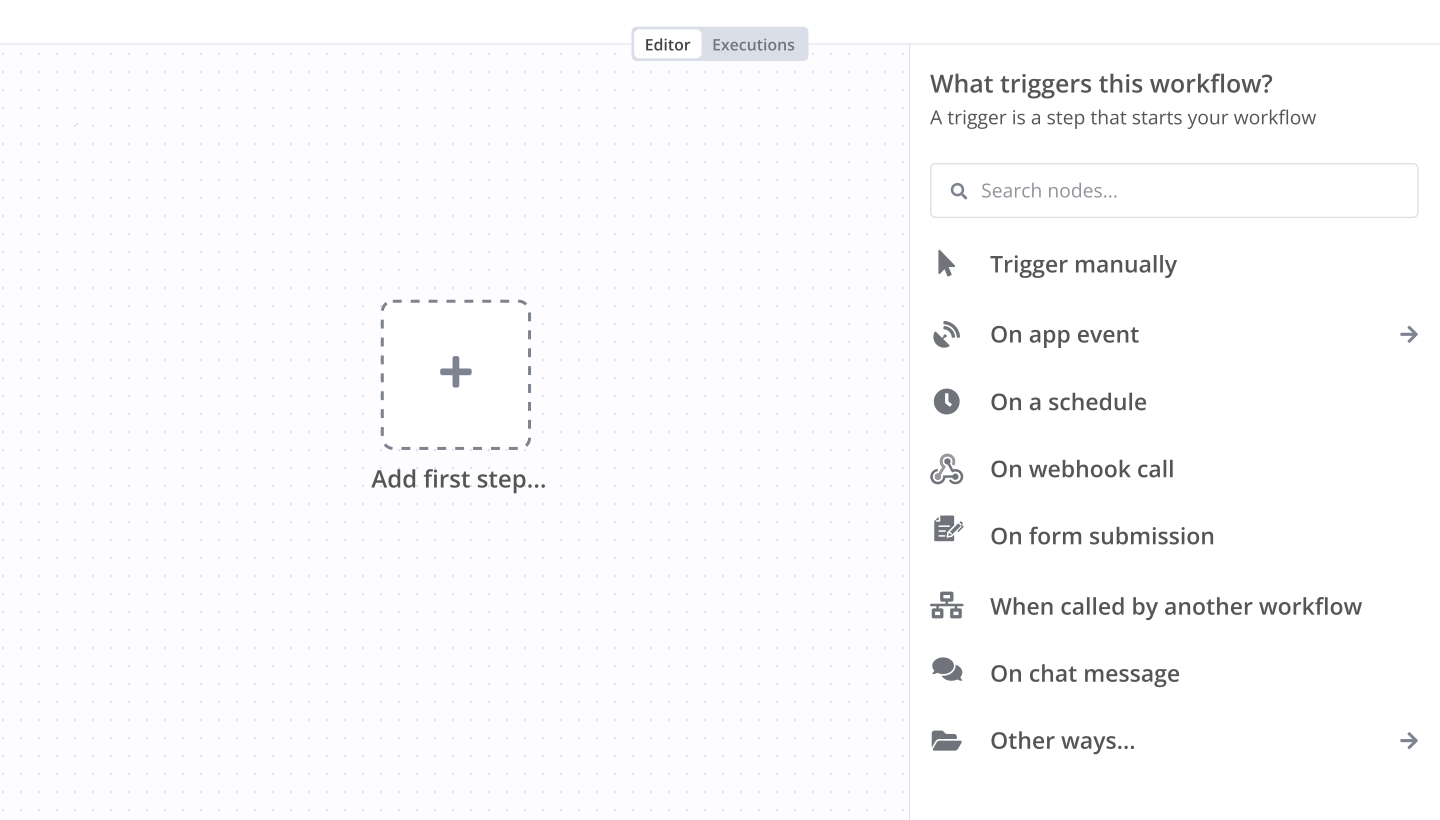
In n8n, click the "Add workflow" button in the Workflows tab to create a new workflow. Add the starting point – a trigger on when your workflow should run: an app event, a schedule, a webhook call, another workflow, an AI chat, or a manual trigger. Sometimes, the HTTP Request node might already serve as your starting point.

GitHub and LinkedIn integration: Create a new workflow and add the first step

Step 2: Add and configure GitHub and LinkedIn nodes

You can find GitHub and LinkedIn in the nodes panel. Drag them onto your workflow canvas, selecting their actions. Click each node, choose a credential, and authenticate to grant n8n access. Configure GitHub and LinkedIn nodes one by one: input data on the left, parameters in the middle, and output data on the right.

GitHub and LinkedIn integration: Add and configure GitHub and LinkedIn nodes

Step 3: Connect GitHub and LinkedIn

A connection establishes a link between GitHub and LinkedIn (or vice versa) to route data through the workflow. Data flows from the output of one node to the input of another. You can have single or multiple connections for each node.

GitHub and LinkedIn integration: Connect GitHub and LinkedIn

Step 4: Customize and extend your GitHub and LinkedIn integration

Use n8n's core nodes such as If, Split Out, Merge, and others to transform and manipulate data. Write custom JavaScript or Python in the Code node and run it as a step in your workflow. Connect GitHub and LinkedIn with any of n8n’s 1000+ integrations, and incorporate advanced AI logic into your workflows.

GitHub and LinkedIn integration: Customize and extend your GitHub and LinkedIn integration

Step 5: Test and activate your GitHub and LinkedIn workflow

Save and run the workflow to see if everything works as expected. Based on your configuration, data should flow from GitHub to LinkedIn or vice versa. Easily debug your workflow: you can check past executions to isolate and fix the mistake. Once you've tested everything, make sure to save your workflow and activate it.

GitHub and LinkedIn integration: Test and activate your GitHub and LinkedIn workflow

Seo blog publishing for Jekyll with GPT-4, GitHub & social sharing

🤖 Auto-Publish SEO Blog Posts for Jekyll with AI + GitHub + Social Sharing

This workflow automates the entire process of publishing SEO-optimized blog posts (e.g., recipes) to a Jekyll site hosted on GitHub. It uses LangChain + OpenAI to write long-form Markdown articles, and commits them directly to your repository. Optional steps include posting to X (Twitter) and LinkedIn.

🔧 Features

📅 Scheduled Execution: Runs daily or manually.
📥 CSV Input: Reads from a local CSV (/data/recipes.csv) with fields like title, description, keywords, and publish date.
✍️ AI Copywriting: Uses a GPT-4 model to generate a professional, structured blog post optimized for SEO in Markdown format.
🧪 Custom Prompting: Includes a detailed, structured prompt tailored for Italian food blogging and SEO rules.
🗂 Markdown Generation:
Automatically builds the Jekyll front matter.
Generates a clean SEO-friendly slug.
Saves to _posts/YYYY-MM-DD-title.md.
✅ Commits to GitHub: Auto-commits new posts using GitHub node.
🧹 Post-Processing: Removes processed lines from the source CSV.
📣 (Optional) Social media sharing: Can post title to X (Twitter) and LinkedIn.

📁 CSV Format Example

titolo;prompt_descrizione;keyword_principale;keyword_secondarie;data_pubblicazione
Pasta alla Norma;Classic Sicilian eggplant pasta...;pasta alla norma;melanzane, ricotta salata;2025-07-04T08:00:00

Nodes used in this workflow

Popular GitHub and LinkedIn workflows

SEO Blog Publishing for Jekyll with GPT-4, GitHub & Social Sharing

🤖 Auto-Publish SEO Blog Posts for Jekyll with AI + GitHub + Social Sharing This workflow automates the entire process of publishing SEO-optimized blog posts (e.g., recipes) to a Jekyll site hosted on GitHub. It uses LangChain + OpenAI to write long-form Markdown articles, and commits them directly to your repository. Optional steps include posting to X (Twitter) and LinkedIn. 🔧 Features 📅 Scheduled Execution: Runs daily or manually. 📥 CSV Input: Reads from a local CSV (/data/recipes.csv) with fields like title, description, keywords, and publish date. ✍️ AI Copywriting: Uses a GPT-4 model to generate a professional, structured blog post optimized for SEO in Markdown format. 🧪 Custom Prompting: Includes a detailed, structured prompt tailored for Italian food blogging and SEO rules. 🗂 Markdown Generation: Automatically builds the Jekyll front matter. Generates a clean SEO-friendly slug. Saves to _posts/YYYY-MM-DD-title.md. ✅ Commits to GitHub: Auto-commits new posts using GitHub node. 🧹 Post-Processing: Removes processed lines from the source CSV. 📣 (Optional) Social media sharing: Can post title to X (Twitter) and LinkedIn. 📁 CSV Format Example titolo;prompt_descrizione;keyword_principale;keyword_secondarie;data_pubblicazione Pasta alla Norma;Classic Sicilian eggplant pasta...;pasta alla norma;melanzane, ricotta salata;2025-07-04T08:00:00
+2

Convert GitHub Code Commits to LinkedIn Posts with Gemini AI and Code Image Generation

Turn your code commits into engaging social media content automatically. This workflow monitors a GitHub repository, uses AI to write a LinkedIn post about your changes, generates a beautiful "Mac-window" style image of your code, and publishes it all to LinkedIn. How it works GitHub Trigger: Watches for new push events in your selected repository. AI Analysis: Passes the code changes to an LLM (via LangChain) to write a professional LinkedIn post and select the best code snippet. Image Generation: Creates a custom HTML view of your code (with syntax highlighting and window controls) and converts it to an image using the HCTI API. Hosting & Posting: Uploads the generated image back to GitHub for hosting, then combines the text and image to publish a live post on LinkedIn. Set up steps Configure Credentials: You will need credentials for: GitHub (OAuth2 or Access Token) LinkedIn (OAuth2) OpenRouter (or swap the model node for OpenAI/Anthropic) HCTI.io (for the HTML-to-Image conversion) Update GitHub Nodes: In the Trigger node: Set your Owner and Repository. In the File Download node: Set the same Owner and Repository. In the Upload Image node: Set the target repo where you want images stored. Update LinkedIn Node: Add your LinkedIn Person URN in the Person field.

Auto-Generate Social Posts from GitHub README/CHANGELOG Updates with GPT-4o and OAuth

Generate social posts from GitHub pushes to Twitter and LinkedIn On each GitHub push, this workflow checks if the commit set includes README.md and CHANGELOG.md, fetches both files, lets an LLM generate a Twitter and LinkedIn post, then publishes to Twitter and LinkedIn (Person). Apps & Nodes Trigger:** Webhook Logic:** IF, Merge, Aggregate GitHub:** Get Repository File (×2) Files:** Extract from File (text) (×2) AI:** OpenAI Chat Model → LLM Chain (+ Structured Output Parser) Publish:** Twitter, LinkedIn (Person) Prerequisites GitHub:** OAuth2 or PAT with repo read. OpenAI:** API key. Twitter:* OAuth2 app with *Read and Write; scopes tweet.read tweet.write users.read offline.access. LinkedIn (Person):* OAuth2 credentials; required scope:* w_member_social, openid. Setup GitHub Webhook: Repo → Settings → Webhooks Payload URL: https://<your-n8n-domain>/webhook/github/push Content type: application/json • Event: Push • Secret (optional) • Branches as needed. Credentials: Connect GitHub, OpenAI, Twitter, and LinkedIn (Person). How it Works Webhook receives GitHub push payload. IF checks that README and CHANGELOG appear in added/modified. GitHub (Get Repository File) pulls README.md and CHANGELOG.md. Extract from File (text) converts both binaries to text. Merge & Aggregate combines into one item with both contents. LLM (OpenAI + Parser) returns a JSON with twitter and linkedin. Twitter posts the tweet. LinkedIn (Person) posts the LinkedIn text.

Build your own GitHub and LinkedIn integration

Create custom GitHub and LinkedIn workflows by choosing triggers and actions. Nodes come with global operations and settings, as well as app-specific parameters that can be configured. You can also use the HTTP Request node to query data from any app or service with a REST API.

GitHub supported actions

Create
Create a new file in repository
Delete
Delete a file in repository
Edit
Edit a file in repository
Get
Get the data of a single file
List
List contents of a folder
Create
Create a new issue
Create Comment
Create a new comment on an issue
Edit
Edit an issue
Get
Get the data of a single issue
Lock
Lock an issue
Get Repositories
Returns all repositories of an organization
Create
Creates a new release
Delete
Delete a release
Get
Get a release
Get Many
Get many repository releases
Update
Update a release
Get
Get the data of a single repository
Get Issues
Returns issues of a repository
Get License
Returns the contents of the repository's license file, if one is detected
Get Profile
Get the community profile of a repository with metrics, health score, description, license, etc
Get Pull Requests
Returns pull requests of a repository
List Popular Paths
Get the top 10 popular content paths over the last 14 days
List Referrers
Get the top 10 referrering domains over the last 14 days
Create
Creates a new review
Get
Get a review for a pull request
Get Many
Get many reviews for a pull request
Update
Update a review
Get Repositories
Returns the repositories of a user
Get Issues
Returns the issues assigned to the user
Invite
Invites a user to an organization
Disable
Disable a workflow
Dispatch
Dispatch a workflow event
Dispatch and Wait for Completion
Dispatch a workflow event and wait for a webhook to be called before proceeding
Enable
Enable a workflow
Get
Get a workflow
Get Usage
Get the usage of a workflow
List
List workflows

LinkedIn supported actions

Create
Create a new post
Use case

Save engineering resources

Reduce time spent on customer integrations, engineer faster POCs, keep your customer-specific functionality separate from product all without having to code.

Learn more
Use case

Automate lead management

Using too many marketing tools? n8n lets you orchestrate all your apps into one cohesive, automated workflow.

Learn more

FAQs

  • Can GitHub connect with LinkedIn?

  • Can I use GitHub’s API with n8n?

  • Can I use LinkedIn’s API with n8n?

  • Is n8n secure for integrating GitHub and LinkedIn?

  • How to get started with GitHub and LinkedIn integration in n8n.io?

Looking to integrate GitHub and LinkedIn in your company?

Over 3000 companies switch to n8n every single week

Why use n8n to integrate GitHub with LinkedIn

Build complex workflows, really fast

Build complex workflows, really fast

Handle branching, merging and iteration easily.
Pause your workflow to wait for external events.

Code when you need it, UI when you don't

Simple debugging

Your data is displayed alongside your settings, making edge cases easy to track down.

Use templates to get started fast

Use 1000+ workflow templates available from our core team and our community.

Reuse your work

Copy and paste, easily import and export workflows.

Implement complex processes faster with n8n

red iconyellow iconred iconyellow icon