Back to Integrations
integrationGitHub node
integrationOpenAI node

GitHub and OpenAI integration

Save yourself the work of writing custom integrations for GitHub and OpenAI and use n8n instead. Build adaptable and scalable Development, AI, and Langchain workflows that work with your technology stack. All within a building experience you will love.

How to connect GitHub and OpenAI

  • Step 1: Create a new workflow
  • Step 2: Add and configure nodes
  • Step 3: Connect
  • Step 4: Customize and extend your integration
  • Step 5: Test and activate your workflow

Step 1: Create a new workflow and add the first step

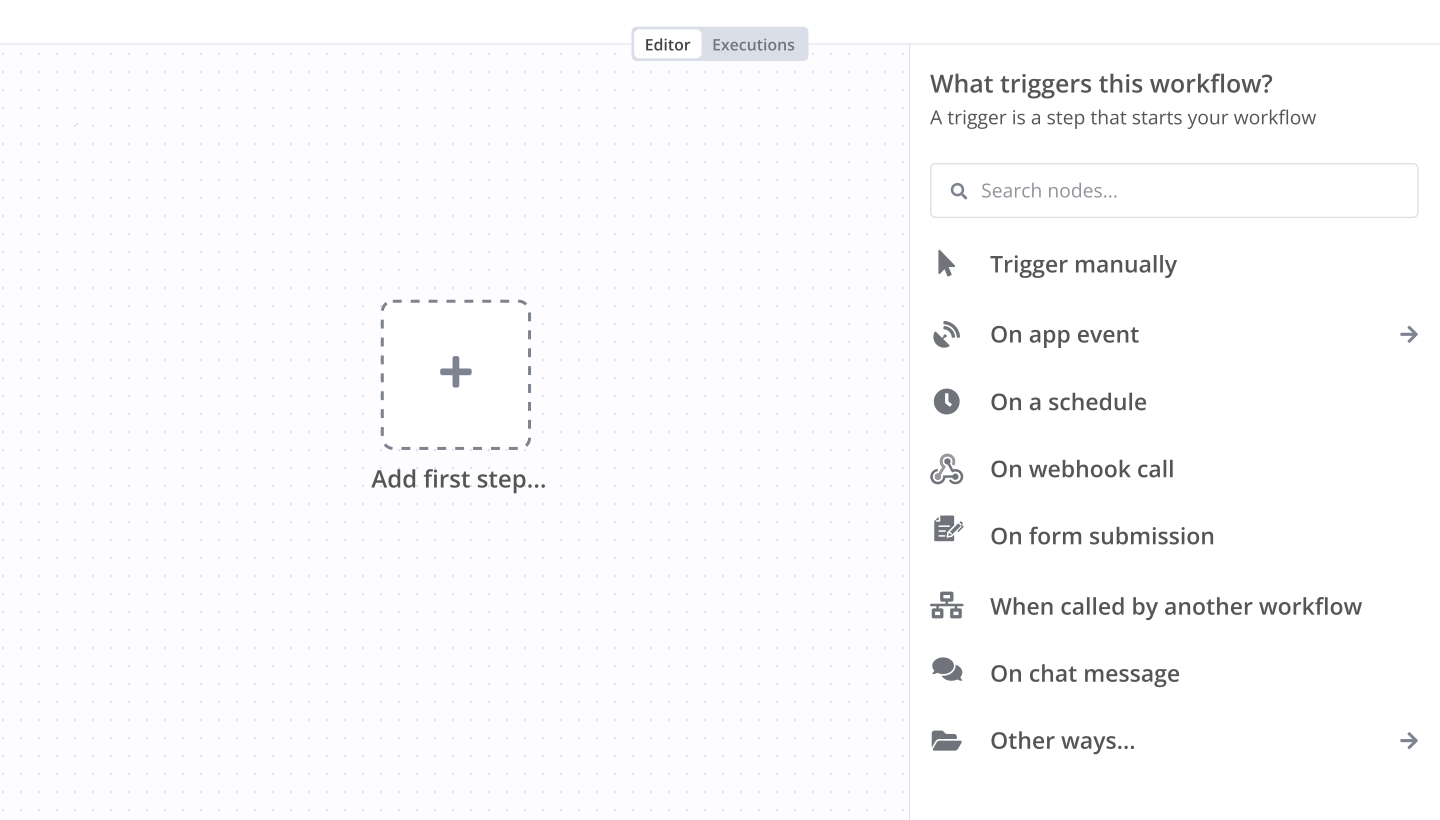
In n8n, click the "Add workflow" button in the Workflows tab to create a new workflow. Add the starting point – a trigger on when your workflow should run: an app event, a schedule, a webhook call, another workflow, an AI chat, or a manual trigger. Sometimes, the HTTP Request node might already serve as your starting point.

GitHub and OpenAI integration: Create a new workflow and add the first step

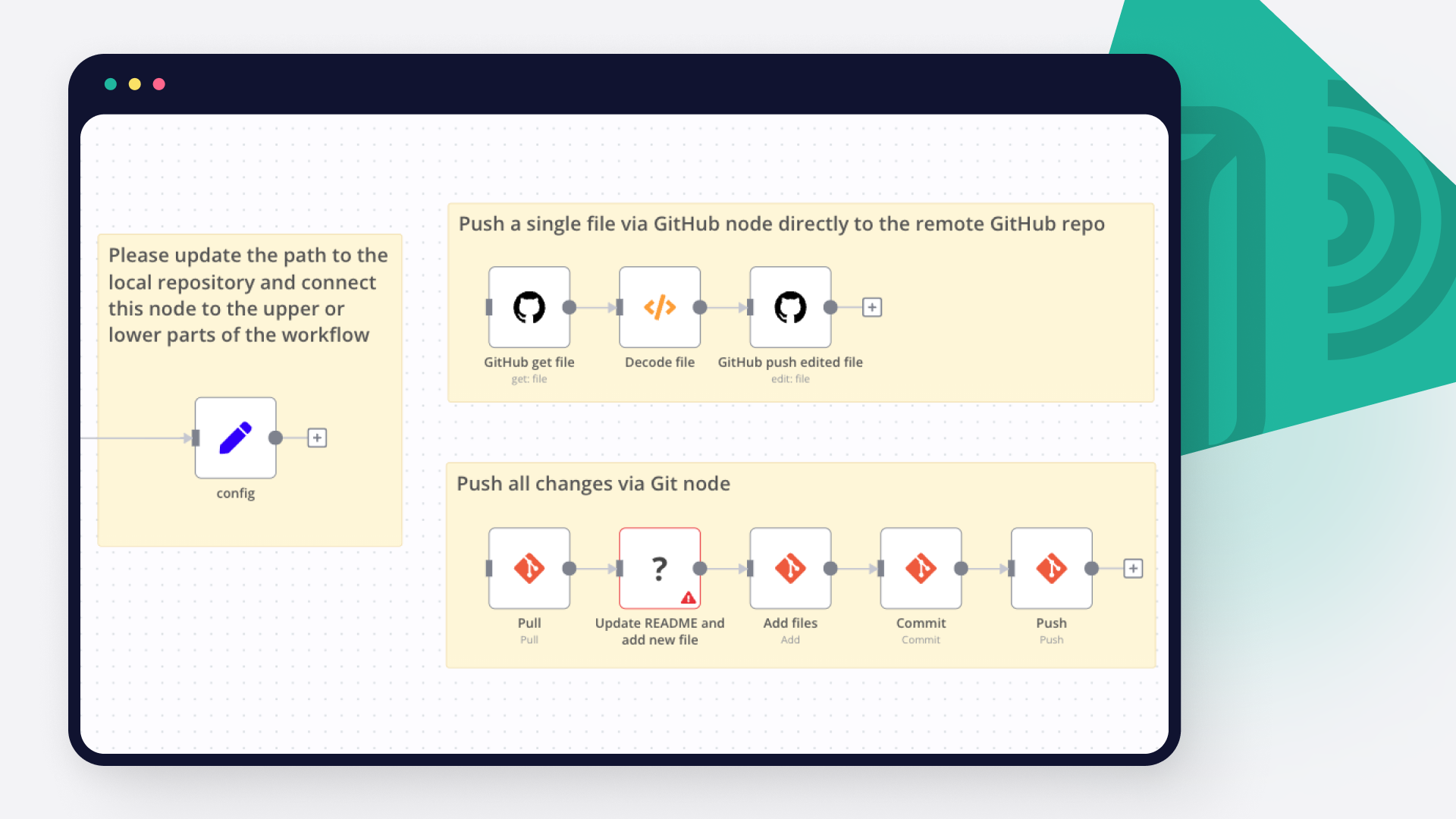
Step 2: Add and configure GitHub and OpenAI nodes

You can find GitHub and OpenAI in the nodes panel. Drag them onto your workflow canvas, selecting their actions. Click each node, choose a credential, and authenticate to grant n8n access. Configure GitHub and OpenAI nodes one by one: input data on the left, parameters in the middle, and output data on the right.

GitHub and OpenAI integration: Add and configure GitHub and OpenAI nodes

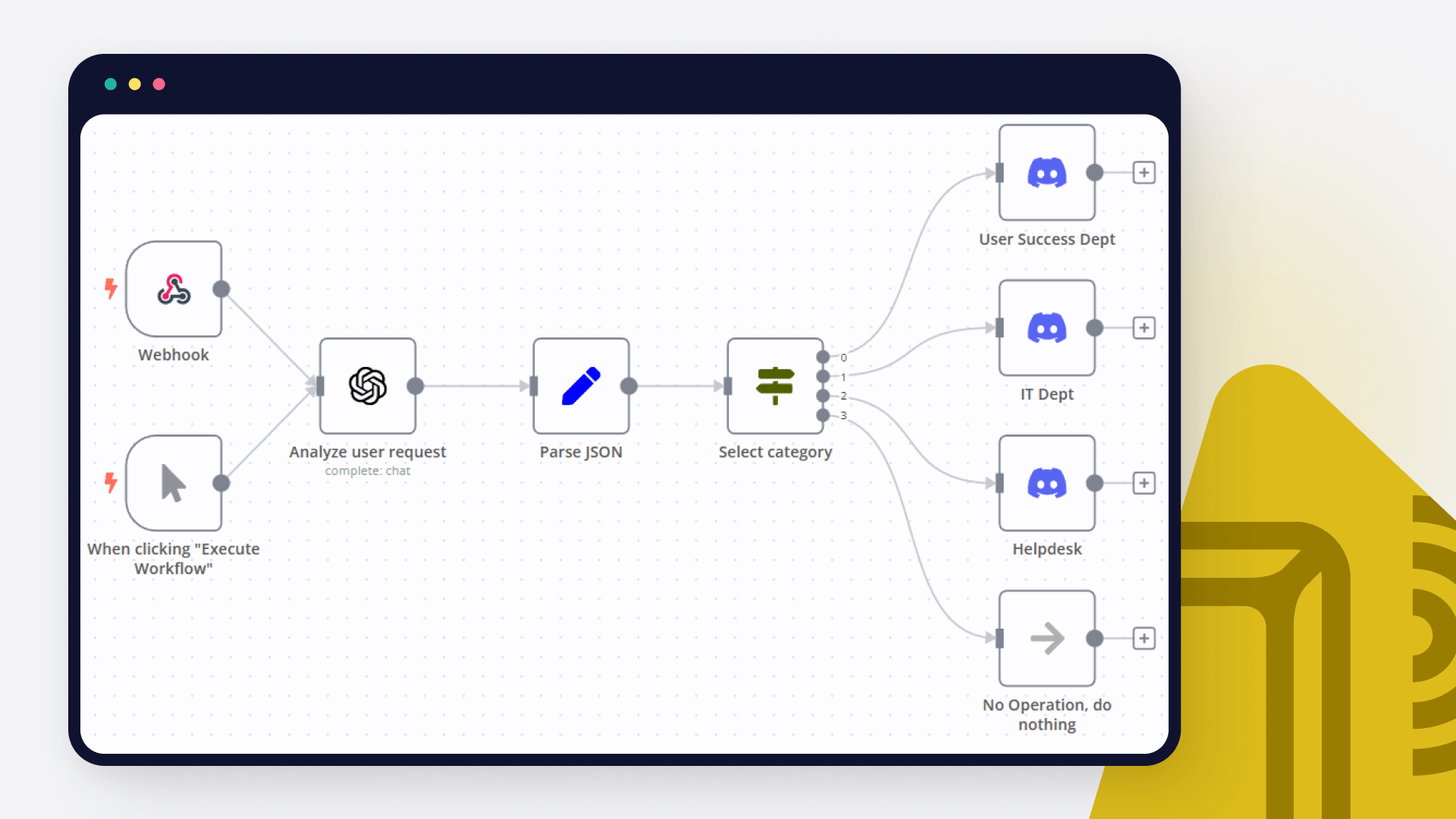
Step 3: Connect GitHub and OpenAI

A connection establishes a link between GitHub and OpenAI (or vice versa) to route data through the workflow. Data flows from the output of one node to the input of another. You can have single or multiple connections for each node.

GitHub and OpenAI integration: Connect GitHub and OpenAI

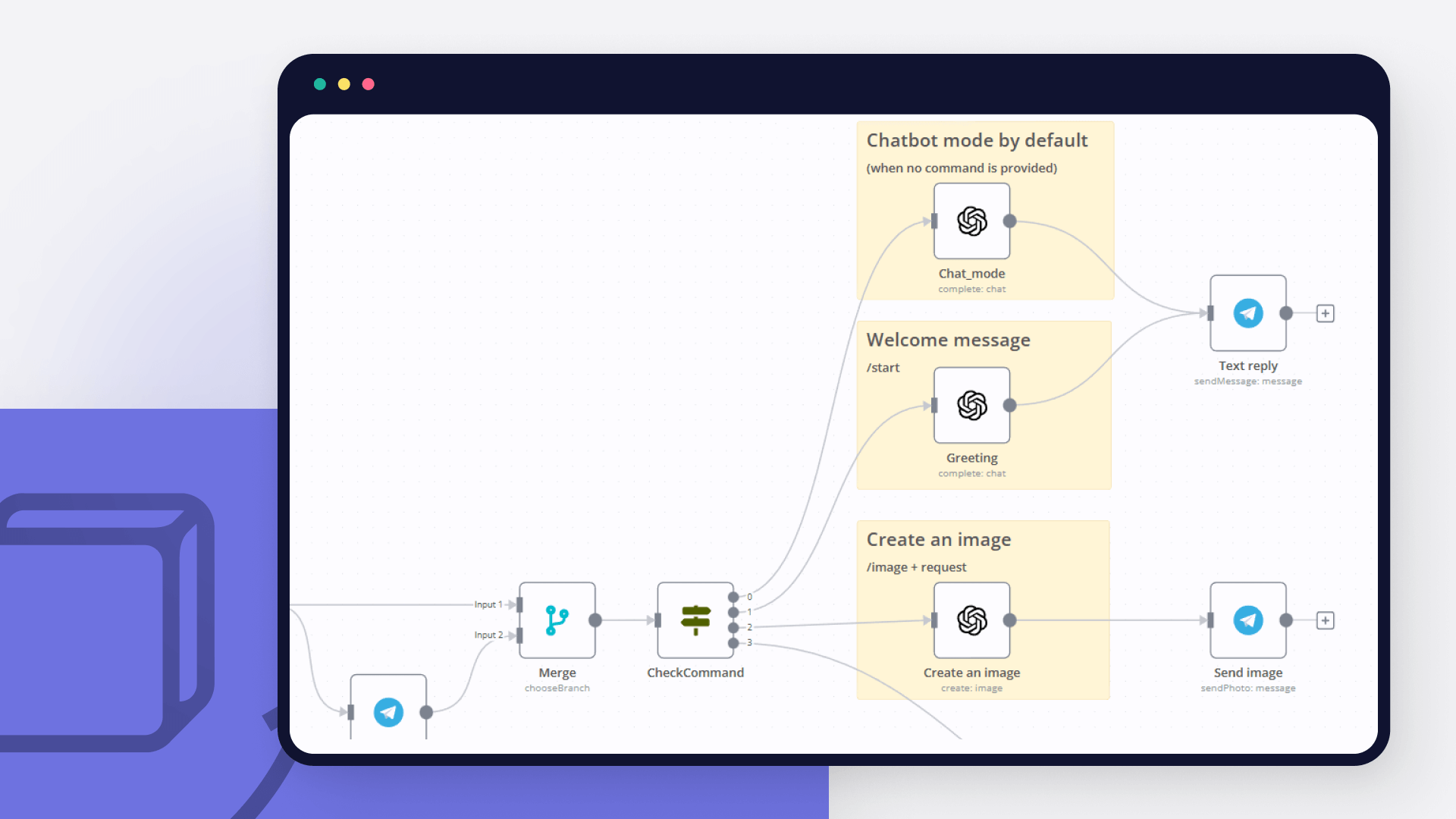
Step 4: Customize and extend your GitHub and OpenAI integration

Use n8n's core nodes such as If, Split Out, Merge, and others to transform and manipulate data. Write custom JavaScript or Python in the Code node and run it as a step in your workflow. Connect GitHub and OpenAI with any of n8n’s 1000+ integrations, and incorporate advanced AI logic into your workflows.

GitHub and OpenAI integration: Customize and extend your GitHub and OpenAI integration

Step 5: Test and activate your GitHub and OpenAI workflow

Save and run the workflow to see if everything works as expected. Based on your configuration, data should flow from GitHub to OpenAI or vice versa. Easily debug your workflow: you can check past executions to isolate and fix the mistake. Once you've tested everything, make sure to save your workflow and activate it.

GitHub and OpenAI integration: Test and activate your GitHub and OpenAI workflow

AI Timesheet Generator with Gmail, Calendar & GitHub to Google Sheets

AI-Powered Automatic Timesheet Generator for Google Sheets

Stop wasting billable hours on manual time-tracking. AutoTimesheet Pro uses AI to collect emails, meetings, and GitHub work, then writes a clean timesheet straight into Google Sheets. Perfect for developers, consultants, agencies, and remote teams.

Get Started with n8n now!

🚀 Key Features

Automated Google Sheets time-tracking** — zero spreadsheet prep.
AI-generated activity summaries** (≤ 120 chars) via OpenAI GPT-4o-mini.
Gmail integration** — logs only important emails, skipping newsletters & no-replies.
Google Calendar time logger** — captures confirmed events, duration, and attendees.
GitHub commit & PR tracker** — records your commits plus opened/closed PRs.
Daily 7 PM cron trigger** (easily adjustable).
Month-based sheet creation** — new tab spins up on the first run each month.
No-code n8n template* — just connect credentials and tweak one Set Variables* node.
🔌 Easily extensible** — drag-and-drop extra n8n nodes to add Slack, Jira, Notion, Asana, Trello, Toggl, or any other data source you need.

🔍 How It Works

Collect — n8n pulls data from Gmail, Google Calendar, and chosen GitHub repos.
Clean — filters remove noise (newsletters, irrelevant commits, etc.).
Condense — OpenAI rewrites each item into a concise, SEO-friendly description.
Write — workflow appends Date, Type, and Description to your Timesheet Google Sheet.
Extend — simply insert new n8n nodes (e.g., Slack, Notion, Jira) and merge them into the same pipeline.

📈 Benefits for SEO-Minded Professionals

Keyword-rich activity log** improves internal search and reporting.
Structured data** in Sheets simplifies export to accounting or PM tools.
Consistent naming** (CALENDAR_EVENT, EMAIL, COMMIT, PR) makes analytics easy.

✅ Why Choose AutoTimesheet Pro?

Zero manual entry — just open the sheet and bill clients.
Immediate visibility into where your hours went.
Works with any GitHub repo list and any inbox you own.
100 % no-code setup — activate in minutes.
Built on n8n, so you can customize and scale without limits.
📥 Get Started

Ready to replace manual time-tracking with smart automation?

https://n8n.partnerlinks.io/ds9podzjls6d

Join N8N now, connect your Google & GitHub accounts, and let AI handle your daily log.

Nodes used in this workflow

Popular GitHub and OpenAI workflows

+2

AI Timesheet Generator with Gmail, Calendar & GitHub to Google Sheets

AI-Powered Automatic Timesheet Generator for Google Sheets Stop wasting billable hours on manual time-tracking. AutoTimesheet Pro uses AI to collect emails, meetings, and GitHub work, then writes a clean timesheet straight into Google Sheets. Perfect for developers, consultants, agencies, and remote teams. Get Started with n8n now! 🚀 Key Features Automated Google Sheets time-tracking** — zero spreadsheet prep. AI-generated activity summaries** (≤ 120 chars) via OpenAI GPT-4o-mini. Gmail integration** — logs only important emails, skipping newsletters & no-replies. Google Calendar time logger** — captures confirmed events, duration, and attendees. GitHub commit & PR tracker** — records your commits plus opened/closed PRs. Daily 7 PM cron trigger** (easily adjustable). Month-based sheet creation** — new tab spins up on the first run each month. No-code n8n template* — just connect credentials and tweak one Set Variables* node. 🔌 Easily extensible** — drag-and-drop extra n8n nodes to add Slack, Jira, Notion, Asana, Trello, Toggl, or any other data source you need. 🔍 How It Works Collect — n8n pulls data from Gmail, Google Calendar, and chosen GitHub repos. Clean — filters remove noise (newsletters, irrelevant commits, etc.). Condense — OpenAI rewrites each item into a concise, SEO-friendly description. Write — workflow appends Date, Type, and Description to your Timesheet Google Sheet. Extend — simply insert new n8n nodes (e.g., Slack, Notion, Jira) and merge them into the same pipeline. 📈 Benefits for SEO-Minded Professionals Keyword-rich activity log** improves internal search and reporting. Structured data** in Sheets simplifies export to accounting or PM tools. Consistent naming** (CALENDAR_EVENT, EMAIL, COMMIT, PR) makes analytics easy. ✅ Why Choose AutoTimesheet Pro? Zero manual entry — just open the sheet and bill clients. Immediate visibility into where your hours went. Works with any GitHub repo list and any inbox you own. 100 % no-code setup — activate in minutes. Built on n8n, so you can customize and scale without limits. 📥 Get Started Ready to replace manual time-tracking with smart automation? https://n8n.partnerlinks.io/ds9podzjls6d Join N8N now, connect your Google & GitHub accounts, and let AI handle your daily log.

SEO Writer: Content Generator (2500 keywords) with Perplexity & Auto Publish

🔥 TLDR Automatically generate and publish 2000+ word SEO-optimized blog posts to GitHub every 8 hours - Complete with trending topic research, AI content generation, and automatic JSON formatting for your blog platform. Instant SEO traffic upcoming! --- 📌 Who's it for Content creators, marketers, and developers who want to: Maintain a consistent blog publishing schedule without manual effort Generate high-quality, SEO-optimized content automatically Keep up with trending topics in their industry Build content libraries for their websites or applications 🚀 What it does This workflow is a complete content generation pipeline that runs automatically every 8 hours: Discovers trending topics using Perplexity Sonar to find what's hot in your chosen categories Conducts deep research with real statistics, expert opinions, and current data Generates comprehensive content - 2000-2500 word articles using GPT-5 mini Formats for web - Converts to JSON with proper metadata (slug, keywords, reading time) Publishes automatically to your GitHub repository as blog-ready JSON files ✨ Key Features SEO Optimization Keyword-rich content with targeted keywords naturally integrated Proper heading structure (H1, H2, H3) for search engine crawling Meta descriptions automatically generated from content Reading time calculation for better user engagement metrics URL-friendly slugs with timestamps for uniqueness Content Quality 2000+ words minimum ensuring comprehensive coverage Research-backed with current statistics and expert opinions Structured format with clear sections: Introduction, Analysis, Applications, Challenges, Future Outlook Markdown formatting for easy rendering on any platform 🛠️ How to set up Requirements n8n instance (self-hosted or cloud) Perplexity API account OpenAI API account (GPT-5 mini access) GitHub repository for storing blog content Setup Steps Import the workflow into your n8n instance Configure credentials: Add your Perplexity API key Add your OpenAI API key Connect your GitHub account via OAuth2 Customize the GitHub node: Set your repository owner and name Adjust the file path if needed (default: public/blog-data/) Adjust the schedule (optional): Default runs every 8 hours Modify the Schedule Trigger node for your preferred frequency Test the workflow with manual execution before enabling automatic scheduling 🎨 How to customize Topic Categories Edit the "Find trending topics" node to focus on your niche: Technology & AI Social Media & Marketing Business & Finance Health & Wellness Education & Career Content Length Adjust word count requirements in the "Format Blog JSON" node validation Output Format Modify the JSON structure in "Format Blog JSON" to match your blog platform's requirements Publishing Destination Change the GitHub repository path or integrate with other platforms like WordPress, Contentful, or Strapi 📊 Workflow Benefits Consistency: Never miss a publishing deadline Scale: Generate multiple articles daily without manual effort Quality: Research-backed content with real data and sources SEO-Ready: Optimized structure and metadata for search engines Cost-Effective: Uses efficient AI models for sustainable content generation

Automatically document and backup N8N workflows

Automatically backs up your workflows to Github and generates documentation in a Notion database. Weekly run, uses the "internal-infra" tag to look for new or recently modified workflows Uses a Notion database page to hold the workflow summary, last updated date, and a link to the workflow Uses OpenAI's 4o-mini to generate a summarization of what the workflow does Stores a backup of the workflow in GitHub (recommend a private repo) Sends notification to Slack channel for new or updated workflows Who is this for Anyone seeking backup of their most important workflows Anyone seeking version control for their most important workflows Credentials required N8N: You will need an N8N credential created so the workflow can query the N8N instance to find all active workflows with the "internal-infra" tag Notion: You will need an Notion credential created OpenAI: You will need an OpenAI credential, unless you intend on rewiring this with your AI of choice (ollama, openrouter, etc.) GitHub: You will need an GitHub credential Slack: You will require an Slack credential, recommend a Bot / access token configuration Setup Notion Create a database with the following columns. Column type is specified in [type]. Workflow Name [text] isActive (dev) [checkbox] Error workflow setup [checkbox] AI Summary [text] Record last update [date/time] URL (dev) [text/url] Workflow created at [date/time] Workflow updated at [date/time] Slack Create a channel for updates to be posted into Github Create a private repo for your workflows to be exported into N8N Download & install the template Configure the blocks to use your N8N, Notion, OpenAI & Slack credentials for your own Edit the "Set Fields" block and change the URL to that of your N8N instance (cloud or self-hosted) Edit the "Add to Notion" action and specify the Database page you wish to update Edit the Slack actions to specify the Channel you want slack notifications posted to Edit the GitHub actions to specify the Repository Owner & Repository Name Sample output in Notion Workflow diagram

Monitor backup and sync logs with Google Cloud Storage, GitHub, Gmail, OpenAI, and GLPI

Reliable Backup & Sync Execution Validation (Log-Driven) This workflow monitors filesystem sync and backup jobs by validating their execution logs, not by running or inspecting the jobs themselves. After purchase, you will receive a complete package including: workflow.json** – ready to be imported into n8n Shell script templates (.sh)** – reference sync job templates designed to generate structured logs fully compatible with the workflow Complete setup documentation** – step-by-step guide covering configuration, deployment, and operational requirements How it works (high level) Sync jobs are executed externally using standardized shell templates: rsync_job-Template.sh rclone_job-Template.sh Each job produces one deterministic log file per run Logs are uploaded daily to Google Cloud Storage This workflow runs on a schedule and: Verifies that all expected logs exist for the day (UTC) Optionally inspects their contents Sends alerts if logs are missing or report failures Key design principles Log-driven monitoring** (evidence-based, not assumption-based) One job = one log = one source of truth** No SSH, no server access, no execution coupling** Safe to run in untrusted or restricted environments Logging contract (required) Each log file must contain the following lifecycle events, in order: event=START event=RSYNC_END or event=RCLONE_END event=SUMMARY event=END If the END event is missing, the job is considered failed or interrupted. Configuration Expected jobs and log filenames are defined in sync-jobs.json. This workflow only validates presence and state of logs — it never assumes job success.

GitHub to Jira Bug Sync with GPT-4o Analysis & Team Alerts

Automate Bug Reports: GitHub Issues → AI Analysis → Jira Tickets with Slack & Discord Alerts Automatically convert GitHub issues into analyzed Jira tickets with AI-powered severity detection, developer assignment, and instant team alerts. Overview This workflow captures GitHub issues in real-time, analyzes them with GPT-4o for severity and categorization, creates enriched Jira tickets, assigns the right developers, and notifies your team across Slack and Discord—all automatically. Features AI-Powered Triage**: GPT-4o analyzes bug severity, category, root cause, and generates reproduction steps Smart Assignment**: Automatically assigns developers based on mentioned files and issue context Two-Way Sync**: Posts Jira ticket links back to GitHub issues Multi-Channel Alerts**: Rich notifications in Slack and Discord with action buttons Time Savings**: Eliminates 15-30 minutes of manual triage per bug Customizable Routing**: Easy developer mapping and priority rules What Gets Created Jira Ticket: Original GitHub issue details with reporter info AI severity assessment and categorization Reproduction steps and root cause analysis Estimated completion time Automatic labeling and priority assignment GitHub Comment: Jira ticket link AI analysis summary Assigned developer and estimated time Team Notifications: Severity badges and quick-access buttons Developer assignment and root cause summary Color-coded priority indicators Use Cases Development teams managing 10+ bugs per week Open source projects handling community reports DevOps teams tracking infrastructure issues QA teams coordinating with developers Product teams monitoring user-reported bugs Setup Requirements Required: GitHub repository with admin access Jira Software workspace OpenAI API key (GPT-4o access) Slack workspace OR Discord server Customization Needed: Update developer email mappings in "Parse GPT Response & Map Data" node Replace YOUR_JIRA_PROJECT_KEY with your project key Update Slack channel name (default: dev-alerts) Replace YOUR_DISCORD_WEBHOOK_URL with your webhook Change your-company.atlassian.net to your Jira URL Setup Time: 15-20 minutes Configuration Steps Import workflow JSON into n8n Add credentials: GitHub OAuth2, Jira API, OpenAI API, Slack, Discord Configure GitHub webhook in repository settings Customize developer mappings and project settings Test with sample GitHub issue Activate workflow Expected Results 90% faster bug triage (20 min → 2 min per issue) 100% consistency in bug analysis Zero missed notifications Better developer allocation Improved bug documentation Tags GitHub, Jira, AI, GPT-4, Bug Tracking, DevOps, Automation, Slack, Discord, Issue Management, Development, Project Management, OpenAI, Webhook, Team Collaboration
+8

Creating SEO-Optimized Blogs for WordPress Using Specific Tools

✍️ AI-Powered High-Quality Blog Automation Automate SEO-optimized blog creation, publishing, and internal linking — designed for Lovable.dev or seamless WordPress integration. Proven to boost impressions by +15% weekly on real websites. 📌 Example: AI Applications in Real Estate Playbook — fully generated, optimized, and published with this automation. 🚀 What This Workflow Does Bring Your Own Keywords** You provide the keyword list — the workflow applies a scoring formula to rank them by relevance and competition for maximum SEO impact. Keyword Scoring & Logging** Scores primary and secondary keywords, logs them in PostgreSQL, and prevents reuse until strategically relevant. Deep Research & Blog Planning** Uses Perplexity AI and other AI models to outline, plan, and enrich each article with authoritative external sources. SEO-Optimized Redaction** Writes multi-part, long-form blogs with integrated internal links (to your existing content) and external links to reputable sites. Image Generation & Selection** Creates or selects high-quality header and in-article images, optimized for your topic. Full Blog Infrastructure** Internal & external linking logic Blog card + metadata updates Sitemap updates & Google indexing submission Post logging for future reference Publishing Flexibility** Direct GitHub commits for Lovable.dev WordPress-ready export Optional Slack approval before publishing 🔗 Integrated Services PostgreSQL** – Keyword & content database Perplexity AI** – Research & planning OpenAI / OpenRouter Models** – Multi-part blog writing Lovable.dev / GitHub** – Direct publishing WordPress-ready JSON output** – Easy CMS import Slack** – Approval workflow before going live 💼 What You Get Detailed Setup Guide** Workflow Description** 📥 Perfect For Website owners wanting consistent SEO growth Agencies handling multiple client sites Marketers running content-heavy campaigns Lovable.dev or WordPress users who want hands-off publishing 💡 Why You’ll Love It This is more than a blog writer — it’s a complete content infrastructure. From keyword prioritization to publishing and indexing, it keeps your site growing in reach and authority while you focus on your business.

Build your own GitHub and OpenAI integration

Create custom GitHub and OpenAI workflows by choosing triggers and actions. Nodes come with global operations and settings, as well as app-specific parameters that can be configured. You can also use the HTTP Request node to query data from any app or service with a REST API.

GitHub supported actions

Create
Create a new file in repository
Delete
Delete a file in repository
Edit
Edit a file in repository
Get
Get the data of a single file
List
List contents of a folder
Create
Create a new issue
Create Comment
Create a new comment on an issue
Edit
Edit an issue
Get
Get the data of a single issue
Lock
Lock an issue
Get Repositories
Returns all repositories of an organization
Create
Creates a new release
Delete
Delete a release
Get
Get a release
Get Many
Get many repository releases
Update
Update a release
Get
Get the data of a single repository
Get Issues
Returns issues of a repository
Get License
Returns the contents of the repository's license file, if one is detected
Get Profile
Get the community profile of a repository with metrics, health score, description, license, etc
Get Pull Requests
Returns pull requests of a repository
List Popular Paths
Get the top 10 popular content paths over the last 14 days
List Referrers
Get the top 10 referrering domains over the last 14 days
Create
Creates a new review
Get
Get a review for a pull request
Get Many
Get many reviews for a pull request
Update
Update a review
Get Repositories
Returns the repositories of a user
Get Issues
Returns the issues assigned to the user
Invite
Invites a user to an organization
Disable
Disable a workflow
Dispatch
Dispatch a workflow event
Dispatch and Wait for Completion
Dispatch a workflow event and wait for a webhook to be called before proceeding
Enable
Enable a workflow
Get
Get a workflow
Get Usage
Get the usage of a workflow
List
List workflows

OpenAI supported actions

Message a Model
Generate a model response with GPT 3, 4, 5, etc. using Responses API
Classify Text for Violations
Check whether content complies with usage policies
Analyze Image
Take in images and answer questions about them
Generate an Image
Creates an image from a text prompt
Edit Image
Edit an image
Generate Audio
Creates audio from a text prompt
Transcribe a Recording
Transcribes audio into text
Translate a Recording
Translates audio into text in English
Delete a File
Delete a file from the server
List Files
Returns a list of files that belong to the user's organization
Upload a File
Upload a file that can be used across various endpoints
Create
Create a conversation
Get
Get a conversation
Remove
Remove a conversation
Update
Update a conversation
Generate
Creates a video from a text prompt

GitHub and OpenAI integration details

Use case

Save engineering resources

Reduce time spent on customer integrations, engineer faster POCs, keep your customer-specific functionality separate from product all without having to code.

Learn more

FAQs

  • Can GitHub connect with OpenAI?

  • Can I use GitHub’s API with n8n?

  • Can I use OpenAI’s API with n8n?

  • Is n8n secure for integrating GitHub and OpenAI?

  • How to get started with GitHub and OpenAI integration in n8n.io?

Need help setting up your GitHub and OpenAI integration?

Discover our latest community's recommendations and join the discussions about GitHub and OpenAI integration.
Artem
sérgio eduardo floresta filho
Andrew adawdad
PinkFloyd
Steve Warburton

Looking to integrate GitHub and OpenAI in your company?

Over 3000 companies switch to n8n every single week

Why use n8n to integrate GitHub with OpenAI

Build complex workflows, really fast

Build complex workflows, really fast

Handle branching, merging and iteration easily.
Pause your workflow to wait for external events.

Code when you need it, UI when you don't

Simple debugging

Your data is displayed alongside your settings, making edge cases easy to track down.

Use templates to get started fast

Use 1000+ workflow templates available from our core team and our community.

Reuse your work

Copy and paste, easily import and export workflows.

Implement complex processes faster with n8n

red iconyellow iconred iconyellow icon