Back to Integrations
integrationGoogle Ads node
integrationSlack node

Google Ads and Slack integration

Save yourself the work of writing custom integrations for Google Ads and Slack and use n8n instead. Build adaptable and scalable Analytics, Communication, and HITL workflows that work with your technology stack. All within a building experience you will love.

How to connect Google Ads and Slack

  • Step 1: Create a new workflow
  • Step 2: Add and configure nodes
  • Step 3: Connect
  • Step 4: Customize and extend your integration
  • Step 5: Test and activate your workflow

Step 1: Create a new workflow and add the first step

In n8n, click the "Add workflow" button in the Workflows tab to create a new workflow. Add the starting point – a trigger on when your workflow should run: an app event, a schedule, a webhook call, another workflow, an AI chat, or a manual trigger. Sometimes, the HTTP Request node might already serve as your starting point.
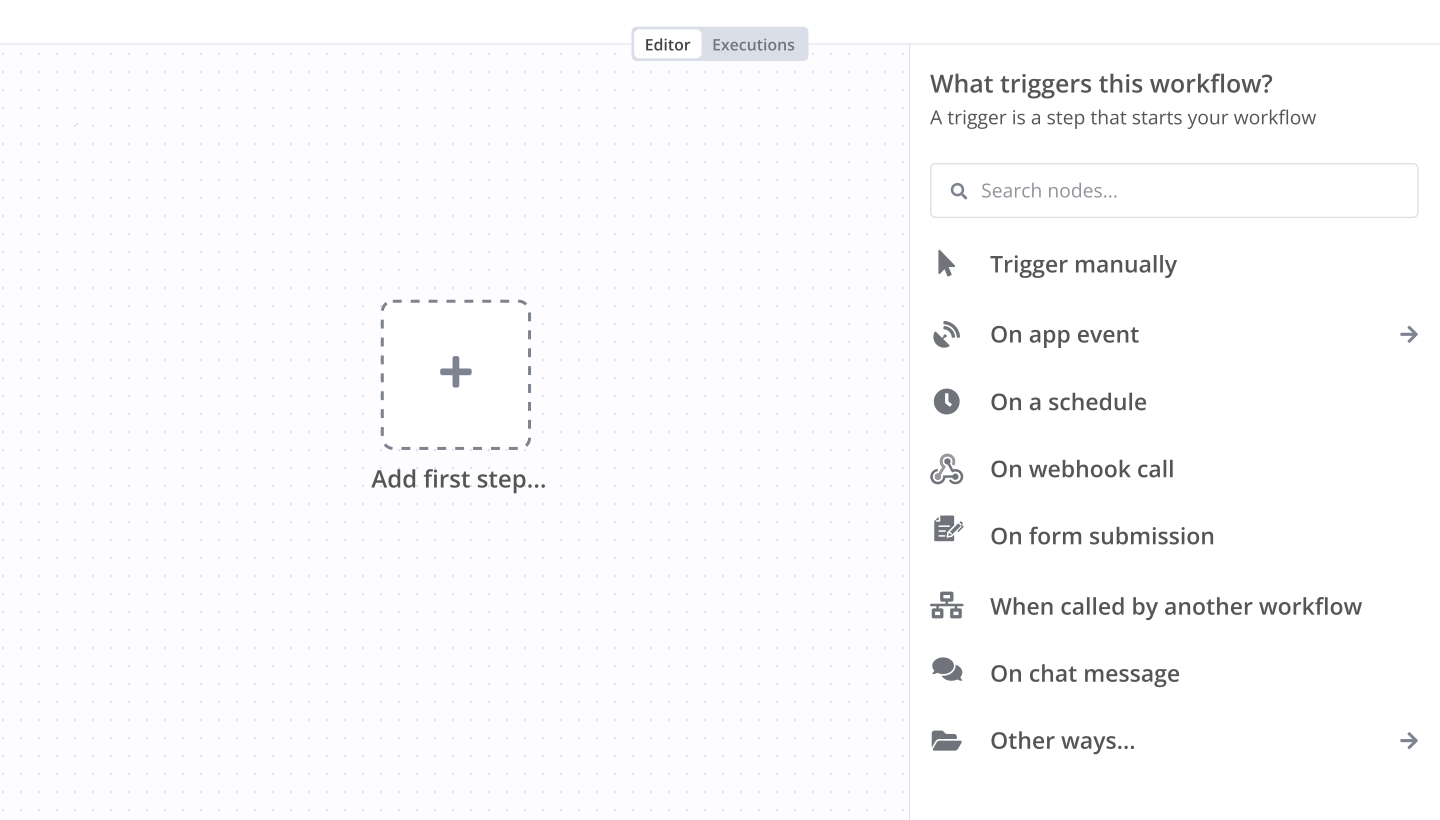
Google Ads and Slack integration: Create a new workflow and add the first step

Step 2: Add and configure Google Ads and Slack nodes

You can find Google Ads and Slack in the nodes panel. Drag them onto your workflow canvas, selecting their actions. Click each node, choose a credential, and authenticate to grant n8n access. Configure Google Ads and Slack nodes one by one: input data on the left, parameters in the middle, and output data on the right.

Google Ads and Slack integration: Add and configure Google Ads and Slack nodes

Step 3: Connect Google Ads and Slack

A connection establishes a link between Google Ads and Slack (or vice versa) to route data through the workflow. Data flows from the output of one node to the input of another. You can have single or multiple connections for each node.

Google Ads and Slack integration: Connect Google Ads and Slack

Step 4: Customize and extend your Google Ads and Slack integration

Use n8n's core nodes such as If, Split Out, Merge, and others to transform and manipulate data. Write custom JavaScript or Python in the Code node and run it as a step in your workflow. Connect Google Ads and Slack with any of n8n’s 1000+ integrations, and incorporate advanced AI logic into your workflows.

Google Ads and Slack integration: Customize and extend your Google Ads and Slack integration

Step 5: Test and activate your Google Ads and Slack workflow

Save and run the workflow to see if everything works as expected. Based on your configuration, data should flow from Google Ads to Slack or vice versa. Easily debug your workflow: you can check past executions to isolate and fix the mistake. Once you've tested everything, make sure to save your workflow and activate it.

Google Ads and Slack integration: Test and activate your Google Ads and Slack workflow

PPC campaign intelligence & optimization with Google Ads, Sheets & Slack

How it Works

This workflow automatically monitors your Google Ads campaigns every day, analyzing performance with AI-powered scoring to identify scaling opportunities and catch issues before they drain your budget. Each morning at 9 AM, it fetches all active campaign data including clicks, impressions, conversions, costs, and conversion rates from your Google Ads account.

The AI analysis engine evaluates four critical dimensions: CTR (click-through rate) to measure ad relevance, conversion rate to assess landing page effectiveness, cost per conversion to evaluate profitability, and traffic volume to identify scale-readiness. Each campaign receives a performance score (0-100 points) and is automatically categorized as Excellent (75+), Good (55-74), Fair (35-54), or Underperforming (0-34).

High-performing campaigns trigger instant Slack alerts to your PPC team with detailed scaling recommendations and projected ROI improvements, while underperforming campaigns generate urgent alerts with specific optimization actions. Every campaign is logged to your Google Sheets dashboard with daily metrics, and the system generates personalized email reports—action-oriented scaling plans for top performers and troubleshooting guides for campaigns needing attention.

The entire analysis takes minutes, providing your team with daily intelligence reports that would otherwise require hours of manual spreadsheet work and data analysis.

Who is this for?

PPC managers and paid media specialists drowning in campaign data and manual reporting
Marketing agencies managing multiple client accounts needing automated performance monitoring
E-commerce brands running high-spend campaigns who can't afford budget waste
Growth teams looking to scale winners faster and pause losers immediately
Anyone spending $5K+ monthly on Google Ads who needs data-driven optimization decisions

Setup Steps

Setup time:** Approx. 15-25 minutes (credential configuration, dashboard setup, alert customization)
Requirements:**
Google Ads account with active campaigns
Google account with a tracking spreadsheet
Slack workspace
SMTP email provider (Gmail, SendGrid, etc.)

Create a Google Sheets dashboard with two tabs: "Daily Performance" and "Campaign Log" with appropriate column headers.
Set up these nodes:
Schedule Daily Check: Pre-configured to run at 9 AM daily (adjust timing if needed).
Fetch Google Ads Data: Connect your Google Ads account and authorize API access.
AI Performance Analysis: Review scoring thresholds (CTR, conversion rate, cost benchmarks).
Route by Performance: Automatically splits campaigns into high-performers vs. issues.
Update Campaign Dashboard: Connect Google Sheets and select your "Daily Performance" tab.
Log All Campaigns: Select your "Campaign Log" tab for historical tracking.
Slack Alerts: Connect workspace and configure separate channels for scaling opportunities and performance issues.
Generate Action Plan: Customize email templates with your brand voice and action items.
Email Performance Report: Configure SMTP and set recipient email addresses.

Credentials must be entered into their respective nodes for successful execution.

Customization Guidance

Scoring Weights:** Adjust point values for CTR (30), conversion rate (35), cost efficiency (25), and volume (10) in the AI Performance Analysis node based on your business priorities.
Performance Thresholds:** Modify the 75-point Excellent threshold and 55-point Good threshold to match your campaign quality distribution and industry benchmarks.
Benchmark Values:** Update CTR benchmarks (5% excellent, 3% good, 1.5% average) and conversion rate targets (10%, 5%, 2%) for your industry.
Alert Channels:** Create separate Slack channels for different alert types or route critical alerts to Microsoft Teams, Discord, or SMS via Twilio.
Email Recipients:** Configure different recipient lists for scaling alerts (executives, growth team) vs. optimization alerts (campaign managers).
Schedule Frequency:** Change from daily to hourly monitoring for high-spend campaigns, or weekly for smaller accounts.
Additional Platforms:** Duplicate the workflow structure for Facebook Ads, Microsoft Ads, or LinkedIn Ads with platform-specific nodes.
Budget Controls:** Add nodes to automatically pause campaigns exceeding cost thresholds or adjust bids based on performance scores.

Once configured, this workflow will continuously monitor your ad spend, identify opportunities worth thousands in additional revenue, and alert you to issues before they waste your budget—transforming manual reporting into automated intelligence.

Built by Daniel Shashko
Connect on LinkedIn

Nodes used in this workflow

Popular Google Ads and Slack workflows

PPC Campaign Intelligence & Optimization with Google Ads, Sheets & Slack

How it Works This workflow automatically monitors your Google Ads campaigns every day, analyzing performance with AI-powered scoring to identify scaling opportunities and catch issues before they drain your budget. Each morning at 9 AM, it fetches all active campaign data including clicks, impressions, conversions, costs, and conversion rates from your Google Ads account. The AI analysis engine evaluates four critical dimensions: CTR (click-through rate) to measure ad relevance, conversion rate to assess landing page effectiveness, cost per conversion to evaluate profitability, and traffic volume to identify scale-readiness. Each campaign receives a performance score (0-100 points) and is automatically categorized as Excellent (75+), Good (55-74), Fair (35-54), or Underperforming (0-34). High-performing campaigns trigger instant Slack alerts to your PPC team with detailed scaling recommendations and projected ROI improvements, while underperforming campaigns generate urgent alerts with specific optimization actions. Every campaign is logged to your Google Sheets dashboard with daily metrics, and the system generates personalized email reports—action-oriented scaling plans for top performers and troubleshooting guides for campaigns needing attention. The entire analysis takes minutes, providing your team with daily intelligence reports that would otherwise require hours of manual spreadsheet work and data analysis. Who is this for? PPC managers and paid media specialists drowning in campaign data and manual reporting Marketing agencies managing multiple client accounts needing automated performance monitoring E-commerce brands running high-spend campaigns who can't afford budget waste Growth teams looking to scale winners faster and pause losers immediately Anyone spending $5K+ monthly on Google Ads who needs data-driven optimization decisions Setup Steps Setup time:** Approx. 15-25 minutes (credential configuration, dashboard setup, alert customization) Requirements:** Google Ads account with active campaigns Google account with a tracking spreadsheet Slack workspace SMTP email provider (Gmail, SendGrid, etc.) Create a Google Sheets dashboard with two tabs: "Daily Performance" and "Campaign Log" with appropriate column headers. Set up these nodes: Schedule Daily Check: Pre-configured to run at 9 AM daily (adjust timing if needed). Fetch Google Ads Data: Connect your Google Ads account and authorize API access. AI Performance Analysis: Review scoring thresholds (CTR, conversion rate, cost benchmarks). Route by Performance: Automatically splits campaigns into high-performers vs. issues. Update Campaign Dashboard: Connect Google Sheets and select your "Daily Performance" tab. Log All Campaigns: Select your "Campaign Log" tab for historical tracking. Slack Alerts: Connect workspace and configure separate channels for scaling opportunities and performance issues. Generate Action Plan: Customize email templates with your brand voice and action items. Email Performance Report: Configure SMTP and set recipient email addresses. Credentials must be entered into their respective nodes for successful execution. Customization Guidance Scoring Weights:** Adjust point values for CTR (30), conversion rate (35), cost efficiency (25), and volume (10) in the AI Performance Analysis node based on your business priorities. Performance Thresholds:** Modify the 75-point Excellent threshold and 55-point Good threshold to match your campaign quality distribution and industry benchmarks. Benchmark Values:** Update CTR benchmarks (5% excellent, 3% good, 1.5% average) and conversion rate targets (10%, 5%, 2%) for your industry. Alert Channels:** Create separate Slack channels for different alert types or route critical alerts to Microsoft Teams, Discord, or SMS via Twilio. Email Recipients:** Configure different recipient lists for scaling alerts (executives, growth team) vs. optimization alerts (campaign managers). Schedule Frequency:** Change from daily to hourly monitoring for high-spend campaigns, or weekly for smaller accounts. Additional Platforms:** Duplicate the workflow structure for Facebook Ads, Microsoft Ads, or LinkedIn Ads with platform-specific nodes. Budget Controls:** Add nodes to automatically pause campaigns exceeding cost thresholds or adjust bids based on performance scores. Once configured, this workflow will continuously monitor your ad spend, identify opportunities worth thousands in additional revenue, and alert you to issues before they waste your budget—transforming manual reporting into automated intelligence. Built by Daniel Shashko Connect on LinkedIn
+8

Analyze Google Ads search terms with AI and send wastage alerts

Who Is This For? This workflow is designed for Google Ads advertisers, PPC managers, and marketing teams who want to automatically monitor and optimize their search term performance. It's particularly valuable for those running brand campaigns who need to identify and eliminate wasteful ad spend on non-brand keywords. What This Workflow Does This workflow functions as an automated Google Ads performance monitoring and optimization system that: Fetches search term data from active Google Ads campaigns daily Filters out brand terms and excluded search terms automatically Analyzes performance metrics using AI to identify wasteful keywords Generates optimization recommendations for negative keyword lists Sends detailed reports through multiple communication platforms Calculates ad wastage in USD for better budget management Key Features Automated Daily Monitoring** – Runs every day at 8 AM to check campaign performance AI-Powered Analysis** – Uses multiple AI models (DeepSeek, OpenAI, xAI, Anthropic) for intelligent keyword categorization Performance Metrics Calculation** – Automatically calculates CTR, CPC, conversions, and ad wastage Multi-Channel Reporting** – Sends reports to Slack, Microsoft Teams, WhatsApp, and Discord Smart Filtering** – Automatically excludes brand terms and excluded search terms Cost Analysis** – Calculates total ad wastage in USD for budget optimization 14-Day Data Window** – Analyzes search terms from the past 14 days for comprehensive insights Requirements & Setup Google Ads API**: Required for fetching campaign and search term data AI Model APIs**: DeepSeek, OpenAI, xAI, or Anthropic for keyword analysis Communication APIs**: Slack, Microsoft Teams, WhatsApp (Rapiwa), Discord for report distribution Scheduled Trigger**: Configured to run daily at 8 AM Google Ads Manager and Client IDs**: For accessing specific campaign data How It Works Data Collection: Fetches active campaigns and extracts search term data from the past 14 days Data Processing: Cleans and aggregates metrics by search term, campaign, and ad group AI Analysis: Uses AI to categorize keywords into wasteful (zero conversions) and review-worthy (has conversions) Report Generation: Creates structured reports with recommendations and cost analysis Multi-Platform Distribution: Sends formatted reports to all configured communication channels Support & Help WhatsApp**: Chat on WhatsApp Discord**: SpaGreen Community Facebook Group**: SpaGreen Support Website**: https://spagreen.net Developer Portfolio**: Codecanyon SpaGreen
+5

Monitor agency profitability with Facebook Ads, Shopify, Stripe, Clockify, Google Sheets, Slack and Gemini

Overview Stop guessing your agency's actual margins. This workflow acts as a centralized financial brain for digital marketing agencies. It aggregates real-time data from your time-tracking, ad platforms, and payment processors to calculate precise profitability metrics (Gross Profit, Net Margin, ROAS, and Efficiency). It doesn't just crunch numbers; it uses Google Gemini to act as a virtual CFO, analyzing the data and sending an executive summary to Slack with actionable insights, while simultaneously archiving the data to Google Sheets for historical trending. Key Features Multi-Source Aggregation: Pulls data from Facebook Ads, Google Ads, Shopify, Stripe, and Clockify. Smart Cost Allocation: Automatically calculates overhead (default 30%) and software costs against your gross revenue. AI Analysis: Uses Google Gemini to review the calculated metrics and draft a "Human-readable" executive summary for Slack. Dual Output: Sends instant alerts to Slack and logs granular data to Google Sheets. How to Setup Configure Credentials Ensure you have authenticated credentials for: Clockify Stripe & Shopify Facebook Marketing API & Google Ads Google Sheets & Google Gemini (PaLM) Slack Prepare Google Sheet Create a new Google Sheet with the following headers in Row 1: timestamp, date, totalRevenue, totalAdSpend, facebookAdSpend, googleAdSpend, totalTimeCost, grossProfit, profitMargin, roas. Adjust Logic Configuration Open the "Code in JavaScript" node. At the very top, you will see a CONFIG object. Edit these values to match your agency's model: const CONFIG = { platformFeeRate: 0.029, // Stripe/Shopify fees monthlySoftwareCosts: 500, // Fixed monthly SaaS costs overheadRate: 0.30, // Overhead % (rent, admin, etc) minProfitMargin: 20 // Target margin % }; Remove Mock Data The template includes "Set" nodes with mock data for testing purposes. Simply bypass these nodes and connect the API nodes directly to the "Merge" node when you are ready to go live.
+2

Monitor Ad Performance Drops with Meta & Google Ads + Multi-channel Alerts

How it works This workflow monitors Meta Ads and Google Ads campaigns on a daily schedule to detect performance drops. It fetches yesterday’s campaign data, standardizes metrics, and calculates CTR and ROAS against fixed benchmarks. Campaigns that fall below thresholds are flagged automatically. Alerts are then sent across multiple channels and all results are logged in Google Sheets for tracking. Step-by-step Step 1: Fetch ad performance data** Schedule Trigger (Daily Ad Check2) – Runs the Meta Ads performance check at the scheduled time. HTTP Request (Fetch Meta Ads Data) – Retrieves campaign metrics from the Meta Ads API. Set (Set Benchmarks) – Normalizes Meta Ads data and assigns platform details. Schedule Trigger (Daily Ad Check3) – Runs the Google Ads performance check at a separate scheduled time. Google Ads (Get many campaigns) – Fetches campaign performance data from Google Ads. Set (Set Benchmarks4) – Normalizes Google Ads data and assigns platform details. Step 2: Detect performance drops** Code (Detect Performance Drop) – Calculates CTR and ROAS, compares them with predefined benchmarks, and flags drops. If – Filters only campaigns where a performance drop is detected. Split In Batches (Loop Over Items) – Processes each affected campaign individually. Step 3: Alert and log results** WhatsApp (Send message1) – Sends instant WhatsApp alerts for critical visibility. Slack (Send a message) – Posts detailed alerts to a Slack channel. Gmail (Send a message4) – Sends email notifications with full campaign metrics. Code (Code in JavaScript) – Recombines campaign data after notifications. Wait (Wait1) – Ensures alert delivery before logging. Google Sheets (your-google-sheets-name) – Appends or updates campaign records for reporting and audit history. Why use this? Catch CTR and ROAS drops before ad spend is wasted. Monitor Meta Ads and Google Ads in a single automated flow. Notify teams instantly via WhatsApp, Slack, and Email. Keep a centralized performance log for analysis and reporting. Reduce manual checks with consistent daily monitoring.
+2

Automate Google Ads Search Term Analysis with Gemini AI and Send to Slack

Automate Google Ads Search Term Analysis and Send Insights to Slack Stop manually digging through endless Google Ads search term reports! 📊 This workflow puts your brand campaign analysis on autopilot, acting as an AI-powered performance marketer that works for you 24/7. This template fetches your recent search term data, uses AI to identify wasted ad spend and new keyword opportunities, and delivers a concise, actionable report directly to your Slack channel—complete with buttons to approve the changes. ⚙️ How it works This workflow connects to your Google Ads account to pull search term data from your brand campaigns. It then feeds this data to Google Gemini with a specific prompt to: Identify Non-Brand Keywords: Isolate all search terms that are not related to your brand. Calculate Wasted Spend: Find terms with zero conversions and sum up the total cost. Flag Opportunities: Highlight non-brand terms that are converting for manual review. Send to Slack: Format the findings into a beautiful, easy-to-read Slack message with interactive buttons to approve adding the wasteful terms as negative keywords. 👥 Who’s it for? PPC & SEM Managers: Save hours each week by automating the search query mining process. Performance Marketers: Instantly spot and plug budget leaks in your brand campaigns. Digital Marketing Agencies: Provide proactive, data-driven insights to clients with zero manual effort. 🛠️ How to set up This is an advanced workflow that requires several connection points. Setup involves connecting your Google Ads account, providing your Manager and Client IDs, specifying which campaign and brand terms to analyze, configuring the direct API call with your developer token, and finally connecting your Slack workspace. 👉 For a detailed, step-by-step guide, please refer to the yellow sticky note inside the workflow.

Build your own Google Ads and Slack integration

Create custom Google Ads and Slack workflows by choosing triggers and actions. Nodes come with global operations and settings, as well as app-specific parameters that can be configured. You can also use the HTTP Request node to query data from any app or service with a REST API.

Google Ads supported actions

Get Many
Get many campaigns linked to the specified account
Get
Get a specific campaign

Slack supported actions

Archive
Archives a conversation
Close
Closes a direct message or multi-person direct message
Create
Initiates a public or private channel-based conversation
Get
Get information about a channel
Get Many
Get many channels in a Slack team
History
Get a conversation's history of messages and events
Invite
Invite a user to a channel
Join
Joins an existing conversation
Kick
Removes a user from a channel
Leave
Leaves a conversation
Member
List members of a conversation
Open
Opens or resumes a direct message or multi-person direct message
Rename
Renames a conversation
Replies
Get a thread of messages posted to a channel
Set Purpose
Sets the purpose for a conversation
Set Topic
Sets the topic for a conversation
Unarchive
Unarchives a conversation
Get
Get Many
Get & filters team files
Upload
Create or upload an existing file
Delete
Get Permalink
Search
Send
Send and Wait for Response
Update
Add
Adds a reaction to a message
Get
Get the reactions of a message
Remove
Remove a reaction of a message
Add
Add a star to an item
Delete
Delete a star from an item
Get Many
Get many stars of autenticated user
Get
Get information about a user
Get Many
Get a list of many users
Get User's Profile
Get a user's profile
Get User's Status
Get online status of a user
Update User's Profile
Update a user's profile
Add Users
Create
Disable
Enable
Get Many
Get Users
Update

FAQs

  • Can Google Ads connect with Slack?

  • Can I use Google Ads’s API with n8n?

  • Can I use Slack’s API with n8n?

  • Is n8n secure for integrating Google Ads and Slack?

  • How to get started with Google Ads and Slack integration in n8n.io?

Need help setting up your Google Ads and Slack integration?

Discover our latest community's recommendations and join the discussions about Google Ads and Slack integration.
Du Ponce
Nicolas N
Muhammed Iqbal P B
Nicolas N

Looking to integrate Google Ads and Slack in your company?

Over 3000 companies switch to n8n every single week

Why use n8n to integrate Google Ads with Slack

Build complex workflows, really fast
Build complex workflows, really fast

Handle branching, merging and iteration easily.
Pause your workflow to wait for external events.

Code when you need it, UI when you don't

Simple debugging

Your data is displayed alongside your settings, making edge cases easy to track down.

Use templates to get started fast

Use 1000+ workflow templates available from our core team and our community.

Reuse your work

Copy and paste, easily import and export workflows.

Implement complex processes faster with n8n

red iconyellow iconred iconyellow icon