Back to Integrations
integrationGoogle Calendar node
integrationSlack node

Google Calendar and Slack integration

Save yourself the work of writing custom integrations for Google Calendar and Slack and use n8n instead. Build adaptable and scalable Productivity, Communication, and HITL workflows that work with your technology stack. All within a building experience you will love.

How to connect Google Calendar and Slack

  • Step 1: Create a new workflow
  • Step 2: Add and configure nodes
  • Step 3: Connect
  • Step 4: Customize and extend your integration
  • Step 5: Test and activate your workflow

Step 1: Create a new workflow and add the first step

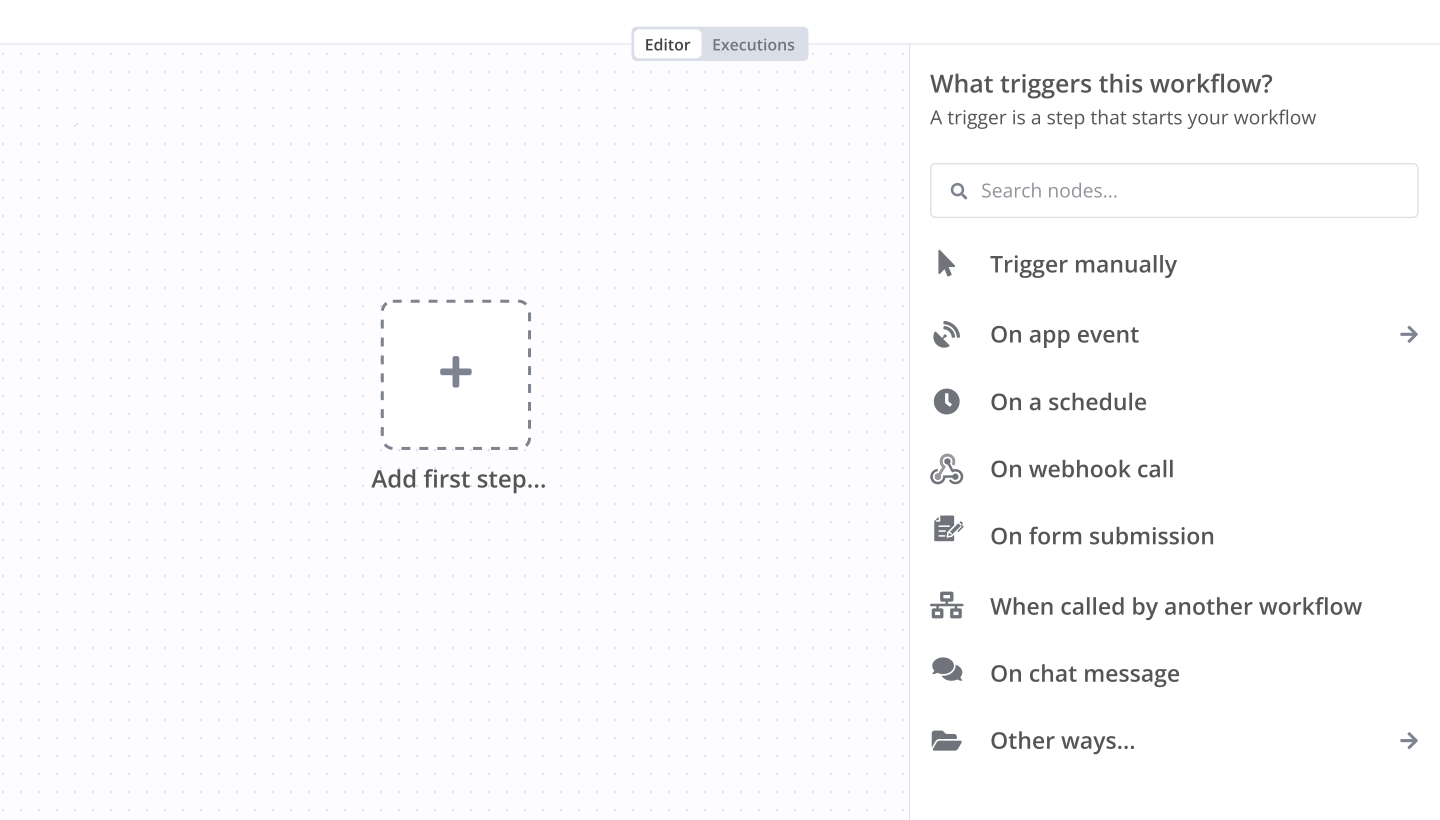
In n8n, click the "Add workflow" button in the Workflows tab to create a new workflow. Add the starting point – a trigger on when your workflow should run: an app event, a schedule, a webhook call, another workflow, an AI chat, or a manual trigger. Sometimes, the HTTP Request node might already serve as your starting point.

Google Calendar and Slack integration: Create a new workflow and add the first step

Step 2: Add and configure Google Calendar and Slack nodes

You can find Google Calendar and Slack in the nodes panel. Drag them onto your workflow canvas, selecting their actions. Click each node, choose a credential, and authenticate to grant n8n access. Configure Google Calendar and Slack nodes one by one: input data on the left, parameters in the middle, and output data on the right.

Google Calendar and Slack integration: Add and configure Google Calendar and Slack nodes

Step 3: Connect Google Calendar and Slack

A connection establishes a link between Google Calendar and Slack (or vice versa) to route data through the workflow. Data flows from the output of one node to the input of another. You can have single or multiple connections for each node.

Google Calendar and Slack integration: Connect Google Calendar and Slack

Step 4: Customize and extend your Google Calendar and Slack integration

Use n8n's core nodes such as If, Split Out, Merge, and others to transform and manipulate data. Write custom JavaScript or Python in the Code node and run it as a step in your workflow. Connect Google Calendar and Slack with any of n8n’s 1000+ integrations, and incorporate advanced AI logic into your workflows.

Google Calendar and Slack integration: Customize and extend your Google Calendar and Slack integration

Step 5: Test and activate your Google Calendar and Slack workflow

Save and run the workflow to see if everything works as expected. Based on your configuration, data should flow from Google Calendar to Slack or vice versa. Easily debug your workflow: you can check past executions to isolate and fix the mistake. Once you've tested everything, make sure to save your workflow and activate it.

Google Calendar and Slack integration: Test and activate your Google Calendar and Slack workflow

Organise an Event using Slack, Google Calendar and AI

This n8n workflow takes Slack conversations and turns them into Calendar events complete with accurate date and times and location information. Adding and removing attendees are also managed automatically.

How it works

Workflow monitors a Slack channel for invite messages with a "📅" reaction and sends this to the AI agent.
AI agent parses the message determining the time, date and location.
Using its Location tool, the AI agent searches for the precise location address from Google Maps.
Using its Calendar tool, the AI agent creates a Google Calendar invite with the title, description and location address for the user.
Back in the Slack channel, others can RSVP to the invite by reacting with the "✅" emjoi.
The workflow polls the message after a while and adds the users who have reacted to the Calendar Invite as attendees. Conversely, removing any attendees who have since removed their reaction.

Examples

Jill: "Hey team, I'm organising a round of Laser Tag (Bunker 51) next Thursday around 6pm. Please RSVP with a ✅"

AI: "I've helped you create an event in your calendar https://cal.google.com/..."

Jack: "✅"

AI: "I've added Jack to the event as an attendee".

Requirements
Slack channel to attach the workflow
OpenAI account to use a GPT model
Google Calendar to create and update events

Customising the Workflow

This workflow can work with other messaging platforms that support reactions or tagging like features such as discord. Don't use Google Calendar? Swap it out for Outlook or your own.

Use any combinations of emjoi reactions and add new rules like "RSVP maybe" which could send reminder updates nearer the event date.

Nodes used in this workflow

Popular Google Calendar and Slack workflows

+3

Send AI pre-op reminders with Google Calendar, Gmail, Sheets, Slack and GPT-4o

📘 Description This workflow automates end-to-end pre-surgery checklist reminders and confirmation tracking for healthcare operations teams. It ensures patients receive timely preparation instructions, can confirm completion with a single click, and allows staff to monitor confirmation status in real time—without manual coordination. Every day at 9:00 AM, the workflow fetches surgery events from Google Calendar, extracts patient details from event descriptions, and generates a unique confirmation link for each patient. An AI assistant then creates a personalized, patient-friendly pre-op checklist email (subject + styled HTML body) that includes surgery details and a confirmation button. When a patient clicks the confirmation link, a webhook captures the confirmation, updates Google Sheets as the source of truth, and records the timestamp. A separate periodic scheduler scans the sheet for patients who have not confirmed within the expected window. If confirmation is missing, the assigned nurse or owner is alerted in Slack with full patient and surgery context for immediate follow-up. This creates a closed-loop system: reminder → confirmation capture → tracking → escalation. ⚙️ What This Workflow Does (Step-by-Step) ▶️ Daily 9:00 AM Trigger Starts the pre-op reminder cycle automatically each morning. 📅 Fetch Today’s Surgery Events (Google Calendar) Pulls calendar events and filters only surgery-related entries. 🧾 Extract Patient Details from Event Description Parses patient name, email, phone, ID, procedure, and surgery time. 🔗 Generate Unique Confirmation Link Creates a secure confirmUrl per patient with tracking parameters. ✉️ AI Email Generation (Subject + HTML Body) Uses Azure OpenAI (gpt-4o) to generate a calm, professional checklist email with: Surgery details Basic preparation checklist Green confirmation button linked to confirmUrl 📤 Send Pre-Op Reminder via Gmail Delivers the styled HTML email directly to the patient. ✅ Confirmation Webhook (GET /confirm) Captures patient clicks, parses query parameters, and marks the checklist as confirmed. 🧾 Upsert Confirmation Status (Google Sheets) Stores and updates patient confirmation records as the operational source of truth. ⏳ Periodic Confirmation Check Runs on a schedule to scan all patient rows for missing confirmations. 🚨 Slack Alert for Missing Confirmations Notifies the nurse or owner with full patient context when confirmation is not received in time. 🧩 Prerequisites • Google Calendar OAuth2 • Gmail OAuth2 • Azure OpenAI (gpt-4o) credentials • Google Sheets OAuth2 • Slack API credentials • Publicly accessible webhook URL for confirmation tracking 💡 Key Benefits ✔ Automated pre-op reminders at a fixed daily time ✔ Personalized AI-generated patient emails ✔ One-click confirmation tracking ✔ Google Sheets audit trail for operations ✔ Proactive Slack alerts for missing confirmations ✔ Reduced manual follow-ups and missed preparations 👥 Perfect For Hospitals and surgical centers Clinic operations teams Care coordinators Day-surgery facilities Healthcare admin automation systems

Automate Employee Date Tracking & Reminders for HR with JavaScript

HR Date Management Automation - Complete Setup Guide 🎯 How It Works This n8n workflow transforms your HR department from reactive to proactive by automatically monitoring 5 critical employee timelines and generating smart alerts before deadlines hit. Core Components Data Input → Employee information (hire dates, contracts, certifications) Date Analysis Engine → Calculates days until critical events Smart Categorization → Sorts employees by urgency level Reminder Scheduler → Creates proactive notifications Multi-Format Export → Sends alerts to your preferred systems Business Value Prevents compliance violations** ($5K-50K+ in fines) Reduces HR workload** (15-20 hours/month saved) Improves employee experience** (no missed reviews/renewals) Provides management visibility** (dashboard reporting) 🚀 Quick Start Test Import the Workflow Download the Javascript_Hr.json file Open n8n and click “Import from file” Select the downloaded JSON file Click “Import” Test with Sample Data Click the “Execute Workflow” button Review the sample output in each node Check the final export data format What you’ll see: 5 sample employees with different scenarios Calculated days until contract/certification expiry Priority levels (high/medium/low) Scheduled reminders with recipient emails Export data in multiple formats 🔧 Real-World Integration Setup Option 1: Google Sheets Integration (Most Popular) Step 1: Prepare Your Employee Data Create a Google Sheet with these columns: | Employee ID | Name | Email | Department | Hire Date | Contract End | Certification Expiry | Last Review | Probation End | Vacation Days | Status | Sample data format: | 1 | John Smith | [email protected] | IT | 2024-01-15 | 2025-12-31 | 2025-03-20 | 2024-06-15 | 2024-07-15 | 20 | active | Step 2: Replace Sample Data Generator Delete the “Sample Data Generator” node Add “Google Sheets” node Connect to your Google account Configure these settings: Operation**: Read Document**: Your employee spreadsheet Sheet**: Employee data sheet Range**: A1:K100 (adjust for your data size) Options**: ✅ RAW data, ✅ Header row Step 3: Map Your Data Add a “Set” node after Google Sheets to standardize field names: // Map your sheet columns to workflow format { "id": "{{ $json['Employee ID'] }}", "name": "{{ $json['Name'] }}", "email": "{{ $json['Email'] }}", "department": "{{ $json['Department'] }}", "hiredOn": "{{ $json['Hire Date'] }}", "contractEndDate": "{{ $json['Contract End'] }}", "certificationExpiry": "{{ $json['Certification Expiry'] }}", "lastReviewDate": "{{ $json['Last Review'] }}", "probationEndDate": "{{ $json['Probation End'] }}", "vacationDays": "{{ $json['Vacation Days'] }}", "status": "{{ $json['Status'] }}" } Option 2: HRIS Integration (BambooHR Example) Step 1: BambooHR API Setup Get your BambooHR API key from Settings > API Keys Note your company subdomain (e.g., yourcompany.bamboohr.com) Step 2: Replace Sample Data Generator Delete the “Sample Data Generator” node Add “HTTP Request” node Configure these settings: Method**: GET URL**: https://api.bamboohr.com/api/gateway.php/[SUBDOMAIN]/v1/employees/directory Authentication**: Basic Auth Username**: Your API key Password**: x (leave as ‘x’) Headers**: Accept: application/json Step 3: Transform BambooHR Data Add a “Code” node to transform the API response: // Transform BambooHR response to workflow format const employees = []; for (const employee of $input.all()) { const emp = employee.json; employees.push({ id: emp.id, name: ${emp.firstName} ${emp.lastName}, email: emp.workEmail, department: emp.department, hiredOn: emp.hireDate, contractEndDate: emp.terminationDate || "2025-12-31", // Default if not set certificationExpiry: emp.customCertDate || "2025-12-31", lastReviewDate: emp.customReviewDate || null, probationEndDate: emp.customProbationDate || null, vacationDays: emp.paidTimeOff || 20, status: emp.employeeStatus || "active" }); } return employees.map(emp => ({ json: emp })); Option 3: CSV File Upload Step 1: Prepare CSV File Create a CSV with the same structure as the Google Sheets format. Step 2: Use CSV Parser Replace “Sample Data Generator” with “Read Binary File” node Add “CSV Parser” node Configure settings: Include Headers**: Yes Delimiter**: Comma Skip Empty Lines**: Yes 📧 Output Integration Setup Email Notifications Step 1: Add Email Node Add “Email” node after “Reminder Scheduler” Connect to your email provider (Gmail/Outlook) Step 2: Configure Email Templates // Dynamic email content based on reminder type const reminder = $json; const emailTemplates = { contract_renewal: { subject: 🚨 Contract Renewal Required - ${reminder.employeeName}, body: ` Hi HR Team, ${reminder.employeeName}'s contract expires on ${reminder.dueDate}. Days remaining: ${Math.ceil((new Date(reminder.dueDate) - new Date()) / (10006060*24))} Please initiate renewal process immediately. Best regards, HR Automation System ` }, certification_renewal: { subject: 📜 Certification Renewal Reminder - ${reminder.employeeName}, body: ` Hi ${reminder.employeeName}, Your certification expires on ${reminder.dueDate}. Please renew your certification to maintain compliance. Contact HR if you need assistance. Best regards, HR Team ` } }; const template = emailTemplates[reminder.type]; return { to: reminder.recipientEmail, subject: template.subject, body: template.body }; Slack Integration Step 1: Add Slack Node Add “Slack” node after “Advanced Date Filters” Connect to your Slack workspace Step 2: Configure Channel Alerts // Send summary to #hr-alerts channel const summary = $json.summary; const message = ` 🏢 Daily HR Report 👥 Total Employees: ${summary.totalEmployees} 🆕 New Hires: ${summary.newHires} ⚠️ High Priority Actions: ${summary.highPriority} 📋 Contracts Expiring: ${summary.contractsExpiring} 🎓 Certifications Expiring: ${summary.certificationsExpiring} Generated: ${new Date().toLocaleDateString()} `; return { channel: '#hr-alerts', text: message }; Google Calendar Integration Step 1: Add Calendar Node Add “Google Calendar” node after “Reminder Scheduler” Connect to your Google account Step 2: Create Calendar Events // Create calendar events for upcoming deadlines const reminder = $json; const eventTitles = { contract_renewal: Contract Renewal - ${reminder.employeeName}, certification_renewal: Certification Renewal - ${reminder.employeeName}, performance_review: Performance Review - ${reminder.employeeName}, probation_review: Probation Review - ${reminder.employeeName} }; return { calendarId: '[email protected]', summary: eventTitles[reminder.type], description: reminder.message, start: { dateTime: reminder.dueDate, timeZone: 'America/New_York' }, end: { dateTime: reminder.dueDate, timeZone: 'America/New_York' }, attendees: [ { email: '[email protected]' }, { email: reminder.recipientEmail } ] }; 🎯 Scheduling & Automation Daily Monitoring Setup Step 1: Add Cron Trigger Replace “Manual Trigger” with “Cron” node Set schedule: 0 9 * * 1-5 (9 AM, Monday-Friday) Configure timezone to your business hours Step 2: Error Handling Add “Error Trigger” node Connect to email notification for failures Set up retry logic for failed integrations Weekly Reports Step 1: Create Weekly Summary Add separate “Cron” trigger for weekly reports Set schedule: 0 9 * * 1 (9 AM every Monday) Modify the filtering logic to show weekly trends 🔍 Customization Options Adjust Alert Timings In the “Date Analysis & Categorization” node: // Modify these values to change alert timing const isContractExpiringSoon = daysUntilContractEnd <= 90; // Change from 90 days const isCertificationExpiringSoon = daysUntilCertificationExpiry <= 60; // Change from 60 days const needsReview = daysSinceLastReview >= 365; // Change from 365 days Add Custom Employee Categories // Add new categories in the analysis node const isContractor = employee.employeeType === 'contractor'; const isRemoteWorker = employee.location === 'remote'; const isHighRisk = employee.performanceRating === 'needs_improvement'; Custom Date Formats Modify the “Date Formatting & Export” node to add your preferred formats: // Add custom date format const formatters = { custom: (date) => { const options = { year: 'numeric', month: 'long', day: 'numeric', weekday: 'long' }; return date.toLocaleDateString('en-US', options); } }; 🎚️ Testing & Validation Step 1: Data Validation Test with 2-3 sample employees first Verify all dates are parsing correctly Check that calculations match manual calculations Step 2: Alert Testing Create test scenarios with dates 30/60/90 days out Verify emails are sent to correct recipients Test Slack notifications in a test channel Step 3: Performance Testing Test with your full employee dataset Monitor execution time (should be under 30 seconds) Check for memory usage with large datasets 🆘 Troubleshooting Guide Common Issues Date Parsing Errors // Add date validation in the analysis node const parseDate = (dateStr) => { const date = new Date(dateStr); if (isNaN(date.getTime())) { console.error(Invalid date: ${dateStr}); return null; } return date; }; Missing Data Fields // Add data validation const validateEmployee = (employee) => { const required = ['name', 'email', 'hiredOn']; const missing = required.filter(field => !employee[field]); if (missing.length > 0) { console.error(Missing required fields for ${employee.name}: ${missing.join(', ')}); return false; } return true; }; API Rate Limits Add “Wait” nodes between API calls Implement retry logic with exponential backoff Cache API responses when possible 🚀 Advanced Features Multi-Company Support // Add company filtering in the analysis node const processEmployeesByCompany = (employees, companyId) => { return employees.filter(emp => emp.companyId === companyId); }; Custom Notification Rules // Advanced notification logic const shouldNotify = (employee, eventType) => { const rules = { contract_renewal: employee.department !== 'intern', certification_renewal: employee.role === 'certified_professional', performance_review: employee.status === 'active' }; return rules[eventType] || false; }; Integration with Time Tracking // Connect to time tracking APIs const calculateWorkingDays = (startDate, endDate) => { // Implementation for working days calculation // Excluding weekends and holidays }; This workflow transforms your HR department from reactive to proactive, preventing costly compliance issues while improving employee experience. The modular design allows you to start simple and add complexity as needed.

Sync Google Calendar events to Google Sheets with Slack notifications

Sync your Google Calendar events with Google Sheets and get daily Slack summaries with meeting statistics. FEATURES: Real-time sync of new and updated events Auto-categorization (Meeting, 1:1, Interview, Demo, Focus Time) Platform detection (Google Meet, Zoom, Teams) Daily statistics dashboard Cancellation tracking Optional email notifications to attendees FLOWS: New Event: Log to Sheets + Slack notification + Optional email Updated Event: Update Sheets + Slack notification Canceled Event: Log cancellation + Slack alert Daily Summary (8AM): Meeting time stats + Schedule to Slack SETUP: Connect Google account with Calendar access Create Google Sheet with 3 tabs: Events: ID, Synced At, Title, Category, Date, Day, Start Time, End Time, Duration, Platform, Attendees, Status, Meeting Link Cancellations: ID, Canceled At, Title, Original Date, Original Time, Affected Attendees Statistics: Date, Total Events, Meeting Time, Minutes, Busy %, Status, Virtual, In-Person Replace YOUR_DOCUMENT_ID in all Sheets nodes Connect Slack (#calendar, #errors channels) Optional: Connect Gmail for attendee notifications DAILY STATISTICS: Total events count Time spent in meetings Busy percentage of work day Virtual vs in-person breakdown Full day schedule IDEAL FOR: Anyone wanting to track their calendar, analyze meeting patterns, or get daily schedule summaries on Slack.
+6

Predictive Health Monitoring & Alert System with GPT-4o-mini

How It Works The system collects real-time wearable health data, normalizes it, and uses AI to analyze trends and risk scores. It detects anomalies by comparing with historical patterns and automatically triggers alerts and follow-up actions when thresholds are exceeded. Setup Steps Configure Webhook Endpoint - Set up webhook to receive data from wearable devices Connect Database - Initialize storage for health metrics and historical data Set Normalization Rules - Define data standardization parameters for different devices Configure AI Model - Set up health score calculation and risk prediction algorithms Define Thresholds - Establish alert triggers for critical health metrics Connect Notification Channels - Configure email and Slack integrations Set Up Reporting - Create automated report templates and schedules Test Workflow - Run end-to-end tests with sample health data Workflow Template Webhook → Store Database → Normalize Data → Calculate Health Score → Analyze Metrics → Compare Previous → Check Threshold → Generate Reports/Alerts → Email/Slack → Schedule Follow-up Workflow Steps Ingest real-time wearable data via webhook, store and standardize it, and use GPT-4 for trend analysis and risk scoring. Monitor metrics against thresholds, trigger SMS, email, or Slack alerts, generate reports, and schedule follow-ups. Setup Instructions Configure webhook, database, GPT-4 API, notifications, calendar integration, and customize alert thresholds. Prerequisites Wearable API, patient database, GPT-4 key, email SMTP, optional Slack/Twilio, calendar integration. Use Cases Monitor glucose for diabetics, track elderly vitals/fall risk, assess corporate wellness, and post-surgery recovery alerts. Customization Adjust risk algorithms, add metrics, integrate telemedicine. Benefits Early intervention reduces readmissions and automates 80% of monitoring tasks.
+4

Automate Recruitment with GPT-4o-mini: CV Screening to Interview Scheduling in Airtable

Introduction Automate candidate evaluation from CV submission to interview booking. Perfect for HR teams and recruiters. How It Works Webhook receives CVs, extracts Airtable data, AI assesses qualifications, filters candidates, sends emails, schedules Google Calendar interviews, and updates records. Workflow Template Webhook → Airtable (Get Data) → AI Extract CV → AI Assessment → Filter Qualified → Generate Email → Send Email → Filter Interview Candidates → Schedule Calendar → Update Airtable → Slack Notification → Respond Workflow Steps Receive & Store: Webhook receives CVs, saves to Airtable. Fetch & Download: Gets job criteria, downloads CVs. AI Assessment: Parses skills, scores candidates. Filter & Email: Routes qualified, sends messages. Schedule & Update: Books interviews, updates Airtable. Notify: Alerts via Slack, confirms status. Setup Instructions Webhook & Airtable: Set URL, create tables, add credentials. AI Configuration: Add OpenAI key, define schema, customize scoring. Communication: Connect Gmail, Calendar, and Slack. Prerequisites Airtable account OpenAI API key Gmail and Google Calendar Slack workspace (optional) Customization Multi-stage scheduling ATS integration (Greenhouse, Lever) Benefits Reduces screening time by 90% Ensures uniform evaluation Cuts time-to-hire by 60%

Form to Meeting: Google Calendar, Zoom, Gmail & Slack Booking Automation

Who’s it for Teams that collect meeting requests via a form and want instant, error-free scheduling: customer success, sales, education, agencies, and community managers. How it works / What it does This workflow ingests a form submission (name, email, preferred date/time), checks Google Calendar for conflicts, and branches automatically. If the slot is free, it creates a calendar event, spins up a Zoom meeting, emails the guest a confirmation, and posts a Slack summary to your team. If busy, it sends a polite “please pick another time” email. Time handling defaults to Asia/Tokyo and converts to ISO internally to keep downstream integrations consistent. How to set up Import the workflow and rename nodes for clarity if needed. Open the Workflow Configuration (Set) node and adjust variables (calendar ID, meeting duration, Slack channel, sender info). Map your form fields in Extract Booking Details. Connect credentials in each service node (Google Calendar, Zoom, Gmail, Slack). Test once with a real submission. Requirements Active accounts and n8n credentials for Google Calendar, Zoom, Gmail, and Slack. A form or webhook source that sends name, email, and a valid datetime. How to customize the workflow Duration & buffers: Change end time calculation in Extract Booking Details. Time zones: If you accept multiple time zones, normalize before building ISO strings. Email copy: Personalize confirmation/alternative-time messages and add attachments if desired. Slack format: Enrich the post with fields (host, Zoom join URL, internal tags). Routing: Add CRM updates or reminders after the “slot free” branch. Security note: No hardcoded API keys in HTTP nodes. Configure all credentials via n8n’s credential manager.

Build your own Google Calendar and Slack integration

Create custom Google Calendar and Slack workflows by choosing triggers and actions. Nodes come with global operations and settings, as well as app-specific parameters that can be configured. You can also use the HTTP Request node to query data from any app or service with a REST API.

Google Calendar supported actions

Availability
If a time-slot is available in a calendar
Create
Add a event to calendar
Delete
Delete an event
Get
Retrieve an event
Get Many
Retrieve many events from a calendar
Update
Update an event

Slack supported actions

Archive
Archives a conversation
Close
Closes a direct message or multi-person direct message
Create
Initiates a public or private channel-based conversation
Get
Get information about a channel
Get Many
Get many channels in a Slack team
History
Get a conversation's history of messages and events
Invite
Invite a user to a channel
Join
Joins an existing conversation
Kick
Removes a user from a channel
Leave
Leaves a conversation
Member
List members of a conversation
Open
Opens or resumes a direct message or multi-person direct message
Rename
Renames a conversation
Replies
Get a thread of messages posted to a channel
Set Purpose
Sets the purpose for a conversation
Set Topic
Sets the topic for a conversation
Unarchive
Unarchives a conversation
Get
Get Many
Get & filters team files
Upload
Create or upload an existing file
Delete
Get Permalink
Search
Send
Send and Wait for Response
Update
Add
Adds a reaction to a message
Get
Get the reactions of a message
Remove
Remove a reaction of a message
Add
Add a star to an item
Delete
Delete a star from an item
Get Many
Get many stars of autenticated user
Get
Get information about a user
Get Many
Get a list of many users
Get User's Profile
Get a user's profile
Get User's Status
Get online status of a user
Update User's Profile
Update a user's profile
Add Users
Create
Disable
Enable
Get Many
Get Users
Update

Google Calendar and Slack integration details

integrationGoogle Calendar node
Google Calendar

Google Calendar is a time-management and calendar service created by Google Workspace. It helps you schedule and organize events and meetings, send notifications, and synchronize with your team. It is widely used by both individuals and organizations.

FAQs

  • Can Google Calendar connect with Slack?

  • Can I use Google Calendar’s API with n8n?

  • Can I use Slack’s API with n8n?

  • Is n8n secure for integrating Google Calendar and Slack?

  • How to get started with Google Calendar and Slack integration in n8n.io?

Need help setting up your Google Calendar and Slack integration?

Discover our latest community's recommendations and join the discussions about Google Calendar and Slack integration.
jake chard
Nicolas N
Muhammed Iqbal P B
Nicolas N

Looking to integrate Google Calendar and Slack in your company?

Over 3000 companies switch to n8n every single week

Why use n8n to integrate Google Calendar with Slack

Build complex workflows, really fast

Build complex workflows, really fast

Handle branching, merging and iteration easily.
Pause your workflow to wait for external events.

Code when you need it, UI when you don't

Simple debugging

Your data is displayed alongside your settings, making edge cases easy to track down.

Use templates to get started fast

Use 1000+ workflow templates available from our core team and our community.

Reuse your work

Copy and paste, easily import and export workflows.

Implement complex processes faster with n8n

red iconyellow iconred iconyellow icon