Back to Integrations
integrationGoogle Docs node
integrationNotion node

Google Docs and Notion integration

Save yourself the work of writing custom integrations for Google Docs and Notion and use n8n instead. Build adaptable and scalable Miscellaneous, and Productivity workflows that work with your technology stack. All within a building experience you will love.

How to connect Google Docs and Notion

  • Step 1: Create a new workflow
  • Step 2: Add and configure nodes
  • Step 3: Connect
  • Step 4: Customize and extend your integration
  • Step 5: Test and activate your workflow

Step 1: Create a new workflow and add the first step

In n8n, click the "Add workflow" button in the Workflows tab to create a new workflow. Add the starting point – a trigger on when your workflow should run: an app event, a schedule, a webhook call, another workflow, an AI chat, or a manual trigger. Sometimes, the HTTP Request node might already serve as your starting point.
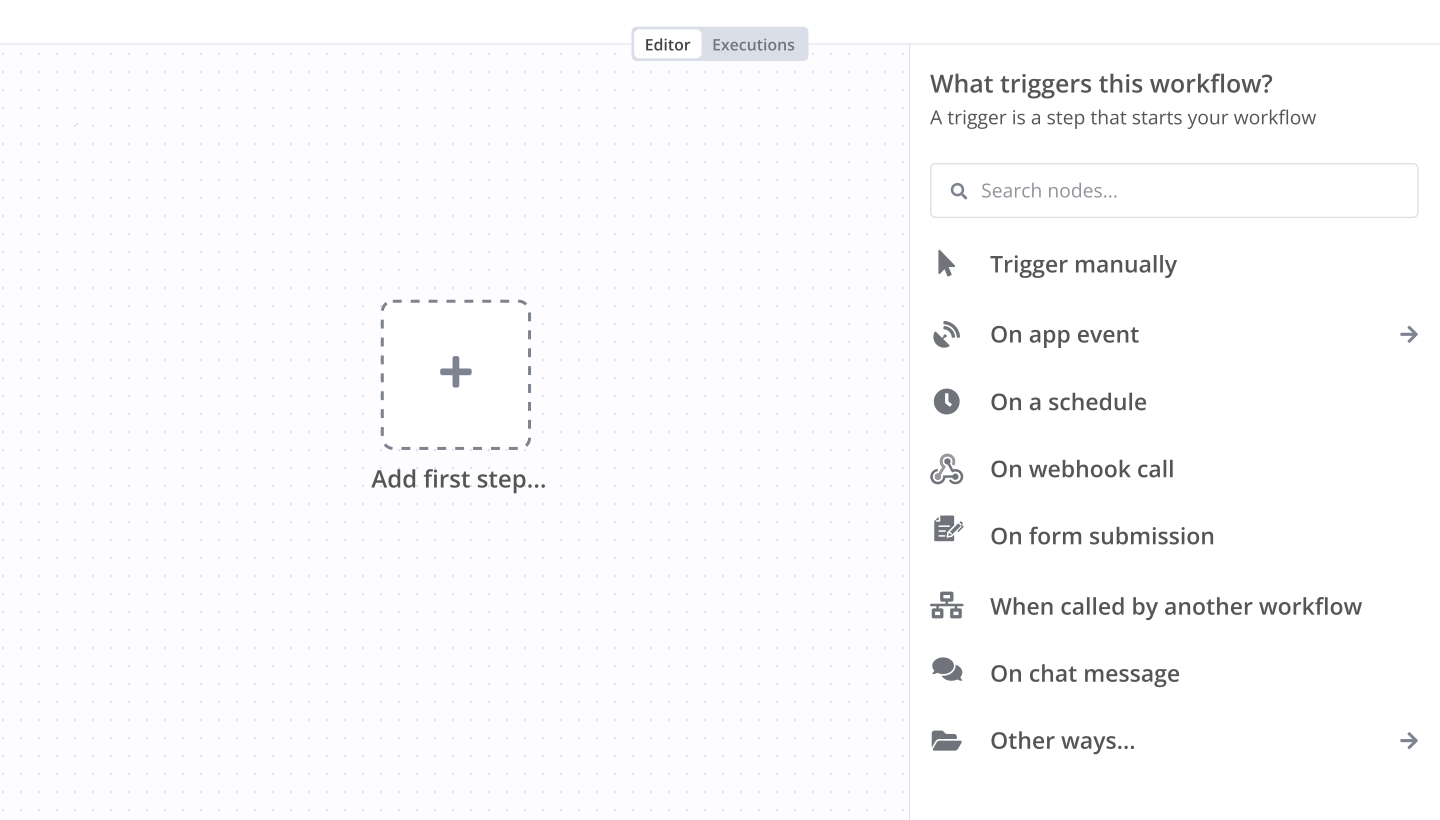
Google Docs and Notion integration: Create a new workflow and add the first step

Step 2: Add and configure Google Docs and Notion nodes

You can find Google Docs and Notion in the nodes panel. Drag them onto your workflow canvas, selecting their actions. Click each node, choose a credential, and authenticate to grant n8n access. Configure Google Docs and Notion nodes one by one: input data on the left, parameters in the middle, and output data on the right.

Google Docs and Notion integration: Add and configure Google Docs and Notion nodes

Step 3: Connect Google Docs and Notion

A connection establishes a link between Google Docs and Notion (or vice versa) to route data through the workflow. Data flows from the output of one node to the input of another. You can have single or multiple connections for each node.

Google Docs and Notion integration: Connect Google Docs and Notion

Step 4: Customize and extend your Google Docs and Notion integration

Use n8n's core nodes such as If, Split Out, Merge, and others to transform and manipulate data. Write custom JavaScript or Python in the Code node and run it as a step in your workflow. Connect Google Docs and Notion with any of n8n’s 1000+ integrations, and incorporate advanced AI logic into your workflows.

Google Docs and Notion integration: Customize and extend your Google Docs and Notion integration

Step 5: Test and activate your Google Docs and Notion workflow

Save and run the workflow to see if everything works as expected. Based on your configuration, data should flow from Google Docs to Notion or vice versa. Easily debug your workflow: you can check past executions to isolate and fix the mistake. Once you've tested everything, make sure to save your workflow and activate it.

Google Docs and Notion integration: Test and activate your Google Docs and Notion workflow

Automate social media content with AI for Instagram, Facebook, LinkedIn & X

AI Social Media Content Automation – n8n Workflow

This workflow is built for creators, solopreneurs, SaaS founders, and agencies looking to automate their social media content process from idea to publication. It combines the power of OpenAI, Google Sheets, and official APIs for Instagram, Facebook, X (Twitter), and LinkedIn to deliver fully automated, brand-consistent social media posts — including text, images, hashtags, CTAs, and scheduling.

No more switching tools, rewriting content, or forgetting to post. Just set it up once and let your brand grow automatically.

🔧 What the Workflow Does
Generates platform-specific post ideas based on your brand tone.
Selects the best idea (or lets you manually input one).
Writes tailored posts for Instagram, Facebook, X, and LinkedIn.
Auto-generates platform-specific visuals using OpenAI (DALL·E) and uploads to Cloudinary.
Publishes content directly using official platform APIs.
Logs all actions to Google Sheets and optionally sends a summary email via Gmail.

⚙️ How It Works
Trigger the workflow manually, on a schedule, or from a chatbot.
AI generates multiple post ideas and filters the best one.
Based on the selected idea, it generates full posts for each platform.
Custom visuals are created using OpenAI and uploaded to Cloudinary.
Final post content is merged and sent to Instagram, Facebook, X, and LinkedIn.
Logs and optional reports are created in Google Sheets and Gmail.

🛠️ Setup Steps
Set up your accounts and credentials: OpenAI, Cloudinary, Gmail, Meta, LinkedIn, X, and Google Sheets.
Import the workflow and subworkflow (Get Brand Brief) into n8n.
Replace all placeholders (sheet IDs, access tokens, profile/page IDs, brand brief URLs).
Optionally personalize prompts and output templates to match your brand voice.
Setup time: ~30–45 minutes (including credentials and testing).

Detailed configuration notes are included in sticky nodes throughout the workflow.

📦 Included in Your Package
JSON workflow file (main flow + brand brief subflow)
Google Sheets templates for history logging
Setup documentation (Markdown & PDF)
Placeholder reference sheet

Nodes used in this workflow

Popular Google Docs and Notion workflows

+10

Automate Social Media Content with AI for Instagram, Facebook, LinkedIn & X

AI Social Media Content Automation – n8n Workflow This workflow is built for creators, solopreneurs, SaaS founders, and agencies looking to automate their social media content process from idea to publication. It combines the power of OpenAI, Google Sheets, and official APIs for Instagram, Facebook, X (Twitter), and LinkedIn to deliver fully automated, brand-consistent social media posts — including text, images, hashtags, CTAs, and scheduling. No more switching tools, rewriting content, or forgetting to post. Just set it up once and let your brand grow automatically. 🔧 What the Workflow Does Generates platform-specific post ideas based on your brand tone. Selects the best idea (or lets you manually input one). Writes tailored posts for Instagram, Facebook, X, and LinkedIn. Auto-generates platform-specific visuals using OpenAI (DALL·E) and uploads to Cloudinary. Publishes content directly using official platform APIs. Logs all actions to Google Sheets and optionally sends a summary email via Gmail. ⚙️ How It Works Trigger the workflow manually, on a schedule, or from a chatbot. AI generates multiple post ideas and filters the best one. Based on the selected idea, it generates full posts for each platform. Custom visuals are created using OpenAI and uploaded to Cloudinary. Final post content is merged and sent to Instagram, Facebook, X, and LinkedIn. Logs and optional reports are created in Google Sheets and Gmail. 🛠️ Setup Steps Set up your accounts and credentials: OpenAI, Cloudinary, Gmail, Meta, LinkedIn, X, and Google Sheets. Import the workflow and subworkflow (Get Brand Brief) into n8n. Replace all placeholders (sheet IDs, access tokens, profile/page IDs, brand brief URLs). Optionally personalize prompts and output templates to match your brand voice. Setup time: ~30–45 minutes (including credentials and testing). Detailed configuration notes are included in sticky nodes throughout the workflow. 📦 Included in Your Package JSON workflow file (main flow + brand brief subflow) Google Sheets templates for history logging Setup documentation (Markdown & PDF) Placeholder reference sheet
+9

AI Email Auto-Responder System- AI RAG Agent for Email Inbox

AI Email Auto-Responder – Smart Client Reply Automation with RAG This workflow is built for individuals, teams, and businesses that receive regular inquiries via email and want to automate responses in a way that’s intelligent, brand-aligned, and always up to date. Its core purpose is to generate high-quality, professional email replies using internal company data, brand voice, and semantic search — fully automated through Gmail, Pinecone, and OpenAI. The system is divided into three steps. First, it allows you to index your internal knowledge base (Docs, Sheets, PDFs) with embeddings. Second, it injects a consistent brand brief into every interaction to ensure tone and positioning. Finally, the main flow listens for incoming emails, understands the user query, retrieves all needed data, and writes a full HTML reply — sending it directly to the original thread via Gmail. This solution is ideal for support teams, solopreneurs, B2B service providers, or anyone looking to scale high-quality client communication without scaling manual work. It can be extended to handle multilingual queries, intent routing, or CRM logging. How it works When a new email arrives in Gmail, the workflow checks whether it's a valid client inquiry. If so, it: Extracts the subject and message content Sends the message through OpenAI to understand the question Queries a Pinecone vector database (populated via a separate embedding workflow) to find relevant internal knowledge Loads a brand brief from a Google Doc or Notion block Combines retrieved data and brand context to generate a clear, structured HTML reply using OpenAI Sends the reply via Gmail and logs the message This process ensures every reply is relevant, accurate, and consistent with your brand — and takes under 10 seconds. Set up steps Getting started takes about 30–60 minutes. Create three workflows: one for embedding documents (Step 1), one sub-workflow for the brand brief (Step 2), and one main responder flow (Step 3) Connect the following APIs: Gmail (OAuth2), OpenAI, Pinecone, Google Drive, and optionally Notion Replace all placeholders: folder ID in Google Drive, Pinecone index and namespace, your brand brief URL or doc ID, and Gmail credentials Test your embedding workflow by uploading a document and verifying its presence in Pinecone Trigger the responder by sending an email and reviewing the AI’s reply Detailed setup instructions are stored in sticky notes within each workflow to guide you through configuration.

Generate product feature announcements from Notion to Google Docs with GPT-5 Mini and Claude

This n8n workflow automatically generates professional product announcements and blog articles from your Notion content planning database. Who's it for & Use Cases Product Marketers, Content Teams, Product Managers, and Founders who want to: Automate product announcement creation from their Notion product backlog. Generate SEO and AI Search/ALLMO optimized blog articles with consistent structure and brand voice Maintain an up to date product changelog for products with frequent udpates. How It Works Phase 1: Notion Trigger & Validation Workflow monitors your Notion "Content Plan" database for page updates Validates that the entry is marked as ready for writing Checks that content type is set to "Product" (filters other content types) Phase 2: AI Outline Generation GPT-5 Mini creates a structured outline based on: Project name from Notion Notes field (context/instructions) Built-in SEO and ALLMO best practices Output includes sections, subsections, and key talking points Phase 3: Full Article Generation Claude Sonnet 4.5 writes the complete product announcement using: The generated outline Project details from Notion Expert product communications system prompt Article follows structured format: headline, summary, feature sections, FAQ, CTA, and SEO metadata Phase 4: Google Docs Creation & Notion Update Creates new Google Doc with your project name as title Inserts the complete Markdown article into the document Updates Notion page with Google Docs link for instant access Marks the project as complete in Notion How to Setup Connect your Notion account and select your Content Plan database Enter API credentials in the Claude and OpenAI nodes Configure your Google Docs folder location Customize system prompts with your company description, target audience, and brand voice How to Expand Replace the Notion node with a product backlog tool of your choice. Update and fine tune the prompts. Output Structure Full Markdown article with YAML front matter Structured sections: headline, summary, feature descriptions, additional improvements, FAQ, CTA SEO metadata included (title, meta description, slug, tags) Automatically saved to Google Docs with link in Notion Requirements API Credentials: Anthropic API (Claude Sonnet 4.5) OpenAI API (GPT-5 Mini) Connected Services: Notion workspace with Content Plan database Google Docs/Drive account Notion Database Fields: Project name (title/text) Notes (text/description field) Google_Docs_Link (URL field) Status field to mark entries as ready (e.g., "Ready for Writing") Content Type field set to "Product"
+3

Create Weekly Space Newsletter with NASA APIs, GPT-4 & Google Workspace

Who is it for This template is perfect for content creators, space enthusiasts, educators, and organizations who want to automatically generate and distribute engaging weekly space newsletters. It's especially useful for those who want to stay updated on space events without manual content creation. How it works This workflow automatically generates a comprehensive space newsletter every week by: Fetching the latest data from multiple NASA APIs (APOD, DONKI, NeoWS) Using AI to create an engaging newsletter from the raw data Creating a formatted document with the content Converting it to PDF format Distributing via email and archiving to your preferred platform Sending success notifications to your team Setup steps Get NASA API Key: Register at https://api.nasa.gov to get your API key (free) Configure OpenAI: Add your OpenAI credentials for content generation Set up Google Workspace: Connect Google Docs, Drive, and Gmail accounts Optional integrations: Configure Notion for archiving and Slack for notifications Customize schedule: Adjust the weekly trigger time to your preference Requirements NASA API key (free at api.nasa.gov) OpenAI API access Google Workspace account (Docs, Drive, Gmail) Optional: Notion and Slack accounts How to customize Modify the AI prompt to change the newsletter style and tone Adjust the date range for fetching space data Add or remove NASA API endpoints based on your interests Customize email recipients and notification channels Enable/disable the Notion archiving feature as needed

Build your own Google Docs and Notion integration

Create custom Google Docs and Notion workflows by choosing triggers and actions. Nodes come with global operations and settings, as well as app-specific parameters that can be configured. You can also use the HTTP Request node to query data from any app or service with a REST API.

Google Docs supported actions

Create
Get
Update

Notion supported actions

Append After
Append a block
Get Child Blocks
Get many child blocks
Get
Get a database
Get Many
Get many databases
Search
Search databases using text search
Get
Get a database
Get Many
Get many databases
Create
Create a page in a database
Get
Get a page in a database
Get Many
Get many pages in a database
Update
Update pages in a database
Create
Create a pages in a database
Get Many
Get many pages in a database
Update
Update pages in a database
Create
Create a page
Get
Get a page
Search
Text search of pages
Archive
Archive a page
Create
Create a page
Search
Text search of pages
Get
Get a user
Get Many
Get many users

FAQs

  • Can Google Docs connect with Notion?

  • Can I use Google Docs’s API with n8n?

  • Can I use Notion’s API with n8n?

  • Is n8n secure for integrating Google Docs and Notion?

  • How to get started with Google Docs and Notion integration in n8n.io?

Need help setting up your Google Docs and Notion integration?

Discover our latest community's recommendations and join the discussions about Google Docs and Notion integration.
Justin Cheu
Cris A. Works
Martin
Liam Skaff
AyS 0908

Looking to integrate Google Docs and Notion in your company?

Over 3000 companies switch to n8n every single week

Why use n8n to integrate Google Docs with Notion

Build complex workflows, really fast
Build complex workflows, really fast

Handle branching, merging and iteration easily.
Pause your workflow to wait for external events.

Code when you need it, UI when you don't

Simple debugging

Your data is displayed alongside your settings, making edge cases easy to track down.

Use templates to get started fast

Use 1000+ workflow templates available from our core team and our community.

Reuse your work

Copy and paste, easily import and export workflows.

Implement complex processes faster with n8n

red iconyellow iconred iconyellow icon