Back to Integrations
integrationGoogle Docs node
integrationSlack node

Google Docs and Slack integration

Save yourself the work of writing custom integrations for Google Docs and Slack and use n8n instead. Build adaptable and scalable Miscellaneous, Communication, and HITL workflows that work with your technology stack. All within a building experience you will love.

How to connect Google Docs and Slack

  • Step 1: Create a new workflow
  • Step 2: Add and configure nodes
  • Step 3: Connect
  • Step 4: Customize and extend your integration
  • Step 5: Test and activate your workflow

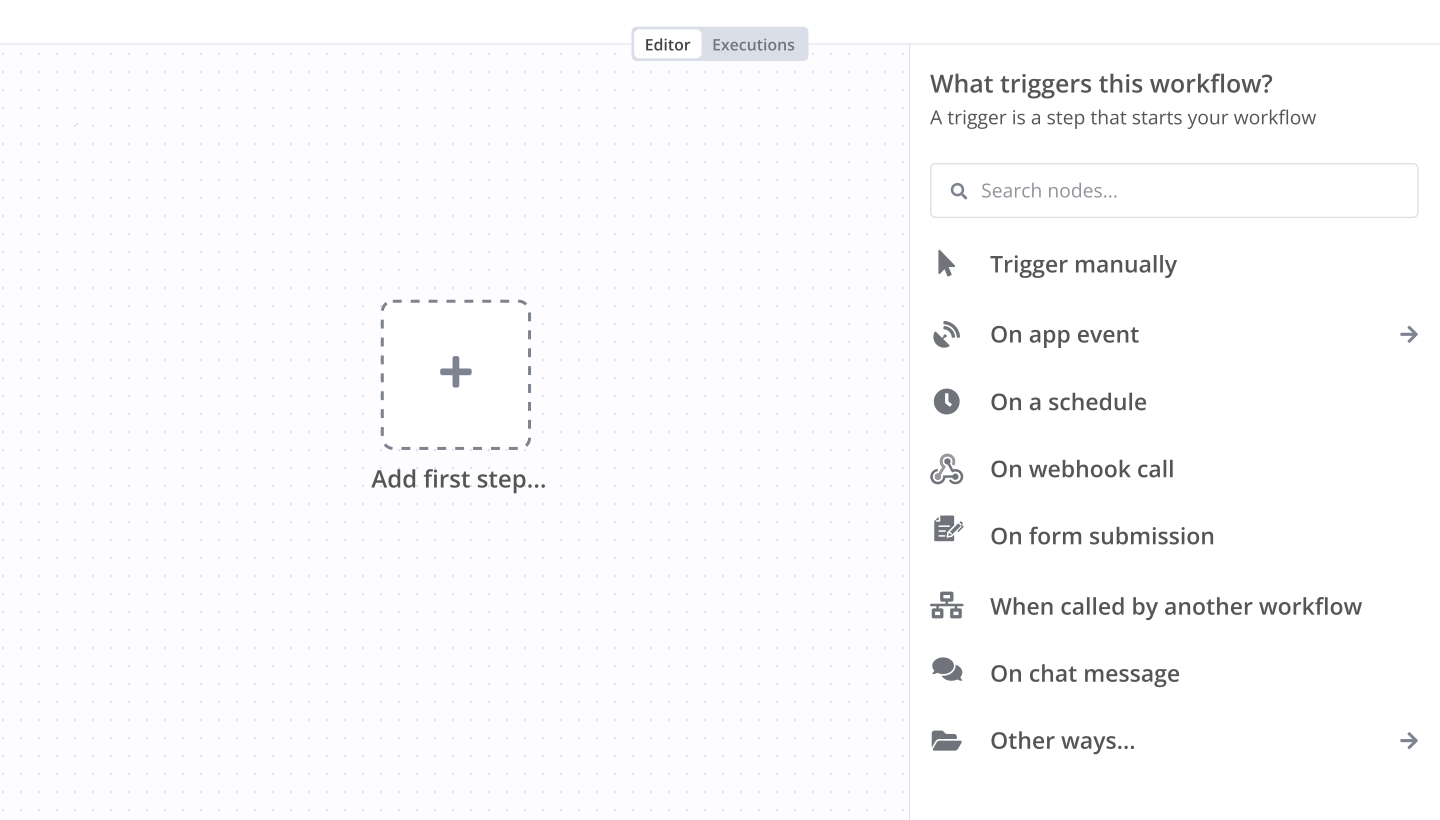
Step 1: Create a new workflow and add the first step

In n8n, click the "Add workflow" button in the Workflows tab to create a new workflow. Add the starting point – a trigger on when your workflow should run: an app event, a schedule, a webhook call, another workflow, an AI chat, or a manual trigger. Sometimes, the HTTP Request node might already serve as your starting point.
Google Docs and Slack integration: Create a new workflow and add the first step

Step 2: Add and configure Google Docs and Slack nodes

You can find Google Docs and Slack in the nodes panel. Drag them onto your workflow canvas, selecting their actions. Click each node, choose a credential, and authenticate to grant n8n access. Configure Google Docs and Slack nodes one by one: input data on the left, parameters in the middle, and output data on the right.
Google Docs and Slack integration: Add and configure Google Docs and Slack nodes

Step 3: Connect Google Docs and Slack

A connection establishes a link between Google Docs and Slack (or vice versa) to route data through the workflow. Data flows from the output of one node to the input of another. You can have single or multiple connections for each node.

Google Docs and Slack integration: Connect Google Docs and Slack

Step 4: Customize and extend your Google Docs and Slack integration

Use n8n's core nodes such as If, Split Out, Merge, and others to transform and manipulate data. Write custom JavaScript or Python in the Code node and run it as a step in your workflow. Connect Google Docs and Slack with any of n8n’s 1000+ integrations, and incorporate advanced AI logic into your workflows.

Google Docs and Slack integration: Customize and extend your Google Docs and Slack integration

Step 5: Test and activate your Google Docs and Slack workflow

Save and run the workflow to see if everything works as expected. Based on your configuration, data should flow from Google Docs to Slack or vice versa. Easily debug your workflow: you can check past executions to isolate and fix the mistake. Once you've tested everything, make sure to save your workflow and activate it.

Google Docs and Slack integration: Test and activate your Google Docs and Slack workflow

Automate Your RFP Process with OpenAI Assistants

This n8n workflow demonstrates how to automate oftern time-consuming form filling tasks in the early stages of the tendering process; the Request for Proposal document or "RFP".

It does this by utilising a company's knowledgebase to generating question-and-answer pairs using Large Language Models.

How it works
A buyer's RFP is submitted to the workflow as a digital document that can be parsed.
Our first AI agent scans and extracts all questions from the document into list form.
The supplier sets up an OpenAI assistant prior loaded with company brand, marketing and technical documents.
The workflow loops through each of the buyer's questions and poses these to the OpenAI assistant.
The assistant's answers are captured until all questions are satisified and are then exported into a new document for review.
A sales team member is then able to use this document to respond quickly to the RFP before their competitors.

Example Webhook Request

curl --location 'https://<n8n_webhook_url>'
--form 'id="RFP001"'
--form 'title="BlueChip Travel and StarBus Web Services"'
--form 'reply_to="[email protected]"'
--form 'data=@"k9pnbALxX/RFP Questionnaire.pdf"'

Requirements
An OpenAI account to use AI services.

Customising the workflow

OpenAI assistants is only one approach to hosting a company knowledgebase for AI to use. Exploring different solutions such as building your own RAG-powered database can sometimes yield better results in terms of control of how the data is managed and cost.

Nodes used in this workflow

Popular Google Docs and Slack workflows

+2

Automate client onboarding with Asana, Google Docs, Gmail, Slack and Sheets

📊 Description Automate short-term trading research by generating high-quality trade ideas using MCP (Market Context Protocol) signals and AI-powered analysis. 📈🤖 This workflow evaluates market context, catalysts, momentum, and risk factors to produce structured trade ideas with clear reasoning, confidence scores, and execution notes. Designed for fast-moving markets, it helps traders and analysts spot actionable opportunities consistently—without manual screening or emotional bias. Perfect for systematic traders, research teams, and AI-driven trading desks. ⚡📊 🔁 What This Template Does 1️⃣ Ingests market context and asset data from MCP inputs. 📥 2️⃣ Normalizes symbols, sectors, and time horizons for analysis. 🧾 3️⃣ Evaluates short-term momentum and catalyst strength. 🚀 4️⃣ Analyzes risk, volatility, and downside exposure. ⚠️ 5️⃣ Uses AI to generate a structured trade thesis. 🤖 6️⃣ Assigns a confidence score and risk level to each idea. 📊 7️⃣ Produces clear entry logic, rationale, and trade direction. 🧠 8️⃣ Filters out low-quality or low-conviction setups. 🚫 9️⃣ Outputs clean JSON-ready trade ideas for downstream systems. 🔁 ⭐ Key Benefits ✅ Automates short-term trade idea generation ✅ Reduces emotional bias with AI-based scoring ✅ Combines market context, catalysts, and momentum ✅ Produces structured, repeatable trade logic ✅ Saves hours of manual chart and news analysis ✅ Ideal for fast-paced trading environments 🧩 Features MCP (Market Context Protocol) data ingestion AI-powered trade thesis generation Confidence and risk scoring logic Short-term momentum and catalyst analysis Strict structured output for automation reliability Easy integration into dashboards or execution systems 🔐 Requirements MCP-compatible market data source OpenAI API credentials (GPT-4o or GPT-4o-mini recommended) n8n instance with AI nodes enabled Defined schema for trade idea output 🎯 Target Audience Short-term and swing traders Quant and discretionary trading teams Market research analysts Fintech platforms generating trade signals Automation engineers building trading workflows
+4

Generate continuous PRD updates in Google Docs from Slack, Zoom, Jira, Zendesk, Figma and analytics using OpenAI

This workflow creates an automated Product Intelligence Engine that continuously collects signals from multiple product sources and generates structured PRD updates using AI. It ingests conversations, feedback, support tickets, analytics, and design comments, standardizes them, analyzes them with an AI PRD Agent, and automatically updates a Google Doc with structured PRD recommendations. Instead of manually reviewing Slack threads, Zoom calls, Jira comments, support tickets, and customer forms, this workflow centralizes everything into one intelligent PRD analysis system. High-Level Architecture - The workflow runs in 4 layers: Signal Ingestion Layer Captures product signals from: • Slack (channel messages + app mentions) • Customer Form submissions • Zoom recordings (scheduled) • Jira comments (scheduled) • Zendesk tickets (scheduled) • Figma comments (file updates) • Platform analytics via webhook • (Extendable to Salesforce / HubSpot) Standardization Layer Each source passes through a Format Node that: • Extracts relevant text • Normalizes metadata • Adds timestamps • Labels source type All inputs are converted into a unified "product signal" object. Intelligence Layer (AI PRD Agent) All signals are merged into a single stream using a Merge node. The PRD Analysis Agent then: • Extracts feature requests • Detects scope changes • Identifies risks and constraints • Evaluates priority signals • Detects target user shifts • Generates structured PRD updates PRD Governance Layer - output in a Google Doc The structured AI output is appended to a Google Doc, which is fully traceable. This creates a living PRD that continuously evolves based on real product signals. Required Credentials (And How To Add Them): You will need to configure the following credentials in n8n: Slack Used for Slack Trigger. Steps: Create a Slack App at api.slack.com Enable: app_mentions:read channels:history chat:write (optional if you want replies) Install app to workspace Copy Bot OAuth Token In n8n → Create Slack API credential Paste token Reference - https://www.youtube.com/watch?v=qk5JH6ImK0I Zoom (OAuth2) Used to fetch recordings. Steps: Create an OAuth App in Zoom Marketplace Add the Redirect URL from n8n Copy Client ID + Secret Add Zoom OAuth2 credential in n8n Connect account Reference - https://www.youtube.com/watch?v=BC6O_3LYgac Google Docs (OAuth2) Used to update PRD document. Steps: Create Google Cloud Project Add Doc URl to n8n Replace the example Google Doc URL with your own PRD document. Reference - https://www.youtube.com/watch?v=iieEHvu93dc Jira (Cloud) Steps: Generate API token from Atlassian Create Jira Software Cloud credential Enter: Email API token Domain Reference - https://www.youtube.com/watch?v=T4z7lzqSZDY Zendesk Steps: Generate API token Add Zendesk credential Enter: Subdomain Email API token Figma Steps: Generate a personal access token in Figma Add Figma credentials with the team ID Paste token Platform Analytics Webhook Replace: <PLACEHOLDER_VALUE__your_analytics_api_endpoint> With your real analytics endpoint. You can: • Send Mixpanel exports • Send Amplitude exports • Or POST custom JSON What Makes This Powerful • Eliminates product signal silos • Creates AI-driven PRD governance • Ensures traceability of decisions • Enables continuous PRD evolution • Scales across teams

Create curated industry trend reports from Medium to Google Docs with Claude via OpenRouter and BrowserAct

Create curated industry trend reports from Medium to Google Docs This workflow automates the process of market research by generating high-quality, curated digests of Medium articles for specific topics. It scrapes recent content, uses AI to filter out spam and duplicates, categorizes the stories into readable buckets, and compiles everything into a formatted Google Doc report. Target Audience Content marketers, market researchers, product managers, and investors looking to track industry trends without reading through noise. How it works Schedule: The workflow runs on a defined schedule (e.g., daily or weekly) via the Schedule Trigger. Define Source: A Set node defines the specific Medium tag URL to track (e.g., /tag/artificial-intelligence). Scrape Content: BrowserAct visits the target Medium page and scrapes the latest article titles, authors, and summaries. Analyze & Filter: An AI Agent (powered by Claude via OpenRouter) analyzes the raw feed. It removes duplicates, filters out spam/clickbait, and categorizes high-quality stories into buckets (e.g., "Must Reads," "Engineering," "Wealth"). Create Report: A Google Docs node creates a new document using the digest title generated by the AI. Build Document: The workflow loops through the analyzed items, appending headers and body text to the Google Doc section by section. Notify Team: A Slack node sends a message to your chosen channel confirming the report is ready. How to set up Configure Credentials: Connect your BrowserAct, Google Docs, Slack, and OpenRouter accounts in n8n. Prepare BrowserAct: Ensure the Automated Industry Trend Scraper & Outline Creator template is saved in your BrowserAct account. Set Target Topic: Open the Target Page node and replace the Target_Medium_Link with the Medium tag archive you wish to track (e.g., https://medium.com/tag/bitcoin/archive). Configure Notification: Open the Send a message node (Slack) and select the channel where you want to receive alerts. Activate: Turn the workflow on. Requirements BrowserAct* account with the Automated Industry Trend Scraper & Outline Creator* template. Google Docs** account. Slack** account. OpenRouter** account (or any compatible LLM credentials). How to customize the workflow Adjust the AI Persona: Modify the system prompt in the Analyzer & Script writer node to change the categorization buckets (e.g., change "Engineering" to "Marketing Strategies"). Change the Output Destination: Replace the Google Docs nodes with Notion or Airtable nodes if you prefer a database format over a document. Add Email Delivery: Add a Gmail or Outlook node at the end to email the finished Google Doc link directly to stakeholders. Need Help? How to Find Your BrowserAct API Key & Workflow ID How to Connect n8n to BrowserAct How to Use & Customize BrowserAct Templates Workflow Guidance and Showcase Video Stop Writing Outlines! Use This AI Trend Scraper (BrowserAct + n8n + Gemini)
+2

Automate Your RFP Process with OpenAI Assistants

This n8n workflow demonstrates how to automate oftern time-consuming form filling tasks in the early stages of the tendering process; the Request for Proposal document or "RFP". It does this by utilising a company's knowledgebase to generating question-and-answer pairs using Large Language Models. How it works A buyer's RFP is submitted to the workflow as a digital document that can be parsed. Our first AI agent scans and extracts all questions from the document into list form. The supplier sets up an OpenAI assistant prior loaded with company brand, marketing and technical documents. The workflow loops through each of the buyer's questions and poses these to the OpenAI assistant. The assistant's answers are captured until all questions are satisified and are then exported into a new document for review. A sales team member is then able to use this document to respond quickly to the RFP before their competitors. Example Webhook Request curl --location 'https://<n8n_webhook_url>' \ --form 'id="RFP001"' \ --form 'title="BlueChip Travel and StarBus Web Services"' \ --form 'reply_to="[email protected]"' \ --form 'data=@"k9pnbALxX/RFP Questionnaire.pdf"' Requirements An OpenAI account to use AI services. Customising the workflow OpenAI assistants is only one approach to hosting a company knowledgebase for AI to use. Exploring different solutions such as building your own RAG-powered database can sometimes yield better results in terms of control of how the data is managed and cost.

Generate proposals with GPT-4o, Google Docs, Gmail and Slack

Who’s it for Consultants, agencies, freelancers, and professional service firms who need to create customized proposals and contracts quickly and efficiently. How it works / What it does This n8n workflow automates the entire proposal and contract creation process: Triggers when a new client is added to Google Sheets or CRM. Normalizes client data for processing. Generates personalized proposal content using OpenAI AI models based on templates, pricing, and client info. Creates a Google Doc proposal. Converts the proposal to PDF. Sends the proposal via Gmail or Outlook. Optionally routes the proposal to DocuSign or PandaDoc for e-signature collection. Logs the proposal and client info in Google Sheets for tracking. Sends Slack notifications to internal teams. Routes high-value clients for priority follow-up via email and Slack alerts. How to set up Connect Google Sheets or your CRM for client data. Configure Gmail or Outlook credentials. Add OpenAI credentials for proposal generation. Connect Slack for notifications. Optional: Connect DocuSign/PandaDoc. Customize decision nodes for priority clients or additional workflows. Requirements n8n account with Google Sheets, Gmail/Outlook, Slack integrations. Optional DocuSign/PandaDoc accounts for signature collection. OpenAI API key for AI proposal generation. How to customize Adjust templates in OpenAI prompts for company tone/style. Modify Sheet columns for additional client info. Change decision logic to define what counts as a high-value client. Add other integrations like CRM updates or analytics dashboards. Created by Hyrum Hurst / QuarterSmart Keywords: AI proposal automation, contract automation, consulting, proposal generation, n8n workflow, QuarterSmart
+3

Generate AI SOPs from Google Drive with GPT‑4o, Google Docs and Sheets

This workflow automatically converts unstructured internal documentation into clear, actionable Standard Operating Procedures (SOPs). Instead of manually rewriting internal knowledge, teams can upload or update documents and let AI generate consistent, step-by-step SOPs that are easy to follow and scale across the organization. How it works When a new or updated document is detected in Google Drive, the workflow extracts the content and splits it into manageable sections. AI then analyzes the material, identifies implicit steps, and generates a structured SOP with clear actions, responsibilities, and outcomes. A second AI pass refines clarity and consistency. Completed SOPs are saved to Google Docs, logged in Google Sheets, and shared with stakeholders via Slack or email. Who it’s for Operations teams Consulting firms Agencies and service businesses Scaling startups Internal enablement teams Requirements Google Drive & Docs Google Sheets OpenAI credentials Slack or Gmail Built by QuarterSmart Created by Hyrum Hurst, AI Automation Engineer at QuarterSmart, specializing in practical, production-ready AI automation systems. For custom SOP automation or enterprise setups: [email protected]

Build your own Google Docs and Slack integration

Create custom Google Docs and Slack workflows by choosing triggers and actions. Nodes come with global operations and settings, as well as app-specific parameters that can be configured. You can also use the HTTP Request node to query data from any app or service with a REST API.

Google Docs supported actions

Create
Get
Update

Slack supported actions

Archive
Archives a conversation
Close
Closes a direct message or multi-person direct message
Create
Initiates a public or private channel-based conversation
Get
Get information about a channel
Get Many
Get many channels in a Slack team
History
Get a conversation's history of messages and events
Invite
Invite a user to a channel
Join
Joins an existing conversation
Kick
Removes a user from a channel
Leave
Leaves a conversation
Member
List members of a conversation
Open
Opens or resumes a direct message or multi-person direct message
Rename
Renames a conversation
Replies
Get a thread of messages posted to a channel
Set Purpose
Sets the purpose for a conversation
Set Topic
Sets the topic for a conversation
Unarchive
Unarchives a conversation
Get
Get Many
Get & filters team files
Upload
Create or upload an existing file
Delete
Get Permalink
Search
Send
Send and Wait for Response
Update
Add
Adds a reaction to a message
Get
Get the reactions of a message
Remove
Remove a reaction of a message
Add
Add a star to an item
Delete
Delete a star from an item
Get Many
Get many stars of autenticated user
Get
Get information about a user
Get Many
Get a list of many users
Get User's Profile
Get a user's profile
Get User's Status
Get online status of a user
Update User's Profile
Update a user's profile
Add Users
Create
Disable
Enable
Get Many
Get Users
Update

FAQs

  • Can Google Docs connect with Slack?

  • Can I use Google Docs’s API with n8n?

  • Can I use Slack’s API with n8n?

  • Is n8n secure for integrating Google Docs and Slack?

  • How to get started with Google Docs and Slack integration in n8n.io?

Need help setting up your Google Docs and Slack integration?

Discover our latest community's recommendations and join the discussions about Google Docs and Slack integration.
Nicolas N
Muhammed Iqbal P B
Nicolas N

Looking to integrate Google Docs and Slack in your company?

Over 3000 companies switch to n8n every single week

Why use n8n to integrate Google Docs with Slack

Build complex workflows, really fast

Build complex workflows, really fast

Handle branching, merging and iteration easily.
Pause your workflow to wait for external events.

Code when you need it, UI when you don't

Simple debugging

Your data is displayed alongside your settings, making edge cases easy to track down.

Use templates to get started fast

Use 1000+ workflow templates available from our core team and our community.

Reuse your work

Copy and paste, easily import and export workflows.

Implement complex processes faster with n8n

red iconyellow iconred iconyellow icon