Back to Integrations
integrationGoogle Docs node
integrationSupabase node

Google Docs and Supabase integration

Save yourself the work of writing custom integrations for Google Docs and Supabase and use n8n instead. Build adaptable and scalable Miscellaneous, and Data & Storage workflows that work with your technology stack. All within a building experience you will love.

How to connect Google Docs and Supabase

  • Step 1: Create a new workflow
  • Step 2: Add and configure nodes
  • Step 3: Connect
  • Step 4: Customize and extend your integration
  • Step 5: Test and activate your workflow

Step 1: Create a new workflow and add the first step

In n8n, click the "Add workflow" button in the Workflows tab to create a new workflow. Add the starting point – a trigger on when your workflow should run: an app event, a schedule, a webhook call, another workflow, an AI chat, or a manual trigger. Sometimes, the HTTP Request node might already serve as your starting point.
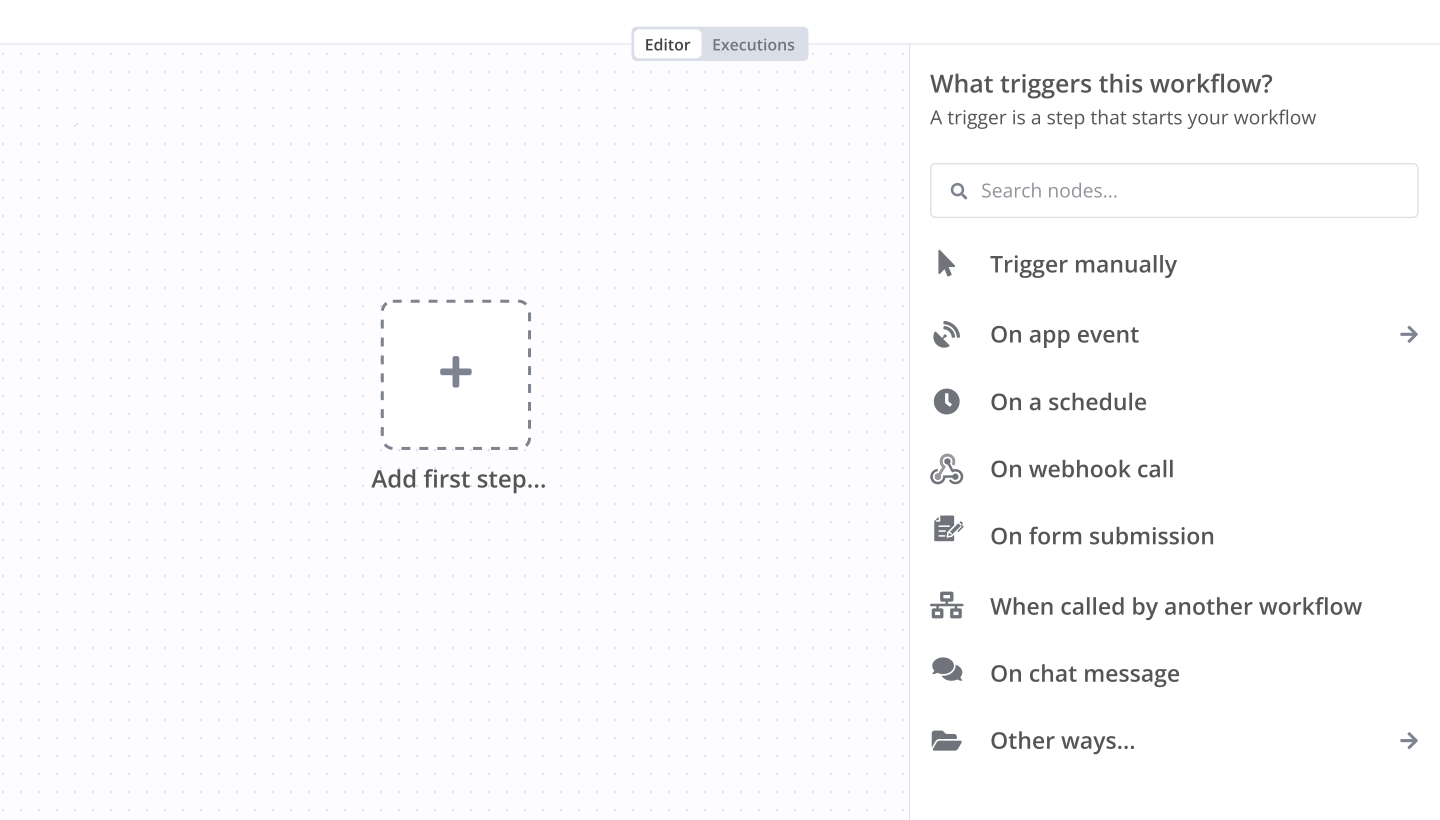
Google Docs and Supabase integration: Create a new workflow and add the first step

Step 2: Add and configure Google Docs and Supabase nodes

You can find Google Docs and Supabase in the nodes panel. Drag them onto your workflow canvas, selecting their actions. Click each node, choose a credential, and authenticate to grant n8n access. Configure Google Docs and Supabase nodes one by one: input data on the left, parameters in the middle, and output data on the right.

Google Docs and Supabase integration: Add and configure Google Docs and Supabase nodes

Step 3: Connect Google Docs and Supabase

A connection establishes a link between Google Docs and Supabase (or vice versa) to route data through the workflow. Data flows from the output of one node to the input of another. You can have single or multiple connections for each node.

Google Docs and Supabase integration: Connect Google Docs and Supabase

Step 4: Customize and extend your Google Docs and Supabase integration

Use n8n's core nodes such as If, Split Out, Merge, and others to transform and manipulate data. Write custom JavaScript or Python in the Code node and run it as a step in your workflow. Connect Google Docs and Supabase with any of n8n’s 1000+ integrations, and incorporate advanced AI logic into your workflows.

Google Docs and Supabase integration: Customize and extend your Google Docs and Supabase integration

Step 5: Test and activate your Google Docs and Supabase workflow

Save and run the workflow to see if everything works as expected. Based on your configuration, data should flow from Google Docs to Supabase or vice versa. Easily debug your workflow: you can check past executions to isolate and fix the mistake. Once you've tested everything, make sure to save your workflow and activate it.

Google Docs and Supabase integration: Test and activate your Google Docs and Supabase workflow

RAG chatbot with Supabase + TogetherAI + Openrouter

⚠️ RUN the FIRST WORKFLOW ONLY ONCE
(as it will convert your content in Embedding format and save it in DB and is ready for the RAG Chat)

📌 Telegram Trigger

Type:** telegramTrigger
Purpose:** Waits for new Telegram messages to trigger the workflow.
Note:** Currently disabled.

📄 Content for the Training

Type:** googleDocs
Purpose:** Fetches document content from Google Docs using its URL.
Details:** Uses Service Account authentication.

✂️ Splitting into Chunks

Type:** code
Purpose:** Splits the fetched document text into smaller chunks (1000 chars each) for processing.
Logic:** Loops over text and slices it.

🧠 Embedding Uploaded Document

Type:** httpRequest
Purpose:** Calls Together AI embedding API to get vector embeddings for each text chunk.
Details:** Sends JSON with model name and chunk as input.

🛢 Save the embedding in DB

Type:** supabase
Purpose:** Saves each text chunk and its embedding vector into the Supabase embed table.

SECOND WORKFLOW EXPLAINATION:

💬 When chat message received

Type:** chatTrigger
Purpose:** Starts the workflow when a user sends a chat message.
Details:** Sends an initial greeting message to the user.

🧩 Embend User Message

Type:** httpRequest
Purpose:** Generates embedding for the user’s input message.
Details:** Calls Together AI embeddings API.

🔍 Search Embeddings

Type:** httpRequest
Purpose:** Searches Supabase DB for the top 5 most similar text chunks based on the generated embedding.
Details:** Calls Supabase RPC function matchembeddings1.

📦 Aggregate

Type:** aggregate
Purpose:** Combines all retrieved text chunks into a single aggregated context for the LLM.

🧠 Basic LLM Chain

Type:** chainLlm
Purpose:** Passes the user's question + aggregated context to the LLM to generate a detailed answer.
Details:** Contains prompt instructing the LLM to answer only based on context.

🤖 OpenRouter Chat Model

Type:** lmChatOpenRouter
Purpose:** Provides the actual AI language model that processes the prompt.
Details:** Uses qwen/qwen3-8b:free model via OpenRouter and you can use any of your choice.

Nodes used in this workflow

Popular Google Docs and Supabase workflows

RAG Chatbot with Supabase + TogetherAI + Openrouter

⚠️ RUN the FIRST WORKFLOW ONLY ONCE (as it will convert your content in Embedding format and save it in DB and is ready for the RAG Chat) 📌 Telegram Trigger Type:** telegramTrigger Purpose:** Waits for new Telegram messages to trigger the workflow. Note:** Currently disabled. 📄 Content for the Training Type:** googleDocs Purpose:** Fetches document content from Google Docs using its URL. Details:** Uses Service Account authentication. ✂️ Splitting into Chunks Type:** code Purpose:** Splits the fetched document text into smaller chunks (1000 chars each) for processing. Logic:** Loops over text and slices it. 🧠 Embedding Uploaded Document Type:** httpRequest Purpose:** Calls Together AI embedding API to get vector embeddings for each text chunk. Details:** Sends JSON with model name and chunk as input. 🛢 Save the embedding in DB Type:** supabase Purpose:** Saves each text chunk and its embedding vector into the Supabase embed table. SECOND WORKFLOW EXPLAINATION: 💬 When chat message received Type:** chatTrigger Purpose:** Starts the workflow when a user sends a chat message. Details:** Sends an initial greeting message to the user. 🧩 Embend User Message Type:** httpRequest Purpose:** Generates embedding for the user’s input message. Details:** Calls Together AI embeddings API. 🔍 Search Embeddings Type:** httpRequest Purpose:** Searches Supabase DB for the top 5 most similar text chunks based on the generated embedding. Details:** Calls Supabase RPC function matchembeddings1. 📦 Aggregate Type:** aggregate Purpose:** Combines all retrieved text chunks into a single aggregated context for the LLM. 🧠 Basic LLM Chain Type:** chainLlm Purpose:** Passes the user's question + aggregated context to the LLM to generate a detailed answer. Details:** Contains prompt instructing the LLM to answer only based on context. 🤖 OpenRouter Chat Model Type:** lmChatOpenRouter Purpose:** Provides the actual AI language model that processes the prompt. Details:** Uses qwen/qwen3-8b:free model via OpenRouter and you can use any of your choice.
+2

Build a Knowledge-Based WhatsApp Assistant with RAG, Gemini, Supabase & Google Docs

Workflow Execution Link: Watch Execution Video Workflow Pre-requisites Step 1: Supabase Setup First, replace the keys in the "Save the embedding in DB" & "Search Embeddings" nodes with your new Supabase keys. After that, run the following code snippets in your Supabase SQL editor: Create the table to store chunks and embeddings: CREATE TABLE public."RAG" ( id bigserial PRIMARY KEY, chunk text NULL, embeddings vector(1024) NULL ) TABLESPACE pg_default; Create a function to match embeddings: DROP FUNCTION IF EXISTS public.matchembeddings1(integer, vector); CREATE OR REPLACE FUNCTION public.matchembeddings1( match_count integer, query_embedding vector ) RETURNS TABLE ( chunk text, similarity float ) LANGUAGE plpgsql AS $$ BEGIN RETURN QUERY SELECT R.chunk, 1 - (R.embeddings <=> query_embedding) AS similarity FROM public."RAG" AS R ORDER BY R.embeddings <=> query_embedding LIMIT match_count; END; $$; Step 2: Create Knowledge Base Create a new Google Doc with the complete knowledge base about your business and replace the document ID in the "Content for the Training" node. Step 3: Get Together AI API Key Get a Together AI API key and paste it into the "Embedding Uploaded document" node and the "Embed User Message" node. Step 4: Setup Meta App for WhatsApp Business Cloud Go to https://business.facebook.com/latest/settings/apps, create an app, and select the use case "Connect with customer through WhatsApp". Copy the Client ID and Client Secret and add them to the first node. Go to that newly created META app in the app dashboard, click on the use case, and then click on "customise...". Go to the API setup, add your number, and also generate an access token on that page. Now paste the access token and the WhatsApp Business Account ID into the send message node. Part A: Document Preparation (One-Time Setup) When clicking ‘Execute workflow’ Type:** manualTrigger Purpose:** Manually starts the workflow for preparing training content. Content for the Training Type:** googleDocs Purpose:** Fetches the document content that will be used for training. Splitting into Chunks Type:** code Purpose:** Breaks the document text into smaller pieces for processing. Embedding Uploaded document Type:** httpRequest Purpose:** Converts each chunk into embeddings via an external API. Save the embedding in DB Type:** supabase Purpose:** Stores both the chunks and embeddings in the database for future use. Part B: Chat Interaction (Realtime Flow) WhatsApp Trigger Type:** whatsAppTrigger Purpose:** Starts the workflow whenever a user sends a WhatsApp message. If Type:** if Purpose:** Checks whether the incoming WhatsApp message contains text. Embend User Message Type:** httpRequest Purpose:** Converts the user’s message into an embedding. Search Embeddings Type:** httpRequest Purpose:** Finds the top matching document chunks from the database using embeddings. Aggregate Type:** aggregate Purpose:** Merges retrieved chunks into one context block. AI Agent Type:** langchain agent Purpose:** Builds the prompt combining user’s message and context. Google Gemini Chat Model Type:** lmChatGoogleGemini Purpose:** Generates the AI response based on the prepared prompt. Send message Type:** whatsApp Purpose:** Sends the AI’s reply back to the user on WhatsApp.

RAG-Powered AI Voice Customer Support Agent (Supabase + Gemini + ElevenLabs)

Execution video: Youtube Link I built an AI voice-triggered RAG assistant where ElevenLabs’ conversational model acts as the front end and n8n handles the brain....here’s the real breakdown of what’s happening in that workflow: Webhook (/inf) Gets hit by ElevenLabs once the user finishes talking. Payload includes user_question. Embed User Message (Together API - BAAI/bge-large-en-v1.5) Turns the spoken question into a dense vector embedding. This embedding is the query representation for semantic search. Search Embeddings (Supabase RPC) Calls matchembeddings1 to find the top 5 most relevant context chunks from your stored knowledge base. Aggregate Merges all retrieved chunk values into one block of text so the LLM gets full context at once. Basic LLM Chain (LangChain node) Prompt forces the model to only answer from the retrieved context and to sound human-like without saying “based on the context”.... Uses Google Vertex Gemini 2.5 Flash as the actual model. Respond to Webhook Sends the generated answer back instantly to the webhook call, so ElevenLabs can speak it back. You essentially have: Voice → Text → Embedding → Vector Search → Context Injection → LLM → Response → Voice
+10

Multi-Language Telegram RAG Chatbot with Supervisor AI & Automated Google Drive Pipeline

N8N Hybrid RAG Chatbot with Multiple AI Agents One of the most powerful system in the market, this template creates a sophisticated, multi-agent hybrid RAG (Retrieval-Augmented Generation) chatbot that can handle diverse user queries by routing them to a “Supervisor AI agent”. The Supervisor agent will then send the request to “Expert AI agents”, agents specializing in specific domains. In addition, this system automates data ingestion from various sources (including websites and Google Drive), processes and stores the information in a vector database, and interacts with users through Telegram in multiple languages. For more powerful n8n templates, visit our website at aiautomationpro.org. Who’s it for? This template is ideal for: Developers and Businesses** looking to build a powerful, knowledge-based chatbot for customer support, internal knowledge management, or lead generation. AI Enthusiasts** who want to explore advanced concepts like multi-agent systems, RAG, and automated data pipelines. n8n Users** who want to build a scalable and customizable AI solution that integrates multiple services. Key Features Multi-Agent Architecture:** Utilizes a supervisor agent to route queries to specialized agents for different domains (e.g., Products, News, Academy). Automated Data Ingestion:** Automatically scrapes data from websites and syncs new or updated files from Google Drive. Retrieval-Augmented Generation (RAG):** Enriches the chatbot's knowledge by retrieving relevant information from a Supabase vector store and a Postgres database. Telegram Integration:** Provides a seamless, multi-language chat interface for users to interact with the bot. Dynamic Data Handling:** Automatically processes and embeds data from various sources like Google Docs, PDFs, and Word documents. Data Management:** Keeps the knowledge base up-to-date by automatically handling document creation, updates, and deletions. How it works The workflow is divided into three main parts: data ingestion, data management, and the chat interface. Data Ingestion & Processing: Web Scraping: The workflow fetches URLs from a Google Sheet, scrapes the content using Crawl4ai, cleans it with an AI agent, and saves it to a Google Doc. Google Drive Sync: It monitors specific Google Drive folders for new or updated files (Google Docs, PDFs, Word documents). Embedding & Storage: The content from these sources is then chunked, converted into vector embeddings using OpenAI, and stored in a Supabase vector database for efficient retrieval. Data Deletion: A scheduled trigger periodically checks a Google Sheet for records marked as "deleted." It then removes the corresponding data from the Supabase vector store and deletes the file from Google Drive to ensure the chatbot's knowledge remains current. Chat Interface & Logic (Telegram): User Input: The chatbot receives user messages via a Telegram trigger. Language Detection: It first detects the language of the query and translates it to English if necessary. Supervisor Agent: A central "Supervisor" AI agent analyzes the user's query. Agent Routing: Based on the query, the Supervisor delegates the task to the most appropriate specialized agent: News AI Agent: Handles questions about current events. Product AI Agent: Answers queries about product details from a Postgres database. Academy AI Agent: Responds to questions about courses and educational content. Response Generation: The selected agent processes the query, retrieves the necessary information using RAG, generates a response, and translates it back to the user's original language before sending it via Telegram. Requirements To use this template, you will need accounts and credentials for the following services: n8n OpenAI Supabase (for vector storage) Google Workspace (Google Drive, Google Sheets, Google Docs) Telegram Bot Postgres Database Crawl4AI Step-by-step Setup Configure Credentials: Add your API keys and credentials for all the required services (OpenAI, Supabase, Google, Telegram, Postgres) in the n8n Credentials section. Set up Google Drive: Create two folders in your Google Drive: one for documents scraped from websites and another for manual document uploads. Note the folder IDs. Set up Google Sheets: Clone the Google Sheet template, or create a Google Sheet with two tabs: Website Links and Manual Documents. In the Website Links tab, add columns for Link, Category Code, Is Scraped, and Is Deleted. In the Manual Documents tab, add columns for Document ID, Title, Category Code, and Is Deleted. Set up Supabase: Create a new project in Supabase. Run the provided SQL script to create the documents table for vector storage. Set up Postgres: Set up a Postgres database (in Supabase). Run the provided SQL script to create the products table to store product details. Configure the Main Workflow: Open the AIAutomationPro Ultimate RAG Chatbot main workflow. Update the Google Drive, Google Sheets, Supabase, and Postgres nodes with your specific Folder IDs, Sheet Names, and table names. Link the three sub-workflows (News AI Agent, Product AI Agent, Academy AI Agent) in the corresponding Workflow Tool nodes. Activate Workflows: Activate the main workflow and all three sub-flow workflows. Start Chatting: Send a message to your Telegram bot to start interacting with your new RAG chatbot. How to Customize the Workflow Add More Agents:** You can create new sub-workflows with specialized agents for different topics (e.g., a "Finance AI Agent"). Simply add a new Workflow Tool node in the main flow and update the Supervisor Agent's system prompt to include the new agent's capabilities. Change Data Sources:** Modify the data ingestion part of the workflow to pull data from other sources like Notion, HubSpot, or a CRM by adding the relevant n8n nodes. Adjust the AI Model:** You can switch to a different LLM by replacing the OpenAI Chat Model nodes. Modify Prompts:** Fine-tune the system prompts in the Agent nodes to alter the personality, instructions, or output format of the chatbot and its specialized agents.

Build your own Google Docs and Supabase integration

Create custom Google Docs and Supabase workflows by choosing triggers and actions. Nodes come with global operations and settings, as well as app-specific parameters that can be configured. You can also use the HTTP Request node to query data from any app or service with a REST API.

Google Docs supported actions

Create
Get
Update

Supabase supported actions

Create
Create a new row
Delete
Delete a row
Get
Get a row
Get Many
Get many rows
Update
Update a row

FAQs

  • Can Google Docs connect with Supabase?

  • Can I use Google Docs’s API with n8n?

  • Can I use Supabase’s API with n8n?

  • Is n8n secure for integrating Google Docs and Supabase?

  • How to get started with Google Docs and Supabase integration in n8n.io?

Looking to integrate Google Docs and Supabase in your company?

Over 3000 companies switch to n8n every single week

Why use n8n to integrate Google Docs with Supabase

Build complex workflows, really fast
Build complex workflows, really fast

Handle branching, merging and iteration easily.
Pause your workflow to wait for external events.

Code when you need it, UI when you don't

Simple debugging

Your data is displayed alongside your settings, making edge cases easy to track down.

Use templates to get started fast

Use 1000+ workflow templates available from our core team and our community.

Reuse your work

Copy and paste, easily import and export workflows.

Implement complex processes faster with n8n

red iconyellow iconred iconyellow icon