Back to Integrations
integrationGoogle Drive node
integrationNotion node

Google Drive and Notion integration

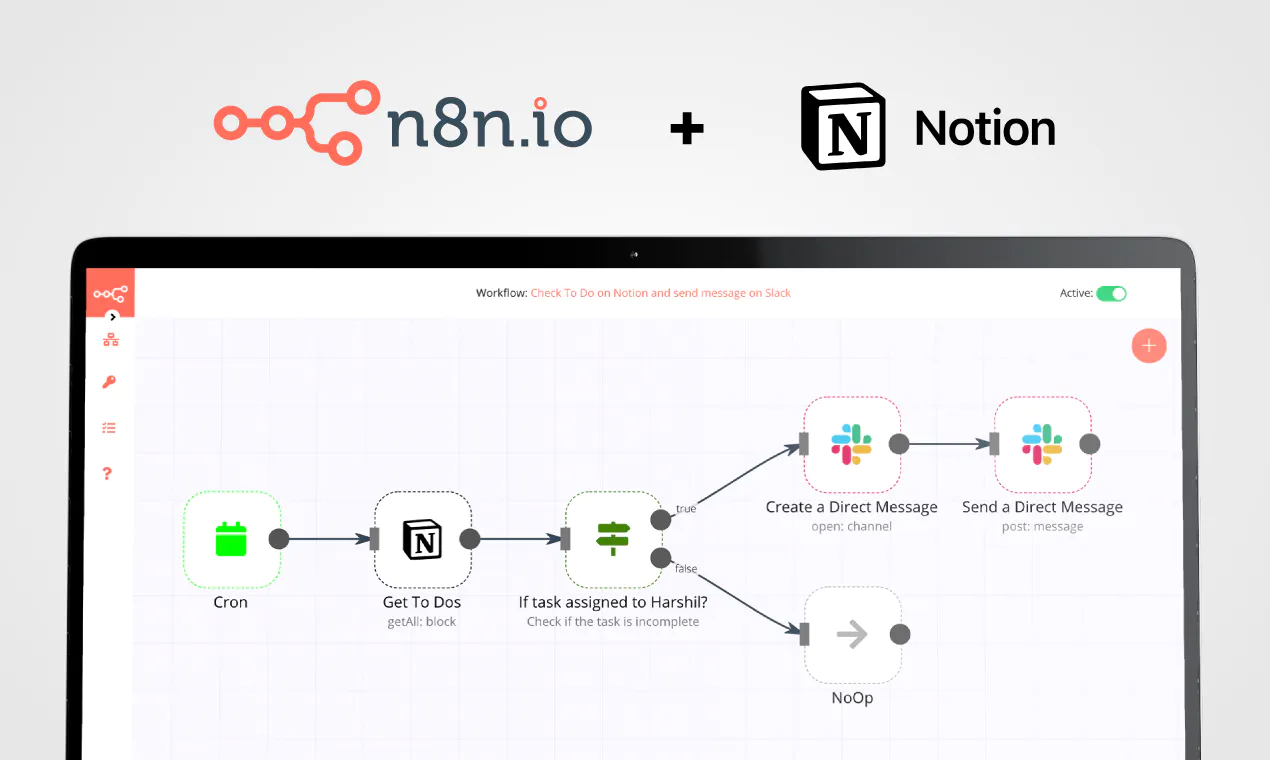
Save yourself the work of writing custom integrations for Google Drive and Notion and use n8n instead. Build adaptable and scalable Data & Storage, and Productivity workflows that work with your technology stack. All within a building experience you will love.

How to connect Google Drive and Notion

  • Step 1: Create a new workflow
  • Step 2: Add and configure nodes
  • Step 3: Connect
  • Step 4: Customize and extend your integration
  • Step 5: Test and activate your workflow

Step 1: Create a new workflow and add the first step

In n8n, click the "Add workflow" button in the Workflows tab to create a new workflow. Add the starting point – a trigger on when your workflow should run: an app event, a schedule, a webhook call, another workflow, an AI chat, or a manual trigger. Sometimes, the HTTP Request node might already serve as your starting point.
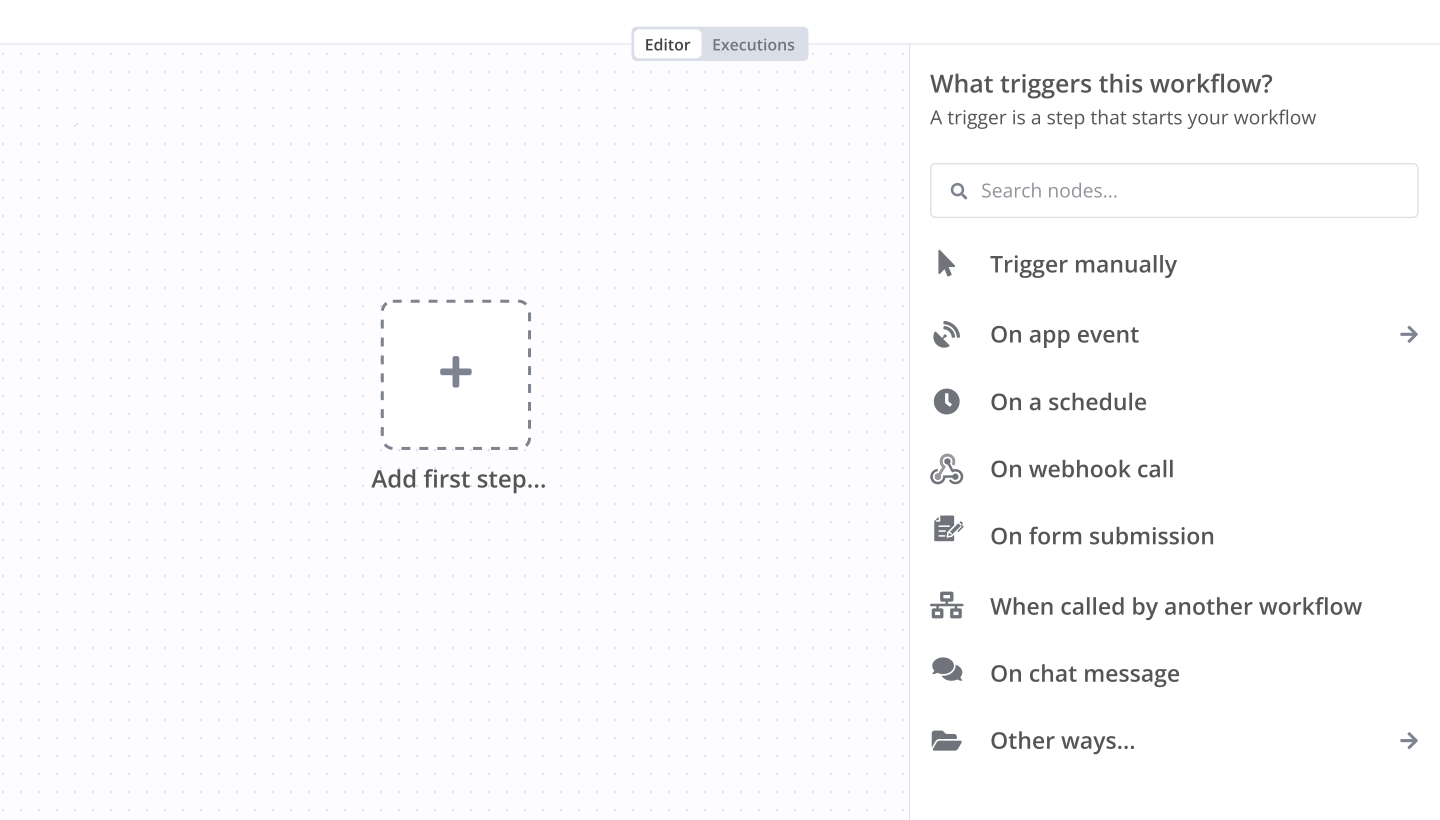
Google Drive and Notion integration: Create a new workflow and add the first step

Step 2: Add and configure Google Drive and Notion nodes

You can find Google Drive and Notion in the nodes panel. Drag them onto your workflow canvas, selecting their actions. Click each node, choose a credential, and authenticate to grant n8n access. Configure Google Drive and Notion nodes one by one: input data on the left, parameters in the middle, and output data on the right.

Google Drive and Notion integration: Add and configure Google Drive and Notion nodes

Step 3: Connect Google Drive and Notion

A connection establishes a link between Google Drive and Notion (or vice versa) to route data through the workflow. Data flows from the output of one node to the input of another. You can have single or multiple connections for each node.

Google Drive and Notion integration: Connect Google Drive and Notion

Step 4: Customize and extend your Google Drive and Notion integration

Use n8n's core nodes such as If, Split Out, Merge, and others to transform and manipulate data. Write custom JavaScript or Python in the Code node and run it as a step in your workflow. Connect Google Drive and Notion with any of n8n’s 1000+ integrations, and incorporate advanced AI logic into your workflows.

Google Drive and Notion integration: Customize and extend your Google Drive and Notion integration

Step 5: Test and activate your Google Drive and Notion workflow

Save and run the workflow to see if everything works as expected. Based on your configuration, data should flow from Google Drive to Notion or vice versa. Easily debug your workflow: you can check past executions to isolate and fix the mistake. Once you've tested everything, make sure to save your workflow and activate it.

Google Drive and Notion integration: Test and activate your Google Drive and Notion workflow

Transcribe audio files, summarize with GPT-4, and store in Notion

Who is this for?
This workflow template is perfect for content creators, researchers, students, or anyone who regularly works with audio files and needs to transcribe and summarize them for easy reference and organization.

What problem does this workflow solve?
Transcribing audio files and summarizing their content can be time-consuming and tedious when done manually. This workflow automates the process, saving users valuable time and effort while ensuring accurate transcriptions and concise summaries.

What this workflow does
This template automates the following steps:

Monitors a specified Google Drive folder for new audio files
Sends the audio file to OpenAI's Whisper API for transcription
Passes the transcribed text to GPT-4 for summarization
Creates a new page in Notion with the summary

Setup
To set up this workflow:

Connect your Google Drive, OpenAI, and Notion accounts to n8n
Configure the Google Drive node with the folder you want to monitor for new audio files
Set up the OpenAI node with your API key and desired parameters for Whisper and GPT-4
Specify the Notion database where you want the summaries to be stored

How to customize this workflow
Adjust the Google Drive folder being monitored
Modify the OpenAI node parameters to fine-tune the transcription and summarization process
Change the Notion database or page properties to match your preferred structure

With this AI-powered workflow, you can effortlessly transcribe audio files, generate concise summaries, and store them in a structured manner within Notion.

Streamline your audio content processing and organization with this automated template.

Nodes used in this workflow

Popular Google Drive and Notion workflows

One-way sync between Telegram, Notion, Google Drive, and Google Sheets

One-way sync between Telegram, Notion, Google Drive, and Google Sheets Who is this for? This workflow is perfect for productivity-focused teams, remote workers, virtual assistants, and digital knowledge managers who receive documents, images, or notes through Telegram and want to automatically organize and store them in Notion, Google Drive, and Google Sheets—without any manual work. What problem is this workflow solving? Managing Telegram messages and media manually across different tools like Notion, Drive, and Sheets can be tedious. This workflow automates the classification and storage of incoming Telegram content, whether it’s a text note, an image, or a document. It saves time, reduces human error, and ensures that media is stored in the right place with metadata tracking. What this workflow does Triggers on a new Telegram message** using the Telegram Trigger node. Classifies the message type** using a Switch node: Text messages are appended to a Notion block. Images are converted to base64, uploaded to imgbb, and then added to Notion as toggle-image blocks. Documents are downloaded, uploaded to Google Drive, and the metadata is logged in Google Sheets. Sends a completion confirmation** back to the original Telegram chat. Setup Telegram Bot: Set up a bot and get the API token. Notion Integration: Share access to your target Notion page/block. Use the Notion API credentials and block ID where content should be appended. Google Drive & Sheets: Connect the relevant accounts. Select the destination folder and spreadsheet. imgbb API: Obtain a free API key from imgbb. Replace placeholder credential IDs and asset URLs as needed in the imported workflow. How to customize this workflow to your needs Change Storage Locations**: Update the Notion block ID or Google Drive folder ID. Switch Google Sheet to log in a different file or sheet. Add More Filters**: Use additional Switch rules to handle other Telegram message types (like videos or voice messages). Modify Response Message**: Personalize the Telegram confirmation text based on the file type or sender. Use a different image hosting service** if you don’t want to use imgbb.

Automate Image Portfolio Organization with GPT-4o Vision, Google Drive and Notion

Overview This template is ideal for photographers, graphic designers, and creative professionals who manage large volumes of visual assets. It is also perfect for Digital Asset Managers looking for a customizable, automated solution to organize files without manual tagging. What it does When a new image is uploaded to a designated "Inbox" folder in Google Drive, the workflow performs the following actions: AI Analysis**: Uses GPT-4o to analyze the image content, generating a description, extracting dominant colors, and determining the category (e.g., Portrait vs. Landscape). Safety Check**: Runs an AI-based NSFW filter. If inappropriate content is detected, the process stops, and a warning is sent to Slack. Smart Sorting**: Automatically moves the file into the correct subfolder based on its category. Contextual Tagging**: Generates specific tags (e.g., "smile, natural light" for portraits) and updates the file metadata. Archiving**: Creates a comprehensive entry in a Notion Database with the image link, tags, and description. Notification**: Sends a success alert to Slack with a summary of the archived asset. How to set up This workflow is designed to be plug-and-play using a central configuration node. Credentials: Connect your Google Drive, OpenAI, Notion, and Slack accounts in n8n. Set Variables: Open the node named "Workflow Configuration". Replace the placeholder IDs with your actual Folder IDs (for Inbox, Portraits, and Landscapes), Notion Database ID, and Slack Channel ID. Prepare Notion: Create a Database in Notion with the following properties: Category (Select) Description (Rich Text) Image URL (URL) Tags (Rich Text) Date (Date) Requirements n8n Version**: 1.0 or later. OpenAI API: Access to the **gpt-4o model is recommended for accurate vision analysis. Google Drive**: A specific folder structure (Inbox, Portraits, Landscapes). Notion**: A dedicated database for the portfolio. Slack**: A channel for notifications. How to customize Add Categories**: You can expand the "Category Router" (Switch node) to include more specific genres like "Architecture," "Macro," or "Street," and add corresponding paths. Adjust Prompts**: Modify the system prompts in the AI nodes to change the language of the output or the style of the generated tags. Change Output**: Connect to Airtable or Excel instead of Notion if you prefer a different database system.
+5

Resume Screening & Behavioral Interviews with Gemini, Elevenlabs, & Notion ATS

Description Candidate Engagement | Resume Screening | AI Voice Interviews | Applicant Insights This intelligent n8n workflow automates the process of extracting and scoring resumes received through a company career page, populating a Notion database with AI insights where the recruiter or hiring manager can automatically invite the applicant to an instant interview with an Elevenlabs AI voice agent. After the agent conducts the behavior-based interview, the workflow scores the overall interview against customizable evaluation criteria and updates the Notion database with AI insights about the applicant. AI Powered Resume Screening & Voice AI that interviews like a Recruiter! AI Insights in Notion dashboard Who is this for? HR teams, recruiters, and talent acquisition professionals This workflow is ideal for HR teams, recruiters, and talent acquisition professionals looking for a foundational, extensible framework to automate early stage recruiting. Whether you're exploring AI for the first time or scaling automation across your hiring process, this template provides a base for screening, interviewing, and tracking candidates—powered entirely by n8n, Elevenlabs, Notion, and LLM integrations. Be sure to consult State and Country regulations with respect to AI Compliance, AI Bias Audits, AI Risk Assessment, and disclosure requirements. What problem is this workflow solving? Manually screening resumes and conducting initial interviews slows down hiring. This template automates: Resume assessment against job description. Scheduling first and second round interviews. First-round AI-led behavioral interviews with AI scoring assessment. Centralized tracking of AI assessments in Notion. What this does This customizable tool, configured to manage 3 requisitions in parallel, automates the application process, resume screen, and first round behavioral interviews. Pre-screen Applicants with AI Immediately screens and scores applicant’s resume against the job description. The AI Agent generates a score and an AI assessment, adding both to the applicant's profile in Notion. Notion automatically notifies hiring manager when a resume receives a score of 8 or higher. Voice AI that Interviews like a Recruiter AI Voice agent adapts probing questions based on applicant’s response and intelligently dives deeper into skill and experience to assess answers against a scoring rubric for each question. AI Applicant Insights in Notion Get detailed post-interview AI analysis, including interview recordings and question-by-question scoring breakdowns to help identify who you should advance to the next stage in the process. AI insight provided in Notion ATS dashboard with drag and drop to advance top candidates to the next interview stage. How it works Link to Notion Template Notion Career Page: Notion Career Page published to web, can be integrated with your preferred job board posting system. Notion Job Posting: Gateway for applicants to apply to active requisitions with ‘Click to Apply’ button. Application Form: N8N webform embedded into Notion job posting captures applicant information and routes for AI processing. AI Agent evaluates resume against job description AI Agent evaluates resume against the job description, stored in Notion, and scores the applicant on a scale of 1 to 10, providing rationale for score. Creates ATS record in Notion with assessment and score Workflow creates the applicant record in the Notion ATS where Recruiters and Hiring Managers see applicants in a filtered view, sorted by AI generated resume score. Users can automatically advance applicants to the next step in process (AI Conversation interview) with drag and drop functionality. Invites applicant to an Instant AI Interview Dragging the applicant to AI Interview step in the Notion ATS dashboard triggers Notion automation that sends the applicant an email with a link to the Elevenlabs Conversation AI Agent. The AI Conversation Agent is provided with instructions on how to conduct the behavior-based interview, including probing questions, for the specific role. AI Conversation Agent Behavior Based Interview The email link resolves to an ElevenLabs AI Conversation agent that has been instructed to interview applicants using pre-defined interview questions, scoring rubric, job description, and company profile. The Elevenlabs agent assesses the applicant on a scale of 1 to 5 for each interview question and provides an overall assessment of the interview based on established evaluation criteria. Click to hear AI Voice Agent in action Example: Role: IT Support Analyst Mark: Elevenlabs AI Agent instructed to interview applicants for specific role Gemini: Google AI coached to answer questions as an IT Support Analyst being interviewed Updates Notion record with Interview Assessment and Score All results—including the conversation transcript, interview scores, and rationale for assessment are automatically added back to the applicant’s profile in Notion where the Hiring Manager can validate the AI assessment by skimming through the embedded audio file. AI Interview Overall Score: 1 to 5 based on response to all questions and probes. AI Agent confirms that it was able to evaluate the interview using the assigned rubric. AI Interview Criteria Score: Success/Failure based on response to individual interview questions. Invites applicant to second interview with Hiring Manager Dragging the applicant to the ‘Hiring Manager Interview’ step in the Notion ATS dashboard triggers a Notion automation that sends an email with a link to the Hiring Manager’s calendar scheduling solution. Configuration and Set Up Accounts & API Keys You wil need accounts and credentials for: n8n (hosted or self-hosted) Elevenlabs (for AI Conversation Agent) Gemini (for LLM model access) Google Drive (to back up applicant data) Calendly (to automate interview scheduling) Gmail (to automate interview scheduling) Data / Documents to implement Job Descriptions for each role Interview questions for each role Evaluation criteria for each interview question Notion Set Up Customize your Notion Career Page Link to Free Notion Template that enables workflow: Update Notion job description database -update job description(s) for each role -add interview questions to the job description database page in Notion -add evaluation criteria to the job description database page in Notion -edit each ‘Click to Apply’ button in the job description template so it resolves to the corresponding N8N 'Application Form' webform production URL (detail provided below) Notion Applicant Tracker In the Applicant Tracker database, update position titles, tab headings, in the custom database view (Notion) so it reflects the title of the position you are posting. Edit the filter for each tab so it matches the position title. Notion Email Automation Update Notion automation templates used to invite applicants to the AI Interview and Hiring Manager interview. Note: Trigger email automation by dragging applicant profile to the next Applicant Comm Status in the Applicant Tracker. AI Interview invite template: revise position title to reflect the title of the role you are posting; include the link to your Conversation AI Agent for that role in the email body. Note: each unique role will use an Elevenlabs AI conversation agent designed for that role. Hiring Manager Interview invite template: revise position title to reflect the title of the role you are posting; include the link to your Calendly page or similar solution provider to automate interview scheduling. N8N Configuration Workflow 1 Application Forms (3 Nodes - one for each job) Update the N8N form title and description to match the job description you configured in Notion. Confirm Job Code in Applicant Form node matches Job Code in Notion for that position. Edit the Form Response to customize the message you want displayed after applicant clicks submit. Upload CV - Google Drive Authenticate your Google Drive account and select the folder that will be used to store resumes Get Job Description - Notion Authenticate your Notion account and select your Career Page from the list of databases that contain your job descriptions. Applicant Data Backup - Google Sheet Create a Google Sheet where you will track applicant data for AI Compliance reporting requirements. Open the node in n8n and use the field names in the node as Google Sheet column headings. Workflow 2 Elevenlabs Web Hook (Node 1) Edit the Web Hook POST node and copy your production URL that is displayed in the Node. This URL is entered into the Elevenlabs AI Conversation Agent post-call webhook described below. AI Agent Authenticate your LLM model (Gemini in this example) and add your Notion database as a tool to pull the evaluation_criteria hosted in Notion for the specific role. Extract Audio Create an Elevenlabs API key for your conversation agent and enter that key as a json header for the Extract Audio node Upload Audio to Drive - Google Drive Authenticate your Google Drive account and select the folder that will be used to store the audio file. Elevenlabs Configuration Create an Elevenlabs account Create Conversation AI Agent Add First Message and Systems Prompt: Design your ‘First Message’ and ‘Systems Prompt’ that guides the AI agent conducting the interview. Tool Tip: provide instruction that limits the number of probes per interview question. Knowledge Base: Upload your role specific interview questions and job description, using the same text that is stored in your Notion Career page for the role. You can also add a document about your company and instruct the Elevenlabs agent to answer questions about culture, strategy, and company growth. Analysis: Evaluation Criteria: Add your evaluation criteria, less than 2000 characters, for each interview question / competency. Analysis: Data Collection: Add the following elements, using the exact character string represented below. phone_number_AI_screen "capture applicant's phone number provided at the start of the conversation and share this as a string, integers only." full_name "capture applicant's full name provided at the start of the conversation." Advanced: Max Duration Set the max duration for interview in seconds. The AI Agent will timeout at the max duration. Conversation AI Widget: Customize your AI Conversation Agent landing page, including the position tile and company name. AI Conversation Agent URL: Copy the AI Conversation Agent URL and add it to your Notion email template triggered by the AI Interview email automation. Use a custom AI Agent URL for each distinct job description. Enable your Elevenlabs Post-Call Webhook for your Conversation Agent: Log into your Elevenlabs account and go to Conversational AI Settings and click on Post-Call Web Hook. This is where you enter the production URL from the N8N Web Hook node (Workflow 2). This sends the AI Voice Agent output to your n8n workflow which feeds back to your Notion dashboard.
+2

Summarize Gmail into Notion with OpenAI and create audio digests in Google Drive

Gmail → AI Summary → Notion + Audio Digest This n8n workflow turns incoming Gmail emails into structured AI summaries and optional audio digests, automatically delivered to Notion and Google Drive. It is designed to reduce email overload by transforming raw messages into concise, readable, and listenable content. What this workflow does On a scheduled basis, the workflow: Retrieves Gmail messages (all subjects or filtered) Marks processed emails as read to avoid duplicates Extracts and normalizes the email body Uses OpenAI to generate a clean, structured summary From the summary, the workflow branches into two outputs: Text summary The final AI-generated summary is appended as a block in Notion Ideal for daily logs, knowledge bases, or team dashboards Audio transcript (optional) The summary text is converted into speech using a TTS model The audio file is uploaded to Google Drive A shareable link is generated The audio reference is added back into Notion Key features Automated Gmail ingestion AI-powered email summarization JavaScript preprocessing for clean input Notion integration for structured storage Text-to-speech audio generation Google Drive hosting for audio files Error-aware branching for TTS generation Idempotent and schedule-safe execution Typical use cases Daily or weekly email digests Executive summaries of inbox activity Audio briefings you can listen to on the go Knowledge capture from important emails Reducing cognitive load from long email threads Who this template is for Professionals dealing with high email volume Teams using Notion as a central workspace n8n users building AI productivity automations Anyone who wants emails summarized instead of skimmed This template is designed to be practical, extensible, and production-ready, and can be easily adapted to: multiple Gmail labels different summary styles alternative TTS providers additional destinations (Slack, Docs, databases)
+9

AI Email Auto-Responder System- AI RAG Agent for Email Inbox

AI Email Auto-Responder – Smart Client Reply Automation with RAG This workflow is built for individuals, teams, and businesses that receive regular inquiries via email and want to automate responses in a way that’s intelligent, brand-aligned, and always up to date. Its core purpose is to generate high-quality, professional email replies using internal company data, brand voice, and semantic search — fully automated through Gmail, Pinecone, and OpenAI. The system is divided into three steps. First, it allows you to index your internal knowledge base (Docs, Sheets, PDFs) with embeddings. Second, it injects a consistent brand brief into every interaction to ensure tone and positioning. Finally, the main flow listens for incoming emails, understands the user query, retrieves all needed data, and writes a full HTML reply — sending it directly to the original thread via Gmail. This solution is ideal for support teams, solopreneurs, B2B service providers, or anyone looking to scale high-quality client communication without scaling manual work. It can be extended to handle multilingual queries, intent routing, or CRM logging. How it works When a new email arrives in Gmail, the workflow checks whether it's a valid client inquiry. If so, it: Extracts the subject and message content Sends the message through OpenAI to understand the question Queries a Pinecone vector database (populated via a separate embedding workflow) to find relevant internal knowledge Loads a brand brief from a Google Doc or Notion block Combines retrieved data and brand context to generate a clear, structured HTML reply using OpenAI Sends the reply via Gmail and logs the message This process ensures every reply is relevant, accurate, and consistent with your brand — and takes under 10 seconds. Set up steps Getting started takes about 30–60 minutes. Create three workflows: one for embedding documents (Step 1), one sub-workflow for the brand brief (Step 2), and one main responder flow (Step 3) Connect the following APIs: Gmail (OAuth2), OpenAI, Pinecone, Google Drive, and optionally Notion Replace all placeholders: folder ID in Google Drive, Pinecone index and namespace, your brand brief URL or doc ID, and Gmail credentials Test your embedding workflow by uploading a document and verifying its presence in Pinecone Trigger the responder by sending an email and reviewing the AI’s reply Detailed setup instructions are stored in sticky notes within each workflow to guide you through configuration.
+6

Create Structured Notion Workspaces from Notes & Voice Using Gemini & GPT

AI Assistant Workflow: Create Notion Workspaces from Notes & Voice Records 👤 Who is this for? This workflow is designed for anyone who loves Notion—from project managers, freelancers, to students—who want to turn scattered ideas, handwritten notes, or quick thoughts into fully structured Notion databases without the hassle of manual setup. 😩 The Problem You have a brilliant idea jotted down during a meeting or on a piece of paper. But turning that into a structured Notion workspace (for project management, CRM, habit tracking, recipes, etc.) is time-consuming and disruptive. Designing properties, configuring views, and entering sample data can interrupt your creative flow and slow down execution. ⚡️ How It Works This workflow acts as a smart AI assistant that automatically builds a full Notion workspace from just a simple note or voice record. Notes & Upload Snap a picture of your handwritten notes or type a quick description of what you want to manage. Upload it into a Google Drive folder. AI Reads & Understands Step 1: Google Gemini AI converts handwritten notes into text (OCR). Step 2: Another AI (OpenAI/Vertex AI) analyzes the intent—figuring out whether you want a project plan, a CRM contact list, or maybe a recipe collection. AI Designs & Builds A specialized AI then designs the database structure, including: Properties (date, status, assignee, tags, etc.) Dropdown options Useful views (Table, Kanban Board, Calendar, Gallery) Database Creation & Sample Data The system creates the database in your Notion automatically. Fills it with realistic sample entries so you can start working immediately. ⚙️ Detailed Workflow Steps 🔄 Automated Flow Trigger & Read Notes Workflow starts when a file (image or text) is uploaded to a Google Drive folder. Gemini AI extracts text from handwritten notes. Track Request System generates a unique Request ID. Creates a new page in a Notion tracking database "Agent Notes" with status = "Not started". AI Intent Analysis An AI Agent analyzes the extracted text to identify: Content type (e.g., project_management, crm_contacts, inventory_tracking) Complexity level (scale 1–5) Suggested database title, description, and icon AI Database Design Another AI Agent designs the structure: Schema: Names and types for each property (column) Sample Data: 5–10 rows of context-appropriate sample entries (localized for Vietnam if needed) Views: Recommendations for Table, Board, Calendar, Gallery, etc. Database Creation AI output is formatted for Notion API. Workflow creates a new inline database inside the tracking page. Insert Sample Data Workflow iterates over the AI-generated sample rows and inserts them into the new database. Completion Updates the status of the "Agent Notes" page to "Done". Records completion time. 🛠️ Setup Instructions 📝 Configure Notion Create a new Integration in Notion (My Integrations) → Copy the Internal Integration Token. Create a database named "Agent Notes" with properties: Name (Title) Status (Status) Request ID (Text) Last Updated (Date) Share "Agent Notes" with your integration. Copy the database ID from the URL. 📁 Configure Google Drive Create a new folder in Google Drive (e.g., "Notes for Notion"). Copy the folder ID from the URL. 🔧 Setup in n8n Import the workflow into your n8n instance. Add credentials for Notion, Google Drive, and OpenAI/Google AI (Vertex). Update configuration in nodes: Google Drive Trigger → Paste your Drive folder ID Notion Nodes (Create Row, Get Row) → Paste "Agent Notes" database ID AI Nodes → Ensure correct credentials are selected 🚀 Usage Example Imagine you want to manage your recipes. Write on paper: Create a recipe collection. Needed fields: Dish name, Ingredients, Cooking time, Difficulty (easy/medium/hard), Type (main/dessert), Picture. Take a photo and upload it to the configured Google Drive folder. Wait a few minutes. A new database “Recipe Collection 🍲” will appear in Notion, with: Columns already set up Sample recipes filled in Useful views (Table, Gallery, Calendar) 🌟 Key Benefits No manual setup required Transforms messy notes into structured, usable data Works with both handwritten notes and typed text Saves time, maintains creative flow, and boosts productivity

Build your own Google Drive and Notion integration

Create custom Google Drive and Notion workflows by choosing triggers and actions. Nodes come with global operations and settings, as well as app-specific parameters that can be configured. You can also use the HTTP Request node to query data from any app or service with a REST API.

Google Drive supported actions

Copy
Create a copy of an existing file
Create From Text
Create a file from a provided text
Delete
Permanently delete a file
Download
Download a file
Move
Move a file to another folder
Share
Add sharing permissions to a file
Update
Update a file
Upload
Upload an existing file to Google Drive
Search
Search or list files and folders
Create
Create a folder
Delete
Permanently delete a folder
Share
Add sharing permissions to a folder
Create
Create a shared drive
Delete
Permanently delete a shared drive
Get
Get a shared drive
Get Many
Get the list of shared drives
Update
Update a shared drive

Notion supported actions

Append After
Append a block
Get Child Blocks
Get many child blocks
Get
Get a database
Get Many
Get many databases
Search
Search databases using text search
Get
Get a database
Get Many
Get many databases
Create
Create a page in a database
Get
Get a page in a database
Get Many
Get many pages in a database
Update
Update pages in a database
Create
Create a pages in a database
Get Many
Get many pages in a database
Update
Update pages in a database
Create
Create a page
Get
Get a page
Search
Text search of pages
Archive
Archive a page
Create
Create a page
Search
Text search of pages
Get
Get a user
Get Many
Get many users

FAQs

  • Can Google Drive connect with Notion?

  • Can I use Google Drive’s API with n8n?

  • Can I use Notion’s API with n8n?

  • Is n8n secure for integrating Google Drive and Notion?

  • How to get started with Google Drive and Notion integration in n8n.io?

Need help setting up your Google Drive and Notion integration?

Discover our latest community's recommendations and join the discussions about Google Drive and Notion integration.
Justin Cheu
Cris A. Works
Martin
hubschrauber
Jon

Looking to integrate Google Drive and Notion in your company?

Over 3000 companies switch to n8n every single week

Why use n8n to integrate Google Drive with Notion

Build complex workflows, really fast
Build complex workflows, really fast

Handle branching, merging and iteration easily.
Pause your workflow to wait for external events.

Code when you need it, UI when you don't

Simple debugging

Your data is displayed alongside your settings, making edge cases easy to track down.

Use templates to get started fast

Use 1000+ workflow templates available from our core team and our community.

Reuse your work

Copy and paste, easily import and export workflows.

Implement complex processes faster with n8n

red iconyellow iconred iconyellow icon