Back to Integrations
integrationGoogle Drive node
integrationSlack node

Google Drive and Slack integration

Save yourself the work of writing custom integrations for Google Drive and Slack and use n8n instead. Build adaptable and scalable Data & Storage, Communication, and HITL workflows that work with your technology stack. All within a building experience you will love.

How to connect Google Drive and Slack

  • Step 1: Create a new workflow
  • Step 2: Add and configure nodes
  • Step 3: Connect
  • Step 4: Customize and extend your integration
  • Step 5: Test and activate your workflow

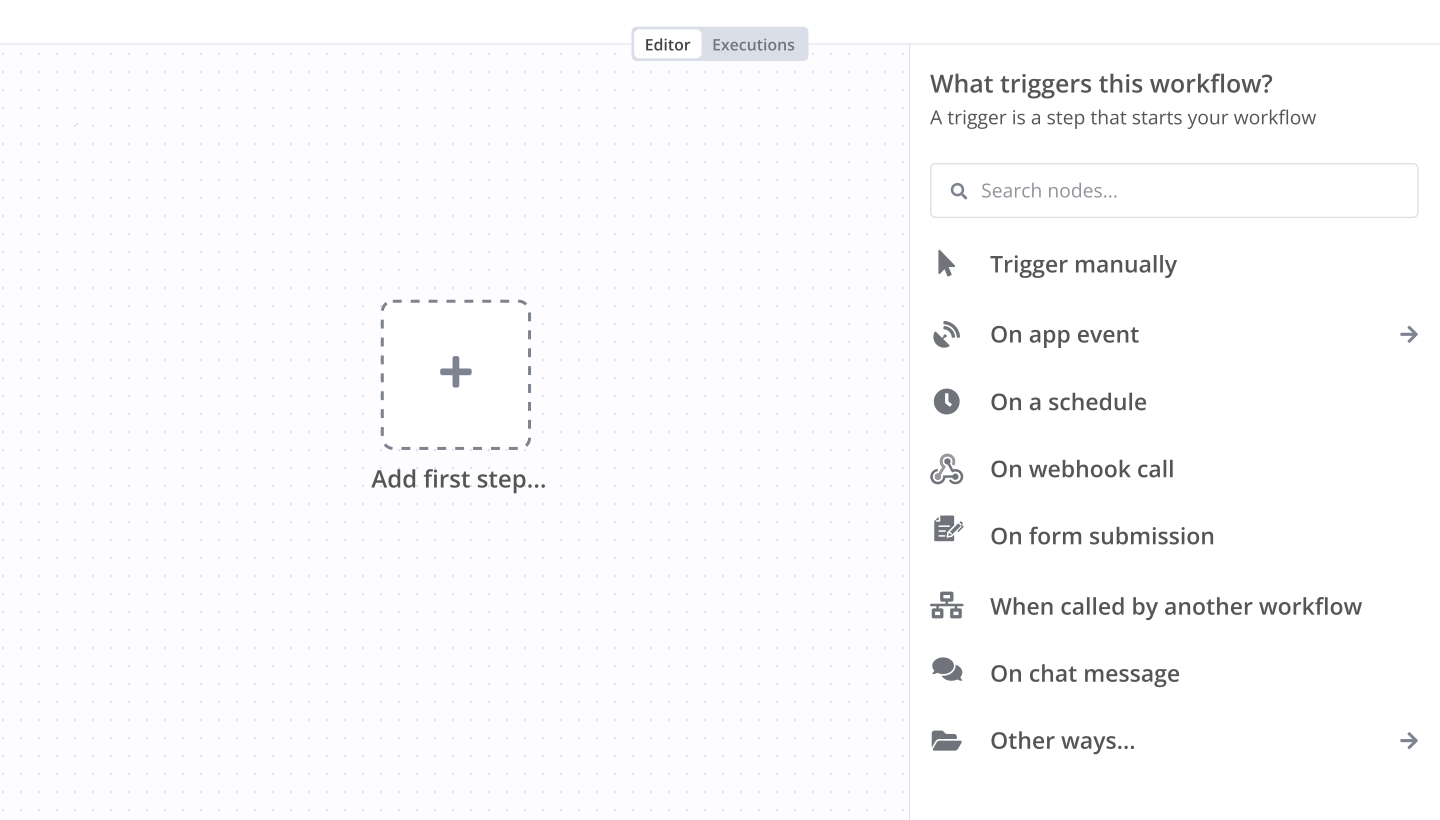
Step 1: Create a new workflow and add the first step

In n8n, click the "Add workflow" button in the Workflows tab to create a new workflow. Add the starting point – a trigger on when your workflow should run: an app event, a schedule, a webhook call, another workflow, an AI chat, or a manual trigger. Sometimes, the HTTP Request node might already serve as your starting point.

Google Drive and Slack integration: Create a new workflow and add the first step

Step 2: Add and configure Google Drive and Slack nodes

You can find Google Drive and Slack in the nodes panel. Drag them onto your workflow canvas, selecting their actions. Click each node, choose a credential, and authenticate to grant n8n access. Configure Google Drive and Slack nodes one by one: input data on the left, parameters in the middle, and output data on the right.

Google Drive and Slack integration: Add and configure Google Drive and Slack nodes

Step 3: Connect Google Drive and Slack

A connection establishes a link between Google Drive and Slack (or vice versa) to route data through the workflow. Data flows from the output of one node to the input of another. You can have single or multiple connections for each node.

Google Drive and Slack integration: Connect Google Drive and Slack

Step 4: Customize and extend your Google Drive and Slack integration

Use n8n's core nodes such as If, Split Out, Merge, and others to transform and manipulate data. Write custom JavaScript or Python in the Code node and run it as a step in your workflow. Connect Google Drive and Slack with any of n8n’s 1000+ integrations, and incorporate advanced AI logic into your workflows.

Google Drive and Slack integration: Customize and extend your Google Drive and Slack integration

Step 5: Test and activate your Google Drive and Slack workflow

Save and run the workflow to see if everything works as expected. Based on your configuration, data should flow from Google Drive to Slack or vice versa. Easily debug your workflow: you can check past executions to isolate and fix the mistake. Once you've tested everything, make sure to save your workflow and activate it.

Google Drive and Slack integration: Test and activate your Google Drive and Slack workflow

Slack AI chatbot for business team with RAG, Claude 3.7 Sonnet and Google Drive

Imagine having an AI chatbot on Slack that seamlessly integrates with your company’s workflow, automating repetitive requests. No more digging through emails or documents to find answers about IT requests, company policies, or vacation days—just ask the bot, and it will instantly provide the right information.

With its 24/7 availability, the chatbot ensures that team members get immediate support without waiting for a colleague to be online, making assistance faster and more efficient.

Moreover, this AI-powered bot serves as a central hub for internal communication, allowing everyone to quickly access procedures, documents, and company knowledge without searching manually. A simple Slack message is all it takes to get the information you need, enhancing productivity and collaboration across teams.

How It Works
Slack Trigger: The workflow starts when a user mentions the AI bot in a Slack channel. The trigger captures the message and forwards it to the AI Agent.
AI Agent Processing:
The AI Agent, powered by Anthropic's Claude 3.7 Sonnet model, processes the query.
It uses Retrieval-Augmented Generation (RAG) to fetch relevant information from the company’s internal knowledge base stored in Qdrant (a vector database).
A Simple Memory buffer retains recent conversation context (last 10 messages) for continuity.
Knowledge Retrieval:
The RAG tool searches Qdrant’s vector store using OpenAI embeddings to find the most relevant document chunks (top 10 matches).
Response Generation:
The AI synthesizes the retrieved data into a concise, structured response (1-2 sentences for the answer, 2-3 supporting details, and a source citation).
The response is formatted in Slack-friendly markdown (bullet points, blockquotes) and sent back to the user.

Set Up Steps
Prepare Qdrant Vector Database:
Create a Qdrant collection via HTTP request (Create collection node).
Optionally, refresh/clear the collection (Refresh collection node) before adding new documents.
Load Company Documents:
Fetch files from a Google Drive folder (Get folder → Download Files).
Process documents: Split text into chunks (Token Splitter) and generate embeddings (Embeddings OpenAI2).
Store embeddings in Qdrant (Qdrant Vector Store1).
Configure Slack Bot:
Create a Slack bot via Slack API with required permissions
Add the bot to the desired Slack channel and note the channelId for the workflow.
Deploy AI Components:
Connect the AI Agent to Anthropic’s model, RAG tool, and memory buffer.
Ensure OpenAI embeddings are configured for both RAG and document processing.
Test & Activate:
Use the manual trigger (When clicking ‘Test workflow’) to validate document ingestion.
Activate the workflow to enable real-time Slack interactions.

Need help customizing?
Contact me for consulting and support or add me on Linkedin.

Nodes used in this workflow

Popular Google Drive and Slack workflows

Generate Viral Bigfoot Vlog Videos with Veo 3

Transform simple ideas into viral-ready Bigfoot vlogs! This automated workflow creates charming 8-scene video content featuring "Sam" the Bigfoot - a lovable, outdoorsy character inspired by popular YouTube adventure channels. How It Works The workflow transforms your creative concept into professional video content through three automated stages: Story Generation - AI creates an 8-scene narrative arc featuring Sam the Bigfoot, complete with character-consistent dialogue and engaging plot development Human Approval - Review and approve the generated storyline via Slack before proceeding to video production Video Production - Each scene is automatically converted into 8-second video clips using Google's VEO 3 AI, then uploaded to Google Drive for easy access Required Credentials Anthropic API - Add your Claude API key for story generation FAL API - Configure your FAL.ai key for VEO 3 video generation Slack OAuth - Set up Slack app with channel permissions for approvals Google Drive OAuth - Connect your Google Drive for video storage Configuration Steps Import the workflow into your n8n instance Update Slack channel ID in the notification nodes to match your desired channel Set Google Drive folder - Update the folder ID where videos should be stored Test the form trigger - The workflow starts with a web form for video ideas Customize character (optional) - Modify Sam's personality in the narrative prompts
+2

Automate client onboarding with Asana, Google Docs, Gmail, Slack and Sheets

📊 Description Automate short-term trading research by generating high-quality trade ideas using MCP (Market Context Protocol) signals and AI-powered analysis. 📈🤖 This workflow evaluates market context, catalysts, momentum, and risk factors to produce structured trade ideas with clear reasoning, confidence scores, and execution notes. Designed for fast-moving markets, it helps traders and analysts spot actionable opportunities consistently—without manual screening or emotional bias. Perfect for systematic traders, research teams, and AI-driven trading desks. ⚡📊 🔁 What This Template Does 1️⃣ Ingests market context and asset data from MCP inputs. 📥 2️⃣ Normalizes symbols, sectors, and time horizons for analysis. 🧾 3️⃣ Evaluates short-term momentum and catalyst strength. 🚀 4️⃣ Analyzes risk, volatility, and downside exposure. ⚠️ 5️⃣ Uses AI to generate a structured trade thesis. 🤖 6️⃣ Assigns a confidence score and risk level to each idea. 📊 7️⃣ Produces clear entry logic, rationale, and trade direction. 🧠 8️⃣ Filters out low-quality or low-conviction setups. 🚫 9️⃣ Outputs clean JSON-ready trade ideas for downstream systems. 🔁 ⭐ Key Benefits ✅ Automates short-term trade idea generation ✅ Reduces emotional bias with AI-based scoring ✅ Combines market context, catalysts, and momentum ✅ Produces structured, repeatable trade logic ✅ Saves hours of manual chart and news analysis ✅ Ideal for fast-paced trading environments 🧩 Features MCP (Market Context Protocol) data ingestion AI-powered trade thesis generation Confidence and risk scoring logic Short-term momentum and catalyst analysis Strict structured output for automation reliability Easy integration into dashboards or execution systems 🔐 Requirements MCP-compatible market data source OpenAI API credentials (GPT-4o or GPT-4o-mini recommended) n8n instance with AI nodes enabled Defined schema for trade idea output 🎯 Target Audience Short-term and swing traders Quant and discretionary trading teams Market research analysts Fintech platforms generating trade signals Automation engineers building trading workflows
+4

Generate Contextual Recommendations from Slack using Pinecone

This advanced Retrieval-Augmented Generation (RAG) automation template for n8n enables contextual, real-time recommendations using Slack messages as input. The workflow extracts referenced documents from Google Drive, performs semantic retrieval from Pinecone, and generates next-step advice using GPT-4o — tailored specifically for executives and knowledge workers. Perfect for AI copilots, Slack-based assistants, or CTO coaching tools, this no-code RAG implementation gives you the building blocks to combine unstructured inputs with memory-augmented intelligence. What This Template Does ✅ Triggers from a Slack Message or Mention Monitors a Slack channel using a bot, capturing user input in real-time. 🔍 Extracts Key Info from Message GPT-4o parses the message to identify the subject person and Google Drive link (if present). 📥 Downloads File from Google Drive Automatically fetches and extracts PDF content using the built-in extractor. 📇 Retrieves Metadata from Google Sheets & Pinecone Looks up user ID from Google Sheets and retrieves context from Pinecone based on embeddings and reranking. 🧠 Contextual Response via GPT-4o (RAG) Combines user data and document context to generate a single, actionable next step using a tightly scoped GPT-4o prompt. 🛠️ Auto-Fixes & Structures Output Ensures formatted response with recommended_action, rationale, and optional risk_note. 📨 Sends Final Output Back to Slack Posts the recommendation directly to the channel as a reply. Required Integrations Slack Bot with channels:history & app_mentions:read Google Drive OAuth for file fetching Google Sheets for ID mapping Pinecone for vector document retrieval Azure OpenAI or OpenAI GPT-4o for language processing (Optional) Cohere for reranking results Ideal Use Cases 🧑‍💼 Executive coaching bots (e.g., for CTOs or founders) 🧠 Slack-based internal AI assistants 📄 AI-powered document summarization with memory 💬 Actionable recommendations based on real Slack conversations 📊 Enterprise knowledge augmentation from vector DBs Why This Template Stands Out Combines live Slack interaction, file ingestion, and Pinecone retrieval into a fully RAG-powered response system. AI prompts are carefully scoped for actionable, context-aware, and time-bound responses. No-code setup with modular components for scaling or adapting to new use cases (e.g., different roles or goals).
+4

Fast-track CV screening with AI analysis from Gmail to Slack and Google Sheets

CV → Match → Screen → Decide, all automated This workflow automatically processes candidate CVs from email, intelligently matches them to job descriptions, performs AI-powered screening analysis, and sends actionable summaries to your team in Slack. Good to know Handles both PDF and Word document CVs automatically Two-stage JD matching: prioritizes role mentioned in candidate's email, falls back to CV analysis if needed Uses Google Gemini API for AI screening (generous free tier and rate limits, typically enough to avoid paying for API requests, but check latest pricing at Google AI Pricing) All CVs stored in Google Drive with standardized naming (candidate name + date/time) Complete audit trail logged in Google Sheets Who's it for Hiring teams and recruiters who want to automate first-round CV screening while maintaining quality. Perfect for companies receiving high volumes of applications across multiple roles, especially in tech, sales, or automation-focused positions. How it works Gmail monitors inbox for CVs with specific label and downloads attachments Detects file type (PDF or Word) and converts/standardizes format for text extraction AI agent matches candidate to best-fit job description by analyzing email context first (if candidate mentioned a role), or CV content as fallback (selects up to 3 potential JD matches) If multiple JDs matched, second AI agent selects the single best fit AI recruiter agent analyzes CV against selected JD and generates structured screening report (strengths, weaknesses, risk/reward factors, overall fit score 0-10 with justification) Extracts candidate details (name, email) from CV text Logs complete analysis to Google Sheets tracker Sends formatted summary to Slack with Proceed/Reject action buttons for instant team decisions Requirements Gmail account with API access Google Drive account (OAuth2) Google Sheets account (OAuth2) Slack workspace with bot permissions Google Gemini API key (Get free key here) Google Drive folders: one for CVs, one for Job Descriptions (as PDFs or Google Docs) How to set up Add credentials: Gmail OAuth2, Google Drive OAuth2, Google Sheets OAuth2, Slack OAuth2, Google Gemini API Create Gmail label (e.g., "CV-Screening") for incoming candidate emails In "Receive CV via Email" node: select your Gmail label for filtering Create two Google Drive folders: "Candidate CVs" and "Job Descriptions" In "Upload CV - PDF" and "Stream Doc/Docx File" nodes: update folder ID to your "Candidate CVs" folder In "Access JD Files" node: update folder ID to your "Job Descriptions" folder Create Google Sheet named "AI Candidate Screening" with columns matching the sample AI Candidate Screening sheet In "Append row in sheet" node: select your Google Sheet In "Send Candidate Screening Confirmation" node: select your Slack channel Activate workflow Customizing this workflow Change JD matching logic: Edit "JD Matching Agent" node prompt to adjust how CVs are matched to roles (e.g., weight technical skills vs. experience). Change "Company Description" in AI prompts: Insert your "Company Description" in System Message sections in "JD Matching Agent" and "Detailed JD Matching Agent" nodes Modify screening criteria: Edit "Recruiter Scoring Agent" node system message to focus on specific qualities (culture fit, leadership, technical depth, etc.) Add more storage locations: Add nodes to save CVs to other systems (Notion, Airtable, ATS platforms) Customize Slack message: Edit "Send Candidate Screening Confirmation" node to change formatting, add more context, or include additional candidate data Auto-proceed logic: Add IF node after screening to auto-proceed candidates with fit score above threshold (e.g., 8+/10) Add email responses: Connect nodes to automatically email candidates (confirmation, rejection, interview invite) Add human-in-the-loop: Sub-workflow triggered by Slack response or email response, to update Sheet with approve/reject status Add candidate email responses + interview scheduling**: For approved candidates, trigger email to candidate with Cal.com or Calendly link so they can book their interview Quick Troubleshooting No CVs being processed: Check Gmail label is correctly set in "Receive CV via Email" node and emails are being labeled Word documents failing: Verify "Stream Doc/Docx File" node has correct parent folder ID and Google Drive credentials authorized JD matching returns no results: Check "Access JD Files" node folder ID points to your Job Descriptions folder, and JD files are named clearly (e.g., "Marketing Director JD.pdf") JD matching is not relevant for my company: Update the "Company Description" in the System Messages in the "JD Matching Agent" and "Detailed JD Matching Agent" nodes "Can't find matching JD": Ensure candidate's email mentions role name OR their CV clearly indicates relevant experience for available JDs Google Sheets errors: Verify sheet name is "AI Candidate Screening" and column headers exactly match workflow expectations (Submission ID, Date, CV, First Name, etc.) Slack message not appearing: Re-authorize Slack credentials and confirm channel ID in "Send Candidate Screening Confirmation" node Missing candidate name/email: CV text must be readable - check PDF extraction quality or try converting complex CVs to simpler format 401/403 API errors: Re-authorize all OAuth2 credentials (Gmail, Google Drive, Google Sheets, Slack) AI analysis quality issues: Edit system prompts in "JD Matching Agent" and "Recruiter Scoring Agent" nodes to refine screening criteria Sample Outputs Google Sheets - AI Candidate Screening - sample Slack confirmation message Acknowledgments This workflow was inspired by Nate Herk's YouTube demonstration on building a resume analysis system. This implementation builds upon that foundation by adding dynamic job description matching (initial + detailed JD matching agents), Slack Block Kit integration with interactive buttons, updated Google Drive API methods for document handling, and enhanced candidate data capture in Google Sheets.
+4

Create script-to-video avatar videos with GPT-4.1-mini, HeyGen, Google Drive, Gmail and Slack

📘 Description This workflow automates the entire process of taking a raw user-submitted script, rewriting it into a polished HeyGen-ready narration, generating a full avatar video, handling all processing checks, retrieving the final MP4, uploading it to Google Drive, and notifying the user through email and Slack. It turns an unstructured script into a complete, ready-to-share video package without any manual intervention. The system rewrites scripts into structured sections (intro → narration sections → closing), ensures the final narration fits HeyGen’s free-tier limits, submits the script to HeyGen’s video API, initiates a polling loop until the video is fully rendered, downloads the finished file, uploads it to Drive with metadata, and generates clean notification messages containing the file links. Errors at any point trigger automated Slack alerts for debugging. This workflow replaces manual rewriting, video rendering, download/upload, and team communication—providing a fully-managed script-to-video pipeline. ⚙️ What This Workflow Does (Step-by-Step) 🟢 Receive Script Request via Webhook Captures the raw script payload submitted by the user. 🧹 Parse Incoming Script Payload Converts stringified JSON body into structured data for processing. ✍️ Rewrite & Structure Video Script Using AI Transforms the raw script into: • Video title • Intro • Multiple sections (title + narration) • Closing • Combined full_script optimized for HeyGen’s ~300–350 word limit Ensures natural, human narration with smooth transitions. 🧠 Script Writing Memory + LLM Engine Maintains writing consistency and uses GPT-4.1-mini to generate polished narration. 🧪 Validate Structured Script Output Enforces strict JSON schema for titles, sections, closing, and full_script. 🎞️ Submit Video Generation Request to HeyGen Sends structured script to HeyGen API with avatar, voice, and background settings for 1280×720 export. ⏳ Wait Before Polling Loop Initial delay before the first status check. 📡 Check HeyGen Video Status Queries the HeyGen API to check progress of the video generation. ⏳ Wait Before Rechecking Adds timed spacing between repeated polls. 🔍 Evaluate Video Completion If status = completed → proceed If still processing → loop back to polling sequence 📥 Download Generated HeyGen Video Retrieves the completed MP4 using the returned video_url. ☁️ Upload Video to Google Drive Uploads the MP4 to a specific Google Drive folder, returning: • File name • View link • Download link • Timestamp • Size metadata 📣 Generate Completion Notifications Using AI Creates two outputs: • A friendly short email summary • A concise Slack message Both containing the Google Drive file link. 🧠 Notification Memory + LLM Engine Maintains tone and ensures consistent messaging across channels. 🧪 Validate Notification Output JSON Ensures email_subject, email_body, and slack_message follow schema. 💬 Send Video Ready Slack Notification Posts the final Slack message containing file details and Drive link. 📧 Send Video Ready Email Notification Emails the summary and file link to the designated recipient. 🚨 Error Handler Trigger → Slack Alert Any workflow failure sends a detailed diagnostic alert with node name, message, and timestamp. 🧩 Prerequisites • HeyGen API key • Google Drive OAuth connection • Slack API credentials • Gmail OAuth connection • Valid webhook endpoint to receive scripts 💡 Key Benefits ✔ Converts raw script → structured HeyGen-ready narration automatically ✔ Produces full HD avatar video with zero manual steps ✔ Polls HeyGen until the video is fully rendered ✔ Securely uploads final MP4 to Google Drive ✔ Auto-generates polished email + Slack notifications ✔ Ensures narrative consistency using memory context ✔ Provides real-time error alerts via Slack 👥 Perfect For HR teams automating onboarding videos Marketing teams producing quick avatar explainers Training content creators Founders creating rapid how-to or announcement videos Anyone needing instant script-to-video automation

Automate Image Portfolio Organization with GPT-4o Vision, Google Drive and Notion

Overview This template is ideal for photographers, graphic designers, and creative professionals who manage large volumes of visual assets. It is also perfect for Digital Asset Managers looking for a customizable, automated solution to organize files without manual tagging. What it does When a new image is uploaded to a designated "Inbox" folder in Google Drive, the workflow performs the following actions: AI Analysis**: Uses GPT-4o to analyze the image content, generating a description, extracting dominant colors, and determining the category (e.g., Portrait vs. Landscape). Safety Check**: Runs an AI-based NSFW filter. If inappropriate content is detected, the process stops, and a warning is sent to Slack. Smart Sorting**: Automatically moves the file into the correct subfolder based on its category. Contextual Tagging**: Generates specific tags (e.g., "smile, natural light" for portraits) and updates the file metadata. Archiving**: Creates a comprehensive entry in a Notion Database with the image link, tags, and description. Notification**: Sends a success alert to Slack with a summary of the archived asset. How to set up This workflow is designed to be plug-and-play using a central configuration node. Credentials: Connect your Google Drive, OpenAI, Notion, and Slack accounts in n8n. Set Variables: Open the node named "Workflow Configuration". Replace the placeholder IDs with your actual Folder IDs (for Inbox, Portraits, and Landscapes), Notion Database ID, and Slack Channel ID. Prepare Notion: Create a Database in Notion with the following properties: Category (Select) Description (Rich Text) Image URL (URL) Tags (Rich Text) Date (Date) Requirements n8n Version**: 1.0 or later. OpenAI API: Access to the **gpt-4o model is recommended for accurate vision analysis. Google Drive**: A specific folder structure (Inbox, Portraits, Landscapes). Notion**: A dedicated database for the portfolio. Slack**: A channel for notifications. How to customize Add Categories**: You can expand the "Category Router" (Switch node) to include more specific genres like "Architecture," "Macro," or "Street," and add corresponding paths. Adjust Prompts**: Modify the system prompts in the AI nodes to change the language of the output or the style of the generated tags. Change Output**: Connect to Airtable or Excel instead of Notion if you prefer a different database system.

Build your own Google Drive and Slack integration

Create custom Google Drive and Slack workflows by choosing triggers and actions. Nodes come with global operations and settings, as well as app-specific parameters that can be configured. You can also use the HTTP Request node to query data from any app or service with a REST API.

Google Drive supported actions

Copy
Create a copy of an existing file
Create From Text
Create a file from a provided text
Delete
Permanently delete a file
Download
Download a file
Move
Move a file to another folder
Share
Add sharing permissions to a file
Update
Update a file
Upload
Upload an existing file to Google Drive
Search
Search or list files and folders
Create
Create a folder
Delete
Permanently delete a folder
Share
Add sharing permissions to a folder
Create
Create a shared drive
Delete
Permanently delete a shared drive
Get
Get a shared drive
Get Many
Get the list of shared drives
Update
Update a shared drive

Slack supported actions

Archive
Archives a conversation
Close
Closes a direct message or multi-person direct message
Create
Initiates a public or private channel-based conversation
Get
Get information about a channel
Get Many
Get many channels in a Slack team
History
Get a conversation's history of messages and events
Invite
Invite a user to a channel
Join
Joins an existing conversation
Kick
Removes a user from a channel
Leave
Leaves a conversation
Member
List members of a conversation
Open
Opens or resumes a direct message or multi-person direct message
Rename
Renames a conversation
Replies
Get a thread of messages posted to a channel
Set Purpose
Sets the purpose for a conversation
Set Topic
Sets the topic for a conversation
Unarchive
Unarchives a conversation
Get
Get Many
Get & filters team files
Upload
Create or upload an existing file
Delete
Get Permalink
Search
Send
Send and Wait for Response
Update
Add
Adds a reaction to a message
Get
Get the reactions of a message
Remove
Remove a reaction of a message
Add
Add a star to an item
Delete
Delete a star from an item
Get Many
Get many stars of autenticated user
Get
Get information about a user
Get Many
Get a list of many users
Get User's Profile
Get a user's profile
Get User's Status
Get online status of a user
Update User's Profile
Update a user's profile
Add Users
Create
Disable
Enable
Get Many
Get Users
Update

FAQs

  • Can Google Drive connect with Slack?

  • Can I use Google Drive’s API with n8n?

  • Can I use Slack’s API with n8n?

  • Is n8n secure for integrating Google Drive and Slack?

  • How to get started with Google Drive and Slack integration in n8n.io?

Need help setting up your Google Drive and Slack integration?

Discover our latest community's recommendations and join the discussions about Google Drive and Slack integration.
hubschrauber
Jon
David O'Neil
Nicolas N
Muhammed Iqbal P B

Looking to integrate Google Drive and Slack in your company?

Over 3000 companies switch to n8n every single week

Why use n8n to integrate Google Drive with Slack

Build complex workflows, really fast

Build complex workflows, really fast

Handle branching, merging and iteration easily.
Pause your workflow to wait for external events.

Code when you need it, UI when you don't

Simple debugging

Your data is displayed alongside your settings, making edge cases easy to track down.

Use templates to get started fast

Use 1000+ workflow templates available from our core team and our community.

Reuse your work

Copy and paste, easily import and export workflows.

Implement complex processes faster with n8n

red iconyellow iconred iconyellow icon