Back to Integrations
integrationGoogle Drive node
integrationSupabase node

Google Drive and Supabase integration

Save yourself the work of writing custom integrations for Google Drive and Supabase and use n8n instead. Build adaptable and scalable Data & Storage workflows that work with your technology stack. All within a building experience you will love.

How to connect Google Drive and Supabase

  • Step 1: Create a new workflow
  • Step 2: Add and configure nodes
  • Step 3: Connect
  • Step 4: Customize and extend your integration
  • Step 5: Test and activate your workflow

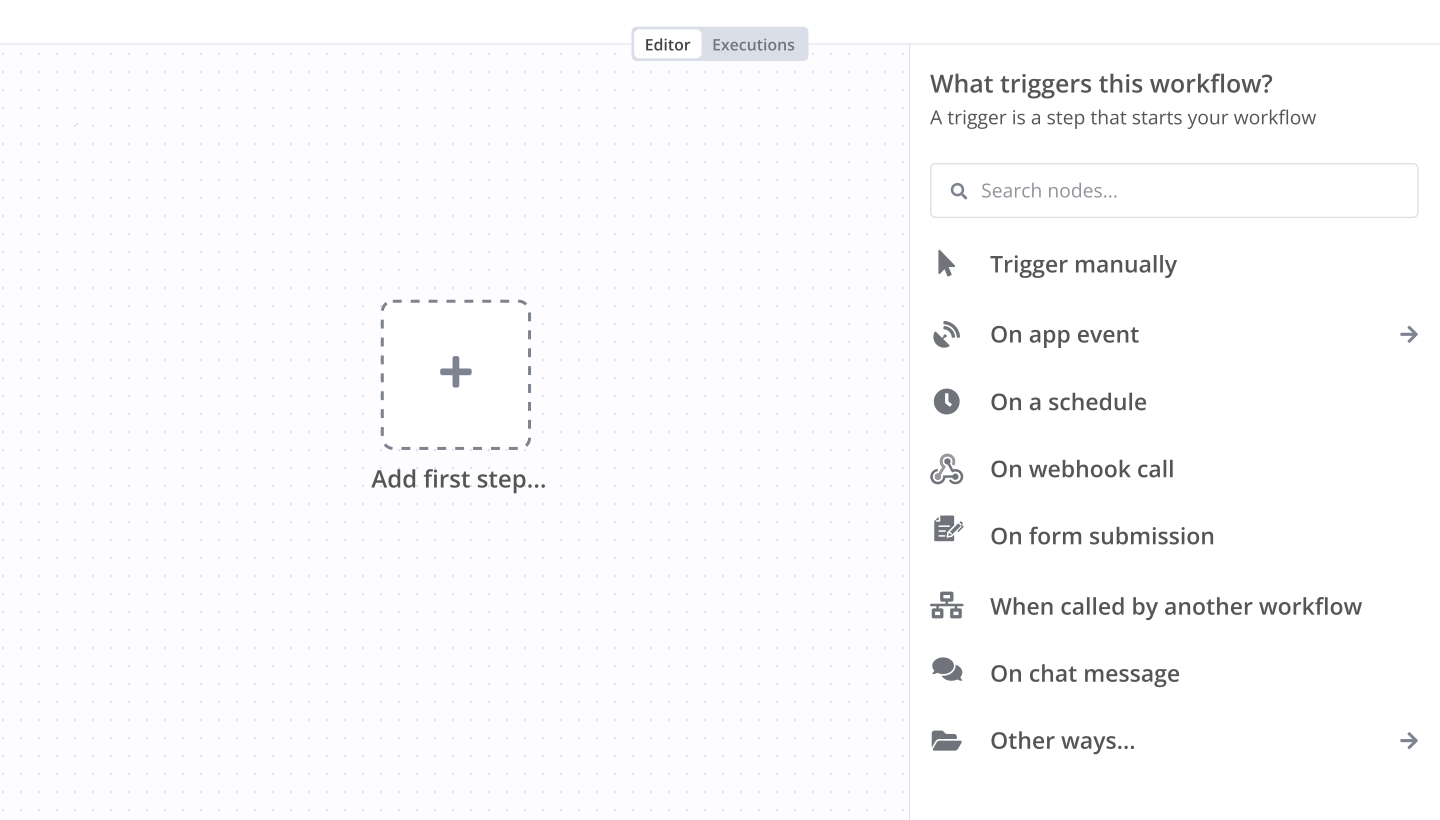
Step 1: Create a new workflow and add the first step

In n8n, click the "Add workflow" button in the Workflows tab to create a new workflow. Add the starting point – a trigger on when your workflow should run: an app event, a schedule, a webhook call, another workflow, an AI chat, or a manual trigger. Sometimes, the HTTP Request node might already serve as your starting point.

Google Drive and Supabase integration: Create a new workflow and add the first step

Step 2: Add and configure Google Drive and Supabase nodes

You can find Google Drive and Supabase in the nodes panel. Drag them onto your workflow canvas, selecting their actions. Click each node, choose a credential, and authenticate to grant n8n access. Configure Google Drive and Supabase nodes one by one: input data on the left, parameters in the middle, and output data on the right.

Google Drive and Supabase integration: Add and configure Google Drive and Supabase nodes

Step 3: Connect Google Drive and Supabase

A connection establishes a link between Google Drive and Supabase (or vice versa) to route data through the workflow. Data flows from the output of one node to the input of another. You can have single or multiple connections for each node.

Google Drive and Supabase integration: Connect Google Drive and Supabase

Step 4: Customize and extend your Google Drive and Supabase integration

Use n8n's core nodes such as If, Split Out, Merge, and others to transform and manipulate data. Write custom JavaScript or Python in the Code node and run it as a step in your workflow. Connect Google Drive and Supabase with any of n8n’s 1000+ integrations, and incorporate advanced AI logic into your workflows.

Google Drive and Supabase integration: Customize and extend your Google Drive and Supabase integration

Step 5: Test and activate your Google Drive and Supabase workflow

Save and run the workflow to see if everything works as expected. Based on your configuration, data should flow from Google Drive to Supabase or vice versa. Easily debug your workflow: you can check past executions to isolate and fix the mistake. Once you've tested everything, make sure to save your workflow and activate it.

Google Drive and Supabase integration: Test and activate your Google Drive and Supabase workflow

Supabase insertion & upsertion & retrieval

This is a demo workflow to showcase how to use Supabase to embed a document, retrieve information from the vector store via chat and update the database.

Setup steps:
set your credentials for Supabase
set your credentials for an AI model of your choice
set credentials for any service you want to use to upload documents
please follow the guidelines in the workflow itself (Sticky Notes)

Feedback & Questions

If you have any questions or feedback about this workflow - Feel free to get in touch at [email protected]

Nodes used in this workflow

Popular Google Drive and Supabase workflows

+7

Company Knowledge Base Agent (RAG)

Overview Turn your docs into an AI-powered internal or public-facing assistant. This chatbot workflow uses RAG (Retrieval-Augmented Generation) with Supabase vector search to answer employee or customer questions based on your company documents—automatically updated via Google Drive. Whether it’s deployed in Telegram or embedded on your website, this agent supports voice and text input, transcribes voice messages, pulls relevant context from your internal files, and responds with a helpful, AI-generated answer. Two additional workflows listen for file changes in a shared Google Drive folder, convert them into embeddings using OpenAI, and sync them with your Supabase vector DB—so your knowledge base is always up to date. Who’s it for Startups building an internal ops or HR assistant SaaS companies deploying help bots on their websites Customer support teams reducing repetitive questions Knowledge-driven teams needing internal AI assistants How it works Triggered via Telegram bot (or easily swapped for website chatbot or “on chat message”) If user sends a voice message, it’s transcribed to text using OpenAI Whisper Input is passed to a RAG agent that: Searches a Supabase vector store for relevant docs Pulls context from matching chunks using OpenAI embeddings Responds with an LLM-powered answer The response is sent back as a Telegram message Two separate workflows: New File Workflow: Listens for file uploads in Google Drive, extracts and splits text, then sends to Supabase with embeddings Update File Workflow: Detects file edits, deletes old rows, and updates embeddings for the revised file Example use case > You upload your internal policy docs and client FAQs into a Google Drive folder. > > Employees or customers can now ask: > - “What’s the refund policy for annual plans?” > - “How do I request a day off?” > - “What tools are approved for use by the engineering team?” > > The chatbot instantly pulls up the right section and responds with a smart, confident answer. How to set up Connect a Telegram bot or use n8n’s webchat / chatbot widget Hook up OpenAI for transcription, embeddings, and completion Set up a Supabase project and connect it as a vector store Upload your internal docs to Google Drive Deploy the “Add File” and “Update File” automations to manage embedding sync Customize the chatbot’s tone and personality with prompt tweaks Requirements Telegram bot (or n8n Chat widget) Google Drive integration Supabase with pgvector or similar enabled OpenAI API key (Whisper, Embeddings, ChatGPT) Two folders: one for raw documents and one for tracking updates How to customize Swap Supabase for Pinecone, Weaviate, or Qdrant Replace Telegram with web chat, Slack, Intercom, or Discord Add logic to handle fallback answers or escalate to human Embed the chat widget on your site for public customer use Add filters (e.g. department, date, author) to narrow down context
+5

AI Agent To Chat With Files In Supabase Storage and Google Drive

Video Guide I prepared a detailed guide that illustrates the entire process of building an AI agent using Supabase and Google Drive within N8N workflows. Youtube Link Who is this for? This workflow is designed for developers, data scientists, and business users who wish to automate document management and enable AI-powered interactions over their stored files. It's especially beneficial for scenarios where users need to process, analyze, and retrieve information from uploaded documents rapidly. What problem does this workflow solve? Managing files across multiple platforms often involves tedious manual processes. This workflow facilitates automated file handling, making it easier for users to upload, parse, and interact with documents through an AI agent. It reduces redundancy and enhances the efficiency of data retrieval and management tasks. What this workflow does This workflow integrates Supabase storage with Google Drive and employs an AI agent to manage files effectively. The agent can: Upload files to Supabase storage and activate processes based on file changes in Google Drive. Retrieve and parse documents, converting them into a structured format for easy querying. Utilize an AI agent to answer user queries based on saved document data. Data Collection: The workflow initially gathers files from Supabase storage, ensuring no duplicates are processed in the 'files' table. File Handling: It processes files to be parsed based on their type, leveraging LlamaParse for effective data transformation. Google Drive Integration: The workflow monitors a designated Google Drive folder to upload files automatically and refresh document records in the database with new data. AI Interaction: A webhook is established to enable the AI agent to converse with users, facilitating queries and leveraging stored document knowledge. Setup Supabase Storage Setup: Create a private bucket in Supabase storage, modifying the default name in the URL. Upload your files using the provided upload options. Database Configuration: Establish the 'file' and 'document' tables in Supabase with the necessary fields. Execute any required SQL queries for enabling vector matching features. N8N Workflow Logic: Start with a manual trigger for the initial workflow segment or consider alternative triggers like webhooks. Replace all relevant credentials across nodes with your own to ensure seamless operation. File Processing and Google Drive Monitoring: Set up file processing to take care of downloading and parsing files based on their types. Create triggers to monitor the designated Google Drive folder for file uploads and updates. Integrate AI Agent: Configure the webhook for the AI agent to accept chat inputs while maintaining session context for enhanced user interactions. Utilize PostgreSQL to store user interactions and manage conversation states effectively. Testing and Adjustments: Once everything is set up, run tests with the AI agent to validate its responses based on the documents in your database. Fine-tune the workflow and AI model as needed to achieve desired performance.
+6

Interactive Knowledge Base Chat with Supabase RAG using AI 📚💬

Google Drive File Ingestion to Supabase for Knowledge Base 📂💾 Overview 🌟 This n8n workflow automates the process of ingesting files from Google Drive into a Supabase database, preparing them for a knowledge base system. It supports text-based files (PDF, DOCX, TXT, etc.) and tabular data (XLSX, CSV, Google Sheets), extracting content, generating embeddings, and storing data in structured tables. This is a foundational workflow for building a company knowledge base that can be queried via a chat interface (e.g., using a RAG workflow). 🚀 Problem Solved 🎯 Manually managing a knowledge base with files from Google Drive is time-consuming and error-prone. This workflow solves that by: Automatically ingesting files from Google Drive as they are created or updated. Extracting content** from various file types (text and tabular). Generating embeddings for text-based files to enable vector search. Storing data in Supabase for efficient retrieval. Handling duplicates and errors to ensure data consistency. Target Audience: Knowledge Managers**: Build a centralized knowledge base from company files. Data Teams**: Automate the ingestion of spreadsheets and documents. Developers**: Integrate with other workflows (e.g., RAG for querying the knowledge base). Workflow Description 🔍 This workflow listens for new or updated files in Google Drive, processes them based on their type, and stores the extracted data in Supabase tables for later retrieval. Here’s how it works: File Detection: Triggers when a file is created or updated in Google Drive. File Processing: Loops through each file, extracts metadata, and validates the file type. Duplicate Check: Ensures the file hasn’t been processed before. Content Extraction: Text-based Files: Downloads the file, extracts text, splits it into chunks, generates embeddings, and stores the chunks in Supabase. Tabular Files: Extracts data from spreadsheets and stores it as rows in Supabase. Metadata Storage: Stores file metadata and basic info in Supabase tables. Error Handling: Logs errors for unsupported formats or duplicates. Nodes Breakdown 🛠️ Detect New File 🔔 Type**: Google Drive Trigger Purpose**: Triggers the workflow when a new file is created in Google Drive. Configuration**: Credential: Google Drive OAuth2 Event: File Created Customization**: Specify a folder to monitor specific directories. Detect Updated File 🔔 Type**: Google Drive Trigger Purpose**: Triggers the workflow when a file is updated in Google Drive. Configuration**: Credential: Google Drive OAuth2 Event: File Updated Customization**: Currently disconnected; reconnect if updates need to be processed. Process Each File 🔄 Type**: Loop Over Items Purpose**: Processes each file individually from the Google Drive trigger. Configuration**: Input: {{ $json.files }} Customization**: Adjust the batch size if processing multiple files at once. Extract File Metadata 🆔 Type**: Set Purpose**: Extracts metadata like file_id, file_name, mime_type, and web_view_link. Configuration**: Fields: file_id: {{ $json.id }} file_name: {{ $json.name }} mime_type: {{ $json.mimeType }} web_view_link: {{ $json.webViewLink }} Customization**: Add more metadata fields if needed (e.g., size, createdTime). Check File Type ✅ Type**: IF Purpose**: Validates the file type by checking the MIME type. Configuration**: Condition: mime_type contains supported types (e.g., application/pdf, application/vnd.openxmlformats-officedocument.spreadsheetml.sheet). Customization**: Add more supported MIME types as needed. Find Duplicates 🔍 Type**: Supabase Purpose**: Checks if the file has already been processed by querying knowledge_base. Configuration**: Operation: Select Table: knowledge_base Filter: file_id = {{ $node['Extract File Metadata'].json.file_id }} Customization**: Add additional duplicate checks (e.g., by file name). Handle Duplicates 🔄 Type**: IF Purpose**: Routes the workflow based on whether a duplicate is found. Configuration**: Condition: {{ $node['Find Duplicates'].json.length > 0 }} Customization**: Add notifications for duplicates if desired. Remove Old Text Data 🗑️ Type**: Supabase Purpose**: Deletes old text data from documents if the file is a duplicate. Configuration**: Operation: Delete Table: documents Filter: metadata->>'file_id' = {{ $node['Extract File Metadata'].json.file_id }} Customization**: Add logging before deletion. Remove Old Data 🗑️ Type**: Supabase Purpose**: Deletes old tabular data from document_rows if the file is a duplicate. Configuration**: Operation: Delete Table: document_rows Filter: dataset_id = {{ $node['Extract File Metadata'].json.file_id }} Customization**: Add logging before deletion. Route by File Type 🔀 Type**: Switch Purpose**: Routes the workflow based on the file’s MIME type (text-based or tabular). Configuration**: Rules: Based on mime_type (e.g., application/pdf for text, application/vnd.openxmlformats-officedocument.spreadsheetml.sheet for tabular). Customization**: Add more routes for additional file types. Download File Content 📥 Type**: Google Drive Purpose**: Downloads the file content for text-based files. Configuration**: Credential: Google Drive OAuth2 File ID: {{ $node['Extract File Metadata'].json.file_id }} Customization**: Add error handling for download failures. Extract PDF Text 📜 Type**: Extract from File (PDF) Purpose**: Extracts text from PDF files. Configuration**: File Content: {{ $node['Download File Content'].binary.data }} Customization**: Adjust extraction settings for better accuracy. Extract DOCX Text 📜 Type**: Extract from File (DOCX) Purpose**: Extracts text from DOCX files. Configuration**: File Content: {{ $node['Download File Content'].binary.data }} Customization**: Add support for other text formats (e.g., TXT, RTF). Extract XLSX Data 📊 Type**: Extract from File (XLSX) Purpose**: Extracts tabular data from XLSX files. Configuration**: File ID: {{ $node['Extract File Metadata'].json.file_id }} Customization**: Add support for CSV or Google Sheets. Split Text into Chunks ✂️ Type**: Text Splitter Purpose**: Splits extracted text into manageable chunks for embedding. Configuration**: Chunk Size: 1000 Chunk Overlap: 200 Customization**: Adjust chunk size and overlap based on document length. Generate Text Embeddings 🌐 Type**: OpenAI Purpose**: Generates embeddings for text chunks using OpenAI. Configuration**: Credential: OpenAI API key Operation: Embedding Model: text-embedding-ada-002 Customization**: Switch to a different embedding model if needed. Store Text in Supabase 💾 Type**: Supabase Vector Store Purpose**: Stores text chunks and embeddings in the documents table. Configuration**: Credential: Supabase credentials Operation: Insert Documents Table Name: documents Customization**: Add metadata fields to store additional context. Store Tabular Data 💾 Type**: Supabase Purpose**: Stores tabular data in the document_rows table. Configuration**: Operation: Insert Table: document_rows Columns: dataset_id, row_data Customization**: Add validation for tabular data structure. Store File Metadata 📋 Type**: Supabase Purpose**: Stores file metadata in the document_metadata table. Configuration**: Operation: Insert Table: document_metadata Columns: file_id, file_name, file_type, file_url Customization**: Add more metadata fields as needed. Record in Knowledge Base 📚 Type**: Supabase Purpose**: Stores basic file info in the knowledge_base table. Configuration**: Operation: Insert Table: knowledge_base Columns: file_id, file_name, file_type, file_url, upload_date Customization**: Add indexes for faster lookups. Log File Errors ⚠️ Type**: Supabase Purpose**: Logs errors for unsupported file types. Configuration**: Operation: Insert Table: error_log Columns: error_type, error_message Customization**: Add notifications for errors. Log Duplicate Errors ⚠️ Type**: Supabase Purpose**: Logs errors for duplicate files. Configuration**: Operation: Insert Table: error_log Columns: error_type, error_message Customization**: Add notifications for duplicates. Interactive Knowledge Base Chat with Supabase RAG using GPT-4o-mini 📚💬 Introduction 🌟 This n8n workflow creates an interactive chat interface that allows users to query a company knowledge base using Retrieval-Augmented Generation (RAG). It retrieves relevant information from text documents and tabular data stored in Supabase, then generates natural language responses using OpenAI’s GPT-4o-mini model. Designed for teams managing internal knowledge, this workflow enables users to ask questions like “What’s the remote work policy?” or “Show me the latest budget data” and receive accurate, context-aware responses in a conversational format. 🚀 Problem Statement 🎯 Managing a company knowledge base can be a daunting task—employees often struggle to find specific information buried in documents or spreadsheets, leading to wasted time and inefficiencies. Traditional search methods may not understand natural language queries or provide contextually relevant results. This workflow solves these issues by: Offering a chat-based interface for natural language queries, making it easy for users to ask questions in their own words. Leveraging RAG to retrieve relevant text and tabular data from Supabase, ensuring responses are accurate and context-aware. Supporting diverse file types, including text-based files (e.g., PDFs, DOCX) and tabular data (e.g., XLSX, CSV), for comprehensive knowledge access. Maintaining conversation history to provide context during interactions, improving the user experience. Target Audience 👥 This workflow is ideal for: HR Teams**: Quickly access company policies, employee handbooks, or benefits documents. Finance Teams**: Retrieve budget data, expense reports, or financial summaries from spreadsheets. Knowledge Managers**: Build a centralized assistant for internal documentation, streamlining information access. Developers**: Extend the workflow with additional tools or integrations for custom use cases. Workflow Description 🔍 This workflow consists of a chat interface powered by n8n’s Chat Trigger node, an AI Agent node for RAG, and several tools to retrieve data from Supabase. Here’s how it works step-by-step: User Initiates a Chat: The user interacts with a chat interface, sending queries like “Summarize our remote work policy” or “Show budget data for Q1 2025.” Query Processing with RAG: The AI Agent processes the query using RAG, retrieving relevant data from Supabase tables and generating a response with OpenAI’s GPT-4o-mini model. Data Retrieval and Response Generation: The workflow uses multiple tools to fetch data: Retrieves text chunks from the documents table using vector search. Fetches tabular data from the document_rows table based on file IDs. Extracts full document text or lists available files as needed. Generates a natural language response combining the retrieved data. Conversation History Management: Stores the conversation history in Supabase to maintain context for follow-up questions. Response Delivery: Formats and sends the response back to the chat interface for the user to view. Nodes Breakdown 🛠️ Start Chat Interface 💬 Type**: Chat Trigger Purpose**: Provides the interactive chat interface for users to input queries and receive responses. Configuration**: Chat Title: Company Knowledge Base Assistant Chat Subtitle: Ask me anything about company documents! Welcome Message: Hello! I’m your Company Knowledge Base Assistant. How can I help you today? Suggestions: What is the company policy on remote work?, Show me the latest budget data., List all policy documents. Output Chat Session ID: true Output User Message: true Customization**: Update the title and welcome message to align with your company branding (e.g., HR Knowledge Assistant). Add more suggestions relevant to your use case (e.g., What are the company benefits?). Process Query with RAG 🧠 Type**: AI Agent Purpose**: Orchestrates the RAG process by retrieving relevant data using tools and generating responses with OpenAI’s GPT-4o-mini. Configuration**: Credential: OpenAI API key Model: gpt-4o-mini System Prompt: You are a helpful assistant for a company knowledge base. Use the provided tools to retrieve relevant information from documents and tabular data. If the query involves tabular data, format it clearly in your response. If no relevant data is found, respond with "I couldn’t find any relevant information. Can you provide more details?" Input Field: {{ $node['Start Chat Interface'].json.message }} Customization**: Switch to a different model (e.g., gpt-3.5-turbo) to adjust cost or performance. Modify the system prompt to change the tone (e.g., more formal for HR use cases). Retrieve Text Chunks 📄 Type**: Supabase Vector Store (Tool) Purpose**: Retrieves relevant text chunks from the documents table using vector search. Configuration**: Credential: Supabase credentials Operation Mode: Retrieve Documents (As Tool for AI Agent) Table Name: documents Embedding Field: embedding Content Field: content_text Metadata Field: metadata Embedding Model: OpenAI text-embedding-ada-002 Top K: 10 Customization**: Adjust Top K to retrieve more or fewer results (e.g., 5 for faster responses). Ensure the match_documents function (see prerequisites) is defined in Supabase. Fetch Tabular Data 📊 Type**: Supabase (Tool, Execute Query) Purpose**: Retrieves tabular data from the document_rows table based on a file ID. Configuration**: Credential: Supabase credentials Operation: Execute Query Query: SELECT row_data FROM document_rows WHERE dataset_id = $1 LIMIT 10 Tool Description: Run a SQL query - use this to query from the document_rows table once you know the file ID you are querying. dataset_id is the file_id and you are always using the row_data for filtering, which is a jsonb field that has all the keys from the file schema given in the document_metadata table. Customization**: Modify the query to filter specific columns or add conditions (e.g., WHERE dataset_id = $1 AND row_data->>'year' = '2025'). Increase the LIMIT for larger datasets. Extract Full Document Text 📜 Type**: Supabase (Tool, Execute Query) Purpose**: Fetches the full text of a document by concatenating all text chunks for a given file_id. Configuration**: Credential: Supabase credentials Operation: Execute Query Query: SELECT string_agg(content_text, ' ') as document_text FROM documents WHERE metadata->>'file_id' = $1 GROUP BY metadata->>'file_id' Tool Description: Given file id fetch the text from the documents Customization**: Add filters to the query if needed (e.g., limit to specific metadata fields). List Available Files 📋 Type**: Supabase (Tool, Select) Purpose**: Lists all files in the knowledge base from the document_metadata table. Configuration**: Credential: Supabase credentials Operation: Select Schema: public Table: document_metadata Tool Description: Use this tool to fetch all documents including the table schema if the file is csv, excel or xlsx Customization**: Add filters to list specific file types (e.g., WHERE file_type = 'application/pdf'). Modify the columns selected to include additional metadata (e.g., file_size). Manage Chat History 💾 Type**: Postgres Chat Memory (Tool) Purpose**: Stores and retrieves conversation history to maintain context. Configuration**: Credential: Supabase credentials (Postgres-compatible) Table Name: n8n_chat_history Session ID Field: session_id Session ID Value: {{ $node['Start Chat Interface'].json.sessionId }} Message Field: message Sender Field: sender Timestamp Field: timestamp Context Window Length: 5 Customization**: Increase the context window length for longer conversations (e.g., 10 messages). Add indexes on session_id and timestamp in Supabase for better performance. Format and Send Response 📤 Type**: Set Purpose**: Formats the AI Agent’s response and sends it back to the chat interface. Configuration**: Fields: response: {{ $node['Process Query with RAG'].json.output }} Customization**: Add additional formatting to the response if needed (e.g., prepend with a timestamp or apply markdown formatting). Setup Instructions 🛠️ Prerequisites 📋 n8n Setup: Ensure you’re using n8n version 1.0 or higher. Enable the AI features in n8n settings. Supabase: Create a Supabase project and set up the following tables: documents: id (uuid), content_text (text), embedding (vector(1536)), metadata (jsonb) document_rows: id (uuid), dataset_id (varchar), row_data (jsonb) document_metadata: file_id (varchar), file_name (varchar), file_type (varchar), file_url (text) knowledge_base: id (serial), file_id (varchar), file_name (varchar), file_type (varchar), file_url (text), upload_date (timestamp) n8n_chat_history: id (serial), session_id (varchar), message (text), sender (varchar), timestamp (timestamp) Add the match_documents function to Supabase to enable vector search: CREATE OR REPLACE FUNCTION match_documents ( query_embedding vector(1536), match_count int DEFAULT 5, filter jsonb DEFAULT '{}' ) RETURNS TABLE ( id uuid, content_text text, metadata jsonb, similarity float ) LANGUAGE plpgsql AS $$ BEGIN RETURN QUERY SELECT documents.id, documents.content_text, documents.metadata, 1 - (documents.embedding <=> query_embedding) as similarity FROM documents WHERE documents.metadata @> filter ORDER BY similarity DESC LIMIT match_count; END; $$;

+12

🤖 AI Restaurant Assistant for WhatsApp, Instagram & Messenger

Hi, I’m Amanda! 💌 This workflow was created with so much love, care, and attention… especially for you, who runs a restaurant, a cozy little burger place, or a delivery business full of heart. 🥰 I know how busy your days can be, so I made this sweet AI assistant to help you take care of your customers on WhatsApp, Instagram, Messenger (or Evolution API). It sends your beautiful menu, checks ZIP codes, creates payment links, and even notifies the kitchen when the order is ready. All gentle, all automatic, all with love. 💛 💡 What this workflow does Replies to customers via WhatsApp API, Instagram Direct, Messenger, and Evolution API Checks ZIP codes to see if delivery is available using Google Maps Sends your menu as images, because food should look as good as it tastes 🍕 Collects item selections and offers lovely upsells like drinks or extras Creates payment links with the Asaas API Confirms when the payment is complete and sends the order to the kitchen Stores all messages and session data safely in Supabase Uses OpenAI GPT-4o to talk naturally and kindly with your customers ⚙️ How to set it up (I’ll guide you with care 🧸) Connect your webhook from WhatsApp, Instagram, Messenger, or Evolution API Create a Supabase table called n8n_workflow_followup You can use this ready-made template here: 👉 Supabase Sheet Template Add your API keys (OpenAI, Supabase, Google Maps, and Asaas) securely in n8n Customize the AI prompt with your brand’s voice and sweet style 💫 Set your delivery radius (default is 10km, but you can change it!) Upload your menu images (from Google Drive, your website, or any link) That’s it! Your assistant is now ready to serve with kindness and automation 💕 🍯 Works with: ✅ n8n Cloud and Self-Hosted n8n 🔐 All API credentials are safely stored using n8n’s secure credential manager Want something customized just for you? Chat with me, I’d love to help 💻💛 Chat via WhatsApp (+55 17 99155-7874) . . . Tradução em Português: Oi, eu sou a Amanda! 💌 Esse workflow foi feito com muito carinho, dedicação e cuidado... pensando especialmente em você, que tem um restaurante, lanchonete ou delivery cheio de amor pelo que faz. 🥰 Eu sei como o dia a dia pode ser corrido, e foi por isso que eu criei esse atendente com IA: pra te ajudar a responder clientes no WhatsApp, Instagram, Messenger (ou Evolution API), enviar cardápio com imagens lindas, calcular entregas, gerar links de pagamento e até avisar a cozinha. Tudo com jeitinho, sem complicação, e com muito coração. 💛 💡 O que esse fluxo faz Atende clientes pelo WhatsApp API, Instagram Direct, Messenger e Evolution API Valida CEP e calcula se o cliente está dentro da área de entrega (usando Google Maps) Envia cardápio com imagens, porque comer começa pelos olhos 🍕 Coleta os pedidos e também oferece bebidas e adicionais Gera link de pagamento automaticamente com a API do Asaas Confirma o pagamento e avisa a cozinha quando estiver tudo certo Armazena mensagens, horários e histórico no Supabase Usa o GPT-4o da OpenAI pra conversar de forma educada e natural com seus clientes ⚙️ Como configurar (com meu passo a passo cheio de cuidado 🧸) Conecte seu webhook do WhatsApp, Instagram, Messenger ou Evolution API Crie uma tabela no Supabase chamada n8n_workflow_followup Você pode usar esse modelo aqui: 👉 Planilha modelo Supabase Adicione suas chaves de API do OpenAI, Google Maps, Supabase e Asaas no gerenciador do n8n Personalize o prompt da IA com o nome do seu restaurante, estilo de fala e sua magia 💫 Defina a distância máxima de entrega (padrão: 10km) Coloque seus próprios links de imagens do cardápio (pode ser do Drive, site ou CDN) Prontinho! Agora o seu restaurante tem um atendente inteligente, gentil e muito eficiente 💕 🍯 Funciona com: ✅ n8n Cloud e n8n auto-hospedado 🔐 E suas credenciais ficam guardadinhas com segurança no próprio n8n, tá bom? Quer algo feito especialmente pra você? Fala comigo com todo carinho 💻💛 Falar no WhatsApp (+55 17 99155-7874)
+2

AI Website Scraper & Company Intelligence

AI Website Scraper & Company Intelligence Description This workflow automates the process of transforming any website URL into a structured, intelligent company profile. It's triggered by a form, allowing a user to submit a website and choose between a "basic" or "deep" scrape. The workflow extracts key information (mission, services, contacts, SEO keywords), stores it in a structured Supabase database, and archives a full JSON backup to Google Drive. It also features a secondary AI agent that automatically finds and saves competitors for each company, building a rich, interconnected database of company intelligence. Quick Implementation Steps Import the Workflow: Import the provided JSON file into your n8n instance. Install Custom Community Node: You must install the community node from: https://www.npmjs.com/package/n8n-nodes-crawl-and-scrape FIRECRAWL N8N Documentation https://docs.firecrawl.dev/developer-guides/workflow-automation/n8n Install Additional Nodes: n8n-nodes-crawl-and-scrape and n8n-nodes-mcp fire crawl mcp . Set up Credentials: Create credentials in n8n for FIRE CRAWL API,Supabase, Mistral AI, and Google Drive. Configure API Key (CRITICAL): Open the Web Search tool node. Go to Parameters → Headers and replace the hardcoded Tavily AI API key with your own. Configure Supabase Nodes: Assign your Supabase credential to all Supabase nodes. Ensure table names (e.g., companies, competitors) match your schema. Configure Google Drive Nodes: Assign your Google Drive credential to the Google Drive2 and save to Google Drive1 nodes. Select the correct Folder ID. Activate Workflow: Turn on the workflow and open the Webhook URL in the “On form submission” node to access the form. What It Does Form Trigger Captures user input: “Website URL” and “Scraping Type” (basic or deep). Scraping Router A Switch node routes the flow: Deep Scraping →** AI-based MCP Firecrawler agent. Basic Scraping →** Crawlee node. Deep Scraping (Firecrawl AI Agent) Uses Firecrawl and Tavily Web Search. Extracts a detailed JSON profile: mission, services, contacts, SEO keywords, etc. Basic Scraping (Crawlee) Uses Crawl and Scrape node to collect raw text. A Mistral-based AI extractor structures the data into JSON. Data Storage Stores structured data in Supabase tables (companies, company_basicprofiles). Archives a full JSON backup to Google Drive. Automated Competitor Analysis Runs after a deep scrape. Uses Tavily web search to find competitors (e.g., from Crunchbase). Saves competitor data to Supabase, linked by company_id. Who's It For Sales & Marketing Teams:** Enrich leads with deep company info. Market Researchers:** Build structured, searchable company databases. B2B Data Providers:** Automate company intelligence collection. Developers:** Use as a base for RAG or enrichment pipelines. Requirements n8n instance** (self-hosted or cloud) Supabase Account:** With tables like companies, competitors, social_links, etc. Mistral AI API Key** Google Drive Credentials** Tavily AI API Key** (Optional) Custom Nodes: n8n-nodes-crawl-and-scrape How It Works Flow Summary Form Trigger: Captures “Website URL” and “Scraping Type”. Switch Node: deep → MCP Firecrawler (AI Agent). basic → Crawl and Scrape node. Scraping & Extraction: Deep path: Firecrawler → JSON structure. Basic path: Crawlee → Mistral extractor → JSON. Storage: Save JSON to Supabase. Archive in Google Drive. Competitor Analysis (Deep Only): Finds competitors via Tavily. Saves to Supabase competitors table. End: Finishes with a No Operation node. How To Set Up Import workflow JSON. Install community nodes (especially n8n-nodes-crawl-and-scrape from npm). Configure credentials (Supabase, Mistral AI, Google Drive). Add your Tavily API key. Connect Supabase and Drive nodes properly. Fix disconnected “basic” path if needed. Activate workflow. Test via the webhook form URL. How To Customize Change LLMs:** Swap Mistral for OpenAI or Claude. Edit Scraper Prompts:** Modify system prompts in AI agent nodes. Change Extraction Schema:** Update JSON Schema in extractor nodes. Fix Relational Tables:** Add Items node before Supabase inserts for arrays (social links, keywords). Enhance Automation:** Add email/slack notifications, or replace form trigger with a Google Sheets trigger. Add-ons Automated Trigger:** Run on new sheet rows. Notifications:** Email or Slack alerts after completion. RAG Integration:** Use the Supabase database as a chatbot knowledge source. Use Case Examples Sales Lead Enrichment:** Instantly get company + competitor data from a URL. Market Research:** Collect and compare companies in a niche. B2B Database Creation:** Build a proprietary company dataset. WORKFLOW IMAGE Troubleshooting Guide | Issue | Possible Cause | Solution | |-------|----------------|-----------| | Form Trigger 404 | Workflow not active | Activate the workflow | | Web Search Tool fails | Missing Tavily API key | Replace the placeholder key | | FIRECRAWLER / find competitor fails | Missing MCP node | Install n8n-nodes-mcp | | Basic scrape does nothing | Switch node path disconnected | Reconnect “basic” output | | Supabase node error | Wrong table/column names | Match schema exactly | Need Help or More Workflows? Want to customize this workflow for your business or integrate it with your existing tools? Our team at Digital Biz Tech can tailor it precisely to your use case from automation logic to AI-powered enhancements. Contact: [email protected] For more such offerings, visit us: https://www.digitalbiz.tech

Automated Document Sync Between SharePoint and Google Drive with Supabase

SharePoint → Supabase → Google Drive Sync Workflow Overview This workflow is a multi-system document synchronization pipeline built in n8n, designed to automatically sync and back up files between Microsoft SharePoint, Supabase/Postgres, and Google Drive. It runs on a scheduled trigger, compares SharePoint file metadata against your Supabase table, downloads new or updated files, uploads them to Google Drive, and marks records as completed — keeping your databases and storage systems perfectly in sync. Workflow Structure Data Source:** SharePoint REST API for recursive folder and file discovery. Processing Layer:** n8n logic for filtering, comparison, and metadata normalization. Destination Systems:** Supabase/Postgres for metadata, Google Drive for file backup. SharePoint Sync Flow (Frontend Flow) Trigger:** Schedule Trigger Runs at fixed intervals (customizable) to start synchronization. Fetch Files:** Microsoft SharePoint HTTP Request Recursively retrieves folders and files using SharePoint’s REST API: /GetFolderByServerRelativeUrl(...)?$expand=Files,Folders,Folders/Files,Folders/Folders/Folders/Files Filter Files:** filter files A Code node that flattens nested folders and filters unwanted file types: Excludes system or temporary files (~$) Excludes extensions: .db, .msg, .xlsx, .xlsm, .pptx Normalize Metadata:** normalize last modified date Ensures consistent Last_modified_date format for accurate comparison. Fetch Existing Records:** Supabase (Get) Retrieves current entries from n8n_metadata to compare against SharePoint files. Compare Datasets:** Compare Datasets Detects new or modified files based on UniqueId, Last_modified_date, and Exists. Routes only changed entries forward for processing. File Processing Engine (Backend Flow) Loop:** Loop Over Items2 Iterates through each new or updated file detected. Build Metadata:** get metadata and Set metadata Constructs final metadata fields: file_id, file_title, file_url, file_type, foldername, last_modified_date Generates fileUrl using UniqueId and ServerRelativeUrl if missing. Upsert Metadata:** Insert Document Metadata Inserts or updates file records in Supabase/Postgres (n8n_metadata table). Operation: upsert with id as the primary matching key. Download File:** Microsoft SharePoint HTTP Request1 Fetches the binary file directly from SharePoint using its ServerRelativeUrl. Rename File:** rename files Renames each downloaded binary file to its original file_title before upload. Upload File:** Upload file Uploads the renamed file to Google Drive (My Drive → root folder). Mark Complete:** Postgres Updates the Supabase/Postgres record setting Loading Done = true. Optional Cleanup:** Supabase1 Deletes obsolete or invalid metadata entries when required. Integrations Used | Service | Purpose | Credential | |----------|----------|-------------| | Microsoft SharePoint | File retrieval and download | microsoftSharePointOAuth2Api | | Supabase / Postgres | Metadata storage and synchronization | Supabase account 6 ayan | | Google Drive | File backup and redundancy | Google Drive account 6 rn dbt | | n8n Core | Flow control, dataset comparison, batch looping | Native | System Prompt Summary > “You are a SharePoint document synchronization workflow. Fetch all files, compare them to database entries, and only process new or modified files. Download files, rename correctly, upload to Google Drive, and mark as completed in Supabase.” Workflow rule summary: > “Maintain data integrity, prevent duplicates, handle retries gracefully, and continue on errors. Skip excluded file types and ensure reliable backups between all connected systems.” Key Features Scheduled automatic sync across SharePoint, Supabase, and Google Drive Intelligent comparison to detect only new or modified files Idempotent upsert for consistent metadata updates Configurable file exclusion filters Safe rename + upload pipeline for clean backups Error-tolerant and fully automated operation Summary > A reliable, SharePoint-to-Google Drive synchronization workflow built with n8n, integrating Supabase/Postgres for metadata management. It automates file fetching, filtering, downloading, uploading, and marking as completed — ensuring your data stays mirrored across platforms. Perfect for enterprises managing document automation, backup systems, or cross-cloud data synchronization. Need Help or More Workflows? Want to customize this workflow for your organization? Our team at Digital Biz Tech can extend it for enterprise-scale document automation, RAGs and social media automation. We can help you set it up for free — from connecting credentials to deploying it live. Contact: [email protected] Website: https://www.digitalbiz.tech LinkedIn: https://www.linkedin.com/company/digital-biz-tech/ You can also DM us on LinkedIn for any help.

Build your own Google Drive and Supabase integration

Create custom Google Drive and Supabase workflows by choosing triggers and actions. Nodes come with global operations and settings, as well as app-specific parameters that can be configured. You can also use the HTTP Request node to query data from any app or service with a REST API.

Google Drive supported actions

Copy
Create a copy of an existing file
Create From Text
Create a file from a provided text
Delete
Permanently delete a file
Download
Download a file
Move
Move a file to another folder
Share
Add sharing permissions to a file
Update
Update a file
Upload
Upload an existing file to Google Drive
Search
Search or list files and folders
Create
Create a folder
Delete
Permanently delete a folder
Share
Add sharing permissions to a folder
Create
Create a shared drive
Delete
Permanently delete a shared drive
Get
Get a shared drive
Get Many
Get the list of shared drives
Update
Update a shared drive

Supabase supported actions

Create
Create a new row
Delete
Delete a row
Get
Get a row
Get Many
Get many rows
Update
Update a row

FAQs

  • Can Google Drive connect with Supabase?

  • Can I use Google Drive’s API with n8n?

  • Can I use Supabase’s API with n8n?

  • Is n8n secure for integrating Google Drive and Supabase?

  • How to get started with Google Drive and Supabase integration in n8n.io?

Need help setting up your Google Drive and Supabase integration?

Discover our latest community's recommendations and join the discussions about Google Drive and Supabase integration.
hubschrauber
Jon
David O'Neil

Looking to integrate Google Drive and Supabase in your company?

Over 3000 companies switch to n8n every single week

Why use n8n to integrate Google Drive with Supabase

Build complex workflows, really fast

Build complex workflows, really fast

Handle branching, merging and iteration easily.
Pause your workflow to wait for external events.

Code when you need it, UI when you don't

Simple debugging

Your data is displayed alongside your settings, making edge cases easy to track down.

Use templates to get started fast

Use 1000+ workflow templates available from our core team and our community.

Reuse your work

Copy and paste, easily import and export workflows.

Implement complex processes faster with n8n

red iconyellow iconred iconyellow icon