
Back to Integrations
integrationGoogle Gemini Chat Model node
integrationMicrosoft Outlook node

Google Gemini Chat Model and Microsoft Outlook integration

Save yourself the work of writing custom integrations for Google Gemini Chat Model and Microsoft Outlook and use n8n instead. Build adaptable and scalable AI, Langchain, Communication, and HITL workflows that work with your technology stack. All within a building experience you will love.

How to connect Google Gemini Chat Model and Microsoft Outlook

  • Step 1: Create a new workflow
  • Step 2: Add and configure nodes
  • Step 3: Connect
  • Step 4: Customize and extend your integration
  • Step 5: Test and activate your workflow

Step 1: Create a new workflow and add the first step

In n8n, click the "Add workflow" button in the Workflows tab to create a new workflow. Add the starting point – a trigger on when your workflow should run: an app event, a schedule, a webhook call, another workflow, an AI chat, or a manual trigger. Sometimes, the HTTP Request node might already serve as your starting point.
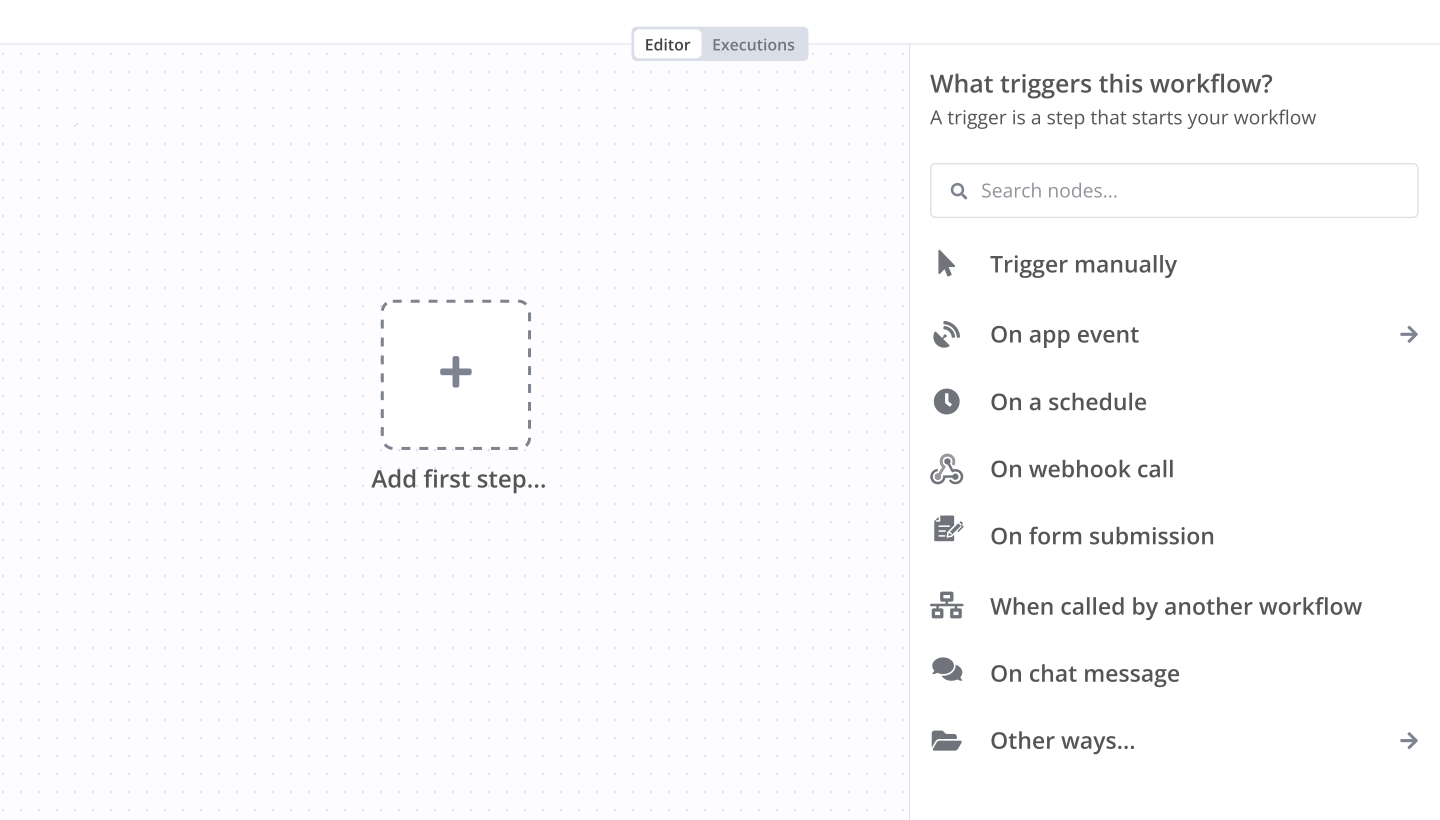
Google Gemini Chat Model and Microsoft Outlook integration: Create a new workflow and add the first step

Step 2: Add and configure Google Gemini Chat Model and Microsoft Outlook nodes

You can find Google Gemini Chat Model and Microsoft Outlook in the nodes panel. Drag them onto your workflow canvas, selecting their actions. Click each node, choose a credential, and authenticate to grant n8n access. Configure Google Gemini Chat Model and Microsoft Outlook nodes one by one: input data on the left, parameters in the middle, and output data on the right.

Google Gemini Chat Model and Microsoft Outlook integration: Add and configure Google Gemini Chat Model and Microsoft Outlook nodes

Step 3: Connect Google Gemini Chat Model and Microsoft Outlook

A connection establishes a link between Google Gemini Chat Model and Microsoft Outlook (or vice versa) to route data through the workflow. Data flows from the output of one node to the input of another. You can have single or multiple connections for each node.

Google Gemini Chat Model and Microsoft Outlook integration: Connect Google Gemini Chat Model and Microsoft Outlook

Step 4: Customize and extend your Google Gemini Chat Model and Microsoft Outlook integration

Use n8n's core nodes such as If, Split Out, Merge, and others to transform and manipulate data. Write custom JavaScript or Python in the Code node and run it as a step in your workflow. Connect Google Gemini Chat Model and Microsoft Outlook with any of n8n’s 1000+ integrations, and incorporate advanced AI logic into your workflows.

Google Gemini Chat Model and Microsoft Outlook integration: Customize and extend your Google Gemini Chat Model and Microsoft Outlook integration

Step 5: Test and activate your Google Gemini Chat Model and Microsoft Outlook workflow

Save and run the workflow to see if everything works as expected. Based on your configuration, data should flow from Google Gemini Chat Model to Microsoft Outlook or vice versa. Easily debug your workflow: you can check past executions to isolate and fix the mistake. Once you've tested everything, make sure to save your workflow and activate it.

Google Gemini Chat Model and Microsoft Outlook integration: Test and activate your Google Gemini Chat Model and Microsoft Outlook workflow

Generate monthly financial reports with Gemini AI, SQL, and Outlook

🚀 AI-Powered Business Performance Reporting Automation

Unlock executive-level insights with ZERO manual work!
This n8n template empowers you to automate your entire monthly business performance reporting using dynamic SQL queries, AI-driven analysis, and beautiful HTML dashboards — all delivered directly to your inbox.

🎯 What This Automation Does

📆 Triggers automatically every month (5th of each month)
🧮 Fetches financial data from SQL (ERPNext or any database)
🔁 Loops over cost centers to analyze each business unit individually
📊 Generates Profit & Loss reports, WIP, Employee stats, and vertical breakdowns
🤖 Uses Google Gemini 2.5 AI to perform advanced financial analysis
💌 Delivers a polished HTML report to your email inbox
🔧 Fully modular – replace data source with Excel, Google Sheets, or APIs

🧑‍🏫 Step-by-Step Video Tutorial

🎥 Watch the full tutorial on YouTube:

📌 Learn how each node works and see the AI-generated report in action.

🌐 Useful Links

🔗 Sign up for n8n Cloud (recommended for non-tech users):
👉 https://n8n.syncbricks.com

📘 Download the step-by-step Guidebook (Free):
👉 https://lms.syncbricks.com/books/n8n

📚 Explore the full course on n8n (includes templates, workflows, and AI integrations):
👉 https://lms.syncbricks.com/courses/n8n

🛠 Requirements

✅ n8n (Self-hosted or Cloud)
✅ SQL Database (MySQL / PostgreSQL / ERPNext)
✅ Microsoft Outlook or Gmail (to send the report)
✅ Gemini API Key (for AI analysis)
✅ Basic understanding of your data schema

💡 Why Use This Template?

⏱ Saves 2-3 days of manual work every month
📈 Improves financial visibility across business units
🤝 Great for CFOs, COOs, Finance Analysts, and BI teams
🔄 Scales across multiple divisions and companies
🧠 Leverages AI for actionable insights and recommendations

🧩 Customize It Your Way

Replace the SQL nodes with:
Excel / Google Sheets
Airtable / APIs
Custom Applications

Swap the AI model:
OpenAI GPT
Claude
DeepSeek

Adjust the report structure or HTML style

🙌 Get Started Now

🎯 Import the JSON template → Connect your data → Receive business insights via email.
Don’t let manual reporting slow down your decision-making.

👉 Sign up for n8n Cloud
👉 Learn n8n with Amjid
👉 Download Guide

Created by Amjid Ali | SyncBricks™ – Automation for Everyone

Nodes used in this workflow

Popular Google Gemini Chat Model and Microsoft Outlook workflows

+2

Automated Invoice-PO Matching with Google Gemini AI and Email Notifications

Automated Invoice-Processing AI Agent for n8n Overview The Automated Invoice-Processing AI Agent in n8n is designed to streamline and optimize invoice management for finance teams and accounts payable (AP) professionals. This solution addresses the common challenge of verifying invoice data manually, cross-checking it against purchase orders (POs), and ensuring compliance before releasing payments. By intelligently fetching invoices from Google Drive, extracting key details, validating them against PO records from Google Sheets, and automating the next actions, this system reduces human intervention, minimizes errors, and accelerates the payment process. Target Audience This automation primarily serves finance and AP teams responsible for managing large volumes of vendor invoices. It also supports finance managers, procurement departments, and auditors who require accuracy in payment reconciliation, ensuring that invoices align with approved POs before processing. Business Problem Addressed Organizations frequently struggle with time-consuming manual invoice verification and data entry. Discrepancies between invoices and purchase orders can lead to payment delays, compliance risks, or duplicate payments. This n8n-based AI agent automates that process—ensuring that every invoice is validated, exceptions are flagged to the finance team promptly, and payments of smaller value (under defined thresholds) are processed automatically. Prerequisites Active n8n account or self-hosted instance Google Drive and Google Sheets connected via n8n credentials LLM (AI node) configured for document extraction (optional but recommended) A Google Sheet set up with existing PO data (including PO Number, Amount, and Date fields) Setup Instructions Connect Google Drive and Google Sheets integrations within n8n. Configure the workflow trigger to monitor a designated "Invoices" folder. Add a document-parsing node to extract invoice details such as PO Number, Invoice Date, and Amount. Implement conditional logic: If the invoice amount > 5000, the agent cross-references PO details from the Google Sheet. If it matches, it updates the PO sheet status to “Process Payment.” If not, an automated email notifies the finance team. If the amount ≤ 5000, the workflow marks it for direct payment. Test the workflow with sample invoices before full deployment. Customization Options Adjust the payment threshold value (e.g., 10,000 instead of 5,000). Customize the email notification template and recipient list. Integrate with accounting systems such as QuickBooks or SAP for end-to-end automation. Add audit logging nodes to create traceability for every action taken. This AI-driven automation brings speed, accuracy, and scalability to invoice verification—empowering finance professionals to focus on analytical and strategic tasks rather than repetitive manual work.
+3

Generate Monthly Financial Reports with Gemini AI, SQL, and Outlook

🚀 AI-Powered Business Performance Reporting Automation Unlock executive-level insights with ZERO manual work! This n8n template empowers you to automate your entire monthly business performance reporting using dynamic SQL queries, AI-driven analysis, and beautiful HTML dashboards — all delivered directly to your inbox. 🎯 What This Automation Does 📆 Triggers automatically every month (5th of each month) 🧮 Fetches financial data from SQL (ERPNext or any database) 🔁 Loops over cost centers to analyze each business unit individually 📊 Generates Profit & Loss reports, WIP, Employee stats, and vertical breakdowns 🤖 Uses Google Gemini 2.5 AI to perform advanced financial analysis 💌 Delivers a polished HTML report to your email inbox 🔧 Fully modular – replace data source with Excel, Google Sheets, or APIs 🧑‍🏫 Step-by-Step Video Tutorial 🎥 Watch the full tutorial on YouTube: 📌 Learn how each node works and see the AI-generated report in action. 🌐 Useful Links 🔗 Sign up for n8n Cloud (recommended for non-tech users): 👉 https://n8n.syncbricks.com 📘 Download the step-by-step Guidebook (Free): 👉 https://lms.syncbricks.com/books/n8n 📚 Explore the full course on n8n (includes templates, workflows, and AI integrations): 👉 https://lms.syncbricks.com/courses/n8n 🛠 Requirements ✅ n8n (Self-hosted or Cloud) ✅ SQL Database (MySQL / PostgreSQL / ERPNext) ✅ Microsoft Outlook or Gmail (to send the report) ✅ Gemini API Key (for AI analysis) ✅ Basic understanding of your data schema 💡 Why Use This Template? ⏱ Saves 2-3 days of manual work every month 📈 Improves financial visibility across business units 🤝 Great for CFOs, COOs, Finance Analysts, and BI teams 🔄 Scales across multiple divisions and companies 🧠 Leverages AI for actionable insights and recommendations 🧩 Customize It Your Way Replace the SQL nodes with: Excel / Google Sheets Airtable / APIs Custom Applications Swap the AI model: OpenAI GPT Claude DeepSeek Adjust the report structure or HTML style 🙌 Get Started Now 🎯 Import the JSON template → Connect your data → Receive business insights via email. Don’t let manual reporting slow down your decision-making. 👉 Sign up for n8n Cloud 👉 Learn n8n with Amjid 👉 Download Guide Created by Amjid Ali | SyncBricks™ – Automation for Everyone

Parse Incoming Invoices From Outlook using AI Document Understanding

This n8n template monitors an Outlook mailbox for invoices, automatically parses/extracts data from them and then uploads the output to an Excel Workbook. One of my top workflow requests, this template can save many hours of manual labour for you or your finance/accounts team. How it works A scheduled trigger is set to fetch recent Outlook messages to the Accounts receivable mailbox. Each message is analysed to determine whether or not it from a supplier and is issuing/contains an invoice. For each valid message, the attachments are downloaded and non-invoice documents are filtered out via AI Vision classification. Invoices are then processed through a AI vision model again to extract the details. The extracted data can then be used for reconciliation or otherwise. For this demonstration, we'll just append the row to an Excel sheet for now. How to use Ensure your Microsoft365 credential points to the correct mailbox. If a shared folder is used, toggle "shared folder" option to "on" and for the principal ID, use the email address. If you receive lots of other types of messages such as replies and forwards, you may want to implement additional checks to prevent processing invoices twice. The "remove duplicates" node can help with this. Requirements Outlook for Mailbox Google Gemini for Document Understanding and Invoice Extraction Excel for Data Storage Customising this workflow Note the assumption for this template is that all invoices will come as a PDF attachment. In real life, this is rarely the case! Adding in document conversion to cover all invoice formats. Human feedback is also an important factor in AI workflows. Try tagging emails as a way to notify team members that the invoice was processed.

🎓 How to Transform Unstructured Email Data into Structured Format with AI Agent

This workflow automates the process of extracting structured, usable information from unstructured email messages across multiple platforms. It connects directly to Gmail, Outlook, and IMAP accounts, retrieves incoming emails, and sends their content to an AI-powered parsing agent built on OpenAI GPT models. The AI agent analyzes each email, identifies relevant details, and returns a clean JSON structure containing key fields: From** – sender’s email address To** – recipient’s email address Subject** – email subject line Summary** – short AI-generated summary of the email body The extracted information is then automatically inserted into an n8n Data Table, creating a structured database of email metadata and summaries ready for indexing, reporting, or integration with other tools. Key Benefits ✅ Full Automation: Eliminates manual reading and data entry from incoming emails. ✅ Multi-Source Integration: Handles data from different email providers seamlessly. ✅ AI-Driven Accuracy: Uses advanced language models to interpret complex or unformatted content. ✅ Structured Storage: Creates a standardized, query-ready dataset from previously unstructured text. ✅ Time Efficiency: Processes emails in real time, improving productivity and response speed. ✅ Scalability:* Easily extendable to handle additional sources or extract more data fields. How it works This workflow automates the transformation of unstructured email data into a structured, queryable format. It operates through a series of connected steps: Email Triggering: The workflow is initiated by one of three different email triggers (Gmail, Microsoft Outlook, or a generic IMAP account), which constantly monitor for new incoming emails. AI-Powered Parsing & Structuring: When a new email is detected, its raw, unstructured content is passed to a central "Parsing Agent." This agent uses a specified OpenAI language model to intelligently analyze the email text. Data Extraction & Standardization: Following a predefined system prompt, the AI agent extracts key information from the email, such as the sender, recipient, subject, and a generated summary. It then forces the output into a strict JSON structure using a "Structured Output Parser" node, ensuring data consistency. Data Storage: Finally, the clean, structured data (the from, to, subject, and summarize fields) is inserted as a new row into a specified n8n Data Table, creating a searchable and reportable database of email information. Set up steps To implement this workflow, follow these configuration steps: Prepare the Data Table: Create a new Data Table within n8n. Define the columns with the following names and string type: From, To, Subject, and Summary. Configure Email Credentials: Set up the credential connections for the email services you wish to use (Gmail OAuth2, Microsoft Outlook OAuth2, and/or IMAP). Ensure the accounts have the necessary permissions to read emails. Configure AI Model Credentials: Set up the OpenAI API credential with a valid API key. The workflow is configured to use the model, but this can be changed in the respective nodes if needed. Connect the Nodes: The workflow canvas is already correctly wired. Visually confirm that the email triggers are connected to the "Parsing Agent," which is connected to the "Insert row" (Data Table) node. Also, ensure the "OpenAI Chat Model" and "Structured Output Parser" are connected to the "Parsing Agent" as its AI model and output parser, respectively. Activate the Workflow: Save the workflow and toggle the "Active" switch to ON. The triggers will begin polling for new emails according to their schedule (e.g., every minute), and the automation will start processing incoming messages. Need help customizing? Contact me for consulting and support or add me on Linkedin.

Financial News Digest with Google Gemini AI to Outlook Email

🧠 Key Features Looping source scraping: Collects content from news sites you have selected (it might not work for all of them however) HTML extraction & cleaning: Parses, cleans, and filters messy website data to isolate only the most relevant content. AI-powered synthesis: Uses Google Gemini (via LangChain agent) to summarize and structure financial news into a clear, bullet-pointed format. Email-ready output: Generates styled HTML summaries with coral-colored headings, ideal for daily email reports. Fully automated delivery: Sends out beautifully formatted updates via Outlook — no manual work required. 🔧 Technologies Used n8n workflow orchestration LangChain agents for prompt logic and formatting Google Gemini API for advanced NLP Custom JS logic to manage dynamic inputs and cleanup Microsoft Outlook API for final distribution > Feel free to reach out if needed !
+2

AI-Powered Candidate Shortlisting Automation for ERPNext

Template Guide for Employee Shortlisting AI Agent Automation Overview This template automates the process of shortlisting job applicants using ERPNext, n8n, and AI-powered decision-making tools like Google Gemini and OpenAI. It reduces manual effort, ensures fast evaluations, and provides justifiable decisions about applicants. This is ideal for businesses aiming to streamline their recruitment process while maintaining accuracy and professionalism. YouTube Tutorial:** For a full walkthrough of this template, visit: Integrate AI in ERPNext: Automate Recruitment Job Applicant Shortlisting in Seconds! What Does This Template Do? Webhook Integration with ERPNext: Automatically triggers the workflow when a job application is created in ERPNext. Resume Validation: Ensures resumes are attached and correctly processes various file formats like PDF and DOC. AI-Powered Evaluation: Uses AI to compare resumes against job descriptions and provides a: Fit Level (Strong, Moderate, or Weak) Score (0–100) Justification for the decision. Automated Decision Making: Based on AI-generated scores: Candidates with a score of 80 or higher are Accepted. Candidates below 80 are Rejected. Applications missing required fields or attachments are put On Hold. ERPNext Integration: Updates applicant records in ERPNext, including custom fields such as justification, fit level, and scores. Notifications: Notifies candidates via email, WhatsApp, or SMS about their application status. Step-by-Step Guide Step 1: Set Up ERPNext Webhook Go to Webhooks in ERPNext. Create a webhook for the Job Applicant DocType. Set the trigger to Insert. Pin and test the webhook to ensure proper data flow. Step 2: Import the Template into n8n Open your n8n instance. Import the provided workflow template. Check all nodes for proper configuration. Step 3: Configure Credentials Add your ERPNext API credentials to the ERPNext nodes. Add credentials for AI services like OpenAI or Google Gemini. Configure additional services like WhatsApp or email if you plan to use them for notifications. Step 4: Test Resume Validation Test how the workflow handles different file types (e.g., PDF, DOC, JPG). Ensure resumes without the proper format or attachment are flagged and rejected. Step 5: AI Evaluation The AI model (Google Gemini or OpenAI) will evaluate resumes against job descriptions. Customize the AI prompt to suit your job evaluation needs. The output will include a Fit Level, Score, Rating, and Justification. Step 6: Decision Automation The workflow automatically categorizes applicants: Accepted for scores ≥ 80. Rejected for scores < 80. On Hold if essential fields or attachments are missing. Step 7: Update ERPNext Records The workflow updates the Job Applicant record in ERPNext with: Status (Accepted, Rejected, On Hold) AI-generated Fit Level, Score, Rating, and Justification. Step 8: Notify Candidates Configure notification nodes (email, WhatsApp, or SMS). Inform candidates about their application status and include feedback if required. How It Works Trigger: The workflow starts when a job application is submitted in ERPNext. Validation: Checks if the resume is attached and in the correct format. AI Evaluation: Compares the resume with the job description and generates a decision. ERPNext Update: Updates the applicant's record with the decision and justification. Notification: Sends a personalized notification to the candidate. Dos and Don’ts Dos: Customize Prompts:** Tailor the AI prompt to match your specific job evaluation requirements. Test the Workflow:** Run sample data to ensure the process works as intended. Secure Your Credentials:** Keep your API credentials safe and do not share them publicly. Optimize for Different Formats:** Ensure the workflow can handle all types of resumes you expect. Don’ts: Avoid Manual Intervention:** Let the workflow handle most of the tasks to ensure efficiency. Do Not Skip Testing:** Always test the workflow with various scenarios to avoid errors. Do Not Overlook Notifications:** Ensure candidates are notified promptly to maintain professionalism. Customization Options Add logic for more file types (e.g., scanned images using OCR). Enhance the AI prompts to analyze more complex resume data. Integrate additional tools like Slack or Trello for recruitment tracking. Resources GET n8n Now N8N COURSE n8n Book YouTube Tutorial:** For a full walkthrough of this template, visit: SyncBricks YouTube Channel Detailed Guides and Courses:** Learn more about ERPNext and AI-driven automation at: SyncBricks LMS Support If you encounter issues or want to explore more possibilities with AI-driven automation, feel free to reach out: Email:** [email protected] Website:** ERPNext and Other Courses LinkedIn:** Amjid Ali Let me know if you'd like further details or modifications to the guide!

Build your own Google Gemini Chat Model and Microsoft Outlook integration

Create custom Google Gemini Chat Model and Microsoft Outlook workflows by choosing triggers and actions. Nodes come with global operations and settings, as well as app-specific parameters that can be configured. You can also use the HTTP Request node to query data from any app or service with a REST API.

Microsoft Outlook supported actions

Create
Create a new calendar
Delete
Delete a calendar
Get
Retrieve a calendar
Get Many
List and search calendars
Update
Update a calendar
Create
Create a new contact
Delete
Delete a contact
Get
Retrieve a contact
Get Many
List and search contacts
Update
Update a contact
Create
Create a new email draft
Delete
Delete an email draft
Get
Retrieve an email draft
Send
Send an existing email draft
Update
Update an email draft
Create
Create a new event
Delete
Delete an event
Get
Retrieve an event
Get Many
List and search events
Update
Update an event
Create
Create a mail folder in the root folder of the user's mailbox
Delete
Delete a folder
Get
Retrieve a folder
Get Many
Get many folders
Update
Update a folder
Get Many
Retrieves the messages in a folder
Delete
Delete a message
Get
Retrieve a single message
Get Many
List and search messages
Move
Move a message to a folder
Reply
Create a reply to a message
Send
Send a message
Send and Wait for Response
Send a message and wait for response
Update
Update a message
Add
Add an attachment to a message
Download
Download an attachment from a message
Get
Retrieve information about an attachment of a message
Get Many
Retrieve information about the attachments of a message

FAQs

  • Can Google Gemini Chat Model connect with Microsoft Outlook?

  • Can I use Google Gemini Chat Model’s API with n8n?

  • Can I use Microsoft Outlook’s API with n8n?

  • Is n8n secure for integrating Google Gemini Chat Model and Microsoft Outlook?

  • How to get started with Google Gemini Chat Model and Microsoft Outlook integration in n8n.io?

Looking to integrate Google Gemini Chat Model and Microsoft Outlook in your company?

Over 3000 companies switch to n8n every single week

Why use n8n to integrate Google Gemini Chat Model with Microsoft Outlook

Build complex workflows, really fast
Build complex workflows, really fast

Handle branching, merging and iteration easily.
Pause your workflow to wait for external events.

Code when you need it, UI when you don't

Simple debugging

Your data is displayed alongside your settings, making edge cases easy to track down.

Use templates to get started fast

Use 1000+ workflow templates available from our core team and our community.

Reuse your work

Copy and paste, easily import and export workflows.

Implement complex processes faster with n8n

red iconyellow iconred iconyellow icon