
Back to Integrations
integrationMicrosoft Outlook node
integrationMicrosoft Excel 365 node

Microsoft Outlook and Microsoft Excel 365 integration

Save yourself the work of writing custom integrations for Microsoft Outlook and Microsoft Excel 365 and use n8n instead. Build adaptable and scalable Communication, HITL, Data & Storage, and Productivity workflows that work with your technology stack. All within a building experience you will love.

How to connect Microsoft Outlook and Microsoft Excel 365

  • Step 1: Create a new workflow
  • Step 2: Add and configure nodes
  • Step 3: Connect
  • Step 4: Customize and extend your integration
  • Step 5: Test and activate your workflow

Step 1: Create a new workflow and add the first step

In n8n, click the "Add workflow" button in the Workflows tab to create a new workflow. Add the starting point – a trigger on when your workflow should run: an app event, a schedule, a webhook call, another workflow, an AI chat, or a manual trigger. Sometimes, the HTTP Request node might already serve as your starting point.
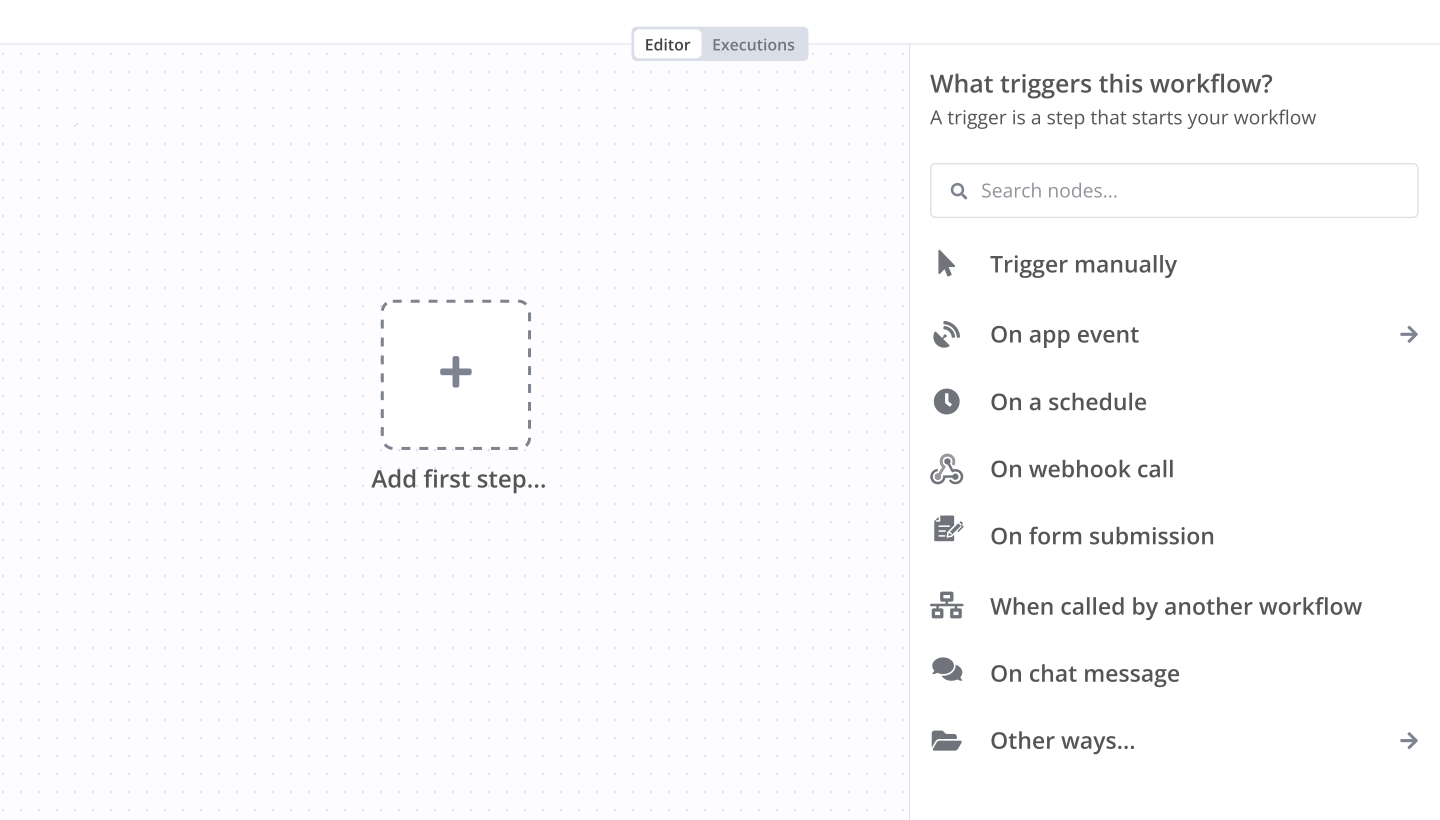
Microsoft Outlook and Microsoft Excel 365 integration: Create a new workflow and add the first step

Step 2: Add and configure Microsoft Outlook and Microsoft Excel 365 nodes

You can find Microsoft Outlook and Microsoft Excel 365 in the nodes panel. Drag them onto your workflow canvas, selecting their actions. Click each node, choose a credential, and authenticate to grant n8n access. Configure Microsoft Outlook and Microsoft Excel 365 nodes one by one: input data on the left, parameters in the middle, and output data on the right.

Microsoft Outlook and Microsoft Excel 365 integration: Add and configure Microsoft Outlook and Microsoft Excel 365 nodes

Step 3: Connect Microsoft Outlook and Microsoft Excel 365

A connection establishes a link between Microsoft Outlook and Microsoft Excel 365 (or vice versa) to route data through the workflow. Data flows from the output of one node to the input of another. You can have single or multiple connections for each node.

Microsoft Outlook and Microsoft Excel 365 integration: Connect Microsoft Outlook and Microsoft Excel 365

Step 4: Customize and extend your Microsoft Outlook and Microsoft Excel 365 integration

Use n8n's core nodes such as If, Split Out, Merge, and others to transform and manipulate data. Write custom JavaScript or Python in the Code node and run it as a step in your workflow. Connect Microsoft Outlook and Microsoft Excel 365 with any of n8n’s 1000+ integrations, and incorporate advanced AI logic into your workflows.

Microsoft Outlook and Microsoft Excel 365 integration: Customize and extend your Microsoft Outlook and Microsoft Excel 365 integration

Step 5: Test and activate your Microsoft Outlook and Microsoft Excel 365 workflow

Save and run the workflow to see if everything works as expected. Based on your configuration, data should flow from Microsoft Outlook to Microsoft Excel 365 or vice versa. Easily debug your workflow: you can check past executions to isolate and fix the mistake. Once you've tested everything, make sure to save your workflow and activate it.

Microsoft Outlook and Microsoft Excel 365 integration: Test and activate your Microsoft Outlook and Microsoft Excel 365 workflow

Daily newsletter service using Excel, Outlook and AI

This n8n template builds a newsletter ("daily digest") delivery service which pulls and summarises the latest n8n.io template in select categories defined by subscribers.

It's scheduled to run once a day and sends the newsletter directly to subscriber via a nicely formatted email. If you've had trouble keeping up with the latest and greatest templates beign published daily, this workflow can save you a lot of time!

How it works
A scheduled trigger pulls a list of subscribers (email and category preferences) from an Excel workbook.
We work out unique categories amongst all subscribers and only fetch the latest n8n website templates from these categories to save on resources and optimise the number of API calls we make.
The fetched templates are summarised via AI to produce a short description which is more suitable for our email format.
For each subscriber, we filter and collect only the templates relevant to their category preferences (as defined in the Excel) and ensure that duplicate templates or those which have been "seen before" are omitted.
A HTML node is then used to generate the email newsletter. HTML emails are the perfect format since we can add links back to the template.
Finally, we use the Outlook node to send the email digest to the subscriber.

How to use
Populate your Excel sheet with 3 columns: name, email and categories. Categories is a comma-delimited list of categories which match the n8n template website. The available categories are AI, SecOps, Sales, IT Ops, Marketing, Engineering, DevOps, Building Blocks, Design, Finance, HR, Other, Product and Support.
To subscribe a new user, simply add their email to the Excel sheet with at least one category.
To unsubscribe a user, remove them from the sheet.
If you're not interested in paid templates, you may want to filter them out after fetching.

Requirements
Microsoft Excel for subscriber list
Microsoft Outlook for delivering emails
OpenAI for AI-generated descriptions

Customising the workflow
Use AI to summarise the week's trend of templates types and use-cases
This template can be the basis for other similar newsletters - just pull in a list of things from anywhere!

Nodes used in this workflow

Popular Microsoft Outlook and Microsoft Excel 365 workflows

Parse Incoming Invoices From Outlook using AI Document Understanding

This n8n template monitors an Outlook mailbox for invoices, automatically parses/extracts data from them and then uploads the output to an Excel Workbook. One of my top workflow requests, this template can save many hours of manual labour for you or your finance/accounts team. How it works A scheduled trigger is set to fetch recent Outlook messages to the Accounts receivable mailbox. Each message is analysed to determine whether or not it from a supplier and is issuing/contains an invoice. For each valid message, the attachments are downloaded and non-invoice documents are filtered out via AI Vision classification. Invoices are then processed through a AI vision model again to extract the details. The extracted data can then be used for reconciliation or otherwise. For this demonstration, we'll just append the row to an Excel sheet for now. How to use Ensure your Microsoft365 credential points to the correct mailbox. If a shared folder is used, toggle "shared folder" option to "on" and for the principal ID, use the email address. If you receive lots of other types of messages such as replies and forwards, you may want to implement additional checks to prevent processing invoices twice. The "remove duplicates" node can help with this. Requirements Outlook for Mailbox Google Gemini for Document Understanding and Invoice Extraction Excel for Data Storage Customising this workflow Note the assumption for this template is that all invoices will come as a PDF attachment. In real life, this is rarely the case! Adding in document conversion to cover all invoice formats. Human feedback is also an important factor in AI workflows. Try tagging emails as a way to notify team members that the invoice was processed.

Daily Newsletter Service using Excel, Outlook and AI

This n8n template builds a newsletter ("daily digest") delivery service which pulls and summarises the latest n8n.io template in select categories defined by subscribers. It's scheduled to run once a day and sends the newsletter directly to subscriber via a nicely formatted email. If you've had trouble keeping up with the latest and greatest templates beign published daily, this workflow can save you a lot of time! How it works A scheduled trigger pulls a list of subscribers (email and category preferences) from an Excel workbook. We work out unique categories amongst all subscribers and only fetch the latest n8n website templates from these categories to save on resources and optimise the number of API calls we make. The fetched templates are summarised via AI to produce a short description which is more suitable for our email format. For each subscriber, we filter and collect only the templates relevant to their category preferences (as defined in the Excel) and ensure that duplicate templates or those which have been "seen before" are omitted. A HTML node is then used to generate the email newsletter. HTML emails are the perfect format since we can add links back to the template. Finally, we use the Outlook node to send the email digest to the subscriber. How to use Populate your Excel sheet with 3 columns: name, email and categories. Categories is a comma-delimited list of categories which match the n8n template website. The available categories are AI, SecOps, Sales, IT Ops, Marketing, Engineering, DevOps, Building Blocks, Design, Finance, HR, Other, Product and Support. To subscribe a new user, simply add their email to the Excel sheet with at least one category. To unsubscribe a user, remove them from the sheet. If you're not interested in paid templates, you may want to filter them out after fetching. Requirements Microsoft Excel for subscriber list Microsoft Outlook for delivering emails OpenAI for AI-generated descriptions Customising the workflow Use AI to summarise the week's trend of templates types and use-cases This template can be the basis for other similar newsletters - just pull in a list of things from anywhere!

Collect Conference Feedback with Forms and Log to Excel OneDrive with Outlook Notifications

Conference Feedback Collection and OneDrive Logging Workflow This n8n workflow is designed to collect feedback through a web form, log the responses into an Excel file stored in Microsoft OneDrive, and notify the support team via email. 🧭 Overall Goal To collect user feedback from a web form, structure the data, log it into a OneDrive Excel file, and notify support via Outlook email. 🔄 Workflow Breakdown Form Submission (On form submission) Node Type**: formTrigger Purpose**: Captures user feedback via a web form. Form Fields**: Full Name (Required) Email (Required) Company Name Job Title How did you hear about the conference? (Required) Overall experience rating (Required) Favorite sessions/speakers Relevance to interests/work (Required) Networking opportunities (Required) Suggestions for improvement Future topics/speakers Willingness to attend again (Required) Additional comments Contact permission (Required) Access URL**: /webhook/feedback (or /webhook-test/feedback during testing) Parse Data (Set) Purpose**: Renames form fields to snake_case. Output**: Structured JSON with renamed fields. Sample File (Convert to File) Purpose**: Generates a file name reference for search. Filename**: test-n8n-feedback-form-data.xlsx Search Document (Microsoft OneDrive) Purpose**: Searches OneDrive for the specified Excel file. Query**: test-n8n-feedback-form-data.xlsx Extract File ID (Code) Purpose**: Extracts the ID of the file from the search result. Output**: { "id": "someFileId" } or { "id": null } Check File Existence (If) Purpose**: Branch logic based on file existence. Condition**: If id exists. Build Sheet Data (Set) Purpose**: Prepares the data to match the Excel column headers. Only Runs If**: File was found. Append Data to Excel (Microsoft Excel) Purpose**: Appends the new feedback as a row. Workbook ID**: {{ $('Code').item.json.id }} Worksheet Name**: Sheet1 Mode**: Auto-map from input fields Notify Support (Microsoft Outlook) Purpose**: Sends a notification email with key feedback details. To**: [email protected] Subject**: "New Feedback Submission Received" Body**: Includes key details from submission End Workflow (NoOp) Purpose**: Marks logical end of the workflow. 📝 Sticky Notes ✅ Upload Target Excel File First: Ensure the Excel file exists in OneDrive. 📝 Filename Consistency: Filename should match in "Sample File" and "Search Document" nodes. 📧 Customize Email Content: Update "Notify Support" node with your desired message and recipient. 🔧 Customization Guide 🧾 Form Customization Change form title, description, fields, or path. 🧪 Parsing Logic Update field mappings if form labels change. 📁 Excel File Settings Filename must match your actual OneDrive file. Worksheet name and column headers must match in "Build Sheet Data". 📬 Email Settings Update subject and body using variables like {{ $('Parse Data').item.json.full_name }}. ❗ Error Handling Tips Adjust email content based on file presence. Add an "Error Trigger" for advanced error management. 🔁 Alternatives and Extensions Use Google Sheets, Airtable, or databases instead of OneDrive/Excel. Add Slack or SMS notifications. 📌 Use Cases Post-event Feedback CSAT Surveys Employee Feedback Bug Reporting Lead Capture Contact Forms Webinar Registration 🔐 Required Credentials Microsoft OneDrive (OAuth2) Used by**: "Search Document" Credential Name**: Microsoft Drive account Microsoft Excel (OAuth2) Used by**: "Append Data" Credential Name**: Microsoft Excel account Microsoft Outlook (OAuth2) Used by**: "Notify Support" Credential Name**: Outlook 0Auth2 ❤️ Made with n8n by Akhil

Extract and log Outlook invoices to OneDrive Excel with GPT-4.1-mini

Invoice Processor – Microsoft 365 > Automatically extract, log, and archive invoices from your Outlook inbox using GPT-4.1-mini, OneDrive, and Excel — no manual data entry required. Who It's For This workflow is built for small business owners, finance teams, and operations managers who receive invoices via email and need a hands-free way to capture, organize, and track them. It works entirely within the Microsoft 365 ecosystem — no third-party apps required. How It Works The workflow runs on a daily schedule (default: 7 AM) and fetches all unread emails from a specified Outlook folder. Each email body is cleaned from HTML to plain text and passed to GPT-4.1-mini, which extracts 14 structured invoice fields — including vendor name, invoice number, issue date, due date, and total amount due. If the email includes a PDF attachment, the workflow fetches it via the Microsoft Graph API, checks whether a dated subfolder exists in OneDrive (Invoices/YYYY-MM-DD), creates one if needed, and uploads the file as VENDOR-YYYY-MM.pdf, capturing the shareable link. All extracted data is appended to an Excel table for record-keeping. Finally, processed emails are marked as read and a formatted HTML digest summarizing all invoices is sent via Outlook. How to Set Up Add your Microsoft Outlook OAuth2 credential — used to fetch emails and send the digest. Add your Microsoft Graph OAuth2 credential — used for OneDrive folder creation, PDF upload, and Excel append. In Outlook — Get Unread Emails, update foldersToInclude to your target Outlook folder ID (find it via Graph Explorer). In Excel — Append Invoice Row, update the workbook, worksheet, and table IDs to match your tblInvoices tracker file in OneDrive. In Code — Build Digest Email, replace YOUR_ONEDRIVE_FOLDER_URL with a direct link to your Invoices folder. In Outlook — Send Daily Digest, replace [email protected] with your recipient address. Requirements Microsoft Outlook OAuth2 credential Microsoft Graph OAuth2 credential (Generic OAuth2 with https://graph.microsoft.com/.default scope) OpenAI API credential (GPT-4.1-mini) An Excel workbook in OneDrive with a table named tblInvoices containing columns matching the field list A PDF Link column added to your tblInvoices table How to Customize Change the schedule: Adjust the cron expression in **Schedule — Daily Trigger to run more or less frequently. Add more fields: Extend the extraction prompt in **AI — Extract Invoice Fields with additional fields and add matching columns to your Excel table. Modify the folder structure: Edit **Code — Build Upload Path to change how PDF subfolders are named or organized in OneDrive. Filter by sender or subject: Add a Filter node after **Outlook — Get Unread Emails to process only emails matching specific criteria. Support: [email protected] | Automated Intelligent Solutions

Convert legal timesheets to LEDES and PDF invoices

Who is this for This template is built for solo attorneys, small law firms, and legal billing coordinators who receive timesheet documents by email and need to produce LEDES-compliant e-billing files for client billing management systems. If you have an IMAP inbox, an OpenAI API key, a self-hosted Gotenberg instance, and a Microsoft 365 account, you can have AI-processed LEDES invoices delivering automatically in under 30 minutes of setup. What it does The workflow monitors an inbox for emails with PDF or Word timesheet attachments, extracts all time entries using GPT-4o, assigns UTBMS task codes, auto-increments an invoice number, and returns a PDF invoice, LEDES 1998B file, and LEDES XML 2.0 file to the original sender — all without any manual data entry. How it works An IMAP — Watch Inbox trigger monitors for unread emails with attachments. Classify Attachment detects whether the file is a PDF or Word document and routes it to the correct extractor. Extract — PDF Text or Extract — Word Text pulls the raw text content from the attachment and passes it to the AI pipeline. AI Agent — Extract Time Entries uses GPT-4o to parse all time entries from the document, capture date, timekeeper, hours, rate, description, client, and matter fields, and assign the best-fit UTBMS ABA task code (A101–A111) for each line. If rate or timekeeper information is missing, configurable defaults are applied automatically. AI Agent — Extract Sender Info runs a second GPT-4o-mini pass over the email body and signature to extract the sender's name, address, and contact details for the "Remit To" section of the invoice. Excel — Read Invoice Numbers queries your timesheets.xlsx tracking workbook via Microsoft Graph API to find the last issued invoice number and increment it automatically. Merge — Time Entries + Invoice Number combines the AI-extracted data with the new invoice number, then fans out to four parallel generation nodes. Generate — LEDES 1998B, Generate — LEDES XML 2.0, Generate — Invoice HTML, and Prep Excel Rows run simultaneously to produce all outputs. All brand variables — logo URL, firm name, colors — are defined as named constants at the top of the Invoice HTML Code node for easy one-time customization. Convert to PDF sends the finished HTML to your self-hosted Gotenberg instance, returning a print-ready US Letter PDF — no third-party PDF service required. Send Invoice Email delivers all three billing files as attachments via Gmail OAuth2 back to the original sender. Excel — Append Time Entries and Excel — Append Invoice Number update your tracking workbook with the full LEDES row data and the new invoice record. How to set up Install the n8n-nodes-word2text community node under Settings → Community Nodes and restart n8n. In IMAP — Watch Inbox, configure your IMAP credential for the inbox you want to monitor. On both LLM nodes, connect your OpenAI API credential. In Send Invoice Email, connect your Gmail OAuth2 credential. On all three Excel nodes, connect your Microsoft Excel OAuth2 credential and point each node at your timesheets.xlsx workbook, worksheet, and table. In Convert to PDF, update the Gotenberg base URL to your self-hosted instance and configure HTTP Basic Auth if required. In Get Next Invoice Number, update the 'INV-' prefix to match your firm's invoice numbering convention. In Generate — Invoice HTML, update logoUrl and the brand color constants to match your firm identity. Requirements Self-hosted n8n — required for the n8n-nodes-word2text community node OpenAI API key (GPT-4o for time entry extraction; GPT-4o-mini for sender info) IMAP-accessible inbox for monitoring incoming timesheets Gmail account with OAuth2 configured in n8n Microsoft 365 account with OneDrive or SharePoint access for Excel tracking Self-hosted Gotenberg instance for HTML-to-PDF conversion How to customize the workflow Default billing rate** — Change the fallback hourly rate in the AI Agent system prompt (currently $650/hr) to match your firm's standard rate. UTBMS task codes* — Add, remove, or redefine task code mappings in the AI Agent — Extract Time Entries* system prompt to match your practice area or client requirements. Invoice layout* — All styling, fonts, colors, and section order are controlled inside Generate — Invoice HTML*. The HTML uses @page CSS rules and table-based layout for reliable PDF rendering. Email delivery** — Swap the Gmail node for Outlook, SendGrid, or any SMTP-compatible service supported by n8n. The binary attachment references require no changes. Approval gate* — Insert a Wait node and an internal Slack or email notification between Convert to PDF and Send Invoice Email* to require internal review before delivery. Word-only or PDF-only** — If you only process one file type, remove the unused branch and its corresponding If node to simplify the workflow. Visit automatedintelligentsolutions.com for more information, support, and workflows.

Generate PDF pricing proposals from Excel with Gotenberg and Outlook

Who is this for This template is built for consultants, agencies, and service businesses that quote custom engagements and want to eliminate the manual work of building, formatting, and delivering pricing proposals. If you have a SharePoint or OneDrive pricing sheet, a self-hosted Gotenberg instance, and a Gmail account, you can have personalized PDF proposals landing in prospect inboxes in under 30 minutes of setup. What it does The workflow accepts a form submission from your website or internal tools, looks up live pricing from your Excel pricing sheet, calculates the correct totals for the selected services and discount tier, renders a branded PDF proposal, and emails it to the requestor — all without any manual steps. How it works A Webhook Trigger receives a POST request from your web form containing the prospect's details, the services they're interested in, the applicable discount level, and the requestor's contact information. Fetch Pricing Sheet calls the Microsoft Graph API to pull all rows from your pricing_request.xlsx Excel table stored in OneDrive or SharePoint — so your proposals always reflect current, live pricing without any hardcoding. Process & Price is a Code node that filters the pricing rows down to only the selected services, applies the correct price tier (Discount, Retail, or Premium), and calculates line items and a grand total. It normalizes raw Excel data into clean proposal objects ready for rendering. Build HTML renders the processed data into a fully branded, print-optimized HTML document. The layout includes a cover page with prospect and firm details, a line-item pricing table, payment terms, and a signature block. All brand variables — logo URL, firm name, colors, and footer content — are defined as named constants at the top of the Code node for easy one-time customization. Convert to PDF sends the finished HTML to your self-hosted Gotenberg instance, which returns a print-ready, US Letter PDF using your CSS page layout — no third-party PDF service or API key required. Email Proposal delivers the PDF as an attachment via Gmail OAuth2 to the requestor. Internal recipients (e.g., a sales inbox) can be added as a CC with a single constant. How to set up In Webhook Trigger, copy the production webhook URL and wire it to your web form's POST action. In Fetch Pricing Sheet, update the SharePoint hostname, site path, drive, and file path to point to your pricing_request.xlsx. In Process & Price, confirm that your Excel column names match the field references in the Code node (service name, retail price, discount price, premium price). In Build HTML, update the brand constants at the top of the Code node: FIRM_NAME, LOGO_URL, ACCENT_COLOR, FOOTER_TEXT, and TERMS_TEXT. In Convert to PDF, update the Gotenberg base URL to your self-hosted instance. In Email Proposal, select your Gmail OAuth2 credential and update the INTERNAL_CC constant if desired. Requirements Microsoft 365 account with OneDrive or SharePoint access (for the pricing Excel file) Self-hosted Gotenberg instance (for HTML-to-PDF conversion) Gmail account with OAuth2 configured in n8n A web form or API client capable of POSTing JSON to a webhook URL Self-hosted n8n** — this workflow uses direct Microsoft Graph API calls and Gotenberg, which require a self-hosted instance for full compatibility How to customize the workflow Pricing tiers* — Add or rename price columns in your Excel sheet and update the tier-selection logic in Process & Price* to match. Proposal layout* — All styling, fonts, colors, and section order are controlled inside Build HTML*. The HTML uses @page CSS rules and table-based layout for reliable PDF rendering across Gotenberg versions. Discount logic* — Modify the discount calculation in Process & Price* to support percentage-based discounts, volume thresholds, or client-specific pricing rules. Email delivery** — Swap the Gmail node for Outlook, SendGrid, or any SMTP-compatible service supported by n8n. Map the pdfBuffer binary attachment and the rest of the workflow requires no changes. CRM routing** — Add a lookup step after the webhook to pull prospect details from HubSpot, Salesforce, or a SharePoint contact list and merge them into the proposal data before pricing. Approval gate* — Insert a Wait node and an internal Slack or email notification between Convert to PDF and Email Proposal* to require internal sign-off before delivery. Visit automatedintelligentsolutions.com for more information, support, and workflows.

Build your own Microsoft Outlook and Microsoft Excel 365 integration

Create custom Microsoft Outlook and Microsoft Excel 365 workflows by choosing triggers and actions. Nodes come with global operations and settings, as well as app-specific parameters that can be configured. You can also use the HTTP Request node to query data from any app or service with a REST API.

Microsoft Outlook supported actions

Create
Create a new calendar
Delete
Delete a calendar
Get
Retrieve a calendar
Get Many
List and search calendars
Update
Update a calendar
Create
Create a new contact
Delete
Delete a contact
Get
Retrieve a contact
Get Many
List and search contacts
Update
Update a contact
Create
Create a new email draft
Delete
Delete an email draft
Get
Retrieve an email draft
Send
Send an existing email draft
Update
Update an email draft
Create
Create a new event
Delete
Delete an event
Get
Retrieve an event
Get Many
List and search events
Update
Update an event
Create
Create a mail folder in the root folder of the user's mailbox
Delete
Delete a folder
Get
Retrieve a folder
Get Many
Get many folders
Update
Update a folder
Get Many
Retrieves the messages in a folder
Delete
Delete a message
Get
Retrieve a single message
Get Many
List and search messages
Move
Move a message to a folder
Reply
Create a reply to a message
Send
Send a message
Send and Wait for Response
Send a message and wait for response
Update
Update a message
Add
Add an attachment to a message
Download
Download an attachment from a message
Get
Retrieve information about an attachment of a message
Get Many
Retrieve information about the attachments of a message

Microsoft Excel 365 supported actions

Append
Add rows to the end of the table
Convert to Range
Convert a table to a range
Create
Add a table based on range
Delete
Delete a table
Get Columns
Retrieve a list of table columns
Get Rows
Retrieve a list of table rows
Lookup
Look for rows that match a given value in a column
Add Sheet
Add a new sheet to the workbook
Delete
Delete workbook
Get Many
Get workbooks
Append
Append data to sheet
Append or Update
Append a new row or update the current one if it already exists (upsert)
Clear
Clear sheet
Delete
Delete sheet
Get Many
Get a list of sheets
Get Rows
Retrieve a list of sheet rows
Update
Update rows of a sheet or sheet range

FAQs

  • Can Microsoft Outlook connect with Microsoft Excel 365?

  • Can I use Microsoft Outlook’s API with n8n?

  • Can I use Microsoft Excel 365’s API with n8n?

  • Is n8n secure for integrating Microsoft Outlook and Microsoft Excel 365?

  • How to get started with Microsoft Outlook and Microsoft Excel 365 integration in n8n.io?

Looking to integrate Microsoft Outlook and Microsoft Excel 365 in your company?

Over 3000 companies switch to n8n every single week

Why use n8n to integrate Microsoft Outlook with Microsoft Excel 365

Build complex workflows, really fast

Build complex workflows, really fast

Handle branching, merging and iteration easily.
Pause your workflow to wait for external events.

Code when you need it, UI when you don't

Simple debugging

Your data is displayed alongside your settings, making edge cases easy to track down.

Use templates to get started fast

Use 1000+ workflow templates available from our core team and our community.

Reuse your work

Copy and paste, easily import and export workflows.

Implement complex processes faster with n8n

red iconyellow iconred iconyellow icon