Back to Integrations
integrationGoogle Gemini Chat Model node
integrationNotion node

Google Gemini Chat Model and Notion integration

Save yourself the work of writing custom integrations for Google Gemini Chat Model and Notion and use n8n instead. Build adaptable and scalable AI, Langchain, and Productivity workflows that work with your technology stack. All within a building experience you will love.

How to connect Google Gemini Chat Model and Notion

  • Step 1: Create a new workflow
  • Step 2: Add and configure nodes
  • Step 3: Connect
  • Step 4: Customize and extend your integration
  • Step 5: Test and activate your workflow

Step 1: Create a new workflow and add the first step

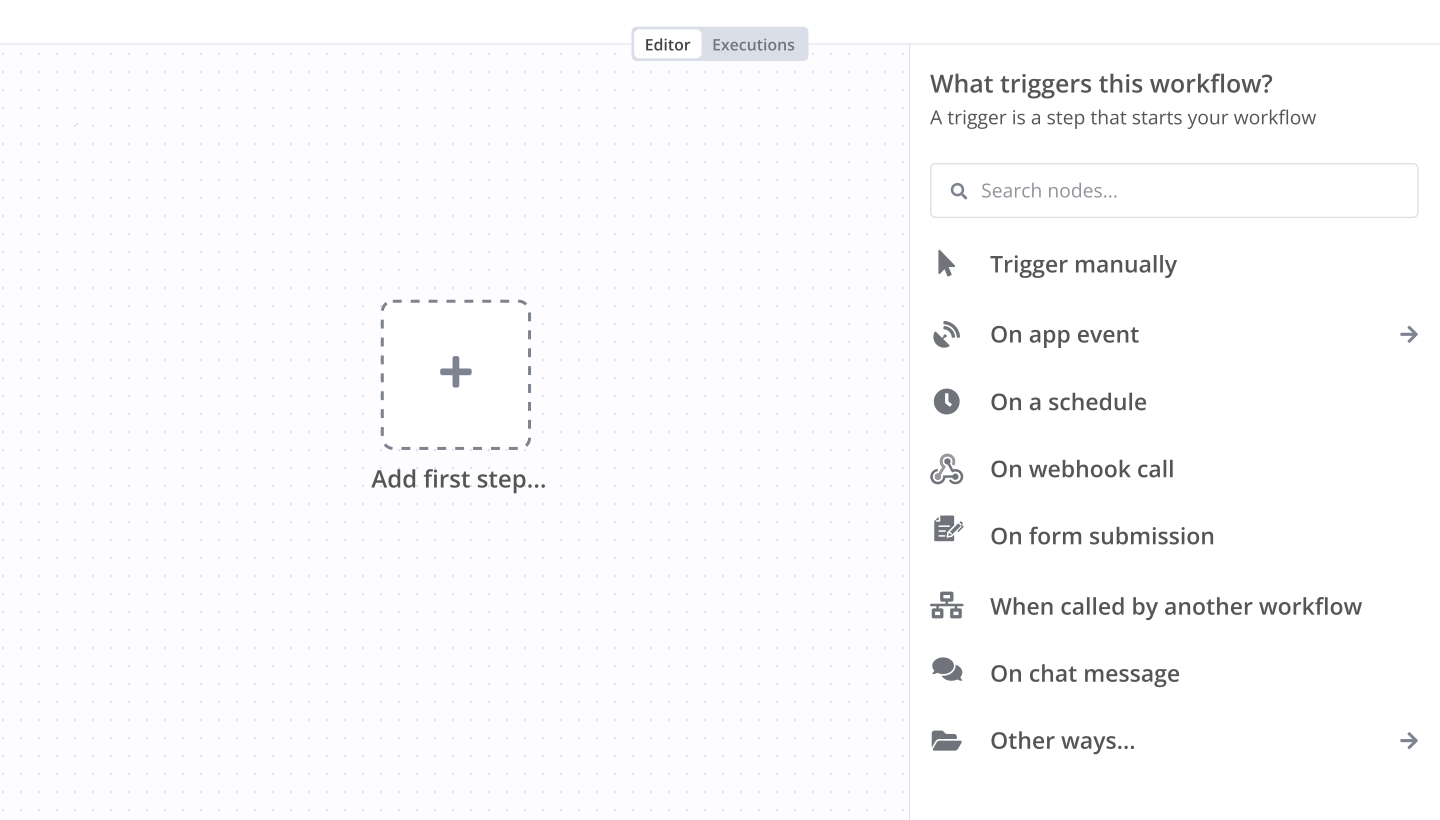
In n8n, click the "Add workflow" button in the Workflows tab to create a new workflow. Add the starting point – a trigger on when your workflow should run: an app event, a schedule, a webhook call, another workflow, an AI chat, or a manual trigger. Sometimes, the HTTP Request node might already serve as your starting point.

Google Gemini Chat Model and Notion integration: Create a new workflow and add the first step

Step 2: Add and configure Google Gemini Chat Model and Notion nodes

You can find Google Gemini Chat Model and Notion in the nodes panel. Drag them onto your workflow canvas, selecting their actions. Click each node, choose a credential, and authenticate to grant n8n access. Configure Google Gemini Chat Model and Notion nodes one by one: input data on the left, parameters in the middle, and output data on the right.

Google Gemini Chat Model and Notion integration: Add and configure Google Gemini Chat Model and Notion nodes

Step 3: Connect Google Gemini Chat Model and Notion

A connection establishes a link between Google Gemini Chat Model and Notion (or vice versa) to route data through the workflow. Data flows from the output of one node to the input of another. You can have single or multiple connections for each node.

Google Gemini Chat Model and Notion integration: Connect Google Gemini Chat Model and Notion

Step 4: Customize and extend your Google Gemini Chat Model and Notion integration

Use n8n's core nodes such as If, Split Out, Merge, and others to transform and manipulate data. Write custom JavaScript or Python in the Code node and run it as a step in your workflow. Connect Google Gemini Chat Model and Notion with any of n8n’s 1000+ integrations, and incorporate advanced AI logic into your workflows.

Google Gemini Chat Model and Notion integration: Customize and extend your Google Gemini Chat Model and Notion integration

Step 5: Test and activate your Google Gemini Chat Model and Notion workflow

Save and run the workflow to see if everything works as expected. Based on your configuration, data should flow from Google Gemini Chat Model to Notion or vice versa. Easily debug your workflow: you can check past executions to isolate and fix the mistake. Once you've tested everything, make sure to save your workflow and activate it.

Google Gemini Chat Model and Notion integration: Test and activate your Google Gemini Chat Model and Notion workflow

Host your own AI deep research agent with n8n, Apify and OpenAI o3

This template attempts to replicate OpenAI's DeepResearch feature which, at time of writing, is only available to their pro subscribers.

> An agent that uses reasoning to synthesize large amount of online information and complete multi-step research tasks for you.
Source

Though the inner workings of DeepResearch have not been made public, it is presumed the feature relies on the ability to deep search the web, scrape web content and invoking reasoning models to generate reports. All of which n8n is really good at!

Using this workflow, n8n users can enjoy a variation of the Deep Research experience for themselves and their teams at a fraction of the cost. Better yet, learn and customise this Deep Research template for their businesses and/or organisations.

Check out the generated reports here: https://jimleuk.notion.site/19486dd60c0c80da9cb7eb1468ea9afd?v=19486dd60c0c805c8e0c000ce8c87acf

How it works
A form is used to first capture the user's research query and how deep they'd like the researcher to go.
Once submitted, a blank Notion page is created which will later hold the final report and the researcher gets to work.
The user's query goes through a recursive series of web serches and web scraping to collect data on the research topic to generate partial learnings.
Once complete, all learnings are combined and given to a reasoning LLM to generate the final report.
The report is then written to the placeholder Notion page created earlier.

How to use
Duplicate this Notion database template and make sure all Notion related nodes point to it.
Sign-up for APIFY.com API Key for web search and scraping services.
Ensure you have access to OpenAI's o3-mini model. Alternatively, switch this out for o1 series.
You must publish this workflow and ensure the form url is publically accessible.

On depth & breadth configuration
For more detailed reports, increase depth and breadth but be warned the workflow will take exponentially longer and cost more to complete. The recommended defaults are usually good enough.

Depth=1 & Breadth=2 - will take about 5 - 10mins.
Depth=1 & Breadth=3 - will take about 15 - 20mins.
Dpeth=3 & Breadth=5 - will take about 2+ hours!

Customising this workflow
I deliberately chose not to use AI-powered scrapers like Firecrawl as I felt these were quite costly and quotas would be quickly exhausted. However, feel free to switch web search and scraping services which suit your environment.
Maybe you don't decide to source the web and instead, data collection comes from internal documents instead. This template gives you freedom to change this.
Experiment with different Reasoning/Thinking models such as Deepseek and Google's Gemini 2.0.
Finally, the LLM prompts could definitely be improved. Refine them to fit your use-case.

Credits
This template is largely based off the work by David Zhang (dzhng) and his open source implementation of Deep Research: https://github.com/dzhng/deep-research

Nodes used in this workflow

Popular Google Gemini Chat Model and Notion workflows

+2

Host Your Own AI Deep Research Agent with n8n, Apify and OpenAI o3

This template attempts to replicate OpenAI's DeepResearch feature which, at time of writing, is only available to their pro subscribers. > An agent that uses reasoning to synthesize large amount of online information and complete multi-step research tasks for you. Source Though the inner workings of DeepResearch have not been made public, it is presumed the feature relies on the ability to deep search the web, scrape web content and invoking reasoning models to generate reports. All of which n8n is really good at! Using this workflow, n8n users can enjoy a variation of the Deep Research experience for themselves and their teams at a fraction of the cost. Better yet, learn and customise this Deep Research template for their businesses and/or organisations. Check out the generated reports here: https://jimleuk.notion.site/19486dd60c0c80da9cb7eb1468ea9afd?v=19486dd60c0c805c8e0c000ce8c87acf How it works A form is used to first capture the user's research query and how deep they'd like the researcher to go. Once submitted, a blank Notion page is created which will later hold the final report and the researcher gets to work. The user's query goes through a recursive series of web serches and web scraping to collect data on the research topic to generate partial learnings. Once complete, all learnings are combined and given to a reasoning LLM to generate the final report. The report is then written to the placeholder Notion page created earlier. How to use Duplicate this Notion database template and make sure all Notion related nodes point to it. Sign-up for APIFY.com API Key for web search and scraping services. Ensure you have access to OpenAI's o3-mini model. Alternatively, switch this out for o1 series. You must publish this workflow and ensure the form url is publically accessible. On depth & breadth configuration For more detailed reports, increase depth and breadth but be warned the workflow will take exponentially longer and cost more to complete. The recommended defaults are usually good enough. Depth=1 & Breadth=2 - will take about 5 - 10mins. Depth=1 & Breadth=3 - will take about 15 - 20mins. Dpeth=3 & Breadth=5 - will take about 2+ hours! Customising this workflow I deliberately chose not to use AI-powered scrapers like Firecrawl as I felt these were quite costly and quotas would be quickly exhausted. However, feel free to switch web search and scraping services which suit your environment. Maybe you don't decide to source the web and instead, data collection comes from internal documents instead. This template gives you freedom to change this. Experiment with different Reasoning/Thinking models such as Deepseek and Google's Gemini 2.0. Finally, the LLM prompts could definitely be improved. Refine them to fit your use-case. Credits This template is largely based off the work by David Zhang (dzhng) and his open source implementation of Deep Research: https://github.com/dzhng/deep-research
+2

Automated Resume Scoring with Gemini LLM, Gmail and Notion Job Profiles

This n8n template demonstrates how to use AI to score the all Resumes by matching it with Job profile Problem Statement: A Hr person is flooded with resume and spends hours manually checking each to find most suitable ones. How it works It is linked to Gmail Trigger which upon receving any mail with specific subject will check for the attachment. Attachment will be parsed to understand the resume Candidate informtion will be broken into Personal, Eductional and Professional type Job profile will be pulled from Notion Board A HR expert powered by Gemini LLM will score each profile on basis on its relevancy Information will be updated back to Gsheet Message lable will be updated back for clarity How to use The gmail trigger node is used as an example but feel free to replace this with other triggers such as webhook or even a form. Requirements Gemini account for LLM Google sheet for upload Gmail as trigger Llama parse credentials
+5

Resume Screening & Behavioral Interviews with Gemini, Elevenlabs, & Notion ATS

Description Candidate Engagement | Resume Screening | AI Voice Interviews | Applicant Insights This intelligent n8n workflow automates the process of extracting and scoring resumes received through a company career page, populating a Notion database with AI insights where the recruiter or hiring manager can automatically invite the applicant to an instant interview with an Elevenlabs AI voice agent. After the agent conducts the behavior-based interview, the workflow scores the overall interview against customizable evaluation criteria and updates the Notion database with AI insights about the applicant. AI Powered Resume Screening & Voice AI that interviews like a Recruiter! AI Insights in Notion dashboard Who is this for? HR teams, recruiters, and talent acquisition professionals This workflow is ideal for HR teams, recruiters, and talent acquisition professionals looking for a foundational, extensible framework to automate early stage recruiting. Whether you're exploring AI for the first time or scaling automation across your hiring process, this template provides a base for screening, interviewing, and tracking candidates—powered entirely by n8n, Elevenlabs, Notion, and LLM integrations. Be sure to consult State and Country regulations with respect to AI Compliance, AI Bias Audits, AI Risk Assessment, and disclosure requirements. What problem is this workflow solving? Manually screening resumes and conducting initial interviews slows down hiring. This template automates: Resume assessment against job description. Scheduling first and second round interviews. First-round AI-led behavioral interviews with AI scoring assessment. Centralized tracking of AI assessments in Notion. What this does This customizable tool, configured to manage 3 requisitions in parallel, automates the application process, resume screen, and first round behavioral interviews. Pre-screen Applicants with AI Immediately screens and scores applicant’s resume against the job description. The AI Agent generates a score and an AI assessment, adding both to the applicant's profile in Notion. Notion automatically notifies hiring manager when a resume receives a score of 8 or higher. Voice AI that Interviews like a Recruiter AI Voice agent adapts probing questions based on applicant’s response and intelligently dives deeper into skill and experience to assess answers against a scoring rubric for each question. AI Applicant Insights in Notion Get detailed post-interview AI analysis, including interview recordings and question-by-question scoring breakdowns to help identify who you should advance to the next stage in the process. AI insight provided in Notion ATS dashboard with drag and drop to advance top candidates to the next interview stage. How it works Link to Notion Template Notion Career Page: Notion Career Page published to web, can be integrated with your preferred job board posting system. Notion Job Posting: Gateway for applicants to apply to active requisitions with ‘Click to Apply’ button. Application Form: N8N webform embedded into Notion job posting captures applicant information and routes for AI processing. AI Agent evaluates resume against job description AI Agent evaluates resume against the job description, stored in Notion, and scores the applicant on a scale of 1 to 10, providing rationale for score. Creates ATS record in Notion with assessment and score Workflow creates the applicant record in the Notion ATS where Recruiters and Hiring Managers see applicants in a filtered view, sorted by AI generated resume score. Users can automatically advance applicants to the next step in process (AI Conversation interview) with drag and drop functionality. Invites applicant to an Instant AI Interview Dragging the applicant to AI Interview step in the Notion ATS dashboard triggers Notion automation that sends the applicant an email with a link to the Elevenlabs Conversation AI Agent. The AI Conversation Agent is provided with instructions on how to conduct the behavior-based interview, including probing questions, for the specific role. AI Conversation Agent Behavior Based Interview The email link resolves to an ElevenLabs AI Conversation agent that has been instructed to interview applicants using pre-defined interview questions, scoring rubric, job description, and company profile. The Elevenlabs agent assesses the applicant on a scale of 1 to 5 for each interview question and provides an overall assessment of the interview based on established evaluation criteria. Click to hear AI Voice Agent in action Example: Role: IT Support Analyst Mark: Elevenlabs AI Agent instructed to interview applicants for specific role Gemini: Google AI coached to answer questions as an IT Support Analyst being interviewed Updates Notion record with Interview Assessment and Score All results—including the conversation transcript, interview scores, and rationale for assessment are automatically added back to the applicant’s profile in Notion where the Hiring Manager can validate the AI assessment by skimming through the embedded audio file. AI Interview Overall Score: 1 to 5 based on response to all questions and probes. AI Agent confirms that it was able to evaluate the interview using the assigned rubric. AI Interview Criteria Score: Success/Failure based on response to individual interview questions. Invites applicant to second interview with Hiring Manager Dragging the applicant to the ‘Hiring Manager Interview’ step in the Notion ATS dashboard triggers a Notion automation that sends an email with a link to the Hiring Manager’s calendar scheduling solution. Configuration and Set Up Accounts & API Keys You wil need accounts and credentials for: n8n (hosted or self-hosted) Elevenlabs (for AI Conversation Agent) Gemini (for LLM model access) Google Drive (to back up applicant data) Calendly (to automate interview scheduling) Gmail (to automate interview scheduling) Data / Documents to implement Job Descriptions for each role Interview questions for each role Evaluation criteria for each interview question Notion Set Up Customize your Notion Career Page Link to Free Notion Template that enables workflow: Update Notion job description database -update job description(s) for each role -add interview questions to the job description database page in Notion -add evaluation criteria to the job description database page in Notion -edit each ‘Click to Apply’ button in the job description template so it resolves to the corresponding N8N 'Application Form' webform production URL (detail provided below) Notion Applicant Tracker In the Applicant Tracker database, update position titles, tab headings, in the custom database view (Notion) so it reflects the title of the position you are posting. Edit the filter for each tab so it matches the position title. Notion Email Automation Update Notion automation templates used to invite applicants to the AI Interview and Hiring Manager interview. Note: Trigger email automation by dragging applicant profile to the next Applicant Comm Status in the Applicant Tracker. AI Interview invite template: revise position title to reflect the title of the role you are posting; include the link to your Conversation AI Agent for that role in the email body. Note: each unique role will use an Elevenlabs AI conversation agent designed for that role. Hiring Manager Interview invite template: revise position title to reflect the title of the role you are posting; include the link to your Calendly page or similar solution provider to automate interview scheduling. N8N Configuration Workflow 1 Application Forms (3 Nodes - one for each job) Update the N8N form title and description to match the job description you configured in Notion. Confirm Job Code in Applicant Form node matches Job Code in Notion for that position. Edit the Form Response to customize the message you want displayed after applicant clicks submit. Upload CV - Google Drive Authenticate your Google Drive account and select the folder that will be used to store resumes Get Job Description - Notion Authenticate your Notion account and select your Career Page from the list of databases that contain your job descriptions. Applicant Data Backup - Google Sheet Create a Google Sheet where you will track applicant data for AI Compliance reporting requirements. Open the node in n8n and use the field names in the node as Google Sheet column headings. Workflow 2 Elevenlabs Web Hook (Node 1) Edit the Web Hook POST node and copy your production URL that is displayed in the Node. This URL is entered into the Elevenlabs AI Conversation Agent post-call webhook described below. AI Agent Authenticate your LLM model (Gemini in this example) and add your Notion database as a tool to pull the evaluation_criteria hosted in Notion for the specific role. Extract Audio Create an Elevenlabs API key for your conversation agent and enter that key as a json header for the Extract Audio node Upload Audio to Drive - Google Drive Authenticate your Google Drive account and select the folder that will be used to store the audio file. Elevenlabs Configuration Create an Elevenlabs account Create Conversation AI Agent Add First Message and Systems Prompt: Design your ‘First Message’ and ‘Systems Prompt’ that guides the AI agent conducting the interview. Tool Tip: provide instruction that limits the number of probes per interview question. Knowledge Base: Upload your role specific interview questions and job description, using the same text that is stored in your Notion Career page for the role. You can also add a document about your company and instruct the Elevenlabs agent to answer questions about culture, strategy, and company growth. Analysis: Evaluation Criteria: Add your evaluation criteria, less than 2000 characters, for each interview question / competency. Analysis: Data Collection: Add the following elements, using the exact character string represented below. phone_number_AI_screen "capture applicant's phone number provided at the start of the conversation and share this as a string, integers only." full_name "capture applicant's full name provided at the start of the conversation." Advanced: Max Duration Set the max duration for interview in seconds. The AI Agent will timeout at the max duration. Conversation AI Widget: Customize your AI Conversation Agent landing page, including the position tile and company name. AI Conversation Agent URL: Copy the AI Conversation Agent URL and add it to your Notion email template triggered by the AI Interview email automation. Use a custom AI Agent URL for each distinct job description. Enable your Elevenlabs Post-Call Webhook for your Conversation Agent: Log into your Elevenlabs account and go to Conversational AI Settings and click on Post-Call Web Hook. This is where you enter the production URL from the N8N Web Hook node (Workflow 2). This sends the AI Voice Agent output to your n8n workflow which feeds back to your Notion dashboard.
+3

Automated Financial Tracker: Telegram Invoices to Notion with Gemini AI Reports

Automated Financial Tracker: Telegram Invoices to Notion with AI Summaries & Reports Tired of manually logging every expense? Streamline your financial tracking with this powerful n8n workflow! Snap a photo of your invoice in Telegram, and let AI (powered by Google Gemini) automatically extract the details, record them in your Notion database, and even send you a quick summary. Plus, get scheduled weekly reports with charts to visualize your spending. Automate your finances, save time, and gain better insights with this easy-to-use template! Transform your expense tracking from a chore into an automated breeze. Try it out! Overview: This workflow revolutionizes how you track your finances by automating the entire process from invoice capture to reporting. Simply send a photo of an invoice or receipt to a designated Telegram chat, and this workflow will: Extract Data with AI: Utilize Google Gemini's capabilities to perform OCR on the image, understand the content, and extract key details like item name, quantity, price, total, date, and even attempt to categorize the expense. Store in Notion: Automatically log each extracted transaction into a structured Notion database. Instant Feedback: Send a summary of the processed transaction back to your Telegram chat. Scheduled Reporting: Generate and send a visual summary of your expenses (e.g., weekly spending by category) as a chart to your preferred Telegram chat or group. This workflow is perfect for individuals, freelancers, or small teams looking to effortlessly manage their expenses without manual data entry. Key Features & Benefits: Effortless Expense Logging:** Just send a picture – no more typing! AI-Powered Data Extraction:** Leverages Google Gemini for intelligent invoice processing. Centralized Data in Notion:** Keep all your financial records neatly organized in a Notion database. Automated Categorization:** AI helps in categorizing your expenses (e.g., Food & Beverage, Transportation). Instant Summaries:** Get immediate confirmation and a summary of what was recorded. Visual Reporting:** Receive scheduled charts (e.g., bar charts of spending by category) directly in Telegram. Customizable:** Easily adapt the workflow to your specific needs, categories, and reporting preferences. Time-Saving:** Drastically reduces the time spent on manual financial administration. How It Works (Workflow Breakdown): The workflow is divided into two main parts: Part 1: Real-time Invoice Processing & Logging (## Auto Notes Transaction with Telegram and Notion database) Telegram Trigger (Telegram Trigger | When recive photo): Activates when a new photo is sent to the configured Telegram chat. Get Photo Info (Get Info Photo from telegram chat): Retrieves the details of the received photo. Get Image Info (Get Image Info): Prepares the image data. AI Data Extraction (Google Gemini Chat Model & Basic LLM Chain): The image data is sent to the Google Gemini Chat Model. A specific prompt instructs the AI to extract details (date, ID, name, quantity, price, total, category, tax) in a JSON array format and provide a summary message. The categories include Food & Beverage, Transportation, Utilities, Shopping, Healthcare, Entertainment, Housing, and Education. Parse AI Output (Parse To your object | Table): Structures the AI's JSON output for easier handling. Split Transactions (Split Out | data transaction): If an invoice contains multiple items, this node splits them into individual records. Record to Notion (Record To Notion Database): Each transaction item is added as a new page/entry in your specified Notion database, mapping fields like Name, Quantity, Price, Total, Category, Date, and Tax. Send Telegram Summary (Sendback to chat and give summarize text): The summary message generated by the AI is sent back to the original Telegram chat. Part 2: Scheduled Financial Reporting (## Schedule report to send on chanel or private message) Schedule Trigger (Schedule Trigger | for send chart report): Runs at a predefined interval (e.g., every week) to generate reports. Get Recent Data from Notion (Get Recent Data from Notions): Fetches transaction data from the Notion database for a specific period (e.g., the past week). Summarize Data (Summarize Transaction Data): Aggregates the data, for example, by summing up the 'total' amount for each 'category'. Prepare Chart Data (Convert Data to JSON chart payload): Transforms the summarized data into a JSON format suitable for generating a chart (e.g., labels for categories, data for spending amounts). Generate Chart (Generate Chart): Uses the QuickChart node to create a visual chart (e.g., a bar chart) from the prepared data. Send Chart to Telegram (Send Chart Image to Group or Private Chat): Sends the generated chart image to a specified Telegram chat ID or group. Nodes Used (Key Nodes): Telegram Trigger & Telegram Node:** For receiving images and sending messages/images. Google Gemini Chat Model (Langchain):** For AI-powered OCR and data extraction from invoices. Basic LLM Chain (Langchain):** To interact with the language model using specific prompts. Output Parser Structured (Langchain):** To structure the output from the language model. Notion Node:** For reading from and writing to your Notion databases. Schedule Trigger:** To automate the reporting process. Summarize Node:** To aggregate data for reports. Code Node:** Used here to format data for the chart. QuickChart Node:** For generating charts. SplitOut Node:** To process multiple items from a single invoice. Setup Instructions: Credentials: Telegram: Create a Telegram bot and get its API token. You'll also need the Chat ID where you'll send invoices and where reports should be sent. Google Gemini (PaLM) API: You'll need an API key for Google Gemini. Notion: Create a Notion integration and get the API key. Create a Notion database with properties corresponding to the data you want to save (e.g., Name (Title), Quantity (Number), Price (Number), Total (Number), Category (Select), Date (Text or Date), Tax (Number)). Share this database with your Notion integration. Configure Telegram Trigger: Add your Telegram Bot API token. When you first activate the workflow or test the trigger, send /start to your bot in the chat you want to use for sending invoices. n8n will then capture the Chat ID. Configure Google Gemini Node (Google Gemini Chat Model): Select or add your Google Gemini API credentials. Review the prompt in the Basic LLM Chain node and adjust if necessary (e.g., date format, categories). Configure Notion Nodes: Record To Notion Database: Select or add your Notion API credentials. Select your target Notion Database ID. Map the properties from the workflow (e.g., ={{ $json.name }}) to your Notion database columns. Get Recent Data from Notions: Select or add your Notion API credentials. Select your target Notion Database ID. Adjust the filter if needed (default is "past_week"). Configure Telegram Node for Reports (Send Chart Image to Group or Private Chat): Select or add your Telegram Bot API token. Enter the Chat ID for the group or private chat where you want to receive the reports. Configure Schedule Trigger (Schedule Trigger | for send chart report): Set your desired schedule (e.g., every Monday at 9 AM). Test: Send an image of an invoice to your Telegram bot and check if the data appears in Notion and if you receive a summary message. Wait for the scheduled report or manually trigger it to test the reporting functionality. Sticky Note Text for Your n8n Template: (These are suggestions. You would place these directly into the sticky notes within your n8n workflow editor.) Existing High-Level Sticky Notes: Auto Notes Transaction with Telegram and Notion database Schedule report to send on chanel or private message Specific Sticky Notes to Add: On Telegram Trigger | When recive photo:** 📸 INVOICE INPUT 📸 Bot listens here for photos of your receipts/invoices. Ensure your Telegram Bot API token is set in credentials. Near Google Gemini Chat Model & Basic LLM Chain:** 🤖 AI MAGIC HAPPENS HERE 🧠 Image is sent to Google Gemini for data extraction. Check 'Basic LLM Chain' to customize the AI prompt (e.g., categories, output format). Requires Google Gemini API credentials. On Parse To your object | Table:** ✨ STRUCTURING AI DATA ✨ Converts the AI's text output into a usable JSON object. Check the schema if you modify the AI prompt significantly. On Record To Notion Database:** 📝 SAVING TO NOTION 📝 Extracted transaction data is saved here. Configure with your Notion API key & Database ID. Map fields correctly to your database columns! On Sendback to chat and give summarize text:** 💬 TRANSACTION SUMMARY 💬 Sends a confirmation message back to the user in Telegram with a summary of the recorded expense. On Schedule Trigger | for send chart report:** 🗓️ REPORTING SCHEDULE 🗓️ Set how often you want to receive your spending report (e.g., weekly, monthly). On Get Recent Data from Notions:** 📊 FETCHING DATA FOR REPORT 📊 Retrieves transactions from Notion for the report period. Default: "Past Week". Adjust filter as needed. Requires Notion API credentials & Database ID. On Summarize Transaction Data:** ➕ SUMMARIZING SPENDING ➕ Aggregates your expenses, usually by category, to prepare for the chart. On Convert Data to JSON chart payload (Code Node):** 🎨 PREPARING CHART DATA 🎨 This Code node formats the summarized data into the JSON structure needed by QuickChart. On Generate Chart (QuickChart Node):** 📈 GENERATING VISUAL REPORT 📈 Creates the actual chart image based on your spending data. You can customize chart type (bar, pie, etc.) here. On Send Chart Image to Group or Private Chat:** 📤 SENDING REPORT TO TELEGRAM 📤 Delivers the generated chart to your chosen Telegram chat/group. Set the correct Chat ID and Bot API token. General Sticky Note (Place where relevant):** 🔑 CREDENTIALS NEEDED 🔑 Remember to set up API keys/tokens for: Telegram Google Gemini Notion General Sticky Note (Place where relevant):** 💡 CUSTOMIZE ME! 💡 Adjust AI prompts for better accuracy. Change Notion database structure. Modify report frequency and content. `

Analyze Google Forms feedback with Gemini AI and send weekly reports

Who is this for Product managers, customer success teams, and small business owners who collect feedback via Google Forms and want automated sentiment analysis without manual review. Ideal for teams processing 10-100+ responses weekly. What this workflow does This workflow reads new Google Forms responses from a linked Google Sheets spreadsheet, sends them to Gemini AI for sentiment analysis and topic categorization, then writes results back to the sheet, logs weekly insights in a Notion database, and emails an HTML summary report to your team. Each response gets a sentiment label (positive, neutral, negative), a 1-10 score, a category tag, and a key theme extraction. How to set up Create a Google Form and link responses to a Google Sheet. Add four columns to the sheet: Processed, Sentiment, Category, Score. Connect your Google Sheets OAuth2 credential and select the responses sheet. Connect your Google Gemini API credential (requires a Google AI Studio API key). Create a Notion database with columns: Date, Total Responses, Positive Rate, Top Themes, Recommendation. Connect your Notion API credential. Connect your Gmail OAuth2 credential and set the recipient email address. Activate the workflow. Requirements Google Sheets OAuth2 credentials (linked to a Google Form) Google Gemini API key (Google AI Studio) Notion API integration token Gmail OAuth2 credentials How to customize Change the schedule trigger interval for more or less frequent analysis runs. Edit the AI prompt in the Analyze feedback node to add custom categories relevant to your product. Modify the email HTML template in the Parse results node to match your branding. Add a Slack notification node after the email for real-time team alerts.

Route and prioritize Gmail support tickets to Notion with Gemini AI and Slack alerts

Who is this for Customer support teams and operations managers who receive support requests via email and need automated triage. Works well for small to mid-size teams using Notion as their ticket tracker. What this workflow does This workflow watches a Gmail inbox for incoming support emails. Each email is analyzed by Gemini AI to determine its category (billing, technical, feature request, or general), priority level, and a suggested response draft. A new page is created in a Notion database with all classified fields. Critical tickets trigger an immediate Slack alert to the on-call team, while all tickets get a summary notification. Setup Add a Gmail OAuth2 credential and configure label or address filters. Add a Google Gemini API credential for email classification. Add a Notion API credential and create a database with columns: Title, Category, Priority, Status, Summary. Add a Slack OAuth2 credential and set your alerts channel. Requirements Gmail account with OAuth2 access Google Gemini API key Notion workspace with API integration enabled Slack workspace with OAuth2 app How to customize Edit the AI prompt in "Classify ticket with AI" to add more categories or adjust priority rules. Change the critical priority condition in "Is critical priority" to include high-priority tickets. Replace Notion with Airtable or Google Sheets for a different ticket backend.

Build your own Google Gemini Chat Model and Notion integration

Create custom Google Gemini Chat Model and Notion workflows by choosing triggers and actions. Nodes come with global operations and settings, as well as app-specific parameters that can be configured. You can also use the HTTP Request node to query data from any app or service with a REST API.

Notion supported actions

Append After
Append a block
Get Child Blocks
Get many child blocks
Get
Get a database
Get Many
Get many databases
Search
Search databases using text search
Get
Get a database
Get Many
Get many databases
Create
Create a page in a database
Get
Get a page in a database
Get Many
Get many pages in a database
Update
Update pages in a database
Create
Create a pages in a database
Get Many
Get many pages in a database
Update
Update pages in a database
Create
Create a page
Get
Get a page
Search
Text search of pages
Archive
Archive a page
Create
Create a page
Search
Text search of pages
Get
Get a user
Get Many
Get many users

FAQs

  • Can Google Gemini Chat Model connect with Notion?

  • Can I use Google Gemini Chat Model’s API with n8n?

  • Can I use Notion’s API with n8n?

  • Is n8n secure for integrating Google Gemini Chat Model and Notion?

  • How to get started with Google Gemini Chat Model and Notion integration in n8n.io?

Need help setting up your Google Gemini Chat Model and Notion integration?

Discover our latest community's recommendations and join the discussions about Google Gemini Chat Model and Notion integration.
Justin Cheu
Cris A. Works
Martin
Liam Skaff
AyS 0908

Looking to integrate Google Gemini Chat Model and Notion in your company?

Over 3000 companies switch to n8n every single week

Why use n8n to integrate Google Gemini Chat Model with Notion

Build complex workflows, really fast

Build complex workflows, really fast

Handle branching, merging and iteration easily.
Pause your workflow to wait for external events.

Code when you need it, UI when you don't

Simple debugging

Your data is displayed alongside your settings, making edge cases easy to track down.

Use templates to get started fast

Use 1000+ workflow templates available from our core team and our community.

Reuse your work

Copy and paste, easily import and export workflows.

Implement complex processes faster with n8n

red iconyellow iconred iconyellow icon