Back to Integrations
integrationGoogle Gemini Chat Model node
integrationSlack node

Google Gemini Chat Model and Slack integration

Save yourself the work of writing custom integrations for Google Gemini Chat Model and Slack and use n8n instead. Build adaptable and scalable AI, Langchain, Communication, and HITL workflows that work with your technology stack. All within a building experience you will love.

How to connect Google Gemini Chat Model and Slack

  • Step 1: Create a new workflow
  • Step 2: Add and configure nodes
  • Step 3: Connect
  • Step 4: Customize and extend your integration
  • Step 5: Test and activate your workflow

Step 1: Create a new workflow and add the first step

In n8n, click the "Add workflow" button in the Workflows tab to create a new workflow. Add the starting point – a trigger on when your workflow should run: an app event, a schedule, a webhook call, another workflow, an AI chat, or a manual trigger. Sometimes, the HTTP Request node might already serve as your starting point.
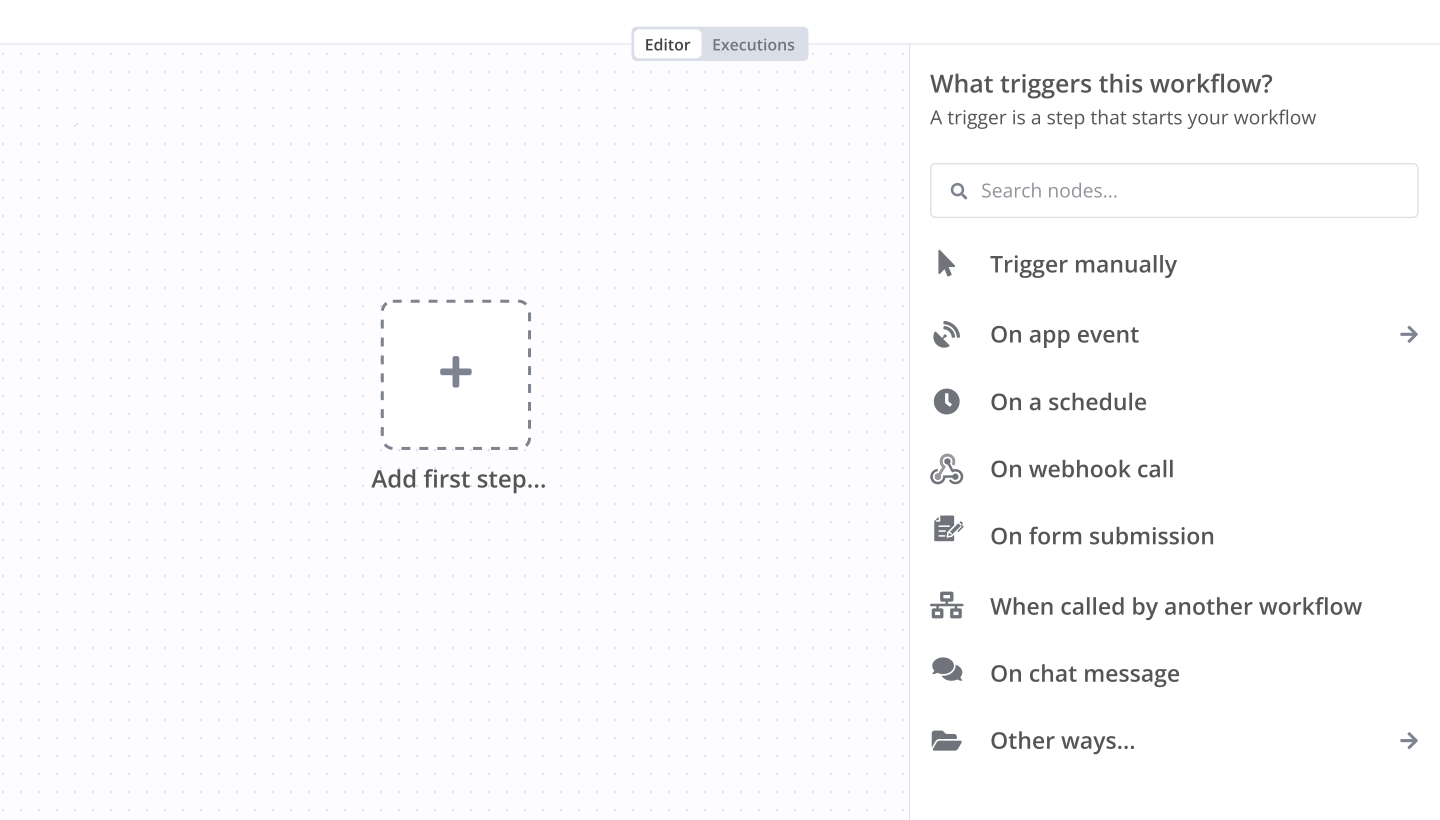
Google Gemini Chat Model and Slack integration: Create a new workflow and add the first step

Step 2: Add and configure Google Gemini Chat Model and Slack nodes

You can find Google Gemini Chat Model and Slack in the nodes panel. Drag them onto your workflow canvas, selecting their actions. Click each node, choose a credential, and authenticate to grant n8n access. Configure Google Gemini Chat Model and Slack nodes one by one: input data on the left, parameters in the middle, and output data on the right.

Google Gemini Chat Model and Slack integration: Add and configure Google Gemini Chat Model and Slack nodes

Step 3: Connect Google Gemini Chat Model and Slack

A connection establishes a link between Google Gemini Chat Model and Slack (or vice versa) to route data through the workflow. Data flows from the output of one node to the input of another. You can have single or multiple connections for each node.

Google Gemini Chat Model and Slack integration: Connect Google Gemini Chat Model and Slack

Step 4: Customize and extend your Google Gemini Chat Model and Slack integration

Use n8n's core nodes such as If, Split Out, Merge, and others to transform and manipulate data. Write custom JavaScript or Python in the Code node and run it as a step in your workflow. Connect Google Gemini Chat Model and Slack with any of n8n’s 1000+ integrations, and incorporate advanced AI logic into your workflows.

Google Gemini Chat Model and Slack integration: Customize and extend your Google Gemini Chat Model and Slack integration

Step 5: Test and activate your Google Gemini Chat Model and Slack workflow

Save and run the workflow to see if everything works as expected. Based on your configuration, data should flow from Google Gemini Chat Model to Slack or vice versa. Easily debug your workflow: you can check past executions to isolate and fix the mistake. Once you've tested everything, make sure to save your workflow and activate it.

Google Gemini Chat Model and Slack integration: Test and activate your Google Gemini Chat Model and Slack workflow

Creating a AI Slack bot with Google Gemini

This is an example of how we can build a slack bot in a few easy steps

Before you can start, you need to o a few things

Create a copy of this workflow
Create a slack bot
Create a slash command on slack and paste the webhook url to the slack command

Note
Make sure to configure this webhook using a https:// wrapper and don't use the default http://localhost:5678 as that will not be recognized by your slack webhook.

Once the data has been sent to your webhook, the next step will be passing it via an AI Agent to process data based on the queries we pass to our agent.

To have some sort of a memory, be sure to set the slack token to the memory node. This way you can refer to other chats from the history.

The final message is relayed back to slack as a new message. Since we can not wait longer than 3000 ms for slack response, we will create a new message with reference to the input we passed.

We can advance this using the tools or data sources for it to be more custom tailored for your company.

Usage
To use the slackbot, go to slack and click on your set slash command eg /Bob and send your desired message.

This will send the message to your endpoint and get return the processed results as the message.

If you would like help setting this up, feel free to reach out to [email protected]

Nodes used in this workflow

Popular Google Gemini Chat Model and Slack workflows

+2

AI-Powered Feedback Triage: Jotform to Trello, Airtable & Slack with Gemini

Turn raw feedback into actionable product insights. This workflow collects feedback from both customers and staff via a single Jotform, uses Gemini AI to analyze and categorize it, then intelligently routes it: Actionable bugs and feature requests* become tasks in specific Trello* lists, tagged with source and priority. General feedback* is logged in a structured Airtable* base for later review. Urgent bugs* trigger instant Slack* alerts for your dev team. An optional confirmation email is sent via Gmail if the submitter provides their address. Stop manually sorting feedback and ensure nothing falls through the cracks. This workflow centralizes input, automates triage, and delivers structured data directly to your product and development teams. Features Unified Feedback Collection:** Uses a single Jotform for customers and staff. AI-Powered Triage:** Gemini AI categorizes feedback (Bug, Feature Request, General), suggests priority, and extracts keyword tags. Intelligent Filtering:** An IF node separates actionable tasks from general comments. Automated Task Creation:** Creates Trello cards in specific lists ("Bugs," "Feature Backlog") with relevant labels (Source, Urgent). Structured Logging:** Saves all general feedback to an Airtable base for review and trend analysis. Conditional Alerts:* Notifies a Slack channel *only for high-priority bugs. Optional Email Confirmation:** Sends a thank-you email if the submitter provides their address. Nodes Used 🟣 Jotform Trigger (Jotform Trigger) ✉️ Gmail (Send Confirmation Email) 🧠 AI Agent (AI Feedback Triage) 🃏 Trello (Create Trello Card) 📣 Slack (Alert Dev Team) 🗂️ Airtable (Log General Feedback to Airtable) 🔧 Set, **❓ IF, 🚫 No Operation, do nothing How to use this template Follow these steps to configure the workflow with your accounts and specific IDs. Set up Jotform, Trello, and Airtable (CRITICAL) Before starting, you must create the Jotform form, Trello board, and Airtable base exactly as described in the "Required Setup" section at the end of this document. Configure the Jotform Trigger Node Credentials:** Connect your Jotform account. Form:** Select your "Help us improve IdeaToBiz" form (replace the title with your company name). Resolve Data:* Ensure the "Resolve Data" toggle in the node's parameters is turned ON*. Configure the Config (Set) Node This node stores your Trello IDs. You must replace the placeholder values. Find Your IDs:** Open your Trello board, add .json to the URL, and press Enter. Search the JSON page for your List names ("Bugs," "Feature Backlog") and Label names ("Customer," "Staff," "Other," "Urgent") to find their corresponding "id" values. Action:** Paste your unique IDs into the value fields in this node. Configure the Email Provided? (IF) and Send Confirmation Email (Gmail) Nodes IF Node:** No configuration needed. Gmail Node:** Credentials: Connect your Gmail (or other email service) account. Customize: Edit the Subject and Body to match your company's voice. Configure the AI Feedback Triage Node Credentials:** Connect your Google AI (Gemini) credentials. Check Prompt:** Ensure the prompt correctly references your feedback field (e.g., {{ $('Jotform Trigger').item.json['Feedback Details'] }}). Check Schema:** Ensure the "Structured Output" JSON schema matches the required fields (task_title, category, suggested_priority, tags). Configure the Is it a Bug or Feature? (IF) Node No configuration needed. This node filters based on the AI output. Configure the Create Trello Card Node Credentials:** Connect your Trello credentials. Board ID:** Select your Product Feedback board. Check Expressions:** Verify that the expressions for List ID and Labels correctly pull the IDs from your Config node and data from the AI Feedback Triage and Jotform Trigger nodes. The template should be pre-filled, but double-check node names if you renamed them. Configure the Is it an Urgent Bug? (IF) Node No configuration needed. This checks the AI output before alerting Slack. Configure the Alert Dev Team (Slack) Node Credentials:** Connect your Slack credentials. Channel:** Select the channel for urgent bug alerts (e.g., #dev-alerts). Customize:** Edit the message text if desired. Ensure the Trello card URL expression ({{ $('Create Trello Card').item.json.shortUrl }}) is correct. Configure the Log General Feedback to Airtable Node Credentials:** Connect your Airtable credentials. Base ID:** Select your Product Feedback Log base. Table ID:** Select your Feedback Submissions table. Enable Typecast:* In the node's Options, ensure the *Typecast toggle is ON. This is crucial for allowing n8n to create new tag options in Airtable. Check Field Mappings:** Verify that the field mappings correctly reference the AI Feedback Triage and Jotform Trigger nodes. Activate Your Workflow! Once all credentials and IDs are configured, save and activate your workflow. How to Adapt the Template Change Task Destination:* Replace the Trello node with ClickUp, *Asana, Jira, or another task manager. You'll need to adapt the field mappings. Change Logging Destination:* Replace the Airtable node with Google Sheets, *Notion, or send logs via Email or Discord. Adjust AI Prompt:** Modify the prompt in the AI Feedback Triage node to change how feedback is categorized, prioritized, or tagged. Modify Filtering Logic:** Change the conditions in the Is it a Bug or Feature? IF node (e.g., maybe you also want "UI/UX Issue" to go to Trello). Refine Alerting:** Change the conditions in the Is it an Urgent Bug? IF node or send alerts for different categories (e.g., alert the design team for UI issues). Required Setup Jotform Form Setup Create Account: If needed, sign up at Jotform. Create Form: Build a form titled "Help us improve IdeaToBiz" (or similar). Add Fields: Radio Button: Label I am a..., Options Customer, Staff, Other (Required: ON). Email: Label Your Email (Optional) (Required: OFF). Long Text: Label Feedback Details (Required: ON). Submit Button: Label Submit Feedback. Trello Board Setup Create Board: Create a new Trello board named Product Feedback. Create Lists (Columns): Add at least these two lists: Feature Backlog Bugs Create Labels: Go to Menu -> More -> Labels and create: Urgent (Red recommended) Customer (Blue recommended) Staff (Green recommended) Other (Grey recommended) Airtable Base Setup Create Base: Create a new Airtable base named Product Feedback Log. Create Table: Name the table Feedback Submissions. Configure Fields: Rename the primary field (Name) to Feedback Summary (Type: Single line text). Rename Notes to Full Feedback (Type: Long text). Delete Assignee. Rename Status to Source (Type: Single select, Options: Customer, Staff, Other). Add Email field (Type: Email). Add AI Tags field (Type: Multiple select). Add Submitted At field (Type: Created time).
+4

Fast-track CV screening with AI analysis from Gmail to Slack and Google Sheets

CV → Match → Screen → Decide, all automated This workflow automatically processes candidate CVs from email, intelligently matches them to job descriptions, performs AI-powered screening analysis, and sends actionable summaries to your team in Slack. Good to know Handles both PDF and Word document CVs automatically Two-stage JD matching: prioritizes role mentioned in candidate's email, falls back to CV analysis if needed Uses Google Gemini API for AI screening (generous free tier and rate limits, typically enough to avoid paying for API requests, but check latest pricing at Google AI Pricing) All CVs stored in Google Drive with standardized naming (candidate name + date/time) Complete audit trail logged in Google Sheets Who's it for Hiring teams and recruiters who want to automate first-round CV screening while maintaining quality. Perfect for companies receiving high volumes of applications across multiple roles, especially in tech, sales, or automation-focused positions. How it works Gmail monitors inbox for CVs with specific label and downloads attachments Detects file type (PDF or Word) and converts/standardizes format for text extraction AI agent matches candidate to best-fit job description by analyzing email context first (if candidate mentioned a role), or CV content as fallback (selects up to 3 potential JD matches) If multiple JDs matched, second AI agent selects the single best fit AI recruiter agent analyzes CV against selected JD and generates structured screening report (strengths, weaknesses, risk/reward factors, overall fit score 0-10 with justification) Extracts candidate details (name, email) from CV text Logs complete analysis to Google Sheets tracker Sends formatted summary to Slack with Proceed/Reject action buttons for instant team decisions Requirements Gmail account with API access Google Drive account (OAuth2) Google Sheets account (OAuth2) Slack workspace with bot permissions Google Gemini API key (Get free key here) Google Drive folders: one for CVs, one for Job Descriptions (as PDFs or Google Docs) How to set up Add credentials: Gmail OAuth2, Google Drive OAuth2, Google Sheets OAuth2, Slack OAuth2, Google Gemini API Create Gmail label (e.g., "CV-Screening") for incoming candidate emails In "Receive CV via Email" node: select your Gmail label for filtering Create two Google Drive folders: "Candidate CVs" and "Job Descriptions" In "Upload CV - PDF" and "Stream Doc/Docx File" nodes: update folder ID to your "Candidate CVs" folder In "Access JD Files" node: update folder ID to your "Job Descriptions" folder Create Google Sheet named "AI Candidate Screening" with columns matching the sample AI Candidate Screening sheet In "Append row in sheet" node: select your Google Sheet In "Send Candidate Screening Confirmation" node: select your Slack channel Activate workflow Customizing this workflow Change JD matching logic: Edit "JD Matching Agent" node prompt to adjust how CVs are matched to roles (e.g., weight technical skills vs. experience). Change "Company Description" in AI prompts: Insert your "Company Description" in System Message sections in "JD Matching Agent" and "Detailed JD Matching Agent" nodes Modify screening criteria: Edit "Recruiter Scoring Agent" node system message to focus on specific qualities (culture fit, leadership, technical depth, etc.) Add more storage locations: Add nodes to save CVs to other systems (Notion, Airtable, ATS platforms) Customize Slack message: Edit "Send Candidate Screening Confirmation" node to change formatting, add more context, or include additional candidate data Auto-proceed logic: Add IF node after screening to auto-proceed candidates with fit score above threshold (e.g., 8+/10) Add email responses: Connect nodes to automatically email candidates (confirmation, rejection, interview invite) Add human-in-the-loop: Sub-workflow triggered by Slack response or email response, to update Sheet with approve/reject status Add candidate email responses + interview scheduling**: For approved candidates, trigger email to candidate with Cal.com or Calendly link so they can book their interview Quick Troubleshooting No CVs being processed: Check Gmail label is correctly set in "Receive CV via Email" node and emails are being labeled Word documents failing: Verify "Stream Doc/Docx File" node has correct parent folder ID and Google Drive credentials authorized JD matching returns no results: Check "Access JD Files" node folder ID points to your Job Descriptions folder, and JD files are named clearly (e.g., "Marketing Director JD.pdf") JD matching is not relevant for my company: Update the "Company Description" in the System Messages in the "JD Matching Agent" and "Detailed JD Matching Agent" nodes "Can't find matching JD": Ensure candidate's email mentions role name OR their CV clearly indicates relevant experience for available JDs Google Sheets errors: Verify sheet name is "AI Candidate Screening" and column headers exactly match workflow expectations (Submission ID, Date, CV, First Name, etc.) Slack message not appearing: Re-authorize Slack credentials and confirm channel ID in "Send Candidate Screening Confirmation" node Missing candidate name/email: CV text must be readable - check PDF extraction quality or try converting complex CVs to simpler format 401/403 API errors: Re-authorize all OAuth2 credentials (Gmail, Google Drive, Google Sheets, Slack) AI analysis quality issues: Edit system prompts in "JD Matching Agent" and "Recruiter Scoring Agent" nodes to refine screening criteria Sample Outputs Google Sheets - AI Candidate Screening - sample Slack confirmation message Acknowledgments This workflow was inspired by Nate Herk's YouTube demonstration on building a resume analysis system. This implementation builds upon that foundation by adding dynamic job description matching (initial + detailed JD matching agents), Slack Block Kit integration with interactive buttons, updated Google Drive API methods for document handling, and enhanced candidate data capture in Google Sheets.
+4

Generate & Schedule Social Posts with Gemini/OpenAI for X and LinkedIn

💼 LinkedIn Content Machine – AI-Powered Post Generator & Scheduler for X and LinkedIn How it works: This end-to-end workflow automates your personal or brand content strategy by: 🧠 Using Google Gemini or OpenAI to generate engaging LinkedIn/X content from a title or trending posts. 🗓️ Posting directly to LinkedIn and X (formerly Twitter). 📊 Pulling high-performing LinkedIn posts to inspire new ideas. ✍️ Saving AI-generated drafts to Google Sheets for review. 🔔 Notifying your team on Slack when drafts are ready. Steps to set up: Add your API keys for Google Gemini or OpenAI. Set up your LinkedIn, X (Twitter), Google Sheets, and Slack credentials. Customize prompt logic or post filters if needed. Schedule the idea generation module or trigger it manually. Start generating and posting consistent, high-quality content with zero manual effort!

Summarise Slack Channel Activity for Weekly Reports with AI

This n8n template lets you summarize team member activity on Slack for the past week and generates a report. For remote teams, chat is a crucial communication tool to ensure work gets done but with so many conversations happening at once and in multiple threads, ideas, information and decisions usually live in the moment and get lost just as quickly - and all together forgotten by the weekend! Using this template, this doesn't have to be the case. Have AI crawl through last week's activity, summarize all threads and generate a casual and snappy report to bring the team back into focus for the current week. A project manager's dream! How it works A scheduled trigger is set to run every Monday at 6am to gather all team channel messages within the last week. Each message thread are grouped by user and data mined for replies. Combined, an AI analyses the raw messages to pull out interesting observations and highlights. The summarized threads of the user are then combined together and passed to another AI agent to generate a higher level overview of their week. These are referred to as the individual reports. Next, all individual reports are summarized together into a team weekly report. This allows understanding of group and similar activities. Finally, the team weekly report is posted back to the channel. The timing is important as it should be the first message of the week and ready for the team to glance over coffee. How to use Ideally works best per project and where most of the comms happens on a single channel. Avoid combining channels and instead duplicate this workflow for more channels. You may need to filter for specific team members if you want specific team updates. Customise the report to suit your organisation, team or the channel. You may prefer to be more formal if clients or external stakeholders are also present. Requirements Slack for chat platform Gemini for LLM (or switch for other models) Customising this workflow If the slack channel is busy enough already, consider posting the final report to email. Pull in project metrics to include in your report. As extra context, it may be interesting to tie the messages to production performance. Use an AI Agent to query for knowledgebase or tickets relevant to the messages. This may be useful for attaching links or references to add context. Channel not so busy or way too busy for 1 week? Play with the scheduled trigger and set an interval which works for your team.

Query Databricks data and SQL insights via Slack with Gemini AI agent

Automated Databricks Data Querying & SQL Insights via Slack with AI Agent & Gemini Node-by-Node Explanation This workflow is divided into three functional phases: Initialization, AI Processing, and Response Delivery. | Node Name | Category | What it does | | :--- | :--- | :--- | | When Slack Message Received | Trigger | Monitors a Slack channel for @mentions. It captures the user's question and the thread ID to keep the conversation organized. | | Set Databricks Config | Configuration | A "helper" node where you hardcode your Databricks warehouse_id and target_table. This makes it easy to update settings in one place. | | Fetch Databricks Schema | Data Retrieval | Sends a DESCRIBE command to the Databricks API. It learns what columns exist (e.g., "price", "date", "store_id") so the AI knows what it can query. | | Parse Table Schema | Data Transformation | Uses JavaScript to clean up the raw Databricks response. it converts complex technical data into a simple list that the AI can easily read. | | SQL Data Analyst Agent | AI Brain | The "manager" of the workflow. It takes the user's question and the table schema, decides which SQL query to write, and interprets the results. | | Gemini Model | LLM Engine | Provides the actual intelligence (using Google Gemini 3.1 Flash). This is what "thinks" and generates the SQL and conversational text. | | Redis Chat Memory | Memory | Stores previous messages in the thread. This allows you to ask follow-up questions (e.g., "Now show me only the top 5") without repeating the whole context. | | Run Primary SQL Query | AI Tool | An HTTP tool given to the Agent. The Agent "calls" this node to actually run the generated SQL on Databricks and get the real data back. | | If Output Valid | Logic Gate | A safety check. It verifies if the Agent successfully produced a message for Slack or if something went wrong during the process. | | Post to Slack Channel | Output (Success) | Sends the final answer (e.g., "The total revenue for Q3 was $4.2M") back to the user in Slack. | | Post Error to Slack | Output (Failure) | If the SQL fails or the AI hits a wall, this node sends an error message to the user so they aren't left waiting. | How the "Agent" Loop Works Unlike a standard linear workflow, the SQL Data Analyst Agent doesn't just move to the next step. It performs a "Reasoning" loop: Observe: "The user wants to know sales for March." Think: "I have a table called 'franchises' with a 'sale_date' column. I should run a SUM query." Act: It triggers the Run Primary SQL Query node. Observe Results: "The query returned 150,000." Final Response: "The total sales for March were 150,000."
+2

AI Gmail Support Automation with Google Gemini, OpenAI & Pinecone

💬 AI Gmail Support Automation with Google Gemini, OpenAI & Pinecone 🚀 How it Works This workflow turns your Gmail inbox into an AI-powered customer support assistant using Google Gemini, OpenAI embeddings, and Pinecone vector search. It automatically classifies incoming emails, retrieves context-based answers from your knowledge base, and replies instantly saving your support team valuable time. 🔁 Workflow Overview Gmail Trigger** → Detects new incoming customer emails. Intent Classifier** → Identifies if the email is a support query or something else. Vector Store (Pinecone)** → Retrieves the most relevant information. Email Support Agent (Gemini)** → Generates a clear, human-like response. Gmail Node** → Sends the AI-generated reply automatically. Slack Notification** → Updates your team about the response. Label Query** → Adds Gmail labels for tracking and organization. This automation provides 24/7 AI-based email support, faster customer responses, and zero manual data lookup — ideal for busy teams handling repetitive queries. 👥 Who It’s For SaaS companies** managing frequent customer support requests Startups and agencies** looking to automate inbox replies Customer success teams** aiming to improve response time Freelancers or small businesses** who want smart, auto-handled Gmail support ⚙️ Set Up Steps Estimated setup time: 10–15 minutes Connect your Gmail and Slack accounts to n8n. Add your API keys: Google Gemini API key OpenAI API key Link your Pinecone Vector Database (or create a new one). Customize the system message in the “Email Support Agent” node to match your tone or brand style. Send test emails to ensure the automation responds correctly and labels messages as intended. Check Slack notifications to confirm your team gets updates on replies. 💡 Detailed setup notes are included in the sticky notes inside the workflow. 🧩 Integrations Used Gmail API Google Gemini LLM OpenAI Embeddings Pinecone Vector Database Slack API 💡 Key Benefits Provides instant AI-based email replies 24/7 Reduces manual workload for support teams Maintains consistent and accurate tone using your knowledge base Keeps your inbox organized with automatic labels and team alerts Ideal for scaling customer support without hiring more agents

Build your own Google Gemini Chat Model and Slack integration

Create custom Google Gemini Chat Model and Slack workflows by choosing triggers and actions. Nodes come with global operations and settings, as well as app-specific parameters that can be configured. You can also use the HTTP Request node to query data from any app or service with a REST API.

Slack supported actions

Archive
Archives a conversation
Close
Closes a direct message or multi-person direct message
Create
Initiates a public or private channel-based conversation
Get
Get information about a channel
Get Many
Get many channels in a Slack team
History
Get a conversation's history of messages and events
Invite
Invite a user to a channel
Join
Joins an existing conversation
Kick
Removes a user from a channel
Leave
Leaves a conversation
Member
List members of a conversation
Open
Opens or resumes a direct message or multi-person direct message
Rename
Renames a conversation
Replies
Get a thread of messages posted to a channel
Set Purpose
Sets the purpose for a conversation
Set Topic
Sets the topic for a conversation
Unarchive
Unarchives a conversation
Get
Get Many
Get & filters team files
Upload
Create or upload an existing file
Delete
Get Permalink
Search
Send
Send and Wait for Response
Update
Add
Adds a reaction to a message
Get
Get the reactions of a message
Remove
Remove a reaction of a message
Add
Add a star to an item
Delete
Delete a star from an item
Get Many
Get many stars of autenticated user
Get
Get information about a user
Get Many
Get a list of many users
Get User's Profile
Get a user's profile
Get User's Status
Get online status of a user
Update User's Profile
Update a user's profile
Add Users
Create
Disable
Enable
Get Many
Get Users
Update

FAQs

  • Can Google Gemini Chat Model connect with Slack?

  • Can I use Google Gemini Chat Model’s API with n8n?

  • Can I use Slack’s API with n8n?

  • Is n8n secure for integrating Google Gemini Chat Model and Slack?

  • How to get started with Google Gemini Chat Model and Slack integration in n8n.io?

Need help setting up your Google Gemini Chat Model and Slack integration?

Discover our latest community's recommendations and join the discussions about Google Gemini Chat Model and Slack integration.
Nicolas N
Muhammed Iqbal P B
Nicolas N

Looking to integrate Google Gemini Chat Model and Slack in your company?

Over 3000 companies switch to n8n every single week

Why use n8n to integrate Google Gemini Chat Model with Slack

Build complex workflows, really fast

Build complex workflows, really fast

Handle branching, merging and iteration easily.
Pause your workflow to wait for external events.

Code when you need it, UI when you don't

Simple debugging

Your data is displayed alongside your settings, making edge cases easy to track down.

Use templates to get started fast

Use 1000+ workflow templates available from our core team and our community.

Reuse your work

Copy and paste, easily import and export workflows.

Implement complex processes faster with n8n

red iconyellow iconred iconyellow icon