
Back to Integrations
integrationGoogle Gemini Chat Model node
integrationSupabase node

Google Gemini Chat Model and Supabase integration

Save yourself the work of writing custom integrations for Google Gemini Chat Model and Supabase and use n8n instead. Build adaptable and scalable AI, Langchain, and Data & Storage workflows that work with your technology stack. All within a building experience you will love.

How to connect Google Gemini Chat Model and Supabase

  • Step 1: Create a new workflow
  • Step 2: Add and configure nodes
  • Step 3: Connect
  • Step 4: Customize and extend your integration
  • Step 5: Test and activate your workflow

Step 1: Create a new workflow and add the first step

In n8n, click the "Add workflow" button in the Workflows tab to create a new workflow. Add the starting point – a trigger on when your workflow should run: an app event, a schedule, a webhook call, another workflow, an AI chat, or a manual trigger. Sometimes, the HTTP Request node might already serve as your starting point.
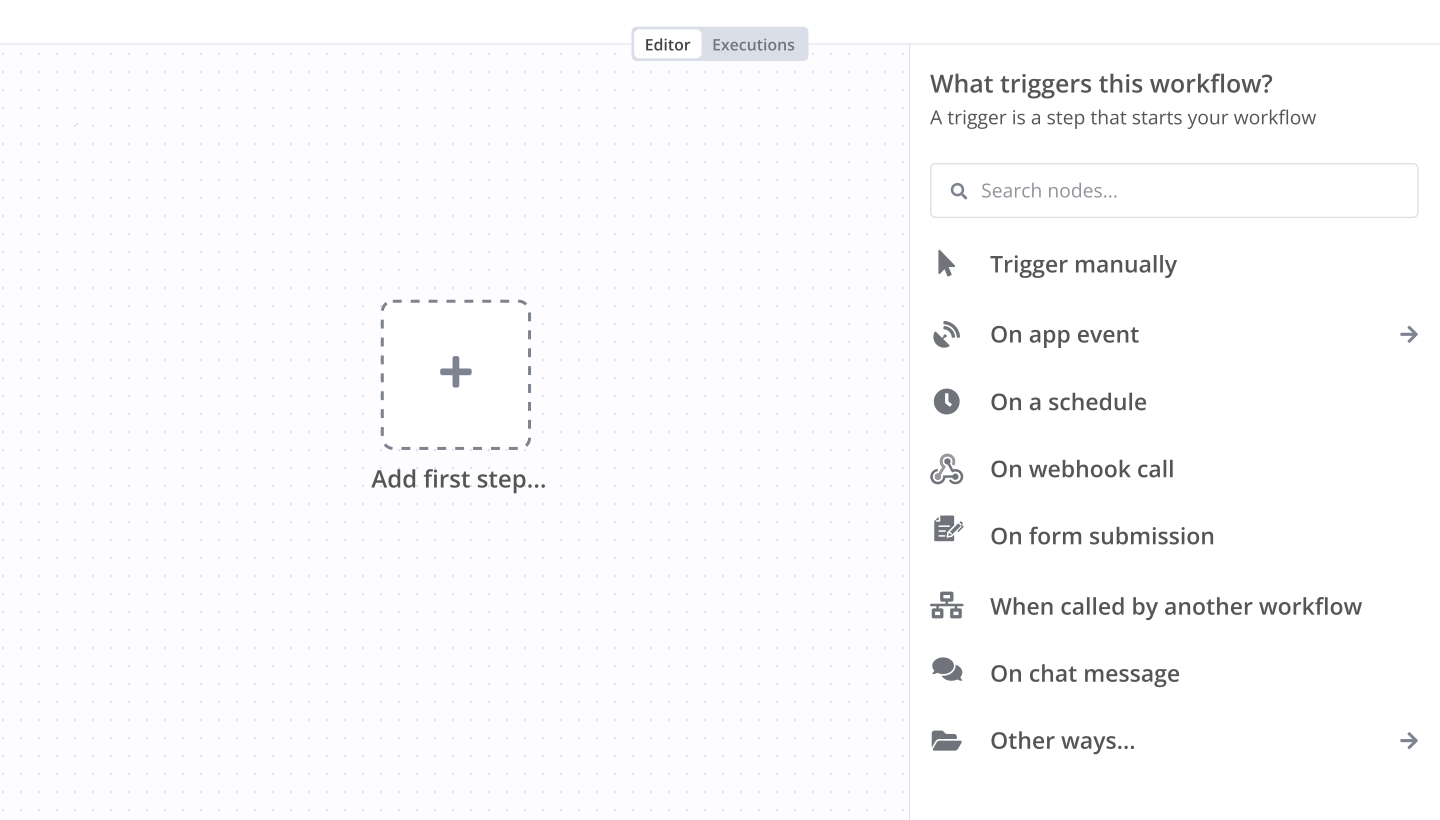
Google Gemini Chat Model and Supabase integration: Create a new workflow and add the first step

Step 2: Add and configure Google Gemini Chat Model and Supabase nodes

You can find Google Gemini Chat Model and Supabase in the nodes panel. Drag them onto your workflow canvas, selecting their actions. Click each node, choose a credential, and authenticate to grant n8n access. Configure Google Gemini Chat Model and Supabase nodes one by one: input data on the left, parameters in the middle, and output data on the right.

Google Gemini Chat Model and Supabase integration: Add and configure Google Gemini Chat Model and Supabase nodes

Step 3: Connect Google Gemini Chat Model and Supabase

A connection establishes a link between Google Gemini Chat Model and Supabase (or vice versa) to route data through the workflow. Data flows from the output of one node to the input of another. You can have single or multiple connections for each node.

Google Gemini Chat Model and Supabase integration: Connect Google Gemini Chat Model and Supabase

Step 4: Customize and extend your Google Gemini Chat Model and Supabase integration

Use n8n's core nodes such as If, Split Out, Merge, and others to transform and manipulate data. Write custom JavaScript or Python in the Code node and run it as a step in your workflow. Connect Google Gemini Chat Model and Supabase with any of n8n’s 1000+ integrations, and incorporate advanced AI logic into your workflows.

Google Gemini Chat Model and Supabase integration: Customize and extend your Google Gemini Chat Model and Supabase integration

Step 5: Test and activate your Google Gemini Chat Model and Supabase workflow

Save and run the workflow to see if everything works as expected. Based on your configuration, data should flow from Google Gemini Chat Model to Supabase or vice versa. Easily debug your workflow: you can check past executions to isolate and fix the mistake. Once you've tested everything, make sure to save your workflow and activate it.

Google Gemini Chat Model and Supabase integration: Test and activate your Google Gemini Chat Model and Supabase workflow

🤖 Create a Documentation Expert Bot with RAG, Gemini, and Supabase

How it works

This template is a complete, hands-on tutorial for building a RAG (Retrieval-Augmented Generation) pipeline. In simple terms, you'll teach an AI to become an expert on a specific topic—in this case, the official n8n documentation—and then build a chatbot to ask it questions.

Think of it like this: instead of a general-knowledge AI, you're building an expert librarian.

The workflow is split into two main parts:

Part 1: Indexing the Knowledge (Building the Library)
This is a one-time process you run manually. The workflow automatically scrapes all the pages of the n8n documentation, breaks them down into small, digestible chunks, and uses an AI model to create a special numerical representation (an "embedding") for each chunk. These embeddings are then stored in your own private knowledge base (a Supabase vector store). This is like a librarian reading every book and creating a hyper-detailed index card for every paragraph.

Part 2: The AI Agent (The Expert Librarian)
This is the chat interface. When you ask a question, the AI agent doesn't guess the answer. Instead, it uses your question to find the most relevant "index cards" (chunks) from the knowledge base it just built. It then feeds these specific, relevant chunks to a powerful language model (like Gemini) with a strict instruction: "Answer the user's question using ONLY this information." This ensures the answers are accurate, factual, and grounded in your provided documents.

Set up steps

Setup time: ~15-20 minutes

This is an advanced workflow that requires setting up a free external database. Follow these steps carefully.

Set up Supabase (Your Knowledge Base):
You need a free Supabase account.
Follow the detailed instructions in the large Workflow Setup sticky notes in the top-right of the workflow to:
Create a new Supabase project.
Run the provided SQL query in the SQL Editor to prepare your database.
Get your Project URL and Service Role Key.

Configure n8n Credentials:
In your n8n instance, create a new Supabase credential using the Project URL and Service Role Key from the previous step.
Create a new Google AI credential with your Gemini API key.

Configure the Workflow Nodes:
Select your new Supabase credential in the three Supabase nodes: Your Supabase Vector Store, Official n8n Documentation and Keep Supabase Instance Alive.
Select your new Google AI credential in the three Gemini nodes: Gemini Chunk Embedding, Gemini Query Embedding and Gemini 2.5 Flash.

Build the Knowledge Base:
Find the Start Indexing manual trigger node at the top-left.
Click its "Execute workflow" button to start the indexing process. This will take several minutes as it scrapes and processes the entire n8n documentation. You only need to do this once.

Chat with Your Expert Agent:
Once the indexing is complete, Activate the entire workflow.
Open the RAG Chatbot chat trigger node and copy its Public URL.
Open the URL in a new tab and start asking questions about n8n! For example: "How does the IF node work?" or "What is a sub-workflow?".

Nodes used in this workflow

Popular Google Gemini Chat Model and Supabase workflows

Build a Knowledge Base Chatbot with Jotform, RAG Supabase, Together AI & Gemini

Youtube Video: https://youtu.be/dEtV7OYuMFQ?si=fOAlZWz4aDuFFovH Workflow Pre-requisites Step 1: Supabase Setup First, replace the keys in the "Save the embedding in DB" & "Search Embeddings" nodes with your new Supabase keys. After that, run the following code snippets in your Supabase SQL editor: Create the table to store chunks and embeddings: CREATE TABLE public."RAG" ( id bigserial PRIMARY KEY, chunk text NULL, embeddings vector(1024) NULL ) TABLESPACE pg_default; Create a function to match embeddings: DROP FUNCTION IF EXISTS public.matchembeddings1(integer, vector); CREATE OR REPLACE FUNCTION public.matchembeddings1( match_count integer, query_embedding vector ) RETURNS TABLE ( chunk text, similarity float ) LANGUAGE plpgsql AS $$ BEGIN RETURN QUERY SELECT R.chunk, 1 - (R.embeddings <=> query_embedding) AS similarity FROM public."RAG" AS R ORDER BY R.embeddings <=> query_embedding LIMIT match_count; END; $$; Step 2: Create Jotform with these fields Your full name email address Upload PDF Document [field where you upload the knowledgebase in PDF] Step 3: Get Together AI API Key Get a Together AI API key and paste it into the "Embedding Uploaded document" node and the "Embed User Message" node. Here is a detailed, node-by-node explanation of the n8n workflow, which is divided into two main parts. Part 1: Ingesting Knowledge from a PDF This first sequence of nodes runs when you submit a PDF through a Jotform. Its purpose is to read the document, process its content, and save it in a specialized database for the AI to use later. JotForm Trigger Type: Trigger What it does: This node starts the entire workflow. It's configured to listen for new submissions on a specific Jotform. When someone uploads a file and submits the form, this node activates and passes the submission data to the next step. Grab New knowledgebase Type: HTTP Request What it does: The initial trigger from Jotform only contains basic information. This node makes a follow-up call to the Jotform API using the submissionID to get the complete details of that submission, including the specific link to the uploaded file. Grab the uploaded knowledgebase file link Type: HTTP Request What it does: Using the file link obtained from the previous node, this step downloads the actual PDF file. It's set to receive the response as a file, not as text. Extract Text from PDF File Type: Extract From File What it does: This utility node takes the binary PDF file downloaded in the previous step and extracts all the readable text content from it. The output is a single block of plain text. Splitting into Chunks Type: Code What it does: This node runs a small JavaScript snippet. It takes the large block of text from the PDF and chops it into smaller, more manageable pieces, or "chunks," each of a predefined length. This is critical because AI models work more effectively with smaller, focused pieces of text. Embedding Uploaded document Type: HTTP Request What it does: This is a key AI step. It sends each individual text chunk to an embeddings API. A specified AI model converts the semantic meaning of the chunk into a numerical list called an embedding or vector. This vector is like a mathematical fingerprint of the text's meaning. Save the embedding in DB Type: Supabase What it does: This node connects to your Supabase database. For every chunk, it creates a new row in a specified table and stores two important pieces of information: the original text chunk and its corresponding numerical embedding (its "fingerprint") from the previous step. Part 2: Answering Questions via Chat This second sequence starts when a user sends a message. It uses the knowledge stored in the database to find relevant information and generate an intelligent answer. When chat message received Type: Chat Trigger What it does: This node starts the second part of the workflow. It listens for any incoming message from a user in a connected chat application. Embend User Message Type: HTTP Request What it does: This node takes the user's question and sends it to the exact same embeddings API and model used in Part 1. This converts the question's meaning into the same kind of numerical vector or "fingerprint." Search Embeddings Type: HTTP Request What it does: This is the "retrieval" step. It calls a custom database function in Supabase. It sends the question's embedding to this function and asks it to search the knowledge base table to find a specified number of top text chunks whose embeddings are mathematically most similar to the question's embedding. Aggregate Type: Aggregate What it does: The search from the previous step returns multiple separate items. This utility node simply bundles those items into a single, combined piece of data. This makes it easier to feed all the context into the final AI model at once. AI Agent & Google Gemini Chat Model Type: LangChain Agent & AI Model What it does: This is the "generation" step where the final answer is created. The AI Agent node is given a detailed set of instructions (a prompt). The prompt tells the Google Gemini Chat Model to act as a professional support agent. Crucially, it provides the AI with the user's original question and the aggregated text chunks from the Aggregate node as its only source of truth. It then instructs the AI to formulate an answer based only on that provided context, format it for a specific chat style, and to say "I don't know" if the answer cannot be found in the chunks. This prevents the AI from making things up.
+5

Smarter RAG Agents with Enriched Retrieval and Modular Workflows

An extendable RAG template to build powerful, explainable AI assistants — with query understanding, semantic metadata, and support for free-tier tools like Gemini, Gemma and Supabase. Description This workflow helps you build smart, production-ready RAG agents that go far beyond basic document Q&A. It includes: ✅ File ingestion and chunking ✅ Asynchronous LLM-powered enrichment ✅ Filterable metadata-based search ✅ Gemma-based query understanding and generation ✅ Cohere re-ranking ✅ Memory persistence via Postgres Everything is modular, low-cost, and designed to run even with free-tier LLMs and vector databases. Whether you want to build a chatbot, internal knowledge assistant, documentation search engine, or a filtered content explorer — this is your foundation. ⚙️ How It Works This workflow is divided into 3 pipelines: 📥 Ingestion Upload a PDF via form Extract text and chunk it for embedding Store in Supabase vector store using Google Gemini embeddings 🧠 Enrichment (Async) Scheduled task fetches new chunks Each chunk is enriched with LLM metadata (topics, use_case, risks, audience level, summary, etc.) Metadata is added to the vector DB for improved retrieval and filtering 🤖 Agent Chat A user question triggers the RAG agent Query Builder transforms it into keywords and filters Vector DB is queried and reranked The final answer is generated using only retrieved evidence, with references Chat memory is managed via Postgres 🌟 Key Features Asynchronous enrichment** → Save tokens, batch process with free-tier LLMs like Gemma Metadata-aware** → Improved filtering and reranking Explainable answers** → Agent cites sources and sections Chat memory** → Persistent context with Postgres Modular design** → Swap LLMs, rerankers, vector DBs, and even enrichment schema Free to run** → Built with Gemini, Gemma, Cohere, Supabase (free tier-compatible) 🔐 Required Credentials |Tool|Use| |-|-|-| |Supabase w/ PostreSQL|Vector DB + storage| |Google Gemini/Gemma|Embeddings & LLM| |Cohere API|Re-ranking| |PostgreSQL|Chat memory| 🧰 Customization Tips Swap extractFromFile with Notion/Google Drive integrations Extend Metadata Obtention prompt to fit your domain (e.g., financial, legal) Replace LLMs with OpenAI, Mistral, or Ollama Replace Postgre Chat Memory with Simple Memory or any other Use a webhook instead of a form to automate ingestion Connect to Telegram/Slack UI with a few extra nodes 💡 Use Cases Company knowledge base bot (internal docs, SOPs) Educational assistant with smart filtering (by topic or level) Legal or policy assistant that cites source sections Product documentation Q&A with multi-language support Training material assistant that highlights risks/examples Content Generation 🧠 Who It’s For Indie developers building smart chatbots AI consultants prototyping Q&A assistants Teams looking for an internal knowledge agent Anyone building affordable, explainable AI tools 🚀 Try It Out! Deploy a modular RAG assistant using n8n, Supabase, and Gemini — fully customizable and almost free to run. 📁 Prepare Your PDFs Use any internal documents, manuals, or reports in *PDF *format. Optional: Add Google Drive integration to automate ingestion. 🧩 Set Up Supabase Create a free Supabase project Use the table creation queries included in the workflow to set up your schema. Add your *supabaseUrl *and *supabaseKey *in your n8n credentials. > 💡 Pro Tip: Make sure you match the embedding dimensions to your model. This workflow uses Gemini text-embedding-04 (768-dim) — if switching to OpenAI, change your table vector size to 1536. 🧠 Connect Gemini & Gemma Use Gemini/Gemma for embeddings and optional metadata enrichment. Or deploy locally for lightweight async LLM processing (via Ollama/HuggingFace). ⚙️ Import the Workflow in n8n Open n8n (self-hosted or cloud). Import the workflow file and paste your credentials. You’re ready to ingest, enrich, and query your document base. 💬 Have Feedback or Ideas? I’d Love to Hear This project is open, modular, and evolving — just like great workflows should be :). If you’ve tried it, built on top of it, or have suggestions for improvement, I’d genuinely love to hear from you. Let’s share ideas, collaborate, or just connect as part of the n8n builder community. 📧 [email protected] 🔗 Linkedin
+4

AI-Powered Restaurant Order and Menu Management with WhatsApp and Google Gemini

RestaurantBot Pro - WhatsApp Order Automation System Description RestaurantBot Pro is a complete AI-powered restaurant ordering system that transforms your WhatsApp into a smart ordering platform. This intelligent automation handles customer interactions in any language you configure, manages your menu database, processes orders, and coordinates delivery operations - all through familiar WhatsApp messaging. How It Works Customer Experience: Customers message your restaurant's WhatsApp number in their preferred language The AI assistant greets them and presents your current menu with prices Customers can ask questions about items, place orders, and specify delivery details The system remembers customer preferences and order history for personalized service Customers receive instant confirmation and order updates Restaurant Operations: All orders are automatically saved to your database with customer details The system generates formatted messages for your delivery team with all order specifics Menu items are stored using advanced AI search, making it easy to find and recommend dishes Customer database grows automatically, tracking preferences and order history Real-time order processing with preparation time estimates Smart Features: Understands natural language ordering in any language (easily customizable in system settings) Intelligent menu recommendations based on customer queries Automatic price calculations and order summaries Memory system that recalls customer preferences across conversations Seamless integration between customer orders and delivery coordination Fully customizable language support - simply modify the AI agent's system instructions to serve customers in Arabic, English, French, Spanish, or any language of your choice Setup Steps Database Preparation Set up your restaurant database with customer and order tables Configure AI-powered menu search capabilities Enable vector extensions for intelligent menu recommendations WhatsApp Integration Connect your business WhatsApp account Configure webhook endpoints for message handling Set up automated responses and delivery notifications AI Configuration Connect Google Gemini AI models for natural language processing Customize language settings by editing the AI agent's system instructions to match your target audience Set up structured order processing and validation Menu Management Add your menu items through the admin interface Include prices, descriptions, categories, and preparation times Enable intelligent search and recommendations Delivery Setup : just add delevery phone number to the "Send Order to delevery" node Perfect for: Restaurants serving any cuisine and customer base - whether you need Arabic, English, French, Spanish, or any other language support. Simply adjust the AI agent's language settings to match your customers' preferences. Ideal for traditional ethnic restaurants, international chains, local eateries, delivery-focused establishments, and any restaurant wanting to modernize their ordering process while maintaining authentic customer communication in their preferred language.
+5

🤖 Create a Documentation Expert Bot with RAG, Gemini, and Supabase

How it works This template is a complete, hands-on tutorial for building a RAG (Retrieval-Augmented Generation) pipeline. In simple terms, you'll teach an AI to become an expert on a specific topic—in this case, the official n8n documentation—and then build a chatbot to ask it questions. Think of it like this: instead of a general-knowledge AI, you're building an expert librarian. The workflow is split into two main parts: Part 1: Indexing the Knowledge (Building the Library) This is a one-time process you run manually. The workflow automatically scrapes all the pages of the n8n documentation, breaks them down into small, digestible chunks, and uses an AI model to create a special numerical representation (an "embedding") for each chunk. These embeddings are then stored in your own private knowledge base (a Supabase vector store). This is like a librarian reading every book and creating a hyper-detailed index card for every paragraph. Part 2: The AI Agent (The Expert Librarian) This is the chat interface. When you ask a question, the AI agent doesn't guess the answer. Instead, it uses your question to find the most relevant "index cards" (chunks) from the knowledge base it just built. It then feeds these specific, relevant chunks to a powerful language model (like Gemini) with a strict instruction: "Answer the user's question using ONLY this information." This ensures the answers are accurate, factual, and grounded in your provided documents. Set up steps Setup time: ~15-20 minutes This is an advanced workflow that requires setting up a free external database. Follow these steps carefully. Set up Supabase (Your Knowledge Base): You need a free Supabase account. Follow the detailed instructions in the large Workflow Setup sticky notes in the top-right of the workflow to: Create a new Supabase project. Run the provided SQL query in the SQL Editor to prepare your database. Get your Project URL and Service Role Key. Configure n8n Credentials: In your n8n instance, create a new Supabase credential using the Project URL and Service Role Key from the previous step. Create a new Google AI credential with your Gemini API key. Configure the Workflow Nodes: Select your new Supabase credential in the three Supabase nodes: Your Supabase Vector Store, Official n8n Documentation and Keep Supabase Instance Alive. Select your new Google AI credential in the three Gemini nodes: Gemini Chunk Embedding, Gemini Query Embedding and Gemini 2.5 Flash. Build the Knowledge Base: Find the Start Indexing manual trigger node at the top-left. Click its "Execute workflow" button to start the indexing process. This will take several minutes as it scrapes and processes the entire n8n documentation. You only need to do this once. Chat with Your Expert Agent: Once the indexing is complete, Activate the entire workflow. Open the RAG Chatbot chat trigger node and copy its Public URL. Open the URL in a new tab and start asking questions about n8n! For example: "How does the IF node work?" or "What is a sub-workflow?".

Classify Lead Sentiment with Google Gemini and Send WhatsApp Responses via Typeform & Supabase

Automatically classify incoming leads based on the sentiment of their message using Google Gemini, store them in Supabase by category, and send tailored WhatsApp messages via the official WhatsApp Cloud API. ✅ Use Case: This workflow is ideal for sales, onboarding, and customer support teams who want to: Understand the tone and urgency of each lead Prioritize hot leads instantly Send smart, automatic WhatsApp replies based on user sentiment 🧠 How it works: Capture lead via a Typeform webhook Clean and structure the data (name, email, message, etc.) Run sentiment analysis using Google Gemini to classify the message as: Positive → Hot Lead Neutral → Warm Lead Negative → Cold Lead Store lead data in Supabase under the corresponding category Merge data to unify flow paths Send WhatsApp message using the official WhatsApp Cloud API, with a custom reply for each sentiment result 🔧 Tools used: Typeform (incoming data) Google Gemini (AI-based sentiment classification) Supabase (database) WhatsApp Cloud API (response automation) 🏷 Tags: AI, Sentiment Analysis, Lead Qualification, Supabase, WhatsApp, Gemini, Typeform, CRM, Automation, Customer Engagement
+5

End-to-end Ai blog research and writer with Gemini AI, Supabase and Nano-Banana

Blog Research and Writer n8n Workflow - Ai Blog Writer Fully automated blog creation system using n8n + AI Agents + Image Generation Example Blog Overview This workflow automates the entire blog creation pipeline—from topic research to final publication. Three specialized AI agents collaborate to produce publication-ready blog posts with custom images, all saved directly to your Supabase database. How It Works Research Agent (Topic Discovery) Triggers**: Runs on schedule (default: daily at 4 AM) Process**: Fetches existing blog titles from Supabase to avoid duplicates Uses Google Search + RSS feeds to identify trending topics in your niche Scrapes competitor content to find content gaps Generates detailed topic briefs with SEO keywords, search intent, and differentiation angles Output**: Comprehensive research document with SERP analysis and content strategy Writer Agent (Content Creation) Triggers**: Receives research from Agent 1 Process**: Writes full blog article based on research brief Follows strict SEO and readability guidelines (no AI fluff, natural tone, actionable content) Structures content with proper HTML markup Includes key sections: hook, takeaways, frameworks, FAQs, CTAs Places image placeholders with mock URLs (https://db.com/image_1, etc.) Output**: Complete JSON object with title, slug, excerpt, tags, category, and full HTML content Image Prompt Writer (Visual Generation) Triggers**: Receives blog content from Agent 2 Process**: Analyzes blog content to determine number and type of images needed Generates detailed 150-word prompts for each image (feature image + content images) Creates prompts optimized for Nano-Banana image model Names each image descriptively for SEO Output**: Structured prompts for 3-6 images per blog post Image Generation Pipeline Process**: Loops through each image prompt Generates images via Nano-Banana API (Wavespeed.ai) Downloads and converts images to PNG Uploads to Supabase storage bucket Generates permanent signed URLs Replaces mock URLs in HTML with real image URLs Output**: Blog HTML with all images embedded Publication Final blog post saved to Supabase blogs table as draft Ready for immediate publishing or review Key Features ✅ Duplicate Prevention: Checks existing blogs before researching new topics ✅ SEO Optimized: Natural language, proper heading structure, keyword integration ✅ Human-Like Writing: No robotic phrases, varied sentence structure, actionable advice ✅ Custom Images: Generated specifically for each blog's content ✅ Fully Structured: JSON output with all metadata (tags, category, excerpt, etc.) ✅ Error Handling: Automatic retries with wait periods between agent calls ✅ Tool Integration: Google Search, URL scraping, RSS feeds for research Setup Requirements API Keys Needed Google Gemini API**: For Gemini 2.5 Pro/Flash models (content generation/writing) Groq API (optional)**: For Kimi-K2-Instruct model (research/writing) Serper.dev API**: For Google Search (2,500 free searches/month) Wavespeed.ai API**: For Nano-Banana image generation Supabase Account**: For database and image storage Supabase Setup Create blogs table with fields: title, slug, excerpt, category, tags, featured_image, status, featured, content Create storage bucket for blog images Configure bucket as public or use signed URLs Workflow Configuration Update these placeholders: RSS Feed URLs**: Replace [your website's rss.xml] with your site's RSS feed Storage URLs**: Update Supabase storage paths in "Upload object" and "Generate presigned URL" nodes API Keys**: Add your credentials to all HTTP Request nodes Niche/Brand**: Customize Research Agent system prompt with your industry keywords Writing Style**: Adjust Writer Agent prompt for your brand voice Customization Options Change Image Provider Replace the "nano banana" node with: Gemini Imagen 3/4 DALL-E 3 Midjourney API Any Wavespeed.ai model Adjust Schedule Modify "Schedule Trigger" to run: Multiple times daily Specific days of week On-demand via webhook Alternative Research Tools Replace Serper.dev with: Perplexity API (included as alternative node) Custom web scraping Different search providers Output Format { "title": "Your SEO-Optimized Title", "slug": "your-seo-optimized-title", "excerpt": "Compelling 2-3 sentence summary with key benefits.", "category": "Your Category", "tags": ["tag1", "tag2", "tag3", "tag4"], "author_name": "Your Team Name", "featured": false, "status": "draft", "content": "...complete HTML with embedded images..." } Performance Notes Average runtime**: 15-25 minutes per blog post Cost per post**: ~$0.10-0.30 (depending on API usage) Image generation**: 10-15 seconds per image with Nano-Banana Retry logic**: Automatically handles API timeouts with 5-15 minute wait periods Best Practices Review Before Publishing: Workflow saves as "draft" status for human review Monitor API Limits: Track Serper.dev searches and image generation quotas Test Custom Prompts: Adjust Research/Writer prompts to match your brand Image Quality: Review generated images; regenerate if needed SEO Validation: Check slugs and meta descriptions before going live Workflow Architecture 3 Main Phases: Research → Writer → Image Prompts (Sequential AI Agent chain) Image Generation → Upload → URL Replacement (Loop-based processing) Final Assembly → Database Insert (Single save operation) Error Handling: Wait nodes between agents prevent rate limiting Retry logic on agent failures (max 2 retries) Conditional checks ensure content quality before proceeding Result: Hands-free blog publishing that maintains quality while saving 3-5 hours per post.

Build your own Google Gemini Chat Model and Supabase integration

Create custom Google Gemini Chat Model and Supabase workflows by choosing triggers and actions. Nodes come with global operations and settings, as well as app-specific parameters that can be configured. You can also use the HTTP Request node to query data from any app or service with a REST API.

Supabase supported actions

Create
Create a new row
Delete
Delete a row
Get
Get a row
Get Many
Get many rows
Update
Update a row

FAQs

  • Can Google Gemini Chat Model connect with Supabase?

  • Can I use Google Gemini Chat Model’s API with n8n?

  • Can I use Supabase’s API with n8n?

  • Is n8n secure for integrating Google Gemini Chat Model and Supabase?

  • How to get started with Google Gemini Chat Model and Supabase integration in n8n.io?

Looking to integrate Google Gemini Chat Model and Supabase in your company?

Over 3000 companies switch to n8n every single week

Why use n8n to integrate Google Gemini Chat Model with Supabase

Build complex workflows, really fast

Build complex workflows, really fast

Handle branching, merging and iteration easily.
Pause your workflow to wait for external events.

Code when you need it, UI when you don't

Simple debugging

Your data is displayed alongside your settings, making edge cases easy to track down.

Use templates to get started fast

Use 1000+ workflow templates available from our core team and our community.

Reuse your work

Copy and paste, easily import and export workflows.

Implement complex processes faster with n8n

red iconyellow iconred iconyellow icon