Back to Integrations
integrationGoogle Sheets node
integrationMicrosoft Teams node

Google Sheets and Microsoft Teams integration

Save yourself the work of writing custom integrations for Google Sheets and Microsoft Teams and use n8n instead. Build adaptable and scalable Data & Storage, Productivity, Communication, and HITL workflows that work with your technology stack. All within a building experience you will love.

How to connect Google Sheets and Microsoft Teams

  • Step 1: Create a new workflow
  • Step 2: Add and configure nodes
  • Step 3: Connect
  • Step 4: Customize and extend your integration
  • Step 5: Test and activate your workflow

Step 1: Create a new workflow and add the first step

In n8n, click the "Add workflow" button in the Workflows tab to create a new workflow. Add the starting point – a trigger on when your workflow should run: an app event, a schedule, a webhook call, another workflow, an AI chat, or a manual trigger. Sometimes, the HTTP Request node might already serve as your starting point.
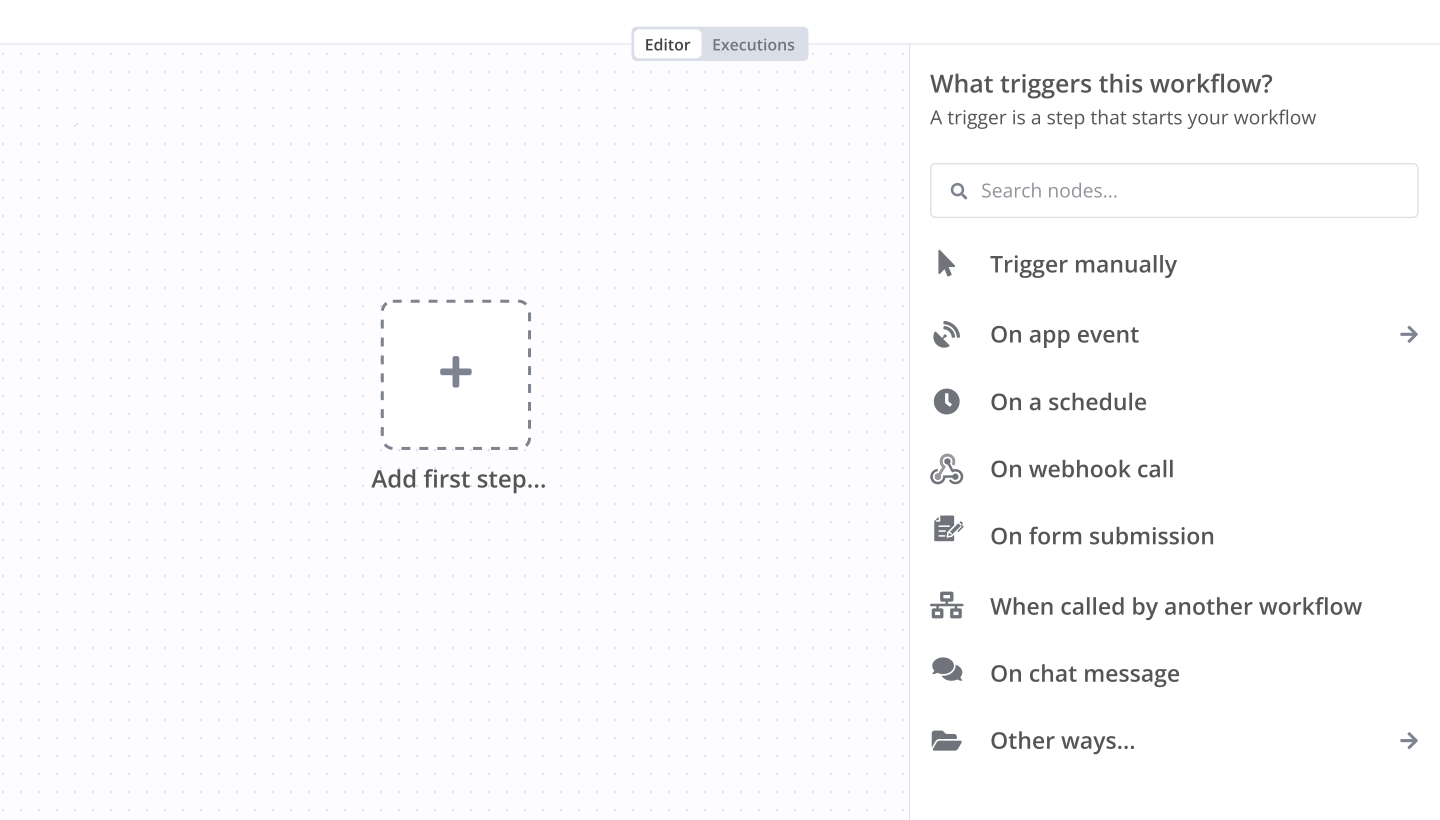
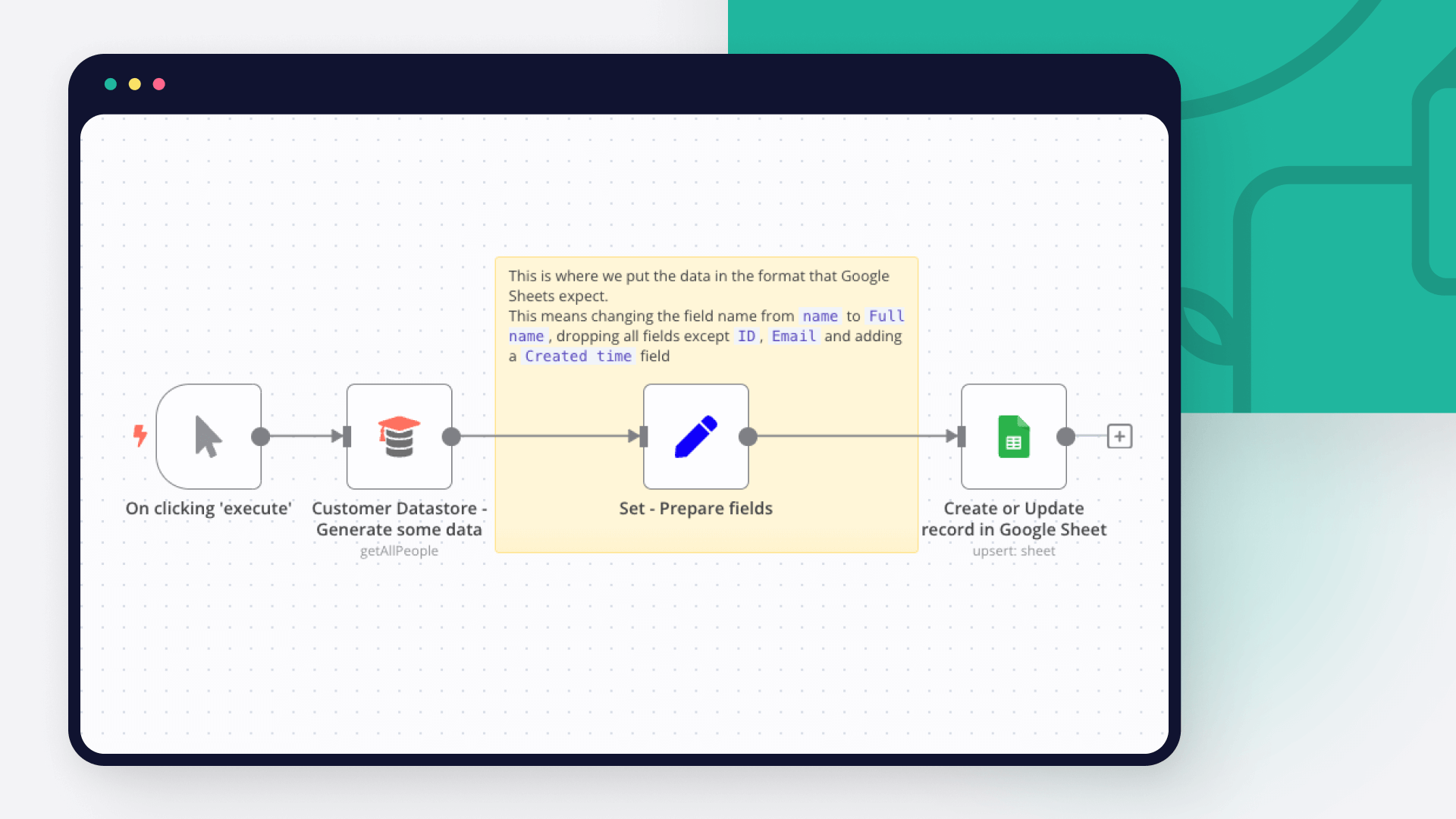
Google Sheets and Microsoft Teams integration: Create a new workflow and add the first step

Step 2: Add and configure Google Sheets and Microsoft Teams nodes

You can find Google Sheets and Microsoft Teams in the nodes panel. Drag them onto your workflow canvas, selecting their actions. Click each node, choose a credential, and authenticate to grant n8n access. Configure Google Sheets and Microsoft Teams nodes one by one: input data on the left, parameters in the middle, and output data on the right.

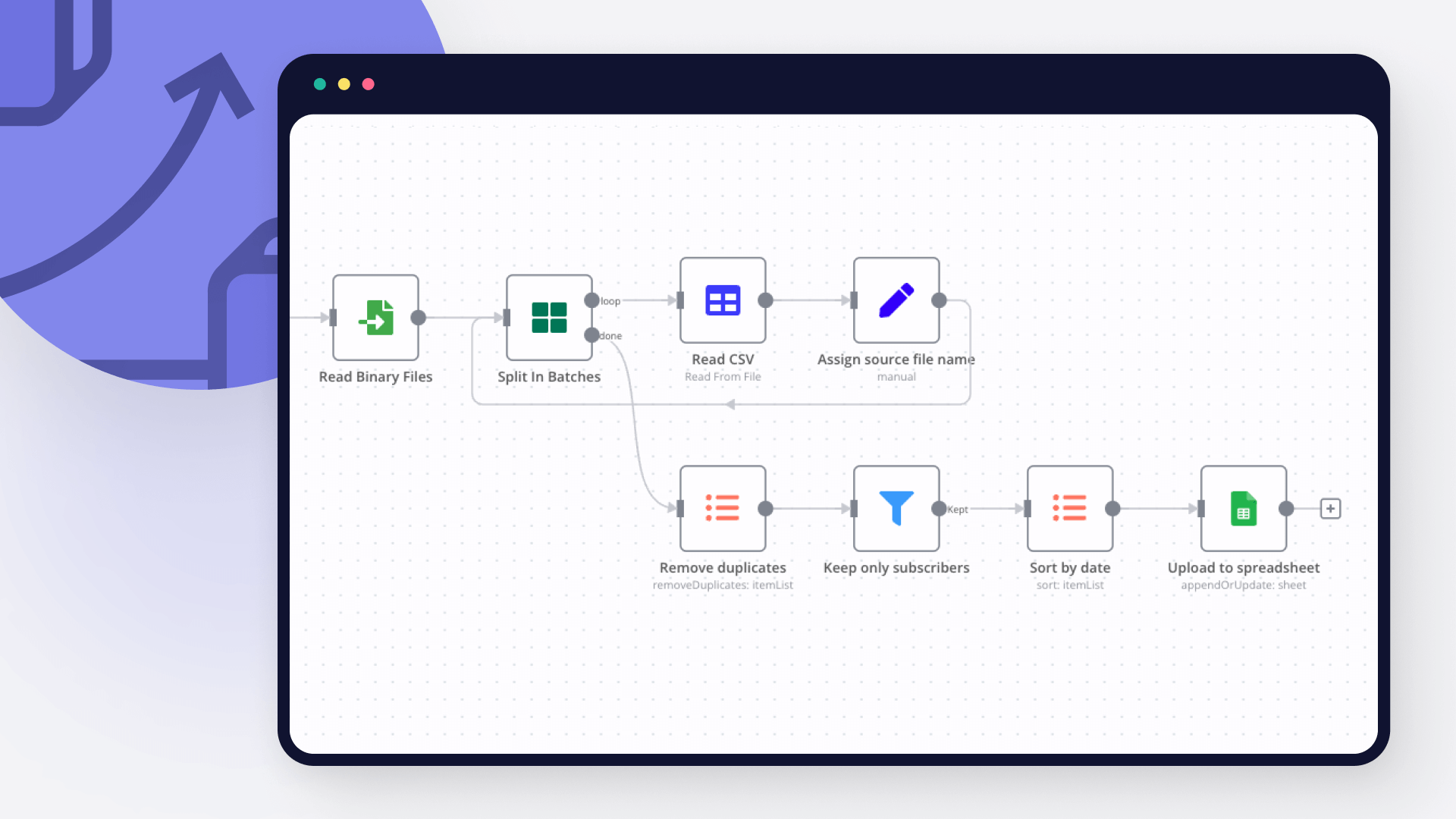
Google Sheets and Microsoft Teams integration: Add and configure Google Sheets and Microsoft Teams nodes

Step 3: Connect Google Sheets and Microsoft Teams

A connection establishes a link between Google Sheets and Microsoft Teams (or vice versa) to route data through the workflow. Data flows from the output of one node to the input of another. You can have single or multiple connections for each node.

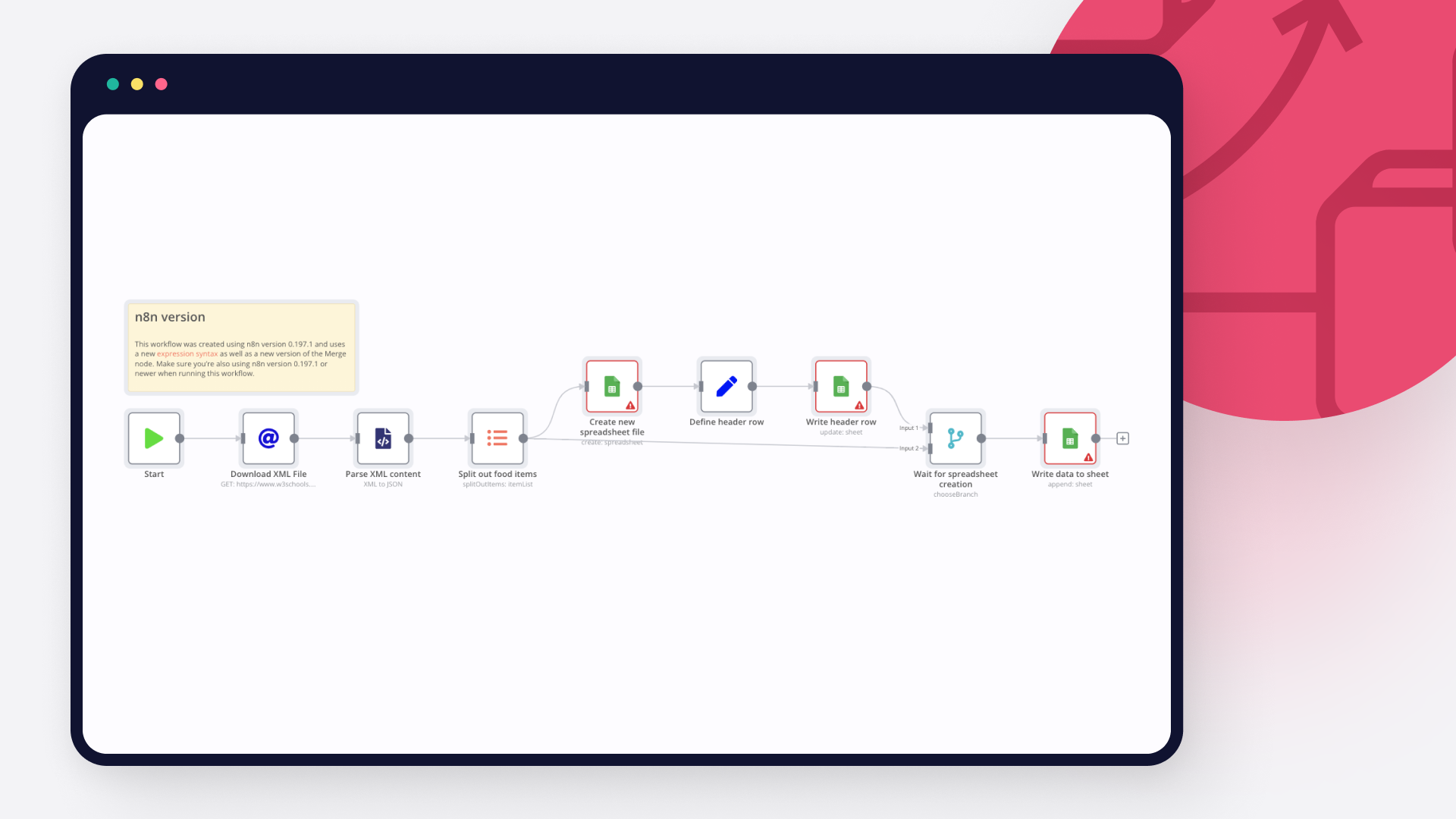
Google Sheets and Microsoft Teams integration: Connect Google Sheets and Microsoft Teams

Step 4: Customize and extend your Google Sheets and Microsoft Teams integration

Use n8n's core nodes such as If, Split Out, Merge, and others to transform and manipulate data. Write custom JavaScript or Python in the Code node and run it as a step in your workflow. Connect Google Sheets and Microsoft Teams with any of n8n’s 1000+ integrations, and incorporate advanced AI logic into your workflows.

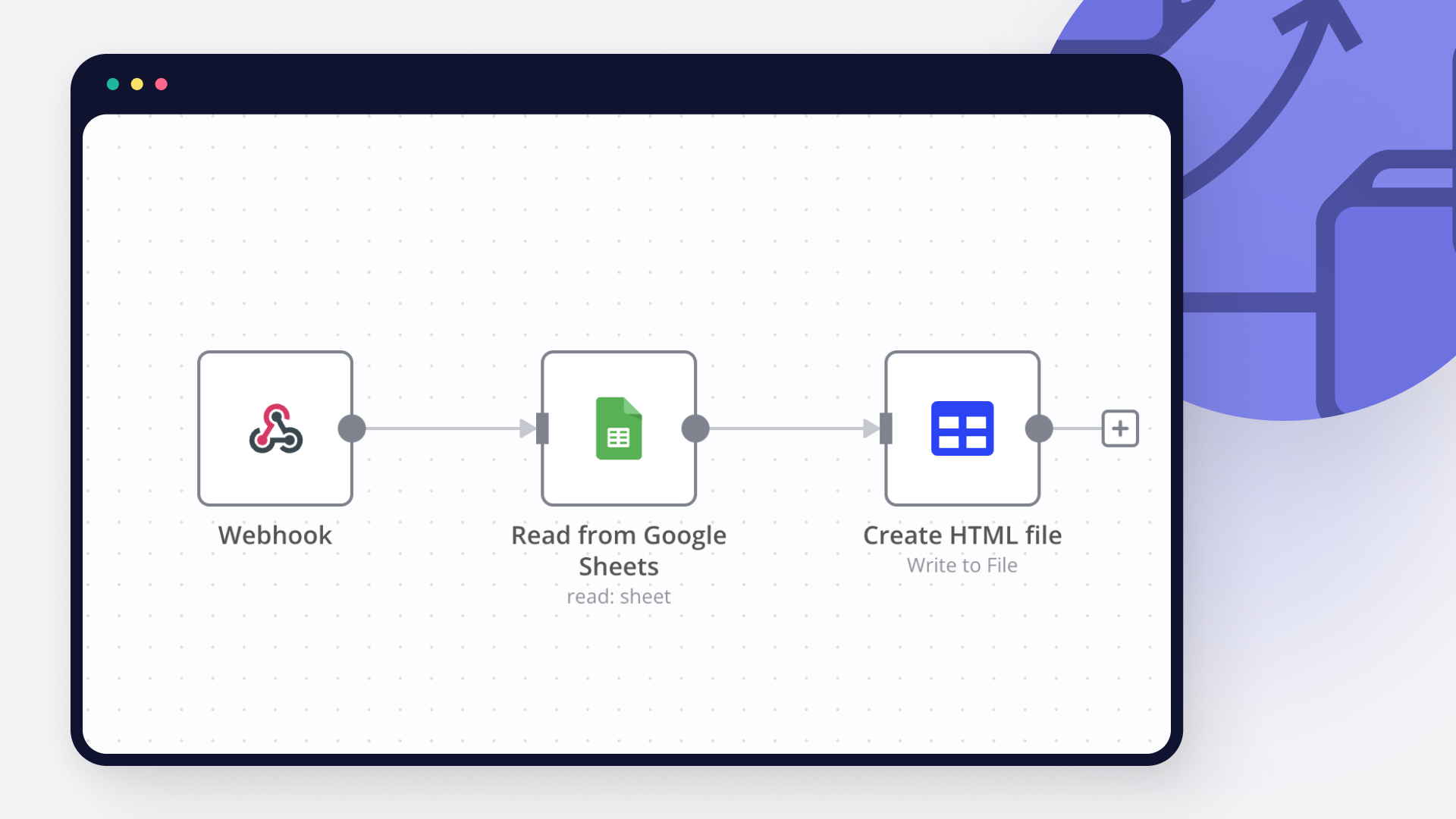
Google Sheets and Microsoft Teams integration: Customize and extend your Google Sheets and Microsoft Teams integration

Step 5: Test and activate your Google Sheets and Microsoft Teams workflow

Save and run the workflow to see if everything works as expected. Based on your configuration, data should flow from Google Sheets to Microsoft Teams or vice versa. Easily debug your workflow: you can check past executions to isolate and fix the mistake. Once you've tested everything, make sure to save your workflow and activate it.

Google Sheets and Microsoft Teams integration: Test and activate your Google Sheets and Microsoft Teams workflow

Pick a Topic & Auto-Publish Translated Content on Multiple Social Media Platform

Who it's for
This n8n workflow is designed for content creators, digital marketers, and social media managers who want to automate their entire content creation and publishing process across multiple platforms. It provides a complete end-to-end system capable of taking a single specific idea and automatically generating a full piece of content from it—complete with images, translations, and platform-optimized formatting. The workflow then publishes the final content to WordPress, Facebook, LinkedIn, and Telegram.

Features
Multi-platform publishing:** WordPress, Facebook, LinkedIn, Telegram
AI-powered content generation using OpenAI (LangChain):* Can generate a full article or content piece from a single specific idea or topic*
Multi-language support:** Automatic translation via Google Translate API
Automatic image processing:** Resizing, optimization, and WordPress upload
Google Sheets integration:** For topic management, content queueing, and status tracking
Notifications:** Send updates via Discord, Telegram, WhatsApp, and Gmail
Flexible workflow triggers:** Supports both manual form submissions and automated scheduled publishing

Requirements
OpenAI API access for content generation
Google Translate API credentials
WordPress API access
Social media API credentials (Facebook, Telegram, LinkedIn)
Google Sheets OAuth2 credentials
Google Drive access for image storage

Configure Credentials
Google APIs**: Configure Google Sheets, Google Drive, and Google Translate with proper OAuth2 credentials
OpenAI API**: Set up with appropriate model access (gpt-4.1-mini)
WordPress API**: Configure with your WordPress site credentials
Social Media APIs**: Set up each platform with proper API keys and target IDs
Notification Services**: Configure each service with proper API keys and target IDs

Important Notes
Form captures topic, type, user, word count, company info, domain, language, and image
AI content generation uses customizable prompts
Images resized up to 5000x5000 px before upload
Content can be translated via Google Translate API
Workflow publishes text and image posts across platforms
Google Sheets tracks content status in real-time

Support & Help
WhatsApp**: Chat on WhatsApp
Discord**: SpaGreen Community
Facebook Group**: SpaGreen Support
Website**: https://spagreen.net
Developer Portfolio**: Codecanyon SpaGreen

Nodes used in this workflow

Popular Google Sheets and Microsoft Teams workflows

+7

Repurpose long-form content into Instagram and LinkedIn posts with OpenAI and Teams

Who is this for Content creators, solopreneurs, and marketing teams who produce long-form content (podcasts, newsletters, interviews, scripts) and want to automatically turn it into multiple social media assets -- Instagram carousels, LinkedIn carousels, LinkedIn text posts, and LinkedIn media posts -- with human-in-the-loop approval via Microsoft Teams. What this workflow does This workflow takes a long-form content file sent via email, extracts strategic content pillars using AI, then fans out into four parallel branches -- each producing a different social media format. Every draft is reviewed and approved in Microsoft Teams before images are generated, assets are saved to Google Drive, and posts are published via Blotato. How it works Email trigger -- A Gmail Trigger watches for emails with a specific subject line (e.g. "Content Repurposing"). The email contains a text attachment (podcast transcript, newsletter, etc.) and optionally a link to the original content. File extraction & storage -- The attachment is extracted, saved as a Google Doc in a timestamped project subfolder on Google Drive, and the source URL is parsed from the email body. AI content strategist -- The Repurpose Strategist agent (OpenAI) analyzes the full text and extracts 5 strategic content pillars, each with a hook headline, core insight, virality factor, and relevant quote. Results are logged in Google Sheets. Four parallel content branches -- The 5 pillars feed into four specialized AI agents that each produce a different format: Instagram/YouTube carousel -- 5 punchy one-liners (max 25 words each) + a social media caption LinkedIn carousel -- 5 slide texts with hooks + a companion caption, plus a styled PDF carousel via HTML-to-PDF LinkedIn text post -- A single strong LinkedIn post (max 100 words) LinkedIn media post -- A post with a guiding statement rendered as an image Human review loop -- Each branch sends its draft to Microsoft Teams for approval via a custom form (approve/reject with feedback). If rejected, feedback is routed back to the AI agent for targeted revisions. Asset generation & storage -- On approval, carousel images are generated via APITemplate.io, all assets (images, post texts, PDFs) are saved to organized Google Drive subfolders, and results are logged back to Google Sheets. Publishing -- Approved posts are published to Instagram and LinkedIn via Blotato, with status monitoring and Teams notifications on success or failure. Setup steps Gmail -- Create OAuth2 credentials. The trigger watches for emails with "Content Repurposing" in the subject. You can customize this filter. Google Drive & Docs -- Create OAuth2 credentials. Set the target folder ID in the Google Drive Trigger node where project subfolders will be created. Google Sheets -- Create a spreadsheet to serve as the content tracker. It will store pillars, carousel texts, post texts, and metadata. Update the Sheet ID in all Google Sheets nodes. OpenAI -- Add your API key. Used by 5 AI agents (strategist + 4 content specialists). Microsoft Teams -- Create OAuth2 credentials. Set the Teams chat ID in the 4 review nodes to route drafts to your approval channel. APITemplate.io -- Create an account and design carousel slide templates. Set the template ID in the image generation nodes. Blotato -- Connect your Instagram and LinkedIn accounts. Add the Blotato API credential and update account IDs in the publishing nodes. HTML-to-PDF -- Install the community node n8n-nodes-htmlcsstopdf (self-hosted only). Customize the carousel slide HTML/CSS template with your branding (logo, colors, profile photo). Requirements Community nodes:** @blotato/n8n-nodes-blotato n8n-nodes-htmlcsstopdf Self-hosted n8n only** (due to community nodes) Gmail OAuth2 credentials Google Drive, Docs & Sheets OAuth2 credentials OpenAI API key Microsoft Teams OAuth2 credentials APITemplate.io account and template Blotato account with connected Instagram and LinkedIn profiles How to customize AI prompts** -- Each of the 5 AI agents has a detailed system prompt you can adjust for tone, word count, language, or output structure. Carousel design** -- Edit the HTML/CSS in the "HTML to PDF" node to match your brand (colors, fonts, logo, profile photo). Update the APITemplate.io template IDs for Instagram-style slides. Platforms** -- Add or remove publishing branches. Currently supports Instagram (via Blotato) and LinkedIn (text post, carousel, media post). Review channel** -- Change the Teams chat ID to route to different teams or channels. Trigger** -- Swap Gmail for another trigger (e.g. Google Drive, webhook, or manual) depending on your content intake workflow. Feedback loop** -- Each branch supports unlimited revision cycles. The AI applies feedback minimally without rewriting from scratch.
+2

Automate Peer Review Assignments with Sonar Pro AI & Multi-Channel Deadline Reminders

Introduction Automate peer review assignment and grading with AI-powered evaluation. Designed for educators managing collaborative assessments efficiently. How It Works Webhook receives assignments, distributes them, AI generates review rubrics, emails reviewers, collects responses, calculates scores, stores results, emails reports, updates dashboards, and posts analytics to Slack. Workflow Template Webhook → Store Assignment → Distribute → Generate Review Rubric → Notify Slack → Email Reviewers → Prepare Response → Calculate Score → Store Results → Check Status → Generate Report → Email Report → Update Dashboard → Analytics → Post to Slack → Respond to Webhook Workflow Steps Receive & Store: Webhook captures assignments, stores data. Distribute & Generate: Assigns peer reviewers, AI creates rubrics. Notify & Email: Alerts via Slack, sends review requests. Collect & Score: Gathers responses, calculates peer scores. Report & Update: Generates reports, emails results, updates dashboard. Analyze & Alert: Posts analytics to Slack, confirms completion. Setup Instructions Webhook & Storage: Configure endpoint, set up database. AI Configuration: Add OpenAI key, customize rubric prompts. Communication: Connect Gmail, Slack credentials. Dashboard: Link analytics platform, configure metrics. Prerequisites OpenAI API key Gmail account Slack workspace Database or storage system Dashboard tool Use Cases University peer review assignments Corporate training evaluations Research paper assessments Customization Multi-round review cycles Custom scoring algorithms LMS integration (Canvas, Moodle) Benefits Eliminates manual distribution Ensures consistent evaluation Provides instant feedback and analytics
+2

Generate job descriptions from briefing notes with OpenAI and Google Docs

Auto-generate job descriptions from briefing notes with OpenAI and Google Docs Who is this for Recruiters, HR teams, and hiring managers who conduct role briefing conversations and want to convert their meeting notes into polished, structured job descriptions automatically -- without manual copywriting. What this workflow does This workflow watches a Google Drive folder for new briefing documents, extracts structured job data using AI, generates a professional HTML job description, sends it to Microsoft Teams for approval, and exports the final version as a PDF to Google Drive. How it works Trigger -- A Google Drive Trigger detects when a new Google Doc (e.g. a briefing transcript) is created in a watched folder. File organization -- A timestamped subfolder is created and the document is moved into it for clean project structure. Document reading -- The Google Doc content is fetched via the Google Docs API. AI data extraction -- An OpenAI AI Agent analyzes the transcript (supports German input) and extracts structured job data: title, department, responsibilities, skills, benefits, tech stack, and more -- output as JSON. Data logging -- The extracted fields are appended to a Google Sheets tracker for reference and audit. Prompt assembly -- A Code node builds a detailed prompt from the structured data, choosing between "create" mode (first draft) or "revise" mode (feedback loop). JD generation -- A second AI Agent (JD-Writer) generates a complete, styled HTML job description following a professional template with sections like responsibilities, profile, benefits, and diversity statement. Human review -- The draft is sent to a Microsoft Teams chat with an approve/reject form and an optional feedback field. Approval path -- If approved, the HTML is converted to PDF and uploaded to the Google Drive subfolder alongside the original briefing. Revision loop -- If rejected, the feedback is routed back to the JD-Writer for targeted revisions, and the updated draft is re-sent for approval. Setup steps Google Drive & Docs -- Create OAuth2 credentials. Set the folder ID in the Google Drive Trigger node to the folder where briefing documents are saved. Google Sheets -- Create a spreadsheet with columns for all job data fields (job_title, department, responsibilities, hard_skills, soft_skills, etc.). Update the Sheet ID in the Google Sheets node. OpenAI -- Add your API key as an OpenAI credential. Used for both the data extraction agent (reads the transcript) and the JD-Writer agent (generates the job description). Microsoft Teams -- Create OAuth2 credentials. Set the Teams chat ID in the approval node to the chat or channel where drafts should be reviewed. HTML-to-PDF -- Install the community node n8n-nodes-htmlcsstopdf (self-hosted only). Add the API credential. Requirements Community node:* n8n-nodes-htmlcsstopdf -- self-hosted n8n only* OpenAI API key (GPT-4 or newer recommended) Google Drive, Docs & Sheets OAuth2 credentials Microsoft Teams OAuth2 credentials How to customize AI extraction prompt** -- Edit the system message in the "Extract job data from transcript" node to adjust which fields are extracted or to support different transcript languages. JD template style** -- Modify the prompt in the "Build JD-Writer prompt" Code node to change tone, section order, or formatting style of the generated job description. Approval channel** -- Change the Teams chat ID to route drafts to a different team or channel. Output format** -- Swap the HTML-to-PDF node for a different converter, or skip PDF and use the raw HTML output directly. Tracker columns** -- Add or remove columns in Google Sheets to match your internal job data schema. Revision depth** -- The approval loop supports unlimited revision cycles. The JD-Writer applies feedback minimally without rewriting from scratch.

Scan Gmail links with VirusTotal and send alerts to WhatsApp, Teams, and Sheets

Who it's for This n8n workflow is designed for IT security professionals, email administrators, and organizations that want to automatically scan URLs received in emails for potential security threats. It provides a complete end-to-end system capable of automatically detecting malicious URLs using VirusTotal API, analyzing the results, and sending notifications when suspicious links are found. Features Automatically monitors Gmail for new emails on a continuous basis (every minute) Extracts all URLs from email content while filtering out Google links Scans each URL using VirusTotal's comprehensive security database Categorizes URLs based on threat level (malicious, suspicious, harmless, undetected) Sends immediate alerts through multiple channels (WhatsApp via Rapiwa, Microsoft Teams) Updates Google Sheets with scan results for historical tracking and analysis Processes URLs in batches to optimize performance Filters out common Google links to reduce false positives Requirements Gmail account with OAuth2 credentials VirusTotal API key Google Sheets API access with OAuth2 credentials Rapiwa API credentials for WhatsApp notifications Microsoft Teams credentials for team notifications A Google Sheet configured to store scan results Important Notes Workflow runs continuously, checking for new emails every minute Only non-Google URLs are scanned to focus on potentially suspicious links Results are categorized based on VirusTotal's analysis: malicious, suspicious, harmless, undetected, timeout, failure, or type_unsupported Alert messages include the URL and all relevant security statistics from VirusTotal All scan results are stored in a Google Sheet for future reference and analysis The workflow processes URLs in batches to optimize performance and avoid API limits Immediate notifications are sent when potentially malicious URLs are detected Support & Help WhatsApp**: Chat on WhatsApp Discord**: SpaGreen Community Facebook Group**: SpaGreen Support Website**: https://spagreen.net Developer Portfolio**: Codecanyon SpaGreen
+10

Pick a Topic & Auto-Publish Translated Content on Multiple Social Media Platform

Who it's for This n8n workflow is designed for content creators, digital marketers, and social media managers who want to automate their entire content creation and publishing process across multiple platforms. It provides a complete end-to-end system capable of taking a single specific idea and automatically generating a full piece of content from it—complete with images, translations, and platform-optimized formatting. The workflow then publishes the final content to WordPress, Facebook, LinkedIn, and Telegram. Features Multi-platform publishing:** WordPress, Facebook, LinkedIn, Telegram AI-powered content generation using OpenAI (LangChain):* Can generate a full article or content piece from a single specific idea or topic* Multi-language support:** Automatic translation via Google Translate API Automatic image processing:** Resizing, optimization, and WordPress upload Google Sheets integration:** For topic management, content queueing, and status tracking Notifications:** Send updates via Discord, Telegram, WhatsApp, and Gmail Flexible workflow triggers:** Supports both manual form submissions and automated scheduled publishing Requirements OpenAI API access for content generation Google Translate API credentials WordPress API access Social media API credentials (Facebook, Telegram, LinkedIn) Google Sheets OAuth2 credentials Google Drive access for image storage Configure Credentials Google APIs**: Configure Google Sheets, Google Drive, and Google Translate with proper OAuth2 credentials OpenAI API**: Set up with appropriate model access (gpt-4.1-mini) WordPress API**: Configure with your WordPress site credentials Social Media APIs**: Set up each platform with proper API keys and target IDs Notification Services**: Configure each service with proper API keys and target IDs Important Notes Form captures topic, type, user, word count, company info, domain, language, and image AI content generation uses customizable prompts Images resized up to 5000x5000 px before upload Content can be translated via Google Translate API Workflow publishes text and image posts across platforms Google Sheets tracks content status in real-time Support & Help WhatsApp**: Chat on WhatsApp Discord**: SpaGreen Community Facebook Group**: SpaGreen Support Website**: https://spagreen.net Developer Portfolio**: Codecanyon SpaGreen

Build your own Google Sheets and Microsoft Teams integration

Create custom Google Sheets and Microsoft Teams workflows by choosing triggers and actions. Nodes come with global operations and settings, as well as app-specific parameters that can be configured. You can also use the HTTP Request node to query data from any app or service with a REST API.

Google Sheets supported actions

Create
Create a spreadsheet
Delete
Delete a spreadsheet
Append or Update Row
Append a new row or update an existing one (upsert)
Append Row
Create a new row in a sheet
Clear
Delete all the contents or a part of a sheet
Create
Create a new sheet
Delete
Permanently delete a sheet
Delete Rows or Columns
Delete columns or rows from a sheet
Get Row(s)
Retrieve one or more rows from a sheet
Update Row
Update an existing row in a sheet

Microsoft Teams supported actions

Create
Create a channel
Delete
Delete a channel
Get
Get a channel
Get Many
Get many channels
Update
Update a channel
Create
Create a message in a channel
Get Many
Get many messages from a channel
Create
Create a message in a chat
Get
Get a message from a chat
Get Many
Get many messages from a chat
Send and Wait for Response
Send a message and wait for response
Create
Create a task
Delete
Delete a task
Get
Get a task
Get Many
Get many tasks
Update
Update a task

FAQs

  • Can Google Sheets connect with Microsoft Teams?

  • Can I use Google Sheets’s API with n8n?

  • Can I use Microsoft Teams’s API with n8n?

  • Is n8n secure for integrating Google Sheets and Microsoft Teams?

  • How to get started with Google Sheets and Microsoft Teams integration in n8n.io?

Need help setting up your Google Sheets and Microsoft Teams integration?

Discover our latest community's recommendations and join the discussions about Google Sheets and Microsoft Teams integration.
Sergey Komardenkov
sérgio eduardo floresta filho
Julian
therealJMT
Guilherme

Looking to integrate Google Sheets and Microsoft Teams in your company?

Over 3000 companies switch to n8n every single week

Why use n8n to integrate Google Sheets with Microsoft Teams

Build complex workflows, really fast

Build complex workflows, really fast

Handle branching, merging and iteration easily.
Pause your workflow to wait for external events.

Code when you need it, UI when you don't

Simple debugging

Your data is displayed alongside your settings, making edge cases easy to track down.

Use templates to get started fast

Use 1000+ workflow templates available from our core team and our community.

Reuse your work

Copy and paste, easily import and export workflows.

Implement complex processes faster with n8n

red iconyellow iconred iconyellow icon