Back to Integrations
integrationGoogle Sheets node
integrationSlack node

Google Sheets and Slack integration

Save yourself the work of writing custom integrations for Google Sheets and Slack and use n8n instead. Build adaptable and scalable Data & Storage, Productivity, Communication, and HITL workflows that work with your technology stack. All within a building experience you will love.

How to connect Google Sheets and Slack

  • Step 1: Create a new workflow
  • Step 2: Add and configure nodes
  • Step 3: Connect
  • Step 4: Customize and extend your integration
  • Step 5: Test and activate your workflow

Step 1: Create a new workflow and add the first step

In n8n, click the "Add workflow" button in the Workflows tab to create a new workflow. Add the starting point – a trigger on when your workflow should run: an app event, a schedule, a webhook call, another workflow, an AI chat, or a manual trigger. Sometimes, the HTTP Request node might already serve as your starting point.
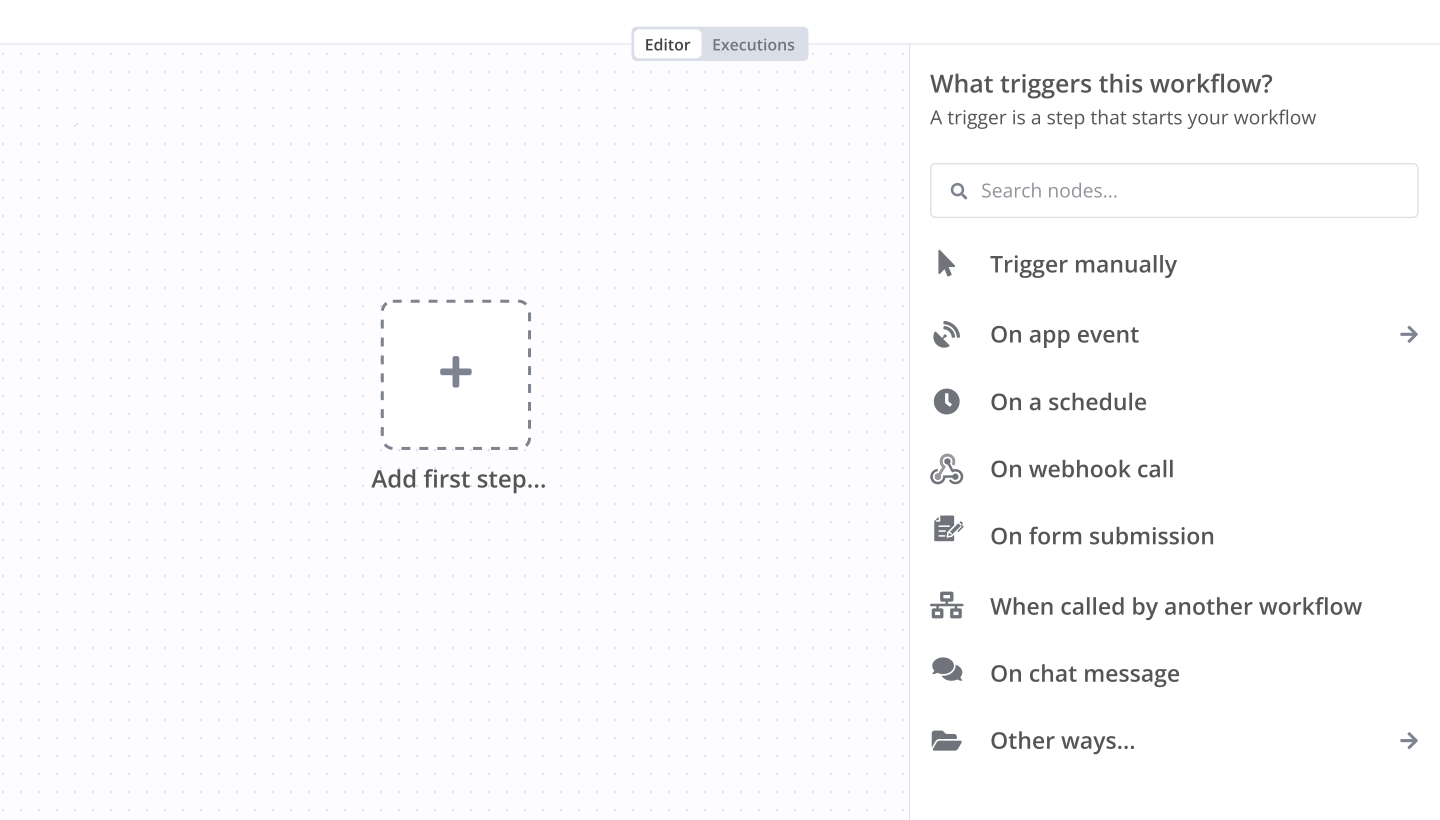
Google Sheets and Slack integration: Create a new workflow and add the first step

Step 2: Add and configure Google Sheets and Slack nodes

You can find Google Sheets and Slack in the nodes panel. Drag them onto your workflow canvas, selecting their actions. Click each node, choose a credential, and authenticate to grant n8n access. Configure Google Sheets and Slack nodes one by one: input data on the left, parameters in the middle, and output data on the right.

Google Sheets and Slack integration: Add and configure Google Sheets and Slack nodes

Step 3: Connect Google Sheets and Slack

A connection establishes a link between Google Sheets and Slack (or vice versa) to route data through the workflow. Data flows from the output of one node to the input of another. You can have single or multiple connections for each node.

Google Sheets and Slack integration: Connect Google Sheets and Slack

Step 4: Customize and extend your Google Sheets and Slack integration

Use n8n's core nodes such as If, Split Out, Merge, and others to transform and manipulate data. Write custom JavaScript or Python in the Code node and run it as a step in your workflow. Connect Google Sheets and Slack with any of n8n’s 1000+ integrations, and incorporate advanced AI logic into your workflows.

Google Sheets and Slack integration: Customize and extend your Google Sheets and Slack integration

Step 5: Test and activate your Google Sheets and Slack workflow

Save and run the workflow to see if everything works as expected. Based on your configuration, data should flow from Google Sheets to Slack or vice versa. Easily debug your workflow: you can check past executions to isolate and fix the mistake. Once you've tested everything, make sure to save your workflow and activate it.

Google Sheets and Slack integration: Test and activate your Google Sheets and Slack workflow

AI-powered information monitoring with OpenAI, Google Sheets, Jina AI and Slack

Check Legal Regulations:
This workflow involves scraping, so ensure you comply with the legal regulations in your country before getting started. Better safe than sorry!

📌 Purpose
This workflow enables automated and AI-driven topic monitoring, delivering concise article summaries directly to a Slack channel in a structured and easy-to-read format.
It allows users to stay informed on specific topics of interest effortlessly, without manually checking multiple sources, ensuring a time-efficient and focused monitoring experience.

To get started, copy the Google Sheets template required for this workflow from here.

🎯 Target Audience
This workflow is designed for:
Industry professionals** looking to track key developments in their field.
Research teams** who need up-to-date insights on specific topics.
Companies** aiming to keep their teams informed with relevant content.

⚙️ How It Works
Trigger: A Scheduler initiates the workflow at regular intervals (default: every hour).
Data Retrieval:
RSS feeds are fetched using the RSS Read node.
Previously monitored articles are checked in Google Sheets to avoid duplicates.
Content Processing:
The article relevance is assessed using OpenAI (GPT-4o-mini).
Relevant articles are scraped using Jina AI to extract content.
Summaries are generated and formatted for Slack.
Output:
Summaries are posted to the specified Slack channel.
Article metadata is stored in Google Sheets for tracking.

🛠️ Key APIs and Nodes Used
Scheduler Node:** Triggers the workflow periodically.
RSS Read:** Fetches the latest articles from defined RSS feeds.
Google Sheets:** Stores monitored articles and manages feed URLs.
OpenAI API (GPT-4o-mini):** Classifies article relevance and generates summaries.
Jina AI API:** Extracts the full content of relevant articles.
Slack API:** Posts formatted messages to Slack channels.

This workflow provides an efficient and intelligent way to stay informed about your topics of interest, directly within Slack.

Nodes used in this workflow

Popular Google Sheets and Slack workflows

Scrape physician profiles from BrowserAct into Google Sheets and notify Slack

Scrape physician profiles from BrowserAct to Google Sheets This workflow automates the process of building a targeted database of healthcare providers by scraping physician details for a specific location and syncing them to your records. It leverages BrowserAct to extract data from healthcare directories and ensures your database stays clean by preventing duplicate entries. Target Audience Medical recruiters, pharmaceutical sales representatives, lead generation specialists, and healthcare data analysts. How it works Define Location: The workflow starts by setting the target Location and State in a Set node. Scrape Data: A BrowserAct node executes a task (using the "Physician Profile Enricher" template) to search a healthcare directory (e.g., Healow) for doctors matching the criteria. Parse JSON: A Code node takes the raw string output from the scraper and parses it into individual JSON objects. Update Database: The workflow uses a Google Sheets node to append new records or update existing ones based on the physician's name, preventing duplicates. Notify Team: A Slack node sends a message to a specific channel to confirm the batch job has finished successfully. How to set up Configure Credentials: Connect your BrowserAct, Google Sheets, and Slack accounts in n8n. Prepare BrowserAct: Ensure the Physician Profile Enricher template is saved in your BrowserAct account. Setup Google Sheet: Create a new Google Sheet with the required headers (listed below). Select Spreadsheet: Open the Google Sheets node and select your newly created file and sheet. Set Variables: Open the Define Location node and input your target Location (City) and State. Configure Notification: Open the Slack node and select the channel where you want to receive alerts. Google Sheet Headers To use this workflow, create a Google Sheet with the following headers: Name Specialty Address Requirements BrowserAct* account with the Physician Profile Enricher* template. Google Sheets** account. Slack** account. How to customize the workflow Change the Data Source: Modify the BrowserAct template to scrape a different directory (e.g., Zocdoc or WebMD) and update the Google Sheet columns accordingly. Switch Notifications: Replace the Slack node with a Microsoft Teams, Discord, or Email node to suit your team's communication preferences. Enrich Data: Add an AI Agent node after the Code node to format addresses or research the specific clinics listed. Need Help? How to Find Your BrowserAct API Key & Workflow ID How to Connect n8n to BrowserAct How to Use & Customize BrowserAct Templates Workflow Guidance and Showcase Video Automate Medical Lead Gen: Scrape Healow to Google Sheets & Slack

PPC Campaign Intelligence & Optimization with Google Ads, Sheets & Slack

How it Works This workflow automatically monitors your Google Ads campaigns every day, analyzing performance with AI-powered scoring to identify scaling opportunities and catch issues before they drain your budget. Each morning at 9 AM, it fetches all active campaign data including clicks, impressions, conversions, costs, and conversion rates from your Google Ads account. The AI analysis engine evaluates four critical dimensions: CTR (click-through rate) to measure ad relevance, conversion rate to assess landing page effectiveness, cost per conversion to evaluate profitability, and traffic volume to identify scale-readiness. Each campaign receives a performance score (0-100 points) and is automatically categorized as Excellent (75+), Good (55-74), Fair (35-54), or Underperforming (0-34). High-performing campaigns trigger instant Slack alerts to your PPC team with detailed scaling recommendations and projected ROI improvements, while underperforming campaigns generate urgent alerts with specific optimization actions. Every campaign is logged to your Google Sheets dashboard with daily metrics, and the system generates personalized email reports—action-oriented scaling plans for top performers and troubleshooting guides for campaigns needing attention. The entire analysis takes minutes, providing your team with daily intelligence reports that would otherwise require hours of manual spreadsheet work and data analysis. Who is this for? PPC managers and paid media specialists drowning in campaign data and manual reporting Marketing agencies managing multiple client accounts needing automated performance monitoring E-commerce brands running high-spend campaigns who can't afford budget waste Growth teams looking to scale winners faster and pause losers immediately Anyone spending $5K+ monthly on Google Ads who needs data-driven optimization decisions Setup Steps Setup time:** Approx. 15-25 minutes (credential configuration, dashboard setup, alert customization) Requirements:** Google Ads account with active campaigns Google account with a tracking spreadsheet Slack workspace SMTP email provider (Gmail, SendGrid, etc.) Create a Google Sheets dashboard with two tabs: "Daily Performance" and "Campaign Log" with appropriate column headers. Set up these nodes: Schedule Daily Check: Pre-configured to run at 9 AM daily (adjust timing if needed). Fetch Google Ads Data: Connect your Google Ads account and authorize API access. AI Performance Analysis: Review scoring thresholds (CTR, conversion rate, cost benchmarks). Route by Performance: Automatically splits campaigns into high-performers vs. issues. Update Campaign Dashboard: Connect Google Sheets and select your "Daily Performance" tab. Log All Campaigns: Select your "Campaign Log" tab for historical tracking. Slack Alerts: Connect workspace and configure separate channels for scaling opportunities and performance issues. Generate Action Plan: Customize email templates with your brand voice and action items. Email Performance Report: Configure SMTP and set recipient email addresses. Credentials must be entered into their respective nodes for successful execution. Customization Guidance Scoring Weights:** Adjust point values for CTR (30), conversion rate (35), cost efficiency (25), and volume (10) in the AI Performance Analysis node based on your business priorities. Performance Thresholds:** Modify the 75-point Excellent threshold and 55-point Good threshold to match your campaign quality distribution and industry benchmarks. Benchmark Values:** Update CTR benchmarks (5% excellent, 3% good, 1.5% average) and conversion rate targets (10%, 5%, 2%) for your industry. Alert Channels:** Create separate Slack channels for different alert types or route critical alerts to Microsoft Teams, Discord, or SMS via Twilio. Email Recipients:** Configure different recipient lists for scaling alerts (executives, growth team) vs. optimization alerts (campaign managers). Schedule Frequency:** Change from daily to hourly monitoring for high-spend campaigns, or weekly for smaller accounts. Additional Platforms:** Duplicate the workflow structure for Facebook Ads, Microsoft Ads, or LinkedIn Ads with platform-specific nodes. Budget Controls:** Add nodes to automatically pause campaigns exceeding cost thresholds or adjust bids based on performance scores. Once configured, this workflow will continuously monitor your ad spend, identify opportunities worth thousands in additional revenue, and alert you to issues before they waste your budget—transforming manual reporting into automated intelligence. Built by Daniel Shashko Connect on LinkedIn

AI Personal Assistant

Email Personal Assistant - Comprehensive Communication Manager This automation flow is designed to proactively monitor email, calendar, and Slack communications, analyze priorities across all channels, and generate a comprehensive daily briefing with actionable tasks for executive productivity management. ⚙️ How It Works (Step-by-Step): ⏰ Automated Daily Trigger Runs automatically on weekdays: Scheduled execution every weekday at 8:00 AM Manual trigger available for on-demand analysis Comprehensive daily communication audit 📧 Email Assistant Agent Analyzes inbox priorities and context: Scans unread emails across "To Respond" and "FYI" labels Checks email history to determine relationship context Identifies *company-related opportunities and partnerships Categorizes emails by urgency (High, Medium, Low) Cross-references with sent emails for follow-up context 📅 Follow-Up Assistant Agent Monitors meeting follow-up requirements: Reviews last 3 days of calendar meetings Fetches Fireflies transcripts for recorded sessions Identifies meetings without post-meeting communication Flags meetings requiring action items or follow-ups Checks sent emails and Slack for completed follow-ups 💬 Slack Assistant Agent Tracks Slack communication priorities: Monitors direct messages and @mentions Identifies unreplied Slack conversations Cross-references with email and calendar context Prioritizes responses based on sender importance Checks for threaded conversations requiring attention 🎯 Master Orchestrator Agent Synthesizes all communication data: Combines reports from all three assistant agents Cross-references with existing Google Sheets to-do list Prioritizes tasks by urgency and business impact Identifies correlations between different communication channels Creates comprehensive daily action plan 📊 Task Management Integration Automated tracking and delivery: Appends new tasks to Google Sheets to-do tracker Sends personalized daily briefing via Slack DM Maintains conversation memory for context continuity Tracks outstanding vs. completed items 🛠️ Tools Used: n8n: Workflow orchestration and scheduling Claude Sonnet 4 & Opus 4: Multi-agent AI analysis Gmail API: Email monitoring and history checking Google Calendar: Meeting tracking and scheduling Slack API: Message monitoring and user management Fireflies API: Meeting transcript analysis Google Sheets: Task tracking and persistence 📦 Key Features: Multi-channel communication monitoring (Email, Calendar, Slack) AI-powered priority assessment and context analysis Cross-platform relationship tracking and history Automated daily briefing generation and delivery Persistent task tracking with Google Sheets integration Meeting follow-up verification and flagging Conversation memory for continuity across sessions 🚀 Ideal Use Cases: C-level executives managing multiple communication channels Sales leaders tracking prospect interactions and follow-ups Business development professionals managing partnerships Busy professionals needing communication prioritization Teams requiring systematic follow-up management Anyone wanting automated daily productivity briefings `
+5

Generate & Publish SEO Articles with Claude AI, Webflow & Image Generation

**Content engine that ships fresh, SEO-ready articles every single day. ** Workflow: ⸻ Layout Blueprint • Purpose: Define content structure before writing begins. • What’s Included: • Search intent mapping • Internal link planning • Call-to-action (CTA) placement • Benefit: Ensures consistency, SEO alignment, and content goals are baked in early. ⸻ AI-Assisted Drafting • Tool: GPT generates the first draft. • Editor’s Role: • Focus on depth and accuracy • Align tone and style with existing site content • Context-Aware: Pulls insights from top-ranking articles already live on the site. ⸻ SEO Validation • Automated Checks for: • Keyword coverage • Readability scoring • Schema markup • Internal/external link quality • Outcome: Each piece is validated before hitting publish. ⸻ Media Production • Process: AI auto-generates relevant images. • Delivery: Visual assets are automatically added to the CMS library. ⸻ Optional Human Review: Team feedback via Slack or Teams if needed. ⸻ Automated Publishing • Action: Instantly publishes content to Webflow once approved. • Result: A fully streamlined pipeline from draft to live with minimal manual steps.

Onboard employees from Google Forms with Slack, Jira, and GitHub access

How it works New Google Form response triggers the workflow Checks if employee was already onboarded (prevents duplicates) Adds user to department-specific Slack channel If in Software department, grants GitHub repo access Invites user to Jira and creates an onboarding task Updates Google Sheet status to "Completed" Set up steps Estimated setup time: 10-15 minutes Connect Google Sheets (2 min) - Update sheet ID in trigger and update nodes Configure Slack (3 min) - Add channel IDs and admin user ID to Code node config Set up Jira (3 min) - Add project keys and component IDs to Code node config Configure GitHub (2 min) - Add org name and repo names to Code node config Detailed setup instructions are included in the sticky notes within the workflow.
+2

Automate client onboarding with Asana, Google Docs, Gmail, Slack and Sheets

📊 Description Automate short-term trading research by generating high-quality trade ideas using MCP (Market Context Protocol) signals and AI-powered analysis. 📈🤖 This workflow evaluates market context, catalysts, momentum, and risk factors to produce structured trade ideas with clear reasoning, confidence scores, and execution notes. Designed for fast-moving markets, it helps traders and analysts spot actionable opportunities consistently—without manual screening or emotional bias. Perfect for systematic traders, research teams, and AI-driven trading desks. ⚡📊 🔁 What This Template Does 1️⃣ Ingests market context and asset data from MCP inputs. 📥 2️⃣ Normalizes symbols, sectors, and time horizons for analysis. 🧾 3️⃣ Evaluates short-term momentum and catalyst strength. 🚀 4️⃣ Analyzes risk, volatility, and downside exposure. ⚠️ 5️⃣ Uses AI to generate a structured trade thesis. 🤖 6️⃣ Assigns a confidence score and risk level to each idea. 📊 7️⃣ Produces clear entry logic, rationale, and trade direction. 🧠 8️⃣ Filters out low-quality or low-conviction setups. 🚫 9️⃣ Outputs clean JSON-ready trade ideas for downstream systems. 🔁 ⭐ Key Benefits ✅ Automates short-term trade idea generation ✅ Reduces emotional bias with AI-based scoring ✅ Combines market context, catalysts, and momentum ✅ Produces structured, repeatable trade logic ✅ Saves hours of manual chart and news analysis ✅ Ideal for fast-paced trading environments 🧩 Features MCP (Market Context Protocol) data ingestion AI-powered trade thesis generation Confidence and risk scoring logic Short-term momentum and catalyst analysis Strict structured output for automation reliability Easy integration into dashboards or execution systems 🔐 Requirements MCP-compatible market data source OpenAI API credentials (GPT-4o or GPT-4o-mini recommended) n8n instance with AI nodes enabled Defined schema for trade idea output 🎯 Target Audience Short-term and swing traders Quant and discretionary trading teams Market research analysts Fintech platforms generating trade signals Automation engineers building trading workflows

Build your own Google Sheets and Slack integration

Create custom Google Sheets and Slack workflows by choosing triggers and actions. Nodes come with global operations and settings, as well as app-specific parameters that can be configured. You can also use the HTTP Request node to query data from any app or service with a REST API.

Google Sheets supported actions

Create
Create a spreadsheet
Delete
Delete a spreadsheet
Append or Update Row
Append a new row or update an existing one (upsert)
Append Row
Create a new row in a sheet
Clear
Delete all the contents or a part of a sheet
Create
Create a new sheet
Delete
Permanently delete a sheet
Delete Rows or Columns
Delete columns or rows from a sheet
Get Row(s)
Retrieve one or more rows from a sheet
Update Row
Update an existing row in a sheet

Slack supported actions

Archive
Archives a conversation
Close
Closes a direct message or multi-person direct message
Create
Initiates a public or private channel-based conversation
Get
Get information about a channel
Get Many
Get many channels in a Slack team
History
Get a conversation's history of messages and events
Invite
Invite a user to a channel
Join
Joins an existing conversation
Kick
Removes a user from a channel
Leave
Leaves a conversation
Member
List members of a conversation
Open
Opens or resumes a direct message or multi-person direct message
Rename
Renames a conversation
Replies
Get a thread of messages posted to a channel
Set Purpose
Sets the purpose for a conversation
Set Topic
Sets the topic for a conversation
Unarchive
Unarchives a conversation
Get
Get Many
Get & filters team files
Upload
Create or upload an existing file
Delete
Get Permalink
Search
Send
Send and Wait for Response
Update
Add
Adds a reaction to a message
Get
Get the reactions of a message
Remove
Remove a reaction of a message
Add
Add a star to an item
Delete
Delete a star from an item
Get Many
Get many stars of autenticated user
Get
Get information about a user
Get Many
Get a list of many users
Get User's Profile
Get a user's profile
Get User's Status
Get online status of a user
Update User's Profile
Update a user's profile
Add Users
Create
Disable
Enable
Get Many
Get Users
Update

FAQs

  • Can Google Sheets connect with Slack?

  • Can I use Google Sheets’s API with n8n?

  • Can I use Slack’s API with n8n?

  • Is n8n secure for integrating Google Sheets and Slack?

  • How to get started with Google Sheets and Slack integration in n8n.io?

Need help setting up your Google Sheets and Slack integration?

Discover our latest community's recommendations and join the discussions about Google Sheets and Slack integration.
Sergey Komardenkov
sérgio eduardo floresta filho
Julian
therealJMT
Guilherme

Looking to integrate Google Sheets and Slack in your company?

Over 3000 companies switch to n8n every single week

Why use n8n to integrate Google Sheets with Slack

Build complex workflows, really fast
Build complex workflows, really fast

Handle branching, merging and iteration easily.
Pause your workflow to wait for external events.

Code when you need it, UI when you don't

Simple debugging

Your data is displayed alongside your settings, making edge cases easy to track down.

Use templates to get started fast

Use 1000+ workflow templates available from our core team and our community.

Reuse your work

Copy and paste, easily import and export workflows.

Implement complex processes faster with n8n

red iconyellow iconred iconyellow icon