Back to Integrations
integrationNocoDB node
integrationSlack node

NocoDB and Slack integration

Save yourself the work of writing custom integrations for NocoDB and Slack and use n8n instead. Build adaptable and scalable Data & Storage, Communication, and HITL workflows that work with your technology stack. All within a building experience you will love.

How to connect NocoDB and Slack

  • Step 1: Create a new workflow
  • Step 2: Add and configure nodes
  • Step 3: Connect
  • Step 4: Customize and extend your integration
  • Step 5: Test and activate your workflow

Step 1: Create a new workflow and add the first step

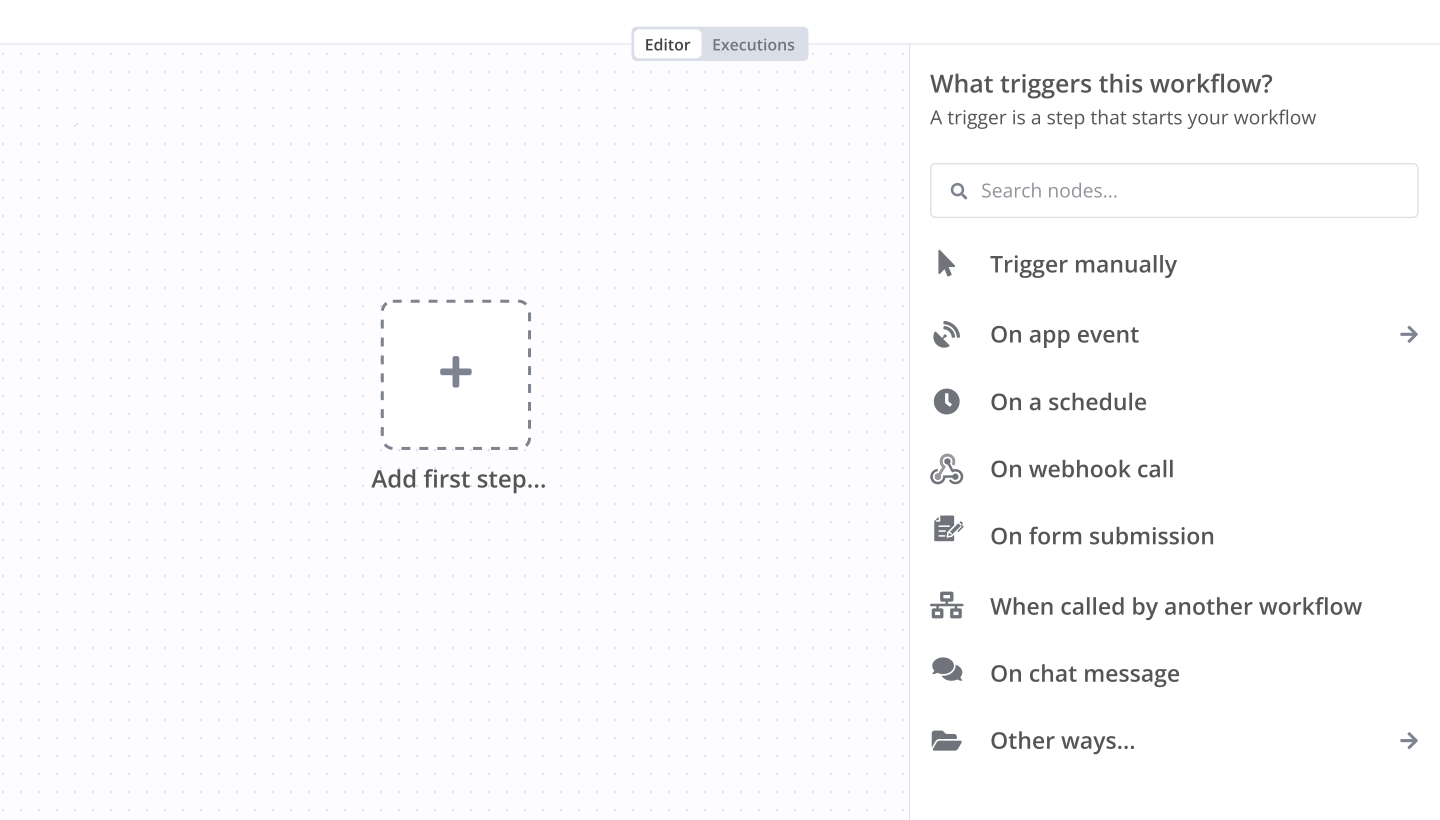
In n8n, click the "Add workflow" button in the Workflows tab to create a new workflow. Add the starting point – a trigger on when your workflow should run: an app event, a schedule, a webhook call, another workflow, an AI chat, or a manual trigger. Sometimes, the HTTP Request node might already serve as your starting point.

NocoDB and Slack integration: Create a new workflow and add the first step

Step 2: Add and configure NocoDB and Slack nodes

You can find NocoDB and Slack in the nodes panel. Drag them onto your workflow canvas, selecting their actions. Click each node, choose a credential, and authenticate to grant n8n access. Configure NocoDB and Slack nodes one by one: input data on the left, parameters in the middle, and output data on the right.

NocoDB and Slack integration: Add and configure NocoDB and Slack nodes

Step 3: Connect NocoDB and Slack

A connection establishes a link between NocoDB and Slack (or vice versa) to route data through the workflow. Data flows from the output of one node to the input of another. You can have single or multiple connections for each node.

NocoDB and Slack integration: Connect NocoDB and Slack

Step 4: Customize and extend your NocoDB and Slack integration

Use n8n's core nodes such as If, Split Out, Merge, and others to transform and manipulate data. Write custom JavaScript or Python in the Code node and run it as a step in your workflow. Connect NocoDB and Slack with any of n8n’s 1000+ integrations, and incorporate advanced AI logic into your workflows.

NocoDB and Slack integration: Customize and extend your NocoDB and Slack integration

Step 5: Test and activate your NocoDB and Slack workflow

Save and run the workflow to see if everything works as expected. Based on your configuration, data should flow from NocoDB to Slack or vice versa. Easily debug your workflow: you can check past executions to isolate and fix the mistake. Once you've tested everything, make sure to save your workflow and activate it.

NocoDB and Slack integration: Test and activate your NocoDB and Slack workflow

Create LinkedIn contributions with AI and notify users on Slack

This workflow automates the process of gathering LinkedIn advice articles, extracting their content, and generating unique contributions for each article using an AI model. The contributions are then posted to a Slack channel and a NocoDB database for record-keeping. The workflow is triggered weekly to ensure new articles are continuously collected and responded to.

Who is this for?
This workflow is designed for professionals, marketers, and content creators looking to boost their LinkedIn presence by regularly engaging with LinkedIn advice articles. It’s especially useful for those who want to be seen as a "thought leader" or "top voice" in their niche by contributing relevant and unique advice to trending topics.

What problem is this workflow solving?
Manually searching for relevant LinkedIn articles, reading through them, and crafting thoughtful contributions can be time-consuming. This workflow solves that by automating the process of finding new articles, extracting key content, and generating AI-powered contributions. It helps users stay consistently active on LinkedIn, contributing value to trending discussions.

What this workflow does
Triggers Weekly: The workflow is set to run every Monday at 8:00 AM.
Search Google for LinkedIn Advice Articles: Uses a predefined Google search URL to find the latest LinkedIn advice articles based on the user's area of expertise.
Extract LinkedIn Article Links: A code node extracts all LinkedIn advice article links from the search results.
Retrieve Article Content: For each article link, the workflow retrieves the HTML content and extracts the article title, topics, and existing contributions.
Generate AI-Powered Contributions: The workflow sends the extracted article content to an AI model, which generates unique, helpful advice for each topic within the article.
Post to Slack & NocoDB: The AI-generated contributions, along with the article links, are posted to a designated Slack channel and stored in a NocoDB database for future reference.

Setup
Google Search URL: Update the Google search URL with the relevant LinkedIn advice query for your field (e.g., "site:linkedin.com/advice 'marketing automation'").
Slack Integration: Connect your Slack account and specify the Slack channel where you want the contributions to be posted.
NocoDB Integration: Set up your NocoDB project to store the generated contributions along with the article titles and links.

How to customize this workflow
Change Search Terms**: Modify the Google search URL to focus on a different LinkedIn topic or expertise area.
Adjust Trigger Frequency**: The workflow is set to run weekly, but you can adjust the frequency by changing the schedule trigger.
Enhance Contribution Quality**: Customize the AI model's prompt to generate contributions that align with your brand voice or content strategy.

Workflow Summary
This workflow helps users maintain a consistent presence on LinkedIn by automating the discovery of new advice articles and generating unique contributions using AI. It is ideal for professionals who want to engage with LinkedIn content regularly without spending too much time manually searching and drafting responses.

Nodes used in this workflow

Popular NocoDB and Slack workflows

Comprehensive SEO Keyword Research with OpenAI & DataForSEO Analytics to NocoDB

AI-Powered SEO Keyword Research Workflow with n8n > automates comprehensive keyword research for content creation Table of Contents Introduction Workflow Architecture NocoDB Integration Data Flow Core Components Setup Requirements Possible Improvements Introduction This n8n workflow automates SEO keyword research using AI and data-driven analytics. It combines OpenAI's language models with DataForSEO's analytics to generate comprehensive keyword strategies for content creation. The workflow is triggered by a webhook from NocoDB, processes the input data through multiple stages, and returns a detailed content brief with optimized keywords. Workflow Architecture The workflow follows a structured process: Input Collection: Receives data via webhook from NocoDB Topic Expansion: Generates keywords using AI Keyword Metrics Analysis: Gathers search volume, CPC, and difficulty metrics Competitor Analysis: Analyzes competitor content for ranking keywords Final Strategy Creation: Combines all data to generate a comprehensive keyword strategy Output Storage: Saves results back to NocoDB and sends notifications NocoDB Integration Database Structure The workflow integrates with two tables in NocoDB: Input Table Schema This table collects the input parameters for the keyword research: | Field Name | Type | Description | | --------------- | ------------- | --------------------------------------------------------------------------- | | ID | Auto Number | Unique identifier | | Primary Topic | Text | The main keyword/topic to research | | Competitor URLs | Text | Comma-separated list of competitor websites | | Target Audience | Single Select | Description of the target audience (Solopreneurs, Marketing Managers, etc.) | | Content Type | Single Select | Type of content (Blog, Product page, etc.) | | Location | Single Select | Target geographic location | | Language | Single Select | Target language for keywords | | Status | Single Select | Workflow status (Pending, Started, Done) | | Start Research | Checkbox | Active Workflow when you set this to true | Output Table Schema This table stores the generated keyword strategy: | Field Name | Type | Description | | ------------------ | ----------- | ------------------------------------------------ | | ID | Auto Number | Unique identifier | | primary_topic_used | Text | The topic that was researched | | report_content | Long Text | The complete keyword strategy in Markdown format | | generatedAt | Datetime | Automatically generated by NocoDb | Webhook Settings NocoDB Webhook Settings Data Flow The workflow handles data in the following sequence: Webhook Trigger: Receives input from NocoDB when a new keyword research request is created Field Extraction: Extracts primary topic, competitor URLs, audience, and other parameters AI Topic Expansion: Uses OpenAI to generate related keywords, categorized by type and intent Keyword Analysis: Sends primary keywords to DataForSEO to get search volume, CPC, and difficulty Competitor Research: Analyzes competitor pages to identify their keyword rankings Strategy Generation: Combines all data to create a comprehensive keyword strategy Storage & Notification: Saves the strategy to NocoDB and sends a notification to Slack Core Components Topic Expansion This component uses OpenAI and a structured output parser to generate: 20 primary keywords 30 long-tail keywords with search intent 15 question-based keywords 10 related topics DataForSEO Integration Two API endpoints are used: Search Volume & CPC**: Gets monthly search volume and cost-per-click data Keyword Difficulty**: Evaluates how difficult it would be to rank for each keyword Competitor Analysis This component: Analyzes competitor URLs to identify which keywords they rank for Identifies content gaps or opportunities Determines the search intent their content targets Final Keyword Strategy The AI-generated strategy includes: Top 10 primary keywords with metrics 15 long-tail opportunities with low competition 5 question-based keywords to address in content Content structure recommendations 3 potential content titles optimized for SEO Setup Requirements To use this workflow, you'll need: n8n Instance: Either cloud or self-hosted NocoDB Account: For data input and storage API Keys: OpenAI API key DataForSEO API credentials Slack API token (for notifications) Database Setup: Create the required tables in NocoDB as described above Possible Improvements The workflow could be enhanced with the following improvements: Enhanced Keyword Strategy Add topic clustering to group related keywords Enhance the final output with more specific content structure suggestions Include word count recommendations for each content section Additional Data Sources Integrate Google Search Console data for existing content optimization Add Google Trends data to identify rising topics Include sentiment analysis for different keyword groups Improved Competitor Analysis Analyze content length and structure from top-ranking pages Identify common backlink sources for competitor content Extract content headings to better understand content organization Automation Enhancements Add scheduling capabilities to run updates on existing content Implement content performance tracking over time Create alert thresholds for changes in keyword difficulty or search volume Example Output Here is an example Output the Workflow generated based on the following inputs. Inputs: Primary Topic: AI Automation Competitor URLs: n8n.io, zapier.com, make.com Target Audience: Small Business Owners Content Type: Landing Page Location: United States Language: English Output: Final Keyword Strategy The workflow provides a powerful automation for content marketers and SEO specialists to develop data-driven keyword strategies with minimal manual effort. > Original Workflow: AI-Powered SEO Keyword Research Automation - The vibe Marketer

Assign Requests Using AI and Send Reminders Based On NocoDB Kanban Board Status

Who is it for? This is automation for support project manager, which helps not only to keep developres informed but also automatically keep clients in the loop - especially useful if you are managing SLA-like agreement. It is actually simple incident management board using free Kanban board, that is extended in functionality via N8N. How It Works? Script has two entry points. The first one is incident form. When incident details are provided, automation gets incident definitions from database and pushes both information to AI. AI comparse definitions with client request, refines incident priority and pushed it in NocoDB database. Second is schedule trigger, which is responsible for regular notificaitons on task status. If task is not picked up or delivered in proper time, then emails or slack messages are being sent both to client and responsible developer. How to set up? Clone automation Create (samples below) two NocoDB tables: one with definitions and second that servers as Kanban board (mind column naming!) Set up email and slack connection You should be ready to go Different incident naming If your incident level naming is different, you need to update few nodes and few columns in NocoDB. This is because incident naming must be unified through: automation flow, incident definitions and column NocoDB select fields. So be sure that following is the same: NocoDB: Incident definitions, column "Title" NocoDB: Tasks table, single select fields: "expected category" "assigned category" N8N: Incident Form "Incident Desired Category" NocoDB Tables Incident definitions table |Title |Definition |Response time|Resolution time|Default assignee| |single line text|text|number|number|email| Tasks table |email|message|expected category|internal notes|assigned category|status|expected response|expected resolution|assignee|assignee slack| |email|text|single select|text|single select|single select|date and time|date and time|email|slack username| Use kanban board Simply set up Kanban view and stack by "status" field. What's More? That's actually it. I hope that this automation will help your support line be much more streamlined! There is actually more that you could do with this automation, but it really depends on your needs. For example, you could add Email trigger to handle incoming support requests (but remember to adjust nodes accordingly). Another thing is that you could make different notification schema, depending on your needs (for example I do imagine that you may want a day or two delay before you notify client that task is after due). Thank you, perfect! Glad I could help. Visit my profile for other automations for businesses. And if you are looking for dedicated software development, do not hesitate to reach out!
+3

Create LinkedIn Contributions with AI and Notify Users On Slack

This workflow automates the process of gathering LinkedIn advice articles, extracting their content, and generating unique contributions for each article using an AI model. The contributions are then posted to a Slack channel and a NocoDB database for record-keeping. The workflow is triggered weekly to ensure new articles are continuously collected and responded to. Who is this for? This workflow is designed for professionals, marketers, and content creators looking to boost their LinkedIn presence by regularly engaging with LinkedIn advice articles. It’s especially useful for those who want to be seen as a "thought leader" or "top voice" in their niche by contributing relevant and unique advice to trending topics. What problem is this workflow solving? Manually searching for relevant LinkedIn articles, reading through them, and crafting thoughtful contributions can be time-consuming. This workflow solves that by automating the process of finding new articles, extracting key content, and generating AI-powered contributions. It helps users stay consistently active on LinkedIn, contributing value to trending discussions. What this workflow does Triggers Weekly: The workflow is set to run every Monday at 8:00 AM. Search Google for LinkedIn Advice Articles: Uses a predefined Google search URL to find the latest LinkedIn advice articles based on the user's area of expertise. Extract LinkedIn Article Links: A code node extracts all LinkedIn advice article links from the search results. Retrieve Article Content: For each article link, the workflow retrieves the HTML content and extracts the article title, topics, and existing contributions. Generate AI-Powered Contributions: The workflow sends the extracted article content to an AI model, which generates unique, helpful advice for each topic within the article. Post to Slack & NocoDB: The AI-generated contributions, along with the article links, are posted to a designated Slack channel and stored in a NocoDB database for future reference. Setup Google Search URL: Update the Google search URL with the relevant LinkedIn advice query for your field (e.g., "site:linkedin.com/advice 'marketing automation'"). Slack Integration: Connect your Slack account and specify the Slack channel where you want the contributions to be posted. NocoDB Integration: Set up your NocoDB project to store the generated contributions along with the article titles and links. How to customize this workflow Change Search Terms**: Modify the Google search URL to focus on a different LinkedIn topic or expertise area. Adjust Trigger Frequency**: The workflow is set to run weekly, but you can adjust the frequency by changing the schedule trigger. Enhance Contribution Quality**: Customize the AI model's prompt to generate contributions that align with your brand voice or content strategy. Workflow Summary This workflow helps users maintain a consistent presence on LinkedIn by automating the discovery of new advice articles and generating unique contributions using AI. It is ideal for professionals who want to engage with LinkedIn content regularly without spending too much time manually searching and drafting responses.

Send multi-stage overdue invoice reminders with NocoDB, Gmail, PostGrid and Slack

What Is This? This workflow is an automated invoice payment tracking and vindication system that monitors unpaid and overdue invoices stored in NocoDB, then sends escalating reminders to clients based on configurable time thresholds. The system handles three escalation levels: friendly payment reminders before/at due date, formal warning notices for overdue invoices, and legal action notifications for severely overdue accounts. It works with any accounting system that can populate a NocoDB database, making it ideal for businesses using custom invoicing systems, international accounting software, or multiple invoice sources. Who Is It For? Designed for small to medium-sized businesses, IT service providers, consulting agencies, and accounting departments that need professional payment enforcement without expensive debt collection services. This workflow is particularly valuable for companies experiencing cash flow challenges due to late-paying clients. B2B service providers, software development agencies, consultancies, and freelancers managing multiple client invoices will benefit from automated, multi-channel payment reminders that maintain professional relationships while firmly enforcing payment terms. Whether you're tracking 5 high-value contracts or managing 200+ monthly invoices, this automation ensures no payment deadline slips through the cracks. It's especially useful for businesses operating internationally or using accounting systems without built-in reminder features. How Does It Work? This comprehensive invoice vindication automation consists of four main stages: Configuration & Company Details Setup Defines critical parameters including escalation timeframes (Days before Due Date for reminder, Days after Due Date for warning, Days after Due Date for Legal action), and toggles for notification channels (Send Email, Send Physical Letter). The workflow also captures complete company information for professional correspondence including banking details, tax identification numbers, and contact information. Invoice & Client Data Retrieval Connects to NocoDB to fetch all invoices with their associated client information. The workflow uses a Split in Batches node to process each invoice individually, retrieving complete client details (name, email, full address) from the linked Clients table. This two-step fetch ensures all necessary data is available for personalized communications. Intelligent Filtering & Categorization Invoices are filtered to remove already-paid invoices (checking both Invoice Status ≠ "Paid" and Payment Date = empty), then categorized into three escalation groups: Today/Upcoming Invoices**: Due date is today OR X days away → Sends friendly payment reminder Overdue for Warning**: Exactly Y days past due date → Sends formal warning about potential legal action Overdue for Legal Notice**: Exactly Z days past due date → Sends notice of commenced legal proceedings Multi-Channel Notification Dispatch For each escalation level, the workflow generates professionally formatted HTML content with complete invoice details, payment instructions, and appropriate urgency levels. Notifications are dispatched via: Email** (Gmail): Professional HTML emails with company branding Physical Mail** (PostGrid): Printed letters delivered via postal service for serious escalations Slack**: Internal team notifications for tracking sent reminders Each notification includes invoice number, amounts, due dates, payment details (bank account, SWIFT code), and clear call-to-action based on escalation level. How To Set It Up? Prerequisites: An active N8N account or self-hosted instance A NocoDB instance (hosted at your domain or using NocoDB Cloud) A Slack workspace with bot permissions (Optional) Gmail account configured for sending emails (Optional) PostGrid account for physical mail delivery Step 1: Create NocoDB Tables Execute the "Create Tables" manual trigger to automatically create two tables in your NocoDB base: Invoices Table with fields: Invoice Id (SingleLineText) Amount (Currency, PLN) Issue Date (Date) Due Date (Date) Invoice Status (SingleSelect: Unpaid, Partial, Paid, Overdue) Vindication Status (SingleSelect: None, Reminder Sent, Warning Sent, Legal Notice Sent) Reminder Sent Date, Warning Sent Date, Legal Notice Sent Date (Date fields) Payment Date (Date) Clients Table with fields: Name (SingleLineText) Email (Email) Country Code, Province, City, Postal Code, Address (SingleLineText) The workflow automatically creates a one-to-many relationship between Clients and Invoices. Step 2: Configure NocoDB Connection In the "NocoDB Config" node: Base ID**: Your NocoDB base identifier (e.g., pksfpoc943gwhvy) NocoDB Url**: Your NocoDB instance URL (e.g., https://noco.sbyte.eu/) Update all NocoDB credentials to point to your instance using the "NocoDB Token" authentication. Step 3: Set Escalation Timing In the "Config" node, configure: Days before Due Date for reminder**: How early to send friendly reminders (default: 7 days before) Days after Due Date for warning**: When to escalate to formal warning (default: 7 days overdue) Days after Due Date for Legal action**: When to send legal notices (default: 10 days overdue) Critical: Ensure "Days after Due Date for Legal action" > "Days after Due Date for warning" to maintain proper escalation sequence. Setting legal action earlier than warning will confuse clients. Step 4: Configure Notification Channels In the "Config" node: Send Email**: Toggle to enable/disable Gmail notifications Send Physical Letter**: Toggle to enable/disable PostGrid physical mail Step 5: Add Your Company Details In the "Your Company Details" node, provide: Company Name, Email, Phone Full address (Country Code, City, Street, Postal Code) Banking information (Bank Name, Bank Account Number, SWIFT Code) Tax Identification Number (TIN) This information appears in all correspondence and legal notices. Step 6: Configure Credentials Set up the following credentials: NocoDB API Token**: From your NocoDB account settings Gmail OAuth2**: For email delivery (if Send Email = true) PostGrid API**: For physical letter delivery (if Send Physical Letter = true) Slack OAuth2**: For internal team notifications Step 7: Customize Slack Channel In the "Send a message" node, update the Slack channel ID to your desired notification channel. Step 8: Schedule Execution The workflow runs automatically daily at 7:00 AM via the "Run daily" trigger node. Adjust timing in the Schedule Trigger node as needed. For testing, execute manually using the "Execute workflow" button. What's More? Professional HTML Email Templates: Three distinct HTML email templates provide escalating urgency levels while maintaining professional communication standards. Each template includes: Company branding and letterhead Clear invoice details with formatting Payment instructions with bank details Appropriate tone for escalation level (friendly → formal → legal) Contact information for questions Smart Date Calculations: The workflow uses N8N's DateTime functions to calculate: Days until due date for upcoming invoices Days overdue for late payments Exact matching for escalation thresholds (uses equals operator, not ranges) This ensures invoices are processed exactly once at each escalation stage, preventing duplicate notifications. Flexible Data Model: The NocoDB schema supports tracking: Multiple vindication stages with dedicated date fields Invoice status progression (Unpaid → Partial → Overdue → Paid) Vindication status history (None → Reminder Sent → Warning Sent → Legal Notice Sent) Payment reconciliation via Payment Date field Multi-Format Address Handling: The workflow correctly formats addresses for: Email recipients (standard format) PostGrid API (structured JSON with country codes, provinces, postal codes) HTML templates (human-readable format) Batch Processing with Error Isolation: The Split in Batches node processes invoices individually, ensuring one failed notification (e.g., invalid email address) doesn't block processing of remaining invoices. Each invoice proceeds through the workflow independently. Conditional Notification Routing: IF nodes check configuration flags before sending notifications, allowing granular control: Send only emails for low-cost operations Send only physical letters for serious escalations Send both for maximum impact Disable specific channels temporarily without modifying workflow Slack Notification Intelligence: Slack messages include structured blocks showing: Email subject (escalation type) Invoice number and amount Contractor name Days overdue calculation Payment deadline and issue date This provides at-a-glance visibility into which invoices triggered notifications and why. Table Creation Automation: Rather than requiring manual NocoDB table setup, the workflow includes HTTP Request nodes that programmatically create tables with exact field types, validation rules, and relationships using NocoDB's Meta API. This ensures consistent schema across deployments and eliminates manual configuration errors. Currency Support: While defaulting to PLN (Polish Złoty), the Amount field uses NocoDB's Currency type, which can be easily changed to EUR, USD, GBP, or 150+ other currencies via the table schema without modifying workflow logic. Thank You, Perfect! Visit my profile for other free business automations. And if you're looking for dedicated software development or custom n8n workflow solutions, don't hesitate to reach out at [email protected] or on sailingbyte.com!

Send end-of-life software alerts using NocoDB, endoflife.date, and Slack

What Is This? This workflow is an automated system that tracks End-of-Life (EOL) dates for software and technologies used across your projects. It eliminates the need to manually monitor EOL dates in spreadsheets or calendars by automatically fetching the latest EOL information and sending Slack notifications when software versions are approaching their end of support, end of life, or when new subversions are released. Who Is It For? Designed for DevOps teams, IT managers, project managers, CTOs, and technical leads responsible for maintaining software infrastructure. This workflow empowers anyone who needs to ensure their projects stay secure and compliant by using supported software versions. Development agencies managing multiple client projects, internal IT teams overseeing infrastructure maintenance, and compliance officers tracking software support lifecycles will all find this solution invaluable. By automatically monitoring EOL dates from endoflife.date and cross-referencing them with your project inventory, the workflow ensures you never miss critical upgrade windows. Whether you manage a handful of internal applications or oversee dozens of client projects with varied technology stacks, this automated pipeline delivers timely, actionable alerts without manual date tracking. How Does It Work? This end-to-end EOL monitoring automation consists of five main stages: Software Inventory Collection Retrieves your list of software to monitor from the NocoDB EOL Software table, then processes each software individually through the pipeline. EOL Data Fetching Connects to the free endoflife.date API to fetch comprehensive EOL information for each software, including version cycles, latest subversions, release dates, support end dates, and EOL dates for over 400 products. Data Normalization & Storage Renames API fields to human-readable formats, converts boolean values to proper nulls, and intelligently updates or creates records in the EOL Dates table based on existing data. Project Analysis Uses JavaScript to analyze all projects and their associated software versions, categorizing them into three priority groups: Past EOL (already end-of-life), EOL Today (ending today), and EOL in X days (approaching within configured threshold). Intelligent Notifications Filters out projects without EOL concerns and sends beautifully formatted Slack messages to your designated channel, clearly organizing alerts by severity with complete version and date information. How To Set It Up? Prerequisites: An active n8n account or self-hosted instance A NocoDB account with API access, might be self-hosted A Slack workspace with appropriate permissions Required NocoDB Tables: You need to create three tables with specific schemas. Luckily, our workflow automates the set up as much as possible to provide better experience. EOL Software Table (manually populated): Title: Single line text - must use valid software identifiers from endoflife.date EOL Dates Table (automatically populated): key: Single line text Software: Single line text Version: Single line text Latest Subversion: Single line text Subversion Release: Date field End Of Life: Date field End Of Support: Date field Long Term Support: Checkbox EOL Projects Table (manually populated): Project Name: Single line text EOLDates: Link field - Many-to-Many relationship to EOL Dates table Configuration: In the "Config" node, set Days before EOL to your desired notification threshold (default: 31 days). Credentials Setup: Configure NocoDB API token in the NocoDB nodes Set up Slack OAuth2 credentials in the "Send a message" node Update the Slack channel ID to your desired notification channel Scheduling: The workflow runs automatically daily at 7:00 AM via the Schedule Trigger node. For initial setup, run it manually by pressing "Execute workflow" to populate the EOL Dates table. Initial Data Entry: First run: Manually populate the EOL Software table with software you want to track Execute the workflow manually to populate the EOL Dates table Populate the EOL Projects table by linking your project names to the relevant software versions from EOL Dates The workflow will now automatically monitor and notify you daily What's More? Rate Limiting Protection: The workflow includes a Wait node between API calls to respect endoflife.date's rate limits, ensuring reliable long-term operation. Smart Update Logic: The workflow intelligently checks if EOL data already exists before deciding whether to update existing records or insert new ones, preventing duplicates and maintaining data integrity. Flexible Alerting: Configure your notification window from 1 to any number of days before EOL events, adapting to your team's upgrade planning cycles. Thank You, Perfect! Visit my profile for other free business automations. And if you're looking for dedicated software development or custom n8n workflow solutions, don't hesitate to reach out at [email protected] or on sailingbyte.com!

Process Voice Notes to AI Responses with Claude Sonnet, Nuclino & Slack

This workflow provides a way to capture detailed AI prompts using a voice note transcription service and then passes them on for completion to an AI agent. To preserve outputs in a knowledge management system, the AI response and the prompt are combined into one document that is created in a Nuclino collection (note: the Nuclino step is configured manually with a HTTP request node). How it works A webhook receives voice note data from Voicenotes.com containing the title and transcript The transcript is extracted and sent to an AI Agent powered by OpenRouter's Claude Sonnet model The AI generates a structured response in markdown format with Summary, Prompt, and Response sections The original prompt and AI response are merged and prepared for multiple outputs A Nuclino document is created via HTTP Request with the structured content A Slack notification is sent with the prompt, response, and Nuclino note URL Both the original prompt and AI response are archived in NocoDB for future reference How to use The webhook trigger can be configured to receive data from Voicenotes.com or any service that provides title and transcript data Replace the manual trigger with webhook, form, or other triggers as needed Customize the AI system message to change response format and behavior Configure Nuclino workspace and collection IDs for proper document organization Requirements OpenRouter account** for AI model access (Claude Sonnet) Nuclino account** and API token for document creation Slack workspace** with bot permissions for notifications NocoDB instance** for archiving (optional) Voicenotes.com account** for voice input (or alternative webhook source) Customising this workflow AI Models**: Switch between different OpenRouter models by changing the model parameter Response Format**: Modify the AI Agent system message to change output structure Documentation Platforms**: Replace Nuclino HTTP Request with other documentation APIs Notification Channels**: Add multiple Slack channels or other notification services Archive Storage**: Replace NocoDB with other database solutions Input Sources**: Adapt webhook to accept data from different voice note or transcription services Nuclino API The Nuclino API is documented here.

Build your own NocoDB and Slack integration

Create custom NocoDB and Slack workflows by choosing triggers and actions. Nodes come with global operations and settings, as well as app-specific parameters that can be configured. You can also use the HTTP Request node to query data from any app or service with a REST API.

NocoDB supported actions

Create
Create a row
Delete
Delete a row
Get
Retrieve a row
Get Many
Retrieve many rows
Update
Update a row

Slack supported actions

Archive
Archives a conversation
Close
Closes a direct message or multi-person direct message
Create
Initiates a public or private channel-based conversation
Get
Get information about a channel
Get Many
Get many channels in a Slack team
History
Get a conversation's history of messages and events
Invite
Invite a user to a channel
Join
Joins an existing conversation
Kick
Removes a user from a channel
Leave
Leaves a conversation
Member
List members of a conversation
Open
Opens or resumes a direct message or multi-person direct message
Rename
Renames a conversation
Replies
Get a thread of messages posted to a channel
Set Purpose
Sets the purpose for a conversation
Set Topic
Sets the topic for a conversation
Unarchive
Unarchives a conversation
Get
Get Many
Get & filters team files
Upload
Create or upload an existing file
Delete
Get Permalink
Search
Send
Send and Wait for Response
Update
Add
Adds a reaction to a message
Get
Get the reactions of a message
Remove
Remove a reaction of a message
Add
Add a star to an item
Delete
Delete a star from an item
Get Many
Get many stars of autenticated user
Get
Get information about a user
Get Many
Get a list of many users
Get User's Profile
Get a user's profile
Get User's Status
Get online status of a user
Update User's Profile
Update a user's profile
Add Users
Create
Disable
Enable
Get Many
Get Users
Update

FAQs

  • Can NocoDB connect with Slack?

  • Can I use NocoDB’s API with n8n?

  • Can I use Slack’s API with n8n?

  • Is n8n secure for integrating NocoDB and Slack?

  • How to get started with NocoDB and Slack integration in n8n.io?

Need help setting up your NocoDB and Slack integration?

Discover our latest community's recommendations and join the discussions about NocoDB and Slack integration.
Alex Kim
JOduMonT
Luc Berge
Nicolas N
Muhammed Iqbal P B

Looking to integrate NocoDB and Slack in your company?

Over 3000 companies switch to n8n every single week

Why use n8n to integrate NocoDB with Slack

Build complex workflows, really fast

Build complex workflows, really fast

Handle branching, merging and iteration easily.
Pause your workflow to wait for external events.

Code when you need it, UI when you don't

Simple debugging

Your data is displayed alongside your settings, making edge cases easy to track down.

Use templates to get started fast

Use 1000+ workflow templates available from our core team and our community.

Reuse your work

Copy and paste, easily import and export workflows.

Implement complex processes faster with n8n

red iconyellow iconred iconyellow icon