Back to Integrations
integrationNotion node
integrationPostgres node

Notion and Postgres integration

Save yourself the work of writing custom integrations for Notion and Postgres and use n8n instead. Build adaptable and scalable Productivity, Development, and Data & Storage workflows that work with your technology stack. All within a building experience you will love.

How to connect Notion and Postgres

  • Step 1: Create a new workflow
  • Step 2: Add and configure nodes
  • Step 3: Connect
  • Step 4: Customize and extend your integration
  • Step 5: Test and activate your workflow

Step 1: Create a new workflow and add the first step

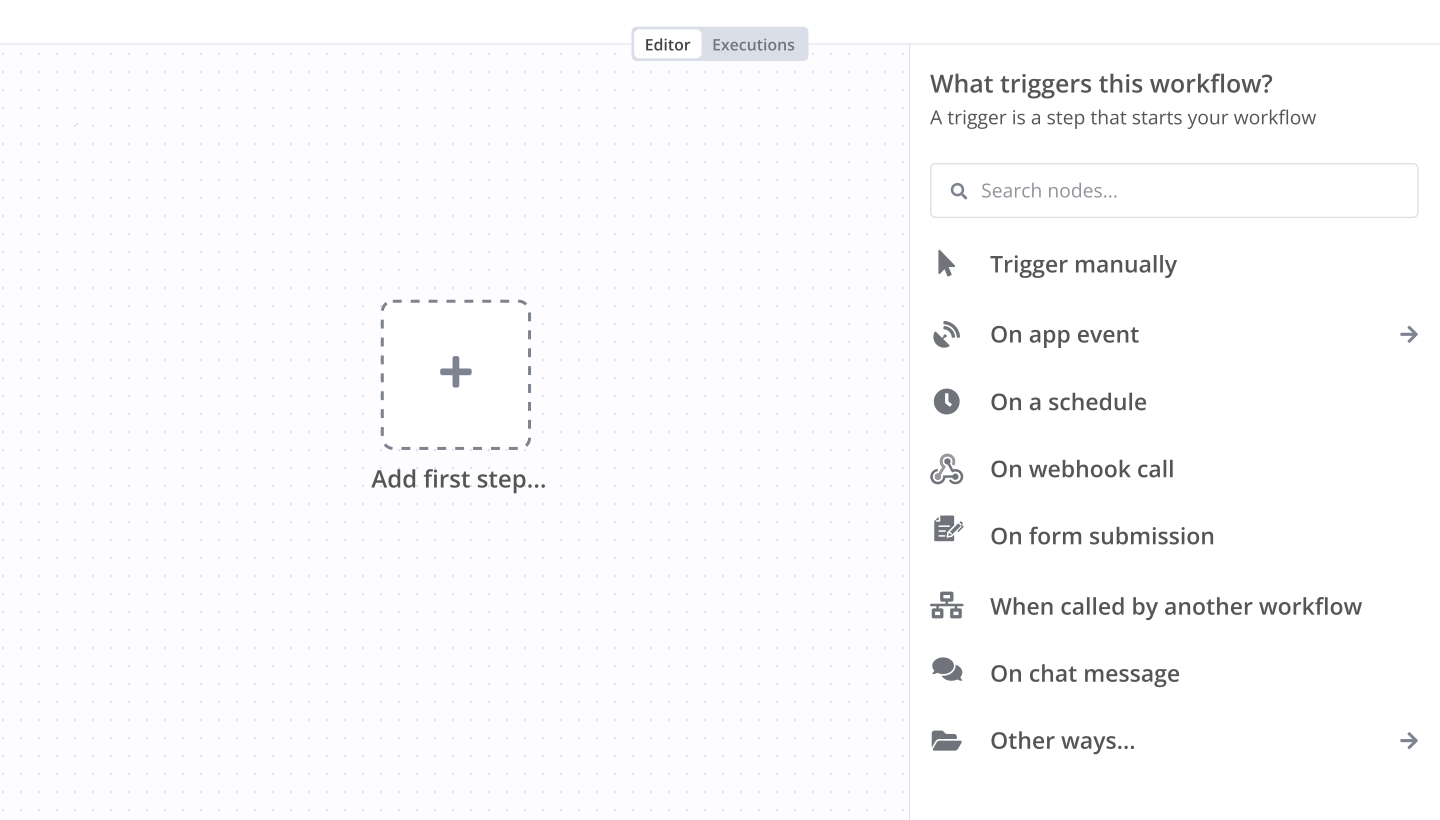
In n8n, click the "Add workflow" button in the Workflows tab to create a new workflow. Add the starting point – a trigger on when your workflow should run: an app event, a schedule, a webhook call, another workflow, an AI chat, or a manual trigger. Sometimes, the HTTP Request node might already serve as your starting point.

Notion and Postgres integration: Create a new workflow and add the first step

Step 2: Add and configure Notion and Postgres nodes

You can find Notion and Postgres in the nodes panel. Drag them onto your workflow canvas, selecting their actions. Click each node, choose a credential, and authenticate to grant n8n access. Configure Notion and Postgres nodes one by one: input data on the left, parameters in the middle, and output data on the right.

Notion and Postgres integration: Add and configure Notion and Postgres nodes

Step 3: Connect Notion and Postgres

A connection establishes a link between Notion and Postgres (or vice versa) to route data through the workflow. Data flows from the output of one node to the input of another. You can have single or multiple connections for each node.

Notion and Postgres integration: Connect Notion and Postgres

Step 4: Customize and extend your Notion and Postgres integration

Use n8n's core nodes such as If, Split Out, Merge, and others to transform and manipulate data. Write custom JavaScript or Python in the Code node and run it as a step in your workflow. Connect Notion and Postgres with any of n8n’s 1000+ integrations, and incorporate advanced AI logic into your workflows.

Notion and Postgres integration: Customize and extend your Notion and Postgres integration

Step 5: Test and activate your Notion and Postgres workflow

Save and run the workflow to see if everything works as expected. Based on your configuration, data should flow from Notion to Postgres or vice versa. Easily debug your workflow: you can check past executions to isolate and fix the mistake. Once you've tested everything, make sure to save your workflow and activate it.

Notion and Postgres integration: Test and activate your Notion and Postgres workflow

Monitor data quality with Notion rules, SQL checks & AI-powered alerts

Description

This workflow continuously validates data quality using rules stored in Notion, runs anomaly checks against your SQL database, generates AI-powered diagnostics, and alerts your team only when real issues occur.

Notion holds all data quality rules (source, field, condition, severity).
n8n reads them on schedule, converts them into live SQL queries, and aggregates anomalies into a global run summary.

The workflow then scores data health, creates a Notion run record, optionally opens a Jira issue, and sends a Slack/email alert including AI-generated root cause & recommended fixes.

Target users
Perfect for:
DataOps
Analytics
Product Data
BI
Compliance
ETL/ELT pipelines
Platform reliability teams.

Workflow steps

How it works

  1. Notion → Rules Database
    Each entry defines a check (table, field, condition, severity).

  2. n8n → Dynamic Query Execution
    Rules are converted into SQL and checked automatically.

  3. Summary Engine
    Aggregates anomalies, computes data quality score.

  4. AI Diagnostic Layer
    Root cause analysis + recommended fix plan.

  5. Incident Handling
    Notion Run Page + optional Slack/Email/Jira escalation.
    Silent exit when no anomaly = zero noise.

Setup Instructions

Create two Notion databases:
Data Quality Rules → source / field / rule / severity / owner

Data Quality Runs → run_id / timestamp / score / anomalies / trend / AI summary/recommendation

Connect SQL database (Postgres / Supabase / Redshift etc.)
Add OpenAI credentials for AI analysis
Connect Slack + Gmail + Jira for incident alerts
Set your execution schedule (daily/weekly)

Expected outcomes

Fully automated, rule-based data quality monitoring with minimal maintenance and zero manual checking.
When everything is healthy, runs remain silent.
When data breaks, the team is notified instantly: with context, root cause insight, and a structured remediation output.

Tutorial video
Watch the Youtube Tutorial video

About me :
I’m Yassin a Project & Product Manager Scaling tech products with data-driven project management.
📬 Feel free to connect with me on Linkedin

Nodes used in this workflow

Popular Notion and Postgres workflows

+2

Monitor Data Quality with Notion Rules, SQL Checks & AI-Powered Alerts

Description This workflow continuously validates data quality using rules stored in Notion, runs anomaly checks against your SQL database, generates AI-powered diagnostics, and alerts your team only when real issues occur. Notion holds all data quality rules (source, field, condition, severity). n8n reads them on schedule, converts them into live SQL queries, and aggregates anomalies into a global run summary. The workflow then scores data health, creates a Notion run record, optionally opens a Jira issue, and sends a Slack/email alert including AI-generated root cause & recommended fixes. Target users Perfect for: DataOps Analytics Product Data BI Compliance ETL/ELT pipelines Platform reliability teams. Workflow steps How it works 1) Notion → Rules Database Each entry defines a check (table, field, condition, severity). 2) n8n → Dynamic Query Execution Rules are converted into SQL and checked automatically. 3) Summary Engine Aggregates anomalies, computes data quality score. 4) AI Diagnostic Layer Root cause analysis + recommended fix plan. 5) Incident Handling Notion Run Page + optional Slack/Email/Jira escalation. Silent exit when no anomaly = zero noise. Setup Instructions Create two Notion databases: Data Quality Rules → source / field / rule / severity / owner Data Quality Runs → run_id / timestamp / score / anomalies / trend / AI summary/recommendation Connect SQL database (Postgres / Supabase / Redshift etc.) Add OpenAI credentials for AI analysis Connect Slack + Gmail + Jira for incident alerts Set your execution schedule (daily/weekly) Expected outcomes Fully automated, rule-based data quality monitoring with minimal maintenance and zero manual checking. When everything is healthy, runs remain silent. When data breaks, the team is notified instantly: with context, root cause insight, and a structured remediation output. Tutorial video Watch the Youtube Tutorial video About me : I’m Yassin a Project & Product Manager Scaling tech products with data-driven project management. 📬 Feel free to connect with me on Linkedin

Automated Product Health Monitor with Anomaly Detection & AI Root Cause Analysis

Description This workflow transforms raw SaaS metrics into a fully automated Product Health Monitoring & Incident Management system. It checks key revenue and usage metrics every day (such as churn MRR and feature adoption), detects anomalies using a statistical baseline, and automatically creates structured incidents when something unusual happens. When an anomaly is found, the workflow logs it into a central incident database, alerts the product team on Slack and by email, enriches the incident with context and AI-generated root-cause analysis, and produces a daily health report for leadership. It helps teams move from passive dashboard monitoring to a proactive, automated system that surfaces real issues with clear explanations and recommended next steps. Context Most SaaS teams struggle with consistent product health monitoring: Metrics live in dashboards that people rarely check proactively Spikes in churn or drops in usage are noticed days later There is no unified system to track, investigate, and report on incidents Post-mortems rely on memory rather than structured data Leadership often receives anecdotal updates instead of reliable daily reporting This workflow solves that by: Tracking core health metrics daily (revenue and usage) Detecting anomalies based on recent baselines, not arbitrary thresholds Logging all incidents in a consistent format Notifying teams only when action is needed Generating automated root-cause insights using AI + underlying database context Producing a daily “Product Health Report” for decision-makers The result: Faster detection, clearer understanding, and better communication across product, growth, and leadership teams. Target Users This template is ideal for: Product Managers & Product Owners SaaS founders and early-stage teams Growth, Analytics, and Revenue Ops teams PMO / Operations teams managing product performance Any organization wanting a lightweight incident monitoring system without building internal tooling Technical Requirements You will need: A Postgres / Supabase database containing your product metrics Slack credentials for alerts Gmail credentials for email notifications (Optional) Notion credentials for incident documentation and daily reports An OpenAI / Anthropic API key for AI-based root cause analysis Workflow Steps The workflow is structured into four main sections: 1) Daily Revenue Health Runs once per day, retrieves recent revenue metrics, identifies unusual spikes in churn MRR, and creates incidents when needed. If an anomaly is detected, a Slack alert and email notification are sent immediately. 2) Daily Usage Health Monitors feature usage metrics to detect sudden drops in adoption or engagement. Incidents are logged with severity, context, and alerts to the product team. 3) Root Cause & Summary For every open incident, the workflow: Collects additional context from the database (e.g., churn by country or plan) Uses AI to generate a clear root cause hypothesis and suggested next steps Sends a summarized report to Slack and email Updates the incident status accordingly 4) Daily Product Health Report Every morning, the workflow compiles all incidents from the previous day into: A daily summary email for leadership A Notion page for documentation and historical tracking This ensures stakeholders have clear visibility into product performance trends. Key Features Automated anomaly detection across revenue and usage metrics Centralized incident logging with metadata and raw context Severity scoring based on deviation from historical baselines Slack and email alerts for fast response AI-generated root cause analysis with recommended actions Daily product health reporting for leadership and PM teams Optional Notion integration for incident documentation System logging for observability and auditability Fully modular: you can add more metrics, alert channels, or analysis steps easily Expected Output When running, the workflow will generate: Structured incident records in your database Slack alerts for revenue or usage anomalies Email notifications with severity, baseline vs actual, and context AI-generated root cause summaries A daily health report summarizing all incidents (Optional) Notion pages for both incidents and daily reports System logs recording successful executions Tutorial video: Watch the Youtube Tutorial video About me I’m Yassin a Project & Product Manager Scaling tech products with data-driven project management. 📬 Feel free to connect with me on Linkedin
Email to Notion Knowledge Base with IMAP, Postgres Dedup and Telegram Alert

Filter incoming emails via IMAP, extract & clean the body into plain text, normalize (title/slug/snippet/date/from/url), check for duplicates in Postgres, store as a row in a Notion database, then send a Telegram notification. Perfect for building a knowledge base or inbox triage automation without duplicate noise. Key Features IMAP polling (Only UNSEEN). Extract & clean HTML → plain text. Normalization: title, snippet, bodyText, slug, messageId, sentAt, fromAddress, sourceUrl. Deduplication via Postgres (SELECT EXISTS). Create page in Notion database (property mapping). Telegram success notification. Tags: email, imap, notion, postgres, deduplication, telegram, automation, knowledge-base Prerequisites IMAP access (Gmail/Outlook/Custom). Gmail: enable IMAP + App Password if using 2FA. Notion Integration Token & Database ID (database must be shared with the integration). PostgreSQL accessible from n8n. (Optional) Telegram Bot Token & Chat ID.

Build your own Notion and Postgres integration

Create custom Notion and Postgres workflows by choosing triggers and actions. Nodes come with global operations and settings, as well as app-specific parameters that can be configured. You can also use the HTTP Request node to query data from any app or service with a REST API.

Notion supported actions

Append After
Append a block
Get Child Blocks
Get many child blocks
Get
Get a database
Get Many
Get many databases
Search
Search databases using text search
Get
Get a database
Get Many
Get many databases
Create
Create a page in a database
Get
Get a page in a database
Get Many
Get many pages in a database
Update
Update pages in a database
Create
Create a pages in a database
Get Many
Get many pages in a database
Update
Update pages in a database
Create
Create a page
Get
Get a page
Search
Text search of pages
Archive
Archive a page
Create
Create a page
Search
Text search of pages
Get
Get a user
Get Many
Get many users

Postgres supported actions

Delete
Delete an entire table or rows in a table
Execute Query
Execute an SQL query
Insert
Insert rows in a table
Insert or Update
Insert or update rows in a table
Select
Select rows from a table
Update
Update rows in a table

FAQs

  • Can Notion connect with Postgres?

  • Can I use Notion’s API with n8n?

  • Can I use Postgres’s API with n8n?

  • Is n8n secure for integrating Notion and Postgres?

  • How to get started with Notion and Postgres integration in n8n.io?

Need help setting up your Notion and Postgres integration?

Discover our latest community's recommendations and join the discussions about Notion and Postgres integration.
Justin Cheu
Mikhail Savenkov
Cris A. Works
Honza Pav
Martin

Looking to integrate Notion and Postgres in your company?

Over 3000 companies switch to n8n every single week

Why use n8n to integrate Notion with Postgres

Build complex workflows, really fast

Build complex workflows, really fast

Handle branching, merging and iteration easily.
Pause your workflow to wait for external events.

Code when you need it, UI when you don't

Simple debugging

Your data is displayed alongside your settings, making edge cases easy to track down.

Use templates to get started fast

Use 1000+ workflow templates available from our core team and our community.

Reuse your work

Copy and paste, easily import and export workflows.

Implement complex processes faster with n8n

red iconyellow iconred iconyellow icon