Back to Integrations
integrationNotion node
integrationShopify node

Notion and Shopify integration

Save yourself the work of writing custom integrations for Notion and Shopify and use n8n instead. Build adaptable and scalable Productivity, and Sales workflows that work with your technology stack. All within a building experience you will love.

How to connect Notion and Shopify

  • Step 1: Create a new workflow
  • Step 2: Add and configure nodes
  • Step 3: Connect
  • Step 4: Customize and extend your integration
  • Step 5: Test and activate your workflow

Step 1: Create a new workflow and add the first step

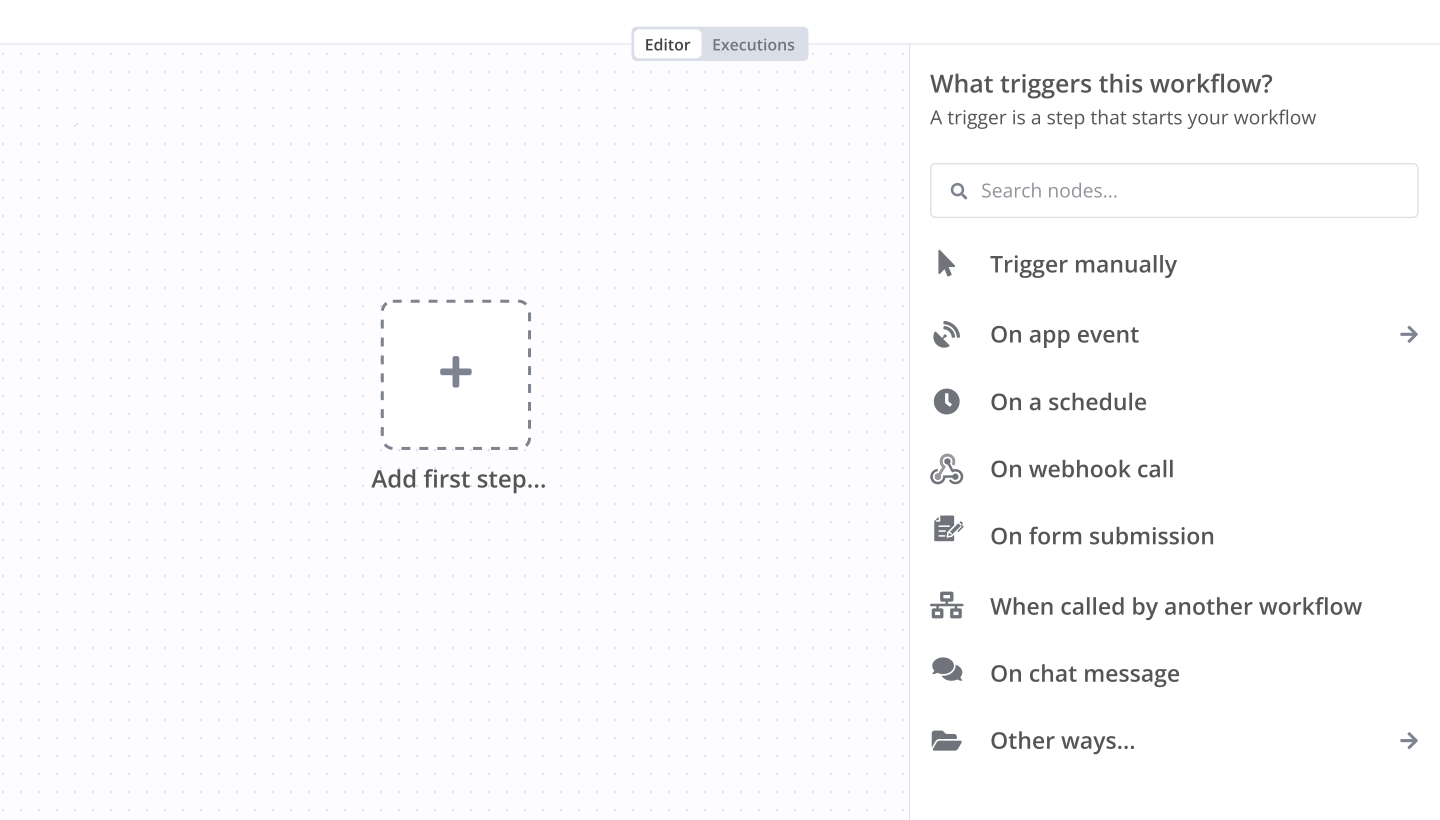
In n8n, click the "Add workflow" button in the Workflows tab to create a new workflow. Add the starting point – a trigger on when your workflow should run: an app event, a schedule, a webhook call, another workflow, an AI chat, or a manual trigger. Sometimes, the HTTP Request node might already serve as your starting point.

Notion and Shopify integration: Create a new workflow and add the first step

Step 2: Add and configure Notion and Shopify nodes

You can find Notion and Shopify in the nodes panel. Drag them onto your workflow canvas, selecting their actions. Click each node, choose a credential, and authenticate to grant n8n access. Configure Notion and Shopify nodes one by one: input data on the left, parameters in the middle, and output data on the right.

Notion and Shopify integration: Add and configure Notion and Shopify nodes

Step 3: Connect Notion and Shopify

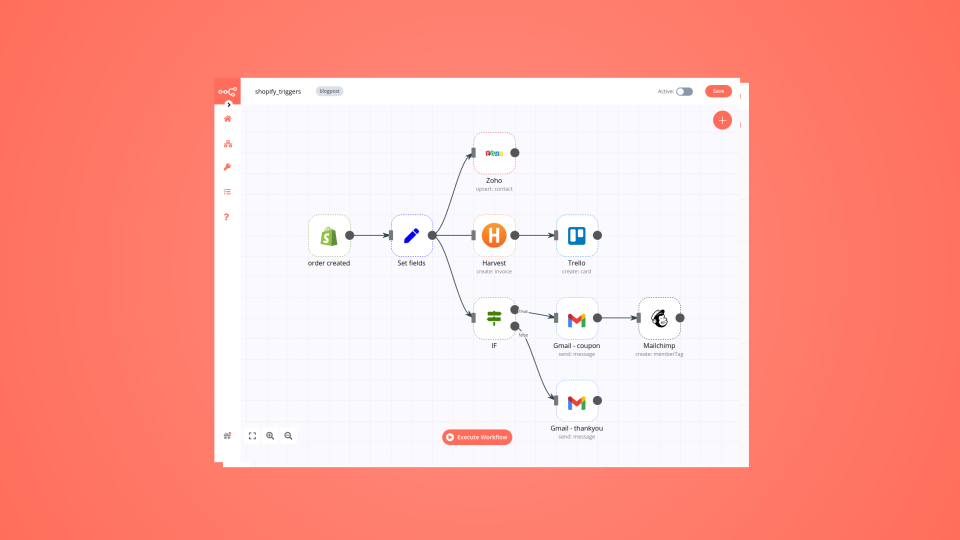
A connection establishes a link between Notion and Shopify (or vice versa) to route data through the workflow. Data flows from the output of one node to the input of another. You can have single or multiple connections for each node.

Notion and Shopify integration: Connect Notion and Shopify

Step 4: Customize and extend your Notion and Shopify integration

Use n8n's core nodes such as If, Split Out, Merge, and others to transform and manipulate data. Write custom JavaScript or Python in the Code node and run it as a step in your workflow. Connect Notion and Shopify with any of n8n’s 1000+ integrations, and incorporate advanced AI logic into your workflows.

Notion and Shopify integration: Customize and extend your Notion and Shopify integration

Step 5: Test and activate your Notion and Shopify workflow

Save and run the workflow to see if everything works as expected. Based on your configuration, data should flow from Notion to Shopify or vice versa. Easily debug your workflow: you can check past executions to isolate and fix the mistake. Once you've tested everything, make sure to save your workflow and activate it.

Notion and Shopify integration: Test and activate your Notion and Shopify workflow

Shopify multi-module automation with GPT-4o, Langchain agents & integrations

This n8n workflow orchestrates a powerful suite of AI Agents and automations to manage and optimize various aspects of an e-commerce operation, particularly for platforms like Shopify. It leverages Langchain AI Agents powered by OpenAI, along with a variety of integrated services, to handle customer support, product recommendations, abandoned cart recovery, inventory management, post-purchase engagement, review monitoring, marketing campaigns, and operational alerts.

Tools & Services Used
n8n:** Core automation and orchestration platform.
Langchain AI Agents:** For intelligent decision-making, task execution, and natural language processing across multiple modules.
OpenAI (e.g., GPT-4o Mini):** Powers the AI Agents and direct LLM calls for tasks like sentiment analysis and content generation.
Shopify (Conceptual - requires specific API/Webhook setup):** For triggers (abandoned cart, order delivered) and actions (fetching products/inventory, creating discounts).
Google Sheets:** Used as a data store for FAQs, logging low stock, review databases, and campaign outcomes.
Slack:** For internal team notifications (escalations, low stock, negative reviews).
Twilio (or similar SMS service):** For sending SMS alerts (cart recovery, restock notifications).
Email (Generic SMTP/API):** For sending various emails (AI responses, recovery emails, review requests, campaign emails).
Notion:** For logging customer interactions.
HTTP Request Nodes:** For generic API interactions (fetching customer info, product search, CRM, campaign tracking).
Webhook Nodes:** For receiving external triggers (incoming messages, product inquiries, review submissions, restock signals).
Cron Nodes:** For scheduled tasks (hourly inventory checks, daily campaigns).

Workflow Overview
This workflow is a collection of interconnected sub-workflows, each designed to automate a specific e-commerce process:

  1. Customer Support & Escalation
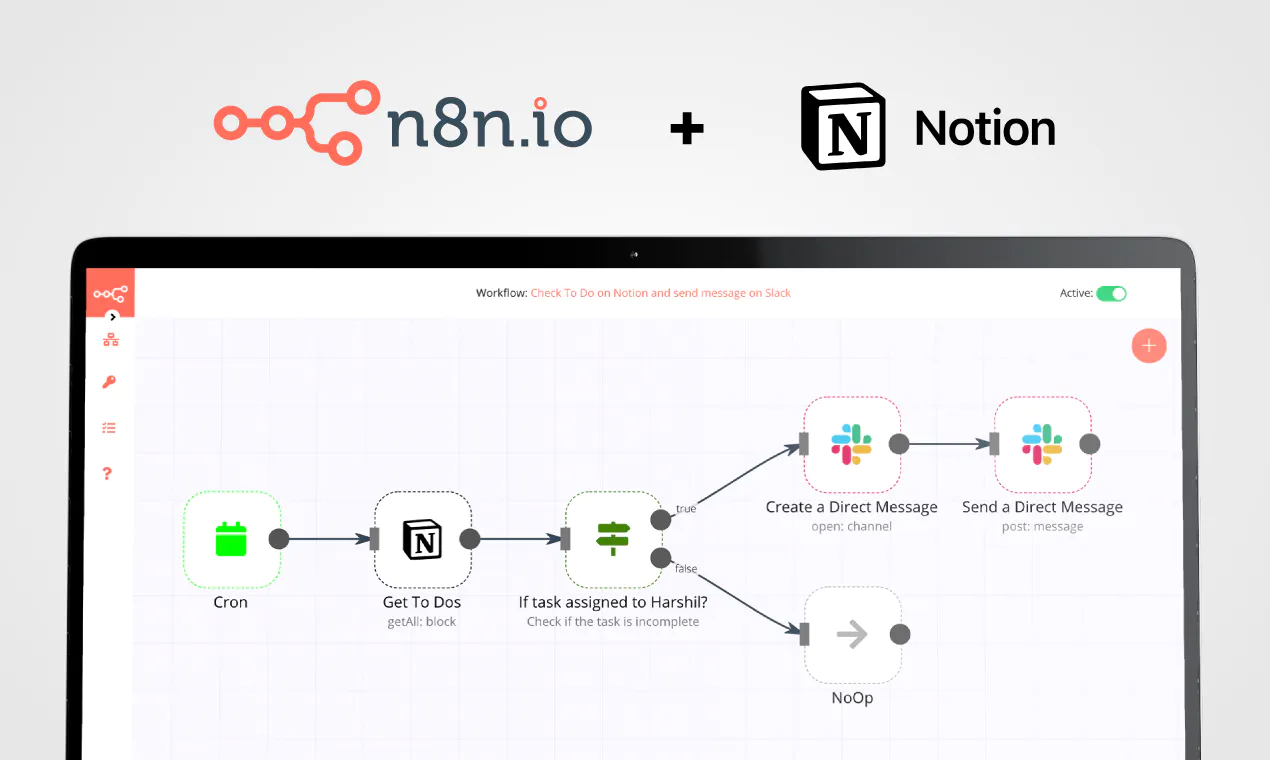
    Handles incoming customer messages, attempts to answer with FAQs or order status using an AI Agent, and escalates to a human agent via Slack if necessary. Logs interactions to Notion.

  2. Product Inquiry & Recommendation
    Processes product inquiries, searches a product catalog, filters/sorts results, uses an AI Agent for selection refinement, and can build a product carousel for user response.

  3. Abandoned Cart Recovery
    Detects abandoned carts, fetches customer data, uses an AI Agent to strategize recovery (e.g., offer discounts), and sends follow-up communications via email/SMS.

  4. Inventory Management (Low Stock Alert)
    Periodically checks inventory levels, identifies low-stock items, uses an AI Agent to format reports, and notifies relevant teams via Slack/email, logging to Google Sheets.

  5. Post-Purchase Review Request
    After a set period post-delivery, an AI Agent drafts and initiates sending a personalized product review request email to the customer.

  6. Review Monitoring & Flagging
    Listens for new product reviews, uses an AI model for sentiment analysis, alerts a support team for negative reviews via Slack, and logs all reviews.

  7. Scheduled Marketing Campaigns
    Fetches target audiences, segments them, uses AI Agents to generate tailored email content, sends campaigns, tracks basic metrics, and employs another AI Agent to suggest campaign adjustments.

  8. Manual Restock Alert & Logging
    Allows triggering a restock notification via webhook, sends an SMS alert, and uses an LLM to log the event.

Prerequisites
Ensure you have active accounts and necessary API keys/credentials for:

OpenAI
Shopify (or your e-commerce platform API)
Google Cloud (for Google Sheets API)
Slack (Bot Token)
Twilio (Account SID, Auth Token, From Number)
Your Email Sending Service (SMTP details or API key)
Notion (Integration Token)
Any other external APIs used (e.g., CRM, Product Search, Customer Info, Campaign Tracking)

How to Use This Template

Step 1: Import the Template
Open your n8n instance.
Go to “Workflows” > “Create Workflow”.
Click the three dots (…) > “Import from File”.
Upload the downloaded JSON file of this workflow.

Step 2: Configure Critical Nodes & Credentials
This is the most crucial step. Systematically go through each of the 8 sections outlined in the Sticky Notes within the workflow and configure the relevant nodes:

SECTION 1 (Customer Support):**
Get FAQs Data (Google Sheets): Set sheetId to YOUR_SHEET_ID_HERE and configure Google API credentials.
Lookup Order API (HTTP Request): Set url to YOUR_ORDER_LOOKUP_API_ENDPOINT_HERE.
Notify Human Agent (Slack): Configure Slack API credentials and channel.
Send AI Response to Customer (HTTP Request): Set url to YOUR_CUSTOMER_RESPONSE_API_ENDPOINT_HERE.
Store to Notion (Notion): Set pageId (Database ID) to YOUR_NOTION_DATABASE_URL_OR_ID_HERE and Notion API credentials.
SECTION 2 (Product Inquiry):**
Search Products API (HTTP Request): Set url to YOUR_PRODUCT_SEARCH_API_ENDPOINT_HERE.
Build Product Carousel (Function): Update YOUR_DEFAULT_PRODUCT_IMAGE_URL_HERE and YOUR_FALLBACK_PRODUCT_URL_HERE.
Respond to User with Carousel (HTTP Request): Set url for sending carousel data.
SECTION 3 (Abandoned Cart):**
Detect Abandoned Cart (Shopify Trigger): Configure Shopify credentials and ensure the correct trigger event.
Fetch Customer Info (HTTP Request): Set url to YOUR_CUSTOMER_INFO_API_ENDPOINT_HERE.
Create Discount (if applicable) (Shopify): Configure Shopify credentials and review discount creation parameters.
Send Recovery Email (HTTP Request/Email Send): Set email API endpoint or SMTP credentials.
Send SMS Reminder (Twilio): Configure Twilio credentials and from number (YOUR_TWILIO_PHONE_NUMBER_HERE).
SECTION 4 (Low Stock Alerts):**
Fetch Inventory (Shopify): Configure Shopify credentials.
Notify Slack (Low Stock) (Slack): Configure Slack API credentials and channel.
Generate Email Report (Low Stock) (Email Send): Configure SMTP/email credentials and to address.
Export to Sheets (Low Stock Log) (Google Sheets): Set sheetId to YOUR_INVENTORY_LOG_SHEET_ID_HERE and Google API credentials.
SECTION 5 (Review Request):**
Order Delivered Trigger (Shopify Trigger): Configure Shopify credentials.
Fetch Customer Data (for Review) (HTTP Request): Set url to YOUR_CUSTOMER_INFO_API_ENDPOINT_HERE.
DraftReviewRequestEmail (Tool): Update YOUR_PRODUCT_PAGE_URL_BASE_HERE and YOUR_WEBSITE_URL_HERE.
Send Review Request Email (Email Send): Configure SMTP/email credentials.
SECTION 6 (Review Monitoring):**
OpenAI node (currently Assistant Create): IMPORTANT: For sentiment analysis, change this node type to @n8n/n8n-nodes-langchain.lmChatOpenAi. Then configure its prompt for sentiment analysis (e.g., System: "Analyze sentiment. Respond with positive, negative, or neutral." User: "Review: {{ $('Listen for Review Webhook').first().json.body.review_text }}"). Set OpenAI credentials.
Notify Support Team (Negative Review) (Slack): Configure Slack API credentials and channel.
Add Review to Database (Google Sheets): Set sheetId to YOUR_REVIEWS_DATABASE_SHEET_ID_HERE and Google API credentials.
SECTION 7 (Marketing Campaigns):**
Fetch Target Audience API (HTTP Request): Set url to YOUR_CRM_API_FOR_AUDIENCE_HERE.
GenerateCampaignEmailVariant (Tool): Update YOUR_CAMPAIGN_LANDING_PAGE_HERE.
Send Campaign Email (Email Send): Configure SMTP/email credentials.
Track Campaign Metrics API (HTTP Request): Set url for YOUR_CAMPAIGN_TRACKING_API_ENDPOINT_HERE.
Log Campaign Outcome & Adjustments (Google Sheets): Set sheetId to YOUR_CAMPAIGN_LOG_SHEET_ID_HERE and Google API credentials.
SECTION 8 (Manual Restock):**
Send SMS Alert (Restock) (Twilio): Configure Twilio credentials, from number (YOUR_TWILIO_PHONE_NUMBER_HERE), and to (WAREHOUSE_MANAGER_PHONE_NUMBER_HERE).
OpenAI Chat Model (for Basic LLM Chain): Configure OpenAI credentials.
Send restock Request Email1 (Email Send): Configure SMTP/email credentials and to address.

Step 3: Implement Tool Logic
Go into each @n8n/n8n-nodes-langchain.toolCode node (e.g., SearchFAQs, RefineProductSelection, DetermineDiscount, etc.).
The current JavaScript is placeholder. You MUST replace this with actual JavaScript logic that performs the intended action for each tool, often by making API calls or processing data based on the agent's input.

Step 4: Review AI Agent Prompts & Tool Connections
Carefully review the systemMessage for each AI Agent node to ensure it accurately reflects its role and how it should use its tools.
CRITICAL:** Verify the index for tools connected to each AI Agent. Each tool connected to a single agent must have a unique, sequential index (0, 1, 2, ...).
AI Agent (ID cd71629d-... in your JSON): SearchFAQs tool should be index: 0, LookupOrderStatus tool should be index: 1. (Please double-check and correct the connection indices in your actual workflow file if they are still both pointing to index 0).
AI Agent6 (ID 4c24879b-... in your JSON): AnalyzeCampaignPerformance tool should be index: 0, SuggestCampaignAdjustments tool should be index: 1. (Please double-check and correct the connection indices in your actual workflow file if they are still both pointing to index 0).

Initial Test Run
Disable most of the workflow sections initially.
Focus on one section at a time (e.g., Section 1: Customer Support).
Manually trigger the first node (e.g., simulate an incoming webhook).
Execute node by node, checking the output and debugging configurations and tool logic.
For time-based triggers (Cron, Wait nodes), temporarily shorten the durations for faster testing.
Once a section is working, move to the next.

Use Cases
E-commerce Businesses (Shopify, etc.):** To automate customer service, marketing, sales recovery, and operations.
Digital Marketing Agencies:** To offer advanced automation services to e-commerce clients.
Freelancers & Consultants:** To build and deploy sophisticated AI-driven e-commerce solutions.
n8n Developers:** As a comprehensive template and learning resource for building complex multi-agent systems.

Nodes used in this workflow

Popular Notion and Shopify workflows

+7

Shopify Multi-Module Automation with GPT-4o, Langchain Agents & Integrations

This n8n workflow orchestrates a powerful suite of AI Agents and automations to manage and optimize various aspects of an e-commerce operation, particularly for platforms like Shopify. It leverages Langchain AI Agents powered by OpenAI, along with a variety of integrated services, to handle customer support, product recommendations, abandoned cart recovery, inventory management, post-purchase engagement, review monitoring, marketing campaigns, and operational alerts. Tools & Services Used n8n:** Core automation and orchestration platform. Langchain AI Agents:** For intelligent decision-making, task execution, and natural language processing across multiple modules. OpenAI (e.g., GPT-4o Mini):** Powers the AI Agents and direct LLM calls for tasks like sentiment analysis and content generation. Shopify (Conceptual - requires specific API/Webhook setup):** For triggers (abandoned cart, order delivered) and actions (fetching products/inventory, creating discounts). Google Sheets:** Used as a data store for FAQs, logging low stock, review databases, and campaign outcomes. Slack:** For internal team notifications (escalations, low stock, negative reviews). Twilio (or similar SMS service):** For sending SMS alerts (cart recovery, restock notifications). Email (Generic SMTP/API):** For sending various emails (AI responses, recovery emails, review requests, campaign emails). Notion:** For logging customer interactions. HTTP Request Nodes:** For generic API interactions (fetching customer info, product search, CRM, campaign tracking). Webhook Nodes:** For receiving external triggers (incoming messages, product inquiries, review submissions, restock signals). Cron Nodes:** For scheduled tasks (hourly inventory checks, daily campaigns). Workflow Overview This workflow is a collection of interconnected sub-workflows, each designed to automate a specific e-commerce process: Customer Support & Escalation Handles incoming customer messages, attempts to answer with FAQs or order status using an AI Agent, and escalates to a human agent via Slack if necessary. Logs interactions to Notion. Product Inquiry & Recommendation Processes product inquiries, searches a product catalog, filters/sorts results, uses an AI Agent for selection refinement, and can build a product carousel for user response. Abandoned Cart Recovery Detects abandoned carts, fetches customer data, uses an AI Agent to strategize recovery (e.g., offer discounts), and sends follow-up communications via email/SMS. Inventory Management (Low Stock Alert) Periodically checks inventory levels, identifies low-stock items, uses an AI Agent to format reports, and notifies relevant teams via Slack/email, logging to Google Sheets. Post-Purchase Review Request After a set period post-delivery, an AI Agent drafts and initiates sending a personalized product review request email to the customer. Review Monitoring & Flagging Listens for new product reviews, uses an AI model for sentiment analysis, alerts a support team for negative reviews via Slack, and logs all reviews. Scheduled Marketing Campaigns Fetches target audiences, segments them, uses AI Agents to generate tailored email content, sends campaigns, tracks basic metrics, and employs another AI Agent to suggest campaign adjustments. Manual Restock Alert & Logging Allows triggering a restock notification via webhook, sends an SMS alert, and uses an LLM to log the event. Prerequisites Ensure you have active accounts and necessary API keys/credentials for: OpenAI Shopify (or your e-commerce platform API) Google Cloud (for Google Sheets API) Slack (Bot Token) Twilio (Account SID, Auth Token, From Number) Your Email Sending Service (SMTP details or API key) Notion (Integration Token) Any other external APIs used (e.g., CRM, Product Search, Customer Info, Campaign Tracking) How to Use This Template Step 1: Import the Template Open your n8n instance. Go to “Workflows” > “Create Workflow”. Click the three dots (…) > “Import from File”. Upload the downloaded JSON file of this workflow. Step 2: Configure Critical Nodes & Credentials This is the most crucial step. Systematically go through each of the 8 sections outlined in the Sticky Notes within the workflow and configure the relevant nodes: SECTION 1 (Customer Support):** Get FAQs Data (Google Sheets): Set sheetId to YOUR_SHEET_ID_HERE and configure Google API credentials. Lookup Order API (HTTP Request): Set url to YOUR_ORDER_LOOKUP_API_ENDPOINT_HERE. Notify Human Agent (Slack): Configure Slack API credentials and channel. Send AI Response to Customer (HTTP Request): Set url to YOUR_CUSTOMER_RESPONSE_API_ENDPOINT_HERE. Store to Notion (Notion): Set pageId (Database ID) to YOUR_NOTION_DATABASE_URL_OR_ID_HERE and Notion API credentials. SECTION 2 (Product Inquiry):** Search Products API (HTTP Request): Set url to YOUR_PRODUCT_SEARCH_API_ENDPOINT_HERE. Build Product Carousel (Function): Update YOUR_DEFAULT_PRODUCT_IMAGE_URL_HERE and YOUR_FALLBACK_PRODUCT_URL_HERE. Respond to User with Carousel (HTTP Request): Set url for sending carousel data. SECTION 3 (Abandoned Cart):** Detect Abandoned Cart (Shopify Trigger): Configure Shopify credentials and ensure the correct trigger event. Fetch Customer Info (HTTP Request): Set url to YOUR_CUSTOMER_INFO_API_ENDPOINT_HERE. Create Discount (if applicable) (Shopify): Configure Shopify credentials and review discount creation parameters. Send Recovery Email (HTTP Request/Email Send): Set email API endpoint or SMTP credentials. Send SMS Reminder (Twilio): Configure Twilio credentials and from number (YOUR_TWILIO_PHONE_NUMBER_HERE). SECTION 4 (Low Stock Alerts):** Fetch Inventory (Shopify): Configure Shopify credentials. Notify Slack (Low Stock) (Slack): Configure Slack API credentials and channel. Generate Email Report (Low Stock) (Email Send): Configure SMTP/email credentials and to address. Export to Sheets (Low Stock Log) (Google Sheets): Set sheetId to YOUR_INVENTORY_LOG_SHEET_ID_HERE and Google API credentials. SECTION 5 (Review Request):** Order Delivered Trigger (Shopify Trigger): Configure Shopify credentials. Fetch Customer Data (for Review) (HTTP Request): Set url to YOUR_CUSTOMER_INFO_API_ENDPOINT_HERE. DraftReviewRequestEmail (Tool): Update YOUR_PRODUCT_PAGE_URL_BASE_HERE and YOUR_WEBSITE_URL_HERE. Send Review Request Email (Email Send): Configure SMTP/email credentials. SECTION 6 (Review Monitoring):** OpenAI node (currently Assistant Create): IMPORTANT: For sentiment analysis, change this node type to @n8n/n8n-nodes-langchain.lmChatOpenAi. Then configure its prompt for sentiment analysis (e.g., System: "Analyze sentiment. Respond with positive, negative, or neutral." User: "Review: {{ $('Listen for Review Webhook').first().json.body.review_text }}"). Set OpenAI credentials. Notify Support Team (Negative Review) (Slack): Configure Slack API credentials and channel. Add Review to Database (Google Sheets): Set sheetId to YOUR_REVIEWS_DATABASE_SHEET_ID_HERE and Google API credentials. SECTION 7 (Marketing Campaigns):** Fetch Target Audience API (HTTP Request): Set url to YOUR_CRM_API_FOR_AUDIENCE_HERE. GenerateCampaignEmailVariant (Tool): Update YOUR_CAMPAIGN_LANDING_PAGE_HERE. Send Campaign Email (Email Send): Configure SMTP/email credentials. Track Campaign Metrics API (HTTP Request): Set url for YOUR_CAMPAIGN_TRACKING_API_ENDPOINT_HERE. Log Campaign Outcome & Adjustments (Google Sheets): Set sheetId to YOUR_CAMPAIGN_LOG_SHEET_ID_HERE and Google API credentials. SECTION 8 (Manual Restock):** Send SMS Alert (Restock) (Twilio): Configure Twilio credentials, from number (YOUR_TWILIO_PHONE_NUMBER_HERE), and to (WAREHOUSE_MANAGER_PHONE_NUMBER_HERE). OpenAI Chat Model (for Basic LLM Chain): Configure OpenAI credentials. Send restock Request Email1 (Email Send): Configure SMTP/email credentials and to address. Step 3: Implement Tool Logic Go into each @n8n/n8n-nodes-langchain.toolCode node (e.g., SearchFAQs, RefineProductSelection, DetermineDiscount, etc.). The current JavaScript is placeholder. You MUST replace this with actual JavaScript logic that performs the intended action for each tool, often by making API calls or processing data based on the agent's input. Step 4: Review AI Agent Prompts & Tool Connections Carefully review the systemMessage for each AI Agent node to ensure it accurately reflects its role and how it should use its tools. CRITICAL:** Verify the index for tools connected to each AI Agent. Each tool connected to a single agent must have a unique, sequential index (0, 1, 2, ...). AI Agent (ID cd71629d-... in your JSON): SearchFAQs tool should be index: 0, LookupOrderStatus tool should be index: 1. (Please double-check and correct the connection indices in your actual workflow file if they are still both pointing to index 0). AI Agent6 (ID 4c24879b-... in your JSON): AnalyzeCampaignPerformance tool should be index: 0, SuggestCampaignAdjustments tool should be index: 1. (Please double-check and correct the connection indices in your actual workflow file if they are still both pointing to index 0). Initial Test Run Disable most of the workflow sections initially. Focus on one section at a time (e.g., Section 1: Customer Support). Manually trigger the first node (e.g., simulate an incoming webhook). Execute node by node, checking the output and debugging configurations and tool logic. For time-based triggers (Cron, Wait nodes), temporarily shorten the durations for faster testing. Once a section is working, move to the next. Use Cases E-commerce Businesses (Shopify, etc.):** To automate customer service, marketing, sales recovery, and operations. Digital Marketing Agencies:** To offer advanced automation services to e-commerce clients. Freelancers & Consultants:** To build and deploy sophisticated AI-driven e-commerce solutions. n8n Developers:** As a comprehensive template and learning resource for building complex multi-agent systems.

Build your own Notion and Shopify integration

Create custom Notion and Shopify workflows by choosing triggers and actions. Nodes come with global operations and settings, as well as app-specific parameters that can be configured. You can also use the HTTP Request node to query data from any app or service with a REST API.

Notion supported actions

Append After
Append a block
Get Child Blocks
Get many child blocks
Get
Get a database
Get Many
Get many databases
Search
Search databases using text search
Get
Get a database
Get Many
Get many databases
Create
Create a page in a database
Get
Get a page in a database
Get Many
Get many pages in a database
Update
Update pages in a database
Create
Create a pages in a database
Get Many
Get many pages in a database
Update
Update pages in a database
Create
Create a page
Get
Get a page
Search
Text search of pages
Archive
Archive a page
Create
Create a page
Search
Text search of pages
Get
Get a user
Get Many
Get many users

Shopify supported actions

Create
Create an order
Delete
Delete an order
Get
Get an order
Get Many
Get many orders
Update
Update an order
Create
Create a product
Delete
Delete a product
Get
Get a product
Get Many
Get many products
Update
Update a product

FAQs

  • Can Notion connect with Shopify?

  • Can I use Notion’s API with n8n?

  • Can I use Shopify’s API with n8n?

  • Is n8n secure for integrating Notion and Shopify?

  • How to get started with Notion and Shopify integration in n8n.io?

Need help setting up your Notion and Shopify integration?

Discover our latest community's recommendations and join the discussions about Notion and Shopify integration.
Justin Cheu
Cris A. Works
Martin
Liam Skaff
AyS 0908

Looking to integrate Notion and Shopify in your company?

Over 3000 companies switch to n8n every single week

Why use n8n to integrate Notion with Shopify

Build complex workflows, really fast

Build complex workflows, really fast

Handle branching, merging and iteration easily.
Pause your workflow to wait for external events.

Code when you need it, UI when you don't

Simple debugging

Your data is displayed alongside your settings, making edge cases easy to track down.

Use templates to get started fast

Use 1000+ workflow templates available from our core team and our community.

Reuse your work

Copy and paste, easily import and export workflows.

Implement complex processes faster with n8n

red iconyellow iconred iconyellow icon