Back to Integrations
integrationNotion node
integrationWordpress node

Notion and Wordpress integration

Save yourself the work of writing custom integrations for Notion and Wordpress and use n8n instead. Build adaptable and scalable Productivity, and Marketing workflows that work with your technology stack. All within a building experience you will love.

How to connect Notion and Wordpress

  • Step 1: Create a new workflow
  • Step 2: Add and configure nodes
  • Step 3: Connect
  • Step 4: Customize and extend your integration
  • Step 5: Test and activate your workflow

Step 1: Create a new workflow and add the first step

In n8n, click the "Add workflow" button in the Workflows tab to create a new workflow. Add the starting point – a trigger on when your workflow should run: an app event, a schedule, a webhook call, another workflow, an AI chat, or a manual trigger. Sometimes, the HTTP Request node might already serve as your starting point.
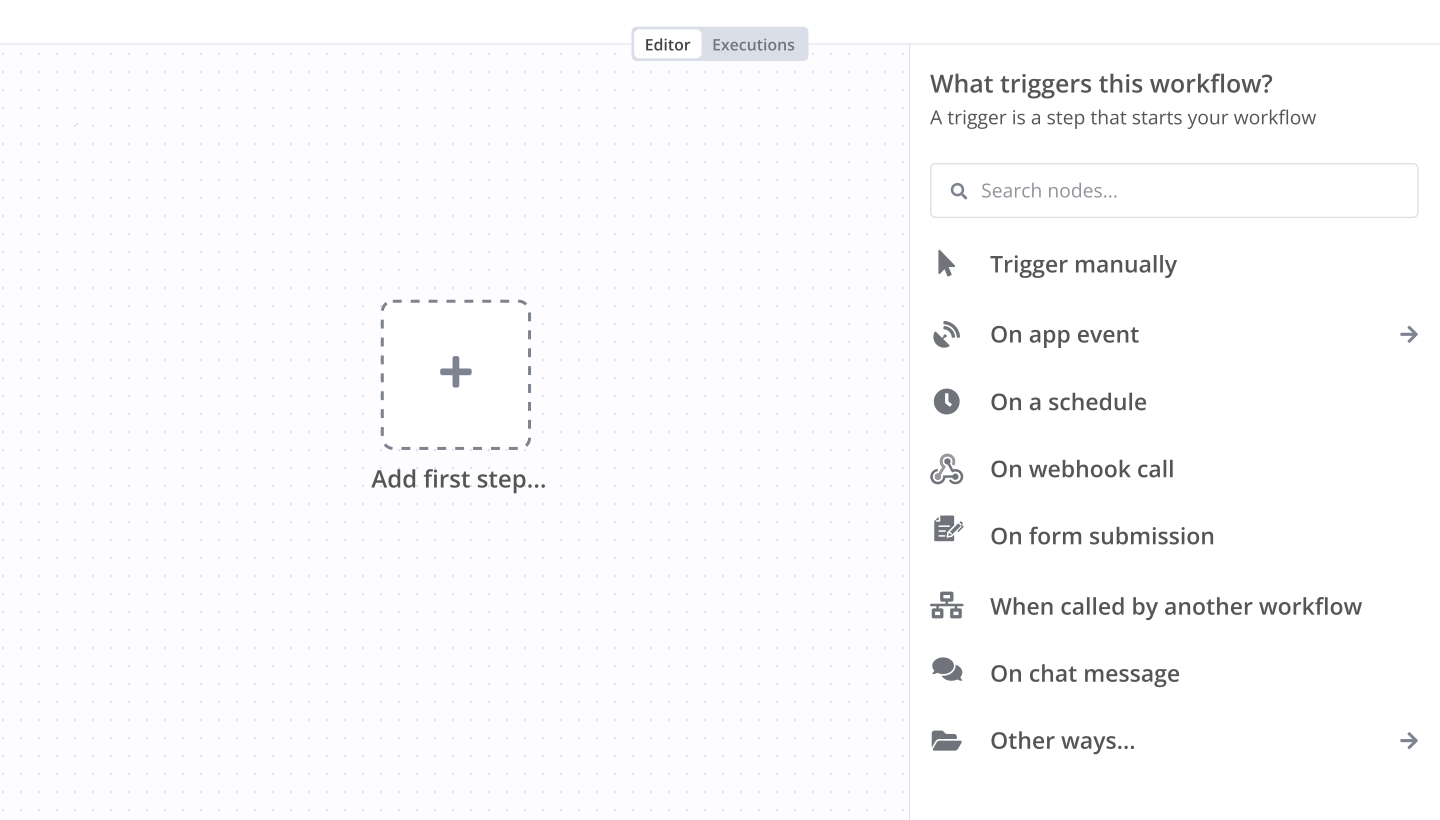
Notion and Wordpress integration: Create a new workflow and add the first step

Step 2: Add and configure Notion and Wordpress nodes

You can find Notion and Wordpress in the nodes panel. Drag them onto your workflow canvas, selecting their actions. Click each node, choose a credential, and authenticate to grant n8n access. Configure Notion and Wordpress nodes one by one: input data on the left, parameters in the middle, and output data on the right.

Notion and Wordpress integration: Add and configure Notion and Wordpress nodes

Step 3: Connect Notion and Wordpress

A connection establishes a link between Notion and Wordpress (or vice versa) to route data through the workflow. Data flows from the output of one node to the input of another. You can have single or multiple connections for each node.

Notion and Wordpress integration: Connect Notion and Wordpress

Step 4: Customize and extend your Notion and Wordpress integration

Use n8n's core nodes such as If, Split Out, Merge, and others to transform and manipulate data. Write custom JavaScript or Python in the Code node and run it as a step in your workflow. Connect Notion and Wordpress with any of n8n’s 1000+ integrations, and incorporate advanced AI logic into your workflows.

Notion and Wordpress integration: Customize and extend your Notion and Wordpress integration

Step 5: Test and activate your Notion and Wordpress workflow

Save and run the workflow to see if everything works as expected. Based on your configuration, data should flow from Notion to Wordpress or vice versa. Easily debug your workflow: you can check past executions to isolate and fix the mistake. Once you've tested everything, make sure to save your workflow and activate it.

Notion and Wordpress integration: Test and activate your Notion and Wordpress workflow

Automate SEO blog content creation with GPT-4, Perplexity AI and WordPress

AI Blog Publisher – Automated Blog Content Workflow
This workflow is designed for individuals and teams who regularly publish content on their blog and want to automate the entire process from start to finish. Its main goal is to generate long-form, SEO-optimized blog posts and publish them directly to WordPress — without needing a copywriter, editor, or someone to handle CMS uploads. The workflow generates a topic, writes a full article based on your brand guidelines, pulls a featured image from Pexels, publishes the post to WordPress, and logs the publication details to Google Sheets, creating a complete archive of published content. This allows users to deliver high-quality, search-optimized content every day while saving significant time. The whole process — from idea to publication — runs fully automatically and can be scheduled to execute without any manual input. It works just as well for solo creators as for marketing teams or agencies producing content at scale.

How it works
When triggered, the workflow generates a new blog post idea and checks your Google Sheet to see if the topic has already been published. If the topic is unique, it calls a sub-workflow that contains your brand’s writing style, tone, and blog goals. It then uses Perplexity AI to gather supporting research and context. Based on all this input, a complete 2000–2500 word article is generated in clean HTML, ready for WordPress. The workflow then searches Pexels for a relevant image and sets it as the featured image. Finally, it publishes the post to WordPress, including the proper title, meta description, and category. All relevant data — such as title, link, and publish date — is logged in your Google Sheet.

How to set up
To get this workflow running, all you need to do is connect the required APIs — OpenAI, WordPress, Google Sheets, and Pexels — and make a few basic adjustments. Replace the placeholder URLs in the HTTP request nodes with your actual WordPress address. In the Google Sheets nodes, add your own spreadsheet ID and tab name. In the node that fetches brand data, insert the workflow ID of your brand brief sub-workflow. You can also personalize the AI prompts by entering your blog name, company name, and a call-to-action to give the content a more tailored voice. Once that’s done, you can trigger the workflow manually or schedule it using the Schedule Trigger node.

Nodes used in this workflow

Popular Notion and Wordpress workflows

+10

Automate SEO Blog Creation + Social Media with GPT-4, Perplexity and WordPress

🚀 AI Blog & Social Media Publisher – Fully Automated Workflow This workflow is ideal for individuals, marketers, agencies, and brands who want to effortlessly automate the entire blogging and social media process—from idea generation to promotion. Its primary goal is to consistently deliver engaging, SEO-optimized blog posts directly to WordPress, accompanied by professionally crafted social media content ready for Instagram, Facebook, and X (Twitter). No writers, editors, designers, or social media managers required. Save countless hours and resources while boosting your brand's online presence. 🔧 Workflow Capabilities: -Automated Blog Topic Generation: Instantly generates unique, high-value blog ideas tailored to your brand. -SEO Content Creation: Produces comprehensive, 2000–2500 word articles optimized for search engines. -Real-Time Research: Integrates Perplexity AI to ensure factually accurate, authoritative content. -Visual Content Generation: Creates custom, AI-generated featured images via GPT-4, with automatic fallback to Pexels. -WordPress Publishing: Automatically publishes articles directly to WordPress with complete formatting (HTML), meta descriptions, featured images, and proper categorization. -Social Media Automation: Generates and schedules engaging, platform-specific posts for Instagram, Facebook, and X, complete with relevant hashtags, calls-to-action, and links. -Detailed Logging & Reporting: Logs every step transparently into Google Sheets and optionally sends publication reports to Gmail. ⚙️ How It Works: When activated, the workflow checks your content calendar in Google Sheets to avoid duplicate topics. It generates fresh, brand-aligned blog ideas, conducts live research, and creates complete, ready-to-publish articles. It then automatically designs and sources appropriate visuals, publishes content seamlessly to WordPress, and prepares engaging social media posts optimized for each platform. 🛠️ Easy Setup Steps: -Connect your APIs: OpenAI, WordPress, Google Sheets, Gmail, and optionally Pexels. -Replace placeholders (WordPress URLs, Google Sheets ID/tab, workflow IDs). -Customize AI prompts with your brand’s tone, keywords, and CTAs for personalized content. -Configure scheduling to automate daily, weekly, or custom publishing intervals. 📌 Additional Features: -Modular workflow design for easy customization and scalability. -Comprehensive Markdown and PDF setup guides included. -Bonus: Reference placeholders and quick-edit Sticky Notes for effortless adjustments. Launch today. Automate permanently. Amplify your reach effortlessly.
+6

Automate SEO Blog Content Creation with GPT-4, Perplexity AI and WordPress

AI Blog Publisher – Automated Blog Content Workflow This workflow is designed for individuals and teams who regularly publish content on their blog and want to automate the entire process from start to finish. Its main goal is to generate long-form, SEO-optimized blog posts and publish them directly to WordPress — without needing a copywriter, editor, or someone to handle CMS uploads. The workflow generates a topic, writes a full article based on your brand guidelines, pulls a featured image from Pexels, publishes the post to WordPress, and logs the publication details to Google Sheets, creating a complete archive of published content. This allows users to deliver high-quality, search-optimized content every day while saving significant time. The whole process — from idea to publication — runs fully automatically and can be scheduled to execute without any manual input. It works just as well for solo creators as for marketing teams or agencies producing content at scale. How it works When triggered, the workflow generates a new blog post idea and checks your Google Sheet to see if the topic has already been published. If the topic is unique, it calls a sub-workflow that contains your brand’s writing style, tone, and blog goals. It then uses Perplexity AI to gather supporting research and context. Based on all this input, a complete 2000–2500 word article is generated in clean HTML, ready for WordPress. The workflow then searches Pexels for a relevant image and sets it as the featured image. Finally, it publishes the post to WordPress, including the proper title, meta description, and category. All relevant data — such as title, link, and publish date — is logged in your Google Sheet. How to set up To get this workflow running, all you need to do is connect the required APIs — OpenAI, WordPress, Google Sheets, and Pexels — and make a few basic adjustments. Replace the placeholder URLs in the HTTP request nodes with your actual WordPress address. In the Google Sheets nodes, add your own spreadsheet ID and tab name. In the node that fetches brand data, insert the workflow ID of your brand brief sub-workflow. You can also personalize the AI prompts by entering your blog name, company name, and a call-to-action to give the content a more tailored voice. Once that’s done, you can trigger the workflow manually or schedule it using the Schedule Trigger node.
+4

Repurpose YouTube videos into blogs and social posts with GPT-4o, WordPress, LinkedIn, X and Instagram

Overview This workflow turns a single YouTube video into multiple content formats and publishes them across different platforms with an optional human approval step. It helps content creators, marketers, and agencies repurpose long-form video content into blog posts and social media updates automatically. How it works Fetches the transcript from a YouTube video Uses AI to generate blog and social media content Optionally waits for manual approval Publishes content to selected platforms Logs the result for tracking Setup steps Add your API credentials (AI, transcript, and social platforms) Paste a YouTube video URL Choose auto-publish or approval mode Run the workflow Use cases Content repurposing for YouTube creators Automated blog and social media publishing Marketing automation for agencies AI-assisted content production pipelines 🧑‍💻 Creator Information Developed by: Adem Tasin 🌐 Website: ademtasin.com 💼 LinkedIn: Adem Tasin

Build your own Notion and Wordpress integration

Create custom Notion and Wordpress workflows by choosing triggers and actions. Nodes come with global operations and settings, as well as app-specific parameters that can be configured. You can also use the HTTP Request node to query data from any app or service with a REST API.

Notion supported actions

Append After
Append a block
Get Child Blocks
Get many child blocks
Get
Get a database
Get Many
Get many databases
Search
Search databases using text search
Get
Get a database
Get Many
Get many databases
Create
Create a page in a database
Get
Get a page in a database
Get Many
Get many pages in a database
Update
Update pages in a database
Create
Create a pages in a database
Get Many
Get many pages in a database
Update
Update pages in a database
Create
Create a page
Get
Get a page
Search
Text search of pages
Archive
Archive a page
Create
Create a page
Search
Text search of pages
Get
Get a user
Get Many
Get many users

Wordpress supported actions

Create
Create a post
Get
Get a post
Get Many
Get many posts
Update
Update a post
Create
Create a page
Get
Get a page
Get Many
Get many pages
Update
Update a page
Create
Create a user
Get
Get a user
Get Many
Get many users
Update
Update a user

FAQs

  • Can Notion connect with Wordpress?

  • Can I use Notion’s API with n8n?

  • Can I use Wordpress’s API with n8n?

  • Is n8n secure for integrating Notion and Wordpress?

  • How to get started with Notion and Wordpress integration in n8n.io?

Need help setting up your Notion and Wordpress integration?

Discover our latest community's recommendations and join the discussions about Notion and Wordpress integration.
Justin Cheu
Cris A. Works
Martin
Liam Skaff
AyS 0908

Looking to integrate Notion and Wordpress in your company?

Over 3000 companies switch to n8n every single week

Why use n8n to integrate Notion with Wordpress

Build complex workflows, really fast
Build complex workflows, really fast

Handle branching, merging and iteration easily.
Pause your workflow to wait for external events.

Code when you need it, UI when you don't

Simple debugging

Your data is displayed alongside your settings, making edge cases easy to track down.

Use templates to get started fast

Use 1000+ workflow templates available from our core team and our community.

Reuse your work

Copy and paste, easily import and export workflows.

Implement complex processes faster with n8n

red iconyellow iconred iconyellow icon