Back to Integrations
integrationOpenAI node
integrationSlack node

OpenAI and Slack integration

Save yourself the work of writing custom integrations for OpenAI and Slack and use n8n instead. Build adaptable and scalable AI, Langchain, Communication, and HITL workflows that work with your technology stack. All within a building experience you will love.

How to connect OpenAI and Slack

  • Step 1: Create a new workflow
  • Step 2: Add and configure nodes
  • Step 3: Connect
  • Step 4: Customize and extend your integration
  • Step 5: Test and activate your workflow

Step 1: Create a new workflow and add the first step

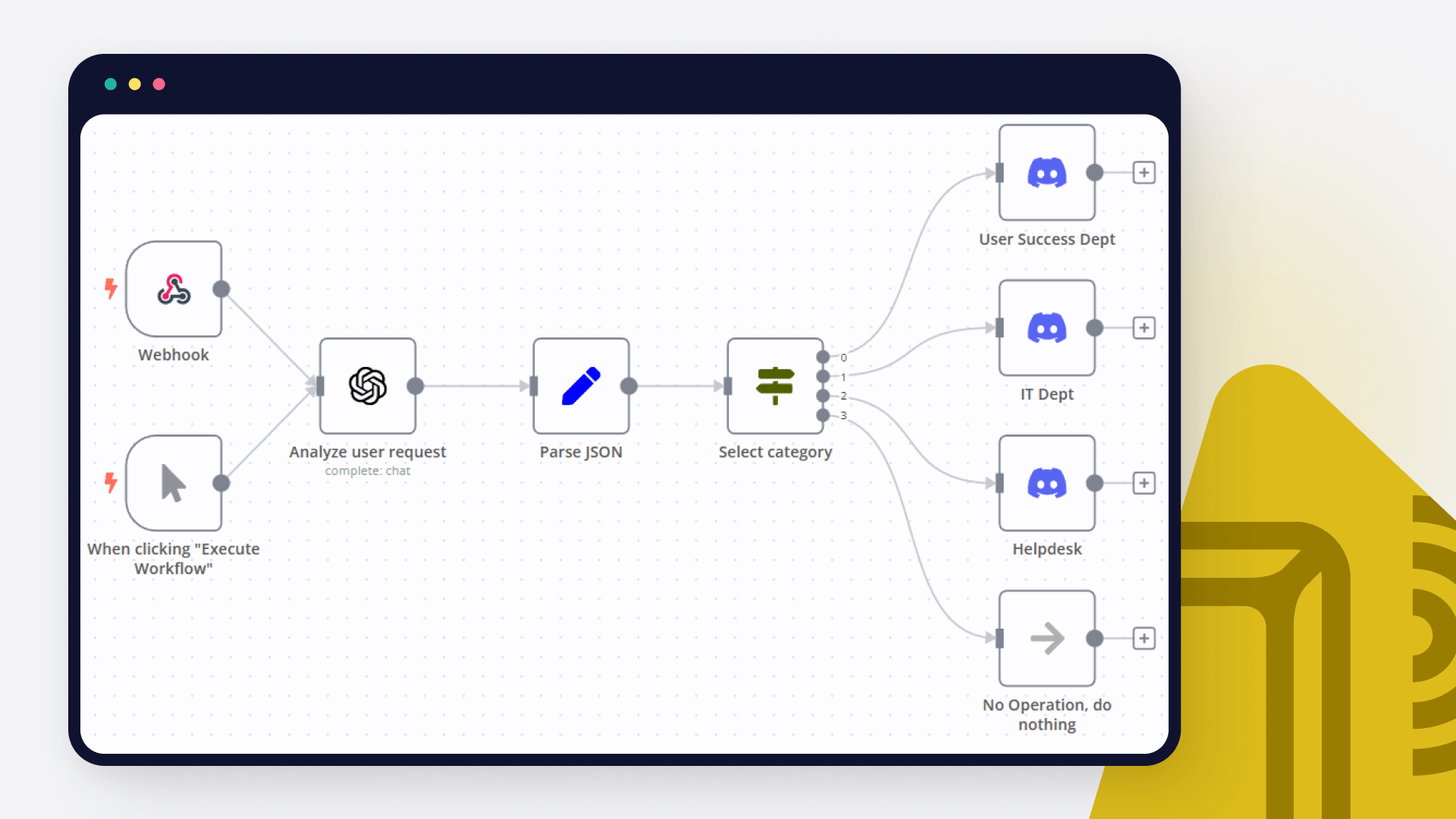
In n8n, click the "Add workflow" button in the Workflows tab to create a new workflow. Add the starting point – a trigger on when your workflow should run: an app event, a schedule, a webhook call, another workflow, an AI chat, or a manual trigger. Sometimes, the HTTP Request node might already serve as your starting point.
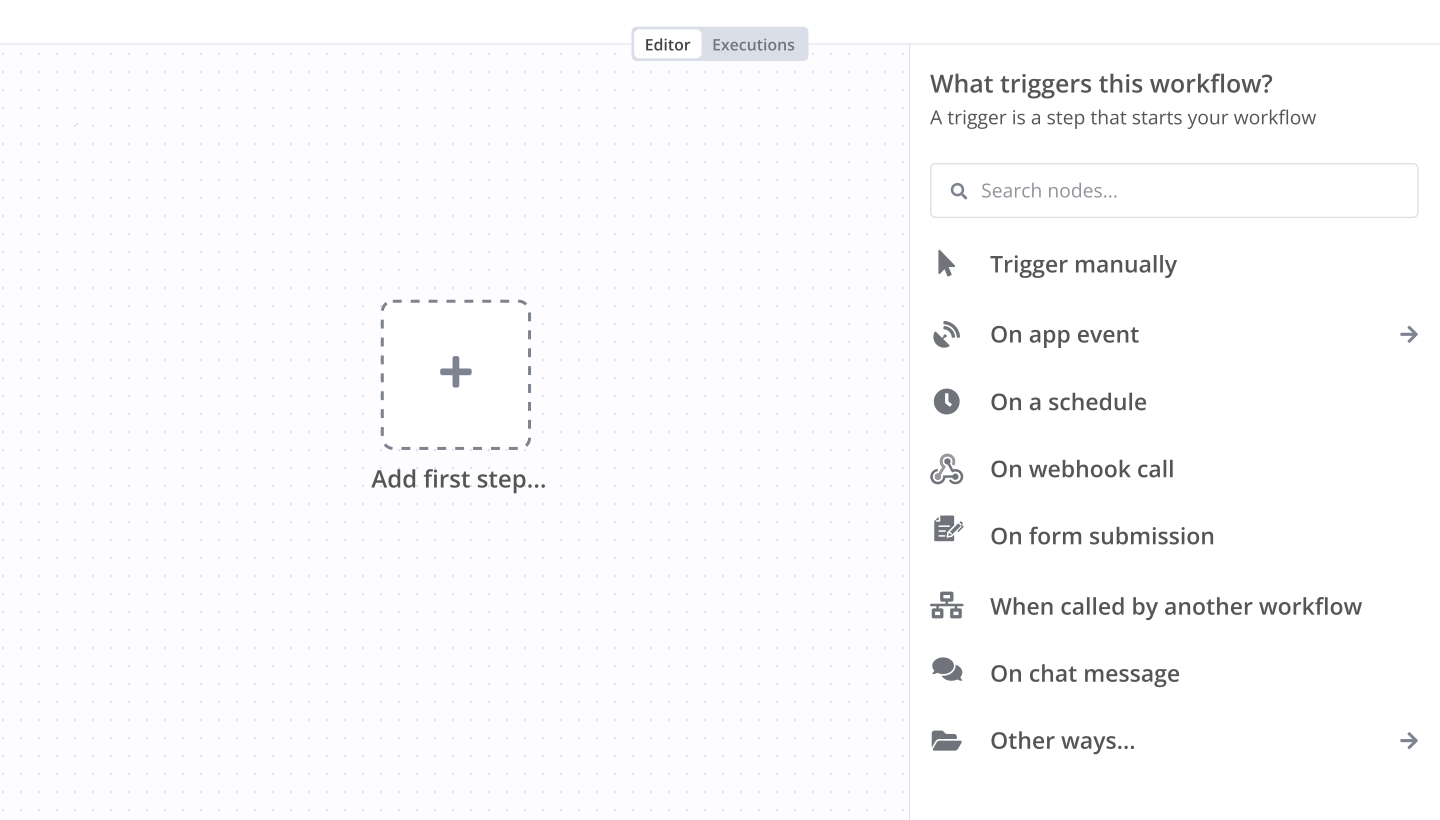
OpenAI and Slack integration: Create a new workflow and add the first step

Step 2: Add and configure OpenAI and Slack nodes

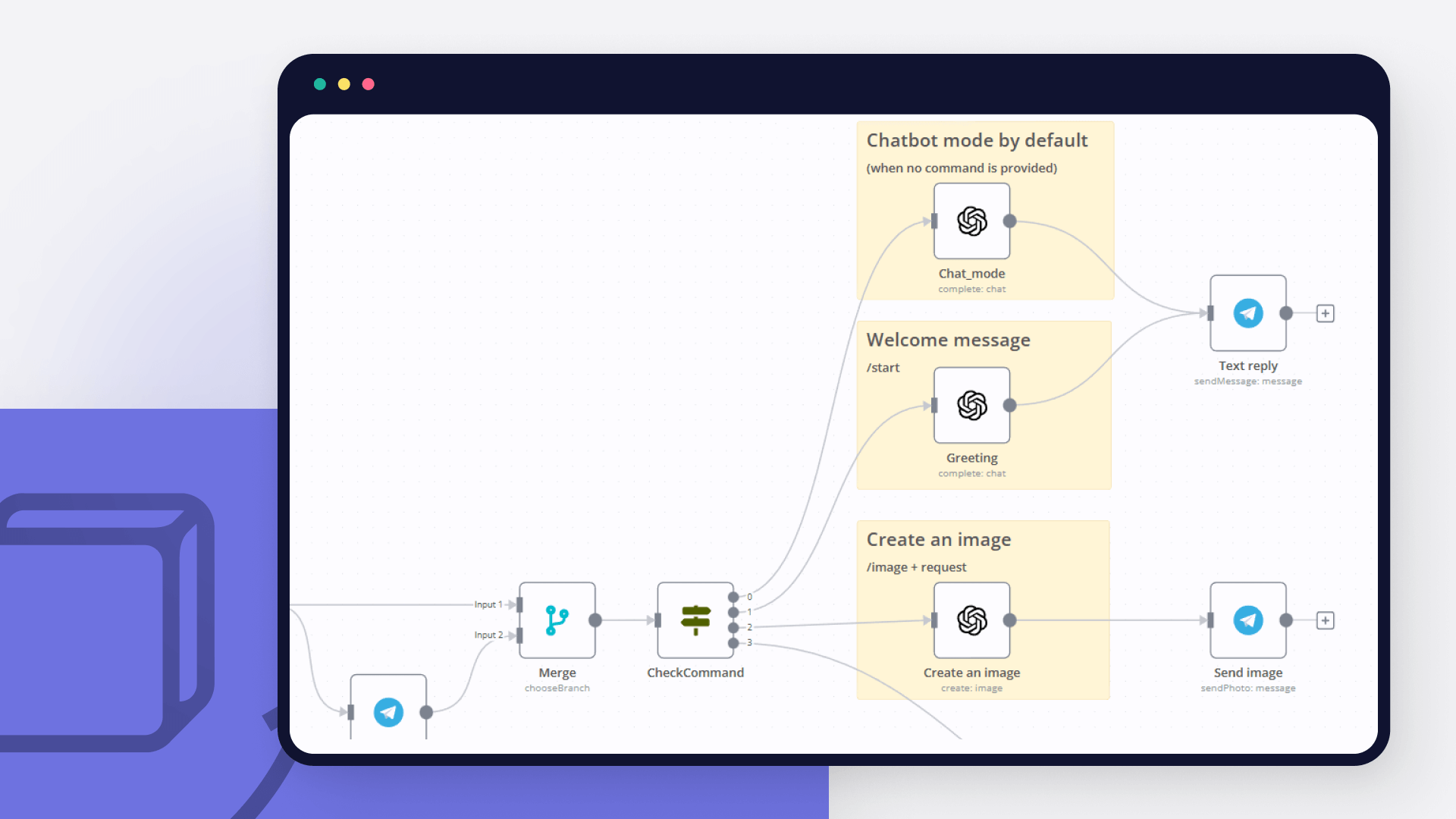
You can find OpenAI and Slack in the nodes panel. Drag them onto your workflow canvas, selecting their actions. Click each node, choose a credential, and authenticate to grant n8n access. Configure OpenAI and Slack nodes one by one: input data on the left, parameters in the middle, and output data on the right.

OpenAI and Slack integration: Add and configure OpenAI and Slack nodes

Step 3: Connect OpenAI and Slack

A connection establishes a link between OpenAI and Slack (or vice versa) to route data through the workflow. Data flows from the output of one node to the input of another. You can have single or multiple connections for each node.

OpenAI and Slack integration: Connect OpenAI and Slack

Step 4: Customize and extend your OpenAI and Slack integration

Use n8n's core nodes such as If, Split Out, Merge, and others to transform and manipulate data. Write custom JavaScript or Python in the Code node and run it as a step in your workflow. Connect OpenAI and Slack with any of n8n’s 1000+ integrations, and incorporate advanced AI logic into your workflows.

OpenAI and Slack integration: Customize and extend your OpenAI and Slack integration

Step 5: Test and activate your OpenAI and Slack workflow

Save and run the workflow to see if everything works as expected. Based on your configuration, data should flow from OpenAI to Slack or vice versa. Easily debug your workflow: you can check past executions to isolate and fix the mistake. Once you've tested everything, make sure to save your workflow and activate it.

OpenAI and Slack integration: Test and activate your OpenAI and Slack workflow

Automate Your RFP Process with OpenAI Assistants

This n8n workflow demonstrates how to automate oftern time-consuming form filling tasks in the early stages of the tendering process; the Request for Proposal document or "RFP".

It does this by utilising a company's knowledgebase to generating question-and-answer pairs using Large Language Models.

How it works
A buyer's RFP is submitted to the workflow as a digital document that can be parsed.
Our first AI agent scans and extracts all questions from the document into list form.
The supplier sets up an OpenAI assistant prior loaded with company brand, marketing and technical documents.
The workflow loops through each of the buyer's questions and poses these to the OpenAI assistant.
The assistant's answers are captured until all questions are satisified and are then exported into a new document for review.
A sales team member is then able to use this document to respond quickly to the RFP before their competitors.

Example Webhook Request

curl --location 'https://<n8n_webhook_url>'
--form 'id="RFP001"'
--form 'title="BlueChip Travel and StarBus Web Services"'
--form 'reply_to="[email protected]"'
--form 'data=@"k9pnbALxX/RFP Questionnaire.pdf"'

Requirements
An OpenAI account to use AI services.

Customising the workflow

OpenAI assistants is only one approach to hosting a company knowledgebase for AI to use. Exploring different solutions such as building your own RAG-powered database can sometimes yield better results in terms of control of how the data is managed and cost.

Nodes used in this workflow

Popular OpenAI and Slack workflows

AI-Powered Stock Market Summary Bot

An automated n8n workflow that analyzes stocks using RSI and MACD, summarizes insights with OpenAI, and sends a Slack-ready market update every hour. This workflow: Runs hourly from 6:30 AM to 2:30 PM PT, Mon–Fri Checks if the U.S. stock market is open using Alpaca’s /clock API Pulls daily stock bars for a list of tickers via Alpaca’s /v2/stocks/bars Calculates RSI and MACD using a Python code node Categorizes each stock as Buy / Hold / Sell Uses OpenAI Assistant to summarize the results in Slack markdown Sends the message to a specific Slack user or channel

Daily Business News Briefings with NewsAPI & GPT-4 Insights to Slack

This n8n workflow automatically fetches trending news articles based on your chosen country, category, and keyword — then enriches the data with AI-powered business insights before posting a concise summary to Slack. Ideal for sales teams, executives, marketers, or anyone who wants fast, actionable news briefings directly in their Slack workspace. ⸻ Who it’s for Executives, analysts, sales teams, or marketing professionals who want curated, AI-enhanced news summaries tailored to business opportunities, risks, and trends — delivered automatically to Slack. ⸻ How it works / What it does A Schedule Trigger runs on a daily, weekly, or custom frequency. It queries the NewsAPI to retrieve top headlines by country, category, or keyword. Headlines are formatted and enriched with your configured query context. The AI model (GPT-4) analyzes articles and summarizes key insights, categorizing them as Opportunities, Risks, or Trends. Finally, the summarized insights are posted directly into a Slack channel of your choice. ⸻ How to set up Set your schedule frequency in the Schedule Trigger node. Configure your preferred country, category, and keyword in the Inject Config node. Add your NewsAPI Key inside the Fetch News Articles node. Connect your Slack credentials in the Post to Slack node. Optional: Adjust the AI prompt for more tailored analysis. ⸻ Requirements A NewsAPI account to fetch headlines. An OpenAI API key for GPT-4 summarization. A Slack workspace and connected credentials via n8n. ⸻ How to customize the workflow Change the country, category, or keyword in the Inject Config to focus on specific markets or sectors. Adjust the AI prompt in the GPT node to prioritize certain insights like ESG factors, M&A activity, or market sentiment. Extend the workflow to log results to Google Sheets, email summaries, or send SMS alerts. Replace the Schedule Trigger with a Webhook if you want to trigger summaries on demand. This template is designed to be modular, making it easy to adapt for competitive intelligence, investment tracking, or industry news curation.

AI Email Assistant: Prioritize Gmail with ChatGPT Summaries and Slack Digests

This n8n workflow acts as an AI-powered Inbox Assistant that automatically summarizes and classifies Gmail emails, prioritizes important messages, and sends a daily digest to Slack. It’s ideal for startup founders and small teams juggling investor intros, customer leads, and support queries — all from a busy Gmail inbox. Each email is processed using ChatGPT to generate a concise summary, classify the message (e.g., Support, Investor, Spam), and determine its urgency. High and medium priority messages are forwarded to Slack instantly. Lower priority emails are logged to Google Sheets for review. A daily 7 PM digest summarizes the day’s most important messages. 💡 Use Cases Preventing missed investor or lead emails Lightweight CRM alternative using Google Sheets Slack summaries of critical Gmail activity 🔧 How It Works Gmail node fetches new messages ChatGPT summarizes and extracts urgency + type High/medium urgency → sent to Slack + labeled in Gmail Low urgency → logged in Google Sheets Cron node triggers a daily 7 PM Slack summary ✅ Requirements OpenAI API Key (GPT-4 or GPT-4o recommended) Gmail access with read and label permission Slack Bot Token or Webhook URL Google Sheets integration (optional) 🛠 Customization Ideas Replace Slack with Telegram or WhatsApp Route investor leads to Airtable or Notion Add multi-language support in ChatGPT prompt Create weekly summaries via email
+4

Generate continuous PRD updates in Google Docs from Slack, Zoom, Jira, Zendesk, Figma and analytics using OpenAI

This workflow creates an automated Product Intelligence Engine that continuously collects signals from multiple product sources and generates structured PRD updates using AI. It ingests conversations, feedback, support tickets, analytics, and design comments, standardizes them, analyzes them with an AI PRD Agent, and automatically updates a Google Doc with structured PRD recommendations. Instead of manually reviewing Slack threads, Zoom calls, Jira comments, support tickets, and customer forms, this workflow centralizes everything into one intelligent PRD analysis system. High-Level Architecture - The workflow runs in 4 layers: Signal Ingestion Layer Captures product signals from: • Slack (channel messages + app mentions) • Customer Form submissions • Zoom recordings (scheduled) • Jira comments (scheduled) • Zendesk tickets (scheduled) • Figma comments (file updates) • Platform analytics via webhook • (Extendable to Salesforce / HubSpot) Standardization Layer Each source passes through a Format Node that: • Extracts relevant text • Normalizes metadata • Adds timestamps • Labels source type All inputs are converted into a unified "product signal" object. Intelligence Layer (AI PRD Agent) All signals are merged into a single stream using a Merge node. The PRD Analysis Agent then: • Extracts feature requests • Detects scope changes • Identifies risks and constraints • Evaluates priority signals • Detects target user shifts • Generates structured PRD updates PRD Governance Layer - output in a Google Doc The structured AI output is appended to a Google Doc, which is fully traceable. This creates a living PRD that continuously evolves based on real product signals. Required Credentials (And How To Add Them): You will need to configure the following credentials in n8n: Slack Used for Slack Trigger. Steps: Create a Slack App at api.slack.com Enable: app_mentions:read channels:history chat:write (optional if you want replies) Install app to workspace Copy Bot OAuth Token In n8n → Create Slack API credential Paste token Reference - https://www.youtube.com/watch?v=qk5JH6ImK0I Zoom (OAuth2) Used to fetch recordings. Steps: Create an OAuth App in Zoom Marketplace Add the Redirect URL from n8n Copy Client ID + Secret Add Zoom OAuth2 credential in n8n Connect account Reference - https://www.youtube.com/watch?v=BC6O_3LYgac Google Docs (OAuth2) Used to update PRD document. Steps: Create Google Cloud Project Add Doc URl to n8n Replace the example Google Doc URL with your own PRD document. Reference - https://www.youtube.com/watch?v=iieEHvu93dc Jira (Cloud) Steps: Generate API token from Atlassian Create Jira Software Cloud credential Enter: Email API token Domain Reference - https://www.youtube.com/watch?v=T4z7lzqSZDY Zendesk Steps: Generate API token Add Zendesk credential Enter: Subdomain Email API token Figma Steps: Generate a personal access token in Figma Add Figma credentials with the team ID Paste token Platform Analytics Webhook Replace: <PLACEHOLDER_VALUE__your_analytics_api_endpoint> With your real analytics endpoint. You can: • Send Mixpanel exports • Send Amplitude exports • Or POST custom JSON What Makes This Powerful • Eliminates product signal silos • Creates AI-driven PRD governance • Ensures traceability of decisions • Enables continuous PRD evolution • Scales across teams

Automated Email Triage with Gmail, GPT-4o, and Slack Urgency Notifications

Hourly Email Summary: This agent scans your inbox every 4 hour and summarizes new emails into a clean, actionable Slack message. Powered by GPT-4, it classifies emails by Urgency (High, Medium, Low) and Intent (Awaiting Reply, To Respond, Comment, Notification, Marketing). No more inbox FOMO — just what you need to act fast. Main Use Cases: • Stay on top of important threads without refreshing your inbox constantly • Prioritize tasks and replies based on urgency and context • Catch missed follow-ups by surfacing emails that need a response • Filter out noise like marketing emails or low-priority notifications • Enable async decision-making by keeping the team updated on critical emails via Slack • Reduce cognitive load by letting AI handle sorting and triaging ⸻ ✅ Steps to Use Connect Your Accounts: Add your Gmail, Slack, Google Sheets, and OpenAI credentials inside n8n. Create Gmail Labels (Required): Go to your Gmail settings and create labels matching the following format: AI Agent/To Respond, AI Agent/Awaiting Reply, AI Agent/Notification, AI Agent/Marketing, etc. These are used by the workflow to auto-tag emails based on intent. Create a Google Sheet with 2 Tabs • Name the sheet something like “N8N - Emails”. • Add two sheets/tabs inside: • Sheet1 → stores all processed emails • Sheet2 → stores only the latest batch for digest view • In both sheets, add these columns (first row): From | Summary | Intent | Category | TimeStamp | Urgency Import the Workflow: Upload or paste the .json file into your n8n instance. Make sure each node is linked to your active credentials. Configure Slack Channel: In the Slack node, select the channel where you want urgent alerts and digest summaries to be posted. Adjust Schedule (Optional): Default: runs every hour. You can tweak this to suit your preference (e.g., every 30 min or 2 hours). Run a Test: Execute manually once to check: • Emails are getting processed • Labels are added correctly in Gmail • Slack notifications are triggered • Data is logged in Google Sheets Turn It On • Once everything looks good, activate the workflow. • Your inbox will now be triaged in real-time — sorted, labeled, summarized. Step-by-Step Breakdown: ⏰ Schedule Trigger: Runs every hour to kick off the workflow automatically. 📩 Fetch Emails & Labels • Pulls all Gmail messages received in the last 4 hours. • Also fetches Gmail labels to use for tagging messages based on intent. 🤖 Analyze with GPT-4 • Each email is analyzed using GPT-4. • Output includes: • Summary • Urgency: High, Medium, Low • Intent: To Respond, Awaiting Reply, Marketing, Notification, etc. • Category: Customer, Investor, Spam, etc. Classify and Label • Emails are tagged with the right intent label inside Gmail. 5.🚨 Slack Alerts for High Urgency • If an email is marked High Urgency, it sends an alert to a designated Slack channel with all key details. 📊 Google Sheets Logging • All emails are logged to two Google Sheets: • Sheet1: All messages, for long-term record. • Sheet2: Temporary sheet to collect latest batch for digest. ⏳ Wait + Digest Preparation • After logging, the workflow waits 30 seconds. • It then fetches recent entries from Sheet2, filters out older messages, and groups them by Medium and Low urgency. 📬 Slack Digest Summary • A clean digest is posted on Slack showing only the Medium and Low urgency messages from the past hour — helping you catch up without inbox overload. Uses a System Prompt to define its role as an AI Chief of Staff. Uses a User Prompt that instructs GPT-4 to analyze each email and return a structured JSON with the following: • summary – One-line summary of the email • urgency – High / Medium / Low • category – Investor, Customer, Support, Spam, Other • Intent – One of: • To Respond: Needs your reply • Awaiting Reply: You’re waiting for a response • Notification: Auto-updates from tools or services • Meeting Update: Calendar or schedule changes • Marketing: Promotional or cold emails • FYI: Informational emails that don’t need action The output is clean JSON with built-in guardrails to avoid hallucinations or irrelevant content. Only real message data is used for summaries and classification. Sections with no relevant data are omitted to keep it concise. 🧩 What’s Next This agent already cuts through inbox noise and gives you clarity — but there’s more you can build on top: 💡 Suggestions to Improve: • Train on your past threads to make prioritization even smarter • Allow custom rules per sender or domain (e.g. always mark investor emails as High) • Add emoji tags or reactions in Slack to quickly mark emails as done or follow-up • Support voice summary via Slack audio snippet or Loom integration 🚀 Next Features You Could Add: • Reply-from-Slack: One-click smart reply suggestions that can be sent right from Slack • Cross-inbox support: Add Outlook or multiple Gmail accounts • Weekend Digest: A weekly email or Slack drop with trends (top senders, most flagged categories) • Daily Timeline View: Generate a Notion page that logs the day’s most critical communication

Generate LinkedIn Posts and AI Images from Web Pages with Airtop and GPT-4

Use Case Turn any web page into a compelling LinkedIn post — complete with an AI-generated image. This automation is ideal for sharing content like blog posts, case studies, or product updates in a polished and engaging format. What This Automation Does Given a page URL and optional user instructions, this automation: Scrapes the content of the webpage Uses AI to write a clear, educational, and LinkedIn-optimized post Generates a brand-aligned visual that matches the content Sends both to Slack for review and approval Handles feedback and revisions via Slack interactions Input: Page URL** — The link to the webpage (required) Instructions** — Optional notes on tone, emphasis, or format Output: LinkedIn post text AI-generated visual prompt and image Slack message with review/approval options How It Works Form Submission: User inputs a web page and optional instructions. Web Scraping: Uses Airtop to extract page content. Post Generation: AI agent writes a post based on the page and instructions. Visual Generation: Another AI model creates an image prompt; this is sent to a sub-workflow for image rendering. Slack Review Flow: Post and image sent to Slack for feedback User can approve, request revisions, or decline Revisions trigger reprocessing steps automatically Final Post Delivery: Approved post and image are sent back to Slack, ready to publish. Setup Requirements Airtop API key OpenAI credentials for post and image prompt generation Slack OAuth integration with a review channel A sub-workflow for branded image generation Next Steps Post Directly**: Add LinkedIn publishing to automate the full content workflow. Template Variations**: Offer post style presets (e.g., technical, story-driven, short-form). CRM Sync**: Save approved posts and stats in Airtable or Notion for team use. Read more about content generation with Airtop

Build your own OpenAI and Slack integration

Create custom OpenAI and Slack workflows by choosing triggers and actions. Nodes come with global operations and settings, as well as app-specific parameters that can be configured. You can also use the HTTP Request node to query data from any app or service with a REST API.

OpenAI supported actions

Message a Model
Generate a model response with GPT 3, 4, 5, etc. using Responses API
Classify Text for Violations
Check whether content complies with usage policies
Analyze Image
Take in images and answer questions about them
Generate an Image
Creates an image from a text prompt
Edit Image
Edit an image
Generate Audio
Creates audio from a text prompt
Transcribe a Recording
Transcribes audio into text
Translate a Recording
Translates audio into text in English
Delete a File
Delete a file from the server
List Files
Returns a list of files that belong to the user's organization
Upload a File
Upload a file that can be used across various endpoints
Create
Create a conversation
Get
Get a conversation
Remove
Remove a conversation
Update
Update a conversation
Generate
Creates a video from a text prompt

Slack supported actions

Archive
Archives a conversation
Close
Closes a direct message or multi-person direct message
Create
Initiates a public or private channel-based conversation
Get
Get information about a channel
Get Many
Get many channels in a Slack team
History
Get a conversation's history of messages and events
Invite
Invite a user to a channel
Join
Joins an existing conversation
Kick
Removes a user from a channel
Leave
Leaves a conversation
Member
List members of a conversation
Open
Opens or resumes a direct message or multi-person direct message
Rename
Renames a conversation
Replies
Get a thread of messages posted to a channel
Set Purpose
Sets the purpose for a conversation
Set Topic
Sets the topic for a conversation
Unarchive
Unarchives a conversation
Get
Get Many
Get & filters team files
Upload
Create or upload an existing file
Delete
Get Permalink
Search
Send
Send and Wait for Response
Update
Add
Adds a reaction to a message
Get
Get the reactions of a message
Remove
Remove a reaction of a message
Add
Add a star to an item
Delete
Delete a star from an item
Get Many
Get many stars of autenticated user
Get
Get information about a user
Get Many
Get a list of many users
Get User's Profile
Get a user's profile
Get User's Status
Get online status of a user
Update User's Profile
Update a user's profile
Add Users
Create
Disable
Enable
Get Many
Get Users
Update

OpenAI and Slack integration details

FAQs

  • Can OpenAI connect with Slack?

  • Can I use OpenAI’s API with n8n?

  • Can I use Slack’s API with n8n?

  • Is n8n secure for integrating OpenAI and Slack?

  • How to get started with OpenAI and Slack integration in n8n.io?

Need help setting up your OpenAI and Slack integration?

Discover our latest community's recommendations and join the discussions about OpenAI and Slack integration.
Artem
sérgio eduardo floresta filho
Andrew adawdad
PinkFloyd
Steve Warburton

Looking to integrate OpenAI and Slack in your company?

Over 3000 companies switch to n8n every single week

Why use n8n to integrate OpenAI with Slack

Build complex workflows, really fast

Build complex workflows, really fast

Handle branching, merging and iteration easily.
Pause your workflow to wait for external events.

Code when you need it, UI when you don't

Simple debugging

Your data is displayed alongside your settings, making edge cases easy to track down.

Use templates to get started fast

Use 1000+ workflow templates available from our core team and our community.

Reuse your work

Copy and paste, easily import and export workflows.

Implement complex processes faster with n8n

red iconyellow iconred iconyellow icon