Back to Integrations
integrationOpenWeatherMap node
integrationSlack node

OpenWeatherMap and Slack integration

Save yourself the work of writing custom integrations for OpenWeatherMap and Slack and use n8n instead. Build adaptable and scalable Miscellaneous, Utility, Communication, and HITL workflows that work with your technology stack. All within a building experience you will love.

How to connect OpenWeatherMap and Slack

  • Step 1: Create a new workflow
  • Step 2: Add and configure nodes
  • Step 3: Connect
  • Step 4: Customize and extend your integration
  • Step 5: Test and activate your workflow

Step 1: Create a new workflow and add the first step

In n8n, click the "Add workflow" button in the Workflows tab to create a new workflow. Add the starting point – a trigger on when your workflow should run: an app event, a schedule, a webhook call, another workflow, an AI chat, or a manual trigger. Sometimes, the HTTP Request node might already serve as your starting point.
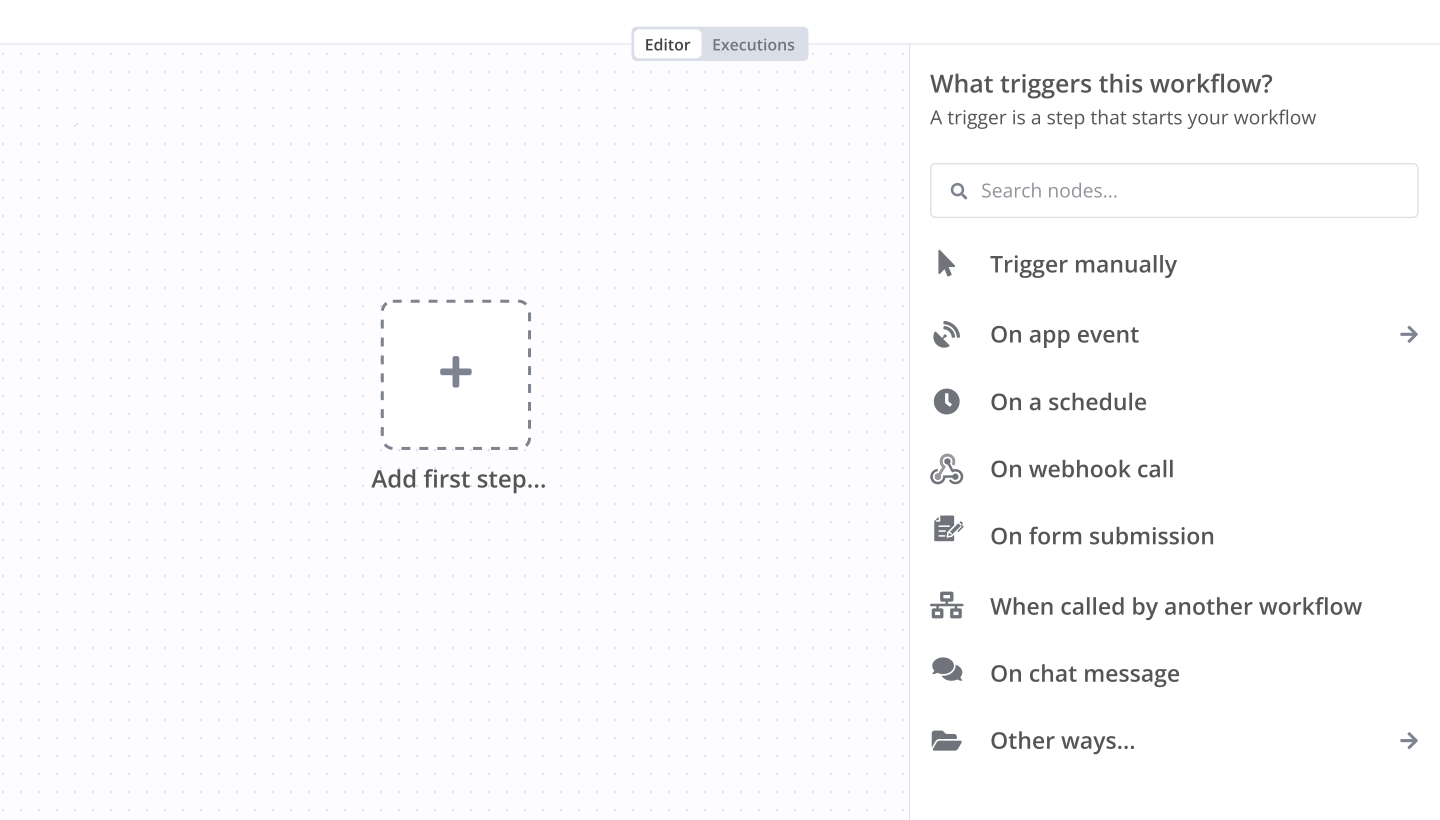
OpenWeatherMap and Slack integration: Create a new workflow and add the first step

Step 2: Add and configure OpenWeatherMap and Slack nodes

You can find OpenWeatherMap and Slack in the nodes panel. Drag them onto your workflow canvas, selecting their actions. Click each node, choose a credential, and authenticate to grant n8n access. Configure OpenWeatherMap and Slack nodes one by one: input data on the left, parameters in the middle, and output data on the right.

OpenWeatherMap and Slack integration: Add and configure OpenWeatherMap and Slack nodes

Step 3: Connect OpenWeatherMap and Slack

A connection establishes a link between OpenWeatherMap and Slack (or vice versa) to route data through the workflow. Data flows from the output of one node to the input of another. You can have single or multiple connections for each node.

OpenWeatherMap and Slack integration: Connect OpenWeatherMap and Slack

Step 4: Customize and extend your OpenWeatherMap and Slack integration

Use n8n's core nodes such as If, Split Out, Merge, and others to transform and manipulate data. Write custom JavaScript or Python in the Code node and run it as a step in your workflow. Connect OpenWeatherMap and Slack with any of n8n’s 1000+ integrations, and incorporate advanced AI logic into your workflows.

OpenWeatherMap and Slack integration: Customize and extend your OpenWeatherMap and Slack integration

Step 5: Test and activate your OpenWeatherMap and Slack workflow

Save and run the workflow to see if everything works as expected. Based on your configuration, data should flow from OpenWeatherMap to Slack or vice versa. Easily debug your workflow: you can check past executions to isolate and fix the mistake. Once you've tested everything, make sure to save your workflow and activate it.

OpenWeatherMap and Slack integration: Test and activate your OpenWeatherMap and Slack workflow

Smart irrigation scheduler with weather forecast and soil analysis

Smart Irrigation Scheduler with Weather Forecast and Soil Analysis

Summary
Automated garden and farm irrigation system that uses weather forecasts and evapotranspiration calculations to determine optimal watering schedules, preventing water waste while maintaining healthy plants.

Detailed Description
A comprehensive irrigation management workflow that analyzes weather conditions, forecasts, soil types, and plant requirements to make intelligent watering decisions. The system considers multiple factors including expected rainfall, temperature, humidity, wind speed, and days since last watering to determine if irrigation is needed and how much.

Key Features
Multi-Zone Management**: Support for multiple irrigation zones with different plant and soil types
Weather-Based Decisions**: Uses OpenWeatherMap current conditions and 5-day forecast
Evapotranspiration Calculation**: Simplified Penman method for accurate water loss estimation
Rain Forecast Skip**: Automatically skips watering when significant rain is expected
Plant-Type Specific**: Different requirements for flowers, vegetables, grass, and shrubs
Soil Type Consideration**: Adjusts for clay, loam, and sandy soil characteristics
Urgency Classification**: High/medium/low priority based on moisture levels
Optimal Timing**: Adjusts watering time based on temperature and wind conditions
IoT Integration**: Sends commands to smart irrigation controllers
Historical Logging**: Tracks all decisions in Google Sheets

Use Cases
Home garden automation
Commercial greenhouse management
Agricultural operations
Landscaping company scheduling
Property management with large grounds
Water conservation projects

Required Credentials
OpenWeatherMap API key
Slack Bot Token
Google Sheets OAuth
IoT Hub API (optional)

Node Count: 24 (19 functional + 5 sticky notes)

Unique Aspects
Uses OpenWeatherMap node (rarely used in templates)
Uses Split Out node for loop-style processing of zones
Uses Filter node for conditional routing
Uses Aggregate node to collect results
Implements evapotranspiration calculation using Code node
Comprehensive multi-factor decision logic

Workflow Architecture
[Daily Morning Check] [Manual Override Trigger]
| |
+----------+-------------+
|
v
[Define Irrigation Zones]
|
v
[Split Zones] (Loop)
/
v v
[Get Current] [Get 5-Day Forecast]
\ /
+----+----+
|
v
[Merge Weather Data]
|
v
[Analyze Irrigation Need]
/
v v
[Filter Needing] [Aggregate All]
\ /
+----+----+
|
v
[Generate Irrigation Schedule]
|
v
[Has Irrigation Tasks?] (If)
/
Has Tasks No Tasks
/ | \ |
Sheets[Slack] [Log No Action]
\ | / |
+---+---+-----------+
|
v
[Respond to Webhook]

Configuration Guide
Irrigation Zones: Edit "Define Irrigation Zones" with your zone data (coordinates, plant/soil types)
Water Thresholds: Adjust waterThreshold per zone based on plant needs
OpenWeatherMap: Add API credentials in the weather nodes
Slack Channel: Set to your garden/irrigation channel
IoT Integration: Configure endpoint URL for your smart valve controller
Google Sheets: Connect to your logging spreadsheet

Decision Logic
The system evaluates:
Expected rainfall in next 24 hours (skip if >5mm expected)
Soil moisture estimate based on days since watering + evapotranspiration
Plant-specific minimum and ideal moisture levels
Temperature adjustments for hot days
Scheduled watering frequency by plant type
Wind speed for optimal watering time

Nodes used in this workflow

Popular OpenWeatherMap and Slack workflows

Smart Irrigation Scheduler with Weather Forecast and Soil Analysis

Smart Irrigation Scheduler with Weather Forecast and Soil Analysis Summary Automated garden and farm irrigation system that uses weather forecasts and evapotranspiration calculations to determine optimal watering schedules, preventing water waste while maintaining healthy plants. Detailed Description A comprehensive irrigation management workflow that analyzes weather conditions, forecasts, soil types, and plant requirements to make intelligent watering decisions. The system considers multiple factors including expected rainfall, temperature, humidity, wind speed, and days since last watering to determine if irrigation is needed and how much. Key Features Multi-Zone Management**: Support for multiple irrigation zones with different plant and soil types Weather-Based Decisions**: Uses OpenWeatherMap current conditions and 5-day forecast Evapotranspiration Calculation**: Simplified Penman method for accurate water loss estimation Rain Forecast Skip**: Automatically skips watering when significant rain is expected Plant-Type Specific**: Different requirements for flowers, vegetables, grass, and shrubs Soil Type Consideration**: Adjusts for clay, loam, and sandy soil characteristics Urgency Classification**: High/medium/low priority based on moisture levels Optimal Timing**: Adjusts watering time based on temperature and wind conditions IoT Integration**: Sends commands to smart irrigation controllers Historical Logging**: Tracks all decisions in Google Sheets Use Cases Home garden automation Commercial greenhouse management Agricultural operations Landscaping company scheduling Property management with large grounds Water conservation projects Required Credentials OpenWeatherMap API key Slack Bot Token Google Sheets OAuth IoT Hub API (optional) Node Count: 24 (19 functional + 5 sticky notes) Unique Aspects Uses OpenWeatherMap node (rarely used in templates) Uses Split Out node for loop-style processing of zones Uses Filter node for conditional routing Uses Aggregate node to collect results Implements evapotranspiration calculation using Code node Comprehensive multi-factor decision logic Workflow Architecture [Daily Morning Check] [Manual Override Trigger] | | +----------+-------------+ | v [Define Irrigation Zones] | v [Split Zones] (Loop) / \ v v [Get Current] [Get 5-Day Forecast] \ / +----+----+ | v [Merge Weather Data] | v [Analyze Irrigation Need] / \ v v [Filter Needing] [Aggregate All] \ / +----+----+ | v [Generate Irrigation Schedule] | v [Has Irrigation Tasks?] (If) / \ Has Tasks No Tasks / | \ | Sheets[Slack] [Log No Action] \ | / | +---+---+-----------+ | v [Respond to Webhook] Configuration Guide Irrigation Zones: Edit "Define Irrigation Zones" with your zone data (coordinates, plant/soil types) Water Thresholds: Adjust waterThreshold per zone based on plant needs OpenWeatherMap: Add API credentials in the weather nodes Slack Channel: Set to your garden/irrigation channel IoT Integration: Configure endpoint URL for your smart valve controller Google Sheets: Connect to your logging spreadsheet Decision Logic The system evaluates: Expected rainfall in next 24 hours (skip if >5mm expected) Soil moisture estimate based on days since watering + evapotranspiration Plant-specific minimum and ideal moisture levels Temperature adjustments for hot days Scheduled watering frequency by plant type Wind speed for optimal watering time
+2

Smart Break Recommendation System using Google Calendar, Weather Data, and GPT-4 to Slack

Who is this for This workflow is perfect for busy professionals, consultants, and anyone who frequently travels between meetings. If you want to make the most of your free time between appointments and discover great nearby spots without manual searching, this template is for you. What it does This workflow automatically monitors your Google Calendar and identifies gaps between appointments. When it detects sufficient free time (configurable, default 30+ minutes), it calculates travel time to your next destination, checks the weather, and uses AI to recommend the top 3 spots to visit during your break. Recommendations are weather-aware: indoor spots like cafés in malls or stations for rainy days, and outdoor terraces or open-air venues for nice weather. How it works Schedule Trigger - Runs every 30 minutes to check your calendar Fetch Data - Gets your next calendar event and user preferences from Notion Calculate Gap Time - Determines available free time by subtracting travel time (via Google Maps) from time until your next appointment Weather Check - Gets current weather at your destination using OpenWeatherMap Smart Routing - Routes to indoor or outdoor spot search based on weather conditions AI Recommendations - GPT-4.1-mini analyzes spots and generates personalized top 3 recommendations Slack Notification - Sends a friendly message with recommendations to your Slack channel Set up steps Configure API Keys - Add your Google Maps, Google Places, and OpenWeatherMap API keys in the "Set Configuration" node Connect Google Calendar - Set up OAuth connection and select your calendar Set up Notion - Create a database for user preferences and add the database ID Connect Slack - Set up OAuth and specify your notification channel Connect OpenAI - Add your OpenAI API credentials Customize - Adjust currentLocation and minGapTimeMinutes to your needs Requirements Google Cloud account with Maps and Places APIs enabled OpenWeatherMap API key (free tier available) Notion account with a preferences database Slack workspace with bot permissions OpenAI API key How to customize Change trigger frequency: Modify the Schedule Trigger interval Adjust minimum gap time: Change minGapTimeMinutes in the configuration node Modify search radius: Edit the radius parameter in the Places API calls (default: 1000m) Customize spot types: Modify the type and keyword parameters in the HTTP Request nodes Change AI model: Switch to a different OpenAI model in the AI node Localize language: Update the AI prompt to generate responses in your preferred language

Daily AI Outfit Recommendations Based on Weather Forecast to Slack

Description Start your day with the perfect outfit suggestion tailored to the local weather. This workflow runs automatically every morning, fetches the current weather forecast for your city, and uses an AI stylist to generate a practical, gender-neutral outfit recommendation. It then designs a clean, vertical image card with all the details—date, temperature, weather conditions, and the complete outfit advice—and posts it directly to your Slack channel. It’s like having a personal stylist and weather reporter deliver a daily briefing right where your team communicates. Who’s it for Teams working in a shared office location who want a fun, daily update. Individuals looking to automate their morning routine and take the guesswork out of getting dressed. Community managers wanting to add engaging, automated content to their Slack workspace. Anyone interested in a practical example of combining weather data, AI, and dynamic image generation. How it works / What it does Triggers Daily: The workflow automatically runs every day at 6 AM. Fetches Weather: It gets the current weather forecast for a specified city (default is Tokyo) using the OpenWeatherMap node. Consults AI Stylist: The weather data is sent to an AI model, which acts as a stylist and returns a practical, gender-neutral outfit suggestion. Designs an Image Card: It dynamically creates a vertical image and writes the date, detailed weather info, and the AI's full recommendation onto it. Posts to Slack: Finally, it uploads the completed image card to your designated Slack channel with a friendly morning greeting. Requirements An n8n instance. An OpenWeatherMap API Key. An OpenRouter API Key (or credentials for another compatible AI model). A Slack workspace and the necessary permissions to connect an app. How to set up Set Weather Location: In the Get Weather Data node, add your OpenWeatherMap API Key and change the city name if you wish. Configure AI Model: In the OpenRouter Chat Model node, add your API Key. Configure Slack: In the Upload a file node, add your Slack credentials and, most importantly, select the channel where you want the forecast to be posted. Adjust Schedule (Optional): You can change the trigger time in the Daily 6AM Trigger node. How to customize the workflow Change the AI's Personality: Edit the system message in the Generate Outfit Advice node. You could ask the AI to be a pirate, a 90s fashion icon, or a formal stylist. Customize the Image: In the Create Image Card node, you can change the background color, font sizes, colors, and the layout of the text. Use a Different Platform: Swap the Slack node for a Discord, Telegram, or Email node to send the forecast to your preferred platform.
+2

Generate Weather-Based Date Itineraries with Google Places, OpenRouter AI, and Slack

🧩 What this template does This workflow builds a 120-minute local date course around your starting point by querying Google Places for nearby spots, selecting the top candidates, fetching real-time weather data, letting an AI generate a matching emoji, and drafting a friendly itinerary summary with an LLM in both English and Japanese. It then posts the full bilingual plan with a walking route link and weather emoji to Slack. 👥 Who it’s for Makers and teams who want a plug-and-play bilingual local itinerary generator with weather awareness — no custom code required. ⚙️ How it works Trigger – Manual (or schedule/webhook). Discovery – Google Places nearby search within a configurable radius. Selection – Rank by rating and pick the top 3. Weather – Fetch current weather (via OpenWeatherMap). Emoji – Use an AI model to match the weather with an emoji 🌤️. Planning – An LLM writes the itinerary in Markdown (JP + EN). Route – Compose a Google Maps walking route URL. Share – Post the bilingual itinerary, route link, and weather emoji to Slack. 🧰 Requirements n8n (Cloud or self-hosted) Google Maps Platform (Places API) OpenWeatherMap API key Slack Bot (chat:write) LLM provider (e.g., OpenRouter or DeepL for translation) 🚀 Setup (quick) Open Set → Fields: Config and fill in coords/radius/time limit. Connect Credentials for Google, OpenWeatherMap, Slack, and your LLM. Test the workflow and confirm the bilingual plan + weather emoji appear in Slack. 🛠 Customize Adjust ranking filters (type, min rating). Modify translation settings (target language or tone). Change output layout (side-by-side vs separated). Tune emoji logic or travel mode. Add error handling, retries, or logging for production use.

Build your own OpenWeatherMap and Slack integration

Create custom OpenWeatherMap and Slack workflows by choosing triggers and actions. Nodes come with global operations and settings, as well as app-specific parameters that can be configured. You can also use the HTTP Request node to query data from any app or service with a REST API.

OpenWeatherMap supported actions

Current Weather
Returns the current weather data
5 Day Forecast
Returns the weather data for the next 5 days

Slack supported actions

Archive
Archives a conversation
Close
Closes a direct message or multi-person direct message
Create
Initiates a public or private channel-based conversation
Get
Get information about a channel
Get Many
Get many channels in a Slack team
History
Get a conversation's history of messages and events
Invite
Invite a user to a channel
Join
Joins an existing conversation
Kick
Removes a user from a channel
Leave
Leaves a conversation
Member
List members of a conversation
Open
Opens or resumes a direct message or multi-person direct message
Rename
Renames a conversation
Replies
Get a thread of messages posted to a channel
Set Purpose
Sets the purpose for a conversation
Set Topic
Sets the topic for a conversation
Unarchive
Unarchives a conversation
Get
Get Many
Get & filters team files
Upload
Create or upload an existing file
Delete
Get Permalink
Search
Send
Send and Wait for Response
Update
Add
Adds a reaction to a message
Get
Get the reactions of a message
Remove
Remove a reaction of a message
Add
Add a star to an item
Delete
Delete a star from an item
Get Many
Get many stars of autenticated user
Get
Get information about a user
Get Many
Get a list of many users
Get User's Profile
Get a user's profile
Get User's Status
Get online status of a user
Update User's Profile
Update a user's profile
Add Users
Create
Disable
Enable
Get Many
Get Users
Update

FAQs

  • Can OpenWeatherMap connect with Slack?

  • Can I use OpenWeatherMap’s API with n8n?

  • Can I use Slack’s API with n8n?

  • Is n8n secure for integrating OpenWeatherMap and Slack?

  • How to get started with OpenWeatherMap and Slack integration in n8n.io?

Need help setting up your OpenWeatherMap and Slack integration?

Discover our latest community's recommendations and join the discussions about OpenWeatherMap and Slack integration.
Nicolas N
Muhammed Iqbal P B
Nicolas N

Looking to integrate OpenWeatherMap and Slack in your company?

Over 3000 companies switch to n8n every single week

Why use n8n to integrate OpenWeatherMap with Slack

Build complex workflows, really fast

Build complex workflows, really fast

Handle branching, merging and iteration easily.
Pause your workflow to wait for external events.

Code when you need it, UI when you don't

Simple debugging

Your data is displayed alongside your settings, making edge cases easy to track down.

Use templates to get started fast

Use 1000+ workflow templates available from our core team and our community.

Reuse your work

Copy and paste, easily import and export workflows.

Implement complex processes faster with n8n

red iconyellow iconred iconyellow icon