Back to Integrations
integrationRedis node
integrationSlack node

Redis and Slack integration

Save yourself the work of writing custom integrations for Redis and Slack and use n8n instead. Build adaptable and scalable Development, Data & Storage, Communication, and HITL workflows that work with your technology stack. All within a building experience you will love.

How to connect Redis and Slack

  • Step 1: Create a new workflow
  • Step 2: Add and configure nodes
  • Step 3: Connect
  • Step 4: Customize and extend your integration
  • Step 5: Test and activate your workflow

Step 1: Create a new workflow and add the first step

In n8n, click the "Add workflow" button in the Workflows tab to create a new workflow. Add the starting point – a trigger on when your workflow should run: an app event, a schedule, a webhook call, another workflow, an AI chat, or a manual trigger. Sometimes, the HTTP Request node might already serve as your starting point.
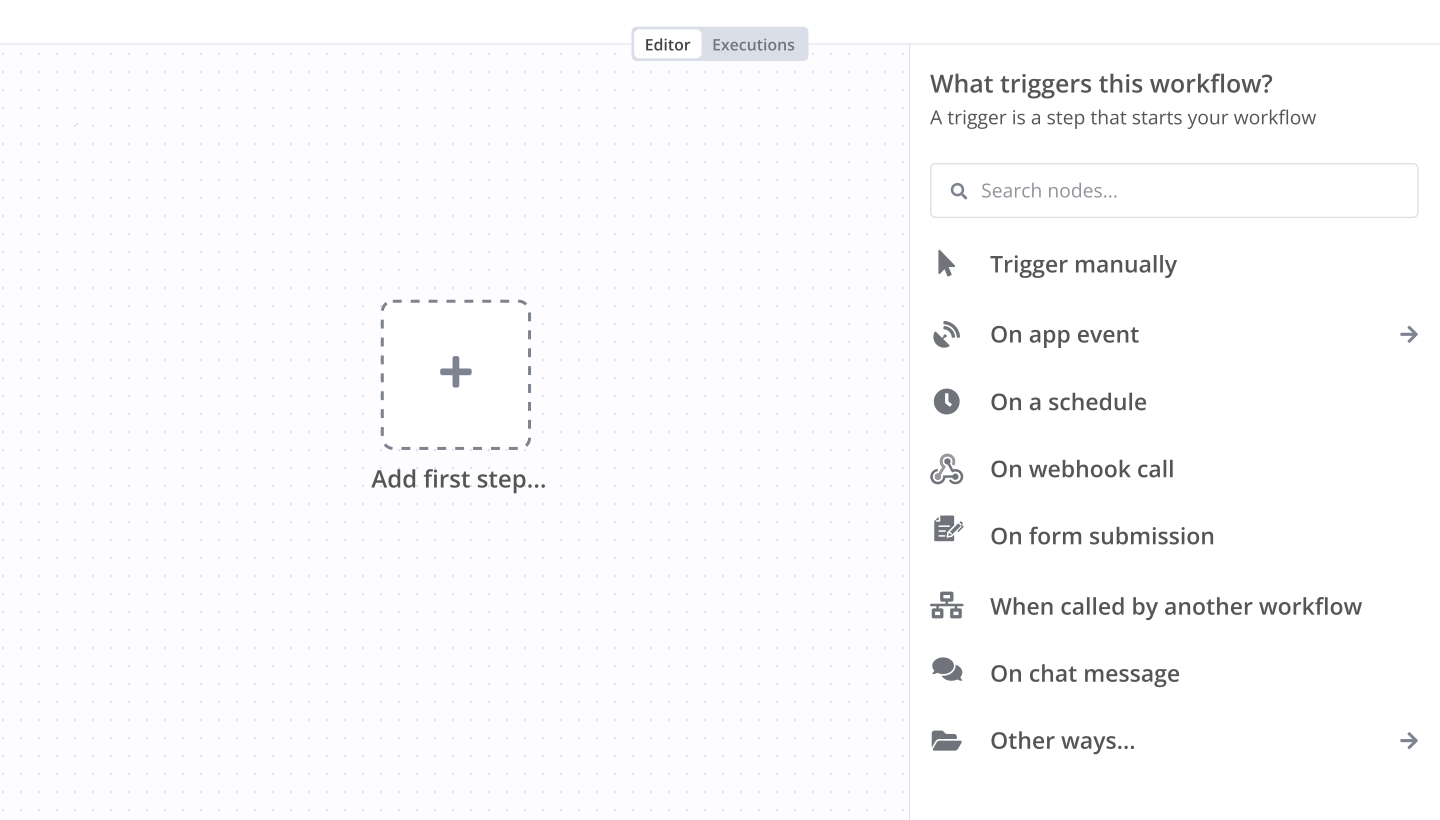
Redis and Slack integration: Create a new workflow and add the first step

Step 2: Add and configure Redis and Slack nodes

You can find Redis and Slack in the nodes panel. Drag them onto your workflow canvas, selecting their actions. Click each node, choose a credential, and authenticate to grant n8n access. Configure Redis and Slack nodes one by one: input data on the left, parameters in the middle, and output data on the right.

Redis and Slack integration: Add and configure Redis and Slack nodes

Step 3: Connect Redis and Slack

A connection establishes a link between Redis and Slack (or vice versa) to route data through the workflow. Data flows from the output of one node to the input of another. You can have single or multiple connections for each node.

Redis and Slack integration: Connect Redis and Slack

Step 4: Customize and extend your Redis and Slack integration

Use n8n's core nodes such as If, Split Out, Merge, and others to transform and manipulate data. Write custom JavaScript or Python in the Code node and run it as a step in your workflow. Connect Redis and Slack with any of n8n’s 1000+ integrations, and incorporate advanced AI logic into your workflows.

Redis and Slack integration: Customize and extend your Redis and Slack integration

Step 5: Test and activate your Redis and Slack workflow

Save and run the workflow to see if everything works as expected. Based on your configuration, data should flow from Redis to Slack or vice versa. Easily debug your workflow: you can check past executions to isolate and fix the mistake. Once you've tested everything, make sure to save your workflow and activate it.

Redis and Slack integration: Test and activate your Redis and Slack workflow

Monitor GitHub releases with Gemini AI Chinese translation & Slack notifications

Overview

This n8n template monitors specified GitHub repositories. When a new release is published, it automatically fetches the information, uses AI (Google Gemini by default) to summarize and translate it into Chinese, and sends a formatted notification to a designated Slack channel.

Core Features:

Automated Monitoring**: Checks for updates on a predefined schedule.
Intelligent Processing**: Uses AI to extract key information and translate.
Error Handling**: Sends an error notification if fetching RSS for a single repository fails, without affecting others.
Duplicate Prevention**: Remembers the last processed release ID using Redis to ensure only new content is pushed.

Prerequisites

Slack**: Configure your Slack app credentials in n8n.
Redis**: Have an available Redis service and configure its credentials in n8n.
AI Provider (Gemini)**: Configure credentials for Google Gemini (or your chosen AI model) in n8n.

Configuration Instructions

After importing the template, you need to modify the following key nodes:

Cron Trigger:
Adjust the Rule setting to change the update check frequency (default is 0 */10 9-23 * * *, checking every 10 minutes between 9 AM and 11 PM daily).
GitHub Config (Repository List - Code Node):
Edit the JavaScript array within this node's code area.
Modify or add the repositories you want to follow. Each repository object needs a name (custom display name) and github (format: owner/repo).
Example:
{
"name": "n8n", // Custom display name
"github": "n8n-io/n8n" // GitHub path
},
{
"name": "LobeChat",
"github": "lobehub/lobe-chat"
}
// ... add more repositories
Redis and Redis2 (Redis Connection):
Select your configured Redis credentials in both nodes.
Gemini (AI Model):
Select your configured Google Gemini credentials.
(Optional) Replace with a different supported AI model node and select its credentials.
Information Extractor (AI Processing & Translation):
Main Configuration: Review the System Prompt. By default, it asks the AI to extract information and translate it into Chinese. Modify this prompt if you need a different language or summary style.
Send Message and Send Error (Slack Notifications):
Select your configured Slack credentials in both Slack nodes.
Set the target Channel ID for notifications.

Workflow Overview

Start: Cron Trigger initiates the workflow on schedule.
Load Config: GitHub Config provides the list of repositories to monitor.
Loop: The Loop node iterates through each repository.
Fetch & Check:
The RSS node attempts to fetch the repository's releases feed.
If No Error checks for success:
Failure: Send Error posts an error to Slack, skips this repository.
Success: Continues.
Check for New Release:
The Redis node retrieves the last recorded Release ID for this repository.
The If New node compares the latest Release ID with the recorded ID:
Different IDs (New Release): Proceeds to processing.
Same ID (Already Processed): Skips this repository.
Process & Notify (Only for New Releases):
Information Extractor (with Gemini) extracts, summarizes, and translates the content.
The Code node formats the information into Slack Block Kit.
Send Message sends the formatted message to Slack.
The Redis2 node stores the current Release ID in Redis.
End: The workflow finishes after processing all repositories.

Conclusion

Once configured, this template automates GitHub release monitoring, uses AI to distill key information, and delivers it efficiently to your Slack workspace.

Nodes used in this workflow

Popular Redis and Slack workflows

+6

Predictive Health Monitoring & Alert System with GPT-4o-mini

How It Works The system collects real-time wearable health data, normalizes it, and uses AI to analyze trends and risk scores. It detects anomalies by comparing with historical patterns and automatically triggers alerts and follow-up actions when thresholds are exceeded. Setup Steps Configure Webhook Endpoint - Set up webhook to receive data from wearable devices Connect Database - Initialize storage for health metrics and historical data Set Normalization Rules - Define data standardization parameters for different devices Configure AI Model - Set up health score calculation and risk prediction algorithms Define Thresholds - Establish alert triggers for critical health metrics Connect Notification Channels - Configure email and Slack integrations Set Up Reporting - Create automated report templates and schedules Test Workflow - Run end-to-end tests with sample health data Workflow Template Webhook → Store Database → Normalize Data → Calculate Health Score → Analyze Metrics → Compare Previous → Check Threshold → Generate Reports/Alerts → Email/Slack → Schedule Follow-up Workflow Steps Ingest real-time wearable data via webhook, store and standardize it, and use GPT-4 for trend analysis and risk scoring. Monitor metrics against thresholds, trigger SMS, email, or Slack alerts, generate reports, and schedule follow-ups. Setup Instructions Configure webhook, database, GPT-4 API, notifications, calendar integration, and customize alert thresholds. Prerequisites Wearable API, patient database, GPT-4 key, email SMTP, optional Slack/Twilio, calendar integration. Use Cases Monitor glucose for diabetics, track elderly vitals/fall risk, assess corporate wellness, and post-surgery recovery alerts. Customization Adjust risk algorithms, add metrics, integrate telemedicine. Benefits Early intervention reduces readmissions and automates 80% of monitoring tasks.

Automate daily standups using Slack, Notion, and Redis

Run automated daily standups using Slack, Notion, and Redis 📌 Overview This workflow fully automates your team's daily standup process using Slack for communication, Notion for structured data storage, and Redis for real-time session management. It automatically sends standup questions to active team members, collects and stores their responses, manages conversation sessions, and generates structured summary reports for managers. Morning and evening standups run on schedule without manual intervention. Redis ensures fast and reliable session tracking, prevents duplicate standups, and maintains conversation state. All responses are securely stored in Notion for long-term reporting and tracking. This workflow eliminates manual follow-ups, improves reporting consistency, and gives managers full visibility into team progress, blockers, and attendance. ⚙️ How it works This workflow runs automatically based on configured schedules. Morning standup Fetches active team members from the Notion database Creates standup sessions in Redis Sends standup questions to each team member via Slack direct message Stores responses in Notion Tracks session state using Redis Automated reports The workflow automatically generates: Morning summary report showing attendance, responses, and blockers Evening summary report showing accomplishments, completion status, and help requests Both reports are automatically sent to the Slack admin channel. Redis ensures session tracking and prevents duplicate standups. 🛠 Setup steps Import this workflow into n8n Connect your Slack credentials Connect your Notion credentials Connect your Redis credentials Configure your Notion database IDs Configure your Slack admin channel ID Activate the workflow The workflow will run automatically based on the configured schedule. 🚀 Features Automated standup management Automatically sends standup questions Tracks team responses Stores responses securely in Notion Prevents duplicate standup sessions Automated reporting Attendance tracking Task completion tracking Blocker detection Missing response detection Automatic Slack summary reports 📋 Requirements You need the following accounts: n8n Slack Notion Redis 🎯 Benefits Fully automated standup system No manual follow-ups required Automatic attendance tracking Identifies blockers early Improves team visibility Saves management time 👨‍💻 Author BytezTech Pvt Ltd

Monitor GitHub Releases with Gemini AI Chinese Translation & Slack Notifications

Overview This n8n template monitors specified GitHub repositories. When a new release is published, it automatically fetches the information, uses AI (Google Gemini by default) to summarize and translate it into Chinese, and sends a formatted notification to a designated Slack channel. Core Features: Automated Monitoring**: Checks for updates on a predefined schedule. Intelligent Processing**: Uses AI to extract key information and translate. Error Handling**: Sends an error notification if fetching RSS for a single repository fails, without affecting others. Duplicate Prevention**: Remembers the last processed release ID using Redis to ensure only new content is pushed. Prerequisites Slack**: Configure your Slack app credentials in n8n. Redis**: Have an available Redis service and configure its credentials in n8n. AI Provider (Gemini)**: Configure credentials for Google Gemini (or your chosen AI model) in n8n. Configuration Instructions After importing the template, you need to modify the following key nodes: Cron Trigger: Adjust the Rule setting to change the update check frequency (default is 0 */10 9-23 * * *, checking every 10 minutes between 9 AM and 11 PM daily). GitHub Config (Repository List - Code Node): Edit the JavaScript array within this node's code area. Modify or add the repositories you want to follow. Each repository object needs a name (custom display name) and github (format: owner/repo). Example: { "name": "n8n", // Custom display name "github": "n8n-io/n8n" // GitHub path }, { "name": "LobeChat", "github": "lobehub/lobe-chat" } // ... add more repositories Redis and Redis2 (Redis Connection): Select your configured Redis credentials in both nodes. Gemini (AI Model): Select your configured Google Gemini credentials. (Optional) Replace with a different supported AI model node and select its credentials. Information Extractor (AI Processing & Translation): Main Configuration: Review the System Prompt. By default, it asks the AI to extract information and translate it into Chinese. Modify this prompt if you need a different language or summary style. Send Message and Send Error (Slack Notifications): Select your configured Slack credentials in both Slack nodes. Set the target Channel ID for notifications. Workflow Overview Start: Cron Trigger initiates the workflow on schedule. Load Config: GitHub Config provides the list of repositories to monitor. Loop: The Loop node iterates through each repository. Fetch & Check: The RSS node attempts to fetch the repository's releases feed. If No Error checks for success: Failure: Send Error posts an error to Slack, skips this repository. Success: Continues. Check for New Release: The Redis node retrieves the last recorded Release ID for this repository. The If New node compares the latest Release ID with the recorded ID: Different IDs (New Release): Proceeds to processing. Same ID (Already Processed): Skips this repository. Process & Notify (Only for New Releases): Information Extractor (with Gemini) extracts, summarizes, and translates the content. The Code node formats the information into Slack Block Kit. Send Message sends the formatted message to Slack. The Redis2 node stores the current Release ID in Redis. End: The workflow finishes after processing all repositories. Conclusion Once configured, this template automates GitHub release monitoring, uses AI to distill key information, and delivers it efficiently to your Slack workspace.
+6

Analyze customer feedback and send AI-written replies with GPT-4 and Gmail

How It Works This workflow automates customer feedback processing by analyzing sentiment, identifying key issues, generating personalized responses, and escalating critical cases to support teams when required. Designed for customer success managers, support teams, and product managers, it enables scalable feedback handling without compromising response quality or urgency. The workflow eliminates manual triage and response drafting by normalizing incoming feedback, performing sentiment and topic analysis, generating context-aware AI responses, validating tone and intent, escalating high-risk or negative feedback, logging all interactions for traceability, and delivering automated replies via email. Setup Steps Configure webhook trigger URL for feedback form integration or email parsing Add OpenAI API key for sentiment analysis and response generation Connect Anthropic Claude API for alternative response generation and validation Set up Google Sheets integration for feedback logging and analytics tracking Configure Gmail OAuth2 credentials for automated customer response delivery Integrate support ticket system (Zendesk, Freshdesk) for escalation routing Prerequisites OpenAI API key, Anthropic Claude API key (optional), Google Workspace account (Sheets, Gmail) Use Cases Product feedback management, customer support automation Customization Adjust sentiment scoring thresholds per industry standards, modify response templates Benefits Responds to feedback 95% faster, maintains consistent response quality across all interactions
+5

Advanced Multi-Source AI Research with Bright Data, OpenAI, Redis

How it Works This workflow transforms natural language queries into research reports through a five-stage AI pipeline. When triggered via webhook (typically from Google Sheets using the companion google-apps-script.js (GitHub gist), it first checks Redis cache for instant results. For new queries, GPT-4o breaks complex questions into focused sub-queries, optimizes them for search, then uses Bright Data's MCP Tool to find the top 5 credible sources (official sites, news, financial reports). URLs are scraped in parallel, bypassing bot detection. GPT-4o extracts structured data from each source: answers, facts, entities, sentiment, quotes, and dates. GPT-4o-mini validates source credibility and filters unreliable content. Valid results aggregate into a final summary with confidence scores, key insights, and extended analysis. Results cache for 1 hour and output via webhook, Slack, email, and DataTable—all in 30-90 seconds with 60 requests/minute rate limiting. Who is this for? Research teams needing automated multi-source intelligence Content creators and journalists requiring fact-checked information Due diligence professionals conducting competitive intelligence Google Sheets power users wanting AI research in spreadsheets Teams managing large research volumes needing caching and rate limiting Setup Steps Setup time: 30-45 minutes Requirements: Bright Data account (Web Scraping API + MCP token) OpenAI API key (GPT-4o and GPT-4o-mini access) Redis instance Slack workspace (optional) SMTP email provider (optional) Google account (optional for Sheets integration) Core Setup: Get Bright Data Web Scraping API token and MCP token Get OpenAI API key Set up Redis instance Configure critical nodes: Webhook Entry: Add Header Auth token Bright Data MCP Tool: Add MCP endpoint with token Parallel Web Scraping: Add Bright Data API credentials Redis Nodes: Add connection credentials All GPT Nodes: Add OpenAI API key (5 nodes) Slack/Email: Add credentials if using Google Sheets Integration: Create Google Sheet Open Extensions → Apps Script Paste the companion google-apps-script.js code Update webhook URL and auth token Save and authorize Test: {"prompt": "What is the population of Tokyo?", "source": "Test", "language": "English"} Customization Guidance Source Count:** Change from 5 to 3-10 URLs per query Cache Duration:** Adjust from 1 hour to 24 hours for stable info Rate Limits:** Modify 60/minute based on usage needs Character Limits:** Adjust 400-char main answer to 200-1000 AI Models:** Swap GPT-4o for Claude or use GPT-4o-mini for all stages Geographic Targeting:** Add more regions beyond us/il Output Channels:** Add Notion, Airtable, Discord, Teams Temperature:** Lower (0.1-0.2) for facts, higher (0.4-0.6) for analysis Once configured, this workflow handles all web research, from fact-checking to complex analysis—delivering validated intelligence in seconds with automatic caching. Built by Daniel Shashko Connect on LinkedIn

Build your own Redis and Slack integration

Create custom Redis and Slack workflows by choosing triggers and actions. Nodes come with global operations and settings, as well as app-specific parameters that can be configured. You can also use the HTTP Request node to query data from any app or service with a REST API.

Redis supported actions

Delete
Delete a key from Redis
Get
Get the value of a key from Redis
Increment
Atomically increments a key by 1. Creates the key if it does not exist.
Info
Returns generic information about the Redis instance
Keys
Returns all the keys matching a pattern
List Length
Returns the length of a list
Pop
Pop data from a redis list
Publish
Publish message to redis channel
Push
Push data to a redis list
Set
Set the value of a key in redis

Slack supported actions

Archive
Archives a conversation
Close
Closes a direct message or multi-person direct message
Create
Initiates a public or private channel-based conversation
Get
Get information about a channel
Get Many
Get many channels in a Slack team
History
Get a conversation's history of messages and events
Invite
Invite a user to a channel
Join
Joins an existing conversation
Kick
Removes a user from a channel
Leave
Leaves a conversation
Member
List members of a conversation
Open
Opens or resumes a direct message or multi-person direct message
Rename
Renames a conversation
Replies
Get a thread of messages posted to a channel
Set Purpose
Sets the purpose for a conversation
Set Topic
Sets the topic for a conversation
Unarchive
Unarchives a conversation
Get
Get Many
Get & filters team files
Upload
Create or upload an existing file
Delete
Get Permalink
Search
Send
Send and Wait for Response
Update
Add
Adds a reaction to a message
Get
Get the reactions of a message
Remove
Remove a reaction of a message
Add
Add a star to an item
Delete
Delete a star from an item
Get Many
Get many stars of autenticated user
Get
Get information about a user
Get Many
Get a list of many users
Get User's Profile
Get a user's profile
Get User's Status
Get online status of a user
Update User's Profile
Update a user's profile
Add Users
Create
Disable
Enable
Get Many
Get Users
Update

FAQs

  • Can Redis connect with Slack?

  • Can I use Redis’s API with n8n?

  • Can I use Slack’s API with n8n?

  • Is n8n secure for integrating Redis and Slack?

  • How to get started with Redis and Slack integration in n8n.io?

Need help setting up your Redis and Slack integration?

Discover our latest community's recommendations and join the discussions about Redis and Slack integration.
Nicolas N
Muhammed Iqbal P B
Nicolas N

Looking to integrate Redis and Slack in your company?

Over 3000 companies switch to n8n every single week

Why use n8n to integrate Redis with Slack

Build complex workflows, really fast

Build complex workflows, really fast

Handle branching, merging and iteration easily.
Pause your workflow to wait for external events.

Code when you need it, UI when you don't

Simple debugging

Your data is displayed alongside your settings, making edge cases easy to track down.

Use templates to get started fast

Use 1000+ workflow templates available from our core team and our community.

Reuse your work

Copy and paste, easily import and export workflows.

Implement complex processes faster with n8n

red iconyellow iconred iconyellow icon