Back to Integrations
integrationShopify node
integrationSlack node

Shopify and Slack integration

Save yourself the work of writing custom integrations for Shopify and Slack and use n8n instead. Build adaptable and scalable Sales, Communication, and HITL workflows that work with your technology stack. All within a building experience you will love.

How to connect Shopify and Slack

  • Step 1: Create a new workflow
  • Step 2: Add and configure nodes
  • Step 3: Connect
  • Step 4: Customize and extend your integration
  • Step 5: Test and activate your workflow

Step 1: Create a new workflow and add the first step

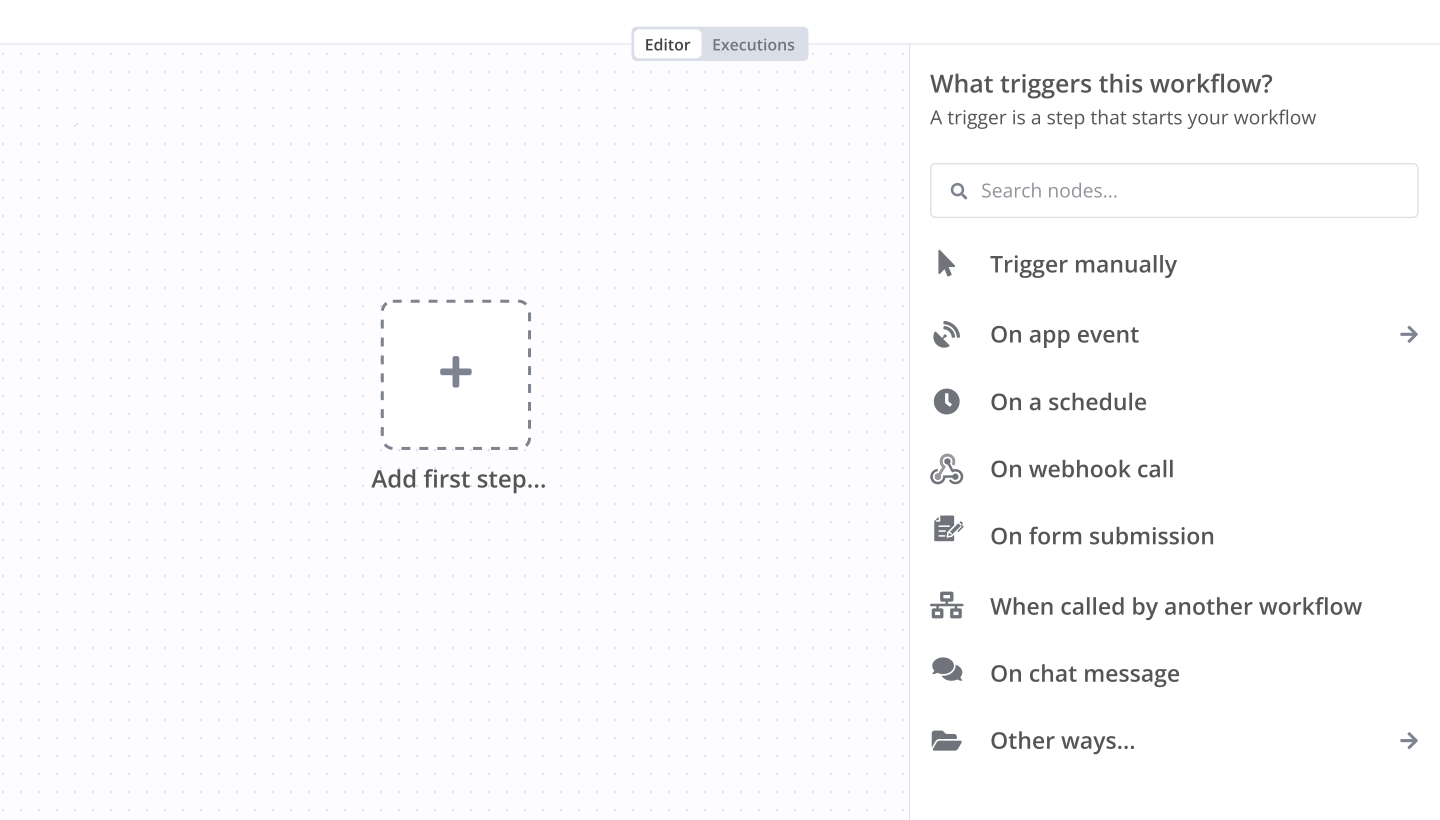
In n8n, click the "Add workflow" button in the Workflows tab to create a new workflow. Add the starting point – a trigger on when your workflow should run: an app event, a schedule, a webhook call, another workflow, an AI chat, or a manual trigger. Sometimes, the HTTP Request node might already serve as your starting point.

Shopify and Slack integration: Create a new workflow and add the first step

Step 2: Add and configure Shopify and Slack nodes

You can find Shopify and Slack in the nodes panel. Drag them onto your workflow canvas, selecting their actions. Click each node, choose a credential, and authenticate to grant n8n access. Configure Shopify and Slack nodes one by one: input data on the left, parameters in the middle, and output data on the right.

Shopify and Slack integration: Add and configure Shopify and Slack nodes

Step 3: Connect Shopify and Slack

A connection establishes a link between Shopify and Slack (or vice versa) to route data through the workflow. Data flows from the output of one node to the input of another. You can have single or multiple connections for each node.

Shopify and Slack integration: Connect Shopify and Slack

Step 4: Customize and extend your Shopify and Slack integration

Use n8n's core nodes such as If, Split Out, Merge, and others to transform and manipulate data. Write custom JavaScript or Python in the Code node and run it as a step in your workflow. Connect Shopify and Slack with any of n8n’s 1000+ integrations, and incorporate advanced AI logic into your workflows.

Shopify and Slack integration: Customize and extend your Shopify and Slack integration

Step 5: Test and activate your Shopify and Slack workflow

Save and run the workflow to see if everything works as expected. Based on your configuration, data should flow from Shopify to Slack or vice versa. Easily debug your workflow: you can check past executions to isolate and fix the mistake. Once you've tested everything, make sure to save your workflow and activate it.

Shopify and Slack integration: Test and activate your Shopify and Slack workflow

Run weekly inventories on Shopify sales

This workflow is scheduled to run every week, when it gets all your Shopify orders, calculates their sales value, stores the data in Google Sheets, and sends a notification message to a Slack channel.

Nodes used in this workflow

Popular Shopify and Slack workflows

Create e-commerce listings from images with UploadToURL, GPT-4o, Shopify

Transform raw product images into fully-optimized e-commerce listings in seconds. This workflow automates the bridge between a photo upload and a live product page by combining UploadToURL for hosting, GPT-4o Vision for content generation, and native integrations for Shopify and WooCommerce. 🎯 What This Workflow Does Turns a single product photo into a comprehensive, SEO-ready store listing: 📝 Captures Product Assets - Receives an image via mobile upload (binary) or a remote URL via Webhook. ☁️ Instant CDN Hosting - UploadToURL hosts the image and generates a permanent, high-speed link for your store. 👁️ Vision AI Analysis - GPT-4o Vision "looks" at the product to generate titles, HTML descriptions, SEO tags, and even suggested categories. 🚦 Smart Platform Routing - Automatically detects your target platform and formats the data for: Shopify: Creates products via GraphQL-compatible REST with full SEO metafields. WooCommerce: Creates listings via REST API with Yoast SEO support and marketing blurbs. 📊 Data Enrichment - Sanitizes SKUs, coerces pricing, and maps inventory data for a production-ready entry. ✨ Key Features Seamless Asset Hosting: Uses the **UploadToURL community node to eliminate the need for manual cloud storage management. Zero-Copywriting Required**: AI generates 5-point bullet features, SEO titles (max 70 chars), and rich HTML descriptions. Dual-Platform Support**: Toggle between Shopify and WooCommerce within a single workflow. Automated Slugs**: Generates URL-friendly "handles" based on AI-suggested product names. Robust Error Handling**: Centralized logic to catch upload or API failures and return structured feedback. 💼 Perfect For E-commerce Managers**: Adding hundreds of products without manual data entry. Dropshippers**: Quickly importing products from supplier URLs with fresh, unique AI copy. Retailers**: Taking photos of new stock on a phone and pushing them live to the store instantly. Agencies**: Automating catalog management for multiple client stores. 🔧 What You'll Need Required Integrations UploadToURL** - To host product images and provide public CDN links. n8n Community Node** - n8n-nodes-uploadtourl must be installed. OpenAI API** - GPT-4o Vision for image analysis and copywriting. Shopify or WooCommerce** - Credentials for your specific store platform. Optional Integrations Google Sheets** - To log all generated product data for an offline backup. Slack** - To notify the team whenever a new product "Draft" is created. 🚀 Quick Start Import Template - Copy the JSON and import it into your n8n instance. Install Node - Verify the UploadToURL community node is installed. Set Credentials - Connect your UploadToURL, OpenAI, and Store (Shopify/WooCommerce) accounts. Set Default Platform - Configure the DEFAULT_PLATFORM variable (shopify/woocommerce). Test Upload - Send a POST request with an image and price to the Webhook URL. Go Live - Switch to "Active" to begin your automated catalog expansion. 🎨 Customization Options Pricing Logic**: Add a node to calculate dynamic markups or currency conversions. Publishing Workflow**: Set publishImmediately to false to create all AI products as "Drafts" for human review. Image Processing**: Add watermarking or resizing steps before uploading to the CDN. Multi-Store Routing**: Use tags to route products to different regional store locations. 📈 Expected Results 95% reduction** in manual listing time (from 15 minutes to 30 seconds per product). SEO-Optimized listings** from day one with zero manual keyword research. Professional, consistent descriptions** across your entire product catalog. Immediate mobile-to-store** capability for on-the-go inventory management. 🏆 Use Cases High-Volume Inventory A warehouse team snaps photos of 50 new arrivals; the workflow creates 50 draft listings with descriptions and prices ready for final approval. Competitor Migration Input a list of product image URLs from a supplier site; the AI re-writes all titles and descriptions to ensure unique content for SEO. Boutique E-commerce Small business owners can manage their entire store from their smartphone by simply "sharing" a photo to the n8n webhook. 💡 Pro Tips High-Res Images**: Better image quality results in significantly more accurate AI feature extraction. SKU Naming**: Send a custom SKU in the webhook to maintain sync with your physical inventory or ERP system. Confidence Scores**: The AI returns a confidenceScore; you can set a filter to only auto-publish products with a score above 0.9. Ready to automate your storefront? Import this template and connect UploadToURL to start building your AI-driven product catalog today. Questions about store-specific fields? Detailed sticky notes inside the workflow explain how to map custom attributes for both Shopify and WooCommerce.
+4

Recover Shopify Abandoned Carts with Email, SMS, WhatsApp & Facebook Retargeting

This workflow is a complete, production-ready solution for recovering abandoned carts in Shopify stores using a multi-channel, multi-touch approach. It automates personalized follow-ups via Email, SMS, and WhatsApp, tracks every customer interaction for multi-touch attribution, and enables advanced retargeting and analytics. Key features: Multi-step, timed recovery sequence (Email → SMS → Email → WhatsApp) Customer segmentation (new, returning, VIP) and A/B testing Dynamic discounting and personalized messaging Touchpoint logging to Google Sheets for attribution analysis Facebook Custom Audience retargeting for unrecovered carts Slack notifications for high-value cart recoveries What does this workflow do? Listens for abandoned cart events from Shopify (or any e-commerce platform) via webhook. Normalizes and enriches cart data by fetching full cart details and customer purchase history. Predicts the likely reason for abandonment (e.g., price sensitivity, checkout complexity, technical issues) using rule-based logic. Segments the customer (new, returning, VIP), assigns an A/B test group, and generates a personalized discount and checkout URL. Runs a timed, multi-channel recovery sequence: 1 hour after abandonment: Checks if the order is completed. If not, sends a personalized Email #1 and logs the touchpoint. 4 hours after abandonment: Checks again. If not recovered, sends an SMS with a discount code and logs the touchpoint. 24 hours after abandonment: Checks again. If not recovered, sends Email #2 (with social proof/urgency) and logs the touchpoint. 48 hours after abandonment: Final check. If not recovered, sends a WhatsApp reminder and logs the touchpoint. If the cart is still not recovered: Hashes customer identifiers and adds them to a Facebook Custom Audience for retargeting. Logs every touchpoint (email, SMS, WhatsApp) to a Google Sheet for multi-touch attribution analysis. Sends a Slack notification if a high-value cart is recovered. Why is this workflow useful? Boosts recovery rates:** By using multiple channels and personalized timing, you maximize the chance of recovering lost sales. Improves attribution:** Every customer interaction is logged, so you can analyze which channels and messages drive conversions. Enables advanced retargeting:** Unrecovered carts are automatically added to a Facebook Custom Audience for paid retargeting. Saves time:** Fully automated, with easy configuration for your store, messaging, and analytics. Scalable and extensible:** Easily adapt the sequence, add more channels, or integrate with other tools. How to install and configure Prerequisites n8n instance (v2.0.2+ recommended) Shopify store with API access Accounts and API credentials for: SendGrid (email) Twilio (SMS) WhatsApp Business API Google Sheets (service account) Facebook Graph API (for Custom Audiences) Slack (for notifications) Setup steps Import the workflow into your n8n instance. Configure the “Workflow Configuration” node: Set your Shopify domain, API URLs, Google Sheets ID, and high-value threshold. Connect all required credentials in the respective nodes: Shopify, SendGrid, Twilio, WhatsApp, Google Sheets, Facebook Graph API, Slack. Create a Google Sheet named “Touchpoints” with columns: cart_id, customer_id, touchpoint_type, timestamp, channel, ab_group. Set up the webhook in your Shopify store (or e-commerce platform) to trigger the workflow on cart abandonment. Test the workflow with a sample abandoned cart event to ensure emails, SMS, WhatsApp, and logging work as expected. Enable the workflow in n8n for live operation. Node-by-node breakdown Abandoned Cart Webhook:** Receives abandoned cart events. Workflow Configuration:** Stores global settings (API URLs, Shopify domain, Google Sheets ID, high-value threshold). Normalize Cart Data:** Cleans and standardizes incoming cart data. Fetch Cart Details / Fetch Customer History:** Enriches data with full cart and customer info. Predict Abandonment Reason:** Uses business logic to guess why the cart was abandoned. Personalization Engine:** Segments the customer, assigns A/B group, calculates discount, and builds checkout URL. Customer Segment Check / Device Type Check:** Applies routing logic for personalized messaging. Wait / Check Order Status / Generate & Send Messages:** Timed sequence for Email, SMS, and WhatsApp, with order status checks at each step. Log Touchpoint (Google Sheets):** Records every message sent for attribution. Attribution Merge:** Combines all touchpoints into a single journey for analysis. Hash Customer Data for Facebook / Add to Retargeting Audience:** Adds unrecovered carts to a Facebook Custom Audience. Check Cart Value Threshold / Notify High-Value Recovery:** Sends Slack alerts for high-value recoveries. Customization tips Adjust wait times and message content to fit your brand and audience. Add or remove channels (e.g., push notifications, phone calls) as needed. Expand the Google Sheet for deeper analytics (e.g., add UTM parameters, campaign IDs). Integrate with your CRM or analytics platform for end-to-end tracking. Troubleshooting Make sure all API credentials are set and tested. Check Google Sheets permissions for the service account. Test each channel (email, SMS, WhatsApp) individually before going live. Review the workflow execution logs in n8n for errors or failed steps.

Scrape & Import Shoe Products to Shopify with BrowserAct (with Variants & Images)

Scrape & Import Products to Shopify from Any Site (with Variants & Images)-(Optimized for shoes) This advanced n8n template automates e-commerce operations by scraping product data (including variants and images) from any URL and creating fully detailed products in your Shopify store. This workflow is essential for dropshippers, e-commerce store owners, and anyone looking to quickly import product catalogs from specific websites into their Shopify store. Self-Hosted Only This Workflow uses a community contribution and is designed and tested for self-hosted n8n instances only. How it works The workflow reads a list of product page URLs from a Google Sheet. Your sheet, with its columns for Product Name and Product Link, acts as a database for your workflow. The Loop Over Items node processes products one URL at a time. Two BrowserAct nodes run sequentially to scrape all product details, including the Name, price, description, sizes, and image links. A custom Code node transforms the raw scraped data (where fields like sizes might be a single string) into a structured JSON format with clean lists for sizes and images. The Shopify node creates the base product entry using the main details. The workflow then uses a series of nodes (Set Option and Add Option via HTTP Request) to dynamically add product options (e.g., "Shoe Size") to the new product. The workflow intelligently uses HTTP Request nodes to perform two crucial bulk tasks: Create a unique variant for each available size, including a custom SKU. Upload all associated product images from their external URLs to the product. A final Slack notification confirms the batch has been processed. Requirements BrowserAct** API account for web scraping BrowserAct* "Bulk Product Scraping From (URLs) and uploading to Shopify (Optimized for shoe - NIKE -> Shopify)*" Template BrowserAct** n8n Community Node -> (n8n Nodes BrowserAct) Google Sheets** credentials for the input list Shopify** credentials (API Access Token) to create and update products, variants, and images Slack** credentials (optional) for notifications Need Help? How to Find Your BrowseAct API Key & Workflow ID How to Connect n8n to Browseract How to Use & Customize BrowserAct Templates How to Use the BrowserAct N8N Community Node Workflow Guidance and Showcase Automate Shoe Scraping to Shopify Using n8n, BrowserAct & Google Sheets
+7

Shopify Multi-Module Automation with GPT-4o, Langchain Agents & Integrations

This n8n workflow orchestrates a powerful suite of AI Agents and automations to manage and optimize various aspects of an e-commerce operation, particularly for platforms like Shopify. It leverages Langchain AI Agents powered by OpenAI, along with a variety of integrated services, to handle customer support, product recommendations, abandoned cart recovery, inventory management, post-purchase engagement, review monitoring, marketing campaigns, and operational alerts. Tools & Services Used n8n:** Core automation and orchestration platform. Langchain AI Agents:** For intelligent decision-making, task execution, and natural language processing across multiple modules. OpenAI (e.g., GPT-4o Mini):** Powers the AI Agents and direct LLM calls for tasks like sentiment analysis and content generation. Shopify (Conceptual - requires specific API/Webhook setup):** For triggers (abandoned cart, order delivered) and actions (fetching products/inventory, creating discounts). Google Sheets:** Used as a data store for FAQs, logging low stock, review databases, and campaign outcomes. Slack:** For internal team notifications (escalations, low stock, negative reviews). Twilio (or similar SMS service):** For sending SMS alerts (cart recovery, restock notifications). Email (Generic SMTP/API):** For sending various emails (AI responses, recovery emails, review requests, campaign emails). Notion:** For logging customer interactions. HTTP Request Nodes:** For generic API interactions (fetching customer info, product search, CRM, campaign tracking). Webhook Nodes:** For receiving external triggers (incoming messages, product inquiries, review submissions, restock signals). Cron Nodes:** For scheduled tasks (hourly inventory checks, daily campaigns). Workflow Overview This workflow is a collection of interconnected sub-workflows, each designed to automate a specific e-commerce process: Customer Support & Escalation Handles incoming customer messages, attempts to answer with FAQs or order status using an AI Agent, and escalates to a human agent via Slack if necessary. Logs interactions to Notion. Product Inquiry & Recommendation Processes product inquiries, searches a product catalog, filters/sorts results, uses an AI Agent for selection refinement, and can build a product carousel for user response. Abandoned Cart Recovery Detects abandoned carts, fetches customer data, uses an AI Agent to strategize recovery (e.g., offer discounts), and sends follow-up communications via email/SMS. Inventory Management (Low Stock Alert) Periodically checks inventory levels, identifies low-stock items, uses an AI Agent to format reports, and notifies relevant teams via Slack/email, logging to Google Sheets. Post-Purchase Review Request After a set period post-delivery, an AI Agent drafts and initiates sending a personalized product review request email to the customer. Review Monitoring & Flagging Listens for new product reviews, uses an AI model for sentiment analysis, alerts a support team for negative reviews via Slack, and logs all reviews. Scheduled Marketing Campaigns Fetches target audiences, segments them, uses AI Agents to generate tailored email content, sends campaigns, tracks basic metrics, and employs another AI Agent to suggest campaign adjustments. Manual Restock Alert & Logging Allows triggering a restock notification via webhook, sends an SMS alert, and uses an LLM to log the event. Prerequisites Ensure you have active accounts and necessary API keys/credentials for: OpenAI Shopify (or your e-commerce platform API) Google Cloud (for Google Sheets API) Slack (Bot Token) Twilio (Account SID, Auth Token, From Number) Your Email Sending Service (SMTP details or API key) Notion (Integration Token) Any other external APIs used (e.g., CRM, Product Search, Customer Info, Campaign Tracking) How to Use This Template Step 1: Import the Template Open your n8n instance. Go to “Workflows” > “Create Workflow”. Click the three dots (…) > “Import from File”. Upload the downloaded JSON file of this workflow. Step 2: Configure Critical Nodes & Credentials This is the most crucial step. Systematically go through each of the 8 sections outlined in the Sticky Notes within the workflow and configure the relevant nodes: SECTION 1 (Customer Support):** Get FAQs Data (Google Sheets): Set sheetId to YOUR_SHEET_ID_HERE and configure Google API credentials. Lookup Order API (HTTP Request): Set url to YOUR_ORDER_LOOKUP_API_ENDPOINT_HERE. Notify Human Agent (Slack): Configure Slack API credentials and channel. Send AI Response to Customer (HTTP Request): Set url to YOUR_CUSTOMER_RESPONSE_API_ENDPOINT_HERE. Store to Notion (Notion): Set pageId (Database ID) to YOUR_NOTION_DATABASE_URL_OR_ID_HERE and Notion API credentials. SECTION 2 (Product Inquiry):** Search Products API (HTTP Request): Set url to YOUR_PRODUCT_SEARCH_API_ENDPOINT_HERE. Build Product Carousel (Function): Update YOUR_DEFAULT_PRODUCT_IMAGE_URL_HERE and YOUR_FALLBACK_PRODUCT_URL_HERE. Respond to User with Carousel (HTTP Request): Set url for sending carousel data. SECTION 3 (Abandoned Cart):** Detect Abandoned Cart (Shopify Trigger): Configure Shopify credentials and ensure the correct trigger event. Fetch Customer Info (HTTP Request): Set url to YOUR_CUSTOMER_INFO_API_ENDPOINT_HERE. Create Discount (if applicable) (Shopify): Configure Shopify credentials and review discount creation parameters. Send Recovery Email (HTTP Request/Email Send): Set email API endpoint or SMTP credentials. Send SMS Reminder (Twilio): Configure Twilio credentials and from number (YOUR_TWILIO_PHONE_NUMBER_HERE). SECTION 4 (Low Stock Alerts):** Fetch Inventory (Shopify): Configure Shopify credentials. Notify Slack (Low Stock) (Slack): Configure Slack API credentials and channel. Generate Email Report (Low Stock) (Email Send): Configure SMTP/email credentials and to address. Export to Sheets (Low Stock Log) (Google Sheets): Set sheetId to YOUR_INVENTORY_LOG_SHEET_ID_HERE and Google API credentials. SECTION 5 (Review Request):** Order Delivered Trigger (Shopify Trigger): Configure Shopify credentials. Fetch Customer Data (for Review) (HTTP Request): Set url to YOUR_CUSTOMER_INFO_API_ENDPOINT_HERE. DraftReviewRequestEmail (Tool): Update YOUR_PRODUCT_PAGE_URL_BASE_HERE and YOUR_WEBSITE_URL_HERE. Send Review Request Email (Email Send): Configure SMTP/email credentials. SECTION 6 (Review Monitoring):** OpenAI node (currently Assistant Create): IMPORTANT: For sentiment analysis, change this node type to @n8n/n8n-nodes-langchain.lmChatOpenAi. Then configure its prompt for sentiment analysis (e.g., System: "Analyze sentiment. Respond with positive, negative, or neutral." User: "Review: {{ $('Listen for Review Webhook').first().json.body.review_text }}"). Set OpenAI credentials. Notify Support Team (Negative Review) (Slack): Configure Slack API credentials and channel. Add Review to Database (Google Sheets): Set sheetId to YOUR_REVIEWS_DATABASE_SHEET_ID_HERE and Google API credentials. SECTION 7 (Marketing Campaigns):** Fetch Target Audience API (HTTP Request): Set url to YOUR_CRM_API_FOR_AUDIENCE_HERE. GenerateCampaignEmailVariant (Tool): Update YOUR_CAMPAIGN_LANDING_PAGE_HERE. Send Campaign Email (Email Send): Configure SMTP/email credentials. Track Campaign Metrics API (HTTP Request): Set url for YOUR_CAMPAIGN_TRACKING_API_ENDPOINT_HERE. Log Campaign Outcome & Adjustments (Google Sheets): Set sheetId to YOUR_CAMPAIGN_LOG_SHEET_ID_HERE and Google API credentials. SECTION 8 (Manual Restock):** Send SMS Alert (Restock) (Twilio): Configure Twilio credentials, from number (YOUR_TWILIO_PHONE_NUMBER_HERE), and to (WAREHOUSE_MANAGER_PHONE_NUMBER_HERE). OpenAI Chat Model (for Basic LLM Chain): Configure OpenAI credentials. Send restock Request Email1 (Email Send): Configure SMTP/email credentials and to address. Step 3: Implement Tool Logic Go into each @n8n/n8n-nodes-langchain.toolCode node (e.g., SearchFAQs, RefineProductSelection, DetermineDiscount, etc.). The current JavaScript is placeholder. You MUST replace this with actual JavaScript logic that performs the intended action for each tool, often by making API calls or processing data based on the agent's input. Step 4: Review AI Agent Prompts & Tool Connections Carefully review the systemMessage for each AI Agent node to ensure it accurately reflects its role and how it should use its tools. CRITICAL:** Verify the index for tools connected to each AI Agent. Each tool connected to a single agent must have a unique, sequential index (0, 1, 2, ...). AI Agent (ID cd71629d-... in your JSON): SearchFAQs tool should be index: 0, LookupOrderStatus tool should be index: 1. (Please double-check and correct the connection indices in your actual workflow file if they are still both pointing to index 0). AI Agent6 (ID 4c24879b-... in your JSON): AnalyzeCampaignPerformance tool should be index: 0, SuggestCampaignAdjustments tool should be index: 1. (Please double-check and correct the connection indices in your actual workflow file if they are still both pointing to index 0). Initial Test Run Disable most of the workflow sections initially. Focus on one section at a time (e.g., Section 1: Customer Support). Manually trigger the first node (e.g., simulate an incoming webhook). Execute node by node, checking the output and debugging configurations and tool logic. For time-based triggers (Cron, Wait nodes), temporarily shorten the durations for faster testing. Once a section is working, move to the next. Use Cases E-commerce Businesses (Shopify, etc.):** To automate customer service, marketing, sales recovery, and operations. Digital Marketing Agencies:** To offer advanced automation services to e-commerce clients. Freelancers & Consultants:** To build and deploy sophisticated AI-driven e-commerce solutions. n8n Developers:** As a comprehensive template and learning resource for building complex multi-agent systems.

Shopify VIP Alerts: AI Summary & Slack Notification for Big Orders

🧨 VIP Radar: Instantly Spot & Summarize High-Value Shopify Orders with AI + Slack Alerts Automatically detect when a new Shopify order exceeds $200, fetch the customer’s purchase history, generate an AI-powered summary, and alert your team in Slack—so no VIP goes unnoticed. 🛠️ Workflow Overview | Feature | Description | |------------------------|-----------------------------------------------------------------------------| | Trigger | Shopify “New Order” webhook | | Conditional Check | Filters for orders > $200 | | Data Enrichment | Pulls full order history for the customer from Shopify | | AI Summary | Uses OpenAI to summarize buying behavior | | Notification | Sends detailed alert to Slack with name, order total, and customer insights | | Fallback | Ignores low-value orders and terminates flow | 📘 What This Workflow Does This automation monitors your Shopify store and reacts to any high-value order (over $200). When triggered: It fetches all past orders of that customer, Summarizes the history using OpenAI, Sends a full alert with context to your Slack channel. No more guessing who’s worth a closer look. Your team gets instant insights, and your VIPs get the attention they deserve. 🧩 Node-by-Node Breakdown 🔔 1. Trigger: New Shopify Order Type**: Shopify Trigger Event**: orders/create Purpose**: Starts workflow on new order Pulls**: Order total, customer ID, name, etc. 🔣 2. Set: Convert Order Total to Number Ensures the total_price is treated as a number for comparison. ❓ 3. If: Is Order > $200? Condition**: $json.total_price > 200 Yes** → Continue No** → End workflow 🔗 4. HTTP: Fetch Customer Order History Uses the Shopify Admin API to retrieve all orders from this customer. Requires your Shopify access token. 🧾 5. Set: Convert Orders Array to String Formats the order data so it's prompt-friendly for OpenAI. 🧠 6. LangChain Agent: Summarize Order History Prompt**: "Summarize the customer's order history for Slack. Here is their order data: {{ $json.orders }}" Model**: GPT-4o Mini (customizable) 📨 7. Slack: Send VIP Alert Sends a rich message to a Slack channel. Includes: Customer name Order value Summary of past behavior 🧱 8. No-Op (Optional) Used to safely end workflow if the order is not high-value. 🔧 How to Customize | What | How | |--------------------------|----------------------------------------------------------------------| | Order threshold | Change 200 in the If node | | Slack channel | Update channelId in the Slack node | | AI prompt style | Edit text in LangChain Agent node | | Shopify auth token | Replace shpat_abc123xyz... with your actual private token | 🚀 Setup Instructions Open n8n editor. Go to Workflows → Import → Paste JSON. Paste this workflow JSON. Replace your Shopify token and Slack credentials. Save and activate. Place a test order in Shopify to watch it work. 💡 Real-World Use Cases 🎯 Notify sales team when a potential VIP buys 🛎️ Prep support reps with customer history 📈 Detect repeat buyers and upsell opportunities 🔗 Resources & Support 👨‍💻 Creator: Yaron Been 📺 YouTube: NoFluff with Yaron Been 🌐 Website: https://nofluff.online 📩 Contact: [email protected] 🏷️ Tags #shopify, #openai, #slack, #vip-customers, #automation, #n8n, #workflow, #ecommerce, #customer-insights, #ai-summaries, #gpt4o

+2

Auto-Generate Problem-Focused Blog Posts for Shopify Products with AI

This workflow contains community nodes that are only compatible with the self-hosted version of n8n. AI Blog Automation for Shopify is a n8n workflow that automatically transforms your Shopify products into engaging, problem-focused blog posts. Say goodbye to spending 5+ hours per article – this workflow generates SEO-optimized content that addresses customer pain points, not just product features. 🎯 Who is this for? E-commerce store owners** wanting consistent content marketing without the time investment. Dropshipping entrepreneurs** with frequent product launches needing automated blog content. Shopify merchants** who know blogging drives traffic but lack writing resources. Content marketers** seeking scalable, cost-effective blog automation. 🚨 Problem Solved Creating quality blog content is time-consuming and expensive. Most store owners either skip blogging entirely or burn out after a few posts. This workflow solves it by: Automatically generating problem-first content (not salesy product descriptions). Creating stunning AI-generated hero images for each post. Publishing directly to your Shopify blog with proper SEO formatting. Costing only $0.05-0.15 per post vs. $200+ for professional writers. ⚙️ What This Workflow Does | Feature | Description | |---------|-------------| | Triggers | - Manual execution for existing products- Automatic trigger when new products are created | | Analyzes Products | Uses LangChain + OpenAI to:- Identify core problems the product solves- Analyze customer pain points- Generate problem-focused angles | | Creates Content | GPT-4o-mini generates 1000-1500 word articles:- Problem-first approach (not product-first)- SEO-optimized structure- Natural product integration- Soft call-to-actions | | Generates Images | DALL-E 3 creates blog hero images:- Matches blog theme (not just product)- Brand-consistent styling- Mobile-optimized dimensions | | Hosts Images | Uploads to ImgBB (free CDN):- No expiration- Fast global delivery- Direct URL integration | | Publishes | Posts directly to Shopify blog:- Proper HTML formatting- SEO meta descriptions- Relevant tags- Mobile-responsive images | 🚀 Setup Instructions 🔐 Credentials Needed Shopify Access Token API** (with read_products, write_content, read_content scopes) OpenAI API** (for content + image generation) ImgBB API** (free image hosting) 🔧 Shopify Configuration Create private app in Shopify admin Enable required API scopes: read_products - Read product data write_content - Create blog posts read_content - Access blog configuration Copy access token (starts with shpat_) 🧩 Node Setup Manual Trigger** — For on-demand execution Shopify Trigger** — Auto-runs on product creation Shopify Node** — Fetches product data LangChain + OpenAI** — Generates problem-focused content Structured Output Parser** — Formats AI response HTTP Request** — Retrieves blog configuration DALL-E Node** — Creates hero images ImgBB Upload** — Hosts images on free CDN GraphQL Mutation** — Publishes to Shopify blog 🛠️ Customization Tips | Feature | How to Customize | |---------|------------------| | Content Length | Adjust word count in AI Content Generator prompt | | Image Style | Modify DALL-E prompt for brand colors/aesthetics | | Author Name | Change author field in Publish Blog Article node | | Blog Selection | Update blog ID to target specific Shopify blog | | Publishing | Set isPublished: false to save as drafts | | Brand Voice | Customize tone and style in content prompts | 📦 Pre-Requirements n8n instance (Cloud or self-hosted)** (Cloud/Self-hosted) Install: @n8n/n8n-nodes-langchain Shopify private app** with proper scopes OpenAI account** with billing enabled ImgBB account** (free) 🔧 Nodes Used Manual Trigger Shopify Trigger Shopify LangChain LLM OpenAI Chat Model Structured Output Parser HTTP Request OpenAI (DALL-E) Wait ✅ Test the Workflow Import workflow and configure all credentials. Update store URLs and API tokens. Run manually or add a new product to trigger automatically. Check your Shopify blog for the new problem-focused post! 💰 Expected Results Time Saved**: 5+ hours per blog post Cost**: $0.10-0.20 per post (vs. $200+ for writers) Traffic**: 40-60% increase within 3 months (typical) Content Quality**: Problem-focused, not salesy Made by: Khaisa Studio Tags: shopify, blog, automation, ai, content-marketing, seo Category: E-commerce Automation, Content Marketing Need customization? contact me on LinkedIn or Web

Build your own Shopify and Slack integration

Create custom Shopify and Slack workflows by choosing triggers and actions. Nodes come with global operations and settings, as well as app-specific parameters that can be configured. You can also use the HTTP Request node to query data from any app or service with a REST API.

Shopify supported actions

Create
Create an order
Delete
Delete an order
Get
Get an order
Get Many
Get many orders
Update
Update an order
Create
Create a product
Delete
Delete a product
Get
Get a product
Get Many
Get many products
Update
Update a product

Slack supported actions

Archive
Archives a conversation
Close
Closes a direct message or multi-person direct message
Create
Initiates a public or private channel-based conversation
Get
Get information about a channel
Get Many
Get many channels in a Slack team
History
Get a conversation's history of messages and events
Invite
Invite a user to a channel
Join
Joins an existing conversation
Kick
Removes a user from a channel
Leave
Leaves a conversation
Member
List members of a conversation
Open
Opens or resumes a direct message or multi-person direct message
Rename
Renames a conversation
Replies
Get a thread of messages posted to a channel
Set Purpose
Sets the purpose for a conversation
Set Topic
Sets the topic for a conversation
Unarchive
Unarchives a conversation
Get
Get Many
Get & filters team files
Upload
Create or upload an existing file
Delete
Get Permalink
Search
Send
Send and Wait for Response
Update
Add
Adds a reaction to a message
Get
Get the reactions of a message
Remove
Remove a reaction of a message
Add
Add a star to an item
Delete
Delete a star from an item
Get Many
Get many stars of autenticated user
Get
Get information about a user
Get Many
Get a list of many users
Get User's Profile
Get a user's profile
Get User's Status
Get online status of a user
Update User's Profile
Update a user's profile
Add Users
Create
Disable
Enable
Get Many
Get Users
Update

FAQs

  • Can Shopify connect with Slack?

  • Can I use Shopify’s API with n8n?

  • Can I use Slack’s API with n8n?

  • Is n8n secure for integrating Shopify and Slack?

  • How to get started with Shopify and Slack integration in n8n.io?

Need help setting up your Shopify and Slack integration?

Discover our latest community's recommendations and join the discussions about Shopify and Slack integration.
Nicolas N
Driss Talainte
Adriano Cantele
Muhammed Iqbal P B
Nicolas N

Looking to integrate Shopify and Slack in your company?

Over 3000 companies switch to n8n every single week

Why use n8n to integrate Shopify with Slack

Build complex workflows, really fast

Build complex workflows, really fast

Handle branching, merging and iteration easily.
Pause your workflow to wait for external events.

Code when you need it, UI when you don't

Simple debugging

Your data is displayed alongside your settings, making edge cases easy to track down.

Use templates to get started fast

Use 1000+ workflow templates available from our core team and our community.

Reuse your work

Copy and paste, easily import and export workflows.

Implement complex processes faster with n8n

red iconyellow iconred iconyellow icon