Back to Integrations
integrationSlack node
integrationX (Formerly Twitter) node

Slack and X (Formerly Twitter) integration

Save yourself the work of writing custom integrations for Slack and X (Formerly Twitter) and use n8n instead. Build adaptable and scalable Communication, HITL, and Marketing workflows that work with your technology stack. All within a building experience you will love.

How to connect Slack and X (Formerly Twitter)

  • Step 1: Create a new workflow
  • Step 2: Add and configure nodes
  • Step 3: Connect
  • Step 4: Customize and extend your integration
  • Step 5: Test and activate your workflow

Step 1: Create a new workflow and add the first step

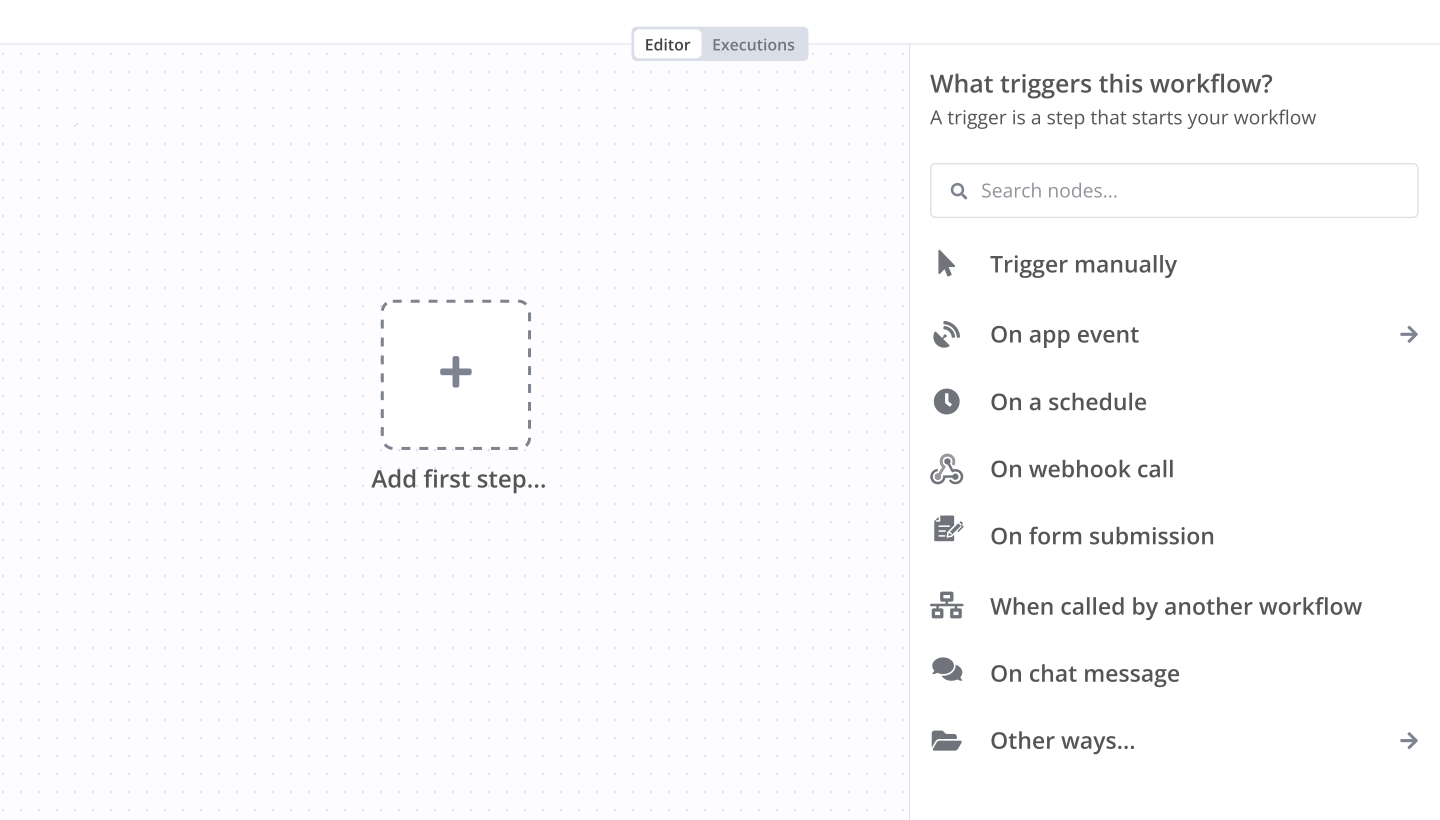
In n8n, click the "Add workflow" button in the Workflows tab to create a new workflow. Add the starting point – a trigger on when your workflow should run: an app event, a schedule, a webhook call, another workflow, an AI chat, or a manual trigger. Sometimes, the HTTP Request node might already serve as your starting point.

Slack and X (Formerly Twitter) integration: Create a new workflow and add the first step

Step 2: Add and configure Slack and X (Formerly Twitter) nodes

You can find Slack and X (Formerly Twitter) in the nodes panel. Drag them onto your workflow canvas, selecting their actions. Click each node, choose a credential, and authenticate to grant n8n access. Configure Slack and X (Formerly Twitter) nodes one by one: input data on the left, parameters in the middle, and output data on the right.

Slack and X (Formerly Twitter) integration: Add and configure Slack and X (Formerly Twitter) nodes

Step 3: Connect Slack and X (Formerly Twitter)

A connection establishes a link between Slack and X (Formerly Twitter) (or vice versa) to route data through the workflow. Data flows from the output of one node to the input of another. You can have single or multiple connections for each node.

Slack and X (Formerly Twitter) integration: Connect Slack and X (Formerly Twitter)

Step 4: Customize and extend your Slack and X (Formerly Twitter) integration

Use n8n's core nodes such as If, Split Out, Merge, and others to transform and manipulate data. Write custom JavaScript or Python in the Code node and run it as a step in your workflow. Connect Slack and X (Formerly Twitter) with any of n8n’s 1000+ integrations, and incorporate advanced AI logic into your workflows.

Slack and X (Formerly Twitter) integration: Customize and extend your Slack and X (Formerly Twitter) integration

Step 5: Test and activate your Slack and X (Formerly Twitter) workflow

Save and run the workflow to see if everything works as expected. Based on your configuration, data should flow from Slack to X (Formerly Twitter) or vice versa. Easily debug your workflow: you can check past executions to isolate and fix the mistake. Once you've tested everything, make sure to save your workflow and activate it.

Slack and X (Formerly Twitter) integration: Test and activate your Slack and X (Formerly Twitter) workflow

ETL pipeline for text processing

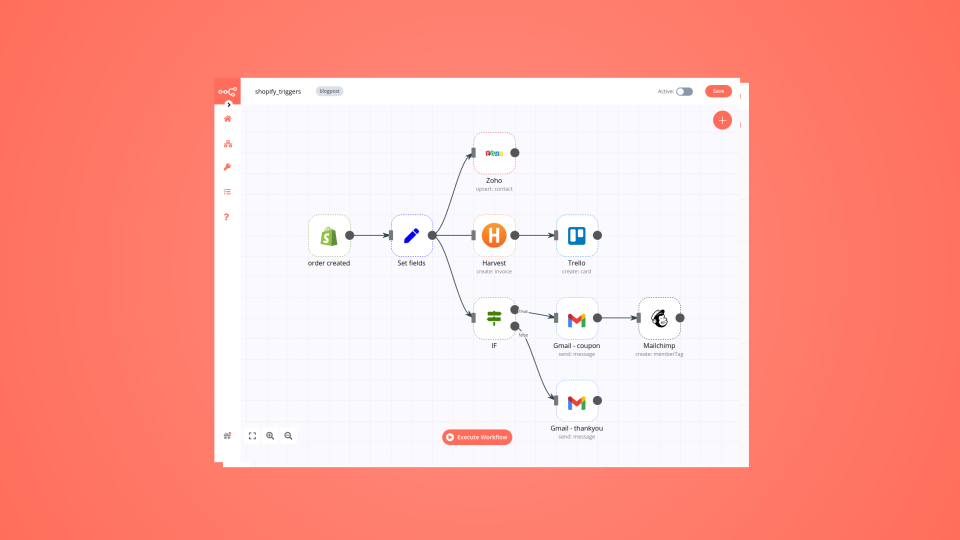
This workflow allows you to collect tweets, store them in MongoDB, analyse their sentiment, insert them into a Postgres database, and post positive tweets in a Slack channel.

Cron node: Schedule the workflow to run every day

Twitter node: Collect tweets

MongoDB node: Insert the collected tweets in MongoDB

Google Cloud Natural Language node: Analyse the sentiment of the collected tweets

Set node: Extract the sentiment score and magnitude

Postgres node: Insert the tweets and their sentiment score and magnitude in a Posgres database

IF node: Filter tweets with positive and negative sentiment scores

Slack node: Post tweets with a positive sentiment score in a Slack channel

NoOp node: Ignore tweets with a negative sentiment score

Nodes used in this workflow

Popular Slack and X (Formerly Twitter) workflows

+4

Generate & Schedule Social Posts with Gemini/OpenAI for X and LinkedIn

💼 LinkedIn Content Machine – AI-Powered Post Generator & Scheduler for X and LinkedIn How it works: This end-to-end workflow automates your personal or brand content strategy by: 🧠 Using Google Gemini or OpenAI to generate engaging LinkedIn/X content from a title or trending posts. 🗓️ Posting directly to LinkedIn and X (formerly Twitter). 📊 Pulling high-performing LinkedIn posts to inspire new ideas. ✍️ Saving AI-generated drafts to Google Sheets for review. 🔔 Notifying your team on Slack when drafts are ready. Steps to set up: Add your API keys for Google Gemini or OpenAI. Set up your LinkedIn, X (Twitter), Google Sheets, and Slack credentials. Customize prompt logic or post filters if needed. Schedule the idea generation module or trigger it manually. Start generating and posting consistent, high-quality content with zero manual effort!

Podcast to X (Twitter) Pipeline with OpenAI Whisper, GPT-4o & Slack Approval

Turn your favorite podcast episodes into engaging social media content automatically. This workflow fetches new episodes from an RSS feed, transcribes the audio using OpenAI Whisper, generates a concise summary using GPT-4o, and drafts a tweet. It then sends the draft to Slack for your review before posting it to X (Twitter). Who is this for Content creators, social media managers, and podcast enthusiasts who want to share insights without manually listening to and typing out every episode. Key Features Large File Support:** Includes a custom logic to download audio in chunks, ensuring stability even with long episodes (preventing timeouts). Human-in-the-Loop:** Nothing gets posted without your approval. You can review the AI-generated draft in Slack before it goes live. High-Quality AI:** Uses OpenAI's Whisper for accurate transcription and GPT-4o for intelligent summarization. How it works Monitor: Checks the Podcast RSS feed daily for new episodes. Process: Downloads the audio (handling large files via chunking) and transcribes it. Draft: AI summarizes the transcript into bullet points and formats it for X (Twitter). Approve: Sends the draft to a Slack channel. Publish: Once approved by you, it posts the tweet to your X account. Requirements OpenAI API Key Slack Account & App (Bot Token) X (Twitter) Developer Account (OAuth2) Setup instructions RSS Feed: The template defaults to "TED Talks Daily" for demonstration. Open the [Step 1] RSS node and replace the URL with your target podcast. Connect Credentials: Set up your credentials for OpenAI, Slack, and X (Twitter) in the respective nodes. Slack Channel: In the [Step 12] Slack node, select the Channel ID where you want to receive the approval request.
+4

Automatically promote your YouTube video on X

YouTube to X Post Overview This n8n workflow automates the process of promoting your latest YouTube videos on X (formerly Twitter). It ensures that posts are engaging, concise, and follow platform-specific requirements. Additionally, the workflow logs social posts into a Google Sheet for record-keeping. Features Fetch Latest YouTube Videos:** Pulls recently uploaded videos from a specified channel. Generate Engaging X Posts:** Uses OpenAI's GPT-4 to create tailored, witty posts about your videos. Character Limit Validation:** Ensures posts comply with X's character limit by rewriting if necessary. Post Scheduling:** Automates post publishing to X. Google Sheets Integration:** Logs posts and their status for tracking and management. Optional Notifications:** Sends updates via Discord, Slack, or Gmail (disabled by default). How It Works Trigger: Manually trigger the workflow or set a scheduled check for new videos (disabled by default). Fetch YouTube Videos: Retrieves the latest videos from your YouTube channel, filtering duplicates. Content Creation: OpenAI generates a witty and humanized post under 220 characters, using video title and description. If the post exceeds the character limit, it is rewritten automatically. Google Sheets Logging: Logs the generated post to a Google Sheet with details like time, date, and post status. Post to X: Publishes the generated post on X. Updates the Google Sheet with the post URL. Optional Notifications: Sends notifications about the published post via Discord, Slack, or Gmail. Setup Instructions Credentials: Add credentials for: YouTube API OpenAI API Google Sheets API X (formerly Twitter) API Use the accounts associated with "AlexK1919." YouTube Node: Specify your YouTube Channel ID in the Fetch Latest Videos node. Find your Channel ID here. Google Sheets Node: Configure the node with your Google Sheet for logging posts. Use the linked sheet: AlexK1919 Social Posts. OpenAI Node: Set up your OpenAI API key for generating posts. X Post Node: Connect your X account to the Post to X node. Optional Notifications: Configure Discord, Slack, or Gmail nodes for custom notifications. Customization Schedule:** Enable and modify the Check Every 2 Hours node to automatically check for new videos. Post Format:** Edit the OpenAI prompt in the Generate X Post node to tweak the tone or style of the generated posts. Additional Platforms:** Expand this workflow to post on other social platforms by adding respective nodes (e.g., Facebook, LinkedIn). Notes Posts are validated for character limits but are restricted to 220 characters to ensure compliance with X's guidelines and leave space for links. Posts are logged in the Google Sheet with details, including post status and timestamps. Current integrations are focused on promoting YouTube content; additional types can be supported with minor adjustments. Contact For support or inquiries: Alex Kim** About Me
+2

Monitor brand reputation crises with Twitter/X, Reddit, News API, Slack and Jira

This workflow monitors brand mentions across multiple platforms (Twitter/X, Reddit, News) and automatically detects reputation crises based on sentiment analysis and trend detection. How it works Multi-platform monitoring: Every 10 minutes, scans Twitter/X, Reddit, and news sites for brand mentions Data normalization: Converts all platform data into unified format Smart filtering: Removes duplicates and already-analyzed mentions AI sentiment analysis: Analyzes each mention for: Sentiment score (positive/negative/neutral) Amplification factors (engagement, verified accounts, news sources) Crisis-level phrases and keywords Trend detection: Compares current sentiment to 24-hour baseline: Detects sharp sentiment drops Identifies negative mention spikes Calculates impact surge Crisis classification: Assigns severity (CRITICAL/HIGH/MEDIUM/LOW) Automated response: For crises, triggers immediate alerts: Executive crisis brief with action plan Slack alerts to crisis team Email to leadership and PR team JIRA ticket creation Crisis event logging Setup steps Connect platforms: Twitter/X: Add OAuth credentials to "Monitor Twitter/X" node Reddit: Add OAuth credentials to "Monitor Reddit" node News API: Get API key from newsapi.org and add to "Monitor News & Blogs" node Configure brand monitoring: Update brand name and handles in search queries Add additional platforms if needed (LinkedIn, Facebook, Instagram) Set up alerting: Slack: Add credentials and update channel names Email: Add SMTP settings and recipient lists JIRA: Add credentials and project ID Adjust sensitivity: Modify sentiment keyword dictionaries in "AI Sentiment Analysis Engine" Adjust crisis threshold scores Customize amplification factors Test thoroughly: Run manual execution with test data Verify alert routing and content Test false positive handling Activate: Enable for continuous 24/7 monitoring Key Features: Multi-platform monitoring** (every 10 minutes): Twitter/X, Reddit, and News sites Data normalization** that converts different platform formats into unified structure AI sentiment analysis** engine that evaluates: Sentiment keywords (critical, severe, moderate, mild negative/positive) Amplification factors (engagement, verified accounts, follower counts) Impact scoring based on reach and influence Baseline trend detection** that tracks 24-hour sentiment history and detects: Sharp sentiment drops (15+ points = crisis) Negative mention spikes (30%+ increase) Impact surges Automated crisis response workflow**: Aggregates crisis mentions into executive brief Generates detailed action plan based on severity Sends Slack alerts to crisis team Emails leadership with comprehensive brief Creates JIRA ticket for tracking Logs all events for analysis Two-path routing**: Crisis-level events trigger full response workflow, while routine mentions are logged for trend analysis
+4

Repurpose YouTube videos into blogs and social posts with GPT-4o, WordPress, LinkedIn, X and Instagram

Overview This workflow turns a single YouTube video into multiple content formats and publishes them across different platforms with an optional human approval step. It helps content creators, marketers, and agencies repurpose long-form video content into blog posts and social media updates automatically. How it works Fetches the transcript from a YouTube video Uses AI to generate blog and social media content Optionally waits for manual approval Publishes content to selected platforms Logs the result for tracking Setup steps Add your API credentials (AI, transcript, and social platforms) Paste a YouTube video URL Choose auto-publish or approval mode Run the workflow Use cases Content repurposing for YouTube creators Automated blog and social media publishing Marketing automation for agencies AI-assisted content production pipelines 🧑‍💻 Creator Information Developed by: Adem Tasin 🌐 Website: ademtasin.com 💼 LinkedIn: Adem Tasin
+2

Schedule and optimize Twitter and LinkedIn posts from Google Sheets with OpenAI GPT-4o-mini

Schedule and optimize social media posts to Twitter and LinkedIn using AI This workflow automates the entire lifecycle of social media management—from fetching draft content to AI-driven optimization and multi-platform publishing. Who’s it for Social media managers, marketing teams, and content creators who use Google Sheets to plan their content but want to leverage AI for better engagement and automate the repetitive task of cross-platform posting. How it works The workflow is triggered either hourly or manually via a webhook. It fetches scheduled content from a designated Google Sheet and identifies posts ready for publication. An AI Agent (OpenAI) then analyzes the raw content to generate two optimized versions: a punchy, character-limited post for Twitter and a more professional, detailed version for LinkedIn. After generating relevant hashtags and engagement tips, the workflow publishes the posts simultaneously. Finally, it logs the live URLs back to your spreadsheet and sends a performance summary to a Slack channel for easy tracking. How to set up Google Sheet: Create a sheet with columns for status, content, platforms, scheduled_time, hashtags, and tone. Credentials: Connect your Google Sheets, OpenAI, Twitter (X), LinkedIn, and Slack accounts. Node Configuration: Select your specific spreadsheet and worksheet in both the "Fetch Content" and "Update Content" nodes. Slack: Specify the channel name or ID in the Slack node to receive notifications. Activation: Test with the Manual Webhook, then toggle the workflow to "Active." Requirements Google Sheets OAuth2** OpenAI API Key** (using GPT-4o-mini or higher) Twitter (X) OAuth2** LinkedIn OAuth2** Slack Bot Token** How to customize the workflow AI Tone**: Modify the "System Message" in the AI Content Optimizer node to match your brand's unique voice. Additional Platforms**: Extend the branching logic after the AI Parse node to include platforms like Discord, Facebook, or Mastodon. Advanced Scheduling**: Adjust the Filter node's JavaScript code if you use a different date format or status labels in your spreadsheet.

Build your own Slack and X (Formerly Twitter) integration

Create custom Slack and X (Formerly Twitter) workflows by choosing triggers and actions. Nodes come with global operations and settings, as well as app-specific parameters that can be configured. You can also use the HTTP Request node to query data from any app or service with a REST API.

Slack supported actions

Archive
Archives a conversation
Close
Closes a direct message or multi-person direct message
Create
Initiates a public or private channel-based conversation
Get
Get information about a channel
Get Many
Get many channels in a Slack team
History
Get a conversation's history of messages and events
Invite
Invite a user to a channel
Join
Joins an existing conversation
Kick
Removes a user from a channel
Leave
Leaves a conversation
Member
List members of a conversation
Open
Opens or resumes a direct message or multi-person direct message
Rename
Renames a conversation
Replies
Get a thread of messages posted to a channel
Set Purpose
Sets the purpose for a conversation
Set Topic
Sets the topic for a conversation
Unarchive
Unarchives a conversation
Get
Get Many
Get & filters team files
Upload
Create or upload an existing file
Delete
Get Permalink
Search
Send
Send and Wait for Response
Update
Add
Adds a reaction to a message
Get
Get the reactions of a message
Remove
Remove a reaction of a message
Add
Add a star to an item
Delete
Delete a star from an item
Get Many
Get many stars of autenticated user
Get
Get information about a user
Get Many
Get a list of many users
Get User's Profile
Get a user's profile
Get User's Status
Get online status of a user
Update User's Profile
Update a user's profile
Add Users
Create
Disable
Enable
Get Many
Get Users
Update

X (Formerly Twitter) supported actions

Create
Send a direct message to a user
Add Member
Add a member to a list
Create
Create, quote, or reply to a tweet
Delete
Delete a tweet
Like
Like a tweet
Retweet
Retweet a tweet
Search
Search for tweets from the last seven days
Get
Retrieve a user by username

FAQs

  • Can Slack connect with X (Formerly Twitter)?

  • Can I use Slack’s API with n8n?

  • Can I use X (Formerly Twitter)’s API with n8n?

  • Is n8n secure for integrating Slack and X (Formerly Twitter)?

  • How to get started with Slack and X (Formerly Twitter) integration in n8n.io?

Need help setting up your Slack and X (Formerly Twitter) integration?

Discover our latest community's recommendations and join the discussions about Slack and X (Formerly Twitter) integration.
lexgabrees
Andrey Khokhlov
Nicolas N
Muhammed Iqbal P B
Nicolas N

Looking to integrate Slack and X (Formerly Twitter) in your company?

Over 3000 companies switch to n8n every single week

Why use n8n to integrate Slack with X (Formerly Twitter)

Build complex workflows, really fast

Build complex workflows, really fast

Handle branching, merging and iteration easily.
Pause your workflow to wait for external events.

Code when you need it, UI when you don't

Simple debugging

Your data is displayed alongside your settings, making edge cases easy to track down.

Use templates to get started fast

Use 1000+ workflow templates available from our core team and our community.

Reuse your work

Copy and paste, easily import and export workflows.

Implement complex processes faster with n8n

red iconyellow iconred iconyellow icon